
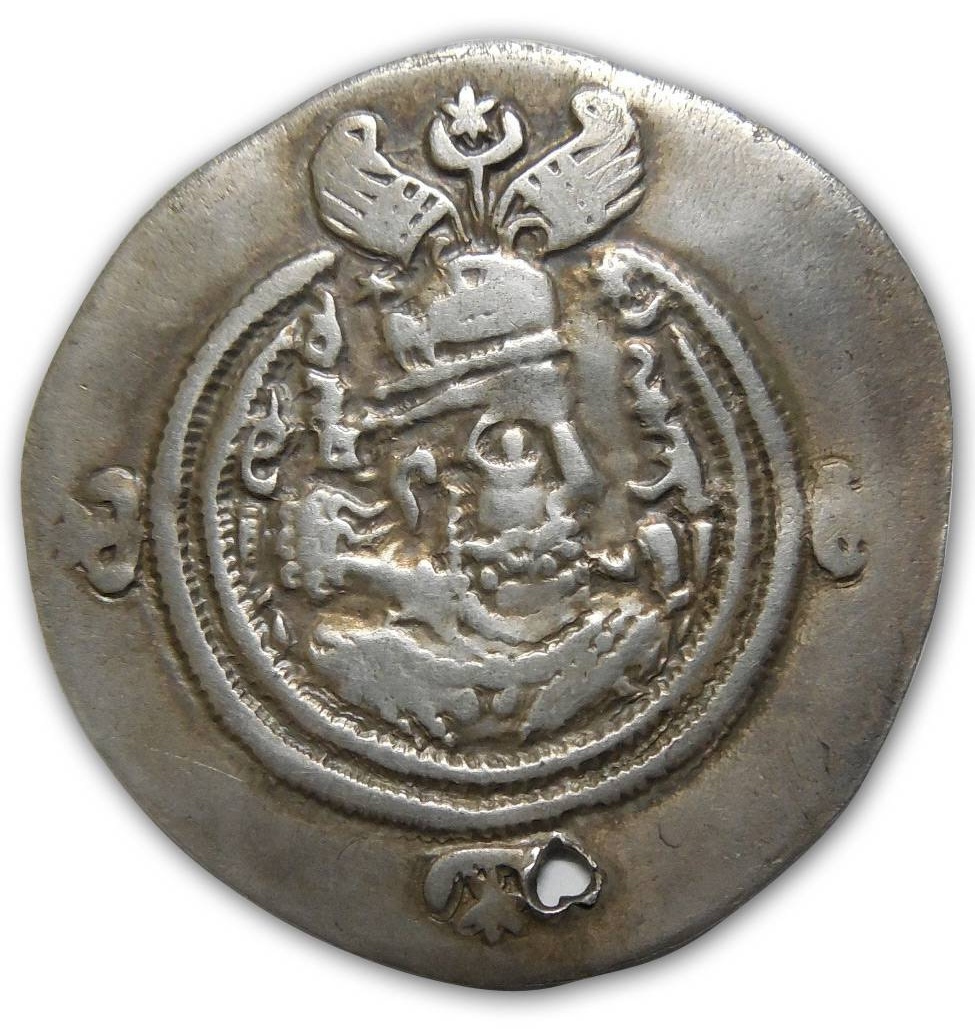



Ḵosrow IV is mentioned in some textual sources and also on coins as a challenger to the last Sasanian king of kings, Yazdegerd III (r. 632-51). After the coup of 628 and the fratricide by Kawād II (r. 628), this Ḵosrow, who is said to be a son of Ḵosrow II (r. 590-628), had been hiding at a place called Ḥiṣn al-Ḥijārah “the Stone Fortress,” near Nisibis. He had been brought back to Ctesiphon by Zāduya, a noble Persian, who held the office of the “chief of the servants” (Ṭabari, I, 1066; tr. Bosworth, pp. 408-9). Arthur Christensen stated that Ḵosrow IV ruled for a few years, between 630 and 632 and gives his full name as “Farroḵzāḏ Ḵosrow” (p. 499). A. I. Kolesnikov saw him as a short-lived ruler as well (Kolesnikov, 1388/2010, 166). The Šāh-nāma of Ferdowsi covers a certain Farroḵ-zād who came to the throne from Jahrom, in central Fārs province, which may suggest that he was originally from there (Zand, 2022, 306). The Šāh-nāma (ed. Khaleghi, VIII, pp. 403-5) states that he ruled for only a month and that his rule was followed by Yazdegerd III, but according to the other Islamic sources Farroḵzāḏ Ḵosrow ruled a year (Zand, 2022, 307). He was one of the contenders raised by a faction of the court and possibly an army in the 7th century (Daryaee, 2011, 48-49).
We do possess coinage of a certain Ḵosrow which was early on identified as Ḵosrow V (Paruk, 1924, 394-96; Malek, 1993, 239; Göbl, 1973, 81), and all of his coinage listed by Mochiri shows him as a bearded man. There are ten mints associated with Ḵosrow IV: Mēšān (MY), Garm-Kermān (GLM), Narmšēr (NAL), Šērāz (ŠY), Bīšāpūr (BYŠ), Ardaxšīr-Xwarrah (ART), Dārābgerd (DA), Ctesiphon/ Mobile court mint (BBA), Weh-Kawād or Weh-Andiok-Šāpur (WH) (for the latter identification, Schindel, 2018, 499), and possibly Abaršahr (APL) (Mochiri, 2010, 196-99). The dates of the coins range from year 2 (632 CE) to year 10 (642 CE), which coincide with the first ten years of Yazdegerd III’s rule (Mochiri, 2010, 180). If we place these coins in the context of the Arab-Muslim conquest and the coinage of the last Sasanian ruler, Yazdegerd III (Tyler- Smith, 2000, 146-48), we can see a much more complicated picture of the 630s for the Sasanian political map. It is important to note that coinage of Ḵosrow IV was also used in the post-Sasanian period, with the addition of the word jayyid, the Arabic translation of the word ʾpd (prosperous; excellent), on the margins (Mochiri, 2010, 185). Thus, this Ḵosrow IV appears to have been a contender to the throne for almost a decade against Yazdegerd III, whose base of power was Kerman, Khuzestan, and Fārs.
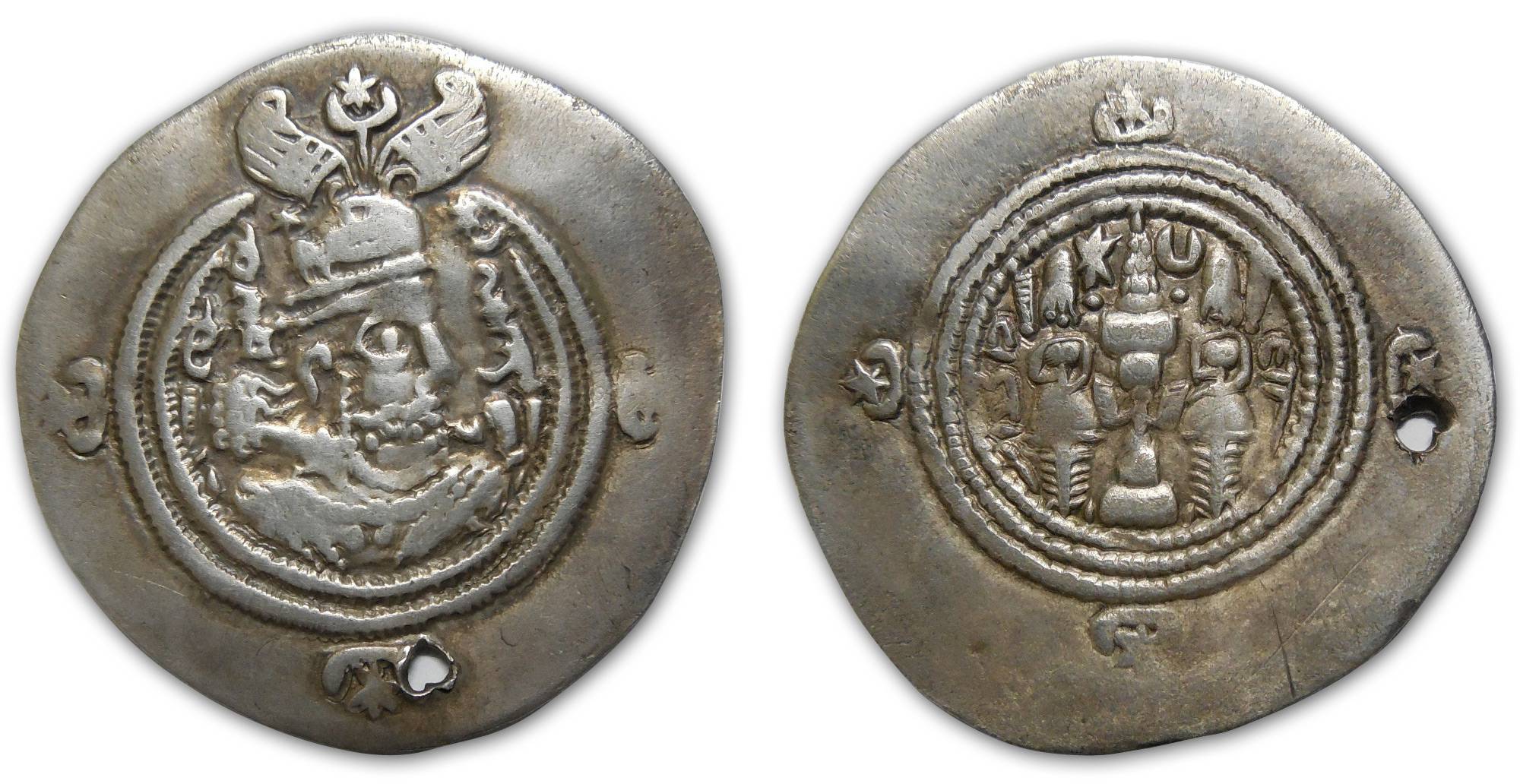
Figure 1. Silver drachm of Ḵosrow IV, mint of DA; wt. 3.2 g; 28.5 × 30.5 mm (ZENO.RU, no. 179193; photo © planar73).
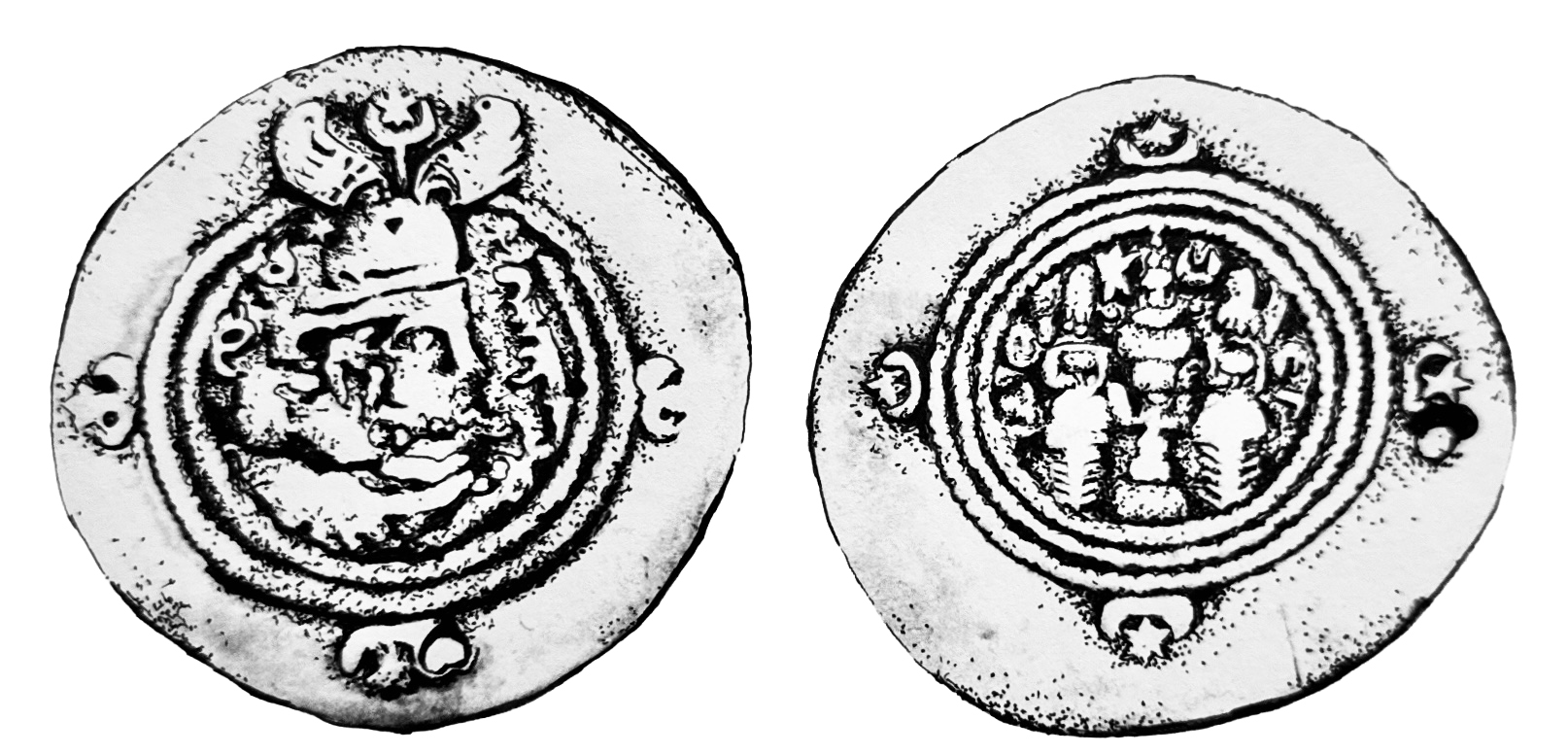
Figure 2. Drawing by Anahita Radpoor.
Bibliography
Christensen, Arthur. L’Iran sous les Sassanides. 2nd rev. and expanded ed. Copenhagen: Ejnar Munksgaard, 1944.
Daryaee, Touraj. “When the End Is Near: Barbarized Armies and Barracks Kings of Late Antique Iran.” In Ancient and Middle Iranian Studies: Proceedings of the 6th European Conference of Iranian Studies, Held in Vienna, 18-22 September 2007, edited by Dieter Weber and Desmond Durkin-Meisterernst, vol. 19. Iranica. Harrassowitz, 2011.
Ferdowsi, Abu’l-Qāsem. The Shahnameh (The Book of Kings). Edited by Djalal Khaleghi-Motlagh, 8 volumes. Costa Mesa, California: Mazda Publishers, 1987-2009.
Göbl, Robert. Der sasanidische Siegelkanon. Handbücher der mittelasiatischen Numismatik, vol. 4. Braunschweig: Klinkhardt & Biermann, 1973.
Kolesnikov, Aliy I. Irān dar āstāna-ye soquṭ-e sāsāniān. Translated by Moḥammad Rafiq Yahyāi. Tehran: Kandokav, 1388/2010.
Malek, Hodge Mehdi. “A Survey of Research on Sasanian Numismatics.” The Numismatic Chronicle 153 (1993): 227-69.
Mochiri, Malek Iradj. “Monnaies dites de ‘Khusraw IV.’” In Res Orientales, vol. 19, Sources for the History of Sasanian and Post-Sasanian Iran, edited by Rika Gyselen, 177–99. Paris: Groupe pour l’Étude de la Civilisation du Moyen-Orient, 2010.
Paruck, Furdoonjee D. J. Sāsānian Coins. Bombay, 1924. Repr., New Delhi: Indological Book Corp., 1976.
Schindel, Nikolaus. “Sasanian Mints – Where and Why?” In Infrastructure and Distribution in Ancient Economies: Proceedings of a conference held at the Austrian Academy of Sciences, Vienna, 28-31 October 2014, edited by Bernhard Woytek, 497–517. Vienna: Austrian Academy of Sciences Press, 2018.
Ṭabarī, Moḥammad b. Jarir. The History of al-Ṭabarī, Vol. V: The Sāsānids, the Byzantines, the Lakhmids, and Yemen. Translated and annotated by C. E. Bosworth. Albany: State University of New York Press, 1999.
Tyler-Smith, Susan. “Coinage in the Name of Yazdgerd III (AD 632-651) and the Arab Conquest of Iran.” The Numismatic Chronicle 160 (2000): 135-70.
Zand, Zagros. Šāh-nāma va pāyān-e Sāsāniān: sanješ-e Šāh-nāma bā manābeʿ-e tāriḵi, az šureš bar Ḵosrow Parviz tā marg-e Yazdegerd-e sevom. Tehran: Sokhan, 1400/2022.