



KAWĀD II, Sasanian king for a few months in 628 CE.
Before accession. Šērōe (PLRE III, pp. 276-77, s.v. “Cavades II qui et Siroes”) was a son of Ḵosrow II (q.v.; r. 590-628) and a Byzantine woman bearing the name Maria (Ṭabari, tr. Nöldeke, p. 360; PLRE III, pp. 827-28, s.v. “Maria 6”). While some Eastern sources call her a daughter of emperor Maurice Tiberius (582-602), there are no indications in Byzantine sources that he had a daughter with this name, let alone that he gave her in marriage to a Sasanian prince. As the union of Ḵosrow and Maria (still in all probability a member of the social elite) cannot be dated before 590, Šērōe was at the most 37 years old at his accession in 628. Since he left a seven-year-old son (the future king Ardašir III [q.v.; r. 628-29]; PLRE III, p. 106, s.v. “Ardashir III”) upon his death, Kawād II certainly was a grown man then. Ḵosrow II seems to have favored the succession of Mardānšāh (PLRE III, p. 883, s.v. “Merdasas”), who was a son of his favorite wife Šīrīn (PLRE III, p. 1144, s.v. “Shirin”). Whether Šērōe was his oldest son is unclear (he is thus labeled in Chronicon Paschale, I, p. 728).
Rule. The war between Sasanian Iran and Byzantium that Ḵosrow II had begun because of the murder of Maurice in 602 had turned against the Sasanians by 627: Emperor Heraclius (610-641) had conquered parts of Ādurbādagān (q.v.; see also Azarbaijan iii. PRE-ISLAMIC HISTORY) and destroyed the sanctuary of Ādur Gušnasp (q.v.), also inflicting a defeat on an army sent against him by Ḵosrow II. Since the king allegedly planned to take revenge on several members of the Iranian military elite, some of them plotted against him and decided to replace Ḵosrow with his son Šērōe, who together with some unnamed brothers had been confined to a castle near Babylon (Ṭabari, tr. Nöldeke, pp. 357-58; Jackson Bonner, pp. 301-7). In a court coup, Šērōe was duly crowned, and Ḵosrow II imprisoned (25 February, Chronicon Paschale, I, p. 729; cF. Ṭabari, tr. Nöldeke, p. 357, note 3). His son took the royal name Kawād, as evidenced by his coins (PLATE I). Under pressure from his courtiers (at least according to some sources, e.g., Ṭabari, tr. Nöldeke, p. 361), Kawād II had Ḵosrow II executed (on 28 February according to Chronicon Paschale, I, p. 729). Maybe at the same time, or later, Kawād also killed all his brothers (17 or 18 of them, cf. Ṭabari, tr. Nöldeke, pp. 358-59, where 18 male children of Ḵosrow II are mentioned); once again, the details remain unclear. Šahrwarāz (PLRE III, p. 1141-44, s.v. “Shahrbarāz”), the commander of the major Sasanian army on Byzantine territory that was still undefeated, seems to have been unenthusiastic about the accession of Kawād II (Jackson Bonner, p. 313). He later rose in rebellion against Kawād’s son and successor Ardašir III. The Byzantine sources concentrate on the diplomatic contacts between Kawād II and Heraclius (see Chronicon Paschale, I, pp. 735-36 for the letter from Kawād II to Heraclius regarding the peace negotiations, which is unfortunately incomplete; Theophanes, AM 6119, tr., pp. 457-58). The oriental sources focus on Kawād’s treatment of his father and brothers (Tabari, tr. Nöldeke, pp. 361-83, 385; Chronicon anonymum, p. 30, where the Persian grandees are blamed for the fratricide). It seems possible that the main reason for choosing Šērōe was the inability of the Sasanian elite in Ctesiphon (q.v.) to stop the advance of the Byzantine army under Heraclius, which was then approaching the imperial capital Ctesiphon. Therefore, perhaps it was less due to the specific abilities of the presumptive new ruler, but rather to the urgent need to replace Ḵosrow II as quickly as possible with someone—anyone —else. This is not to say that Kawād II necessarily must have been a bad ruler. But with the political and military situation of the Sasanian Empire in 628 being as it was, he hardly had any room for maneuver. While one cannot defend the slaughter of his brothers from an ethical point of view, it might have seemed preferable to risking a civil war if any of these potential rivals should have made a bid for the throne, especially given the depleted military manpower. At the same time, such a desperate measure was not completely new, since Hormozd IV (q.v.; r. 579-90 CE) is also said to have killed his brothers upon his accession (Ṭabari, tr. Nöldeke, p. 264, note 5). To what extent factions within the Iranian nobility were acting like modern political parties in their decision-making processes is a matter of dispute (for a very confident treatment of this topic, see Pourshariati, pp. 153-60, 173-78). It is difficult to evade the conclusion that the personal power of Kawād II had declined in comparison with the apogee of royal might under his father. A major factor probably was that since Hormozd IV, the King of Kings no longer led his army in the field; this might have led to a widening gap between the army and the king that enabled field commanders (such as Bahrām VI Čōbīn [q.v.] or Šahrwarāz) to make a bid for the throne, an unheard phenomenon in earlier Sasanian history. One important historical source – Kawād’s coinage (Göbl, pp. 54-55; Malek, 1995; 2014) – proves that he still was in full command of basically the entire empire: if one compares his drachm issues (all dated to regal year [RY] 2) with RY 37 and RY 38 of Ḵosrow II (his RY 39 is too rare for relevant conclusions), one sees that most mints were still active under Kawād II (Table 1); for a detailed treatment of the mint signatures and their localization, see Schindel, 2004, I, pp. 128-74.
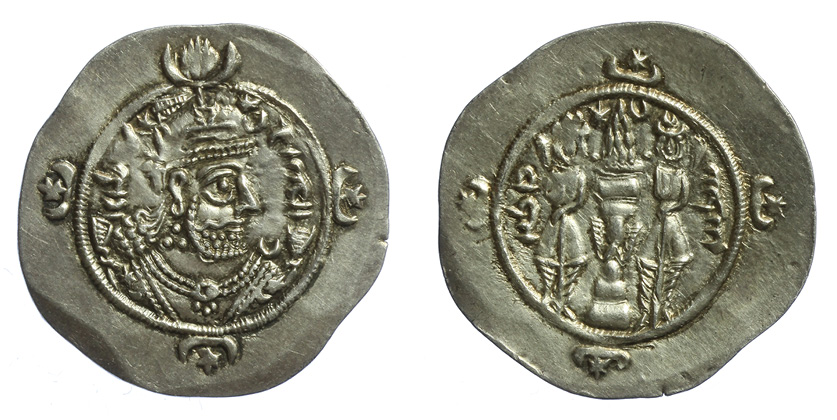
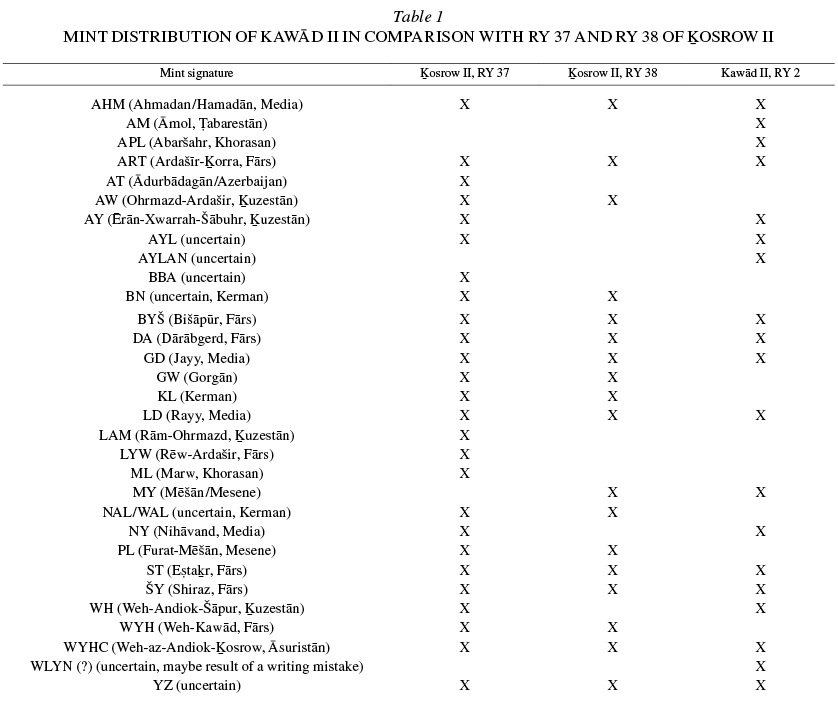
Most of the lacunae in Table 1 are probably due to our incomplete knowledge of the numismatic material. The lack of drachms from the minor mint AT (Ādurbādagān) could be explained by the presence of Heraclius’ army in this region; still, we cannot rule out that also such coins might turn up one day. In any case, all major regions of the Sasanian Empire that struck coins during the last two years of Ḵosrow II are attested also under his successor – Āsuristān (WYHC; on this signature cp. e.g., Schindel, 2004, I, pp. 170-71), Media (AHM, GD, LD, NY), Ḵuzestān (AY, WH; the common mint AW is so far missing from the record), Fārs (ART, BYŠ, DA, LYW, ŠY), Mēšān (MY, PL), and Ṭabarestān (AM). The coinage in Khorasan under Kawād II seems to have been rather weak, but the mint APL is attested, though, proving that Khorasan was not altogether lost to him. Kawād II dropped most of his father’s innovations in the coinage: the multiple rims on obverse and reverse, the wings of Warahrān (Av. Vərəθraγna, see BAHRĀM) in the crown, the use of the word xwarrah (q.v., FARR[AH]), and the replacement of the korymbos with a star (Göbl, p. 54). His choice of the name Kawād is somewhat surprising, considering that the royal propaganda as evidenced by Ṭabari and the like is not particularly well-disposed towards the first king bearing this name (e.g., Ṭabari, tr. Nöldeke, pp. 142, 153, 156).
After a reign of less than 8 months, Kawād II died, probably of the plague that was then ravaging the Sasanian Empire (Ṭabari, tr. Nöldeke, p. 385; less specifically, Chronicon anonymum, p. 31; Christensen, p. 497). Kawād perhaps died on 15 September 628 (Ṭabari, p. 385, note 5), but other sources (Chronicon anonymum, p. 31; Seert Chronicle, p. 553) claim that Kawād perished in early summer on the way to his summer residence. While some sources such as Ṭabari (tr. Nöldeke, p. 385) refer to Kawād as a most unfortunate ruler, other authors show him in a more positive light (cf. Seert Chronicle, p. 551). Had Kawād lived longer, perhaps the total collapse of the Sasanian political system that took place shortly afterwards, and the Arab-Islamic invasion, might not have taken place, as he could have given the empire the stability his son Ardašir III, still a child, certainly could not provide. While one cannot deny that the reign of Kawād II was marked by a steep decline of Sasanian power, it is difficult to imagine a fundamentally more successful approach to the pressing problems of the empire, given the military and political circumstances.
Bibliography
Franz Altheim and Ruth Stiehl, Finanzgeschichte der Spätantike, Frankfurt am Main, 1957.
Arthur Christensen, L’Iran sous les Sassanides, 2nd ed., Copenhagen, 1944.
Chronicon anonymum [Guidi’s Chronicle], tr. Theodor Nöldeke, as Die von Guidi herausgegebene syrische Chronik, Vienna, 1893.
Chronicon Paschale, ed. L. A. Dindorf, Corpus Scriptorum Historiae Byzantinae, 2 vols., Bonn, 1832.
Touraj Daryaee, Sasanian Persia: The Rise and Fall of an Empire, New York, 2009.
Robert Göbl, Sasanian Numismatics, Braunschweig, 1971.
James Howard-Johnston, “The Two Great Powers in Late Antiquity: A Comparison,” in Averil Cameron, ed., The Byzantine and Early Islamic Near East III: States, Resources and Armies, Princeton, N.J., 1995, pp. 157-226.
Michael R. Jackson Bonner, The Last Empire of Iran, Piscataway, N.J., 2020.
Hodge Mehdi Malek, “The Coinage of the Sasanian King Kavād II (AD 628),” Numismatic Chronicle 155, 1995, pp. 119-29.
Idem, “New Coins from the Reign of Kavad II (AD 628),” Numismatic Chronicle 174, 2014, pp. 257-60.
[PLRE] J. R. Martindale, The Prosopography of the Later Roman Empire III: A.D. 527-641, New York, 1992.
Parvaneh Pourshariati, Decline and Fall of the Sasanian Empire: The Sasanian-Parthian Confederacy and the Arab Conquest of Iran, London, 2008.
Nikolaus Schindel, Sylloge Nummorum Sasanidarum Paris – Berlin – Wien. Band III. Shapur II. – Kawad I. / 2. Regierung, Vienna, 2004.
Idem, “Sasanian Coinage,” Encyclopædia Iranica, online edition, 2016.
[Seert Chronicle] Addai Scher, ed. and tr., Histoire nestorienne inédite (Chronique de Séert): Seconde partie (II), in Patrologia Orientalis 13/4, Paris, 1919, pp. 432-639.
Alireza Shapur Shahbazi, “Ardašīr III,” Encyclopædia Iranica II, London and New York, 1987, pp. 381-82.
Moḥammad b. Jarir Ṭabari, tr. Theodor Nöldeke as Geschichte der Perser und Araber zur Zeit der Sasaniden, Leiden, 1879; tr. Clifford E. Bosworth, as The History of al-Ṭabarī V: The Sāsānids, the Byzantines, the Lakmids, and Yemen, Albany, N.Y., 1999.
Theophanes, Chronographia, tr. with introd. and commentary by Cyril Mango and Roger Scott, with the assistance of Geoffrey Greatrex, as The Chronicle of Theophanes Confessor: Byzantine and Near Eastern History, AD 284-813, New York, 1997