



Any attempt to define Khorasan in a historical sense or to define it in terms of physical geography is a difficult endeavor (see KHORASAN i. CONCEPT OF KHORASAN). The geographical term “Khorasan” covers a wide range of connotations due to its long and varying political and territorial history, its historically undefined borders, its adherence to so many different realms, empires, and states – and also due to the fact that it has hardly any clearly defined geographical or natural boundaries.
In its broadest sense, Khorasan stretches from southern Turkmenistan via the northwestern edge of Afghanistan to its central area, i.e., the northeastern part of Iran. The focus of this article, however, is on the three administrative provinces that make up Iranian Khorasan (Ḵorāsān-e Šemāli ‘North Khorasan’; Ḵorāsān-e Janubi ‘South Khorasan’: and Ḵorāsān-e Rażawi ‘Razavi Khorasan’).
Centuries ago, under the rule of Central Asian conquerors, when political borders did not exist and boundaries were not permanent, even parts of today’s Uzbekistan and Tajikistan were considered to be part of a territory called Khorasan. Within these often undefined areas, Khorasan covers a great variety of landforms and climates as well as a broad spectrum of different vegetation zones. The mighty mountain chains of what has been called the “Turkmenian and Chorasanian mountain ranges” (Scharlau, p. 23) may be interpreted as the geological and geomorphological backbone of Khorasan. Its physical geography is chiefly dominated by arid to semi-arid deserts and semi-deserts. The northern foothills of the Turkmenian mountain ranges, covered with the erosional deposits of their hinterlands, mark the transition to the steppe and desert plateaus of Central Asia, geologically called the Turan Plate. The southern fringe of the Khorasan mountain system shows structures similar to those of its northern counterparts: extended hill areas of mostly Tertiary origin intermingle with extensive highlands, intra-montane flats and basins covered by deserts, swamps, and salt-flats (dašt-e kavir; see DESERT). Figure 1 summarizes the general geomorphological setting of central Khorasan and its predominating physical landscape features and differentiations. Toward the west, geological structures and landforms are marked by the lowlands of the Caspian Sea (q.v.) and the Caspian basin. Toward the east, the highlands and mountains of Iranian Khorasan continue into Afghanistan, separated only by the valley of the Hari Rud/Tejen rivers (formerly AKES, q.v.). Again, deserts and steppe landscapes prevail, contributing to an overall extremely arid environment.
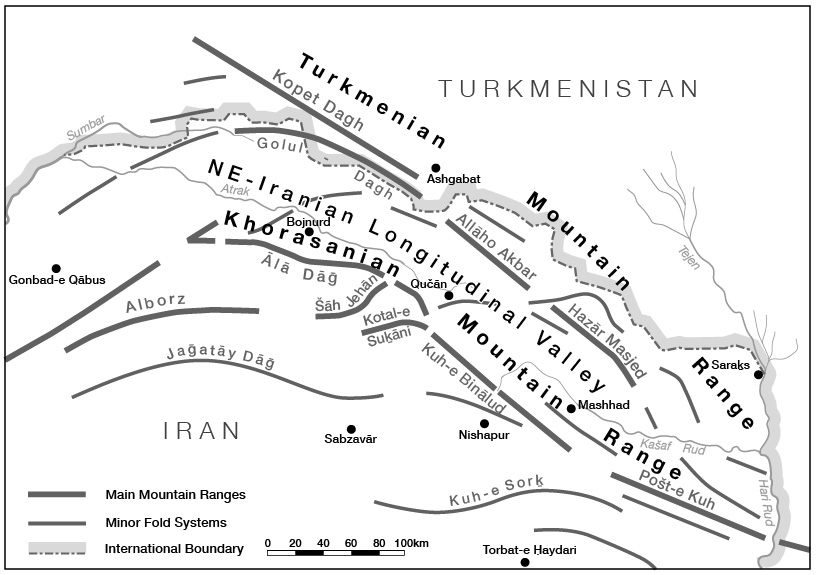
Figure 1. Khorasan: mountain structure and strike directions (adapted from Scharlau, 1963). Map courtesy of the author.
In contrast to these general introductory remarks, a closer analysis of the physical geography of Iranian Khorasan shows the complexity of its geological development and its impacts on land and people. Topography, terrain, climate, and vegetation are all affected by Khorasan’s landscape history. The area, with its total size of more than 315,000 km2, is geologically and tectonically a highly complicated region. Its seemingly clear differentiation into two strings of mountain chains, separated by a deeply incised valley region, conceals a complex landscape history, which still has not come to an end. The alignment of the mountain ranges and the separating valley structures in a general northwest-southeast direction suggest conformity of their orogenesis. Yet the existence of numerous cross-folds and of topographical gaps in predominantly southwestern-northeastern strikes indicate geological disturbances, connected with faults and corresponding seismic activities. As a matter of fact, the process of mountain building is ongoing. Earthquakes, faulting and folding of the lithosphere, landslides, and/or mountain-creeps are permanent threats to people, their habitats, and their economy. The fact that the two mountain systems and their geological development (identical with the aforementioned “Turkmenian and Chorasanian mountain ranges”) adhere to two different geological periods adds to the complexity of the geology and physical geography of the region under review. The southern chains are mainly Jurassic in age, with significant outcrops of much older bedrock, while the Kopet Dagh (q.v.) and its chains are predominantly of Cretaceous lithology. And both systems, upfolded in connection with the alpine orogenesis of the Tertiary, are still drifting against each other (see below) and join finally in the Hindu Kush (q.v., formerly Paropamisus) of Afghanistan.
The northern Turkmenian chain has its origin in the Kopet Dagh/Golul Dagh ranges in Turkmenistan and continues toward the southeast via the Allāho Akbar Mountains (see ALLĀHO AKBAR, KŪH-E) and the ridges of the Hazār Masjed located north of Khorasan’s capital Mashhad. They are characterized by more or less uniform strata of Mesozoic Tertiary age. The almost perfect alignment of their folded ranges is a continuation of the Caucasian mountain system, west of the great Caspian depression. The southern sequence, the Khorasan chain, shows a more complicated oro- and morphogenesis. Emanating from the Alborz (q.v.) and its southwest-northeast and west-east striking ridges, their continuation bends into directions parallel to their northern counterparts: Ālā Dāḡ (q.v.) – Kuh-e Binālud (at over 3,200 m the highest point of the Khorasanian ranges; see BĪNĀLŪD, KŪH-E) – Pošt-e Kuh. Unlike the northern mountain system, however, these chains are interrupted and disturbed by geological flexures and cross-folds (Kuh-e Šāh Jahān and Kotal-e Suḵāni) with again southwest-northeast directions. These strike directions, by the way, are also detectable underneath the valley floor of Khorasan’s third major landscape unit: the central valley separating the Turkmenian and Khorasan ranges. This longitudinal valley, stretching over a distance of approximately 450 km with a width of 40 to 50 km, can be termed a geological trough or a kind of rift valley. It has all the characteristics of a lineament, i.e., a zone of tectonic and seismic weakness (see Figure 1). The valley bottom is filled with erosional deposits from the bordering mountain ranges. It is dissected by two major rivers: the Atrak (q.v.) and the Kašaf Rud. The Atrak, rising in the hill country near Qučān, flows toward the northwest and discharges into the Caspian Sea. The Kašaf Rud, originating in the Kuh-e Binālud, flows in a southeasterly direction. It joins the Hari Rud, the north-flowing river bordering Afghanistan. Both catchment areas are probably separated by one of those geological upfolds in the basement of the rift valley.
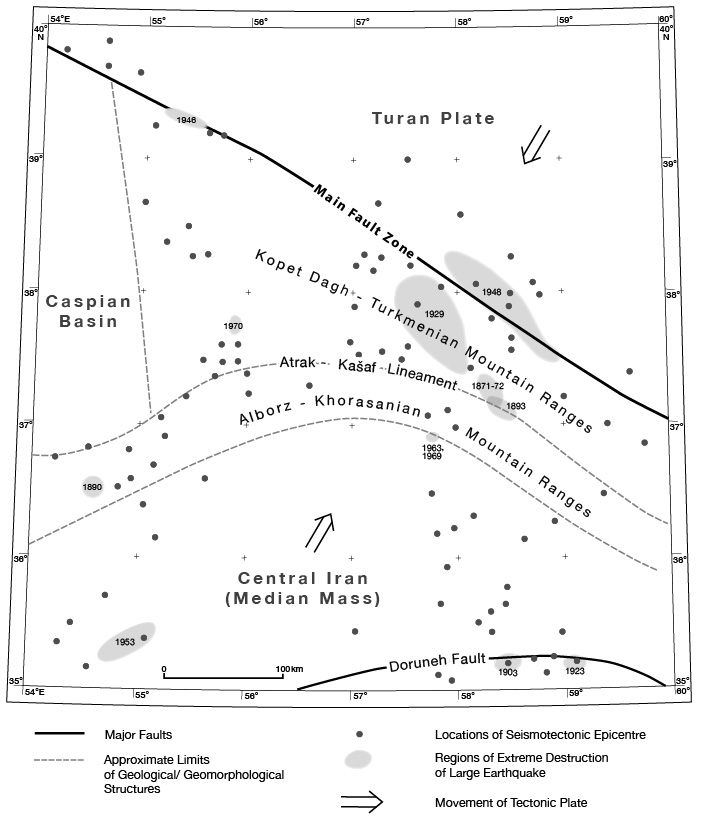
Figure 2. Seismotectonic epicenters of northeast Iran and the Kopet Dagh region (adapted from Berberian, 1976). Map courtesy of the author.
As indicated, the seemingly clear geological structures of Khorasan’s historical, cultural, and economic core area are causes of severe environmental constraints and handicaps. Plate tectonics play an important role. Mountain chains and the Atrak – Kašaf lineament are squeezed in between the northward drift of the Arabian Plate and its central Iranian outpost, the so-called Median Mass, on the one hand, and its northern counterpart, the southward drifting Turan Plate (Figure 2). The movement of these plates and their geologically young formation and uplift, which is still active, make the whole region highly vulnerable. Seismotectonics and devastating earthquakes make Khorasan one of the most affected regions of Iran and the Middle East (Berberian, 1976; Harrison, p. 147; Stöcklin, p. 1245; Tchalenko et al.; see also EARTHQUAKES iii. IN PERSIA). Tectonic instability of the earth crust is especially pronounced where the main strike directions are disturbed. Hotspots are the areas of cross-folds (Kuh-e Šāh Jahān, Kotal-e Suḵāni), the basin of Mashhad and the Khorasan rift valley, but also minor fault lines. Not only Bojnurd (q.v.), Qučān, or Mashhad in Iran (Figure 1), but also Ashgabat (Ashkhabad, q.v.) in Turkmenistan have been destroyed again and again, not to mention the countless smaller urban centers and rural areas and the hundred thousands of human lives (comprehensive surveys are given by Tchalenko et al.; Berberian, 1976; 1977).
Thus, geology and geomorphology and their impacts on the topography of the Khorasan region must be considered as the decisive determinants of most other elements of northeastern Iran’s physical geography: climate, hydrology, vegetation and related biotic factors.
Climatic conditions of Khorasan. In regard to climate, northeastern Iran is characterized by a combination of high-pressure air masses of Central Asian/Siberian origin all year round, in winter months occasionally interrupted by moister air of Mediterranean or Caspian origin, which, however, is mostly affecting the mountainous north of the region. In view of the fact that southern Iran and the Persian Gulf (q.v.) region are low pressure areas, winds blow normally from east and/or north, causing comparatively cool winters. Temperatures in the summer months are also somewhat lower than in many other parts of the country. However, the southern part of Khorasan, i.e., the barren deserts and semi-deserts, are characterized by the typical desert climate of Iran: aridity and temperature extremes. Especially those parts of the region located south of the Khorasan chains, developing their own local high pressure cells, suffer from extremely high temperatures. Hot spots—in the literal sense of the word—are the Dašt-e Kavir and the highlands and basins of northeastern Iran with their all-year-round arid climatic conditions (see also Figure 3). A special feature of Khorasan’s climatic situation is the occurrence of local and regional wind regimes. Besides almost ubiquitous mountain-valley winds in the north of the region, there is the special phenomenon of the “wind of 120 days” (bād-e sad-o-bist ruza; see BĀD [1]), a wind blowing steadily from a northern/northwestern direction between May and September, triggered by extremely low pressure cells over the Indus valley in western Pakistan.
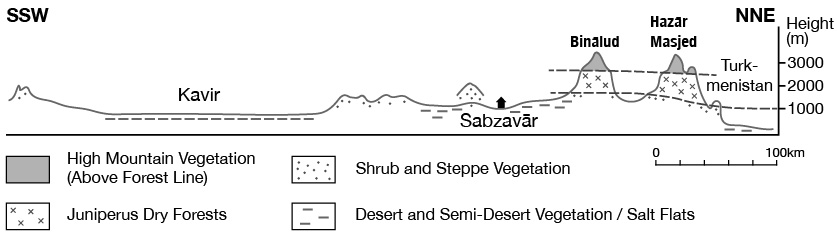
Figure 3. Vegetation profile of Khorasan (adapted from Bobek, 1951). Courtesy of the author.
Topography, the configuration and direction of mountain systems and valleys, as well as the altitude of the terrain are of major importance for the precipitation distribution over the region. As indicated, aridity and extremely low and rare rainfall are characteristic of almost all parts of Khorasan. The long-term annual precipitation is generally less than 120 to 150 mm, often even less than 100 mm. Even the basins and valleys in the north do not receive enough rainfall to sustain a balanced water management. Mashhad, for example, receives less than 250 mm in the long run (Ganji, Table 5, p. 248), while Tabas in the south has less than 100 mm. Only the high-rising ranges of the Turkmenian and Khorasanian mountains receive more moisture, partly in the form of winter snowfall.
Favored by topography and wind directions, occasional humid air masses of Mediterranean and/or Caspian origin may reach Khorasan. More important, however, are northerly winds that hit the Kopet Dagh and the Kuh-e Binālud and neighboring ranges where the winterly moisture load is released in the form of rain or snow, especially at elevations over 2,000 m above medium sea level.
Hydrology of Khorasan. In view of these climatological and meteorological conditions (for further details see Ganji), the hydrology of Khorasan is simple to characterize: scarcity, sparseness, or complete lack of water is its main feature. Having no access to the world oceans, Khorasan is a land-locked region without any exoreic (i.e., outward flowing) streams. On the contrary, the largest part of the region consists of so-called endoreic, i.e., interior, basins, isolated and disconnected. If ever occasional winterly runoffs cover the surface of these flat basins, evaporation transforms these periodic water bodies into swampy, gravel-covered depressions of salt flats. Even the catchment areas and drainage basins of Khorasan’s two biggest rivers, the Atrak and Kašaf Rud, end up in endoreic basins, since neither the Caspian Sea nor the vast desert regions of Turkmenistan have any connections with the world oceans. Wherever surplus water is available, however, it is diverted for agricultural irrigation purposes within Khorasan’s great interior valley and specifically for the hinterlands of its urban centers and in the basin of Mashhad.
A very specific aspect of the hydrological situation of Khorasan is the numerous springs and small rivulets supplied by seepage, by melting snow, or rare rain showers. Together with sometimes remarkable groundwater resources, they are concentrated along the slopes of the mountain ranges and/or hidden underneath the desiccated surfaces of the foothills and their extensive gravel flats ( dašt , q.v.), alluvial fans, and pediments. Winterly precipitation, snowfall, and occasional convectional rainfalls in spring allow more or less intensive irrigated agriculture in the forelands on both sides of the Turkmenian and Khorasan mountain ranges. Where surface water is not available and both terrain and soils are good, the specific technique of qanāt (see KĀRIZ) irrigation is being practiced (Semsar Yazdi and Labbaf Khaneiki, 2017; 2019). Intensive agriculture in the midst of barren and arid deserts and semi-deserts is a common phenomenon in many parts of Khorasan.
Lithology and its weathering products in combination with topography, climate and vegetation cover are preconditions of soil development. M. L. Dewan (1968, p. 251) points to the fact that soil associations are “geographically related within the landscape” and that they “correspond to broad climatic and physiographic units, and they also have a common pattern of land use”. The soils of Khorasan and northeastern Iran in general are perfect reflections of these interrelationships (Dewan and Famouri, 1964). Lithosols, i.e., stony soils, developed over bedrock and with hardly or no significant horizon development, prevail. Lack of soil profiles in combination with water deficits characterize wide parts of southern Khorasan, interrupted by even poorer “soils” in endorheic basins. Summarized as “desert soils,” the surfaces of these areas are very low in organic material, have calcareous or saline subsoils, and are ecologically more or less sterile. In extreme cases, the landscapes are covered by so-called “desert pavements,” surfaces of stones and pebbles, where finer materials such as sand or clay have been blown out. Altogether, the soils of southern Khorasan are useless for any form of human cultivation or animal husbandry. Exceptions to this rule are rare patches of alluvial soils and arable lands with oases agriculture. The northern part of the region shows a somewhat different picture. Terrain and climate, but also its phytogeographic structure, allow the development of brownish soils in the plateau areas along the Turkmenistan border and calcareous lithosols (brown soils and chestnut soils) in the region’s dissected hills and their forelands. Especially parts of the Turkmenian chains’ foreland north of Mashhad and the Mashhad basin itself, as well as the southern counterparts around Nishapur (q.v.; Figure 1), are ecologically ideal regions. The same holds true for the valley troughs of the Atrak and Kašaf Rud. Intensive agriculture, fruit growing, and gardening have also enabled the development of rich urban cultures in these ecologically favored parts of the region in the past and present.
The natural vegetation cover of Khorasan is a more or less perfect indicator of the region’s physiogeographic diversity. Outstanding characteristic is again the distinction between a comparatively favored northern part of the region and its extremely arid southern part in the shadow of the mountains. This basic differentiation of Khorasan’s landscape structure becomes apparent in a vegetation profile (Bobek, 1951) stretching from the Turan plateau in the north to the Dašt-e Kavir in the south.
According to Michael Zohary (p. 34) Khorasan as a whole is part of what he calls the Irano-Turanian vegetation territory, subdivided into five subunits, of which the steppe district, the sand and marsh enclaves, and the alpine and subalpine zones are of relevance for this region. The latter ones are characteristic for elevations of the Kopet Dagh and Kuh-e Binālud massifs with heights over 2,200 to 2,500 m. Here, we find the last remnants of the formerly denser vegetation cover: The alpine and subalpine parts of the mountain ranges (sardsir; see GARMSĪR AND SARDSĪR) are covered by the remnants of perennial grasses amidst dominant weeds, spiny shrubs, and herbs. The somewhat moister slopes of the mountains and hills, characterized also by better soils, are part of what botanists call the “Irano-Turanian vegetation element.” It is characterized by relatively dry juniper, pistachio, and almond forests. Both ecosystems are, however, heavily disturbed, degraded, and/or devastated by overgrazing, firewood collection, and charcoal production, as well as by expansion of agricultural lands wherever possible. The lower parts of the mountains, their somewhat more humid forelands, slopes, and valleys carry a denser vegetation cover with Turanian elements, but are mostly used agriculturally. As Zohary puts it: “Within the boundaries of Iran, the Turanian element is confined mainly to two habitats, salines and dunes, which are diffused or form smaller or larger enclaves throughout the Middle Eastern deserts. Turanian elements are especially abundant in Khurasan and in central Iran” (pp. 51-52). This statement is amply supported by comprehensive lists of plant associations and their environmental characteristics.
Bibliography
- Jean Aubin, “Réseau pastoral et réseau caravanier: les grand’routes du Khurassan à l’époque mongole,” Le Monde Iranien et l’Islam: Sociétés et Cultures I, Geneva and Paris, 1971, pp. 105-30.
- Manuel Berberian, Contribution to the Seismotectonics of Iran (Part II), Geological Survey of Iran, Tectonic and Seismotectonic Section, Report No. 39, Tehran, 1976.
- Idem, Contribution to the Seismotectonics of Iran (Part III), Geological and Mining Survey of Iran, Tectonic and Seismotectonic Research Section, Report No. 40, Tehran, 1977.
- Hans Bobek, Die natürlichen Wälder und Gehölzfluren Iräns, Bonn, 1951.
- Idem, “Vegetation,” in W. B. Fisher, ed., The Cambridge History of Iran I: The Land of Iran, Cambridge, 1968, pp. 280-93.
- Emile-G. Bonnard, “Contribution à la connaissance géologique de nord-est de l’Iran (Environs de Méched),” Ecologae Geologicae Helveticae 37, 1944, pp. 331-54.
- Frederick G. Clapp, “Geology of Eastern Iran,” Bulletin of the Geographical Society of America 51, 1940, pp. 1-102.
- M. L. Dewan and J. Famouri, The Soils of Iran, Rome, 1964.
- M. L. Dewan, J. Famouri, and R. H. S. Robertson, “Soils,” in W. B. Fisher, ed., The Cambridge History of Iran I: The Land of Iran, Cambridge, 1968, pp. 250-63.
- Eckart Ehlers, Iran: Grundzüge einer geographischen Landeskunde, Darmstadt, 1980.
- W. B. Fisher, “Physical Geography,” in W. B. Fisher, ed., The Cambridge History of Iran I: The Land of Iran, Cambridge, 1968, pp. 3-110.
- Frederick Forbes, “Route from Turbat Ḥaïderí, in Khorásán, to the River Herí Rúd, on the Borders of Sístán,” The Journal of the Royal Geographical Society of London 14, 1844, pp. 145-92.
- James Baillie Fraser, Narrative of a Journey into Khorasān in the Years 1821 and 1822, Including Some Account of the Countries to the North-East of Persia, London, 1825.
- M. H. Ganji, “Climate,” in W. B. Fisher, ed., The Cambridge History of Iran I: The Land of Iran, Cambridge, 1968, pp. 212-49.
- J. V. Harrison, “Geology,” in W. B. Fisher, ed., The Cambridge History of Iran I: The Land of Iran, Cambridge, 1968, pp. 111-85.
- Charles Metcalfe MacGregor, Narratives of a Journey Through the Province of Khorassan and on the N.W. Frontier of Afghanistan in 1875, 2 vols., London, 1879.
- G. C. Napier, “Extracts from a Diary of a Tour in Khorassan, and Notes on the Eastern Alburz Tract,” The Journal of the Royal Geographical Society of London 46, 1876, pp. 62-171.
- T. M. Oberlander, “Hydrography,” in W. B. Fisher, ed., The Cambridge History of Iran I: The Land of Iran, Cambridge, 1968, pp. 264-79.
- Kurt Scharlau, “Das Nordost-iranische Gebirgsland und das Becken von Mesched,” Zeitschrift für Geomorphologie: Annals of Geomorphology NS 7, 1963, pp. 23-35.
- Ali Asghar Semsar Yazdi and Majid Labbaf Khaneiki, Qanat Knowledge: Construction and Maintenance, Dordrecht, 2017.
- Idem, Veins of the Desert: A Review on Qanat/Falaj/Karez, Gistrup, 2019.
- Jovan Stöcklin, “Structural History and Tectonics of Iran: A Review,” The American Association of Petroleum Geologists Bulletin, 52/7, 1968, pp. 1229-58.
- J. S. Tchalenko et al., Materials for the Study of Seismotectonics of Iran: North-Central Iran, Geological Survey of Iran, Report No. 29, Tehran, 1974.
- Charles Edward Yate, Khurasan and Sistan, Edinburgh and London, 1900.
- Michael Zohary, “On the Geobotanical Structure of Iran,” Bulletin of the Research Council of Israel, Section D, Botany, vol. 11D, Supplement, March 1963, pp. 1-113.