



This article surveys two centuries of the history of Khorasan, an important province of eastern Iran, from the accession of the first Qajar shah, Āḡā Moḥammad Khan (q.v.), in Ramażān 1210/March 1796 to the fall of the last Pahlavi shah, Moḥammad Reżā, in January 1979. At the beginning of this period, the province of Khorasan comprised a much larger area than it did in the Pahlavi era, as it included, at least nominally, parts of what are now western Afghanistan and southern Turkmenistan and cities such as Herat and Marv (Hedāyat, ed. Kiānfar, XII, pp. 7389-92; see also KHORASAN i. CONCEPT OF KHORASAN).
During the Qajar period, although Khorasan was considered one province geographically and the document of investiture as governor-general was issued in the name of one person, in practice the administration of large parts of it was in the hands of local tribal khans (q.v.). Among the most prominent of these khans, one may mention the Arab Ḵozayma (ʿAlam) family in Birjand, the Qāʾenāt, and southern Khorasan (see ʿALAM KHAN and ʿALAM, MOḤAMMAD); the Zanguʾi in Ṭabas; the Qaraʾi (see KARĀʾI) khans in Torbat Ḥaydariya and parts of eastern Khorasan; the Bayāt (q.v.) in Nishapur and in northern Khorasan; the Zaʿfarānlu in Čenārān and Qučān (formerly Ḵabušān); and the Šādlu khans in Esfarāyen and Bojnurd (for more information, see Ḵāvari Širazi, I, pp. 400-495; Noelle-Karimi, pp. 211-15 and genealogical tables).
During the 130-year rule of the Qajar dynasty, a total of about fifty individuals, many of them Qajar kinsmen, served as governor-generals of the province. Some of these governors were responsible for administering the province during several different tenures (see Fāżeli Birjandi, pp. 42-364). Among the most prominent governors of Khorasan during the Qajar period were ʿAbbās Mirzā Nāyeb-al-Saltanah (q.v.; d. 1833), Moḥammad Mirzā (later Moḥammad Shah, q.v.; r. 1834-48), Allāh-Yār Khan Āṣaf-al-Dawla (on whom, see Noelle-Karimi, pp. 225-30), Solṭān Morād Mirzā Ḥoṣām-al-Salṭana (d. 1883; see Noelle-Karimi, pp. 230-34), Mirzā Ḥosayn Khan Sepahsālār (d. 1881), Kāmrān Mirzā Nāyeb-al-Salṭana (q.v.; d. 1929), Aḥmad Qawām-al-Salṭana (d. 1955; see Šawkat, pp. 75-109), and Jaʿfarqoli Khan Sardār Asʿad Baḵtiāri (d. 1934; see BAḴTIĀRI, s.v. “Jaʿfarqoli Khan”). All of these were eminent Iranian statesmen and politicians of their time, and some went on to take up positions as monarch, vicegerent, prime minister, or cabinet minister.
The province of Khorasan underwent various changes during the Qajar period. Qajar officials faced two major problems in protecting the borders of Khorasan. The first included rebellions by local rulers in areas such as Herat and military attacks by the Khiva and Bukhara khanates on important places such as Marv, as well as occasional Turkmen raids in the north and east of Khorasan. The second problem was the presence, influence, and rivalry of the British and Russian governments in areas adjacent to Khorasan and their persistent meddling in the affairs of Iran within its borders, including Khorasan.
EFFORTS OF ĀḠĀ MOḤAMMAD KHAN AND FATḤ-ʿALI SHAH QĀJĀR TO RULE KHORASAN
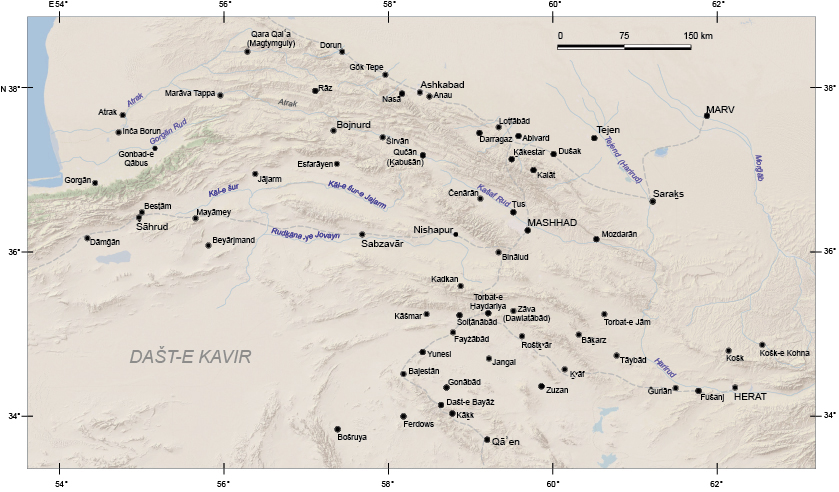
Figure 1. Northern Khorasan and environs in the Qajar to Pahlavi era. (Map prepared with QGIS 3.10 and data from US National Park Service World Physical Map.)
According to Reżāqoli Khan Hedāyat (q.v.; 1800-1871), the first Qajar official in Khorasan was Reżā Khan Qājār Qoyunlu, who was appointed by Āḡā Moḥammad Khan in 1200/1785 (Hedāyat, XIII, p. 7299). ʿAbd-al-Razzāq Beg Donboli (q.v.; 1762-1828) also mentions the name of an early official appointed by Āḡā Moḥammad Khan in Khorasan, Ḥosayn Khan Qullar Āḡāsi (Donboli, p. 80). However, until 1210/1795, when Āḡā Moḥammad Khan entered Mashhad and was greeted by Šāhroḵ Afšār (grandson of Nāder Shah, q.v.) and a group of the province’s ulema and khans (Sepehr, I, p. 80), Khorasan could not truly be considered part of the Qajar domain. In that year, Āḡā Moḥammad Khan, after severely torturing Šāhroḵ, appropriated the crown jewels that had been bequeathed to him by Nāder Shah (Qazvini, p. 157) and appointed Moḥammad Wali Khan Qājār as the governor-general for Khorasan (Šamim, pp. 27-28). Āḡā Moḥammad Khan, who intended to seize Herat, Balḵ, Marv, and Bukhara from their Afghan and Uzbek rulers, had to abandon his expedition in 1796 to deal with a Russian invasion of the eastern Caucasus (Motavalli Ḥaqiqi, 2004, p. 152). Upon the death of the first Qajar shah, Nāder Mirzā, son of Šāhroḵ, supported by the Afghan rulers from Herat, returned to Mashhad and called himself the sovereign of Khorasan (Anonymous MS, f. 166).
Fatḥ-ʿAli Shah Qājār (q.v.) ascended the throne of Iran in 1212/1797, but, in the early years of his reign, Khorasan was outside the area of his authority. He made unsuccessful attempts to seize Mashhad and Khorasan in 1213/1799 and 1215/1801 (Hedāyat, IX, p. 3353), until finally, in 1218/1803, he was able to enter Mashhad after besieging it for several months.
To protect the eastern and northern borders of Khorasan, Qajar officials undertook a number of measures, including several military campaigns. Ḥosayn Khan Qājār’s expedition to Herat in 1222/1807, leading to the surrender of Fēruz-al-Din Mirzā, the governor of that city, was one of these measures (Sepehr, I, p. 164; Ḵāvari Širāzi, pp. 265-66; Nuri, pp. 308 ff.; HERAT vi). Dispersed but continuous attacks by the Turkmens of the Ḵāvarān plain and occasional raids by Uzbek khans on the territory of Khorasan, which sometimes led to the capture of innocent people and looting of their property, as well as revolts by some local Khorasani khans such as Esḥāq Khan Qarāʾi and Reżāqoli Khan Zaʿfarānlu, were among the problems for the people of Khorasan in this historical period. The city of Marv had slipped from Qajar control in 1200/1785, when the Uzbek Manghits (q.v.) killed the governor Bāyrām ʿAli Khan ʿEzz-al-Dinlu Qājār, occupied the city, and destroyed its irrigation system (Skrine and Ross, pp. 206-7), yet it could still be considered an Iranian city. However, in 1223/1808, with the failure of the governor-general of Khorasan, Moḥammad Vali Khan, in his assault on the city, and the subsequent deportation of a thousand families from Marv to Mashhad, the last roots of Iran in the ancient and historic land of Marv were severed (Sayyedi, pp. 282-89). The deteriorating situation in Khorasan forced Fatḥ-ʿAli Shah to send the crown prince, ʿAbbās Mirzā, to the province in 1831 to bring things under control (Hedāyat, ed. Kiānfar, XV, p. 8544). After arriving in Khorasan, ʿAbbās Mirzā was able to suppress all the revolts and to kill, imprison, or subjugate their leaders (Mir Niā, I, pp. 84-87; Noelle-Karimi, pp. 224-25). He then sent his son Moḥammad Mirzā to conquer Herat. The death of ʿAbbās Mirzā in 1833 brought the siege of Herat to an end, and a settlement was reached with Kāmrān Mirzā Sadōzi (Motavalli Ḥaqiqi, 2004, pp. 203-5). The Herat question itself, however, remained unresolved (see HERAT vi).
KHORASAN IN THE ERA OF MOḤAMMAD SHAH AND NĀṢER-AL-DIN SHAH
Moḥammad Mirzā became shah in 1250/1834 and appointed his uncle Allāh-Yār Khan Āṣaf-al-Dawla to govern Khorasan. He besieged Herat in 1253/1837, but the British support for Kāmrān Mirzā Sadōzi, along with the British occupation of Kharg (q.v.) island and the subsequent destabilization of Fārs, caused the siege to be lifted the next year (Šamim, pp. 145-46; Noelle-Karimi, pp. 225-30; Martin, pp. 110-15).
Not long after the setback at Herat, there were disturbances in Mashhad that led in Moḥarram 1255/March 1839 to the conversion, at least outwardly and under duress, of the Jewish community of Mashhad to Islam, an event referred to as Allāhdād ‘God’s Judgment’ (Hedāyat, X, p. 284; Wolff, p. 147; Pirnazar, pp. 115-36; Basch Moreen, p. 242; Nissimi).
In the last years of Moḥammad Shah’s reign, Moḥammad-Ḥasan Khan Sālār (d. 1850), the son of Allāh-Yār Āṣaf-al-Dawla, started a revolt in Khorasan, along with a group of khans in the region, against the central government (Bāmdād, I, p. 158; Noelle-Karimi, pp. 228-30) that continued until the early years of the reign of Nāṣer-al-Din Shah (r. 1848-96). The activities of a prominent follower of ʿAli Moḥammad Bāb (q.v.), Mollā Moḥammad-Ḥosayn Bošruʾi (q.v., 1814-49), also led to local disturbances until he was forced to leave Mashhad in 1848 (Sepehr, III, pp. 1010-14; see also KHORASAN xv. THE BABI-BAHAI COMMUNITY IN KHORASAN).
With the accession of Nāṣer-al-Din Shah in 1264/1848, his prime minister, Mirzā Taqi Khan Amir Kabir (q.v.), faced two immediate problems in Khorasan: the revolt of Ḥasan Khan Sālār and the disobedience of the governors of Herat (Noelle-Karimi, pp. 228-30). He first sent Solṭān Morād Mirzā Ḥosām-al-Salṭana to suppress the revolt of Sālār, who surrendered and was executed in 1850, and then he addressed the problem of regaining control of Herat with a plan of his own (Motavalli Ḥaqiqi, 2004, pp. 235-44; Noelle-Karimi, pp. 231-32). A terrible earthquake in 1267/1851 caused death and destruction among the people and various regions of Khorasan such as Mashhad, Qučān, and Torbat Ḥaydariya (Eʿtemād-al-Salṭana, Montaẓam III, p. 1717). The rebellion of Mirzā Rafiʿ Khan, based at Furg, a citadel in the Qāʾenāt (described in Forbes and Rawlinson, pp. 22-25), also ended with his defeat and flight to Herat (Ḵurmuji, pp. 118-19).
With the death of Amir Kabir, the officials in Herat became disobedient again. Although Ḥosām-al-Salṭana, the governor-general of Khorasan, conquered Herat in October 1856 (see Noelle-Karimi, pp. 232-34), the British intervention and occupation of southern Iran led to the Persian withdrawal from Herat, the signing of the Treaty of Paris between Iran and Britain, and the separation of Herat from Iran. (Motavalli Ḥaqiqi, 2004, pp. 257-64; Champagne, p. 377; see also ANGLO-PERSIAN WAR [1856-57]).
Occasional attacks by Turkmens of the Ḵāvarān plain was another problem for the people of Khorasan during the Nāṣeri era. Ḥamza Mirzā Hešmat-al-Dawla (d. 1880), the governor-general of Khorasan, tried to suppress the Turkmen in campaigns beginning 1275/1859, but he suffered a severe defeat outside Marv in 1277/1860 (see Rowšani Zaʿfarānlu, pp. 75-144; Noelle-Karimi, p. 234). This defeat was, in fact, the beginning of the end of Iran’s claims to dominion over the Ḵāvarān plain. The Akhal (Āḵāl) boundary convention, signed in 1299/1881 between Iran and Russia, effectively ended Iran’s historical claims to lands beyond the Tejen river and to cities such as Meyhana, Abivard, Nesā, and Marv (Sayyedi, pp. 378-79; text in Krausse, pp. 360-62).
During his reign, Nāṣer-al-Din Shah traveled to Khorasan twice. The first time was in 1284/1867, and the second time was in 1300/1882. The travel accounts of these two journeys are recognized as among the most important sources for the history of Khorasan in the Nāṣeri era (Qahramān, passim). One of the worst developments for Khorasan during the last three decades of Nāṣer-al-Din Shah’s reign was the Great Famine that began 1285/1869 and lasted until 1288/1873. It was so severe that people were reduced to eating grass, animals, and religiously forbidden meats, or even digging up corpses for food (Eʿtemād-al-Salṭana, Matlaʿ, II, p. 377; Majd, 2018, pp. 53-68). The Tehran to Mashhad telegraph line was established under the direction of Albert Houtum-Schindler (q.v.; d. 1916) in 1293/1876 (Eʿtemād-al-Salṭana, Montaẓam, III, p. 1964). A house-by-house census of Mashhad was conducted by Zayn-al-ʿĀbedin Mirzā Qājār (Qājār, passim) in 1878, and British and Russian consulates were opened in the spring of 1306/1889 (Curzon, I, pp. 170-74, tr., I, pp. 237-40). The cholera epidemic of 1309/1891 spread along the road from Afghanistan to Khorasan and caused the death of an estimated 20,000 people in Khorasan (Riāżi Heravi, pp. 105-6). One might also note the migration of large groups of Shiʿites, Sādāts, and Hazāras (q.v.) from Afghanistan to Khorasan due to the anti-Shiʿite and anti-Hazāra policies of the Afghan p
ādšāh (amir) ʿAbd-al-Raḥmān Khan (r. 1297-1319/1880-1901; Motavalli Ḥaqiqi, 2004, pp. 308-10; see AFGHANISTAN x; HAZĀRA ii). The “Tobacco Rebellion,” which began in 1308/1891 against the transfer of the exclusive right to buy and sell tobacco to the Régie, a monopoly owned by a British subject (see Keddie; CONCESSIONS ii), spread to Mashhad, and the people of Khorasan and Mashhad, led by Sheikh Moḥammad-Taqi Bojnurdi, began their protests. Nāṣer-al-Din Shah and the British were forced to yield after a five-day uprising by the people of Mashhad and several other cities in Khorasan, exempting Khorasan from this concession (Motavalli Ḥaqiqi, 2013, I, p. 364; cf. Nouraie, pp. 221-31); the concession itself was cancelled in January 1892.
In the last decade of Nāṣer-al-Din Shah’s reign, the situation in Khorasan province became very unstable because of perceptions of tyranny and oppression under governors of Khorasan such as ʿAbd-al-Wahhāb Khan Āṣaf-al-Dawla Širāzi, Moḥammad-Taqi Mirzā Rokn-al-Dawla, and Abu’l-Fatḥ Mirzā Moʾayyed-al-Dawla (q.v.; d. 1330/1912). People in the city of Mashhad often revolted to protest the high prices for bread, meat, and other supplies (Motavalli Ḥaqiqi, 2013, I, pp. 22-26, 45-50). Nāṣer-al-Din Shah Qājār was assassinated in 1313/1896, after reigning for almost 50 years. It was against this background of turmoil and hardship that people in Khorasan, and in other regions of Iran, began to challenge the status quo and the actions of the Qajar government.
KHORASAN IN THE LATE QAJAR PERIOD
In the early years of the reign of Moẓaffar-al-Din Shah (r. 1896-1907), Khorasan continued to face various social crises and uprisings. In those years, the governors of Khorasan seemed to be motivated only by personal greed. Āṣaf-al-Dawla Šāhsavan was one of the governors who was notorious for having his agents beat up their subjects in Khorasan until they were almost dead in order to extort taxes from them. The most infamous episode of his administration occurred in 1905 in Qučān, where the authorities forcibly separated about 300 girls from their families and sold them to the Turkmen for a petty price in lieu of taxes (Nāẓem-al-Eslām Kermāni, pp. 305-6; Browne, pp. 174-79; Najmabadi). The publication of this news became an incentive for intellectuals and constitutionalists to resist the despotic government (Šarif Kāšāni, IV, p. 851).
Simultaneously with the beginning of public dissatisfaction with the Qajar rule in the last years of the reign of Nāṣer-al-Din Shah Qājār and the first years of Moẓaffar-al-Din Shah’s reign, modernization and interest in the achievements of Western civilization began in Khorasan. The creation of new schools, the publication of newspapers, the formation of cultural associations, the organization of various reformist groups among the ulema and merchants, and the emergence of a fledgling group of journalists were the most significant aspects of modernization in Khorasan and Mashhad. Mirzā Ḥasan Rošdiya took the initiative in creating new schools in Mashhad, and others, such as Moḥammad ʿAli Modir, Moḥammad Ḥasan Khan Ṣabā, and Ḥāj Asad-Allāh Fatḥ-Allāh Yusof Ḵāmenaʾi, continued to do so (Motavalli Ḥaqiqi, 2005, p. 129). The establishment of new schools in other cities in Khorasan dates to the post-constitutional years. Birjand, Qučān, Bojnurd, Nishapur, and Torbat-e Ḥaydariya were among the cities that witnessed the launch of new schools a few years after the victory of the Constitutional Revolution (q.v.; Motavalli Ḥaqiqi, 2005, passim). The first newspaper printed in Khorasan, called Adab (q.v.), was founded in Tabriz but published in Mashhad from Ramażān 1318/December 1900 to Rajab 1321/October 1903 under the editorship of Adib-al-Mamālek Farāhāni (q.v.; d. 1917). Adab was the first Iranian newspaper to employ cartoons to express its views (Ṣadr Hāšemi, I, pp. 82-87). Although Khorasan had initially lagged behind other parts of Iran in press publication due to pressures from Tsarist Russia, after the victory of the constitution, dozens of newspapers were published in Mashhad and other cities of Khorasan, which turned this province into a major hub of journalism in Iran (see Elāhi, passim; KHORASAN xxviii. NEWSPAPERS OF KHORASAN). Simultaneously with the establishment of new schools and the publication of newspapers, the province of Khorasan was also home to important writers and political activists such as Ḥaydar Khan ʿAmu-Oḡli (q.v.; d. 1921), Adib-al-Mamālek Farāhāni, Moḥammad-Taqi Mālek-al-Šoʿarāʾ Bahār (q.v.; d. 1951), Sheikh Aḥmad Bahār, and Sheikh Aḥmad Ruḥ-al-Qodos Torbati, better known as Solṭān-al-ʿOlamāʾ Ḵorāsāni. They were among the first notables to participate in the beginning of the Constitutional Revolution in Mashhad (Motavalli Ḥaqiqi, 2013, I, pp. 82-83). The profound dissatisfaction of the citizenry with the government, along with the efforts and struggles of the activist groups, caused some of the people of Khorasan, albeit a little later on, to join the ranks of the constitutionalists.
At the urging of Khorasan’s representatives in the first Majles, the ground was prepared for the dismissal of Āṣaf-al-Dawla Šāhsavan and also the dismissal and trial of ʿAziz-Allāh Khan Šādlu (Sardār Moʿazzaz Bojnurdi), the governor of Bojnurd, on charges of collaborating with the Turkmen in capturing the girls from the Bāškānlu tribe of Qučān (Aʿẓām Qodsi, pp. 175-92). In Mashhad, the Khorasan Provincial Association (Anjoman-e Eyālati-e Ḵorāsān) took over the administration of the city’s affairs. In addition to this association, the Saʿādat Charity Association (Anjoman-e ḵayriya-ye saʿādat) was established with the goal of spreading public culture and establishing new schools in Mashhad (M.-T. Bahār, I, p. yak). With the death of Moẓaffar-al-Din Shah and the succession of his son Moḥammad-ʿAli Shah, who had no interest in compromise with the constitution and the constitutionalists, the situation in Iran, including Khorasan, underwent various transformations.
The general situation in Khorasan was almost calm between the victory of the constitutionalists and the attack on the Majles in June 1908, but with the shelling of the Majles and the beginning of the “Lesser Despotism” (estebd ād -e ṣaḡir) in Tehran, the ground was also prepared in Khorasan for the opponents of the constitution. The anti-constitutionalist ulema in Khorasan were led by those such as Sayyed ʿAli Sistāni and Sheikh Mahdi Wāʿez Ḵorāsāni (Motavalli Ḥaqiqi, 2013, I, pp. 88-89). Other prominent opponents of the constitution in Mashhad included figures such as Yusof Khan Herāti, Moḥammad Qušābādi, and Moḥammad Ṭāleb-al-Ḥaqq Yazdi (Kāviāniān, pp. 87-88). Rabble-rousers and brigands, backed by the financial and military support of the Russians, these people were able to create chaos in Mashhad and other parts of Khorasan, trying to pave the way for the return of the deposed Moḥammad-ʿAli Shah to Iran. They made the courtyards of the Rażawi shrine (see ĀSTĀN-E QODS-E RAŻAWI) and the Gowhar-šād mosque (q.v.) the center of their activities. However, the Russians, once it was clear that the effort to restore Moḥammad-ʿAli Shah had failed, took matters into their own hands and withdrew their support for Yusof Khan and his forces and decided to remove them from the Gowhar-šād mosque and the Rażawi shrine. On 29 March 1912, the Russians directed a volley of hundreds of artillery shells and bullets at the Rażawi shrine (Adib Heravi, pp. 211-12; Sykes, II, p. 426; Matthee; Figure 2). In addition to damaging the dome of the Rażawi shrine, and despite Yusof Khan Herāti and his confederates having left the shrine and its surrounding structures, the Russians brutally occupied the courtyard with their cavalry and infantry, killing many innocent pilgrims. Estimates of the number of people who died in this incident vary greatly, from 40 to 800 (Motavalli Ḥaqiqi, 2013, I, pp. 145-47).
The situation in Khorasan on the eve of World War I was tumultuous due to internal mismanagement and foreign interference. Local miscreants in areas such as Zašk and Čenārān also took advantage of these conditions for their own purposes and banditry (Modarres Rażavi, pp. 233-34). With the outbreak of World War I in 1914, despite the declaration of neutrality by Iran, the country, including the province of Khorasan, became an arena for foreign competition and interference. The Russians, who considered Khorasan to be in their sphere of influence, sent additional troops to occupy most of the territory of the province (Motavalli Ḥaqiqi, 2013, I, p. 156).
Foreign intervention and the irresponsibility of the governors of Khorasan in the last years of the First World War caused famine, exorbitant prices for food and goods, and made life difficult for the Khorasani masses. In addition to inflation and famine, the spread of diseases such as cholera and tuberculosis affected the population in such a way that numerous poor people died of starvation and disease every day (Motavalli Ḥaqiqi, 2013, I, p. 158). Although there is no accurate report on casualties among the people of Khorasan during the period of World War I, it was, according to some estimates, one of the deadliest eras in Iran and in the history of Khorasan in the modern period (Majd, 2008, pp. 59-67, tr. pp. 85-91). The outbreak of the Bolshevik Revolution caused the Russians to withdraw from the territory of Khorasan temporarily, in contrast to the very visible presence the British had amassed in Khorasan (Maḥbub Farimāni and Neʿmati, pp. 346-47).
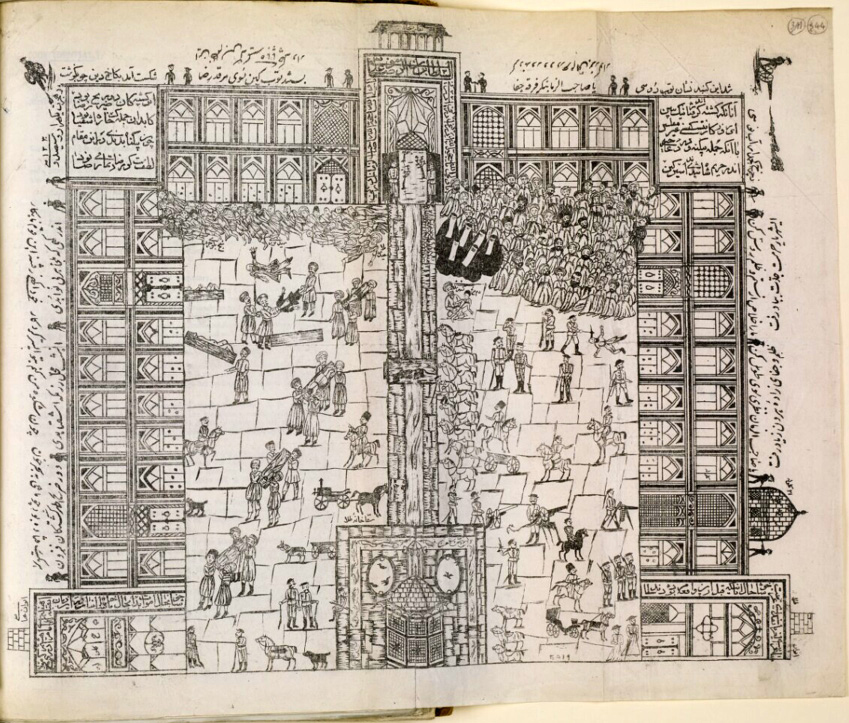
Figure 2. Illustration of the Russian bombardment of the Imam Reżā Shrine in Mashhad, 1912, prepared by a local artist at the request of the British consul in Mashhad, Percy Sykes. The marginal verses read “O Lord of the Time [the Mahdi], Regard Ṭus / The harshness and the oppression of the son of Hārun-al-Rašid is increased. / Release us from the tyranny and oppression of the Russians. | O King [Imam Reżā], the honor of thy ancestor is gone to the wind. / From the crooked ebony revolution of the heavens, / This dome became the target of Russian guns. | O Lord of the Time! Regard this race of tyrants. / They entered the Shrine of the Saint, / they laid guns on the tomb of the Imam Reżā / This tyranny was enough that they all wore long boots [instead of removing them in the shrine]. | The building of Islam cracked in 1330 [1912]. | The place was the refuge of the weak / On that night it became the battle-place of the black-hearted. | Round the grating of the sacred tomb / There were many killed, lying in blood / like fish in a pool / How can I complain of this to Thee, / O Secret of God. / Thou knowest the action of the doers of the bad deeds.” Image and translation of text after India Office Records and Private Papers, British Library, File 52/1912 IOR/L/PS/10/209, 343r-344r; available at www.qdl.qa/en/archive/81055/vdc_100029742540.0x00005d. Copyright status unknown.
One of the most important events in the history of Khorasan in the last years of Qajar rule was the uprising of Colonel Moḥammad-Taqi Khan Pesyān (q.v.; 1892-1921; see Cronin, 1997b, p. 693). In September 1920, Pesyān left for Mashhad to assume command of the Khorasan Gendarmerie (q.v.), and, with the cooperation of Qawām-al-Salṭana, the governor-general of Khorasan, he succeeded in suppressing Khorasani rebels such as Ḵodāverdi Sardār Širvāni, Morsal Khan, and Zabar-dast Khan Darragazi (Mir Niā, I, pp. 296-301). Following the Coup d’Etat of 1299/1921 (q.v.), Sayyed Żiāʾ-al-Din Ṭabāṭabāʾi became prime minister, and Pesyān, acting on the orders of the prime minister, arrested Qawām-al-Salṭana, sent him to Tehran, and took control of Khorasan himself (Motavalli Ḥaqiqi, 2001, pp. 47-56). When Sayyed Żiā’s cabinet fell and Qawām-al-Salṭana replaced him as prime minister, Pesyān refused to cooperate with the new government. Finally, after some military conflicts and despite some peace negotations, the Kurdish khans of northern Khorasan, on instructions from Qawām-al-Salṭana and under the direction of Sardar Moʿazzaz of Bojnurd, defeated the Gendarmeries of Širvān, Fāruj, and Qučān and killed Pesyān in the environs of Qučān on 30 Moḥarram 1340/3 October 1921 (Motavalli Ḥaqiqi, 2001, pp. 96-108; see also Šawkat, pp. 75-110 for a reassessment of these events).
Shortly after attaining the position of prime minister of Iran, Reżā Khan Mir Panj, the former minister of war in Sayyed Żiāʾ’s “Black Cabinet,” sought to hold a referendum on establishing a republic. In Mashhad, groups of people led by Sayyed Ḥasan Meškān Ṭabasi, Sheikh Aḥmad Bahār (see the preface to his Div
ān), and Aḥmad Dehqān supported the declaration of a republic, but smaller groups also expressed their opposition (Motavalli Ḥaqiqi, 2013, I, pp. 194-95). In Khorasan, after the defeat of the plan for establishing a republic and abolishing the monarchy, Jān Moḥammad Khan (q.v.), the military commander of Khorasan; Moḥammad Arjomand, the head of the post; and Morteżā Khan Makri, the military commander of Mashhad, established a committee called Nahżat-e Šarq (Movement of the East) and sent telegrams to Tehran expressing the dissatisfaction of the people of Khorasan with the Qajars and demanding their deposition as rulers of Iran (Arjomand, pp. 67-69). The news of the abolition of the Qajar dynasty and subsequently the rule of Reżā Shah was met with joy by groups of people and ulema of Khorasan, who sent messages of congratulations to Reżā Shah and expressed their support for the changes (Mirzā Ṣāleḥ, p. 569).
KHORASAN IN THE PAHLAVI PERIOD
During the 54-year reign of the Pahlavi dynasty, about 30 people were appointed as governors of Khorasan. Seven of them were appointed during the reign of Reżā Shah (1924-41; see Šaybāni, pp. 6-9), and 23 were appointed during the 38-year reign of Moḥammad Reżā Shah (1941-79; see Fāżeli Birjandi, pp. 13-16).
In the new provincial administrative division of the country created by Reżā Shah in 1937, Khorasan was recognized as the “Ninth Province” (Ostān-e Nohom), with Mashhad as its provincial capital and the seven sub-provinces (šahrestāns) of Sabzavār, Gonābād, Bojnurd, Qučān, Birjand, Torbat Ḥaydariya, and Mashhad. In 1950, the sub-provinces of Darragaz, Nishapur, Ferdows, and Kāšmar were formed, so the number of sub-provinces was expanded to eleven. In 1956, Darragaz was annexed to Qučān and the two sub-provinces of Torbat-e Jām and Ṭabas were created. In 1960, Darragaz became a sub-province again, and the sub-provinces of Širvān and Esfarāyen were also created. In 1975, the Bāḵarz district (baḵš) became the center of Torbat-e Jām and Tāybād was changed from a district to a sub-province (details from Sāzmān-e modiriyat, s.v. “Moʿarrefi-e ostān”).
Although the governors of Khorasan during the Pahlavi period, unlike those of the Qajar period, were not kinsmen of the royal family, many of them were considered to be among the most eminent political and military figures of Iran in their time. They included such notables as Maḥmud Jam (q.v.), Sayyed Ḥasan Taqizāda (q.v.), Major-General Fatḥ-Allāh Pākravān, Rajab-ʿAli Manṣur, Ṣadr al-Ašrāf, Sayyed Jalāl-al-Din Ṭehrāni, General Nāder Bātmānqalič, General Ṣādeq Amir ʿAzizi, and ʿAbd-al-ʿAẓim Valiān. Many of them, before or after being governor of Khorasan, held the rank of prime minister or ministers in various cabinets of Iran. There was an added dimension to their role and prestige as governors of a major province: Many of them, in addition to the duties of their post, would also be entrusted with the administration of the extensive religious-economic resources supporting the shrine around the tomb of Imam Reżā (q.v.), the eighth Imam of the Shiʿites, and held the title of deputy-trustee (n āyeb al-tawliya; on this office, see Nouraie, p. 89) of the Āstān-e Qods-e Rażawi.
The revolt of Lahāk Khan Bāvand broke out during the early years of Reżā Shah’s reign. Lahāk Khan, at the head of a group of soldiers from the Marāva Tappa garrison, initiated a mutiny in July 1926 (Cronin, 2014, pp. 55-56). He had communist sympathies and, after taking over the Inča Borun guardpost, went on to capture the city of Bojnurd (Motavalli Ḥaqiqi, 2008, p. 180). He then took Širvān and Qučān, but he was defeated by government forces at Qučān and fled to the Soviet Union (Bayāt, pp. 440-41).
In Farvardin 1307/April 1928, Reżā Shah appointed Maḥmud Jam to be governor-general of Khorasan. During his two terms of office (April 1928-January 1929 and August 1929-September 1933), Jam introduced numerous reforms. In May 1929, during the governorship of Ḥasan Taqizāda, the powerful Bāḡān earthquake shook the northern cities of Khorasan, such as Qučān, Širvān, and Bojnurd, causing great loss of life and property (Motavalli Ḥaqiqi, 2013, I, p. 237; Berberian, p. 247). The arrest and execution of two troublemakers, the brothers Ḏu’l-Feqār and Ḡanbar-ʿAli (also known as Zolfo and Qamo), who were robbing travelers on the roads of Khorasan, was another of Taqizāda’s achievements in Khorasan (Šākeri, p. 114). In the 1930s, when many Jews from around the world were immigrating to Palestine, numerous Jews from Mashhad also moved there (Yazdāni, pp. 21-27).
One of the most important events in the modern history of Khorasan, the Gowhar-šād uprising, also regarded as the most significant anti-government movement in the early Pahlavi era, occurred during the governorship of Fatḥ-Allāh Pākravān (1934-41). In the absence of Ayatollah Sayyed Ḥosayn Ṭabāṭabāʾi Qomi, who had traveled to Tehran to protest the shah’s new policy requiring men to use the chapeau (western-style hats, see CLOTHING xi; KOLĀH-E PAHLAVI) as headgear and was confined there, groups of Mashhad residents and other Khorasanis assembled at the Gowhar-šād Mosque under the influence of speeches by a firebrand religious student, Moḥammad-Taqi Gonābādi, known as Bohlul, and denounced Reżā Shah’s secularizing policies. Government forces attacked, killed, and wounded a number of the protesters at the Gowhar-šād Mosque over two days, on the mornings of 20 and 21 Tir 1314/12 and 13 July 1935 (Motavalli Haqiqi, 2013, I, pp. 277-302).
In the first months of his reign, Reżā Shah had appointed Moḥammad-Wali Khan Asadi as the deputy-trustee of the Āstān-e Qods. With a flurry of activity, Asadi had been able to change the face of Mashhad from that of a middling city to that of a relatively large and semi-modern metropolis. His impovements included the construction of the capacious and modern Šāhreżā Hospital and the digging of several qan āts (see KĀRIZ) to supply drinking water to Mashhad, as well as the introduction of administrative reforms for the Āstān-e Qods organization (Moʾtaman, pp. 31, 107, 275) and the development of new schools (Motavalli Ḥaqiqi, 2005, p. 162). The construction of a traffic circle around the shrine, connecting the two main avenues in Mashhad, was another of Asadi’s reforms (Šuštari, pp. 226-27). He remained one of the most influential figures in the history of Khorasan until the time of the Gowhar-šād incident. Asadi’s disagreement and rivalry with Pākravān, the governor-general of Khorasan, then led Pākravān to take advantage of Asadi’s opposition to the chapeau policy as a means of discrediting him in the eyes of the shah and putting the blame on him for the uprising at the Gowhar-šād Mosque. This resulted in Asadi’s dismissal, trial, and execution in 1935 (Motavalli Ḥaqiqi, 2013, I, p. 276).
After Asadi’s execution, Pākravān, in addition to being the governor-general, also became the deputy-trustee of the shrine. During his seven years in Khorasan, he carried out many of the government’s directives vigorously and thoroughly on issues such as removing head-coverings from women and developing new schools (Mir Niā, II, p. 142).
With the outbreak of World War II in 1939, although Iran had declared neutrality, Soviet troops moved into Khorasan from the Saraḵs, Darragaz, and Bājgirān fronts on 3 Šahrivar 1320/1941. After brief clashes with Iranian forces and following the declaration of surrender by the Iranian government, the Soviets occupied all of Khorasan, based primarily in cities such as Mashhad and Bojnurd. Soviet forces were present in Khorasan from then until the winter of 1943. The presence of Soviet forces and the conditions of the war caused severe shortages, and famine and high prices in Khorasan made the lives of the people very difficult (Motavalli Ḥaqiqi, 2013, II, p. 39).
The khans of Khorasan, who had been severely repressed during the reign of Reżā Shah, began to revolt after his downfall (Mir Niā, II, p. 192). The rebellions of the khans of the Milānlu tribe in Esfarāyen (Tavaḥḥodi, p. 191) and of Faraj-Allāh Beyg of ʿId-Moḥammad Zuri in Torbat-e Jām were among these revolts (Rāmin-nežād, p. 318). But the biggest revolt during this period was the revolt of Moḥammad Yusof Khan Hazāra, known as Ṣawlat-al-Salṭana. Yusof Khan, who had been the first representative of the people of Mashhad in the Fifth Majles, was exiled from Khorasan during the reign of Reżā Shah and imprisoned for some time on charges of collaborating with Soviet agents (as confirmed by Agabekov, tr., p. 91, Pers. tr., p. 12). After the fall of Reżā Shah, he moved to occupy the eastern regions of Khorasan and rebel against the central government. However, he was eventually killed by agents sent by Rajab-ʿAli Manṣur, the governor-general of Khorasan (Bayāt, passim, and also Mir Niā, II, p. 202).
Another incident that occurred during the Soviet occupation of Khorasan was the uprising of Tuda (communist) officers from the Mashhad garrison in the summer of 1945, led by Major ʿAli-Akbar Eskandāni. He and twenty-five other officers and soldiers of the Tuda armed forces of Khorasan, using several vehicles and military equipment, reached Marāva Tappa and then Gonbad on 25 Mordād 1324/16 August 1945, but they were defeated by gendarmerie forces in Gonbad on 29 Mordād/20 August. Eskandāni was killed, and his remaining supporters fled (Rāmin-nežād, p. 364).
An attack on the Jewish or “New Muslim” inhabitants of Mashhad in the ʿIdgāh neighborhood took place in March 1946. Some Jews were injured and their property looted (Nazarzāda, p. 477). In October 1948, during the governorship of ʿAbbāsqoli Golšāʾiān (q.v.; d. 1990), a severe earthquake centered near Ashgabat in Turkmenistan shook the cities of Mashhad, Darragaz, Qučān, Bojnurd, Širvān, and Bājgirān, causing great damage to the cities and villages of Khorasan, killing or injuring more than a thousand people (Fāżeli Birjandi, p. 449).
The British and also the Americans had various activities in Khorasan in the 1940s and 1950s. The formation of the United Kingdom Commercial Corporation (UKCC) transportation company (Skrine, pp. 150, 197, 200), the publication of a newspaper, and the establishment of a branch of the British-Iranian Cultural Relations Association in Mashhad were among these activities (Elāhi, pp. 173-170). The Americans established their consulate in Mashhad in Ḵordād 1328/July 1949 (Motavalli Ḥaqiqi, 2013, II, p. 97) and also opened offices in Khorasan for Truman’s Point Four program. In the 1950s, at the same time people across Iran were calling for the nationalization of the oil industry, so did newspapers, political parties, and many groups of people in Khorasan. The leaders of the nationalization movement in Khorasan were Moḥammad-Taqi Šariʿati, representing educators and intellectuals; Ḥāji ʿAli-Aṣḡar ʿĀbedzādeh, representing the bazaar merchants and craftsmen; and Sheikh Maḥmud Ḏākerzāda Tulāyi, known as Ḥalabi, representing a group of religious clerics (Jalāli, 118-21). With Moḥammad Moṣaddeq’s rise to power in 1951, the political parties, press, ulema, and people were divided into two groups. Khorasani notables such as Ayatollah Kalbāsi, took the side of Moṣaddeq’s government, while religious scholars such as Mirzā Aḥmad Kafāʾi Ḵorāsāni opposed Moṣaddeq and supported the royalists (Motavalli Ḥaqiqi, 2013, II, pp. 130, 169). After the Coup d’Etat of 1332 Š./1953 (q.v.) and the fall of the Moṣaddeq government, the suppression of members of the Tuda party of Khorasan began (see Baqiʿi, passim; COMMUNISM iii).
In the decades of the 1950s, 60s, and 70s, the Soviet government had little influence in Khorasan. As Russian influence declined, American and British influence in Khorasan increased in various ways (Motavalli Ḥaqiqi, 2013, II, p. 179). During the Coup d’Etat of 1332 Š./1953, many Khorasani newspapers and political parties that opposed the coup were shut down or dissolved. In the period between the Coup d’Etat of 1332 Š.1953 and Bahman 1357/ 1979, a total of fourteen people were named as governor-generals of Khorasan (Motavalli Ḥaqiqi, 2013, p. 210). The Tehran-Mashhad railway, the construction of which had begun in March 1937 but was halted due to the Allied invasion and occupation of Iran in 1941, was completed, and the first train arrived in Mashhad in January 1957 (Saʿidi, p. 90). This railway played a great role in the development of Mashhad, the increase in the number of visitors, and the prosperity of business. The severe Dašt-e Bayāż earthquake in Khorasan struck on 31 August 1968 during the governorship of Bāqer Pirniā. The earthquake was so devastating that it levelled cities such as Ferdows, Gonābād, and Kāḵk, with many deaths and extensive destruction (Fāżeli Birjandi, p. 542; Ambraseys and Tchalenko).
In the 1960s and 1970s, Khorasan also witnessed the opposition of a group of ulema and people against the government. Religious scholars such as Ḥasan Qomi and Moḥammad-Hādi Milāni and clerics such as ʿAbd-al-Karim Hāšemi-nežād, ʿAli Ḵāmenaʾi, ʿAbbās Wāʿeẓ Ṭabasi, and Sheikh ʿAli Ṭehrāni were among the most prominent of these dissidents. Among Khorasan intellectuals, those such as Moḥammad-Taqi Šariʿati and ʿAli Šariʿati were outspoken in their opposition to the government. Among the most prominent governors of Khorasan during this period, Bāqer Pirniā (governor from October 1967 to September 1970) and ʿAbd-al-ʿAẓim Valiān (May 1974 to August 1978) implemented modernization and secularization policies that fueled this discontent in the province; the designation of Valiān as nāyeb al-tawliya was especially unpopular (see Motavalli Ḥaqiqi, 2013, II, pp. 383-433; Bill, pp. 187-88).
Bibliography
- [Anonymous], “Aḥmad Šāh Dorrāni,” tr. Sayyed Ḥosayn Ṣadr al-Maʿāli, MS Ketāb-ḵāna-ye Āstān-e Qods-e Rażawi, Mashhad (dated 1320/1902-3).
- ʿAli Āḏari, Qiām-e Kolonel Moḥammad-Taqi Ḵān Pesyān dar Ḵorāsān, 3rd ed., Tehran, 1965.
- Ḡolām-Reżā Āḏari Ḵākestar, Šenāsāʾi va moʿarrefi avvalinhā-ye šahr -e Mašhad, Mashhad, 2016.
- Moḥammad Ḥasan Adib Heravi, al-Ḥadiqa al-rażawiya, Mashhad, 1946.
- Grigoriĭ Sergeevich Agabekov, GPU: Zapiski Chekista, Berlin, 1930, tr. Henry W. Bunn, as OGPU: The Russian Secret Terror, New York, 1931; Pers. tr. Ḥosayn Abu Torābiān, as Ḵāṭerāt-e Āqa Bekof, Tehran, 1978.
- Abbas Amanat and Arash Khazeni, “The Steppe Roads of Central Asia and the Persian Captivity Narrative of Mirza Mahmud Taqi Ashtiyani,” in Nile Green, ed., Writing Travel in Central Asian History, Bloomington, Indiana, 2014, pp. 113-31.
- N. N. Ambraseys and J. S. Tchalenko, “The Dasht-e Bayāz (Iran) Earthquake of August 31, 1968: A Field Report,” Bulletin of the Seismological Society of America 59, 1969, pp. 1751-92.
- Atepheh Amid, “Night, Space and Urban Design: Case Study of Mashhad, Iran,” Ph.D. diss., University of Westminster, U.K., 2013.
- Mirzā Qahramān Amin-Lašgar, Ruznāma-ye safar-e Ḵorāsān, eds. Iraj Afšār and Moḥammad Rasul Daryāgašt, Tehran, 1995.
- Moḥammad Arjomand, Šeš sāl dar darbār-e pahlavi, Tehran, 2006.
- Mirzā ʿAbd-al-Wahhāb Khan Āṣaf-al-Dawla, Asnād, eds., ʿAbd-al-Ḥosayn Navāʾi and Nilufar Kasri, Tehran, 1998.
- Ḥosayn Aʿẓām Qodsi, Ḵāterāt-e man yā rowšan šodan -e tāriḵ-e ṣad sāla, 2 vols., Tehran, 1970.
- Aḥmad Bahār, Divān, ed. Rāšed Bahār, Tehran, 1991.
- Mehrdād Bahār, ed., Dar bāra-ye qiām-e žāndārmeri -e Ḵorāsān be rahbari-e Kolonel Moḥammad-Taqi Ḵān Pesyān, Tehran, 1990.
- Moḥammad-Taqi Bahār, Tāriḵ-e moḵtaṣar-e aḥzāb-e si ā si dar Irān, 2 vols., repr. Tehran, 1992-93.
- Mahdi Bāmdād, Šarḥ -e ḥāl-e rejāl-e Irān, 6 vols., Tehran, 1968-69.
- Ḡolām-Ḥosayn Baqiʿi, Angiza: Ḵāṭerāti az dawrān-e faʿʿāliat ḥezb-e tuda, Tehran, 1994.
- V. V. Barthold, An Historical Geography of Iran, tr. Svat Soucek, Princeton, 1984.
- Vera Basch Moreen, “The Jews in Iran,” in Abdelwahab Meddeb and Benjamin Stora, eds., A History of Jewish-Muslim Relations: From the Origins to the Present Day, Princeton, 2013, pp. 239-47.
- Kāva Bayāt, Ṣawlat-al-Salṭana Hazāra va šureš -e Ḵorāsān dar zamestān 1320 šamsi, Tehran, 1991. Idem, Qiām-e nāfarjām: Šureš -e Lahāk Ḵān Sālār Jang, Tehran, 1996.
- Kāva Bayāt, ed., Enqelāb-e Ḵorāsān: Majmuʿa-ye asnād wa madārek-e sāl-e 1300 šamsi, Tehran, 1991.
- Manuel Berberian, Earthquakes and Coseismic Surface Faulting on the Iranian Plateau, Oxford and Amsterdam, 2014.
- James Bill, The Eagle and the Lion, New Haven, 1988.
- E. G. Browne, The Press and Poetry of Modern Persia, Cambridge, 1914, pp. 174-79 (“Ballad of the Girls of Qúchán”).
- David Charles Champagne, “The Afghan-Iranian Conflict over Herat Province and European Intervention 1796-1863: A Reinterpretation,” Ph.D. diss., The University of Texas at Austin, 1981.
- Arthur Conolly, Journey to the North of India, Overland from England, through Russia, Persia, and Affghaunistaun. 2 vols., London, 1834.
- Stephanie Cronin, The Army and the Creation of the Pahlavi State in Iran 1910-1926, London, 1997a.
- Idem, “An Experiment in Revolutionary Nationalism: The Rebellion of Colonel Muhammad Taqi Khan Pasyan in Mashhad, April-October 1921,” Middle Eastern Studies 33/4, 1997b, pp. 693-750.
- Idem, “The Provincial Cities in Revolt (i): Colonel Pasyan and the Mashhad Rebellion, April-October 1921,” in idem, Soldiers, Shahs and Subalterns in Iran: Opposition, Protest and Revolt, 1921-1941, Basingstoke, 2010, pp. 44-100.
- Idem, “Riza Shah and the Paradoxes of Military Modernization in Iran, 1921-41,” in idem, ed., The Making of Modern Iran: State and Society under Riza Shah, 1921-1941, London, 2014, pp. 37-64.
- George N. Curzon, Persia and the Persian Question, 2 vols., London, 1892, tr. Ḡolām-ʿAli Vaḥid Māzandarāni, as Irān va qażia-ye Irān, Tehran, 2001.
- ʿAbd-al-Razzāq Donboli, Maʾāṯer-e solṭāniya (az ru-ye nosḵa-ye muzeh-ye Baritāniā), ed. Firuz Manṣuri, Tehran, 2004.
- Moḥammad Eḥtešām Kāviāniān, Šams al- šamus yā tāriḵ-e Āstān -e qods, Mashhad, 1976.
- Ḥosayn Elāhi, Ruznāma va ruznāma-negāri dar Ḵorāsān az āḡāz tā šahrivar 1320, Mashhad, 2000. Idem, Aḥzāb va sāzmānhā-ye siāsi va ʿamalkard -e ānhā dar Ḵorāsān 1320 tā 1332, Mashhad, 2003.
- Maḥmud-Taqi ʿEmād-al-Daftar Āštiāni, ʿEbrat-nāma : ḵāṭerāti az dawrān-e pas az janghā-ye Herāt va Marv, ed. Ḥosayn ʿEmādi Āštiāni, Tehran, 2003.
- Moḥammad Ḥasan Khan Ṣaniʿ-al-Dawla Eʿtemād-al-Salṭana, Maṭlaʿ al- šāms, Tehran, 1983.
- Idem, Tāriḵ-e montaẓam-e nāṣeri, ed. M. Reżwāni, 3 vols, Tehran, 1988.
- Mohammad H. Faghfoory, “The Impact of Modernization on the Ulama in Iran, 1925-1941,” Iranian Studies, 26/3-4, 1993, pp. 277-312.
- Elāha Maḥbub Farimāni and Behzād Neʿmati, Asnād-e ḥożur-e dawlathā-ye bigāna dar šarq -e Irān, Mashhad, 2003.
- Fatema Soudavar Farmanfarmaian, “James Baillie Fraser in Mashhad or the Pilgrimage of a Nineteenth-Century Scotsman to the Shrine of the Imām Riḍā,” Iran 34, 1996, pp. 101-15.
- Idem, “An Iranian Perspective of J. B. Fraser’s Trip to Khorasan in the 1820s,” Iranian Studies 44/2, 2011, pp. 217-42.
- Maḥmud Fāżeli Birjandi, Tārikčaʾi-e farmān-ravāyān-e Ḵorāsān az āḡāz -e Qājār tā pāyān-e Pahlavi, Tehran, 2019.
- Frederick Forbes and W. Rawlinson, “Route from Turbat Haïderí, in Khorásán, to the River Herí Rúd, on the Borders of Sístán” The Journal of the Royal Geographical Society of London 14, 1844, pp. 145-92.
- Reżāqoli Khan Hedāyat, Tāriḵ-e rawżat al-ṣafā-ye nāṣeri, ed. Jamšid Kiānfar, 10 vols. in 15, Tehran, 2001.
- Ḡolām-Reżā Jalāli, Taqvim-e tāriḵ-e Ḵorāsān az mašruṭa tā enqelāb-e eslāmi, Tehran, 1377/1998-99.
- Fażl-Allāh b. ʿAbd-al-Nabi Ḵāvari Širāzi, Tāriḵ-e Ḏu’l-Qarnayn, Tehran, 2001.
- Nikki R. Keddie, Religion and Rebellion in Iran: The Tobacco Protest of 1891-92, London, 1966.
- Alexis Krausse, Russia in Asia, New York, 1899.
- Moḥammad Jaʿfar Ḵurmuji, Ḥaqāʾeq al-aḵbār-e nāṣeri, Tehran, 1984.
- Mohammad Gholi Majd, The Great Famine and Genocide in Persia, 1917-1919, Lanham, Md., 2003, tr. Moḥammad Karimi, as Qaḥṭi-e bozorg, Tehran, 2008.
- Idem, A Victorian Holocaust: Iran in the Great Famine of 1869-1873, Lanham, MD, 2018.
- Ḥosayn Makki, Tārikh-e bist sāla-ye Irān VI: Estemrār-e diktātori-e Reżā Šah Pahlavi, Tehran, 1983, pp. 252-57.
- Vanessa Martin, “Social Networks and Border Conflicts: The First Herat War 1838-1841,” in Roxane Farmanfarmaian, ed., War and Peace in Qajar Persia, London and New York, 2008, pp. 110-22.
- Rudi Matthee, “Infidel Aggression: The Russian Assault on the Holy Shrine of Imam Reza, Mashhad, 1912,” in idem and Elena Andreeva, eds., Russians in Iran: Diplomacy and Power in the Qajar Era and Beyond, London, 2018, pp. 136-72.
- Sayyed ʿAli Mir Niā, Waqāyeʿ-e ḵāvar-e Irān dar dawra-ye Q ājār, Mashhad, 1988.
- Ḡolām-Ḥosayn Mirzā Ṣāleḥ, Forupāši-e Qājār va bar āmadan -e Pahlavi, Tehran, 2008 (compilation of consular documents).
- Moḥammad-Taqi Modarres Rażavi, Sāl- šomār -e vaqāyeʿ-e Mašhad dar qarnhā-ye panjom tā sizdahom, ed. Iraj Afšār, Tehran, 1999.
- ʿAli Moʾtaman, Rāhnemā yā Tāriḵ va tawṣif-e darbār-e velāyatmadār-e Rażavi, Tehran, 1969.
- Yusof Motavalli Ḥaqiqi, Az Tabriz tā Mašhad: pežuheši pirāmun-e zendagi va qiām-e Kolonel Moḥammad-Taqi Ḵān Pesyān, Mashhad, 2001.
- Idem, Afḡānestān va Irān: Pežuheši pirāmun-e ravābeṭ-e siāsi va čālešhā -ye marzi az Aḥmad Šāh Dorrāni ta Aḥmad Šāh Qājār, Mashhad, 2004.
- Idem, Tāriḵča-ye āmuzeš va parvareš-e novin-e Ḵorāsān az āḡāz tā enqelāb-e eslāmi, Mashhad, 2005.
- Idem, Ḵorāsān-e šomāli : Pežuheši pirāmun-e tāriḵ-e taḥavollāt-e siāsi-e šahrhā -e Ḵorāsān-e šomāli az āḡāz tā enqelāb-e eslāmi, Mashhad, 2008.
- Idem, Tāriḵ-e moʿāṣer-e Mašhad: Pežuheši-e pirāmun-e tāriḵ-e taḥavvolāt-e siāsi-ejtemāʿi-e Mašhad az enqelāb-e mašruṭa tā enqelāb-e eslāmi, Mashhad, 2013.
- Afsaneh Najmabadi, The Story of the Daughters of Quchan: Gender and National Memory in Iranian History, Syracuse, 1998.
- Moḥammad Naẓarzāda, “Maḥallahā-ye qadimi-e šahr-e Mašhad: Maḥalla-ye ʿIdgāh,” in Markaz-e asnād-e Āstān-e qods-e rażavi, Daftar-e asnād, vols. II-III.
- Moḥammad Nāẓem-al-Eslām Kermāni, Tāriḵ-e bidāri-e Irāniān, ed. ʿAli-Akbar Saʿidi Sirjāni, 4th printing, 5 vols. in 2, Tehran, 1983.
- Hilda Nissimi, “Memory, Community, and the Mashhadi Jews during the Underground Period,” Jewish Social Studies, n.s. 9/3, 2003, pp. 76-106.
- Christine Noelle-Karimi, The Pearl in Its Midst: Herat and the Mapping of Khurasan (15th-19th Centuries), Vienna, 2014.
- Morteza Nouraei, “Mashhad between 1890 and 1914: A Socio-historical Study,” Ph.D. diss., University of Manchester, 2000.
- Moḥammad Taqi Khan Nuri, Ašraf al-tawāriḵ I: Vaq āyeʿ -e marbuṭ ba dawra-ye ḥokumat-e Moḥammad Vali Mirzā dar Ḵorāsān, sālhā-ye 1218-1331, ed. Susan Aṣili, Tehran, 2007.
- Jaleh Pirnazar, “The Anusim of Mashhad,” in H. Sarshar, Esther’s Children, Philadelphia, 2002, pp. 115-36.
- Abu’l-Ḥasan Qazvini, Fawāʾed al-ṣafaviya, ed. Maryam Mir Aḥmadi, Tehran, 1988.
- Rāmin Rāmin-nežād, Tāriḵ-e laškar-e Ḵorāsān, Mashhad, 2012.
- Moḥammad-Yusof Riāżi Heravi, ʿAyn al-waqāyeʿ, ed. M. Āṣaf Fekrat, Tehran, 1993.
- Qodrat-Allāh Rowšani Zaʿfarānlu, Seh safarnāma (Herāt, Marv, Mašhad), Tehran, 1968.
- Moḥammad Ṣadr Hāšemi, Tāriḵ-e jarāyed va majallāt-e Irān, 2nd ed., 4 vols., Isfahan, 1984-85.
- Ebrāhim Ṣafāʾi, Asnād-e now-yāfta, Tehran, 1970.
- Idem, Yak ṣad sanad-e tāriḵi, Tehran, 1974.
- Ramażān-ʿAbbās Saʿidi, “Joḡrāfiā-ye šahr-e Mašhad,” Majalla-ye Dāneškada-ye adabiāt-e Dānešgāh-e Mašhad 2-3, 1965.
- ʿAli Šākeri, Atrak-nāma: Tāriḵ-e jāmeʿ-e Qučān, Tehran, 1986.
- ʿAli-Aṣḡar Šamim, Irān dar dawra-ye salṭanat-e Qājār, Tehran, 1964.
- Moḥammad-Mehdi Šarif Kāšāni, W āqeʿāt -e ettefāqiya [dar] ruzgār, ed. Manṣura Etteḥādiya (Neẓām Māfi), 3 vols., Tehran, 1983.
- Ḥamid Šawkat, Dar tir-ras-e ḥādaṯa: Zendegi-ye siāsi Qawām-al-Salṭana, Tehran, 2007.
- Akram Šaybāni, Ḵorāsān va naqš-e ostāndārān dar dawra-ye pahlavi-e avval, Mashhad, 2013.
- Mahdi Sayyidi, Tāriḵ-e šahr -e Mašhad, Tehran, 1999. Sāzmān-e modiriyat va barnāma-rizi-e Ḵorāsān-e Rażawi (Khorasan Razavi Province Management and Planning Organization), website, khrazavi.mporg.ir.
- Mirzā Moḥammad-Taqi Lesān-al-Molk Sepehr, Nāseḵ al-tawāriḵ: Tāriḵ-e qājāriyya, ed. Jamšid Kiānfar, 3 vols. in 2, Tehran, 1998.
- A. Reza Sheikholeslami, The Structure of Central Authority in Qajar Iran 1871-1896, Atlanta, Ga., 1997.
- Clarmont P. Skrine, World War in Iran, London, 1962, tr. Ḡolāmḥosayn Mirzā Ṣāleḥ, as Jang-e jahāni dar Irān: Ḵāterāt-e Ser Kalarmunt Iskrin, Tehran, 1984.
- Francis Henry Skrine and Edward Denison ross, The Heart of Asia, London, 1899.
- Moḥammad-ʿAli Šuštari, Ḵaṭerāt-e siāsi-ye Sayyed Moḥammad-ʿAli Šuštari: Ḵofiya-nevis-e Reżā Šāh Pahlavi, ed. Ḡolām-Ḥosayn Mirzā Ṣāleḥ, Tehran, 2000.
- Percy Sykes, A History of Persia, 2 vols., London, 1951.
- Abu’l-Ḥasan Tafrišiān, Qiām-e afsarān-e Ḵorāsān, 2nd ed., Tehran, 1998.
- Kalim-Allāh Tavaḥḥodi, Esfarāyen diruz, emruz, Mashhad, 1996. Sinā Vāḥed, Qiām-e Gowhar-šād, Tehran 1366/1987.
- Mikhail Volodarsky, “Persia’s Foreign Policy between the Two Herat Crises, 1831-56,” Middle Eastern Studies, 21/2, 1985, pp. 111-51.
- Joseph Wolff, Narrative of a Mission to Bokhara, in the Years 1843-1845, to Ascertain the Fate of Colonel Stoddart and Captain Conolly, New York, 1845.
- Marżiya Yazdāni, Asnād-e mohājerat-e yahudiān-e Irān beh Falasṭin, Tehran, 1996.
Zayn-al-ʿĀbedin Mirzā Qājār, Nofus-e arż-e aqdas yā mardom-e Mašhad-e qadim, ed. Mahdi Sayyedi, Mashhad, 2003.