




The growth of the graphic arts in Persia was in direct proportion to the modernization of the country. As Persia became more industrialized and assumed an increasingly significant role on the world stage, the graphic arts began to play an essential part in articulating the country’s commercial, cultural, and political aspirations (see i. above). With the onset of the Revolution of 1978-79 and the subsequent war with Iraq, an even greater emphasize was placed upon them and they were heavily exploited to stir and inspire the public and mobilize them for revolutionary, and later, military action.
At the time of the Revolution, a large percentage of the population was still “functionally illiterate” (see education vii), although very much attuned to a wide range of mental and pictorial images going back centuries, and deeply rooted in the enduring features of the Shiʿite Muslim faith, as expressed in popular beliefs and rituals. The Revolution revitalized and transformed these rituals and images and used them for its own immediate political needs. Thus the Revolution was in full semiotic control of the representation of itself in different media, ranging from graffiti, posters, and murals to banknotes and postage stamps, thereby exemplifying how symbolic features can be used to mobilize a people (Chelkowski and Dabashi, pp. 9-10).
No sooner was the Revolution a fait accompli than the Islamic ideologues launched an all-out propaganda campaign for total control, organizing their own army of graphic artists to mobilize the general public and to immobilize potential rivals and opponents. For about a year and a half after the fall of the Shah, there was a flowering of arts of every kind associated with artist of various political ideologies from Constitutionalists to Communists, and embracing different styles, ranging from Socialist Realism through the beaux arts to native Persian traditions, until the secularists and leftists were, in due course, eliminated or neutralized.
The success of poster art in instilling revolutionary preparedness and the notion of sacrifice in Persia was so great that it seems to have overshadowed even the role played by poster art in the Russian Revolution of 1917. The Persian examples are further proof that posters constitute the most revolutionary genre in the graphic arts. However, this form of communication remained virtually unknown in Persia until 1941, when it came by way of the Allied Occupation following the exile of Reżā Shah. Since French culture was the dominant foreign culture in Persia into the mid 1950s, posters came to be known as āfiš (from the French affiche); later when English became prevalent, āfiš became the poster (Chelkowski, 1989, pp. 7-11).
The real explosion of poster art took place after the departure of the shah in January of 1979. Until that time, the major thrust of revolutionary art had been in the form of graffiti dashed off on walls along the streets. Quite apart from the other dangers involved, the presses needed for the production of posters were government owned.
Traditional Persian houses are separated from the streets by high walls, where graffiti, murals, and posters can easily be scrawled. Where there were no walls, billboards were erected. Art works were also carried in demonstrations. In short, the country was saturated with visual propaganda. Even words were turned into graphic art in the form of calligraphy.
PLATE I, by the master graphic artist Kāẓem Čalipā, depicts the revolutionary struggle waged with paint, ink, and blood on the walls of Persian towns. This descriptive portrayal of the Black Friday (Jomʿa-ye siāh) Massacre (18 Šahrivar 11357 Š./8 September 1978) is in the style of Socialist Realism. It is like a photograph, capturing the most commonly used revolutionary slogans painted in red and black on the walls and on the store shutters at Žāla Square in Tehran, where soldiers fired at people. A Pietà-like figure of a woman holding the head and shoulders of a dying male demonstrator occupies the center and foreground of the painting. The woman observes a strict Islamic dress code; her expression a combination of sorrow and steely determination. The man’s shirt and the bandage around his head are soaked with blood dripping onto the pavement. Tell-tale signs of a crushed demonstration—a fallen poster on a stick, a few loose bricks and a pair of shoes left on the pavement—underline the mood (Gudarzi and Sādeqsā, p. 177; see also Chelkowski and Dabashi, p. 254, fig. 15.6).

PLATE II is clearly influenced by the world-famous photograph of the American Marines raising the American flag on Iwo Jima Island. Here, at the center of the poster, Persian Muslim revolutionaries raise a green flag emblazoned with the Islamic confession of faith “There is no deity but God.” They are surrounded by the bodies of demonstrators mown down by the Imperial tanks, visible in the distance. In the background, the equestrian statue of the shah is being pulled down. Still in exile, the Ayatollah Ruḥ-Allāh Khomeini is very much present in spirit, as indicated by his image hovering over the crowd, fist clenched, inspiring them to fight on until victory is theirs (Chelkowski and Dabashi, pp. 144-45).
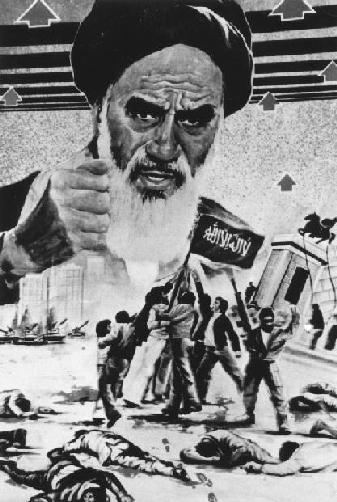
During the 444 days of the hostage crisis (1979-81), anti-American propaganda was often reflected in the graphic arts. The poster depicting an American Schweinhund, with dollar bills sticking out of his head and mouth, ears firmly locked, and a rolled copy of Playboy magazine in his pouch, is an embodiment of the “corrupter on earth” (mofsed fi’l-arż), in reference to a verse in the Qurʾān (Qurʾān 18:94; PLATE III; Chelkowski and Dabashi, pp. 158, 229).

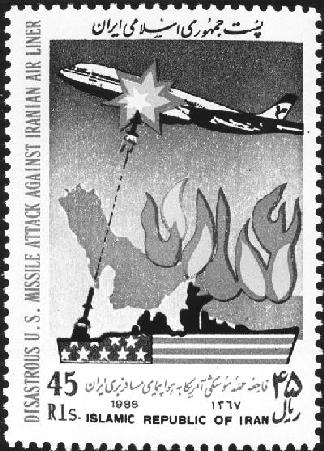
Anti-American feeling reached its height when in a catastrophic error of identification an American warship shot down a civilian Persian airliner. In the graphic layout of this postage stamp, the body of the warship is an American flag, and the map of the Persian Gulf in the background is in flames (PLATE IV)
However, what set off the real avalanche of graphic art in Persia was the “Imposed War” (Jang-e taḥmili) with Iraq (1980-88). During the eight years of the war, every graphic artist was drawn upon to contribute to the war effort and maintain the high morale of the combatants and of the population at large. Working in a myriad of military, government, and non-government studios, they produced some of the most heartfelt and arresting wartime graphics in contemporary history.
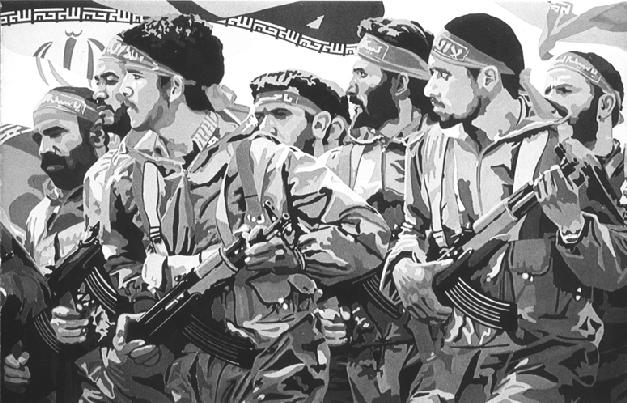
The photograph by Moḥammad Farnud, which appeared on the dust jacket of the multivolume series The Imposed War, was transformed by Aḥadyāri Rād into a 24 x 19 m tile mural in Tehran. The mural succeeds in its potent invocation of the heroism and chivalry of these advancing fighters. The mural was so popular that it was reproduced on postage stamps, as well as in countless books and magazines (PLATE V; Chelkowski and Dabashi, pp. 160-61).
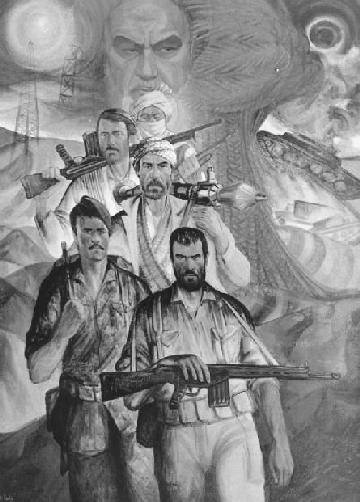
In another poster depicting the Persian fighters, the emphasis by the artist, Kāẓem Čalipā, is on the ethnic diversity of Iranians defending their country. The poster is called “The Guards of the Anemone Fields,” an allusion to the oilfields, whose rigs are seen in the background, under the watchful eyes of Ayatollah Khomeini (PLATE VI; Chelkowski and Dabashi, p. 159).
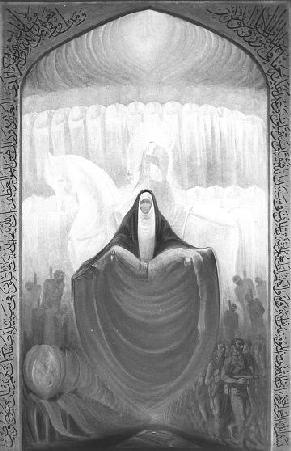
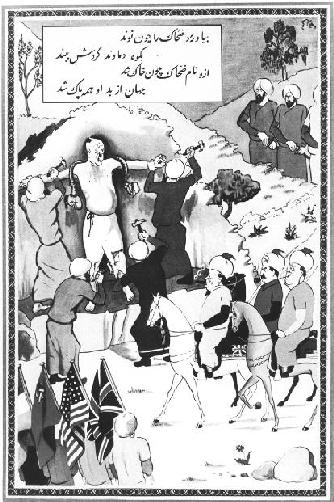
The protracted war with Iraq demanded much sacrifice, determination, steadfastness, from the people of Persia. In their murals, posters, illustrations, and cartoons, the graphic artists devoted themselves to mobilizing the nation and to comforting the bereaved. Another of Kāẓem Čalipā’s powerful murals, which he also made into a poster and a postage stamp, depicts “iṯār” (altruism): Under the shelter of a prayer niche stands a woman holding the dead body of a fallen hero in her arms. Her robes drape below his body like a red tulip, the symbol of selfless love and sacrifice. Behind her rises the army of white-shrouded martyrs of Karbalāʾ. The picture is framed around the three sides of the arch in three quotations from the Qurʾān: “God hath purchased of the believers their persons and their goods; for theirs is Paradise; they fight in his cause, and slay and are slain; a promise binding on Him in Truth, through the law, the Gospel, and the Qurʾān; and who is more faithful to his Covenant than God? . . .” (9:111); “To whomsoever fights in the cause of God, be he slain or be he victorious, on him shall We bestow a great award” (4:74) and “Truly God loves those who fight for His cause in battle array, as if they were a solid cemented structure” (61:4). There is an awesome harmony of color in this mural/poster of gold, white, and red (PLATE VII; Gudarzi, pp. 172-73). The tragic irony in this mural lies in the fact that these Qurʾānic battle cries are directed against another Muslim country, whose leader, Saddam Hossein, is commonly portrayed as Hitler; the inspiration for this came from the Allied depiction of the infamous arch-villain king Żaḥḥāk of the Šāh-nāma. Żaḥḥāk is ingeniously portrayed as Hitler by the French artist working for the Allied propaganda office, and the two serpents sprouting from his shoulders have the heads of General Tojo and Mussolini. Since this illustration quotes from the story of the defeat and capture of Żaḥḥāk in the Šāh-nāma, Żaḥḥāk/Hitler is shown as being shackled to Mount Damāvand in the style of a classical Persian miniature (PLATE VIII; Chelkowski, 1990b). In the poster dating from the war against Iraq, the artist stretches the grim face of Hitler down into the dour face of Saddam Hussein (Chelkowski and Dabashi, p. 164).
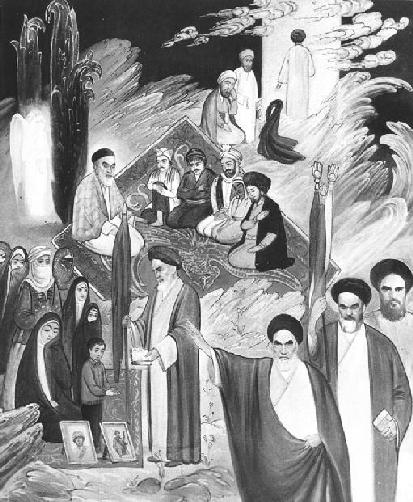
Another poster, in the style of a Persian miniature, narrates the life of Ayatollah Khomeini. In the lower right-hand corner, we see the Ayatollah progressing from young manhood to old age. In the lower left-hand corner the Ayatollah is comforting the families of the martyrs. In the center of the miniature he is host to representatives of the multi-ethnic Iranian nation. They all sit on a carpet into which is woven the figure of the legendary, Simorḡ, the icon of Persia’s mythic past with its mystical connotations. Lastly in the upper right-hand corner, the Ayatollah is seen departing this life, leaving behind his mantle. The movement, the colors, the arrangements of the figures, even the shape of the trees, rocks, and clouds have the quality of a classic Persian miniature (PLATE IX; Chelkowski and Dabashi, p. 174).
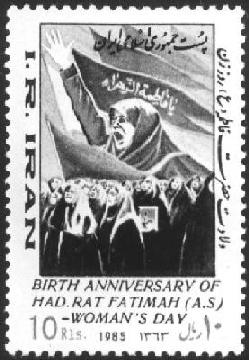
The depiction of women on posters was also closely related to war propaganda by recalling female martyrs. There are two special days devoted to women in the post-Revolution Persian calendar. One is the birthday of the Prophet Moḥammad’s daughter, Fāṭema Zahrā, which is observed as Mother’s Day (Ruz-e mādar). The other is the birthday of Zaynab, the granddaughter of the Prophet Moḥammad and the sister of Imam Ḥosayn, observed as Nurses’ Day (Ruz-e parastār). Both figures are projected as paragons of womanly virtue and fortitude (PLATES XA-Xb, below; Chelkowski and Dabashi, pp. 217, 253).
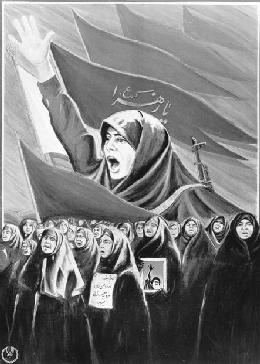
A postage stamp, issued in 1985, features a rally of women clad in black veils. (PLATE Xa) Above them hovers a vibrant figure, draped in a bright blood-red veil with her hand held high exhorting the rally. The palm of her hand is almost touching another palm atop the flagstaff, representing the five holy figures of Shiʿite Islam. The unfurled flags in green and white flying over the women add a dynamic forward thrust to the procession. On one of the green flags is inscribed “O Fāṭema al-Zahrā!” This design also appears in more detail on a poster (PLATE Xb; Chelkowski, 1987, pp. 556-66; Chelkowski and Dabashi, p. 217).
An almost aggressively stark portrait in support of the ḥejāb, the full covering for women, is this 20-rial postage stamp (PLATE XI; Chelkowski, 1987, pp. 556-66). The woman’s head, dead center in this stamp, is covered, but she is looking straight ahead, with the barrel of the machine gun on her back reinforcing the no-nonsense message.

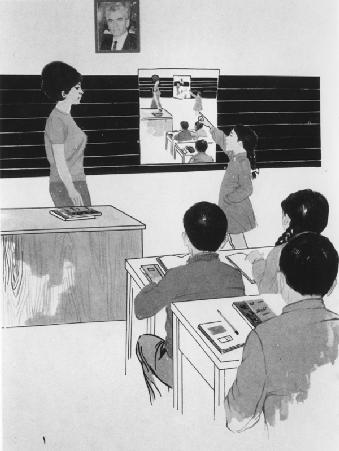
The debate on proper female attire is well illustrated graphically in the first-grade Persian readers. PLATE XIIa is the illustration of a first-grade classroom during the Pahlavi era, while PLATE XIIb shows a similar classroom in the Islamic Republic of Persia. The Pahlavi illustration shows boys and girls in the same class, with both the students and teacher in casual Western style dress, in a relaxed atmosphere. In the Islamic Republic picture, the classes are segregated according to gender, and the girls and their teacher are all wearing headgear and tunic-like dresses over long loose pants (Wezārat-e āmuzeš o parvareš, 1973 and 1993). However, both the pre-Revolutionary and post-Revolutionary textbooks testify to the skill and craftsmanship of Persian graphic artists. The Institute for the Intellectual Development of Children and Young Adults (Kānun-e parvareš-e fekri-e kudakān wa now-javānān) has won several international awards in the past.

The graphic design of banknotes during both the Pahlavi era and in the Islamic Republic are also striking in their detail as well as in the clarity of their message. The 10,000-rial banknote from the Islamic Republic depicts a political march with a few important religious symbols. The banknote was issued while Ayatollah Khomeini was still alive; therefore his image appears not directly but indirectly in the form of standards carried by the demonstrators. After Khomeini’s death, his portrait became a central feature on banknotes of every denomination, as well as on postage stamps (Chelkowski and Dabashi, pp. 194-211, 223-24).
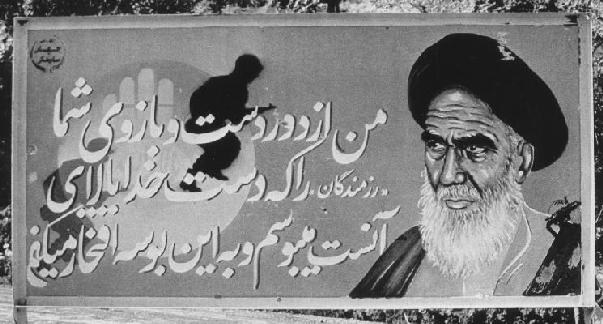
One of the most dramatic examples of using graphic arts as a weapon, a banner, and a rallying point for those at the front and along the supply lines was the Persian art produced during the Imposed War. The Office of Propaganda and Indoctrination (Wezārat-e tabliḡāt wa eršād) had branches at every level of the armed forces. Billboards large and small bearing slogans and graphic images were erected in unprecedented numbers all along the front lines, across the battlefields, along the supply routes, and in the rear. Such a proliferation of art in the field was feasible since, like World War I, this was largely trench warfare with little forward movement.
The text on this billboard reads: “From afar I kiss the arms and hands of you the combatants who are shielded by the Hand of God, and I take pride in this kiss” (PLATE XIII; Maḥmudi and Solaymāni, eds., p. 16; Chelkowski and Dabashi, pp. 282-91).
On the battlefront or back home, outside on a city street or within a public space, the art of persuasion has been an integral part of Persian life for the past twenty-five years.
Bibliography
Abu’l-Fażl ʿĀli, ed., Honar-e gerāfik dar Enqelāb-e eslāmi, Wāḥed-e entešārāt-e ḥawza-ye honari-e Sāzmān-e enqelāb-e eslāmi, Tehran, n.d.
Peter Chelkowski, “Stamps of Blood,” American Philatelist 101, no. 6, 1987, pp. 556-66.
Idem, “Khomeini’s Iran as Seen Through Bank Notes,” in David Menashri, ed., The Iranian Revolution and the Muslim World, Boulder, Col., 1990a, pp. 85-101.
Idem, “Šāh-nāma-ye Ferdowsi watablīyāt-e Engelis,” Irān-Šenāsi 2/2, 1990b, pp. 310-20.
Peter Chelkowski and Hamid Dabashi, Staging a Revolution: The Art of Persuasion in the Islamic Republic of Iran, New York, 1999.
Sayyid Mahdi Fahimi, Farhang-e jebha: Tābloneveshtahā, Tehran, 1369 Š./1990.
Moṣṭafā Gudarzi and Dāwud Ṣādeqsā, Dah sāl bā naqqāšān-e enqelāb-e eslāmi, 1357-1367/A Decade with the Graphists of the Islamic Revolution (1979-89), Ḥawza-ye honari-e tabliḡāt-e eslāmi, Tehran, 1368 Š./1989.
William L. Hanaway Jr., “The Symbolism of Persian Revolutionary Posters,” in Barry M. Rosen, ed., Iran Since the Revolution, Boulder, Col., 1985.
Ḥasan Moḥammadi and Ebrāhim Solaymāni, Jelwahā-i az honar-e enqelāb: majmuʿa-ye yakom manṭaq-e jangi, Kordestān, Bāḵtarān, Ilām,Ḵuzestān,Daftar-e tabliḡāt-e eslāmi-e Ḥawza-ye ʿelmi-e Qom, Qom, 1364 Š./1985.
Ṣedā wa simā-ye Jom-huri-ye eslāmi-e Irān, Ketāb-e gerāfik-e sāl-e 65-66, Tehran, 1366 Š./1987.
The Holy Qurʾān, tr. A. Yusof Ali, Riāż, 1403/1983.
War Information Headquarters, Supreme Defence Council, The Imposed War: Defence vs. Aggression, 5 vols., Tehran, 1987.
Wezārat-e āmuzeš o parvareš, Fārsi-e awwal-e dabestān, Tehran, 1352 Š./1973 and 1372 Š./1993.