



JĀM-E JAM in art.
The “Cup of Jam” (jām-e Jam), or the “cup that shows the world” (jām-e giti namāy), is a major theme in Persian literature (see JAMŠID ii. IN PERSIAN LITERATURE; see also the survey of this theme in Mortażavi, pp. 149-235). Surprisingly, when taking into account the further fortune of jām-e jam, Jamšid’s cup is not mentioned in Ferdowsi’s (q.v.) Šāh-nāma, the jām-e giti namāy being associated simply with Kay Ḵosrow (see KAYĀNIAN vii) in Ferdowsi’s epic. In the Šāh-nāma, only Jamšid’s ring is mentioned and credited with magic powers. Later authors, such as Neẓāmi, ʿAṭṭār, or Hafez (qq.v.), contributed to the making of the myth of the jām-e jam as “Jamšid’s cup.” The episodes related to this “magic” cup are rarely illustrated in Persian painting. However, some objects, mainly ceramics, could make reference to it.
The cup of turquoise (jām-e firuza) or “cup of good fortune.” The drinking cup is often associated with different shades of blue and particularly turquoise color; turquoise is indeed a favorite hue in Persian ceramic, at least from the Saljuq period onwards (Zick-Nissen, p. 181). Turquoise color (firuzaʾi) is also associated with good fortune and victory (firuz, firuzi; the same association occurs with the throne, taḵt-e firuza ‘throne of turquoise/good fortune’; see for instance Ḵᵛāju Kermāni, p. 15). Abu Rayḥān Biruni (q.v.; d. 1048) mentions a “dinner set” made of turquoise that once belonged to Mardāvij b. Ziyār and to his brother Vošmgir, although Biruni asserts that it could be a series of gold vessels known as “Firuzji” (i.e., of good fortune; Biruni, pp. 148-49). The same author describes a wine cup made for the Samanid amir Nuḥ b. Manṣur (q.v.; r. 976-97) that was made of a solid turquoise and contained up to three ratls of wine (Biruni, p. 149).
The turquoise cup is the inverted image of the sky (gonbad-e firuzi); as emphasized by A. S. Mélikian-Chirvani (pp. 102-9), the theme of wine assimilated to solar light is a favorite topic in Persian poetry. Thus, it could be added that the blue color of the cup is a metaphor for the sky, from which the sun/wine emerges. The association between the cup and the sky is also to be found in Hafez (tr. Fouchécour, ḡazal 136, p. 428: gonbad-e minā). In Hafez, we find also mention of a sāḡar-e mināʾi (a cup of mināʾi color; or made of minā; Mortażavi, p. 189; tr. Fouchécour, ḡazal 484, pp. 1174-75).
It must be added that poets often vacillate between different hues of blue and green in their description of the color of the sky (gonbad-e aḵżar ‘green cupola’ or gonbad-e kabud ‘blue cupola’; both expressions occur also in architecture to denote, for example, in the case of green, the caliphal palaces in Damascus and Baghdad, and in the case of blue, a tomb-tower in Marāḡa). This chromatic variation is also to be seen in ceramic objects, their shades varying from greenish to deep cobalt blue.
Very often, the “turquoise” cup is associated with drinking wine, the invention of this drink being also related to the king Jamšid according to Ferdowsi’s Šāh-nāma; on the contrary, drinking cups are seldom colored in red, not only because of the technological difficulty in obtaining a red-colored glaze (however, manganese oxide can easily provide an aubergine color), but probably also because of the chromatic redundancy between container and liquid.
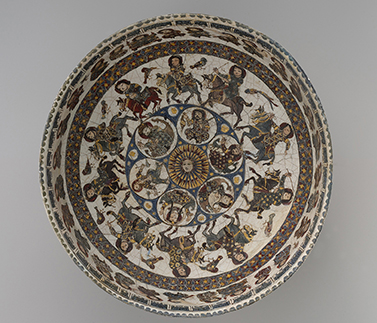
Plate I. Ceramic bowl decorated with figures of the sun surrounded by Mars, Mercury, Venus, the moon, Saturn, and Jupiter. Central or northern Iran, late 12th-early 13th century. 9.5 cm. h. x 18.7 cm diam. The Metropolitan Museum of Art no. 57.36.4. Purchase, Rogers Fund, and Gift of The Schiff Foundation, 1957. Open access image in the public domain.
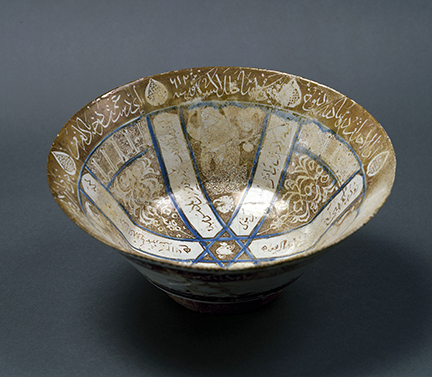
Plate II. Ceramic bowl inscribed with Persian and Arabic verses. Kashan, dated Ḏu’l-Qaʿda 612/February-March 1215. 10 cm h. x 22.4 cm. (top) diameter (top), 9.3 cm (base) diameter. Musée du Louvre, Départment des Arts de l’Islam, MAO 526. Photograph Etienne Revault © RMN-Grand Palais / Art Resource, N.Y..
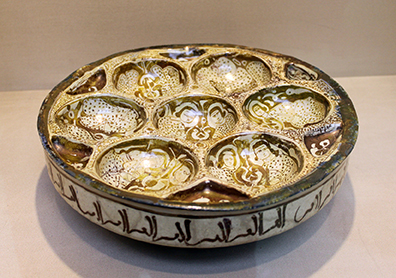
Plate III. Plate with seven inset bowls or cavities, Gorgān, 12th-13th century. Muza-ye Ābgina, Tehran, no. 83 S. Image used under CC Attribution-Share Alike 4.0 International.
Examples of ceramic cups with a turquoise glaze anterior to the 12th century are quite rare, the main reason being technical: The turquoise shade is obtained with copper oxide in an alkaline glaze; if the glaze is lead-based, the shade obtained is green. The alkaline glazes probably appeared only in the second half of the 11th century, together with the stone paste; thus, ceramic objects painted with this kind of glaze are mainly dated after 1050.
This is not the case with glass or vitreous objects. An exceptional piece is the turquoise cup preserved in the Treasure of St. Mark’s, Venice. This cup, made of a vitreous paste (called minā in Persian sources), is engraved with the name of the province “Khorasan” and probably dates from the 10th century (Carboni and Whitehouse, pp. 176-78); blue glass cups dating from the 10th-11th centuries, either transparent or opaque, in shades varying from cobalt to greenish, exist in various collections (Carboni and Whitehouse, p. 86, for instance). There are also literary references to turquoise cups: Zakariā b. Moḥammad Qazvini (d. ca. 1284), quoting Ebn al-Aṯir (q.v.; d. 1233), says that the Saljuq sultan Alp Arslān (q.v.) found a turquoise cup inscribed with the name of Jamšid after besieging Eṣṭaḵr (q.v.), and a similar anecdote is provided by Rašid-al-Din (see Zick-Nissen, p. 183 and n. 21).
Abu’l-Qāsem ʿAbd-Allāh Kāšāni, in his ʿArāʾes al-jawāher wa nafāʾes al-aṭāʾeb (pp. 74-75; see JAWĀHER-NĀMA), mentions this anecdote: The cup (qadaḥ) offered to Alp Arslān was made of Abu Esḥāqi turquoise (i.e., “first rate”; the name of this kind of turquoise is also mentioned, with a play of words, by Hafez, see tr. Fouchécour, ḡazal 203, p. 565); Abu’l-Qāsem Kāšāni (p. 75) adds that, in the same city of Eṣṭaḵr, a cup with a capacity of ten man was found and presented to the caliph ʿOmar who broke it to pieces (the material of this cup is not specified). Abu’l-Qāsem Kāšāni (pp. 71-72), following Moḥammad Jawhari Nišāpuri, also gives the recipe for imitating turquoise in the form of minā (Porter, p. 351).
The cup of the seven planets. Jamšid’s cup, or, in the Šāh-nāma, Kay Ḵosrow’s cup, are often related to number seven (HAFT): The seven climes (haft eqlim), or seven regions (HAFT KEŠVAR), and seven planets (haft owrang) are often mentioned by Ferdowsi and ʿAṭṭār, for example in relation with the magic cup that “shows the world.” In the Šāh-nāma, the cup appears in the story of Bižan (q.v.) and Maniža: On the day of Nowruz (q.v.), Kay Ḵosrow looks into the cup, and the seven planets (see PLANETS) are evoked (in this order: Kayvān, Bahrām, Hormoz, Šir, Nāhid, Tir, Māh; Ferdowsi, III, p. 174). According to Zoroastrian belief, the “seven planets” respond to the seven divinities governing them (Huyse, pp. 136-37), and, of course, to the days of the week (see Neẓāmi, Haft Peykar [q.v.]).
Indeed, ceramic cups decorated with six roundels turning around a central one are quite frequent since proto-historic times. The decoration can be very elementary, as in some cups coming from Susa (9th-10th centuries) preserved in the Louvre Museum (MAO S.36 and 439). In this case, it is not clear if the decoration is intended to carry a symbolical charge. The decoration can also be more sophisticated, as is the case in some ceramics decorated with the figures of the seven planets (The Metropolitan Museum of Art no. 57.36.4; PLATE I) or with a hexagram or Solomon’s seal (ḵātam-e solaymān; lustre painted cup, Louvre MAO 526; PLATE II). It should be remembered that the figures of Jamšid and Solomon are often mixed in medieval historiographies (see JAMŠID ii. IN PERSIAN LITERATURE), the cup of the former and the ring of the latter being also a matter of confusion (on this topic, see also Mortażavi, pp. 207-35, in which connections are made not only between Jamšid, Kay Ḵosrow, and Solomon, but also with Alexander and Ḵeżr [qq.v.]).
The author of Farhang-e Neẓām, Sayyed Moḥammad-ʿAli Dāʿi-al-Eslām (q.v.), says, concerning the jām-e jam, that Jamšid had this cup made for him, and it had seven “lines” (haft ḵaṭṭ). The description in Moḥammad Ḡiāṯ-al-Din Rāmpuri’s Ḡiāṯ al-loḡāt (q.v.) is even more precise, although the cup is there credited to Kay Ḵosrow: The cup had geometric lines (ḵoṭṭuṭ-e hendesi), circles, and numbers and could thus be used as an astrolabe (both texts cited in Mortażavi, pp. 169-70).
This relation between the cup and the stars probably comes from Neẓāmi, when he compared the cup to an astrolabe (Neẓāmi, pp. 1034-35). The cup described in the Šaraf-nāma (see ESKANDAR-NĀMA OF NEẒĀMI) is covered with inscriptions that Bālinās (Apollonius of Tyana) reads to Eskandar (Neẓāmi, p. 1035). The same idea is further used by Hafez (tr. Fouchécour, ḡazal 48, p. 257, for instance); and the cup presented to Alp Arslān referred to above was also decorated with an inscription. Ceramic cups are sometimes decorated with inscriptions (Berlin, Museum für Islamische Kunst I.2015, reproduced in Zick-Nissen, pl. 172); however, there does not seem to be any example mentioning the names of the stars, the epigraphy being more often a series of benedictions and blessings to the owner.
Another reference to the king Jamšid could come from a series of cups, or rather plates, made in the shape of a tray containing seven cavities (PLATE III); these trays could be related to the Nowruz festival, even if the haft-sin (q.v.) – in the present form – are probably of recent apparition. Indeed, the Saljuqs, following Malekšāh’s (q.v.; r. 1072-92) reform of the calendar (q.v.), contributed to the revival of the Iranian festival of the New Year (Zick-Nissen, p. 184). Some of these trays are decorated with lustre painting (Tehran, Muza-ye ābgina, no. 83 S), while others are painted with a plain blue glaze (Karimi and Kiāni, pp. 172-73).
Bibliography
Abu’l-Rayḥān Biruni, Kitāb al-jamāhir fī maʿrifat al-jawāhir, tr. Hakim Mohammad Said, as The Book Most Comprehensive in Knowledge on Precious Stones, Islamabad, 1989.
Stefano Carboni and David Whitehouse, Glass of the Sultans, New York, 2001.
Abu’l-Qāsem Ferdowsi, Šāh-nāma, ed. and tr. Jules Mohl, 7 vols., Paris, 1838-78; repr., Tehran, 1966 (8 vols.).
[Hafez] Hâfez de Chiraz, Le Divân: oeuvre lyrique d’un spirituel en Perse au XIVe siècle, tr. Charles-Henri de Fouchécour, Paris, 2006.
Philip Huyse, La Perse antique, Paris, 2005.
Maḥmud b. ʿAli Ḵᵛāju Kermāni, Homāy va Homāyun, ed. Kamāl ʿAyni, Tehran, 1991.
Abu’l-Qāsem ʿAbd-Allāh Kāšāni, ‘Arāʾes al-jawāher wa nafāʾes al-aṭāʾeb, ed. Iraj Afšār, Tehran, 1966.
Fatema Karimi and Moḥammad-Yusof Kiāni, Honar-e sofālgari-ye dawra-ye eslāmi-e Irān, Tehran, 1985.
Assadullah Souren Mélikian-Chirvani, “The Wine-Bull and the Magian Master,” in Philippe Gignoux, ed., Recurrent Patterns in Iranian Religions: From Mazdaism to Sufism, Cahiers de Studia Iranica 11, Paris, 1992, pp. 101-34.
Manučehr Mortażavi, Maktab-e Ḥāfeẓ, yā moqaddama bar Ḥāfeẓ-šenāsi, Tehran, 1965; 3rd ed. 1991.
Elyās b. Yusof Neẓāmi Ganjavi, Kolliyāt-e Ḵamsa, ed., Vahid-e Dastgerdi, Tehran, 1998.
Yves Porter, “Le quatrième chapitre du Javāher-nāme-ye Neẓāmi,” in N. Pourjavady and Z. Vesel, eds., Sciences, techniques et instruments dans le monde iranien (Xe-XIXe siècle), Tehran, 2004, pp. 341-61.
Johanna Zick-Nissen, “The Turquoise ‘Jām’ of King ‘Jamshid’,” in Robert Hillenbrand, ed., The Art of the Saljūqs in Iran and Anatolia: Proceedings of a Symposium Held in Edinburgh in 1982, Costa Mesa, Calif., 1994, pp. 181-91.