



KINDYKTEPA, an archeological site in the Bandy-Khan (Bandixon) oasis along the Surxondaryo (Pers. Sorḵān Daryā), the right tributary of the Āmū Daryā (q.v.), in the south of modern Uzbekistan (lat. 37° 51´ 12″ N, long. 67° 21´ 44″ E). Kindyktepa preserves the remains of a fire sanctuary that archeologists date from the late Achaemenid period (Rtveladze, 1975; Shaydullaev; Stride; Boroffka; Mokroborodov, 2015a) and the military campaign of Alexander the Great (q.v.) in Central Asia (Grenet and Rapin; Pugachenkova and Rtveladze; Sverchkov, 2013; Rapin and Khasanov).
After a long period of neglect, the first seasons of archeological research in Bandy-Khan, led by Galina A. Pugachenkova, started in the 1970s. The excavation of the site was associated with the early works of the Uzbek Study-of-Art Expedition (UzIskE), working in the Surxondaryo district of Uzbekistan from 1960. The reports on the archeological data for Early Iron Age objects were soon published (see Rtveladze, 1976; 2007; Sagdullaev, 1978), but information on a smaller scale excavation carried out in 1984 at Kindyktepa remained unpublished for a long time (a brief field report was published only after the recommencement of the excavations in Bandy-Khan [Sagdullaev, 2005]; according to this publication exploratory excavations of Kindyktepa at that point gave different results to those presented below).
Large-scale excavations in Bandy-Khan and surrounding areas were conducted since the early 2000s by the expedition of the German Archeological Institute (DAI) and the Institute for Art Studies of Uzbekistan, led by Nikolaus Boroffka and Leonid M. Sverchkov, along with studies of other archaeological objects (Sverchkov and Boroffka, 2006; Mokroborodov, 2010; Sverchkov, Wu Xin and Boroffka; Sverchkov, 2013) and included a complete excavation of Kindyktepa (2005-10) (Mokroborodov, 2018; for preliminary publications see Sverchkov and Boroffka, 2007; Boroffka, 2009).
Kindyktepa is located on the outskirts of the dispersed settlement of Bandy-Khan II (more than 12 hectares), 300 m northwest from its fortified center (Bektepa fortress). The ensemble of cultural layers filling the monumental building is up to 4.6 meters thick. The powerful walls (external perimeter walls are up to 2.5 m thick) were built from mud-bricks (45-52 × 28-34 × 10-12 cm). Based on the stratigraphy, the site is divided into four closely successive stages: (1) the preparation of the surface, the construction of the building and its occupation (floor 1); (2) renovation and minor architectural redevelopment (floor 2); (3) partial destruction and filling of the rooms (especially the central one) by bricks and clay and the use of the complex as a residential building (floor 3); and (4) episodic settlements on the premises. At a later stage, the site was abandoned.
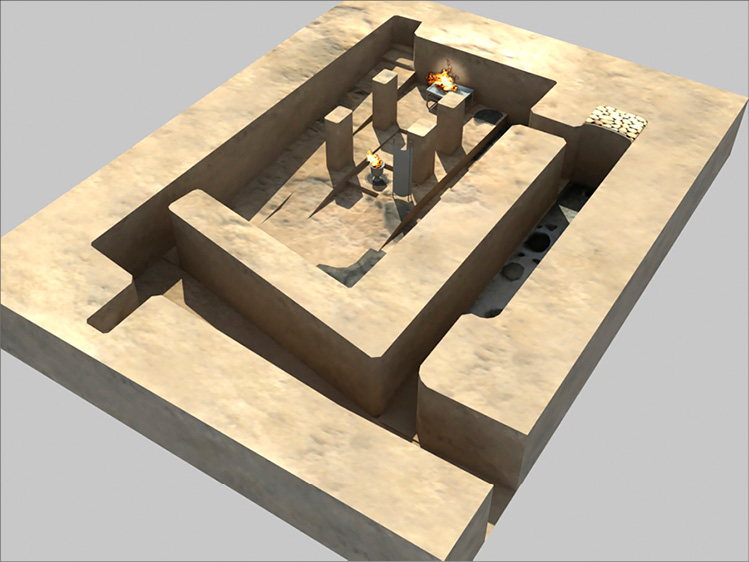
The overall dimensions of the building were 18 × 22.5 m. The complex consisted of three interdependent parts: an entrance at the north-east led through a corridor to a large rectangular room (8.5 × 14 m), whose center was occupied by a fireplace bordered by four columns, interpreted as an altar, and two narrow rooms (the eastern room measures 2.7 × 14 m on the first floor and 2.1 × 22.5 m on the second floor, and the southern room measures 2 × 12.5 m). The building was entered from the southeast.
Architectural characteristics of the first two stages of the building’s use include a narrow ramp along the south-west wall in the central room; a П-shaped podium with two ledges that run smoothly into the floor, which is burnt on a 1 m2 area between the ledges of the podium; and a square, wattle-and-daub, stage (1.6 × 1.6 m), also burnt. In the same area, during stage 2, there are four massive mud-brick columns located asymmetrically (0.65 × 1 m at the base each), with layers of ash on the floors and the podium. The southern room contains a large two-level niche, a small burnt circular-shaped podium, and a shallow box-shaped cist, paved with bricks, containing animal bones and covered with sand (podium and box are present only on Floor 1). The eastern room has a decorated entrance, pylon, and eight (possibly nine along Floor 1) round or oval pits (0.4-1.1 m deep; Figure 1), filled respectively with white sand, pottery, slag, water, ashes, and charcoal. The stage 3 plan included a monumental building with columns in the central hall but no other sophisticated features, pits outside the outer wall for dumping rubbish, large ceramic vessels dug into the floors, and other signs of residential architecture.
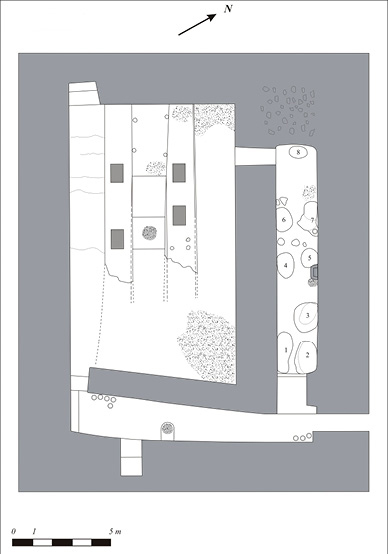
The main characteristics of the building, namely the careful preparation of the site for a relatively independent building, the monumentality of the complex, a cella with columns and an altar, a central room “isolated” by the corridors, a 3-part structure, niches in the walls, and the special treatment of ashes are considered to be inherent to the temples of fire worshipers (cf. Litvinskiĭ and Pichikyan; Rapin, 1994; Rapin, 2017; Shenkar), practicing the Mazdean circle cult.
The architectural features, as well as the locations of fire altars (q.v.) out of sight from the entrances and exits, directly outlined by a corridor-like in the eastern, narrow, rectangular room with the “labyrinth” of pits (Mokroborodov, 2018, p. 346), give rise to the possibility that the building was a cultic structure and may have served as a place for the performance of a purification ritual, that of the nine pits mentioned in the ninth chapter of the Widēwdād (for the ritual, see BARAŠNOM; for analogies of the ritual, see Mokroborodov, 2015b).
There are multiple similarities to the general profile of Kindyktepa and the nearby synchronic sanctuary of Kyzyltepa (q.v.; Sverchkov and Wu Xin). In the absence of direct parallels with the recognized fire temples of the center of the Iranian world (cf. Shippmann), a preliminary conclusion can be drawn that these buildings form a separate regional type of this category of sacred buildings.
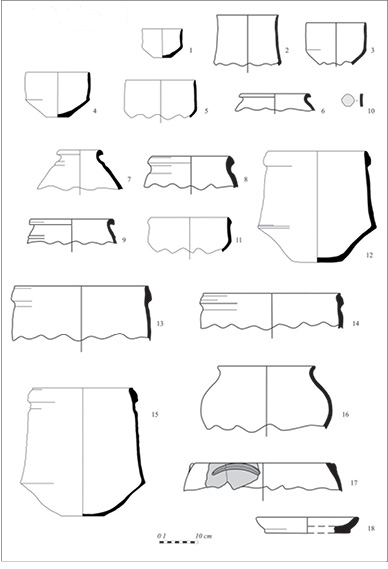
The finds discovered in Kindyktepa include fragments (a total number of 5,368) of ceramic vessels, stone grain grinders and mortars, and occasional metal objects (Figure 2). The analysis of these materials, primarily of the ceramics, makes it possible to attribute this site to the Central Asian archeological complexes of the Early Iron Age of the Yaz III type (Masson, pp. 41, 208-9; Boroffka), dating now within the 6th-4th centuries BCE. Other evidence, such as the ceramic fragments from layers of stages 3 to 4 that can be indirectly identified as Hellenistic, a relatively large proportion of ceramics made without a potter’s wheel, and a brick size that seems to be between that of the massive rectangular one (typical of the Achaemenid period) and the Early Antique large, square brick, can allow us to assign Kindyktepa to the period between the Achaemenid and Early Antique eras in the history of Central Asia (Mokroborodov, 2018, pp. 346-49).
Additional support for dating this archeological site to the end of the 5th – 4th centuries BCE is the context of historical events. In the author’s opinion, it is unlikely that this building was constructed prior to the “daiva inscription” (see DAIVADANA) of Xerxes in the 480s BCE; it is also unlikely that the destruction, the filling of the inner part of the building, and the deliberate change of the sanctuary’s function (the end of the 2nd to 3rd stage of the building’s functioning), was not associated with actions of intruders of a different faith (moreover, evidence of such actions on the described site is not isolated)—for the period under review, these would have been the troops of Alexander the Great, who conducted an extremely difficult campaign in the region in 329-327 BCE.
Kindyktepa (Figure 3) is one of the earliest known, fully excavated, structures in Inner Asia that preserves evidence of a fire cult connected to the Achaemenid era. It may reflect regional variations that were part of a wider Eastern Iranian cultic tradition.
Bibliography
N. Boroffka, “Siedlungsgeschichte in Nordbaktrien: Bandichan zwischen Spätbronzezeit und Frühmittelalter,” in S. Hansen, A. Wieczorek, and M. Tellenbach, eds., Alexander der Grosse und die Öffnung der Welt: Asiens Kulturen im Wandel, Mannheim, 2009, pp. 135-43.
F. Grenet and С. Rapin, “Alexander, Aï Khanum, Termez: Remarks on the Spring Campaign of 328,” Bulletin of the Asia Institute NS 12, 1998 [2001], pp. 79-89.
B. A. Litvinskiĭ and I. R. Pichikian, Ellinisticheskiĭ khram Oksa v Baktrii (Yuznyĭ Tadzhikistan) I: Raskopki, arkhitektura, religioznaya zhizn’ (The Hellenistic Temple of the Oxus in Bactria [South Tajikistan] I: Excavations, architecture, religious life), Moscow, 2000.
V. M. Masson, Drevnezemledel’cheskaya kultura Margiany (The early agricultural culture of Margiana), Materialy i issledovaniya po archeologii SSSR 73, Moscow, 1959.
V. V. Mokroborodov, “Raskopki pamyatnikov serediny I tysyacheletiya do n.e. v Bandykhane” (Excavations of monuments of the mid-1st millenium BCE in Bandy-Khan) in Traditsii drevneĭ i srednevekovoĭ gorodskoĭ kul’tury Sredneĭ Azii, Tashkent, 2010, pp. 105-12.
Idem, “Istoriya i osnovnyye problemy arkheologicheskogo izucheniya Sredneĭ Azii ‘Akhemenidskogo’ vremeni (na primere territoriĭ yuga sovremennogo Uzbekistana)” (History and main problems of the archeological study of Central Asia in Achaemenid times [the example of territories in the south of modern Uzbekistan]), Problemy istorii, filologii, kul’tury 47, 2015a, pp. 99-123.
Idem, “Novye arheologicheskie svidetel’stva ob odnom iz zoroastriĭskikh obryadov” (New archeological evidence about one of the Zoroastrian rites), in A. V. Omel’chenko and D. K. Mirzaakhmedov, eds., Bukharskiĭ oazis i ego sosedi v drevnosti i v Srednevekov’e: na osnove materialov nauchnykh konferentsiĭ 2010 i 2011 gg., Trudy gosudarstvennogo Ėrmitazha 75, St. Petersburg, 2015b, pp. 13-22.
Idem, “Kindyktepa: A Temple of the Mid-first Millennium BC in Southern Uzbekistan,” in J. Lhuillier and N. Boroffka, eds., A Millennium of History: The Iron Age in Southern Central Asia (2nd and 1st millennia BC). Proceedings of the Conference Held in Berlin (June 23-25, 2014). Dedicated to the Memory of Viktor Ivanovich Sarianidi, Archäologie in Iran und Turan 17/Mémoires de la Délegation archéologique Française en Afghanistan 35, Berlin, 2018, pp. 343-53.
G. A. Pugachenkova and E. V. Rtveladze, Severnaya Baktriya – Tokharistan: ocherki istorii i kul’tury: drevnost’ i srednevekov’e (Northern Bactria – Tokharistan: essays on history and culture, antiquity and the Middle Ages), Tashkent, 1990.
C. Rapin, “Svyatilishcha sredneĭ Azii v epokhu ellinizma (sostoyaniye voprosa)” (Sanctuaries of Central Asia during the Hellenistic era [the state of the question]) Vestnik drevneĭ istorii 4, 1994, pp. 128-40. Idem, “Sanctuaires sogdiens et cultes avestiques de l’époque de Gava à l’époque hellénistique,” in W.F.M. Henkelman and C. Redard, eds., Persian Religion in the Achaemenid Period / La religion perse à l’époque achéménide, Wiesbaden, 2017, pp. 417-60.
C. Rapin and M. Khasanov, “Les traditions architecturales de l’époque acheménide à l’époque hellénistique: récentes découvertes en Sogdiane,” in M. Espagne, S. Gorshenina, F. Grenet, S. Mustafayev and C. Rapin, eds., Asie centrale: transferts culturels le long de la route de la soie, Paris, 2016, pp. 61-95.
E. V. Rtveladze, “K Kharakteristike pamyatnikov Surkhandary’inskoy oblasti akhemenidskogo vremeni” (On the characteristics of the monuments of the Surkhandarya region of the Achaemenid period), Sovetskaya Arkheologiya 2, 1975, pp. 262-66.
Idem, “Novye drevnebaktriĭskiye pamyatniki na yuge Uzbekistana” (New ancient-Bactrian monuments in the south of Uzbekistan), in Baktriĭskiye drevnosti:predvaritel’noye soobshcheniye ob arkheologicheskikh rabotakh na yuge Uzbekistana, Leningrad, 1976, pp. 93-103.
Idem, “Arkheologicheskiye issledovaniya v Bandykhane v 1974-75 gg,” in Trudy Baĭsunskoĭ nauchnoĭ ekspeditsii: istoriya i etnografiya III, Tashkent, 2007, pp. 67-95.
A.S. Sagdullaev, “Drevnezemledel’cheskie poseleniya predgoriĭ Baĭsuntau” (Ancient agricultural settlements in the Baysuntau foothills) in O.V. Obelchenko, D. M.Ovezov, and T. Khozhaniyazov, eds., Istoriya i arkheologiya Sredneĭ Azii, Ashgabat, 1978, pp. 30-36.
Idem, “O rabotakh na polelenii Bandykhan II i raskopkakh kurgana no. 1 mogil’nika Saryband” (Survey of Bandykhan II settlement and excavation at mound no. 1 of Saryband burial ground,”in Trudy Baĭsunskoĭ nauchnoĭ ekspeditsii: istoriya i etnografiya II, Tashkent, 2005, pp. 305-6.
K. Schippmann, Die Iranischen Feuerheiligtümer, Religionsgeschichtliche Versuche und Vorarbeiten 31, Berlin and New York, 1971.
Sh. B. Shaydullaev, Severnaya Baktriya v epokhu rannego zheleznogo veka (Northern Bactria during the Early Iron Age), Tashkent, 2000.
M. Shenkar, “Temple Architecture in the Iranian World before the Macedonian Conquest,” Iran and the Caucasus 11/2, 2007, pp. 169-94.
S. Stride, “Géographie archéologique de la province du Surkhan Darya (Ouzbékistan du sud / Bactriane du nord),” Ph.D. diss., Université de Paris 1, vols. I-V, 2005.
L. M. Sverchkov, Kurganzol – krepost’ Aleksandra na yuge Uzbekistana (Kurganzol: Alexander’s fortress in the south of Uzbekistan), Tashkent, 2013.
L. M. Sverchkov and N. Boroffka, “Pamyatniki Bandykhana” (Monuments of Bandykhan), Arkheologicheskiye issledovaniya v Uzbekistane 2004-2005 gody 5, Tashkent, 2006, pp. 193-203.
Idem, “Arkheologicheskie issledovaniya v Bandykhane v 2005 g” (Archeological research in Bandykhan in 2005), in Trudy Baĭsunskoĭ nauchnoĭ ekspeditsii: istoriya i etnografiya III, Tashkent, 2007, pp. 97-132.
L. M. Sverchkov, Wu Xin, and N. Boroffka, “Gorodishche Kizyltepa (VI-IV vv. do n.e.): novye dannye,” (The site of Kyzyltepa [6th-4th centuries BCE]: new data), Scripta antiqua: Voprosy drevney istorii, filologii, iskusstva i material’noy kul’tury 3, 2014, pp. 31-74.
L.M. Sverchkov and Wu Xin, “Khram ognya V-IV vv. do n.e. Kizyltepa” (Fire temple of 5th-4th centuries BCE, Kyzyltepa), Scripta Antiqua: Voprosy drevneĭ istorii, filologii, iskusstva i material’noy kul’tury 8, 2019, pp. 96-128.