



LITHOGRAPHY (Pers. čāp-e sangi, planographic printmaking technique, invented by Alois Senefelder (b. Prague, 1771; d. Munich, 1834) at the end of the 18th century and introduced to Persia through Russia in the early decades of the 19th century.
LITHOGRAPHY i. IN PERSIA
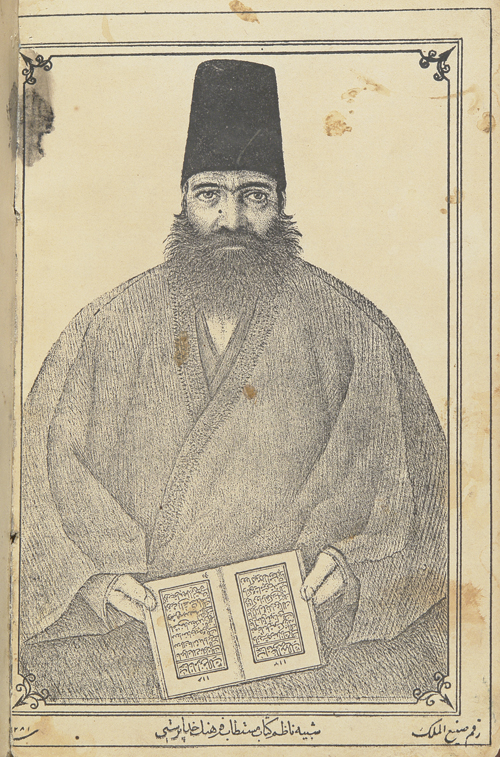
FIGURE 1. Portrait of Mirzā ʿAbd-al-Wahhāb Maḵram Lesān-al-Molk by Ṣaniʿ-al-Molk. Farhang-e ḵodā-parasti, Tehran, State Printing House, 1281/1864.
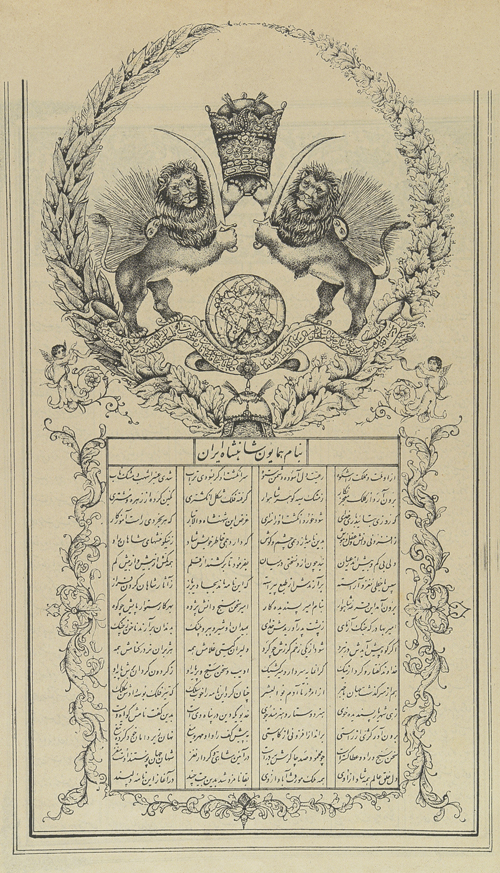
FIGURE 2. First page of the Šāh-nāma of Ferdowsi with a head-piece (ʿonwān); Tehran, printing house of Āqā Mortaża, 1319-22/1901-5; edition initiated by Amir Bahādor Ḥosayn-Pāšā Khan; text prepared by Mubad ʿAbd-al-ʿAli Kāšāni; foreword by Moḥammad-Ṣādeq al-Ḥosayni Farāhāni; painters: Moṣawwer-al-Molk, Moḥammad-Kāẓem, Ḥosayn-ʿAli, ʿAliḵān; lithographers Mirzā Ḥosayn and Āqā Mirzā ʿAbbāsi; copyist Moḥammad-Ḥosayn ʿEmād-al-Kottāb.
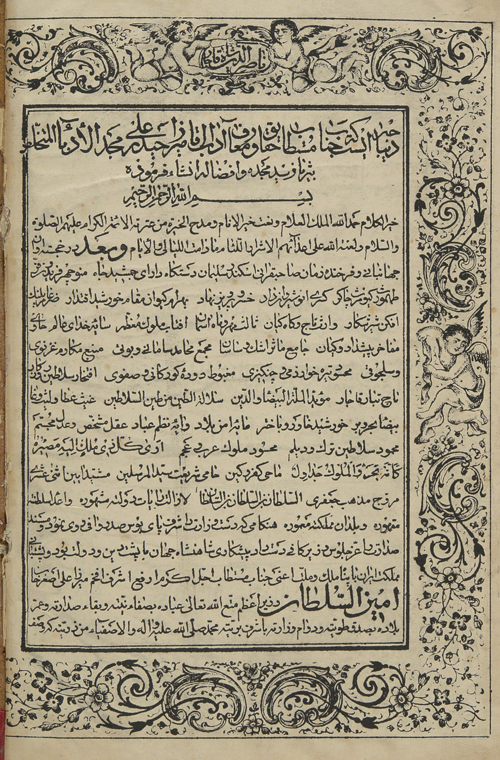
FIGURE 3. The title page of the Dāstān-e Amir Ḥamza; Bombay, late 19th-early 20th century, published by Mirzā Moḥammad Malek-al-kottāb Širāzi.
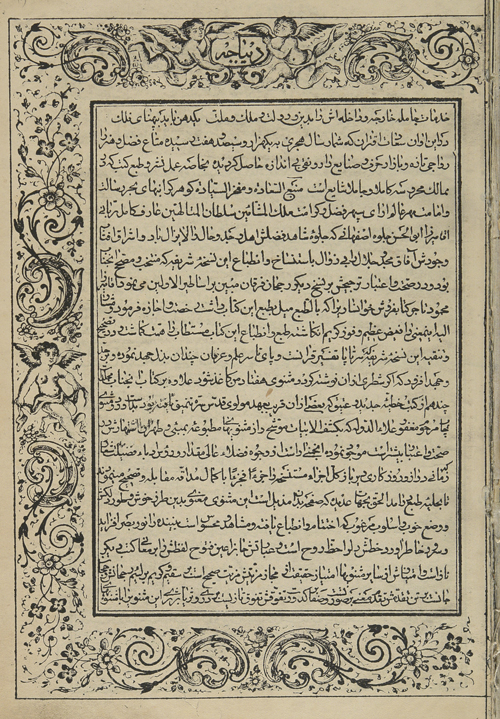
FIGURE 4. The title page of the Maṯnawi-e maʿnawi of Jalāl-al-Din Rumi; Bombay, “Ḥeydari” printing house, 1292-94/1875-77.
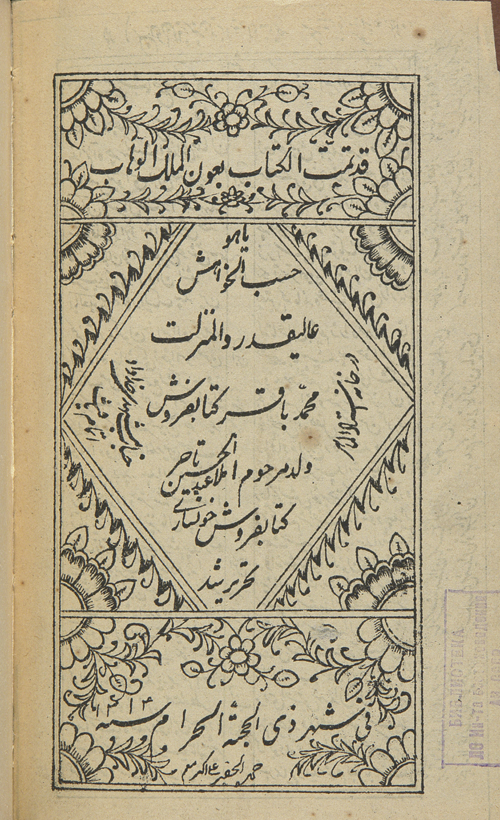
FIGURE 5. The head-piece (ʿonwān) and the first page of the Maṯnawi-e maʿnawi of Jalāl-al-Din Rumi; Bombay, “Ḥeydari” printing house, 1292-94/1875-77.
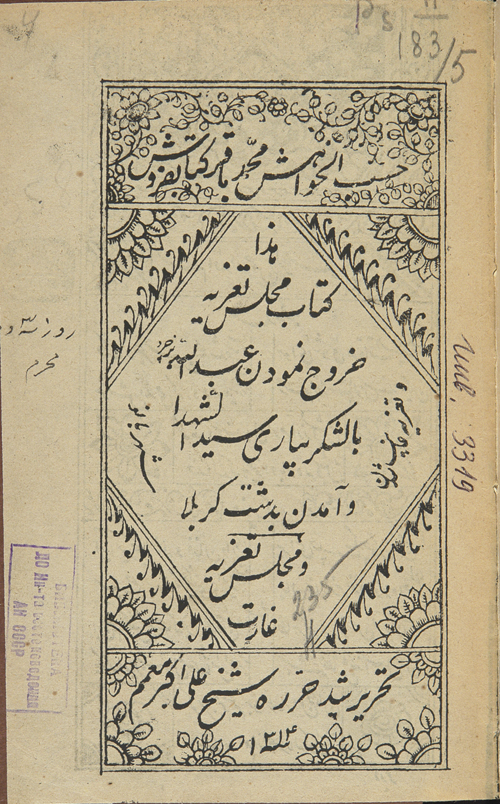
FIGURE 6. Corrigenda for the Sekandar-nāma of Neẓāmi Ganjavi; Lucknow, “Ḥosayni” printing house of Mir Ḥasan Rażawi, 1843.
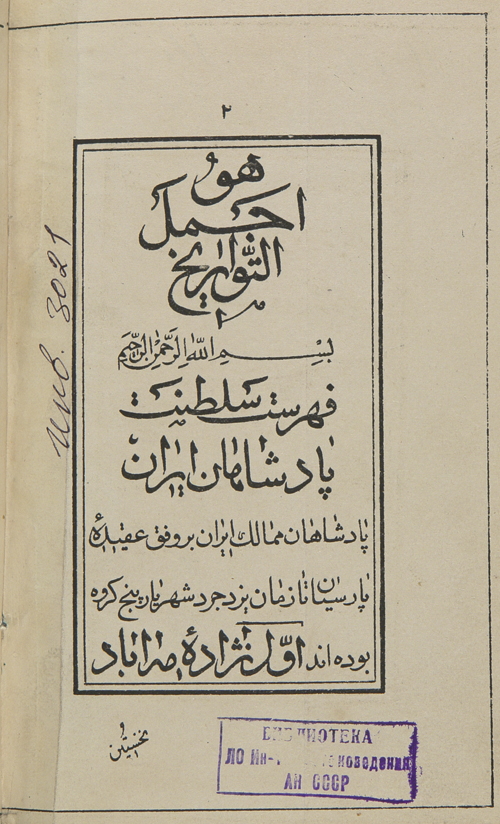
FIGURE 7. Title page of the Ajmal al-tawāriḵ of Reżā-qoli Khan Hedāyat, published together with the ʿEšq-nāma and ḡazals of Asad-Allāh Khan Ḡāleb; Tabriz, printing house of Āqā Reżāʾ, 1283/1866. Copyist Moḥammad-ʿAli Tabrizi; publisher Karbalāʾi Moḥammad-Ḥosayn.
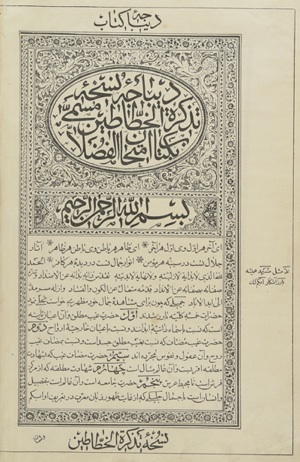
FIGURE 8. First page of the first volume of the Taḏkerat al-ḵaṭṭāṭin or Emteḥān al-fożalaʾ of Mirzā Sanglāḵ Dowrān; Tabriz, printing house of Karbalāʾi Asad Āqā, 1291-95/1874-78.
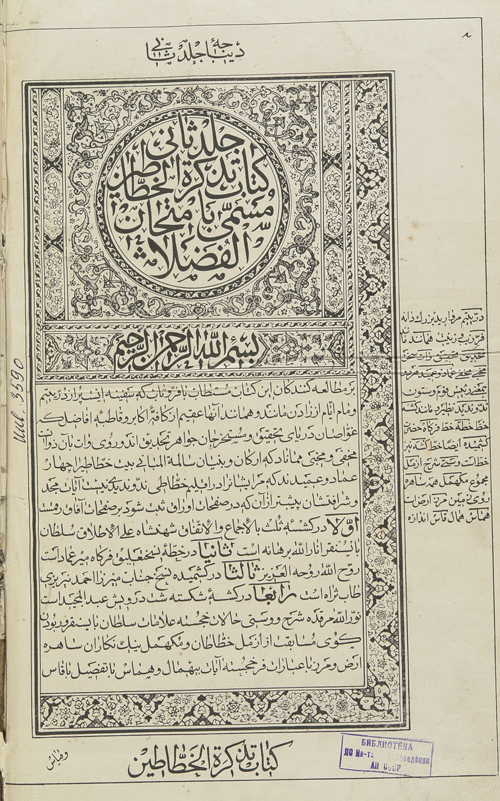
FIGURE 9. First page of the second volume of the Taḏkerat al-ḵaṭṭāṭin or Emteḥān al-fożalaʾ of Mirzā Sanglāḵ Dowrān; Tabriz, printing house of Karbalāʾi Asad Āqā, 1291-95/1874-78.
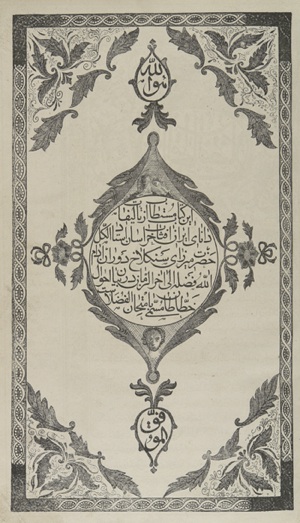
FIGURE 10. Title page of the Taḏkerat al-ḵaṭṭāṭin also known as Emteḥān al-fożalaʾ of Mirzā Sanglāḵ Dowrān; Tabriz, printing house of Karbalāʾi Asad Āqā, 1291-95/1874-78.
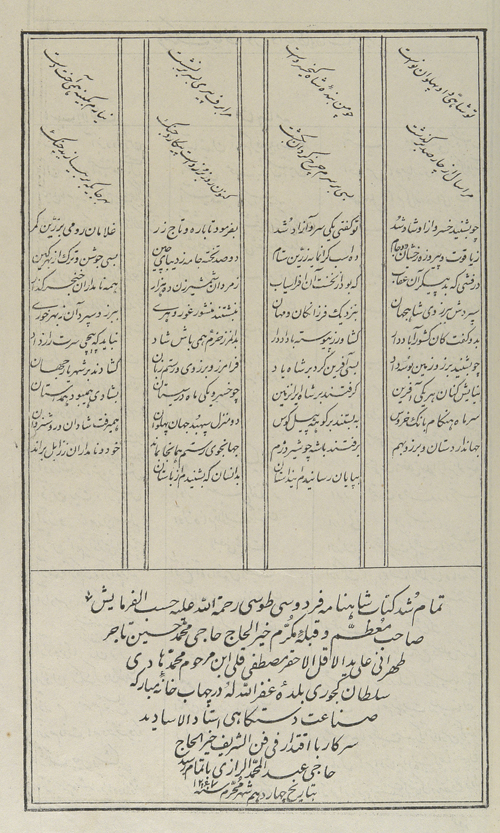
FIGURE 11. Colophon of the Šāh-nāma of Ferdowsi; Tehran, printing house of Ḥājji ʿAbd-al-Moḥammad Rāzi, 1265-67/1848-51; reprint of the edition of the book-seller Moḥammad-Mahdi Eṣfahāni, made upon the order of the book-seller Ḥājji Moḥammad-Ḥosayn tājer Ṭehrāni; copyist Moṣṭafā-qoli b. Moḥammad-Hādi Solṭān Kajuri.
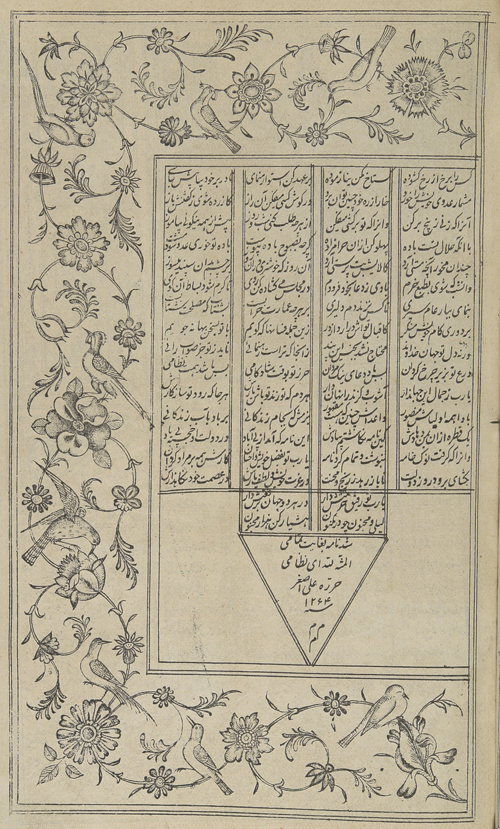
FIGURE 12. Colophon of the Ḵamsa of Neẓāmi; Tehran, 1264/1848; copyist ʿAli-Asḡar Tafreši; lithographer Moḥammad-Reżāʾ; painter Mirzā ʿAli-qoli Ḵoʾi.
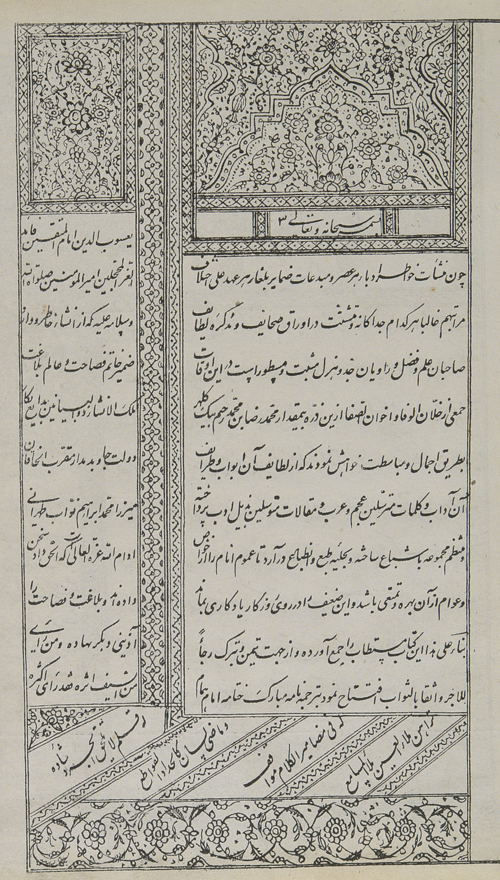
FIGURE 13. First page of the Maḵzan al-enšāʾ; Tehran, printing house of Āqā Sayyed Mahdi, 1285-86/1869; compiled and transcribed by Moḥammad-Reżāʾ b. Moḥammad-Raḥim Kalhor.

FIGURE 14. Right side of the double-page frontispiece for the ʿEšq-nāma of Asad-Allāh Khan Ḡāleb; Tabriz, printing house of Āqā Reżāʾ, 1283/1866.
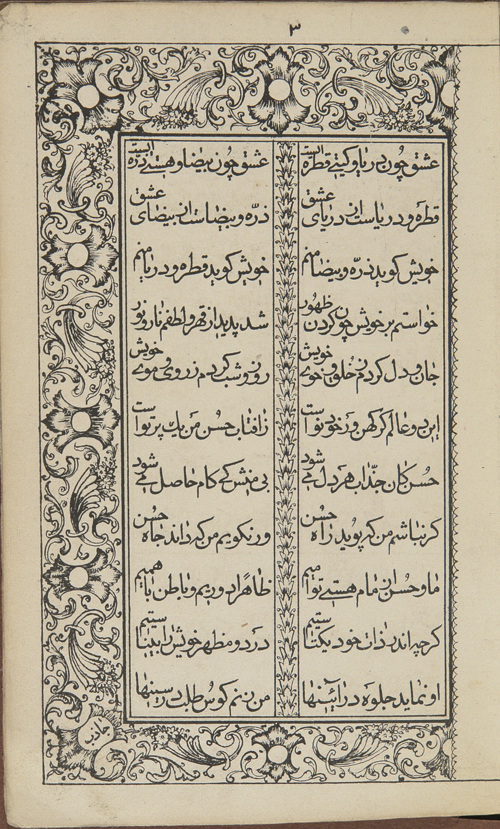
FIGURE 15. Left side of the double-page frontispiece for the ʿEšq-nāma of Asad-Allāh Khan Ḡāleb; Tabriz, printing house of Āqā Reżāʾ, 1283/1866.
The first lithographic printing press was brought to Persia in 1821 from Tiflis (Tbilisi), on the orders of the Crown Prince, ʿAbbās Mirzā. The Persian painter Allāhverdi who had studied lithography there, returned to Tabriz in March 1821 with a complete set of lithographic equipment (Akty, sobrannye kavkazskoyu arkheograficheskoyu komissieyu VI/2, pp. 238-39). The four volumes mentioned by Moḥammad-ʿAli Khan Tarbiyat (1934, p. 662), namely the two-volume of Majlesi’s Ḥayāt al-qolub (I, pub. in 1240/1824-25; II, in 1241/1825-26), the Bustān of Saʿdi (1247/1831-32), and the Maḵāreq al-qolub of Nerāqi (1248/1832-33), were probably printed in Tabriz by this press.
What is certain is that in 1248/1832-33 a lithographic printing press began to operate in Tabriz. It was established through the efforts of Mirzā Ṣāleḥ Širāzi. In 1829, the equipment for the lithography and a printing specialist were presented as a gift to the Embassy of Ḵosrow Mirzā to Russia of which Mirzā Ṣāleḥ was a member (Rozanov, p. 225; Shcheglova, 1979, p. 31). The first books lithographed were the Qur’ān in 1248/1832-33 and the Zād al-maʿād of Majlesi in 1251/1836. The lithographer was Āqā-ʿAli b. Ḥājji Moḥammad-Ḥosayn al-Šarʿ Tabrizi (Tarbiyat, 1931, p. 450).
In Tehran, the first lithographed item was, the newspaper called Kāḡaḏ-e aḵbār (lit. newspaper) published by Mirzā Ṣāleḥ in 1837. There were only three issues, and these came out in Moḥarram-Jomādā I 1253/May-August 1837 (Ṣadr-Hāšemi I, no. 37). As far as printing of books is concerned, the first publications are datable to 1838. These were the Noḵba of Moḥammad-Ebrāhim Eṣfahāni (Mošār, col. 1571), the Soʾāl o javāb of Majlesi (Ibid, col. 909), and the kolliyāt of Hafez (Tarbiyat, 1931, p. 453). It is possible, however, that the first lithographed book was the Qur’ān, as reported by Il’ya Berezin (1819-96) who visited Tehran in 1843 and met Mirzā Ṣāleḥ there (Berezin, p. 248). Berezin also noted that the lithographic press remained mainly idle.
The first lithographic editions, as well as those typeset, were the work of printing enthusiasts who enjoyed the financial backing and patronage of such princely notables as ʿAbbās Mirzā in Tabriz and Manučehr Khan Moʿtamed-al-Dawla in Tehran. The number of published books remained therefore insignificant until the middle of the 1840s, when businessmen and booksellers began to realize the potential profits of the book printing trade. By late 1840s, there were already at least six lithographic printing houses at work in Tehran, and dozens of books were published (Shcheglova, 1979, pp. 33-34). From this time on, one can speak of regular lithographic book printing in Persia. The reasons for the success of the lithographic method of printing are obvious and well-known: simpler and cheaper equipment in comparison to that required for the typographic printing, availability of a large number of professional copyists, and the traditional culture of calligraphy. Although considerably less expensive than manuscripts, lithographed books retained the usual format of the handwritten codex in a sturdy binding.
Tehran and Tabriz remained the main centers of book printing to the end of the 19th century, but lithographic books were also printed in such provincial cities as Shiraz, Isfahan, Mashad (Mašhad), and Kashan (Kāšān). Yet, such local enterprises had, in all probability, originated in single commissions and were connected with the activities of local rulers or enthusiasts of lithography. Provincial Persian booksellers placed their orders for book printing either in Tehran or, in the case of those from Shiraz, in Bombay.
In the latter part of the 1840s, the State Printing House (dār al-ṭabāʿa-ye dowlati) began its work; and was operative until the end of the first decade of the 20th century. After the opening of the Dār al-fonun (the first modern polytechnic on European lines in Persia) in 1851, a lithographic press was established within it for printing teaching aids. Activities of these two printing houses were of some significance for the cultural and scientific life of Persia, since they published books on new subjects: manuals on exact and natural sciences, both translated and original, and works on history and geography.
In 1846 Sayyed Mirzā Jaʿfar Mošir-al-Dowla started working on a mathematics manual entitled Ketāb-e ḥesāb. A royal decree was issued ordering the manual to be printed at the State Printing House and distributed throughout the country. The book came out in 1847 (Shcheglova, 1975, no. 737, colophon; Mošār, col. 561; Storey II, p. 21). At that time, the manager of the lithographic press was Moḥammad-Wali Ṭabib-e Ordubādi, while his brother Mirzā Moḥammad was the lithographer.
Like other printing houses, the State Printing House produced various items, and publishing books was only a part of its activities. As of February 1851, the first Persian regular official newspaper Waqāyeʿ-e ettefāqiya was printed there. During this period, the lithographic facility was managed by Ḥājji ʿAbd-al-Moḥammad (Ṣadr-Hāšemi IV, no. 1160). In the period 1860-65, the head of the State Printing House, and of the Arts School too, was Mirzā Abu’l-Ḥasan Ḡaffāri Ṣaniʿ-al-Molk. After his death, his duties were transferred to the Minister for Sciences (wazir-e ʿolum) ʿAli-qoli Mirzā Eʿteżād-al-Salṭana, who was then the director of the Dār al-fonun as well. One of his many duties up to 1871 was the oversight of the State Printing House and all lithographic printing houses in the capital and in the provinces.
As an illustration of how infrequently books were published during the first years of the State Printing House’s activities, one could point to the fact that the first book under the supervision of Abu’l-Ḥasan Ḡaffāri came out as late as 1864, that is, four years after his appointment to the directorship of the press. This is recorded in the edition of the poem Farhang-e ḵodāparasti of Lesān-al-Molk (Shcheglova, 1975, No. 1338; Idem, 1989, no. 437; FIGURE 1).
The situation changed under Moḥammad-Ḥasan Khan Ṣaniʿ-al-Dawla (as of 1304/1886-87 he bore the title of Eʿtemād-al-Salṭana), who was appointed Minister of Press (wazir-e enṭebāʿāt) in 1871. From 1288 until his death in 1896, he was the head of the publishing complex which included: the Dār al-ṭabāʿa-ye dowlati (the State Printing House with a lithography and a typographic press); the Dār al-tarjoma (the translation bureau); as well as editor of six official newspapers; and, after the death of ʿAli-qoli Mirzā Eʿteżād-al-Salṭana in 1881, the Dār al-taʾlif (the center for publications) as well. This was the period of active book publishing at the State Printing House.
The first book that came out at the State Printing House was, in all probability, the diary of Nāṣer-al-Din Shah’s pilgrimage to Karbalāʾ in September 1870-February 1871. The books were provided with an introduction and were edited by Moḥammad-Ḥasan Khan who had accompanied the shah in his travels (Shcheglova, 1975, no. 134; Idem, 1989, No. 62; Mošār, col. 964, printing house not mentioned). Another publication was the typeset edition of the diary of Nāṣer-al-Din Shah’s travel to Europe in April-September 1873, which came out in April 1874. This too was edited by Moḥammad-Ḥasan Khan and typeset by Aršak Eslāmbuli (Shcheglova, 1989, no. 63; in Persian bibliographies, Istanbul [Eslāmbul] is erroneously mentioned as the place of publication).
From 1873 to 1906, the State Printing House had regularly prepared and published year-books (sāl-nāmas). The first two came out as separate volumes, while those that followed were annexed to multi-volume compositions also printed by the State Printing House. For more than twenty years, multi-volume works were published continuously, and their author was said to be the head of the Ministry of Press and Publications, Moḥammad-Ḥasan Khan Ṣaniʿ-al-Dowla Eʿtemād-al-Salṭana. The first in the series was a book printed in 1876. This contained an ancient history of the world, which had no special title; the Tāriḵ-e Irān which covered the history of Persia from the Arab conquest to the reign of Nāṣer-al-Din Shah; and the almanac for 1292/1875 (Shcheglova, 1989, no. 28; Mošār, cols. 299 and 349; Fehrest-e ketābhā-ye čāpi-e fārsi, col. 672; Storey-Bregel II, p. 711, III, p. 1457).
Other published works included well known scholarly titles: the Merʾat al-boldān (ʿMirror of countries’, a geographical dictionary) printed in 1877-80; the Tāriḵ-e montaẓam-e Nāṣeri printed in 1881-83; the Maṭlaʿ al-šams, a description of Khorasan printed in 1884-86; the Maʾāṯer wa’l-āṯār, a chronicle-almanac printed in 1889. Leaving aside the issue of the authorship, one must acknowledge that without the organizational skills of Moḥammad-Ḥasan Khan these educative and informative works would have never been composed and published. The series of historical works published by the State Printing House came to an end with two volumes of the Tāriḵ-e salāṭin-e Sāsāni (ʿHistory of the Sasanian Rulers,’ printed in 1895-98). This was an expanded translation by of George Rawlinson’s The Seventh Great Oriental Monarchy, (Storey-Bregel II, p. 726). The translation was made by Moḥammad-ʿAli Khan Foruḡi, Ḏokāʾ-al-Molk (1877-1942). The Dār al-taʾlif (The bureau of publications) prepared six volumes of the biographical dictionary Nāma-ye dānešvarān-e Nāṣeri (vols. II-VII, printed in 1894-1906).
Besides historical compositions, the State Printing House also produced lithographed translations from European languages. A play of Fath-Ali Akhundov (Fatḥ-ʿAli Āḵundzāda) was translated into Persian by Mirzā Jaʿfar Qarājadāḡi as Hekāyat-e Mollā Ebrāhim-Ḵalil kimiāgar and printed in 1872 (Shcheglova, 1989, no. 648; Edwards, col. 207); the Sargoḏašt-e mestres Hurtasetet-ḵānom-e englisi dar Hendustān, was printed in 1887 (Shcheglova, 1989, no. 650; Edwards, col. 385; Mošār, col. 596; Fehrest-e ketābhā-ye čāpi-e fārsi, col. 1243); the Mémoires de Mademoiselle de Montpensier was inserted into the Tāriḵ-e Farānsa (History of France) and translated by Moḥammad-Ḥasan Khan, printed in 1895; three volumes of the Ḵayrat al-ḥesān by Mehmet Zihni were translated from Turkish, and printed in 1886-90.
In addition to the diaries of the travels of Nāṣer-al-Din Shah mentioned earlier, descriptions of his travels to Māzandarān in 1877, to Khorasan in 1889, and to Europe in 1887, 1879, and 1891 were also printed.
The State Printing House ceased to function in the first decade of the 20th century. By that time, lithographic printing was being forced out by typeset printing, and from 1911 on, the official newspaper Irān was printed typographically.
As already mentioned, the lithography press of the Dār al-fonun (dār al-ṭabāʿa-ye maḵṣuṣa-ye mobāraka-ye dār al-fonun) was created during the period 1851-58 when Reżā-qoli Khan Hedāyat was its director (raʾis wa nāẓem). In the tenth volume of the Rawżat al-ṣafāʾ, in the section dedicated to the Dār al-fonun, Hedāyat writes that manuals on medicine by Jacob Eduard Polak (1818-91, resided in Persia until 1860) were printed both at the press at the Dār al-fonun and on his own (Hedāyat’s) press. Publication dates of the works by Polak are known, they came out in 1854-57. Earlier editions, including two treatises on artillery by Augustus Kržiž (1814-86, resided in Persia until 1859) were printed by the private lithography press of Moḥammad-Taqi b. Moḥammad-Mahdi Tabrizi in 1269/1852-53 (Shcheglova, 2002, no. 162; Edwards, col. 342, without mentioning the lithography). Some of the other educational manuals for the Dār al-fonun were also published later outside its own printing facilities. For example, the French grammar compiled by Moḥammad-Ḥasan Khan came out at the State Printing House in 1876, and the entire print-run was given to the library of the Dār al-fonun (Shcheglova, 1989, no. 697; Mošār, col. 1300, under “Gerāmer” in Fehrest-e ketābhā-ye čāpi-e fārsi, col. 2709).
The bulk of the book production was published by private lithographic printing houses. In the period from the 30s of the 19th century up to the first decade of the 20th century inclusive, no less than thirty-three lithographic printing houses were at work in Tehran and no less than thirty in Tabriz (Shcheglova, 1979, pp. 211-13). The largest and the most long-lasting of them were eight in Tehran (see below), six of which are mentioned in the afterword to the Zinat al-majāles edited by Iraj Afšār (Zinat al-majāles, pp. 319-20), and seven in Tabriz (see below), four of which are likewise recorded in the afterword to the Zinat al-majāles. Private lithographic printing houses provided the book market with material on Shiʿite rites and creed, feqh, prayers, hagiographies of the Prophet and the Shiʿite martyrs, texts for the taʿzia performances, divāns of Persian classical poets, stories, and fairy tales. Books were printed in Persian and Arabic, and, in Tabriz, in Turkish too.
In Tehran, perhaps the largest of all the lithographic printing houses was that of Mir Bāqer (1850s-1880s) and his descendants. This printing house published works of 19th-century authors who had influenced the development of science and culture at the time. Books printed by Mir Bāqer are among the most outstanding publications of the time from the point of view of printing quality, setup, paper, and script. His son, Sayyed Mortażā (80s of the 19th century-first decade of the 20th century), increased the volume and widened the subject range of the books printed, but failed to surpass his father in craftsmanship.
According to Sayyed Ḥasan Taqizāda (p. 12), Mir Bāqer was a disciple of the first Persian printer Zayn-al-ʿĀbedin Tabrizi, and his lithographic equipment came from one of the first Persian lithographers Mollā ʿAbd-al-ʿAli, who had been the editor of Voltaire’s works printed in 1846. For the publication of his Rowżat al-ṣafāʾ, Reżā-qoli Khan Hedāyat acquired a lithographic press and invited Mir Bāqer to act as the lithographer. The cooperation of Hedāyat and Mir Bāqer continued later, and after the death of the former, Mir Bāqer printed Hedāyat’s work, Majmaʿ al-foṣaḥāʾ, in 1878. The lithographic printing house of Mir Bāqer produced several volumes of the Nāṣeḥ al-tawāriḵ by Sepehr, in particular, all the sections dedicated to the Qajars. Besides that, Mir Bāqer also published two works by ʿAli-qoli Mirzā Eʿteżad-al-Salṭana, the diary of the first travel of Nāṣer-al-Din Shah to Khorasan (1869), the Ganjina of Našāṭ, and many other works.
His sons succeeded the father in book printing business; the afterword to the Zinat al-majāles mentions Āqā Sayyed Ḥosayn, but it was his brother, the aforementioned Sayyed Mortażā, who was the more productive in output. The lithographic printing house of Sayyed Mortażā printed such famous works of contemporary authors as the Fārs-nāma-ye Nāṣeri of Fasāʾi (1895-96), the Ṭarāʾeq al-ḥaqāʾeq of Maʿṣum ʿAlišāh (1898-1900), and the Tāriḵ-e bidāri-e Irāniān of Nāẓem-al-Eslām Kermāni (1910). It also published such historical and poetical classics as ʿĀlam-ārā-ye ʿAbbāsi of Eskandar-Beg Monši (1896), and the Šāh-nāma of Ferdowsi (the famous edition of Amir Bahādor, 1901-5; FIGURE 2).
The lithographic printing house of Āqā-Mirzā Ḥabib-Allāh (1882-1900), a lithographer employed at the State Printing House between 1892-87, was active for about two decades. Here they lithographed the Tāriḵ-e Beyhaqi (1890, the text was edited by Sayyed Aḥmad Adib Pišāvari), the Maṯnawi-e maʿnawi of Rumi (1890, edited by Mirzā Abu’l-Ḥasan Jalva Eṣfahāni; FIGURE 3 and FIGURE 4), and other medieval and contemporary works. One of the best books printed by the lithographer, the Pand-nāma-ye Yaḥyawia (1898), addressed to his son Yaḥyā by Amir Neẓām-e Garrusi (1828-1900) contains a fine portrait of the author.
Lithographic printing house of ʿAli-qoli Khan Qājār survived for more than forty years (1855-98). His editions were distinguished by the high quality of the printing and their elegant script; the best known of them are the Farhang-e anjomanārā-ye Nāṣeri of Hedāyat (1871), and the first volume of the biographical dictionary entitled Nāma-ye dānešvarān-e Nāṣeri (1879).
Activities of the lithographic printing house of Allāh-qoli Khan Qājār spanned more than thirty years (middle of the 1850s to late 1880s). In 1869-70 it printed the work of the contemporaneous philosopher Hādi Sabzavāri entitled Asrār al-ḥekam.
The afterword to the Zinat al-majāles (1305/1887-88) praises the quality of books lithographed at the “Karbalāʾi” printing house of Moḥammad-Ḥosayn where the book itself was printed. This lithographic printing house had been in business for almost four decades (1861-99). It was an ordinary commercial enterprise whose range of publications was not distinguished by any originality and the quality of production was mediocre. Two publications deserve being mentioned: the abovementioned play of Akhundov translated by Mirzā Jaʿfar Qarājadāḡi, and the richly illustrated narrative Eskandar-nāma which was printed in 1897-99 and contains 107 illustrations and four head-pieces (ʿonwān).
The workshop (kārḵāna) “Karbalāʾi” of Moḥammad-Taqi b. Moḥammad-Mahdi Tabrizi existed for half-a-century (1852-1902). It was there that the two treatises of A.Kržiž on artillery, mentioned earlier, were lithographed. One of the best works of this printing house was the first edition of the Nāma-ye ḵosrovān of Jalāl-al-Din Mirzā Qājār), published in 1868.
The major part of production of lithographic printing houses of Mašhadi Taqi (1878-90) and Mašhadi Ḵodādād (1884-1915) was presented by popular works of belles-lettres, of both known and anonymous authors, which were targeted at the lower echelons of the society. These publications were ordered by booksellers exclusively. The quality of books produced by Mašhadi Taqi was good, while that of Mašhadi Ḵodādād’s was low (FIGURE 5 and FIGURE 6).
Tabriz was the first Persian city where the typeset book printing and then the lithographic book printing began. The pioneer of printing from Tabriz, Āqā ʿAli b. Moḥammad-Ḥosayn Amin-al-Šarʿ, did the typesetting of the Jehādiya in 1818, and in 1843 he had a lithographic printing house of his own. The family of Amin-al-Šarʿiya had been in the business of lithographic book printing for about a century, from the 30s of the 19th century up to the middle of the 30s of the 20th century. The works of Āqā Reżā and his son, Asad Āqā, are noted by their high quality of printing. As an example, one can refer to the publication of Ḥedāyat’s Ajmal al-Tawāriḵ (FIGURE 7) and of the two-volume book Emteḥān al-fożalā’ of the calligrapher Sanglāḵ (1874 and 1878; FIGURE 8, FIGURE 9, and FIGURE 10).
The lithographic printing house of the bookseller Ḥājji Mirzā Āqā Tabrizi Moʾayyed-al-ʿOlamāʾ, which is named first in the afterword to the Zinat al-majāles, was producing traditional range of literature: theology, feqh, hagiography, manuals, prose, poetry, and fairy tales. The printing house, the quality of whose productions was not impressive, was active between 1870 and 1914. The lithographic printing house of Ḥājji Ebrāhim in Tabriz had been at work for three decades (1861-91), and Ḥājji Aḥmad-Āqā, the son of its founder, succeeded his father in the business.
The heyday of lithography as the most favored type of book printing in Persia lasted from the 70s-80s of the 19th century up to the first decade of the 20th century. During this time, almost all books were produced lithographically. Private typographies were created in the beginning of the 20th century, but it was only the handwritten books that could compete with the lithographed books. The handwritten method of copying books had been in use in parallel to the lithographic one, and, according to the observation by Yu.N.Marr, as late as in 1925 the easiest way to get a required composition was to order it copied by a scribe (Marr, p. 271). Marr also mentions that, at that time, a half of book production was still done lithographically. Nevertheless, in the 1920s the typeset printing got an upper hand over the lithographic printing. In 1926, twenty-two typographic printing houses functioned in Tehran, while the number of their lithographic competitors at that time was only four (Taʿlim o tarbiyat, pp. 560-61).
Lithographic book production was heterogeneous in its subjects, time of writing of compositions (contemporary works made up only a part of it), level of text preparation, and technical execution. Authors, scholars, professional and amateur editors, calligraphers, and booksellers, all could participate in the publication of books. However, the overwhelming majority of editions were made through the efforts of three categories of people: customers-booksellers, copyists, and lithographers. With rare exceptions (Browne, p. 602; Shcheglova, 1979, pp. 82-84), the lithographic printing house was merely the site of printing. The preparatory stages (selection of manuscript copies, verification of the text, and copying) were the duty of the customer. Such state of affaires is reflected in the afterword to the Zinat al-majāles, and it remained unchanged until the 1920s (Marr, p. 279).
The active role of booksellers in the lithographic book printing is clearly manifested in the more than eighty names of booksellers that appear in this context, and one can trace the activities of some of them, like Āqā Musā, Sayyed Aḥmad Ṭehrāni, Moḥammad-Ḥosayn Amin-al-Tojjār Ṭehrāni (FIGURE 11), Mollā ʿAli-Akbar, Šeyḵ Reżā, and others, through several decades. One of the first of those who engaged in the book business was Āqā Musā (1850s-1880s). In the edition of the Ganjina of Nešāṭ (1865), he placed a list of books offered by him for sale. The list includes 320 books in Persian and 14 books in Arabic (Shcheglova, 1979, pp. 106, 157-58; Marzolph, pp. 223-28).
An important book publisher was Mollā Maḥmud Ḵᵛānsāri (d. 1928). He is best remembered as the publisher of the Tāriḵ-e ʿālamārā-ye ʿAbbāsi of Eskandar-Beg Monši (Yāddāšthā-ye Qazvini, p. 244; Shcheglova, 1979, pp. 107-8), as well as for arranging the publication of the Maṯnawi of Rumi compiled by Mirzā Abu’l-Ḥasan Jalva Eṣfahāni (Shcheglova, 1979, pp. 85-86).
Provincial booksellers too were engaged in book publishing. Since book printing had been mainly developed in Tehran and Tabriz, provincial booksellers placed their orders in these two cities. Often, book publishers from the capital played the role of mediators between the customers (provincial booksellers) and the lithographers.
Hundreds of scribes had been engaged in lithographic book printing, including both acknowledged masters of calligraphy and ordinary craftsmen and amateurs. As in other crafts, the handing down of the family business from father to son(s) can be seen in the lithographic business as well. One can also detect an element of traditional continuity in various professional occupations of those who originated from provincial cities, such as Ḵᵛānsār, Golpāyegān, Tafreš, Ṭāleqān, and others (Shcheglova, 1979, pp. 113-28). The scribes were not members of the staff of the lithographic printing houses, except for those who were employed by a state institution (printing houses, newspaper editorships). They could perform requests from private persons.
During several decades, the following scribes had been engaged in lithographic book production: ʿAli-Asḡar Tafreši (1840s-70s, one of the best masters of nastaʿliq; Bayāni, no. 614; FIGURE 12); Naṣr-Allāh Tafreši (1840s-80s; Idem, no. 1444); Mirzā Āqā Kamaraʾi (1860s-80s; Idem, no. 8); Moḥammad-Ṣādeq Golpāyegāni (1850s-early 20th century, master of nasḵ; Idem, no. 427). An acknowledged master of nastaʿliq was Mirzā Moḥammad-Reżā Kalhor (d. 1892-93; Idem, no. 1050; FIGURE 13). He had a disciple, Zayn-al-ʿĀbedin Qazvini Malek-al-Ḵaṭṭāṭin (1890s-late 1920s; Idem, no. 359), who succeeded his teacher at the official service in the Šaraf newspaper. Sayyed Mortażā Baraḡāni had worked in book publishing for almost fifty years (1880s-late 1920s; Idem, no. 1345). He had frequently acted as both publisher and commentator and also left behind a guide on calligraphy entitled Bedāya-ye Sayyed (Shcheglova, 1979, pp. 125-27). An outstanding master of nastaʿliq from Tabriz was ʿAskar Ordubādi (1840s-60s; Bayāni, no. 598). Moḥammad-ʿAli b. Moḥammad-Šafiʿ from Tabriz was an excellent master of nasḵ and copied the Ajmal al-tawāriḵ and the ʿEšq-nāma (FIGURE 7, FIGURE 14, and FIGURE 15), as well as the two-volume work by Sanglāḵ referred to earlier (FIGURE 8, FIGURE 9, and FIGURE 10).
During the era of lithographic book printing, the number of published contemporary works was on the increase in every decade, but still most of the books printed were old texts, and the question of the quality of the text was not always uppermost in the minds of the publishers. Nonetheless, the attempt to adhere as closely as possible to the original text by the author was a consideration. As a rule, the printed version of the text was based on a single manuscript, sometimes very old and close to author’s lifetime. This copy would be collated with other copies of the text, from which additions were made, in as much as scribes’ errors corrected and obsolete words substituted by modern ones. However, there was no attempt to insert a full critical apparatus. In some cases, the published edition was provided with a foreword that contained information about author’s life and the significance of the work taken from authoritative sources; with a corrigenda frequently appended to the end of the book. Some lithographic publications were the product of scholarly editing made either by a separate publisher, or by a group of people.
The lithographic period in the history of book printing in Persia was also an important stage in the history of culture of the country. The process of formation of secular education and spread of scientific knowledge is inseparably connected with the lithographic book. Lithographic books reflected the development of social thought in the 19th century, as well as achievements in the fields of literature, history, science, and publishing. Moreover, they helped to prolong the traditional culture of calligraphy in Persia.
Bibliography
- Akty, sobrannye Kavkazskoyu arkheograficheskoyu komissieyu. Arkhiv Glavnago Upravleniya Namestnika Kavkazskago (Acts collected by the Caucasian Archaeographic Commission. The Archive of the Central Administrative Board of the Caucasian General-Governor), ed. A.Bergé, vols. I-IX, Tiflis, 1866-84, vol. VI/2, Tiflis, 1875. Editorial remark: the Russian title is given in its original form, according to old (pre-1917-18) grammar rules in Russian.
- Mehdi Bayāni, Ahwāl wa āṯār-e ḵošnevisān, 4 vols., 2nd ed., Tehran, 1984.
- I.Berezin, Puteshestvie po severnoĭ Persii (Travel in Northern Persia), Kazan, 1852.
- E.G.Browne, A Year amongst the Persians (1887-1888), Cambridge, 1926.
- E.M.A.Edwards, A Catalogue of the Persian Printed Books in the British Museum, London, 1922.
- Fehrest-e ketābhā-ye čāpi-e fārsi az āḡāz tā āḵar-e sāl-e 1345. Bar asās-e fehrest-e Ḵānbābā Mošār wa fahāres-e anjoman-e ketāb (A Bibliography of Persian Printed Books (1808-1967)), 3 vols., Tehran, 1973.
- Reżā-qoli Ḵān Hedāyat, Rowżat al-ṣafā-ye Nāṣeri, vol. X, Tehran, 1274/1857, lithography with no internal pagination.
- Yu.N.Marr, Stat’i i soobshcheniya (Articles and Presentations), vol. 2, Moscow and Leningrad, 1939.
- Ulrich Marzolph, “Persian Popular Literature,” Asian Folklore Studies 60, 2001, pp. 215-36.
- Ḵānbābā Mošār, Fehrest-e ketābhā-ye čāpi-e fārsi (A Bibliography of Books Printed in Persian), 2 vols., Tehran, 1958-63.
- M.G.Rozanov, “Persidskoe posol’stvo v Rossii v 1829 g. (Po bumagam grafa P.P.Sukhtelena)” (Persian Embassy in Russia in 1829 (On the Basis of Papers of Count P.P.Sukhtelen), Russkiĭ arkhiv, 1889, no. 2, pp. 209-60.
- Moḥammad Ṣadr-Hāšemi, Tāriḵ-e jarāʾed wa majallāt-e Irān, 4 vols., Isfahan, 1956-1959.
- O.P.Shcheglova, Katalog litografirovannykh knig na persidskom yazyke v sobranii Leningradskogo otdeleniya Instituta vostokovedeniya AN SSSR (Catalogue of lithographed books in the Persian language in the collection of Leningrad branch of the Institute of Oriental Studies of the Academy of Sciences of the USSR), 2 vols., Moscow, 1975.
- Idem, Iranskaya litografirovannaya kniga (iz istorii knizhnogo dela v Irane v XIX-pervom desyatiletii XX veka) (Iranian lithographed book [from the history of book business in Iran in the 19th-first decade of the 20th century]), Moscow, 1979.
- Idem, Katalog litografirovannykh knig na persidskom yazyke v sobranii Vostochnogo otdela nauchnoĭ biblioteki im. A. M. Gor’kogo Leningradskogo gosudarstvennogo universiteta (Catalogue of lithographed books in the Persian language in the collection of the Oriental Department of the Scientific Library named after A.M. Gorky of the Leningrad State University), Moscow, 1989.
- Idem Katalog litografirovannykh knig na persidskom yazyke: iz sobraniya Rossiĭskoĭ Natsional’noĭ Biblioteki (Catalogue of lithographed books in the Persian language: from the collection of the National Library of Russia), Moscow, 2002.
- C.A.Storey, Persian Literature. A Bio-bibliographical Survey, vols. I and II, London, 1927-71; tr. Yu.E.Bregel’ as Persidskaya literatura. Bio-bibliograficheskiĭ obzor, 3 vols., Moscow, 1972.
- Taʿlim o tarbiyat, 3rd year, 1928, nos. 11-12, pp. 560-61.
- Sayyed Ḥasan Taqizāda, “Čāpḵāna wa ruznāma dar Irān,” Kāva, dowra-ye dovvom, 1917, no. 5, pp. 11-41.
- Moḥammad ʿAli-ḵān Tarbiyat, “Mabdaʾ-e tāriḵ-e irānšenāsi dar Orupā,” Armaḡān, 12th year, 1931, no. 6, pp. 369-81; no. 7, pp. 448-56.
- Idem, “Tāriḵ-e maṭbaʿa wa maṭbuʿāt dar Irān,” Taʿlim o tarbiyat, 4th year, 1934, no. 11, pp. 657-64; no. 12, pp. 721-24.
- Yāddāšthā-ye Qazvini, ed. I.Afšār, vol. 8, Tehran, 1966.
- “Zinat al-majāles-e čāp-e sangi-e Ṭehrān 1305 hejri,” Rāhnamāye ketāb, 1st year, 1958, no. 3, pp. 319-20.
LITHOGRAPHY ii. IN INDIA
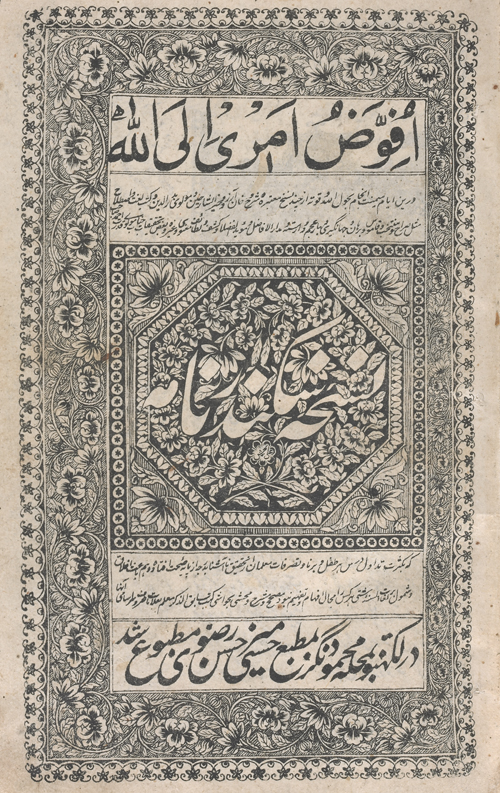
FIGURE 1. The title page of the Sekandar-nāma of Neẓāmi Ganjavi; Lucknow, “Ḥosayni” printing house of Mir Ḥasan Rażawi, 1843.
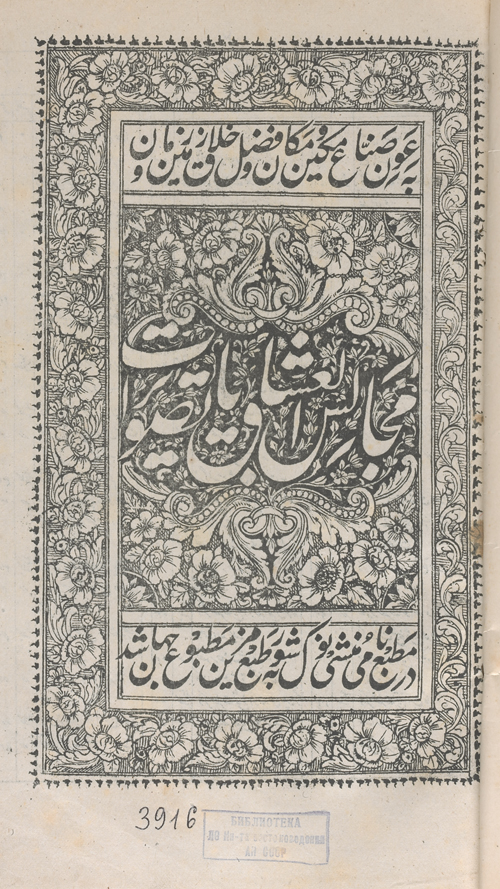
FIGURE 2. The title page of the Majāles al-ʿoššāq ascribed to Solṭān-Ḥosayn Bāyqarā; Lucknow, printing house of Munshi Nawal Kishor, 1876.
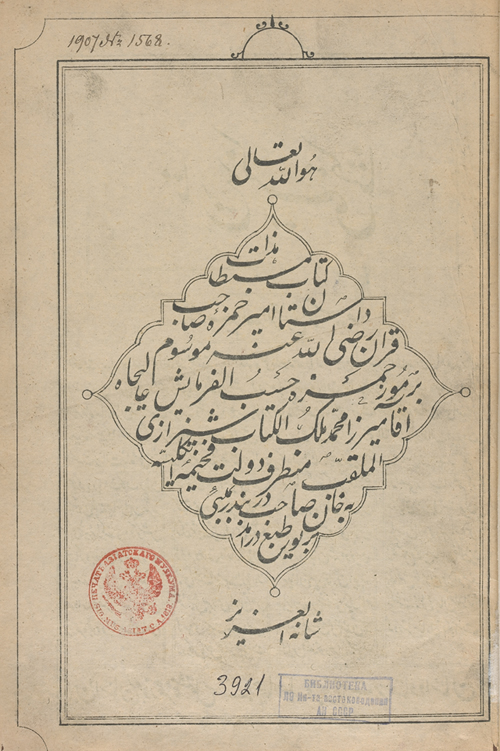
FIGURE 3. The title page of the Dāstān-e Amir Ḥamza; Bombay, late 19th-early 20th century, published by Mirzā Moḥammad Malek-al-kottāb Širāzi.
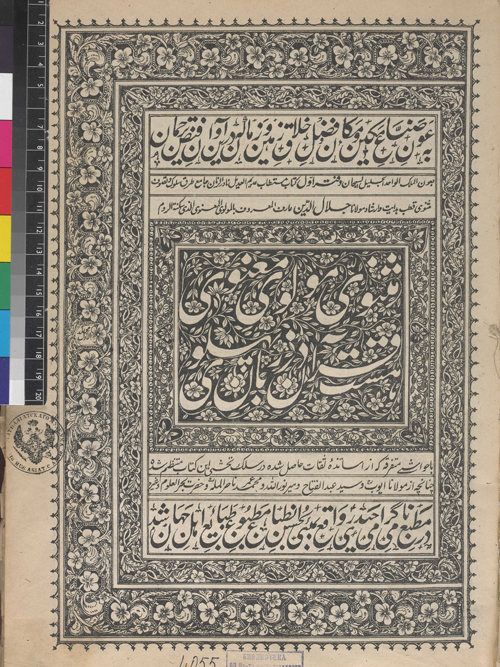
FIGURE 4. The title page of the Maṯnawi-e maʿnawi of Jalāl-al-Din Rumi; Bombay, “Ḥeydari” printing house, 1292-94/1875-77.
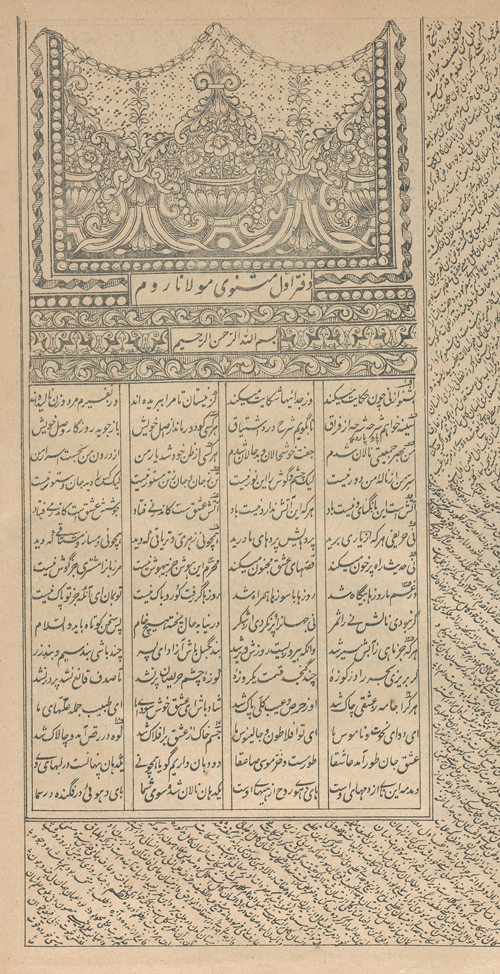
FIGURE 5. The head-piece (ʿonwān) and the first page of the Maṯnawi-e maʿnawi of Jalāl-al-Din Rumi; Bombay, “Ḥeydari” printing house, 1292-94/1875-77.
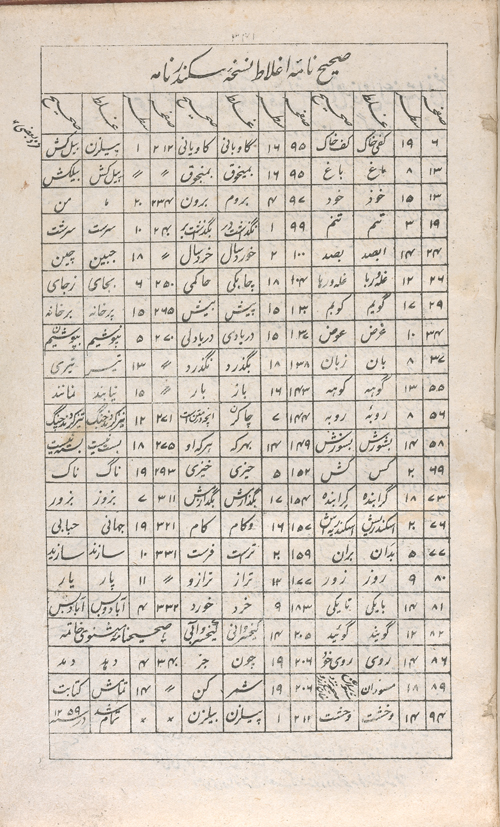
FIGURE 6. Corrigenda for the Sekandar-nāma of Neẓāmi Ganjavi; Lucknow, “Ḥosayni” printing house of Mir Ḥasan Rażawi, 1843.
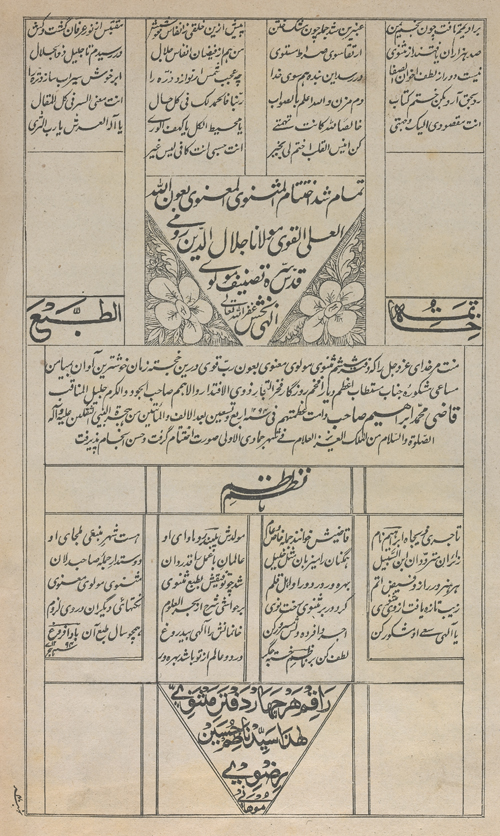
FIGURE 7. The colophon of the Maṯnawi-e maʿnawi of Jalāl-al-Din Rumi; Bombay, “Ḥeydari” printing house, 1292-94/1875-77.
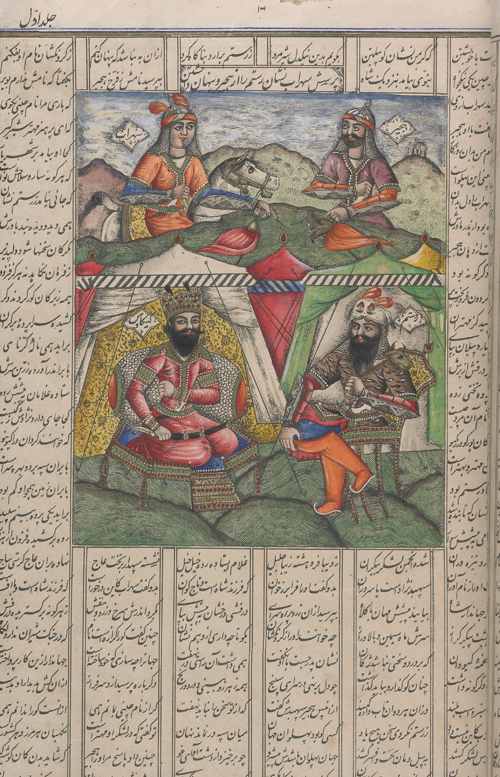
FIGURE 8. An illustration from the first volume of the Šāh-nāma of Ferdowsi; Bombay, printing house of Dādu Miān, 1272/1855-56. Colours applied by hand at a later time.
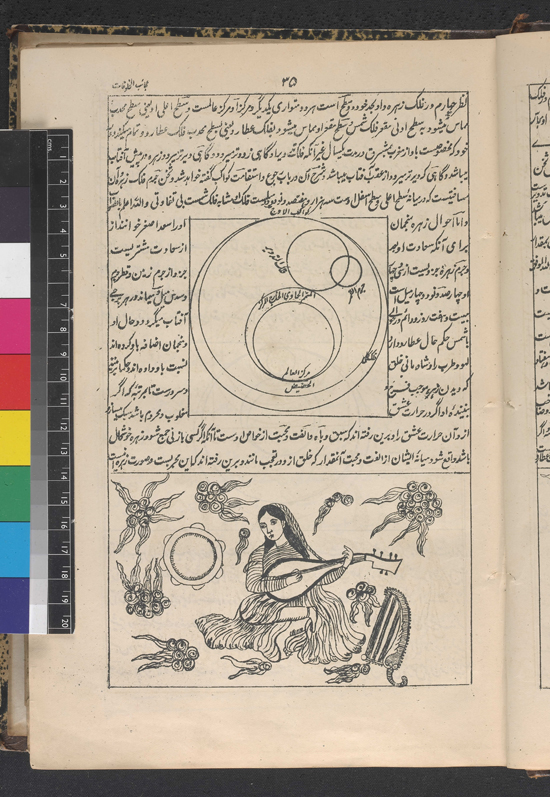
FIGURE 9. An illustration for the ʿAjāʾeb al-maḵluqāt by Zakariyā b. Moḥammad Qazvini; Lucknow, printing house of Munshi Nawal Kishor, 1313/1895.
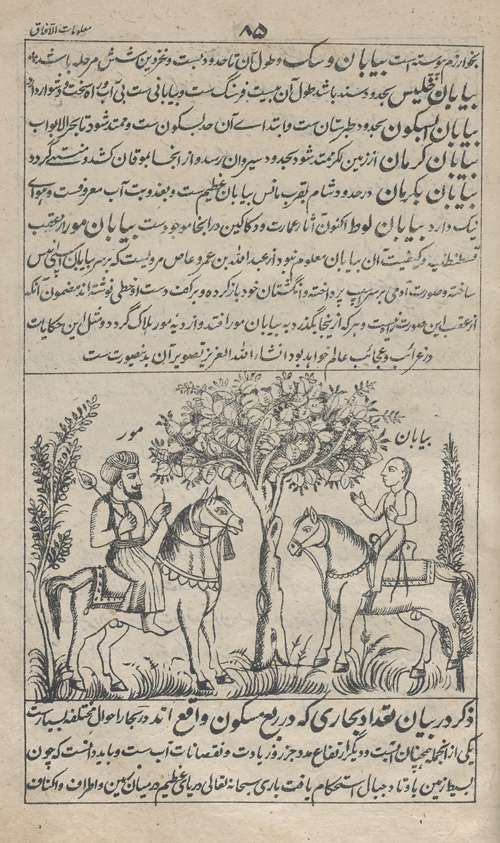
FIGURE 10. An illustration from the Maʿlumāt al-āfāq of Amin-al-Din Khan al-Ḥosayni al-Haravi; Lucknow, printing house of Munshi Nawal Kishor, 1873.
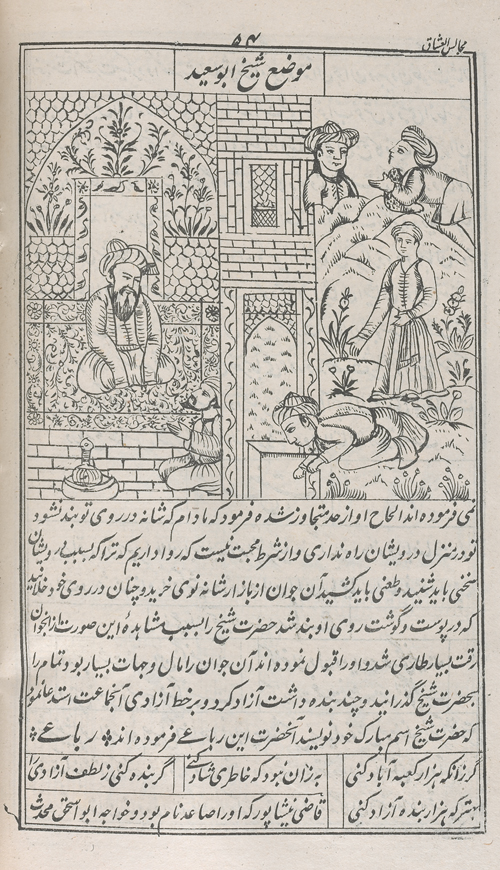
FIGURE 11. An illustration from the Majāles al-ʿoššāq ascribed to Solṭān-Ḥosayn Bāyqarā; Lucknow, printing house of Munshi Nawal Kishor, 1876.
From the 19th century to the first decade of the 20th, India was at the hub of a great expansion in lithographic printing. The success of this particular type of printing was largely due to the fact that the same procedure could be applied to all languages irrespective of the varying scripts, since its basis was the manuscript transcribed by a copyist. Hundreds of lithographic printing houses flourished in India, and although books in Persian were only a part of their production, it was there that the largest number of Persian lithographed books was published.
The study of the catalogues of the library collections, of bibliographies containing Persian editions, and of commercial catalogues of publishers (Shcheglova, 2004) reveals two major points. First, the largest percentage of lithographs was printed in Lucknow, followed by Bombay, Cawnpore, Lahore, and Delhi. Secondly, theological subjects headed the list of the most frequently published titles, followed by educational textbooks and belles-lettres. Titles concerned with other subjects were produced in far fewer numbers. Persian lithographs were also published in other cities of India, but their number was not large.
The first lithographed books can be dated to the third decade of the 19th century: 1824 in Benares (Edwards, p. 281), 1826 in Agra (Ibid, p. 717) and Calcutta (Arberry, p. 110) where the Asiatic lithographic publishing house was at work. Up to the middle of the fourth decade of the 19th century, lithography was still a matter of individual experiments. Lithographed books in Persian started to come out regularly from the mid-40s of the 19th century in Bombay, Lucknow, Cawnpore, Calcutta, and Madras, and from the late 1840s in Agra, Lahore, and Delhi.
Lithographic book printing offered employment for those professionals who had earlier been engaged in the production of manuscripts. These included the booksellers, copyists, painters, writers, and scholars involved in editing classical works on various topics and commenting upon them, authors of schoolbooks, etc. The advent of printing also brought lithographers, editors, and businessmen into this venture. The most successful were the lithographers of Lucknow and Cawnpore. The pioneers of the lithograph business in these cities were Ḥājji Moḥammad-Ḥosayn at the Moḥammadi printing house, and Moṣṭafā Khan at the Moṣṭafāʾi printing house in Cawnpore (Ḡaravi, p. 33; Shcheglova, 2001, pp. 18-32); and Mir Ḥasan Rażawi at the Ḥasani printing house in Lucknow (Shcheglova, 2001, pp. 32-33). Their publications were meticulously prepared, with commentaries in the margins and sometimes with special glossaries. Classical compositions published in these printing houses were taken as samples and frequently reprinted by other publishers during the next decades. The lithographic printing house of Mir Ḥasan Rażawi created a template for the title page (FIGURE 1) that was later adopted by the publishing house of Munshi Nawal Kishor and became the standard format for several decades (FIGURE 2).
The middle years of the 19th century witnessed a decline in printing caused by the adverse political conditions that prevailed in the country at the time, but from the 1860s on, the revival of the lithograph activities started in Lucknow and Cawnpore. In Lucknow, lithographic book printing in Persian reached its peak in the 1870s. At the time, out of the total number of forty-three existing presses in the city, there were twenty-five lithographic printing houses, and seven more were added in the early 20th century. In Cawnpore, the number of the lithographic printing houses was considerably less, no more than a dozen. In the 1880s, the book printing was still substantial, but from the 1890s on, a recession started. Even though dozens of lithographic printing houses functioned in Lucknow and Cawnpore, only some of them published books in Persian regularly.
In 1858, the largest national publishing house in India, Oudh Akhbar of Munshi Nawal Kishor (d. 1895), was established in Lucknow. As well as its well-known Urdu newspaper of the same name, it printed books in many languages, mostly in Urdu, but also in Persian and Arabic. The publishing house had a branch office in Cawnpore, another at Lahore from the late 19th century, and, as of the early 20th century, an office in Delhi as well. Munshi Nawal Kishor, a member of the Indian National Congress (INC), aimed at publishing the most significant Persian and Arabic texts of different periods at his publishing house. He therefore organized, in the 70s of the 19th century, a department for translating from Persian to Urdu at his publishing house, where he printed works on the history of Mughal India, compositions on medicine, jurisprudence, and other topics. At the same time, he was engaged in the publication of Persian translations of monumental works of Indian national culture, in particular, the Mahabharata. During the years of his publishing activities (1858-95), Munshi Nawal Kishor printed thousands of editions; his commercial catalogue of 1874 alone contains 1066 books in Urdu, Persian, Arabic, and Sanskrit. Editions in Persian made up one-third of the total number and encompassed almost the entire range of Persian literary heritage (Shcheglova, 2001, pp. 32-80; Ḡaravi, pp. 34-35).
In Cawnpore too, a branch of the Oudh Akhbar publishing house was the largest publisher of books in Persian. There was also another well-established publishing house that printed books in Persian: the Neẓāmi publishing house, belonging to ʿAbd-al-Raḥmān Khan b. Rowšan Šāker. He was the author of several anthologies and published numerous works (Shcheglova, 2001, pp. 88-100).
In Bombay, the first lithographic printing house was founded during Mountstuart Elphinstone’s (1779-1859) governorship of the Bombay presidency (1819-27). According to Mahdi Ḡaravi, the first lithographed book was published there in 1827 (Ḡaravi, p. 32). The superintendent of the printing house was Captain George Jervis, and books connected with his name were published in 1828-32 (Shcheglova, 2001, p. 103). Under his supervision the edition of the Anwār-e soheyli by Ḥosayn b. ʿAli Wāʿeẓ Kāšefi (d. 1505) was lithographed by Mirzā Ḥasan Širāzi in January 1828. The latter was a professional calligrapher and transcribed texts for a series of lithographic editions (Storey, 1933, p. 459, where names of other calligraphers are also mentioned).
Local lithographic printing houses owned by Indian Muslims and non-Muslims began to appear in Bombay in 1840s; for example, one was founded by Ganpatrao Krishnajee (d. 1861) who had been trained as a printer in the USA (Ḡaravi, p. 33). In the late 1850s, there were already about eighteen printing houses, and over twenty others were added to these by the end of the 19th century (Shcheglova, 2001, p. 106). However, only some of them printed Persian books regularly and in significant numbers.
The largest number of books in Persian was published by the lithographic printing houses that belonged to the Pulbandari family: Ḥeydari, Fatḥ-al-Karim, and Karimi (1850s to the first decade of the 20th century). The names of the owners were Qāżi Ebrāhim, Fatḥ-Moḥammad, and ʿAbd-al-Karim. These were purely commercial enterprises that published books in Arabic, Persian, and Urdu. One-third of the Persian-language production was devoted to manuals and textbooks. In 1880s and 1890s, a series of works on the history of the Mughals were published at the Fatḥ-al-Karim printing house (Shcheglova, 2001, pp. 108-22). The following lithographic printing houses operated for a considerable time: Moḥammadi (1840s-end of the 19th century, belonged to various owners), Dādu Miān (1850s-1870s), Dattprasad Press (1880s to early 20th century), and Nāseri (mid-1880s to early 20th century; this printing house had close ties with Persian booksellers).
A significant pioneer in the lithographic book printing in Bombay was the book-publisher and bookseller Mirzā Moḥammad Malek-al-Kottāb of Shiraz (b. Shiraz 1269/1852-53, d. after 1915; FIGURE 3). He strove to publish important medieval texts that fell outside the sphere of interest of other lithographers, and he was in close contact with booksellers from Persia, Turkey, and Egypt. For instance, the 44th issue of his commercial catalogue dated 1911 contains 711 books in Arabic, 548 books in Persian, and 44 books in Urdu (Shcheglova, 2001, pp. 123-36, 147-79; Idem, 2004, pp. 188-98).
In the two decades spanning the 19th and 20th centuries, Lahore was one of the centers of book printing in Persian. About half of the titles published were concerned with educational textbooks, while a substantial part of the rest was devoted to works on theology. There were also works concerned with diverse issues related to the Muslim community. Commissions from other provincial towns were placed in Lahore too, in particular works by Afghan authors were published here, and a part of production went to the book markets of Central Asia. At various times, thirty-two lithographic printing houses operated in Lahore (Shcheglova, 2001, pp. 180-205).
The earliest books in Persian lithographed in Delhi are datable to the 1840s. Yet, even though about forty lithographic printing houses were at work there, most of them only published the odd volume. Judging by the quantity of Delhi editions in the catalogues, the number of books produced in Persian at Delhi was relatively insignificant (Shcheglova, 2001, pp. 206-16).
The study of the lithographs preserved in library collections and listed in commercial catalogues and bibliographies, shows that the overwhelming majority of the published works had been written before the 19th century. The repertoire of the lithographic printing houses included, above all, the fundamental medieval compositions on theology, Islamic law, philosophy, grammar and lexicography, medicine, history, and belles-lettres. In the 19th century, publishers had continued to reproduce the traditional set of the known compositions, and all printing centers gave preference to the works by Indian authors. At the same time, almost all publishers tried to widen the range of their publications either by publishing contemporary works, or by searching through the manuscript depositaries for interesting or neglected items. Since Persian was on the decline as a living language in India and its current use as a vehicle for social and political discourse was on the wane, the search for forgotten works of the passed centuries proved to be more rewarding.
The commercial catalogue of 1874 by the publishing house of Munshi Nawal Kishor can serve as an illustration showing the ratio of the published books from the point of view of language and subject. The catalogue contains 544 books in Urdu, 249 in Persian, 93 in Arabic, 30 in English, 14 dictionaries (Urdu, Persian, and Arabic), and 136 books in the Devanagari script. With respect to the subject, of the total number of 1,066 editions, 312 were the books for educational purposes, 272 theological works, 217 belles-lettres, 64 historical works, and 52 medical works. The remaining editions contain compositions on various topics (Shcheglova, 2004, pp. 181-82). By way of contrast, the commercial catalogue of 1910-11 issued by the Bombay publishing house of Malek-al-Kottāb contains mainly theological works, followed in the second place by belles-lettres. Books for educational purposes are almost absent from this catalogue.
In a comprehensive list of all the published books, compositions by the 19th-century authors comprise a small part. These are mostly treatises on ritual, manuals for Sufi practices, biographies of eminent Sufis and hagiographies of mystics, some polemical works, a number of works on the history of Muslim rule, and poetic works.
The practice of preferring editions of old texts entailed the development of the publishing culture. Traditional methods of making explanations to the main text in the form of page-by-page notes for separate words (ḥāšia) and continuous commentary to the text (šarḥ) found their continuation in the lithographed books. In Lucknow and Cawnpore from the 1840s on, the publication of educational and other works with detailed explanations of obsolete words and concepts had been in practice, and rules for arranging the glosses and placing them on a page were worked out. The glossary (farhang)—a short explanatory dictionary of obsolete words or terms (juridical, medical, Sufi, etc.)—is taken outside the frames of the text. Both the commentary (šarḥ) and the glossary (farhang) could have been published either together with the commented work, or separately from it. The page-by-page notes (ḥāšia) had remained but shifted from the margins to the lower part of the page. In the end of the 19th century, the šarḥ, the ḥāšia, and the farhang were often composed in Urdu (Shcheglova, 2001, pp. 241-46).
As far as the exterior features were concerned, the Indian lithographed book at first imitated its predecessor—the hand-written book. The first editions published in Lucknow, Cawnpore, and even in those printing houses in Bombay set up by the British, reproduced the make-up of a manuscript, and all data about the author, title, and place of publication was inserted in the colophon. However, the European book culture undoubtedly influenced the local printing practice, and already by the 1840s the main publishing centers had developed new methods of presentation. The lithographed book acquired the title page. The first page, which had earlier remained partially blank, was now used to present information hitherto contained in the colophon only: the name of the author, the title, and the place and year of publication (FIGURE 4). The distinctive feature of the lithographed book was that its title page became the first page, while its verso side contained the beginning of the published text (FIGURE 5). The title page was decorated by ornamentation; the pagination was used along with the catchwords; the title of the work was mentioned above the frame that bordered the text. The structure of the book also changed: introductions by the publishers, tables of contents, epilogues, addenda and corrigenda (FIGURE 6), etc. were distinguished as separate units (Shcheglova, 2001, pp. 248-59).
At the same time, creators of lithographed books followed the traditions that had been worked out within the many centuries and concerned the arrangement of the material on a page, the rules for using various types of script, the highlighting of chapter titles, and the principles of illustration. This has the most striking reflection in the editions of the kolliyāts and the diwāns: the lithographed edition and the manuscript copy were identical. The head-piece (ʿonwān), the empty one-third of a page before the beginning of a section (FIGURE 5) and the colophon of the scribe appear in almost all lithographed editions (FIGURE 7). The same compositions and the same episodes within a work, as those in manuscripts, continued to be illustrated. Most often, illustrations were provided for such works as the Šāh-nāma of Ferdowsi (FIGURE 8), the Eskandar-nāma of Neẓāmi, the Golestān of Saʿdi, the ʿAjāʾeb al-maḵluqāt of Qazvini (FIGURE 9), the Maʿlumāt al-āfāq of Amin-al-Din Khan (FIGURE 10), and Majāles al-ʿOššāq attributed to Ḥosayn Bāyqarā (d. 911/1506, FIGURE 11).
The period of active lithographic book printing in Persian in India came to an end in the first decade of the 20th century. With the change in the role which the Persian language played in the Indian society, the amount and the function of book printing in Persian changed either: from wide mass production to publications of highly specialized works.
Bibliography
- A.J.Arberry, Catalogue of the Library of the India Office, vol. II, pt. 6 (Persian Books), London, 1937.
- E.M.A.Edwards, A Catalogue of the Persian Printed Books in the British Museum, London, 1922.
- Mahdi Ḡaravi, “Ketābhā-ye fārsi-e čāp-e Hend wa tāriḵča-ye ān,” Honar o mardom 102-103, Tehran, 1971.
- Ḵānbābā Mošār, Fehrest-e ketābhā-ye čāpi-e fārsi (A Bibliography of Books Printed in Persian), 2 vols., Tehran, 1958-63.
- Idem, Fehrest-e ketābhā-ye čāpi-e fārsi, 2 vols., Tehran, 1972.
- Fehrest-e ketābhā-ye čāpi-e fārsi az āḡāz tā āḵar-e sāl-e 1345. Bar asās-e fehrest-e Ḵānbābā Mošār wa fahāres-e Anjoman-e ketāb (A Bibliography of Persian Printed Books [1808-1967]), 3 vols., Tehran, 1973.
- Š.M.Qoreyši, “Monši Navāl Kišur,” Rāhnamā-ye Ketāb 17, Tehran, 1974.
- G.W.Shaw, “Maṭbaʿa. 4. In Muslim India,” EI2 VI, 1991, pp. 804-7.
- O.P.Shcheglova, Katalog litografirovannykh knig na persidskom yazyke v sobranii Leningradskogo otdeleniya Instituta vostokovedeniya AN SSSR (Catalogue of lithographed books in the Persian language in the collection of the Leningrad Branch of the Institute of Oriental Studies of the Academy of Sciences of the USSR), 2 vols., Moscow, 1975.
- Idem, Katalog litografirovannykh knig na persidskom yazyke v sobranii Vostochnogo otdela nauchnoĭ biblioteki im. A.M.Gor’kogo Leningradskogo gosudarstvennogo universiteta (Catalogue of lithographed books in the Persian language in the collection of the Oriental Department of the Scientific Library named after A.M.Gorky of the Leningrad State University), Moscow, 1989.
- Idem, Katalog litografirovannykh knig na persidskom yazyke: iz sobraniya Rossiĭskoĭ Natsional’noĭ Biblioteki (Catalogue of lithographed books in the Persian language: from the collection of the National Library of Russia), Moscow, 2002.
- Idem, “Litografskoe knigoizdanie na persidskom yazyke v XIX v. v Irane i Indii (na osnove Sankt-Peterburgskikh kollektsiĭ)” (Lithographic book printing in Persian in the 19th century in Iran and India [on the basis of St.Petersburg collections]), D.Lit. diss., St.Petersburg, 1995.
- Idem, Persoyazychnaya litografirovannaya kniga indiĭskogo proizvodstva (XIX v.) (Persian-language lithographed book of Indian production [19th century]), St.Petersburg, 2001.
- Idem, “Kommercheskie katalogi indiĭskikh knigoizdateleĭ” (Commercial catalogues of Indian book publishers), Pis’mennye pamyatniki Vostoka 1, Moscow, 2004, pp. 177-99.
- C.A. Storey, Persian Literature. A Bio-bibliographical Survey, vols. I and II, London, 1927-71; tr. Yu.E.Bregel’ as Persidskaya literatura. Bio-bibliograficheskiĭ obzor, 3 vols., Moscow, 1972.
- Idem, “The Beginnings of Persian Printing in India,” in Oriental Studies in Honour of Cursetji ErachjiPavry, ed. Jal Dastur Cursetji Pavry, London, 1933, pp. 457-61.
LITHOGRAPHY iii. IN CENTRAL ASIA
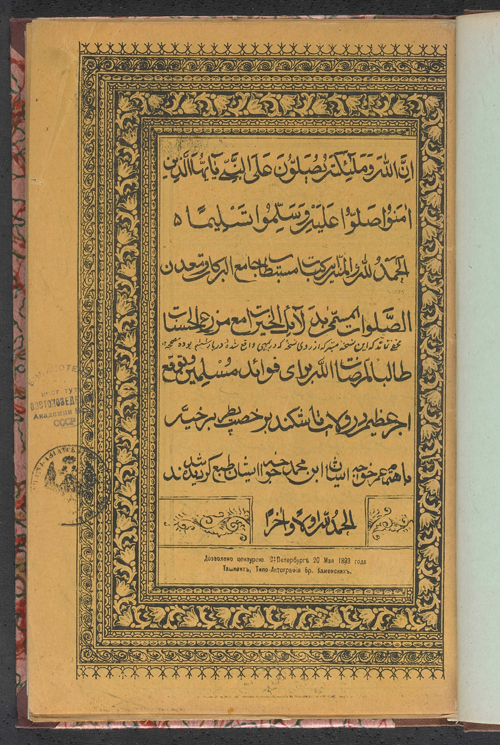
FIGURE 1. The title page of the Dalāʾel al-ḵayrāt of Abu ʿAbd-Allāh Moḥammad b. Solaymān Jazuli; Tashkent, printing house of Kamensky brothers, 1893.
Lithographic printing houses operated in Samarqand too, like those of G.I.Demurov (1900-1908; FIGURE 2), and B.A.Gazarov and K.Sliyanov from 1911; as well as in Andijān and Qoqand from 1904; and in Namangān (the Esḥāqiya printing house, founded in 1909, active in the period 1910-17).
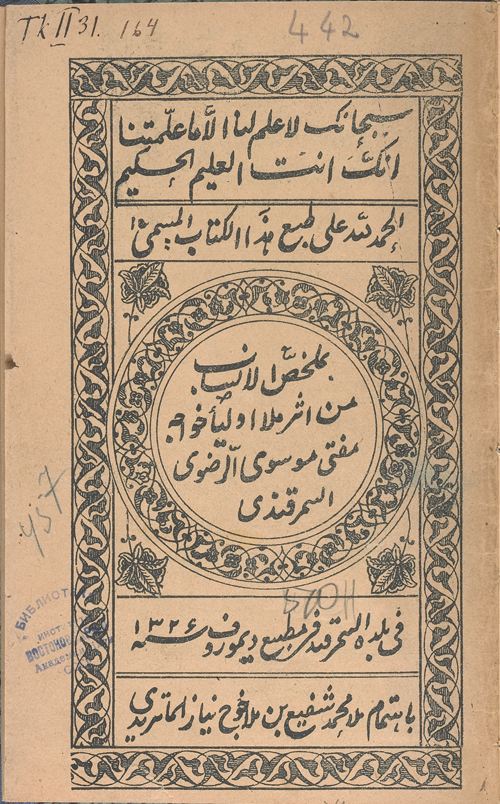
FIGURE 2. The title page of the Molaḵḵaṣ al-ansāb of K3āja Mofti al-Musawi al-Rażawi al-Samarqandi; Samarqand, printing house of Demurov, 1326/1908.
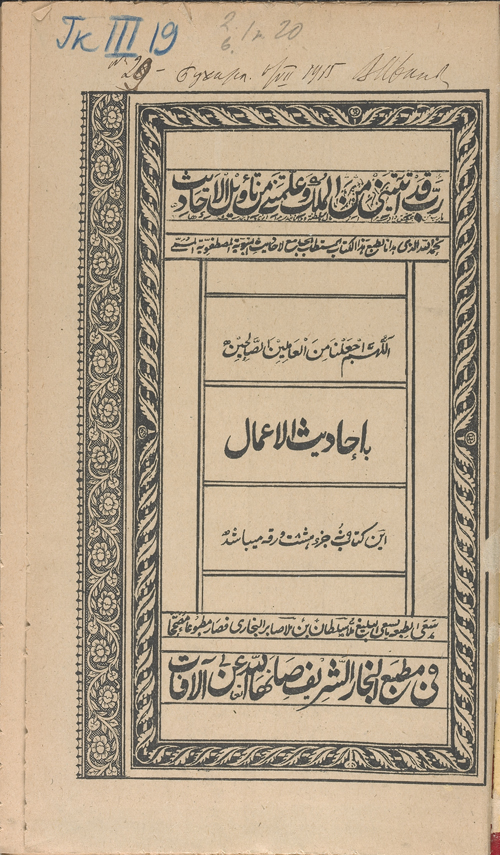
FIGURE 3. The title page for the Aḥādiṯ al-aʿmāl (anonymous); Bukhara, 1330/1912.
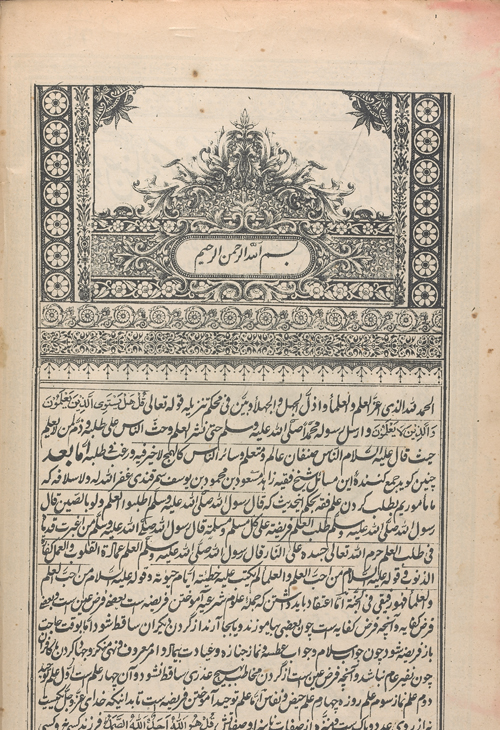
FIGURE 4. The head-piece (ʿonwān) of the Ṣalāt-e Masʿudi of Masʿud b. Maḥmud Samarqandi; Tashkent, printing house of Ilʾyin, 1321-22/1904.
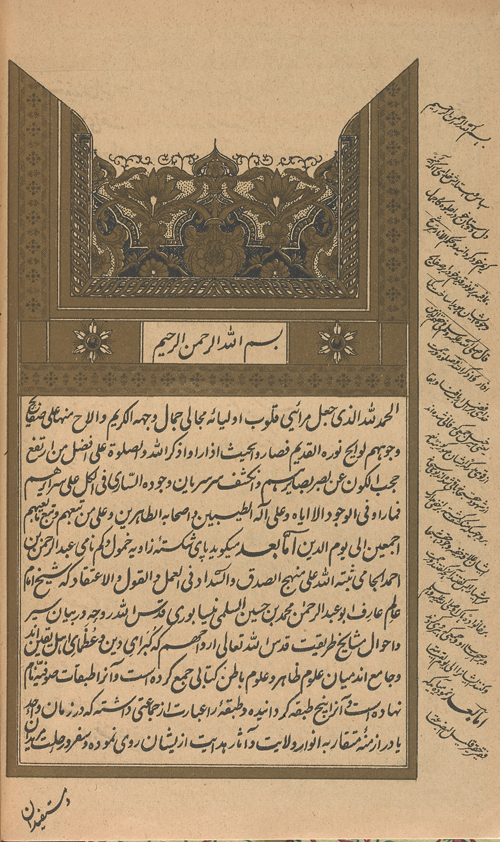
FIGURE 5. The head-piece (ʿonwān) of the Nafaḥāt al-ons of ʿAbd-al-Raḥmān Jāmi; Tashkent, printing house of Portsev, 1915.
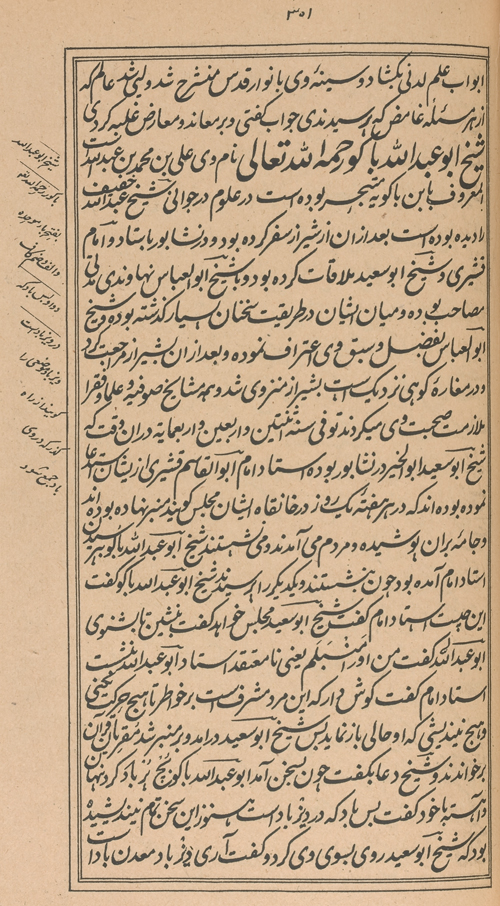
FIGURE 6. A page from the Nafaḥāt al-ons of ʿAbd-al-Raḥmān Jāmi; Tashkent, printing house of Portsev, 1915.
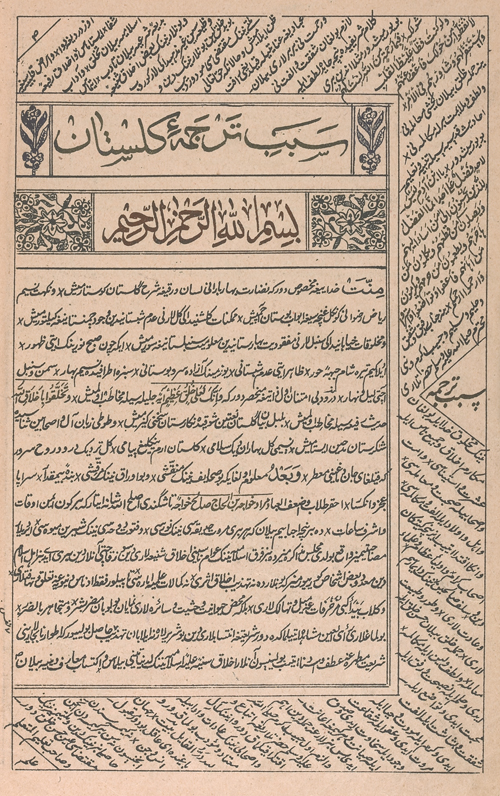
FIGURE 7. Golestān of Saʿdi with an Uzbek translation; Tashkent, “Ḡolāmia” printing house of Arifdzhanov, 1328/1910.
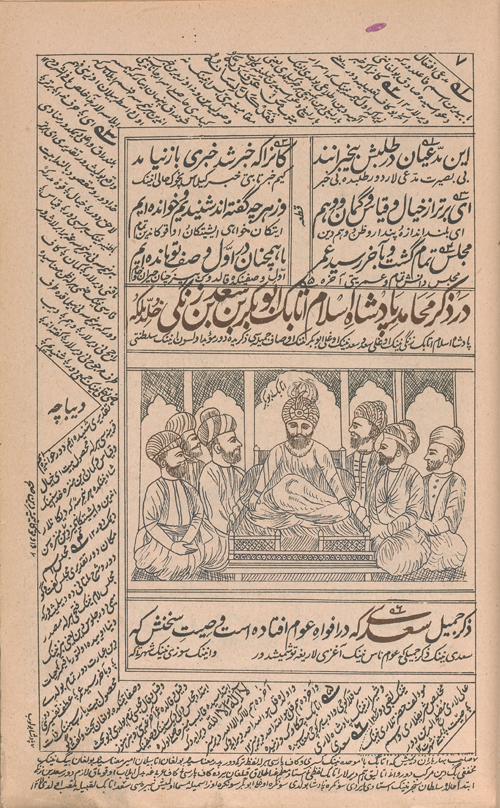
FIGURE 8. An illustration from the Golestān of Saʿdi with an Uzbek translation, Tashkent; “Ḡolāmia” printing house of Arifdzhanov, 1328/1910.
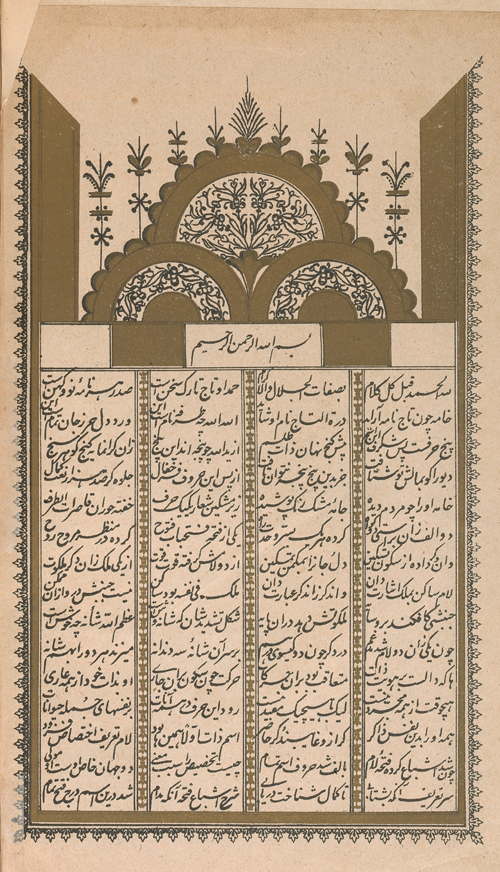
FIGURE 9. The head-piece (ʿonwān) of the Haft owrang of ʿAbd-al-Raḥmān Jāmi; Tashkent, printing house of Yakovlev, 1331/1913-14.
(1881-1918)
Lithographic book printing began in Central Asia in the late 19th century in several regions: in the khanate of Khiva as of 1874 (in Turkic languages only), in Turkistan in Tashkent as of 1881, and in the khanate of Bukhara from 1901 onwards.
The bulk of lithographed books in Oriental languages were published in Tashkent, where, according to estimates by G.N.Chabrov, thirteen typographic and eight lithographic printing houses had been active in various years (Chabrov, 1954, p. 82). However, the largest and the most long-term of these were the three owned by O.A.Portsev (1887–1918), V.M.Il’in (typographic printing house from 1893, typographic-lithographic printing house in 1899–1912), and Gulam-Khasan Arifdzhanov (1906-March 1918), called “Ḡolāmiya” by the owner after the first part of his first name (Ḡolām-Ḥasan). The first commercial enterprise that published books in Oriental languages for sale was the typographic-lithographic printing house of S.I.Lakhtin. It had functioned as typographic printing house from 1877, and as typographic-lithographic printing house from 1880 on. At first, S.I.Lakhtin, together with V.F.Pastukhov (Rustamov, p. 118), were the joint owners, but from 1883 Lakhtin assumed the sole ownership. In 1892-93 the property was in the hands of Lakhtin’s descendants. From the middle of 1893, the printing facility became part of the trading house of the brothers F. and G.Kamenskiĭ (FIGURE 1). According to the information by E.K.Betger, in November 1883 the printing house of Lakhtin published the first lithographic edition in the Uzbek language, namely the work entitled Ṯabāt al-ʿājezin by Ṣufi Allāhyār (Betger, p. 77). Apparently, it was in this printing house where the first two editions in the Persian language were published in 1881: the Čahār ketāb and the Feqh-e keydāni preserved in the collection of the Institute of Oriental Studies in Tashkent (Akmolova and Khamraev, p. 76).
In the khanate of Bukhara, the lithographic printing house of Baranovsky started its activities in New Bukhara in 1901. In 1903-4 it was owned by L.N.Levin, and later, as of 1907, it belonged to I.Gaĭsinskiĭ and M.Bendetskiĭ. In 1910-13, the typographic-lithographic printing house of Levin was working again. The period of active lithographic book printing in Turkestan and in Bukhara lasted for a short time. It operated only in the first two decades of the 20th century and was at its most productive between 1905-17. Besides the printing houses mentioned earlier, books in oriental languages were published by the enterprise of G.Ya.Yakovlev, and in 1900-1906, some books in Persian came out at the printing press belonging to the H.Q. of the Turkestan Military Command. All private enterprises in Turkestan ceased their activities in March 1918 due to nationalization (Chabrov, 1964, pp. 134-41). The lithographic printing house in Bukhara remained operative until 1338/1919-20 (Shcheglova, 1975, nos. 460 and 505).
All the above-mentioned enterprises produced books in various languages. The main centers that published books in Persian were Tashkent and Bukhara. A small number of editions was printed in Samarqand, and the odd volume came out in Namangān, Qoqand, and Ashkhabad. The largest number of books in Persian, often in Persian and Uzbek simultaneously, came out at the first national lithographic printing house of Gulam-Khasan Arifdzhanov.
The lithographic printing houses in Central Asia restricted their activities to the printing process; only G.-Kh.Arifdzhanov at times attempted to publish books on his own initiative, and this was mentioned on the title pages. As a rule, the initiative for publications and their accomplishment came from the local men of erudition and booksellers who also acted as book publishers. Already in the 1890s, the business of book printing was the occupation of about two dozens of local booksellers. Some of them published books in the Turkic languages while others produced books in Persian too.
In Tashkent, Mollā Raḥim Ḵᵛāja Išān b. ʿAli Ḵᵛāja was engaged in the book trade from the last two decades of the 19th century. In the first decade of the 20th century, Ḥājji ʿAbd-al-Raʾuf b. ʿAbd-al-Nabi was active as a publisher. In some cases, booksellers joined together to publish multi-volume compositions. Thus, in 1907-11, three publishers, Mollā ʿAbd-Allāh Ḥājji, Mollā ʿAbd-al-Raʾuf Ḥājji, and Mollā Mir Maḵdum Tāškandi, pooled their resources together at the lithographic printing house of Il’in in Tashkent to publish the three-volume work by Šayḵ Faqih Masʿud Samarqandi (Shcheglova, 2002, no. 206), and this was not their only joint undertaking. In Samarqand, editions were ordered by the local bookseller ʿAbd-al-Ḥakim b. Qāri Šah Naẓar. In Bukhara, the local bookseller Mollā Solṭān b. Mollā Ṣāber Boḵāri was engaged in the book business (FIGURE 3); to him in particular we owe the edition of the Naršaḵi’s Tāriḵ-e Boḵārā that came out at the typo-lithographic printing house of I.Gaĭsinskiĭ and M.Bendetskiĭ in 1904. Some companies invested money in the book publishing business too, for example, the Šerkat-e ḵāreja-ye jadida and the Šerkat-e Boḵārā-ye šarif did so from 1900 on.
Based on the Uzbek lithographed production, R.Makhmudova has listed the names of more than eighty book publishers who had been in the book trade until 1918. One of the prominent publishers, in her opinion, was Mirzā Aḥmad b. Mirzā Karim, who published more than thirty works. Mirzā Aḥmad published his books in Tashkent, and in one of Persian editions of 1910 he is referred to as bookseller in Andijān (Makhmudova, p. 13; Shcheglova, 2002, no. 61). Turkestan booksellers, such as Ṣadiq Ḵᵛāja Ḵojandi and Mir Ṣāber, placed their orders for lithographic printing abroad. Collections in St.Petersburg have preserved eleven books published in 1901-16 by Ṣadiq Ḵᵛāja in India, in the lithographic printing houses of Munshi Nawal Kishor located in the cities of Lucknow, Bombay, and Lahore. The list of his editions, printed in Istanbul, is also noted (Shcheglova, 1975, nos. 202, 280, 338, 445, 586, 1640, 1672; Idem, 2002, nos. 82, 208, 211, 253; Yazberdyev, p. 89).
The overwhelming majority of books in Oriental languages lithographed in Central Asia were in Turkic languages. This is understandable given the predominance of the Turkic population in the region in the years between the end of the 19th century and the beginning of the 20th. Publication of works by contemporary authors in Persian and Tajik (as a rule, the language was named fārsi [‘Persian’]) made up only a small fraction of the total number of the printed books. An important feature was the fact that the book markets in Bukhara and Turkestan were filled by Indian lithographic editions in Persian and Arabic, which were cheap but of sufficiently good quality. Books published in Bombay, Lucknow, Cawnpore, Lahore, Delhi, and some other Indian cities were imported to Central Asia by weight, a dozen kilograms being the weight unit (Dmitriev, pp. 239-54). The subjects of the imported production embraced the entire range of Islamic literary heritage: the Qur’ān with its translations and commentaries, works on Sunni dogma and the shariʿa, prayer books, Sufi treatises, a few encyclopedias, dictionaries, grammar manuals, and historical works. Classical texts of Persian literature, ranging from the Šāh-nāma of Ferdowsi to the poetry of Mughal India, were also represented by the Indian lithographic editions. In such a way, the share of the local publishers covered only a small part of the traditional literary repertoire in Persian. The publishers were forced to print only those books that served practical needs and were also subject to constant demand.
In the 80s of the 19th century, the lithographic book printing in Turkestan in Oriental languages in general, and in Persian in particular, was taking its first hesitant steps, and Persian editions came out one at a time. According to information provided by M.Akmolova and U.Khamraev, the library of the Institute of Oriental Studies of the Republic of Uzbekistan in Tashkent, the largest in Central Asia, contains copies of the Feqh-e keydāni and the Čahār ketāb lithographed in Tashkent in 1881, and the Farż-e ʿayn published in 1883. The first two were teaching aids in the local curriculum, while the third is a collection of prayers in Persian and in Central Asian Turki, also accepted in the local rite (Akmolova and Khamraev, p. 76). The same two authors record that the collection of lithographs at the Institute of Oriental Studies in Tashkent includes 4,118 works in ‘Persian-Tajik’ (using the terminology of the authors) language, 5,921 works in Arabic, and 7,861 works in fourteen Turkic languages, published in different parts of the world (ninety cities of Europe and Asia, including those of Persia, India, Afghanistan, Turkey, and Central Asia).
The lithographic book printing, like any other early type of book printing, had above all been used for producing copies of books most in demand by the public. The priority belonged to those books that had proved popular earlier while still in their handwritten state. Such compositions for the 1880s–1890s were prayer books, manuals for the rite, and teaching aids. Besides the above mentioned Čahār ketāb and the Feqh-e keydāni, the group of the teaching aids also included the versifications of the “Forty Hadiths” (Čehel ḥadiṯ) into Persian by Jāmi and into Turkic by Navāʾi; divāns of Hafez, Bidel, and the bilingual poet Fożuli; and the Maslak al-mottaqin by Ṣufi Allāhyār (Geĭer, p. 22). The edition of the latter had treatises on Arabic grammar in Persian and Arabic amended to it for those who studied at al-Kāfia madrasa.
By the beginning of the 20th century, the lithographic method of book production had received complete recognition by the local printers; the amount of published books increased considerably, and the repertoire became wider. The bulk of the books in Persian consisted of theological compositions of various categories: scholastic theology, rite instructions, prayers, hagiography, and jurisprudence.
Medieval theologians still carried authority, and from time to time such works as the Takmil al-imān by ʿAbd-al-Ḥaqq b. Sayf-al-Din Dehlavi (d. 1642) and the Šāṭebiya by Abu’l-Qāsem b. Farroḵ Šāṭebi (1144-94) were printed by Arifdzhanov in 1325/1907-8 and by Portsev in 1915 (Shcheglova, 1975, nos. 335 and 291). Besides the numerous editions of the versifications of the “Forty Hadiths” by Jāmi and Navāʿi, it was further published in the metrical version of Aḥmad Modarres Waṣli (d. 1925) as well as one by an anonymous author (Shcheglova, 1975, nos. 322 and 327). Brochures with prayers for various occasions were also much published.
Publications dealing with the shariʿa were of particularly practical nature. As was remarked by A.A.Semyonov, the Hedāya by Borhān-al-Din Marḡināni (d. 1197) was the handbook for all Central Asian theologians (Semyonov, 1957, pp. 6-7). Its abridgements, translations, and interpretations (Weqāya, Nokāya, and Tarjoma-ye Kurmiri) had been many times reproduced in the manuscript form earlier and entered the Central Asian market in the lithographed form from India during this period. In early 20th century local publishers in Tashkent and Bukhara brought out independent editions of it to meet orders by booksellers. In 1901 the typographic-lithographic printing house of V.M.Il’in in Tashkent published both the Arabic text and the Persian translation of the Moḵtaṣar al-weqāya by ʿObayd-Allāh b. Masʿud b. Tāj-al-Šariʿa (14th century)—a work that goes back to Marḡināni’s Hedāya. In 1333/1914-15, it was reprinted at the lithographic printing house of Arifdzhanov (Shcheglova, 2002, nos. 202 and 203). In 1909 in Bukhara, using the lithographic printing house of Levin, the local men of letters published the Persian commentary to the Nokāya by Jalāl-al-Din Samarqandi Kurmiri entitled Mollā Jalāl Kurmiri (Shcheglova, 1975, no. 620). The original work by Marḡināni together with a Persian translation of it came out in Bukhara in 1333/1914-15; the edition was made by the society Šerkat-e Boḵārā-ye šarif (Shcheglova, 1975, no. 595).
The medieval work on the Ḥanafite fiqh entitled Ṣalāt-e Masʿudi by Masʿud Samarqandi (14th century) was reprinted three times: in 1904 (FIGURE 4) and in 1907-11 by the typographic-lithographic printing house of Il’in, and in 1917 by the lithographic printing house of Arifdzhanov (Shcheglova, 1975, nos. 609 and 610; Shcheglova, 2002, nos. 206 and 207). It is worth noting that in the collected court orders of contemporary theologians issued in Bukhara and entitled Jong-e fatāwi wa maḥażarāt, references to the Hedāya, Nokāya, and Šarḥ-e weqāya are frequently given to corroborate certain decisions (Shcheglova, 1975, no. 639).
A large part of the printing production was devoted to regional as well as more generally recognized Muslim Sufi masters, and to the theory and practice of Sufism. This was mainly presented by the works of authors from Bukhara, Samarqand, and from Transoxania in general. Descriptions of places of pilgrimage (mazār) were published too. These included works written by both medieval authors, such as the Mollāzāda by Aḥmad Moʿin-al-Foqarāʾ (15th century, published in Bukhara in 1904) and the Qandiya by Nasafi (d. 1142), published in Samarqand in 1908-9; and contemporary men of letters, for example, the versification of the Mollāzāda by Mollā Mir ʿAbd-Allāh Ḵᵛāja Modarres of Bukhara (Bukhara, 1323/1905-6), and the Toḥfat al-zāʾerin by Naṣir-al-Din al-Ḵanafi al-Ḥosayni, also of Bukhara (written in 1906, published in Bukhara in 1910) intended as a guide for pilgrims (Shcheglova, 1975, no. 271).
Collections of biographies of Naqšbandiya shaikhs and Sufis of Transoxania, which are included in the Nafaḥāt al-ons by Jāmi and in the Rašaḥāt ʿayn al-ḥayāt by Faḵr-al-Din ʿAli Wāʿeẓ Kāšefi, were widely distributed in Central Asia in Indian lithographic editions in addition to manuscript copies. Nevertheless, both compositions were published in Tashkent: in 1911 in the lithographic printing house of Arifdzhanov, and in 1915 in the lithographic printing house of Portsev (FIGURE 5 and FIGURE 6). The text of the “serial” edition of Munshi Nawal Kishor with commentaries was taken as the basis for the latter edition (Shcheglova, 1975, no. 234 and Shcheglova, 2002, no. 34; Shcheglova, 1975, no. 240 and Shcheglova, 2002, no. 35).
A specific feature in the Central Asian publishing practice was editing of miscellanies that included several compositions under a single cover. These could be works by the same author, compositions by different authors who belonged to the same Sufi order, works related to a saint, and treatises and excerpts collected from a certain point of view. Samples of such collected editions are numerous; we shall mention only three of them.
In the beginning of the 20th century (no exact date is given in the edition), the typographic-lithographic printing house of Portsev published the Manāqeb-e ḥażrat-e ḡowṯ-e aʿẓam, a miscellany centered on the personality of ʿAbd-al-Qāder Jilāni (d. 1167). The edition contained Persian translations of two Arabic works by ʿAbd-al-Qāder Jilāni, Persian commentaries to them, and an Old Uzbek commentary to one of them, his biography, and his ṭariqat. The publication was undertaken by ʿAbd-al-Raʾuf b. ʿAbd-al-Nabi, one of the professionals engaged in the preparation of theological works for lithographic edition (Shcheglova, 2001, no. 64). The edition was later (again without mentioning the exact date) republished in Namangān (Shcheglova, 2002, no. 65).
The collection of works entitled Maqāmāt-e ḥażrat-e Ḵᵛāja Naqšband was published twice, in 1909 and 1910, in Bukhara. Beside the biography of the founder of the Naqšbandiya order, Bahāʾ-al-Din Naqšband, it also included works by some of his acknowledged followers. The first edition was commissioned by the Bukharan bookseller Mollā Solṭān.
A curious sample of deliberate choice of compositions on different subjects is the collection of works compiled by Mollā ʿAbd-al-Ḥakim Ḵᵛāja from Bukhara and entitled Kajkul-e wājeb al-ḥefẓ wa wājeb al-naẓr (‘Collection of required readings’). This included directions of the rite, prayers, Arabic-Persian dictionary Neṣāb al-ṣebyān, treatises on grammar and poetics, poems by Ḵayyām and Abu Esḥāq Aṭʿema, the treatise Āʾena-ye gitinamā, and an excerpt from the Persian translation of Avicenna under the title Tarjoma-ye qānunča-ye Bu ʿAli Sinā (Shcheglova, 1975, no. 346).
Rare editions of secular and scientific works drowned in the deep sea of educational and theological literature. Publications of historical works were few and far between and included the Naršaḵi’s Tāriḵ-e Boḵārā (Bukhara, 1904), the history of Timur by ʿAbd-al-Raḥman Sirat entitled Timur-nāma. Kolliyāt-e fārsi which is the first volume of the Konuz al-aʿẓam by the same author published at the lithographic printing house of Arifdzhanov in 1913 (Shcheglova, 1975, no. 68; Idem, 2002, no. 6). Information on the history of Central Asia and the history of the reign of the local dynasties could have been contained in appendages to larger works (Shcheglova, 1975, no. 22; Idem, 2002, no. 22). Among the valuable editions, one could mention the encyclopedia Jāmeʿ al-ʿolum by Faḵr-al-Din Rāzi (d. 606/1209) published by the writer and traveler ʿAbd-al-Raḥmān Sayyāḥ Tāškandi, the Šabestān-e nokāt wa golestān-e loḡāt by Šabestari with added poems by classical Persian poets (lithographic printing house of Yakovlev, 1331/1912-13), and the Golestān of Saʿdi with an Uzbek translation by Morād Ḵᵛāja Išān entitled Šowq-e golestān-e moṣawwar (lithographic printing house of Arifdzhanov, 1328/1910). The latter was one of the few illustrated editions with a commentary and a brief biography of Saʿdi in Uzbek (FIGURE 7 and FIGURE 8).
Poems by classical Persian poets were included into collections of didactic works, into entertainment-reading books, and into the bayāżes, that is, collections of poems by various poets who were often bilingual. Works by ʿAbd-al-Raḥmān Jāmi, a classic of Persian poetry, a statesman of Herat, and a Naqšbandiya Sufi, were honored by special publications. In 1325/1907-8, the printing house of Portsev published his Kolliyāt which, to all appearance, was a reprint of the Cawnpore edition by Munshi Nawal Kishor, but on the margins and at the end of which the publisher placed poems by the Qoqand poet Ḥāḏeq (killed between 1830 and 1834). In 1914, the printing house of Yakovlev published Jāmi’s Haft owrang. From the technical point of view, this lithographic edition is one of the best among those produced in Central Asia (FIGURE 9). Both latter editions were prepared by men from Tashkent: the publisher Qāżi Ḡolām Rasul Ḵᵛāja and the calligrapher Moḥammad Šāh-Morād b. Šāh-Neʿmat-Allāh by whose hand many works had been transcribed for their further lithographic printing. The Manṭeq-al-ṭeyr by Farid-al-Din ʿAṭṭār had been reprinted frequently. There were also separate editions of Yosuf o Zoleyḵā by Nāẓem Haravi (by the printing house of Portsev, 1904), and the Golšan-e rāz by Maḥmud Šabestari (Bukhara, 1908). The Ḵosrow o Širin by ʿOrfi of Shiraz came out as a part of the edition of collected works (Shcheglova, 1975, no. 1446). A popular form in both manuscript form and lithographed books were anthologies of poems by different authors (bayāż). Collections of fairy tales were published too.
A special place in the repertoire of the lithographed books was taken by compositions written by contemporary authors who lived in the late 19th-first decades of the 20th century. Such works can be divided into three groups: a) publicist and polemical works; b) editions of teaching aids by the followers of new-method teaching; c) poems by contemporary poets. These authors, to mention just a few, Serāj-al-Din Boḵāri, Mirzā Salimi, Aḥmad Waṣli, Maḥmud Ḵ˚ᵛāja Behbudi, ʿAbd-al-Raʾuf Feṭrat, Monawwar Qāri, and others, had become part of the history of culture, but their works should be related to the Tajik literature.
Lithographic book printing in Turkestan and in Bukhara came to an end in 1918-20 due to revolutionary upheavals and the change of the state system.
Bibliography
- M.Akmolova and U.Khamraev, “Istoriya i vspomogatel’nye distsipliny na tyurkskikh yazykakh v litografirovannykh izdaniyakh Instituta vostokovedeniya AN UzSSR” (History and auxiliary disciplines in Turkic languages in lithographic editions preserved at the Institute of Oriental Studies of the Academy of Sciences of the Uzbek Soviet Socialist Republic), Adabiy meros. Uzbek adabieti tarihidan tahqiqot va materiallar. Ilmiy asarlar tuplami 1(51), 1990, pp. 75-80.
- E.K.Betger, “Iz istorii knizhnogo dela v Uzbekistane (K 70-letiyu poyavleniya pervoĭ uzbekskoĭ litografirovannoĭ knigi)” (From the history of book production in Uzbekistan [For the 70th anniversary of the appearance of the first Uzbek lithographed book]), Izvestiya AN UzSSR, 1951, no. 2, pp. 75-76.
- G.N.Chabrov, “Iz istorii poligrafii i izdatel’stva literatury na mestnykh yazykakh v dorevolyutsionnom Turkestane (1868-1917)” (From the history of polygraphics and editing books in local languages in pre-revolutionary Turkestan [1868-1917]), Trudy Sredneaziatskogo gosudarstvennogo universiteta im. V.I.Lenina 57, 1954, pp. 77-95.
- Idem, “Khudozhestvennoe oformlenie turkestanskoĭ litografirovannoĭ knigi (1880-1917)” (Artistic layout of the Turkistan lithographed book [1880-1917]), Trudy Instituta Istorii AN TadzhSSR 20, 1960, pp. 205-24.
- Idem, “O natsionalizatsii poligraficheskikh predpriyatiĭ v Turkestanskoĭ ASSR (1918-1920 gg.)” (About the nationalization of polygraphic enterprises in the Turkistan Autonomos Soviet Socialist Republic [1918-20]), Nauchnye trudy Tashkentskogo universiteta 238, 1964, Istoricheskie nauki, bk. 50, pp. 134-41.
- Idem, “Illyustratsiya v Turkistanskoĭ litografirovannoĭ knige (1908-1916 gg.)” (Illustration in Turkistan lithographed book [1908-16]), Kniga. Issledovaniya i materialy 49, Moscow, 1984, pp. 95-106.
- G.L.Dmitriev, “Rasprostraneniye indiĭskikh izdaniĭ v Sredneĭ Azii v kontse XIX–nachale XX vekov” (The spreading of Indian editions in Central Asia at the end of the 19th-beginning of the 20th centuries), Kniga. Issledovaniya i materialy 6, Moscow, 1962, pp. 239-54.
- I.Geĭer, Putevoditel’ po Turkestanu (Guidebook on Turkistan), Tashkent, 1901.
- R.Makhmudova, “Litografirovannye proizvedeniya i ikh znacheniye v istorii uzbekskoĭ literatury (konets XIX–nachalo XX v.)” (Lithographed works and their importance in the history of Uzbek literature [end of the 19th–beginning of the 20th century]), Summary of Ph.D. diss., Tashkent, 1971.
- R.N.Kholmatov, “Iz istorii uzbekskoĭ staropechatnoĭ arabografichnoĭ knigi i knizhnoĭ kul’tury v gorodakh Ferganskoĭ doliny. 1867-1917 gg.” (From the history of Uzbek early-printed and lithographed book and the book culture in the cities of the Ferghana valley. 1867-1917), Summary of Ph.D. diss., Tashkent, 1989.
- M.I.Rustamov, “Kniga v Sredneĭ Azii” (Book in Central Asia), Kniga. Issledovaniya i materialy 25, Moscow, 1972, pp. 108-26.
- A.A.Semyonov, ed., Sobranie vostochnykh rukopiseĭ Akademii Nauk Uzbekskoĭ SSR (Collection of Oriental manuscripts of the Academy of Sciences of the Uzbek Soviet Socialist Republic), 7 vols., Tashkent, 1952-64, vol. IV, Tashkent, 1957.
- O.P.Shcheglova, Katalog litografirovannykh knig na persidskom yazyke v sobranii Leningradskogo otdeleniya Instituta vostokovedeniya AN SSSR (Catalogue of lithographed books in the Persian language in the collection of the Leningrad Branch of the Institute of Oriental Studies of the Academy of Sciences of the USSR), 2 vols., Moscow, 1975.
- Idem, Katalog litografirovannykh knig na persidskom yazyke: iz sobraniya Rossiĭskoĭ Natsional’noĭ Biblioteki (Catalogue of lithographed books in Persian: from the collection of the National Library of Russia), Moscow, 2002.
- Idem, “The Repertoire of Books in Persian Published Lithographically in Turkistan during 1883-1917,” History of Printing and Publishing in the Languages and Countries of the Middle East, Journal of Semitic Studies, Supplement 15, Oxford 2004, pp. 17-23.
- A.Yazberdyev, Staropechatnye turkmenskie knigi (Early-printed Turkmen books), Moscow, 2001.
LITHOGRAPHY iv. LITHOGRAPHED ILLUSTRATIONS
Lithographic illustration is a particular art form that was practiced in Persia for about a century, from 1850, when lithographic printing was first introduced to Persia, to about 1950. Lithographic illustration relies on the experience of refined illustration and illumination as previously applied in Persian manuscripts over many centuries. At the same time, it constitutes an intermediary between the often highly artistic miniatures in manuscripts and more popular forms of creative expression, such as painting on glazed tiles (kāši-kāri; see CERAMICS xv), painting behind glass, or the naive painting on canvas known as naqqāši-ye qahva-ḵāna.
i. The historical development of lithographic illustration in Persia
ii. Genres of illustrated lithographed books
iii. Artists active in lithographic illustration
iv. Peculiarities of lithographic illustration
The historical development of lithographic illustration in Persia.
The technique of printing by way of lithography was invented by Aloys Senefelder (b. Prague, 1771; d. Munich, 1834) at the end of the eighteenth century and was introduced to Persia through Russia in the early decades of the nineteenth century (Shcheglova, 1979; Bābāzāda, 1999; Golpāyegāni, 1999). While lithographed books were produced in Persia as of 1833, it took publishers almost a decade to exploit the potentials of lithography as a printing process. Lithography in Persia was preferred to printing from movable type as it constituted a direct continuation of manuscript production, bringing forth similar results, albeit in greater numbers, and involving basically the same set of specialists. The master copy of any item printed by way of lithography in Persia was a sheet of specially prepared paper on which viscid ink was applied. This would stick to the printing stone once the upper face of the paper was applied to it. It did not make a substantial difference whether the paper surface was used for writing, for the drawing of illumination, or in order to apply illustrations. In other words, as in manuscript production, line-drawers, scribes, illuminators, and illustrators would cooperate while applying their own particular contribution to the paper pages one after the other. The scribes are variously known to have complained about the difficulties of writing with the viscid lithographic ink. Illuminators and artists aiming to produce extremely delicate lines and fine drawings might have found their task even more arduous.
The first-ever illustrated Persian lithographed book is the 1259/1843 edition of Maktabi’s Leili o Majnun (Nafisi, 1945-46, 1958) copies of which have been preserved in the National Libraries in Tehran and Tbilisi (Georgia). The four illustrations contained in this book are simple and fairly crude. Besides the illustrations, the booklet contains no other adornment. Even though this first experiment successfully demonstrated the potential of printing lithographed illustrations, it still took a number of years before illustration in lithographic prints became a common practice.
At the same time, publishers kept experimenting with various techniques to produce illustrated books in print. The 1261/1845 edition of Rowżat al-mojāhedin (commonly known as Moḵtār-nāma), printed from movable type, contains eight illustrations probably printed from wood-engravings (grāvur-e čubi). Early editions of Jowhari’s Ṭufān al-bokāʾ that were also printed from movable type (1269/1852, 1271/1854, 1272/1855, 1273/1856) contain lithographed illustrations each extending over a full page, suggesting that the illustrations were added in a separate process after the printing of the text had been achieved. These hybrid printings, combining a text printed from movable type with illustrations printed by way of a different technique, remained exceptional and became obsolete when printing from movable type went out of currency around 1273/1856.
Meanwhile, the production of lithographic books containing illustrations remained a comparatively rare phenomenon for a number of years. Early lithographed editions of books whose later editions were regularly illustrated are devoid of illustrations. Examples include the Persian translation of the Arabian Nights (first edition 1259-1261/1843-45; first illustrated edition 1272/1855), Neẓāmi’s Ḵamsa (first lithographed edition printed in Persia, 1261/1845; first illustrated edition 1264/1847), and Saʿdi’s Kolliyāt (early editions 1257/1841, 1262–64/1845–47; first illustrated edition 1267–68/1850–51). At present, only two illustrated items dated 1261/1845 ( Anwār-e Sohayli , and Yusofiya) and four items dated 1262/1845 (Dozd o qāżi-ye Baḡdād, Leyli o Majnun , Tarassol [two editions]) are known to exist. It was only from 1263/1846 that the production of illustrated lithographed books became a regular phenomenon. The items produced were at first of a rather small size and of popular content, and brought about considerable commercial interest. This assumption is also corroborated by the fact that in 1846, a whole series of popular romances was published, including Nuš-āfarin-e gowhar-tāj, Čehel ṭuṭi, Hormoz o Gol, and Dalla-ye Moḵtār. The year 1847 witnessed the production of a number of lavishly illustrated books, including the Persian version of Qazvini’s ʿAjāʾeb al-maḵluqāt with more than 300 illustrations, Mollā Bamān-ʿAli Rāji Kermāni’s’s Ḥamla-ye Ḥaydariya with 51 illustrations, and the profusely decorated folio edition of Neẓāmi’s Ḵamsa with intricately illuminated chapter headings, 39 large-scale illustrations and some 300 miniature drawings of fabulous creatures in small triangles on the margin (Robinson, 1979). The first Iranian edition of Ferdowsi’s Šāh-nāma, published in 1267/1850 after having been in preparation for about two years, contains 57 large illustrations by Mirzā ʿAli-Qoli Ḵoʾi, the most productive artist of the day in the field of lithographic illustration.
Genres of illustrated lithographed books.
From then on, illustration was a regular feature in several genres of lithographed books including cosmographical and zoographical encyclopedias such as Qazvini’s ʿAjāʾeb al-maḵluqāt (first edition 1264/1847) and its adaptation Ḵawāṣṣ al-ḥayavān (first edition 1275/1858) as well as Damiri’s (Arabic) Ḥayāt al-ḥayawān (1285/1868); dogmatic theology such as the popular catechism ʿAqāʾed al-šiʿa (1266/1849 and numerous subsequent editions) or Kašfi’s Toḥfat al-moluk (1273/1856); historical works such as Noṣrat-nāma (1275/1858) by Mirzā ʿAbbās-ʿAli Ṣafā, or Nāma-ye Ḵosrovān by Jalāl-al-Din-Mirzā b. Fatḥ-ʿAli Shah; medical works such as Anwār-e nāṣeriya (1272/1855), Jawāher al-tašriḥ (1306/1888) or Żiāʿ al-ʿoyun (1309/1891); astronomical and/or astrological works such as Mollā Moẓaffar Gonābādi’s Šarḥ-e bist bāb-e Mollā Moẓaffar (first edition1271/1854) and Eʿteżād-al-Salṭana’s Falak al-saʿāda (1278/1861); books on military drill such as Qānun-e neẓām (1267/1850); travel literature, such as Safar-nāma-ye Nāṣer-al-Din Šāh ba-Māzandarān (1294/1877) or Safar-nāma-ye Nāṣer-al-Din Šāh be Ḵorāsān (1300/1882); pedagogical handbooks such as Taʾdib al-aṭfāl (1307/1889); translations of European narrative literature such as Pétis de la Croix’s Mille et un jours (Alf al-nahār 1314/1896), Boccaccio’s Decameron (1322/1904) or Alexandre Dumas’ Le Comte de Monte-Cristo (1312/1894). Besides, contemporary journals such as Šaraf and Šarāfat contained lifelike portraits of various Iranian and international politicians, and the Ruznāma-ye waqāyaʿ-e ettefāqiya regularly boasted the Qajar emblems on the top of its first page. Lithographic printing was also used to produce decorative single leaf prints, some of which supposedly were distributed or sold at the Shiʿite places of worship (Vinchon, 1925).
Meanwhile, the majority of lithographed illustrations are encountered in works pertaining to traditional Persian literature, whether classical or contemporary Qajar compiled in the classical style (Marzolph, 2001). These works are frequently of a narrative and thus mainly fictional character. While the stories contained often serve to illustrate specific moral or edifying points, many tales readily offer themselves for illustration. The most popular of the classical Persian works in illustrated lithographed editions were Saʿdi’s collected works (Kolliyāt), published at least 15 times between 1851 and 1892, Neżāmi’s Ḵamsa, published nine times between 1847 and 1352/1933, Moḥammad-ʿAli Hablerudi’s book on proverbs and related tales, Jāmeʿ al-tamṯil, published at least eleven times between 1852 and 1903 (Marzolph, 1999), and Ḥosayn b. Wāʿeż Kāšefi’s Anwār-e Sohayli, published some seven times between 1845 and 1880.
In the genre of religious literature, illustrated works treating the pivotal tragedy experienced by the Shiʿite community, the martyrdom of Ḥosayn and his companions at Karbalāʾ, were of particular prominence. These works above all include Mollā Bamān-ʿAli’s Ḥamla-ye Ḥaydariya (six illustrated editions between 1264/1847 and 1312/1894), Sarbāz Borujerdi’s Asrār al-šahāda (eight illustrated editions between 1268/1851 and 1292/1875), and Jowhari’s Ṭufān al-bokāʾ of which, besides the editions printed from movable type mentioned above, some ten illustrated editions were published between 1271/1854 and 1300/1882. Other works of the genre include Anwār al-šahāda, (Ketāb-e) Fāreḡ-e Gilāni, Ganjina-ye asrār, (Ketāb-e) Judi, Ḵāvar-nāma, Majāles al-mottaqin, Mātamkada, Moḵtār-nāma, Toḥfat al-majāles, Toḥfat al-ḏākerin, and Wasilat al-najāt. In the small group of religious narratives belonging to the popular genre of stories of the prophets, Nāʾini’s Yusofiya is of particular interest, as it links the Islamic version of the biblical narrative of Yusof to the martyrdom of Karbalāʾ.
A third major category of illustrated lithographed books comprises various kinds of imaginative narratives. While the largest compilation of this category, the voluminous Romuz-e Ḥamza (first edition 1274–76/1857–79) with its more than 1,100 pages, apparently did not undergo a second impression in the Qajar period, other works were published more frequently. The Eskandar-nāma was published at least five times between 1273–74/1856–57 and 1316/1898, and the Persian translation of the Arabian Nights (Hezār o yek šab) experienced some seven illustrated editions between 1272/1855 and 1320/1902. Most of the illustrated lithographed versions of fictional narrative are concerned with numerous relatively brief tales of adventure and romance, a genre that obviously enjoyed an overwhelming popularity in the Qajar period. To name but the most popular: Dalla-ye Moḵtār, Hormoz o Gol, Ḥosayn-e Kord-e Šabestari , Ḵosrow-ye divzād, Nuš-Āfarin-e gowhar-tāj, Qahramān-e qātel, Rostam-nāma, Salim-e Jawāheri, Širuye, Żarir-e Ḵozāʾi. Many of these narratives remained popular well into the twentieth century. A number of traditional collections of stories ( Baḵtiār-nāma , Čahār darviš, Čehel ṭuṭi) also belong to this category, as do humorous tales (Dozd o qāżi-ye Baghdād, Laṭāʾef o ẓarāʾef, Mollā Naṣr-al-Din) and a few folktales in verse (Ḵāla Suska, Ḵāla Qurbāḡe, Šangul-o Mangul).
Artists active in lithographic illustration.
Judging from the amount of lithographed illustrations preserved, numerous artists must have been active in the field, but many of them remain unknown. Even for those artists whose names have been preserved, we usually have very little biographical data. The majority of lithographic illustrations do not contain the artist’s signature. If the artist signed his work, he would normally do so in specific illustrations he had executed, usually by mentioning his personal name, sometimes introduced with a variant form of the term normally employed for “illustration/illustrated by …”, ʿamal(-e) or raqam(-e)/rāqama(-ye) ... The most prominent artists active in lithographed illustrated were the following (with the years in which their signed production proves them to have been active):
Mirzā ʿAli-Qoli Ḵoʾi (1846-55)
Ostād Sattār Tabrizi (1850-58)
Mirzā Maḥmud al-Ḵᵛānsāri (1852-56)
Mirzā Ḥasan b. Āqā Sayyed Mirzā Eṣfahāni (1854-64)
Mirzā Reżā Tabrizi b. Moḥammad ʿAli-Ḵān Āštiyāni (1855)
Mirzā Hādi (1854-67)
Mirzā Moḥammad-Esmāʿil Tabrizi (1854-57)
Mirzā Sayf-Allāh al-Ḵᵛānsāri (1855-63)
Bahrām Kermānšāhāni (1863)
Naṣr-Allāh-Ḵᵛān Ḵᵛānsāri (1869-82)
ʿAbd al-Ḥosayn al-Ḵᵛānsāri (1872-98)
Moṣṭafā (1881-93)
ʿAli-Ḵān (1880-1913)
Javād (1898-1902)
Ḥosayn-ʿAli b. ‘Abd-Allāh Ḵān (1899-1905)
Moḥammad-Kāẓem al-Hamadāni (1901-5)
Sayyed al-Šoʿarāʾ (1902-6)
Moḥsen Tāj-baḵš (1923-41)
Moḥammad Ṣāneʿi b. Fatḥ-Allāh Ḵᵛānsāri (1931-46)
While some artists might have practiced lithographic illustration exclusively, a number of them are known to have excelled in art forms such as single-leaf drawings ( siāh-qalam ), oil painting or lacquer painting. As a rule, the activities of artist and scribe would constitute separate professions. A notable exception to this rule is Moḥammad Ṣāneʿi, who worked at the very end of the lithographic period and both whose calligraphy and illustrations are of a very modest quality.
The most prolific artist, in fact the supreme master of lithographic illustration was Mirzā ʿAli-Qoli Ḵoʾi (Marzolph, 1997). Originating from Western Azarbaijan, he most probably spent his early days in Tabriz, where lithography was first introduced. After the court had moved to Tehran in the early days of Nāṣer-al-Din Shah, ʿAli-Qoli Ḵoʾi in 1850 attained an official post and towards the end of his documented career signed his illustrations as an employee of the Dār al-fonun (ḵādem-e madrasa-ye Dār-al-fonun). Over a period of about ten years, ʿAli-Qoli Ḵoʾi signed illustrations in some thirty works, containing a total of more than 1,200 illustrations, and varying in size from the format of a small stamp up to a full folio page. Moreover, he prepared numerous intricate illuminations of chapter headings and final pages, in addition to about two thousand miniature decorative and ornamental drawings. He has been justly praised as the “pioneer among artists who devoted their talents to the printed book” in the early Qajar (Robinson, 1979, p. 62). Both the wide range and the intricate quality of his production remain unparalleled.
Particular features of lithographic illustration.
Probably the most important peculiarity of illustrations in Persian lithographed books is their potential uniqueness, resulting mainly from two special characteristics. First, during the process of printing, the stone used for printing a specific illustration was liable to break up, and the artist would be forced to illustrate the same scene again, which he would usually execute in a slightly different design. Second, most of the books containing illustrations were frequently read up to the point of wear and tear, and a great number of the books or specific editions of books are only extant in unique copies. Similar to woodblock prints in medieval Europe, illustrations have sometimes been preserved only as pasted flyleaves in later books. Considerable collections of illustrated Persian lithographed books, besides libraries in Iran, are presently kept in the British Library in London, the Paris Library of the Institut nationale des langues et civilisations orientales (Inalco) and various Russian libraries (Shcheglova, 1975, 1989, 2002).
Research on the potential sources of inspiration for lithographed illustrations is lacking. In terms of the impact on later tradition, the available data permit the identification of standardized programs of illustration. Once fixed in an authoritative edition, the set of illustrations to be included appears to have remained fairy consistent. Ferdowsi’s Šāh-nāma, for instance, was first published in illustrated lithographed editions in India in 1262/1845 and 1266/1849 (Marzolph, 2003). Both editions develop a similar program of altogether 57 illustrations featuring more or less equivalent scenes or topics, yet they also show distinct variations in terms of which moment of a larger event is chosen for depiction or in which manner particular scenes are represented. Four out of the five ensuing Iranian editions follow the narrative program of one of the two early Indian editions. While the Iranian editio princeps illustrated by Mirzā ʿAli-Qoli Ḵoʾi (1265–67/1848–50; see Ṣafi-nejād, 1995) and the second Iranian edition illustrated by Ostād Sattār (1275/1858) follow the illustrative program of the Indian edition of 1262/1845, the later Iranian editions, dated 1307/1889 (illustrated by Moṣṭafā) and 1316/1898 (illustrated by ʿAbd-al-Ḥosayn and Karbalāʾi Ḥasan), more or less follow the illustrative program of the second Indian edition of 1266/1849. Only the Šāh-nāma’s last Iranian edition, the so-called Šāh-nāma-ye Bahādori (1319–22/1901–4), deviates from the traditional models both in terms of imagery and illustrative program (Marzolph, 2006).
While similar evaluations apply to the illustrative program of Neẓāmi’s Ḵamsa or the Ḥamla-ye Ḥaydariya, other frequently published works such as the Anwār-e Sohayli document a steady decrease in the amount of illustrations included in later editions. Still other works, such as the Kolleyāt-e Saʿdi, failed to develop, for reasons unknown, a standard program of illustrations. In addition to these characteristics, the artistic quality of the illustrations is subject to a steady decline. While prominent artists of the early days of lithographic illustration, such as Mirzā ʿAli-Qoli Ḵoʾi or Mirzā Ḥasan, devoted considerable effort to executing minute details and a fairly individual style, most illustrations in lithographed books prepared after the end of Qajar rule betray a modest popular character. Those books have been prepared with comparatively little effort and were aiming at a large readership willing to spend only small amounts of money for entertaining reading-matter. In short, quantity eventually replaced quality of production.
In addition to the above-mentioned points, the illustrations in lithographed books of the Qajar period constitute a valuable source of information about the material culture of the day. As a recent comparison of lithographic illustrations with contemporary photographs (Āqāpur, 1998) has shown, the former constitute a faithful depiction of contemporary reality. This applies to clothing, housing, food, and eating habits, musical instruments, songs and dance, as well as to systems of transportation, the depiction of various occupations, funerals and graves, and mosques and religious ceremonies.
Bibliography
- Iraj Afšār, “Shāhnāma, az ḵaṭṭti tā čāpi,” Honar o mardom 14/162, 2535/1976, pp. 17–45.
- A.-Ḥ. Āqāpur, Barresi-ye mardom-negārāna-ye vijegihā-ye farhangi-ye dowra-ye nāseri (qājāriye) (1264-1313 hejri qamari) be-rewāyat-e naqqāshihā-ye ketābhā-ye chāp-e sangi, “Ejtemāʿiyāt dar naqqāshi,” Dānešgāh-e Tehrān, Dāneškade-ye ʿolum-e ejtemāʿi, Pāyān-nāma, kāršenāsi-ye aršad, rešta-ye mardom-šenāsi, 1377/1998 (M.A. thesis in anthropology, The Faculty of Social Sciences, Tehran University).
- Š. Bābāzāde, Tārikh-a chāp dar Irān, Tehran, 1999.
- Ḥ. Golpāyegāni, Tāriḵ-e čāp va čāpḵāna dar Irān (1050 qamari tā 1320 ṣamsi). Tehran, 1378.
- U. Marzolph, Narrative Illustration in Persian Lithographed Books, Handbook of Oriental Studies I, 60, Leiden, 2001.
- Idem, “Mirzā ʿAli-Qoli Xuʾi: Master of lithograph illustration,” Annali (Istituto Orientale di Napoli) 57,1-2, 1997, pp. 183-202, plates I-XV.
- Idem, “Illustrated exemplary tales: A nineteenth century edition of the classical Persian proverb collection Jāmeʿ al-tamsil,” Proverbium 16, 1999, pp. 167-91.
- Idem, “Illustrated Persian Lithographic Editions of the Shâhnâme,” Edebiyât 13/2, 2003, pp. 177-98.
- Idem, “The Last Qājār Shāhnāme: The Shāhnāme-ye Bahādori,” in C. Melville, ed., Shahnama Studies I, Cambridge, 2006.
- H. Massé, “L’imagerie populaire de l’Iran,” Arts asiatiques 7, 1960, pp. 163-78.
- S. Nafisi, “Ṣanʿat-e čāp-e moṣawwar dar Irān,” Payām-i nou 2,5, 1324-25/1945-46, pp. 22-35.
- Idem, “Naḵostin čāphā-ye moṣavvar dar Irān,” Rāhnamā-ye ketāb 1,3, 1337/1958, pp. 232-40.
- B. W. Robinson, “The Teheran Nizami of 1848 & other Qajar lithographed books,” in Jennifer M. Scarce, ed., Islam in the Balkans/Persian Art and Culture in the 18th and 19th Centuries, Edinburgh 1979, pp. 61-74.
- J. Ṣafi-nejād, “Shāhnāmahā-ye chāp-e sangi,” Mirās-e farhangi 14, 1374/1995, pp. 24-30.
- O. P. Shcheglova, Katalog litografirovannykh knig na persidskom yazyke v sobranii Leningradskogo otdeleniya Instituta vostokovedeniya AN SSR. vol. 1–2. Moscow, 1975.
- Idem, Iranskaya litografirovannaya kniga, Moscow, 1979.
- Idem, Katalog litografirovannykh knig na persidskom yazyke v sobranii vostochnogo otdela nauchnoy biblioteki im. A. M. Gorkogo Leningradskogo gosudarstvennogo universiteta, Moscow, 1989.
- Idem, Katalog litografirovannykh knig na persidskom yazyke iz sobraniya Rossiiskoi Natsional’noi Biblioteki, Moscow, 2002.
- J. Vinchon, “L’imagerie populaire persane,” Revue des arts asiatiques 2/4, 1925, pp. 3–9.