



MALCOLM, Major-General Sir John, G.C.B., K.C.B. (b. 2 May 1769, Dumfriesshire, Scotland, d. 30 May 1833, London; Figure 1), military officer, diplomat, and administrator (British India), member of parliament (United Kingdom), and historian.
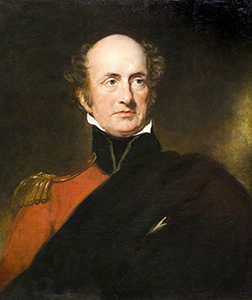
Figure 1. Sir John Malcolm, unknown artist, Langholm Town Hall. Image courtesy of Annan Museum, Scotland.
Early life. John Malcolm was the seventh child and fourth son of George Malcolm (1729-1803), a sheep farmer, and Margaret “Bonnie Peggy” Pasley (1742-1811). One of ten brothers and seven sisters, he was raised on the family’s Burnfoot farm near Langholm in Drumfriesshire, Scotland, and educated up to the age of twelve at the nearby Westerkirk Presbyterian parish school (Kaye, I, p. 5; Pasley, p. 6; Fisher, p.318; Frykenberg, p. 292). Facing precarious financial circumstances following failed speculations, George Malcolm secured employment for his sons at early ages with the assistance of acquaintances, notably through the well-connected Johnstones with the help of Malcolm’s maternal uncle John Pasley, a London merchant. The three eldest Malcolm sons, Robert (at the age of seventeen), James (at the age of twelve), and Pulteney (at the age of ten), entered respectively the English East India Company’s Madras civil service, the Marines, and the Royal Navy. In 1781, John Malcolm, then twelve years old, secured an interview at the East India Company headquarters in London (EIC; see EAST INDIA COMPANY [BRITISH]) through the intercession of the same maternal uncle (Pasley, pp 6-7; J. (I.) Malcolm, pp. 9-15). The EIC, founded in 1600 as a private joint-stock company with a monopoly for trading in the East Indies, had rapidly established its direct and indirect rule over vast areas of the Indian subcontinent following its 1757 military intervention in Bengal (independently of the British government). The company’s military and political affairs were gradually brought under the direct supervision of the government in London (through the 1773 Regulating Act and the 1784 India Act) around the time Malcolm was recruited by the company as a cadet. In what may be an apocryphal account repeated by subsequent biographers, the young John Malcolm was asked during his EIC interview what he would do should he encounter Hyder Ali, the sultan of Mysore who had seized de facto power in 1761 from the rajas of the Wodeyar dynasty, and now a formidable foe of the territorially expanding EIC. Reportedly, the interviewers were greatly pleased by Malcolm’s answer: “I would out with my sword, and cut off his head” (Kaye, I, p. 8).
Malcolm in British India. Malcolm sailed to British-controlled territories in the Indian subcontinent in October 1782. Just shy of his fourteenth birthday by the time he arrived in Madras in April 1783, he was considered too young for combat duty and was initially assigned as an ensign to the garrison in Vellore, where he came to be known as “Boy Malcolm,” his lifelong moniker among the British friends he made in the subcontinent (Kaye, I, pp. 9-11, 213). Within a year, he was given command of the EIC’s sepoys (native soldiers serving under European officers) tasked with the repatriation of EIC prisoners captured during the Second Anglo-Mysore War (1780-84), during the reigns of Hyder Ali and, after 1782, his son Tipu Sultan (Philippart, 469). In 1788, at the age of nineteen and as an adjutant in the 29th battalion of the Madras native infantry, Malcolm’s regiment entered the service of Nizam Ali Khan, the ruler of Hyderabad and an ally of the EIC, as well as a regional adversary of Tipu Sultan. In 1790, Malcolm’s Hyderabad regiment engaged in the Third Anglo-Mysore War (1790-92) against the forces of Tipu Sultan. In Hyderabad, Malcolm made the acquaintance of the British Resident, captain John Kennaway, and his assistant Graeme Mercer, among other EIC administrators at the court of the Nizam. Exposure to EIC officials and their lifestyle kindled Malcolm’s ambition of pursuing an administrative career in British India (Kaye, I, pp. 19-22; Pasley, pp. 12-13). In fulfilment of the necessary qualifications for such a career path, Malcolm, whose formal education had been interrupted at the age of twelve and who was considered “quite illiterate” by the EIC staff who knew him, enthusiastically immersed himself in the study of Persian, the official language of EIC’s transactions in the subcontinent at the time, as well as several other local languages and the political history of the EIC. In late January 1792, during the closing stage of the Third Mysore War and now at the rank of a lieutenant since November 1788, Malcolm was appointed by the governor-general of British India, Lord Charles Cornwallis (1786-93), as the Persian interpreter liaising between the EIC forces and the army of the Nizam of Hyderabad during the siege of Mysore’s capital Seringapatam (Srirangapatna). Malcolm served in this capacity until the end of the war on 18 March 1792 (Kaye, I, pp. 20, 26; Harrington, pp. 21-22). His primary Persian teacher after 1790, and also one of his research assistants on various subsequent publication projects, was Mercer’s Indian munshi (native secretary), Mahomed Hoosein, whom Malcolm met in Hyderabad and later took on as a member of his own staff (Malcolm, Sketches I, p. 107), with others also assisting him in his study of Persian along the way (idem, Sketches II, pp. 118-19; Kaye, I, p. 40; Kaye, II, p. 434). Malcolm continued perfecting his knowledge of Persian until at least the 1820s, by which time he was working on his Sketches of Persia (1827).
Malcolm’s first home visit to Britain and return to British India. Lieutenant Malcolm traveled to Britain on medical leave in early 1794. In London, he submitted a paper to the EIC’s Board of Directors at the East India House, criticizing the conditions of British officers in India. This brought Malcolm to the attention of Lord Henry Dundas, the president of EIC’s Board of Control, the governmental body overseeing the political and military affairs of Britain’s territorial possessions in the subcontinent. Dundas arranged for Malcolm to serve as private secretary to the newly-appointed Commander-in-Chief of Madras forces, General Alured Clarke. Malcolm also occasionally attended classes at the University of Edinburgh while visiting his family in Scotland, before returning to India in Clarke’s company in May 1795. These irregular classes were further opportunity for Malcolm to educate himself on topics that could potentially advance his chances of securing future administrative posts in British India (Philippart, p. 469; Kaye, I, pp. 40-42; Pasley, pp. 14-15; Mclaren, pp. 24, 36-37, 42; Harrington, p. 22). Since February 1793, Britain had been at war with France in what came to be known as the French Revolutionary Wars. On his journey back to British India, Malcolm was involved in military operations against the forces of the pro-French Batavian Republic in the Dutch-controlled Cape Colony (Cape of Good Hope). Serving as temporary aid-de-camp to General Clarke, who was under orders to assist the main British naval invasion force at the Cape on his way to India, Malcolm enlisted four hundred captured German soldiers of the defeated Batavian Republic for service in British India as part of the Madras army’s European contingent. He arrived in India in early 1796, assuming his duties as Clarke’s private secretary. From late 1797, Malcolm served Clarke’s successor, General George Baron Harris, in the same capacity; Malcolm being promoted to the rank of captain-lieutenant in November of that year. With Clarke appointed the acting governor-general of British India and the commander-in-chief of the army of British India in the spring of 1798, Malcolm, while still on General Harris’s personal staff, was made town-major of Fort St. George, the main British garrison in Madras (Philippart, p. 469; Kaye, I, p. 62; Pasley, pp. 17-18; J. (I.) Malcolm, pp. 40-45; Fisher, p. 318; Frykenberg, p. 292).
In May 1798, the new governor-general of British India, Lord Mornington (Richard Colley Wellesley; Marquess Wellesley after 1799) arrived in Calcutta, the administrative capital of Britain’s Indian empire. Mornington appointed Malcolm, now at the rank of a captain (by brevet since January, and regimentally after September), the assistant to the British resident in Hyderabad, Captain James Achilles Kirkpatrick. Before the end of the year, with Britain and France at war in Europe and targeting one another’s colonies and trading posts around the world, as well as those of their rival’s allies, Lord Mornington planned another invasion of Mysore in order to depose Tipu Sultan, who had aligned himself with the French and was receiving French military aid. Tipu’s control of Mysore and further territorial ambitions, including in neighboring Hyderabad, constituted a major obstacle to Mornington’s objective of reviving Britain’s robustly expansionist policy in the subcontinent, which had been curbed by the EIC’s Board of Directors and the Board of Control in London since the resignation in 1785 of the first governor-general of British India, Warren Hastings. Evidently, Lord Mornington exploited the specter of what in actuality would have been implausible, or at best insignificant, French threats to British India during the French Revolutionary Wars (whether by means of French alliances with independent states in the Indian subcontinent, or overland invasions via Afghanistan and Persia, or by sea) in order to obtain London’s backing for the governor-general’s own exorbitant forward policy in the subcontinent (Yapp, pp. 19, passim; cf. Ingram, 1984, pp. 207-11; idem, 1992, p. 27, passim). In preparation for the invasion of Mysore, Mornington pressured the Nizam of Hyderabad to join the British military venture, with the first step being the purge of French military officers in charge of the Nizam’s army. In early October, following news of French forces landing in Egypt under the command of General Napoleon Bonaparte, Malcolm, along with additional British sepoy forces, entered Hyderabad. Later in the month, the reluctant Nizam complied with the British request, discharging the French officers in his service. This was the start of events that gradually reduced Hyderabad to a protectorate status under the terms of a “Subsidiary Alliance” with the EIC. In reaction to the dismissal of the French officers, many of the Nizam’s native soldiers (sepoys) rebelled and took their former French officers hostage, fearful of both losing their arrears in pay and being permanently disbanded. Malcolm was dispatched to negotiate the release of the French officers and arranging for the payment of the Nizam’s forces. He was captured by the rebels, but eventually succeeded in negotiating a favorable outcome, which garnered him greater clout in the estimation of the governor-general and other British administrators in the subcontinent. (Kaye, I, pp. 63-79; Pasley, pp. 22-23; Dalrymple, pp. 118-20.)
In preparation for what became the Fourth Mysore War, on 19 January 1799 Malcolm took charge of the Nizam of Hyderabad’s infantry, which, along with the armies of the Maratha confederacy from the north, served as auxiliary forces to the main British invasion army. The governor-general’s brother, Colonel Arthur Wellesley (the future Duke of Wellington) shortly assumed overall command of infantry and cavalry forces of Hyderabad, with Malcolm and Arthur Wellesley forming a life-long friendship. However, Wellesley’s aristocratic background and, hence, superior social standing to Malcolm, as well as Wellesley’s more senior military and political connections, proved of no advantage to Malcolm in securing the highest administrative posts in British India later in life. By May 1799, British-led forces had killed Tipu Sultan and captured Mysore, turning it into a British protectorate state. Malcolm, along with Captain Thomas Munro, were appointed secretaries to the commission in charge of implementing Mysore’s post-war arrangements, including its territorial divisions and annexations (Philippart, pp. 469-70; Kaye, I, pp. 82-88; Gurwood, pp. 3-42; Pasley, pp.24-26).
Malcolm’s first mission to Persia (1799-1801). The Governor-General now turned his attention to the Dorrāni empire in the northwest (covering much of present-day Afghanistan and parts of Pakistan). The Dorrāni ruler Zamān Shah, who perennially raided Sikh-dominated Punjab and threatened to destabilize, or possibly capture, territories bordering British India, was now suspected of entering an alliance with France. This was yet another opportunity for Lord Mornington to exploit London’s anxiety about French objectives in the region as a means of justifying the governor-general’s own belligerent military and political maneuverings (cf. Ingram, 1992, pp. 43-44). Mornington considered Britain the inevitable successor to the former Mughal Empire in the subcontinent (Dalrymple, pp. 4-5, 117, 205, passim). This outlook was shared by Malcolm. Mornington’s anti-Dorrāni policy launched the start of Malcolm’s diplomatic career. Given Malcolm’s proven ability as a negotiator, his progress in Persian language, his support of the governor-general’s military policies (even if they occasionally differed on the implementation of those policies), and the confidence in Malcolm’s overall abilities on the part of the governor-general’s brother Arthur Wellesley, Malcolm was appointed in August 1799 the EIC envoy to the Persian court of the Qajar ruler Fatḥ-ʿAli Shah (also known as “Bābā Khan”). In this fortuitous diplomatic career overture, Malcolm was to secure Persia’s assistance against Zamān Shah and to conclude a commercial treaty between British India and Persia. At the time, the newly-founded Qajar state (1796-1925) was engaged in a territorial contest with Russia over mastery of the eastern Caucasus, Georgia in particular. Fatḥ-ʿAli Shah was also known for his antagonism toward Zamān Shah, whose political leverage extended into northwestern Persia; the Qajar state, in turn, harboring its own territorial ambitions in Afghan lands. Malcolm set out for Persia in late December 1799, after months of consultation and preparations, including assembling a team of experts and close associates who came to be known as Malcolm’s “Family,” one of whom (Charles Pasley) was an actual relative of Malcolm, as well as a large contingent of accompanying military and other staff (Malcolm, History I, pp. xiii-xv; Philippart, pp. 470-72; Kaye, I, pp. 91-94, 105-10; Pasley, pp. 26-27; Ingram, 1984, pp. 181, 185-200).
Malcolm was the first “British” envoy to Persia since the 1562-63 mission of Anthony Jenkinson, an agent of the Moscovy Company who also served as the representative of England’s Queen Elizabeth I to the Safavid court of Shah Tahmāsp I (see Coote and Morgan, eds., I, pp. 112-56). By the time Malcolm traveled to Persia, the EIC already maintained diplomatic agents in that country at the Persian Gulf port city of Bušehr, known as the Bušehr Residency. The company had engaged in trade with Persia since 1617, during the reign of the Safavid ruler Shah ‘Abbās I and had established a trading factory and a Residency at Bušehr under a 1763 farmān (royal decree) issued by Persia’s Zand ruler Karim Khan. After being withdrawn in 1768, the Residency was re-established in 1775. During Malcolm’s visit to Persia, the EIC Resident at Bušehr (since 1798) was Mahdi-ʿAli Khan, of Iranian extraction (Malcolm, Sketches I, p. 102; Kaye, I, pp. 94, 114-15, 513-15, passim; Wright, 1985, pp. 9-24, passim). Malcolm, however, was the first EIC envoy to the Persian court, acting as the diplomatic representative of the governor-general of British India. He sailed for Persia on board the Bombay on 29 December 1799. On his journey to Iran, Malcolm arranged for an EIC commercial and political agent to be stationed in Muscat, after raising the prospect of a British blockade of Muscat’s trade with all ports in the Indian subcontinent and warning Sultan bin Ahmad of Muscat of the potentially adverse repercussions of the latter’s continued friendly relations with France — Malcolm alluded to the fate of Mysore’s ruler Tipu Sultan (Malcolm, History I, pp. 511-13; Kaye, I, pp. 105-10; Sykes II, pp. 249-53). Malcolm reached Bušehr on 1 February 1800. The primary objectives of Malcolm’s mission were threefold: 1) encouraging Fatḥ Ἁli Shah to attack Zamān Shah’s Persian frontier for diverting Zamān Shah’s attention away from the Indian subcontinent; 2) preventing the extension of French influence to Tehran, a scenario that assumed greater probability from the perspective of British policy makers in light of the recent termination of armed hostilities between Napoleonic France and Russia (under Tsar Paul I); and 3) expanding Britain’s Indian trade with Persia (Malcolm, History II, pp. 315-16; Kaye, I, pp. 89-94; Yapp, pp. 19, passim; Ingram, 1984, pp. 78-87, 91-99; Savory, pp. 35-36; Wright, 2001, p. 4). In his account of the mission, Malcolm was highly critical of the Persian authorities’ penchant for excessive pageantry and long delays in admitting him to the Persian capital for a royal audience, detaining him for weeks on end at each of the major stops along the way to Tehran, such as his stays in Shiraz and Isfahan. For his part, from the moment Malcolm landed on Persian soil, accompanied by a large military entourage and his team of experts (with some of the latter dispatched to different parts of the country on various fact-finding and survey missions), it was clear that Malcolm’s mission would prove to be an exorbitant affair for the EIC. He dispensed lavish gifts to his Persian hosts at various extended stops along the way (the most luxurious of the gifts reserved for the Shah). This was in keeping with Malcolm’s already-formed belief that the professedly “oriental” mind was particularly susceptible to displays of opulence and military power. To this end, Malcolm repeatedly quibbled over correct observance of diplomatic protocols, often refusing to abide by Persian expectations and insisting that as a representative of a constituent part of the British Empire he be exempted from certain formalities and receive exceptional treatment (Malcolm, History II, pp. 554-57, passim; idem, Sketches I, pp. 49-50, 122-24, 126-27, passim; Kaye, I, pp. 111-14, 116-20, 125-26, 130-34, passim; Curzon, pp. 617-18; Pasley, pp. 28-29; Wright, 2001, pp. 32-33; J. (I.) Malcolm pp. 107-8). It is not known if Malcolm’s imposing height of reportedly “six feet seven inches” (Malcolm, Sketches I, p. 57) gave him further advantage in intimidating those Persian officials who were averse to accommodating his requests.
Malcolm eventually reached Tehran in November 1800, where the Persian court assigned the grand vizier, Ḥāji Mirzā Ebrāhim Kalāntar Širāzi (Eʿtemād-al-Dawla), as Malcolm’s host and negotiator. Forming a favorable opinion of Ḥāji Mirzā Ebrāhim, Malcolm would learn not long after returning to India in 1801 of Ḥāji’s fall from royal grace and his murder, as well as the murders and blinding of some of Ḥāji’s male relatives, serving as further confirmation for Malcolm of the accuracy of his existing verdict on the enduring despotic character of Persian kingship (Malcolm, History II, pp. 171, 175-90, 192, passim; Malcolm, Sketches II, pp. 76, 113-15, 118-19, 123-25, 141-44, 152-56; Kaye, I, pp. 130, 134, passim; Harrington, p. 86). Incidentally, Malcolm’s British nemesis in Persia from 1808 to 1811, Sir Harford Jones (later Harford Jones Brydges), would later cite Malcolm’s lofty opinion of Ḥāji Mirzā Ebrāhim as proof of Malcolm’s weak judgment of character and inadequate grasp of the political establishment in Persia. Glossing over the fate of Ḥāji’s relatives, Jones described the hapless grand vizier “as execrable a scoundrel as ever lived; he was the Macbeth of Persia” (Jones Brydges, 1834, I, pp. 413-14 n.†; cf. Busse, pp. 95-100). By the time Malcolm reached Persia, he had acquired intermediate proficiency in Persian, which he spoke with a “Hindostanee pronunciation” (Kaye, I, p. 123). Hence, in some of the formal negotiations with Persian officials, he relied on two of his staff fluent in Persian, identified as “Aga Meer,” a Persian by birth, and the Indian munshi Mahomed Hoosein, Malcolm’s primary Persian-language instructor (Malcolm, Sketches I, pp. 107-10; idem, Sketches II, pp. 118-19). Along with other Persian-speaking staff, Mahomed Hoosein and Aga Meer would accompany Malcolm as his Persian secretaries on his subsequent missions to Persia (Malcolm, Sketches I, pp. 92, 100-112, passim; Kaye, I, pp. 116, 416).
Malcolm gained his first brief introductory royal audience with the shah on 16 November. This was followed by another royal audience on 27 November. By most accounts, the shah developed an affable attitude toward Malcolm. After an exchange of gifts, it was arranged for Malcolm and the Persian grand vizier to undertake what became protracted negotiations for concluding political and commercial treaties between Persia and British India, with further royal audiences in the interim. Separate commercial and political treaties were signed on 28 January 1801. The commercial treaty guaranteed the mutual protection of merchants (and their property) from the other party’s territory. The overarching and ambiguously-termed political treaty called on Persia to support British India, should the Dorrāni rulers invade the latter and British authorities request Persia’s assistance. Persia was to also cooperate with British India in the event of a French invasion of Persia (presumably en route to the Indian subcontinent) and to deny France a presence on Persian islands in the Persian Gulf. In turn, British India was to assist Persia in the event Persia was invaded. The vagueness of this clause would become a point of contention between Calcutta and Tehran when, in 1804, Russia and Persia went to war over Georgia, with Britain at the time being on friendly terms with Russia. To extricate itself from the wrangling circumstances after repeated Persian appeals for military assistance following the outbreak of the Russo-Persian War in 1804, Calcutta first repudiated the interpretation that the 1801 political treaty included actual British military assistance to Persia, rather than mere arbitration for resolving the conflict. It then claimed that neither of the 1801 treaties were formally ratified, lacking the final seal of the governor-general, despite Malcolm having signed them as the governor-general’s representative. As last resort, Calcutta claimed that a British armed engagement with Russia fell outside the sphere of Calcutta’s decision making, since it would ultimately involve Great Britain in a European war with Russia and, therefore, had to be authorized by London (Kaye, I, pp. 130, 132-47, 418, 516-25; Busse, pp. 94-95; Pasley, p. 29; Ingram, 1984, pp. 96-97; idem, 1992, pp. 45-46, 48, 56-8, 71-85).
Malcolm left Persia on 15 March 1801, returning to India via the Persian Gulf by way of the Ottoman Empire (Kaye, I, pp. 152-54). Prone to bouts of self-exaggeration, he later claimed to have introduced the potato crop to Persia during this mission, where the natives allegedly thereafter referred to it as “alou-Malcolmeah,” meaning “Malcolm’s plum” (Malcolm, History II, p. 514 n.*; idem, Sketches I, pp. 35-36; Kaye, II, pp.46-48, 62). This assertion was challenged shortly after Malcolm’s death by Sir Harford Jones, who stated he had eaten potatoes in Bušehr in 1783, where the British Resident in the city also planted the tubers in his own yard (Jones Brydges, 1834 I, Note IV, pp. vii-ix). The potato, known generally in Persian dialects across Persia as sib-e zamini (earth/ground apple; equivalent to the French pomme de terre) and in other local languages by similar (as in Azeri Turkish) or alternative designations (as in Kurdish or Arabic), was introduced to that country much earlier, as indicated by Jones. The actual origins of the introduction of the potato to Persia and the particular common Persian derivation of the European term for it (as opposed to the English designation, or the Spanish “patata,” or the Portuguese “batata”) remain unknown. But, at least as early as the third decade of the 18th century, the Scottish captain Alexander Hamilton noted the ample existence of the crop on the Persian Gulf island of Kharg), which was in regular maritime contact with Bušehr, among other ports in the Gulf (Hamilton, p. 295). In his journal, Malcolm appears to have anticipated future refutation of his claim, admitting the existence of “a vegetable at Ispahan called the alou-i-zumeen [sic], which exactly resembles the potato … translated pomme-de-terre,” with “the merit of introducing this plant … readily given to the French, who had bestowed this benefit on the Persians a hundred years ago.” However, in his resolute determination to take credit for the introduction of the potato to Persia, he proclaimed the previous genus of potatoes existing in that country to have been of an inferior quality and, hence, unfit for human consumption. This assertion was later repeated by Malcolm’s biographer John William Kaye in response to Jones’s contestation of Malcolm’s pioneering claim (Kaye, I, pp. 47 n.*, 48). Casting further doubt on the veracity of Malcolm’s claim is his clearly deliberate and misleading terminological slippage between the homophonous common name for the potato in the Indian subcontinent (āloū / āloo, from the Sanskrit origin for edible roots) and the Persian term for “plum” (ālū / ālūča), when referring to the Persian designation of the tuber he purportedly introduced to Persia as “alou-Malcolmeah” and the allegedly mediocre prior genus as “alou-i-zumeen,” with the latter meaning “earth plum” (cf. Yule and Burnell, pp. 10-11; ALUČA). What is certain, is that through incessant reiteration by Malcolm and other authorities on the subject, he succeeded in taking credit for the origin of the crop in Persia in most subsequent accounts, scholarly or otherwise, including in Persia itself to this day. On this mission, Malcolm also left his name to posterity in Persia in another way, by scratching it on a wall of the ancient ruins of Persepolis during a visit; an act he repeated during his second visit there in 1810, albeit he was not the first, nor the last, “Western” visitor to deface the site with graffiti (Curzon, p. 157; J. (I.) Malcolm, pp. 109-10; Simpson, pp. 42-44; Figure 2).
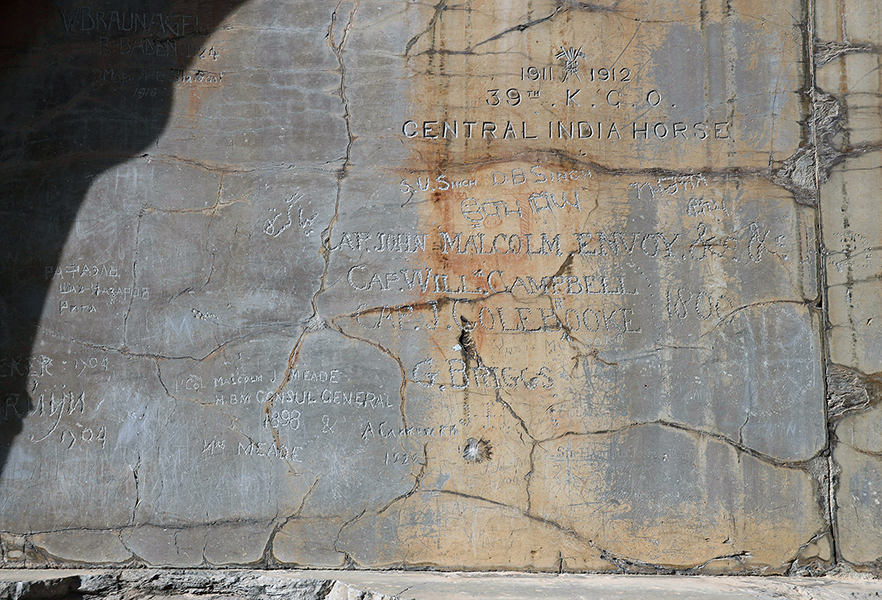
Figure 2. Graffiti on the Gate of All Nations, Persepolis with name of John Malcolm. © Juergen Hasenkopf / Alamy Stock Photo.
Of his three missions to Persia (1799-1801, 1808, and 1810), Malcolm would be best remembered in Persia for his first mission, in part due to its striking pageantry. The mission consisted of a retinue of five hundred, among them nearly a hundred sepoys and sowars (native Indian cavalry force commanded by European officers), joined by hundreds of local porters and attendants enlisted in Persia to transport the effects of the mission and the many luxurious gifts, which were carried overland by porters and mule trains, including several large mirrors among the presents for Fatḥ Ἁli Shah that were manually transported to Tehran at the shah’s insistence by reportedly twelve hundred porters, at a great cost to the Persian government (Kaye, I, pp. 125-26; Jones Brydges, 1833, pp. 111-15; Pasley, p. 29; Ingram, 1984, p. 91). Malcolm’s third mission would be spectacular in its own way. In his 1821 travel narrative, Sir Robert Ker Porter, another Scotsman visiting Persia, noted with perhaps some exaggeration, “everywhere I went in the empire where his mission had led him, still I found his remembrance in the hearts of the inhabitants” (Porter, I, p. 379).
Mysore Residency and marriage. Malcolm returned to Bombay on 13 May 1801, nearly a year-and-a-half after he had set out for Persia (Kaye, I, p. 154). Proud of his achievement, he was censured by the EIC’s Board of Directors and the Board of Control in London for the extraordinary profligacy of his Persian mission and the inexpedience of the mission itself; the governor-general, as might be expected, defending Malcolm (Kaye, I, pp. 158-59; Pasley, pp. 30-31; Ingram, 1984, pp. 91, 98; Wright, 2001, pp. 4-5; Savory, pp. 35-6). Malcolm was now engaged as private secretary and special representative of the governor-general, with the latter known as Marquess Wellesley since December 1799 (formerly Lord Mornington). Malcolm was regularly dispatched to different parts of the subcontinent for policy implementation, negotiating new, or modifying existing, alliance arrangements, and smoothing things over in general (Kaye, I, pp. 155-67, passim). “Send Malcolm!” became a catch-phrase for the wide range of duties he carried out (Pasley, chap. 4; Kaye, I, p. 177; J. (I.) Malcolm, pp. 125-31), with others, such as the governor-general’s brother and Malcolm’s friend, the military officer Arthur Wellesley, continually calling on Malcolm for advice on various matters. Given Malcolm’s range of assignments, he was widely-acknowledged as having “extensive information with regard to the general political system of India” (Gurwood, p. 405). Promoted to the rank of major in January 1802, Malcolm was also called upon to manage a critical diplomatic quandary following the murder of the Persian ambassador to British India, Ḥāji Ḵalil Khan Malek-al-Tojjār. Ḥāji Ḵalil Khan had been appointed in late 1801 as the Persian envoy after persistent solicitations of the shah since 1798 by the EIC’s Bušehr Resident Mahdi Khan. Having reached the Bombay presidency in May 1802 on his way to Calcutta, Ḥāji Ḵalil Khan was accidentally shot and killed on 20 July during a quarrel between his Persian guards and the EIC sepoys protecting him, with some of his Persian guards and attendants also killed or injured in the fray. Malcolm arranged for an official note of apology to the shah; generous pensions in keeping with rank for the families of the Iranians killed in the melee; donations to leading Shi’i clergy in Najaf (in Ottoman Iraq), where the deceased Persian ambassador was to be buried; and a suitable military naval escort for transporting the bodies of the ambassador and other deceased Iranians and the remainder of Ḥāji Ḵalil Khan’s mission to the Persian Gulf (Kaye, I, pp. 177-80, 188-96; Philippart, p. 472; Jones Brydges, 1833, pp. 115, 210-11; Busse, pp. 105-7; Ingram, 1992, pp. 52-6; Wright, 1985, pp. 25-33).
Repeatedly frustrated at being overlooked for senior administrative posts in British India, Malcolm found some solace in his appointment as the British Resident of Mysore in March 1803 at the bidding of the governor of Madras, Lord Edward Clive (later Earl of Powis), the son of the famed Lord Robert Clive, who had set in motion EIC’s gradual territorial conquests in the Indian subcontinent in 1757 (Kaye, I, pp. 203-4). Within weeks, Malcolm was embroiled in the ongoing British-Maratha disputes, which eventually culminated in the second Anglo-Maratha War (1803-5) as a consequence of Marquess Wellesley’s plan to pressure the Maratha Confederacy into a Subsidiary Alliance with Calcutta. The two main territorial rivals in the Maratha Pentarchy were Daulat Rao Sindhia and Yeshwant Rao Holkar, both with nominal allegiance to the Maratha Peshwa, Rao II. Following Holkar’s military advance toward the Confederacy’s capital Poona in late 1802, the Peshwa took refuge onboard a British ship and concluded a Subsidiary Alliance with the EIC in December 1802 (Treaty of Bassein). The rejection by Sindhia and Holkar of the protectorate alliance, which covered the entire Maratha territory, marked the start of the new Anglo-Maratha War. Malcolm was prevented by an illness from participating in the military campaigns led by Arthur Wellesley. But, in late March 1803, at Lord Clive’s recommendation, Malcolm was put in charge of negotiations with the Maratha factions. In February 1804, he oversaw the signing of a Subsidiary Alliance by Daulat Rao Sindhia, followed by a similar alliance treaty with Holkar in December 1805, and a treaty of friendship with Holkar’s Sikh allies in January 1806. After further assignments in connection with the Anglo-Martha War, by early 1807 Malcolm fully resumed his duties as the Resident of Mysore (Gurwood, pp. 419, 430, 438, 442, 443-44, 449, 453-54, 462-66, 481, 513-14, passim; Philippart, p. 474-76, 479; Kaye, I, pp. 199-202, 208-57, 262-87, 288-300, 305-13, 315-19, 329-64; Pasley, pp. 37-48).
Meanwhile, Malcolm’s hope of securing a higher administrative post in near future suffered a major blow with Lord Cornwallis’ reappointment as governor-general in July 1805, replacing Marquess Wellesley, even as Malcolm continued to climb up the military ranks, being a lieutenant-colonel since late 1804. With Cornwallis’s death in October 1805, Sir George Barlow took over as the acting governor-general. Opposed to Wellesley’s expansionist policies, Barlow directed Malcolm to oversee the revocation of certain terms in the treaties imposed on the vanquished Maratha, as in the case of territories captured from Sindhia’s kingdom. The appointment in late 1806 of the new governor-general, Lord Minto (Gilbert Elliot-Murray-Kynynmound), who arrived in Calcutta in July 1807, signaled further marginalization of the political opinion of the likes of Malcolm in British India. Malcolm was principally committed to Marquess Wellesley’s robust policy in the region and effective leverage in neighboring territories; viewing such policy as necessary and inevitable for securing what was an undeniably British imperial possession in the subcontinent, rather than a primarily commercial undertaking by the EIC. At the time, the EIC’s Board of Directors and the Board of Control in London considered further territorial expansion and diplomatic entanglements in neighboring territories inexpedient on financial, commercial, and militarily grounds. Lord Minto happened to be the former president of the Board of Control. In the meantime, in July 1807, at the age of thirty-eight, Malcolm married Charlotte Campbell, the daughter of Colonel Alexander Campbell of the 74th regiment of Madras. The couple would have four daughters and a son (Philippart, p. 473; Kaye, I, pp. 386-88).
Malcolm’s second sission to Persia (1808). Since 1804, Persia had been formally at war with Russia over Georgia. Suffering major losses in the conflict, Tehran had expected British military assistance in keeping with the terms of the 1801 Anglo-Persian political agreement concluded by Malcolm. But no British assistance was provided, as the authorities in London sought to secure Russia’s alliance in the war against France. Rebuffed by Calcutta, the Persian monarch Fatḥ-ʿAli Shah turned to Napoleon for assistance, finally concluding the Treaty of Finkenstein with France on 4 May 1807. The treaty provided French military assistance to Persia and recognized Persia’s territorial claims to parts of Georgia and the remainder of the Caucasus. In turn, Persia was to terminate all relations with Britain and assist any prospective future French plan for invading British India by way Persia and/or Afghanistan. Napoleon dispatched Brigadier-General Claude Gardane to Persia as the French adviser to the Persian army. However, unbeknownst to Gardane and Fatḥ Ἁli Shah, the Franco-Persian treaty was soon superseded by events in Europe, as Napoleon and Tsar Alexander I concluded the Treaty of Tilsit on 7 July 1807. With this turn of events, Malcolm urged Lord Minto to authorize and fund a second mission with the express aim of bringing Fatḥ-ʿAli Shah back into Britain’s regional diplomatic orbit and counteracting any influence the French may have gained in Persia in the preceding months. While Minto opposed a forward policy in the subcontinent, he could not neglect menacing developments in neighboring territories. By the end of the year, with mounting rumors of France’s intended invasion of British India by way of Persia in the aftermath of the Treaty of Tilsit (as unfeasible as the rumored French strategy was), Lord Minto decided to dispatch separate envoys to the Sikh-ruled Punjab in the subcontinent, Afghanistan, and Persia and the Persian Gulf. Malcolm was appointed EIC’s plenipotentiary envoy to the Persian court, the Persian Gulf, and the Arab provinces of the Ottoman Empire (namely Ottoman Iraq, which had access to the Persian Gulf). Tasked with inducing those territories to renounce any ties with France, Malcolm’s diplomatic authority was to supersede those of the existing EIC Residents in the territories. Complicating Malcolm’s second mission was London’s decision to send its own envoy to Persia, Sir Harford Jones, for assuming direct control of British diplomatic relations with Persia. Before Malcolm set sail for the Persian Gulf, he and Lord Minto were aware of Jones’s embassy to the Persian court as the envoy of the crown. Yet, Minto was persuaded by Malcolm that the situation required immediate representation to the Persian court, rather than awaiting Jones’s mission that would take a long time to reach Tehran. Malcolm, temporarily promoted to the rank of Brigadier-General so as to match Gardane’s rank while in Persia, sailed from Bombay on 17 April 1808 with an effective fighting force of three frigates and five hundred troops for countering any possible French hostility, while also signaling to Fatḥ Ἁli Shah the gravity of the British resolve to oppose French presence in the region. Malcolm arrived in Bušehr on 10 May. But Malcolm’s second Persian mission proved a complete fiasco and a serious setback to Calcutta’s leverage in Tehran, while once again being an exorbitant drain on EIC finances. Buoyed by the experience of his first mission, Malcolm also overplayed his hand when issuing stern warnings to Persian officials in Shiraz through his cousin and emissary Charles Pasley, while Malcolm and the rest of the mission remained in Bušehr. He demanded the immediate expulsion of the French advisers still in Tehran (led by Gardane), while grousing over matters of protocol. Given Calcutta’s reneging on the terms of the 1801 political treaty with Tehran signed by Malcolm, and London’s dispatch of Jones to Tehran, it was reckless of Malcolm to presume his stern words to Persian authorities would carry weight, and he subsequently denied adopting a belligerent tone in his communications with Persian officials. Rebuffed by Fatḥ-ʿAli Shah and stuck in Bušehr, with no further hope of succeeding in his mission, Malcolm sailed directly to Calcutta on 12 July 1808, arriving there on 22 August (Kaye, I, pp. 391, 395-422, 426; Philippart, p. 479-81; Jones Brydges, 1834 I, pp. 17-20, 29-30, 35, 38, 43, 53-54, 113, 132, 155, 169, passim; Busse, pp. 125-27; Pasley, pp. 54-59; Ingram, 1984, pp. 122-27, 134-37, 159, 169-170; idem, 1992, pp. 87-99, 104-7, 108, 261; Sykes, II, 402-6; Wright, 2001, pp. 5-9; Savory, pp. 36-9; Lambton, 100).
Malcolm’s abortive assignment in the Persian Gulf and his third mission to Persia (1810). By November 1808, Malcolm had convinced Minto to send him in charge of a major naval expedition to the Persian Gulf as a British show of force for inducing the shah to break all relations with France. This was to also initiate Malcolm’s recommended plan for the permanent seizure of the Persian island of Kharg (“Karrack”) as a British military installation in the Persian Gulf. Malcolm was to enjoy the same temporary rank of brigadier-general and all the diplomatic authority conferred on him by Lord Minto on his earlier abortive Persian mission. However, following firm objections by the authorities in London, who felt such a move was unjustifiable and would at best undermine Sir Harford Jones’s embassy, the expedition was called off in February 1809 while Malcolm was in Bombay (Philippart, pp. 481-82; Kaye, I, pp. 422-25, 429, 432, 433-55; Jones Brydges, 1834, I, pp. 155, 169, 175, 193, 215-18, 227, 345; Ingram, 1984, pp. 87-91; idem, 1992, pp. 111-16, 150, passim; Wright, 2001, p. 69). Malcolm now resumed his duties in Mysore, until he was directed by Lord Minto to lead yet another delegation to Persia the following year.
The arrival of Jones in Tehran and his obtaining a royal audience in February 1809, followed by the signing of the (preliminary) Anglo-Persian treaty of friendship on 15 March (see ANGLO-PERSIAN RELATIONS ii. QAJAR PERIOD), marked the end of Gardane’s suspended French mission; although remnants of the French mission remained in Persia until spring of 1810 (Kaye, I, pp. 508-511; Kay,e II, p. 49; Curzon, pp. 624-25; Ingram, 1992, pp. 117-21). The Persian authorities discovered before long that the treaty signed by Jones (with a definitive treaty later concluded between London and Tehran in 1814) was another unreliable British undertaking, with some of its key terms evaded by London after Britain and Russia joined forces in 1812 for a major showdown with Napoleon (Ingram, 1992, pp. 123-33). More immediately, the conclusion of the 1809 treaty prompted Minto to dispatch Malcolm on his third mission to Persia in 1810, in what was an outlandish bid by Calcutta to wrest direct control of relations with Tehran from London, with Calcutta having been made responsible for the expenditure of Jones’s delegation in Persia. Unbeknownst to Minto, London in the meantime had dispatched Sir Gore Ouseley as Jones’ successor in Tehran and as the first permanent British ambassador to the Qajar court. On 10 January 1810, Malcolm sailed from Bombay for Bušehr, accompanied by an impressive fleet and a large entourage, and transporting a shipment of arms and a few military instructors for the Persian army, along with lavish gifts, as a means of boosting Calcutta’s diplomatic appeal in Tehran. He arrived in Bušehr on 14 February as the plenipotentiary envoy of British India, having again been conferred the brevet rank of brigadier-general and the range of authorities vested in him on his previous failed mission. He again immediately insisted that Persian officials receive and address him with the highest degree of pomp and protocol. Even before he arrived in Tehran, he and Jones engaged in maneuvers to outclass one another as representatives of the British Empire in the estimation of the Persian court, much to the bewilderment of Persian officials. On 21 June, Malcolm reached the royal summer camp stationed in Solțāniya in northwest Persia. He was granted his first royal audience two days later, relieved that Jones was not present as arranged by Persian officials for Malcolm’s ceremonial introduction to Fatḥ-ʿAli Shah. After other royal audiences, Malcolm followed the shah’s camp to the outskirts of Tabriz. It was there that Jones informed the Persian monarch of London’s appointment of Sir Gore Ouseley as Jones’s replacement; appointed by no other than the British foreign secretary Richard Wellesley (Marquess Wellesley), the former governor-general of British India and Malcolm’s erstwhile mentor, who had dispatched Malcolm on his first mission to Persia. With this development, Malcolm, who also met with the Persian crown prince ʿAbbās Mirzā, decided to conclude his stay in Persia, leaving Tabriz on 23 July en route to Bombay by way of Ottoman Iraq and then Bušehr. He had failed in yet another diplomatic mission to Persia, and both he and Minto were censured by the EIC Board of Directors and the Board of Control for yet another excessively costly and completely needless Persian mission. Before Malcolm left Persia, on 15 July, Fatḥ Ἁli Shah awarded him the Order of the Lion and the Sun (šir-o ḵoršid) and titles of khan (designating a social rank equivalent to lord) and sepahdār (brigadier). Malcolm was the first British subject to receive the Order of the Lion and the Sun, created for foreign dignitaries and first given to the French Brigadier-General Gardane. Malcolm was also the only Briton to receive the two titles bestowed upon him by the shah (Malcolm, Sketches II, pp. 163-64; Kaye, I, pp. 488-93, 507-12; idem, II, pp. 1-8, 11-35, 47-53, 55-59; Jones Brydges, 1834, I, pp. 354, 358, 361, 364-65, Note XVIII, p. xxviii; idem, 1833, pp. 365-72, 432-33; Philippart, pp. 482-83; Busse, pp. 133-34; Pasley, pp. 61-63; Wright, 1979, pp. 135-36; Ingram, 1992, pp. 145-49, 153-54, passim; Savory, p. 43.) The shah’s largess, generally interpreted as an indication of the monarch’s deep affection for Malcolm, may in part have been a consolatory measure to compensate for the dismissive treatment meted out to Malcolm by the monarch in 1808 and intended to mend relations with Calcutta as a center of British leverage on London. This was Malcolm’s last visit to Persia. When, in 1823, the EIC considered dispatching him on a Persian mission while he was visiting England, the plan was shelved following Malcolm’s insistence that he jointly represent the crown and British India on such a mission (Kaye, II, pp. 428-31, 459; Ingram, 1984, pp. 184-85; idem, 1992, pp. 248-51). He, nonetheless, remained a keen observer of Persian developments and periodically attempted to influence British policy toward Persia (Kaye, II, pp. 449-55).
Malcolm’s visit to Britain (1812-1816). Arriving in Bombay in late November 1810 from his last Persian mission, Malcolm obtained permission to remain in Bombay until his planned departure for Britain in early 1812, so he could devote himself to writing The History of Persia. There, he regularly attended the gatherings of the Literary Society of Bombay, founded by Sir James Mackintosh on 26 November 1804 and modeled after the older Asiatic Society of Bengal (see, for example, Malcolm, “Translations from the Persian”). With the personal encouragement of Mackintosh, Malcolm deepened his interest in scholarly research and publication. In Bombay, Malcolm was also introduced to Henry Martyn, the English clergyman who would soon travel to Persia, where in 1812, shortly before his death, he completed the Persian translation of the entire New Testament with the assistance of a Persian scholar (Mirzā Sayyed ʿAli Khan of Shiraz). Setting out for Persia, Martyn obtained a letter of recommendation from Malcolm addressed to Sir Gore Ouseley in Tehran (Malcolm, History I, p. xii; Kaye, II, pp. 62-66, 67-69; Harrington, pp. 72-73; Lambton, p.97; Pasley, pp. 71-74). Lord Minto provided Malcolm sufficient staff and support for compiling the necessary documents for The History of Persia, with Malcolm taking along the material for the book-in-progress when he and his family left for London on 19 January 1812.
Malcolm arrived in London in July, by which time he had lost both of his parents; his mother having died as Malcolm was on his voyage home (Kaye, II, p. 70). The Malcolm family took up residence in London, with the Napoleonic War still raging. On 15 December 1812, Malcolm obtained British royal assent to formally wear his Persian Order of the Lion and the Sun and was accorded a civil knighthood as “Sir John.” A lieutenant-colonel at the time, at the recommendation of Lord Minto and others, Malcolm was also awarded the generous sum of £5,000 by the EIC Board of Directors in recognition of his services (Kaye, II, pp. 76-77, 86-88). In England, he campaigned for reforms in the EIC’s army, bringing the grievances of British officers to the attention of the Board of Control. In the spring of 1813, Malcolm gave evidence in both houses of Parliament concerning EIC’s pending charter renewal. The finalized 1813 Charter Act deprived the EIC of its trade monopoly in British India, with the exception of its tea and opium trade with China. The new charter also separated the company’s commercial and political-military jurisdictions, with the company still responsible for military, administrative, and diplomatic expenditures. Furthermore, much to Malcolm’s disappointment, the new charter allowed Christian missionaries to operate freely in British India (Phillipart, pp. 485-86; Kaye, II, pp. 77-84; Pasley, pp. 69, 76-77). Malcolm belonged to the camp in debates on British India opposed to systematic religious and cultural intrusion into the subcontinent (leaving aside here the broader cultural ravages, as well as benefits, of British imperialism in the subcontinent in general). He considered such steps as alienating the natives and politically destabilizing British India (Kaye, II, pp. 361-63; McLaren, pp. 148-51, 157-58), as in the case of the Vellore sepoy mutiny of 1806. He also believed the most efficacious and durable means by which Britain should govern its newly-conquered territories in the subcontinent was through compliant (local) native rulers under British oversight, as a means of minimizing direct friction between British administrators and the native populations (Harrington, 152-57). Malcolm firmly believed in cultural separation between Britons and the natives of the subcontinent (as impossible as such a separation was). At the same time, he disapproved of overt expressions of so-called civilizational superiority by Britons in the subcontinent and gratuitous mistreatment of natives. In his 1821 Notes of Instructions to Assistants and Officers Acting under the Orders of Major-General Sir John Malcolm, G.C.B., he was adamant Britons should refrain from adopting native manners, in order to preserve the (ostensible) impression among the natives of European “comparative superiority in good faith, wisdom, and strength to their own rulers.” Simultaneously, British officers were advised to treat the native population with due respect according to social rank and “without prejudice or self-conceit, by a standard which is suited to [the natives’] … stage of civilization.” This manual was still in use for training British civil servants in India as late as the 1930s (“Central India,” pp. 542, 544; Collingham, 52, 58-59, 123, 188; Pasley, pp. 117- 21, 146). Moreover, Malcolm famously remarked: “I … cannot think that, if all the ranks of the different communities of Europe and India are comparatively viewed, there is just ground for any very arrogant feeling on the part of the inhabitants of the former” (Malcolm, A Memoir of Central India II, p. 438). The principle of treating the native populations of the Orient in a respectful manner in accordance with their “stage of civilization” was also characteristic of Malcolm’s personal interaction with Iranians during his missions to Persia, as indicated by the account of his third mission (1810) appearing in the 1827 Sketches of Persia (see below).
Traveling, spending time with his old friends, including Arthur Wellesley, now the Duke of Wellington, and gauging his own future career paths in British India, in April 1815 Malcolm was made Knight Commander of the Order of the Bath (KCB); his brothers James and Pulteney having been similarly knighted earlier in the year (Phillipart, pp. 483-85; Kaye, II, pp.92-93). This achievement was shortly followed by a major scholarly recognition. He already had published Sketch of the Political History of India, from the Introduction of Mr. Pitt’s Bill, A.D. 1784, to the Present Date in 1811, and Sketch of the Sikhs in 1812 (initially appearing in Asiatick Researches in 1806), and his Observations on the Disturbances in the Madras Army in 1809 had also appeared in 1812, while Malcolm was journeying from Bombay to England. In Britain, he had assiduously devoted himself to completing other publications. In the summer of 1815, what would become his most celebrated historical publication appeared in two volumes as The History of Persia from the Most Early Period to the Present Time, and was received with immediate scholarly and public praise in the United Kingdom; also earning him an honorary doctorate of law (L.L.D.) from the University of Oxford in June 1816 (Kaye, II, pp. 84, 89, 93-96, 111, 113, 118, 141-42, 418; Pasley, pp. 75-78, 81-86; Lambton, p. 101; Fisher, p. 319). Having failed in his quest for a durable diplomatic career in Persia, Malcolm was now hailed as a leading expert on Persia’s history and contemporary society, culture, and politics, in addition to being acknowledged as an authoritative historian of British India (Figure 3).
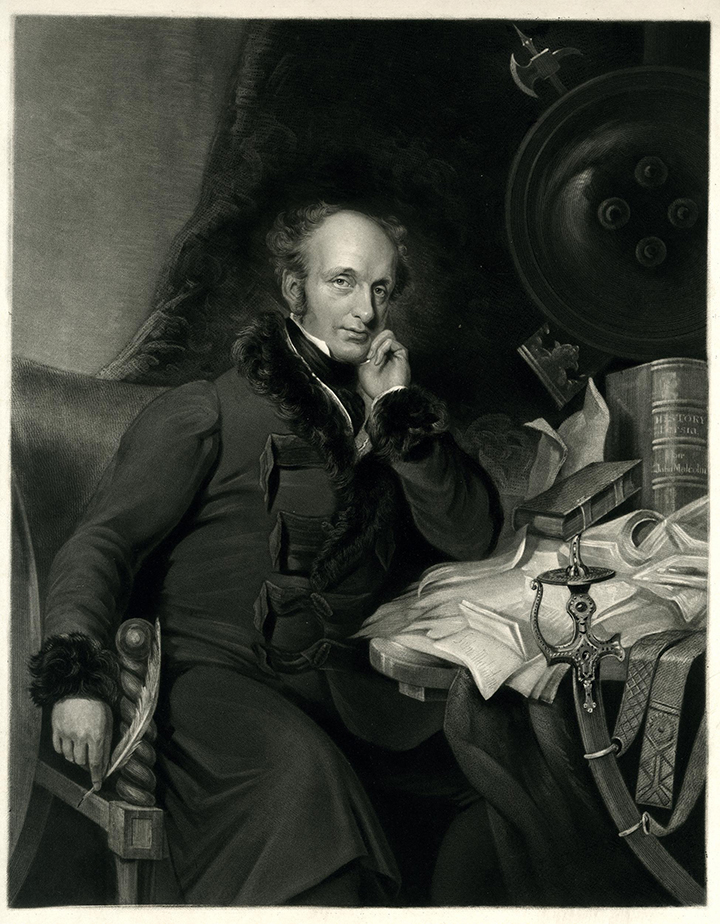
Figure 3. Sir John Malcolm. Print by John Porter ca. 1827, after portrait by Sir George Hayter. British Museum 1892,0714.769. © The Trustees of the British Museum, licensed under CC BY-NC-SA 4.0.
Return to British India and the Third Maratha War. Malcolm left England for India in October 1816, arriving in Madras in March 1817, with his wife and children remaining behind in England (Kaye, II, pp. 143, 144, 149). Not long after his arrival in the subcontinent, the preliminary stages for what became the Third Anglo-Maratha War (1817-1818) got underway. The governor-general of British India since October 1813 was Lord Moira (Francis Rawdon-Hastings; Marquess of Hastings after 1816); hereafter referred to as Lord Hastings (not to be confused with, and no relation to, the first Governor-General of British India, Warren Hastings). Hastings shared with Malcolm Lord Wellesley’s vision of British territorial consolidation and expansion in the subcontinent. Malcolm was appointed Hastings’ political representative at the brevet rank of brigadier-general and placed in charge of forces under the overall command of General Thomas Hislop; the forces of the Maratha Confederacy being under the nominal command of Peshwa Baji Rao II (with Daulat Rao Sindhia initially staying out of the conflict). Among many points of dispute between the two enemy sides in the latest war was the raids into British territory in the Deccan by marauding bands of primarily-Muslim Pindari irregular mercenaries serving the Hindu Maratha administrations. Malcolm, in command of the Third Division of the Deccan Army, was further tasked with securing the military support of Calcutta’s regional allies. His military accomplishments in this war — the first war in which he was in actual military command — included his overseeing the surrender of Malhar Rao Holkar in December 1817, followed by the surrender of the Sindhia and the Pindari chief in February 1818, and the Peshwa in June. Lord Hastings was perturbed by what he regarded as a generous pension settlement granted by Malcolm to the defeated Peshwa (Phillipart, pp. 486-97; Kaye, II, pp. 138, 151-298; Pasley, chap. 8; Frykenberg, p. 294; cf. Chakravorty, pp. 115-22, passim). The final resolution of the latest Maratha War occupied Malcolm until early 1819, with Malcolm evidently also receiving less than his standard share of the war spoils apportioned to officers of his military rank (Colonel regimentally since May 1817, having previously held that rank by brevet in 1813) (“Arguments for and Against,” pp. 105-11). He spent the next two years supervising the consolidation of British power in the Deccan, the suppression of remnant resistance by former Maratha forces, and the full pacification of the Maratha state of Malwa. With the capture of Maratha territories, the EIC was in control of much of the subcontinent through direct or indirect rule (Pasley, chap. 9).
The Third Anglo-Maratha War marked the highpoint of Malcolm’s military career. In May 1820, he was made major-general and on 14 September was awarded the Knight Grand Cross of the Order of the Bath (GCB) during a ceremony in Bombay. Yet, high-level administrative office in British India still eluded him. His hope of being appointed either the governor of Bombay or of Madras, or even lieutenant-governor of the recently-conquered central Deccan region, were frustrated. In December 1821, he set out for England, this time via Egypt and across Europe by land (Phillipart, pp. 498-500; Kaye, II, pp. 299-353).
Malcolm in England (1822-1827). Malcolm arrived in London at the end of April 1822, rejoining his family after five-and-a-half years (Kaye, II, pp. 414-18). This visit was to last five years, and it was during this prolonged family reunion in England that Malcolm set to work on his next, and final, book on Persia (Sketches of Persia), while also working on publications on British India. In 1822, his Report on the Province of Malwa was published, followed by A Memoir of Central India the next year, and The Political History of India from 1784 to 1823 appeared in 1826. In July 1827, Sketches of Persia, from the Journals of a Traveller in the East was published anonymously; although his authorship was never in doubt (Kaye, II, pp. 419, 422; Lambton, p. 102). These publications garnered him further renown as a leading authority on Indian territories and on Persia, even if his views on British policy in the Indian subcontinent were controversial and challenged by the likes of another Scotsman, James Mill, the Utilitarian philosopher and unabashed castigator of Hinduism, as well as a staunch critic of the expansionist policy of Governor-General Lord Mornington/Marquess Wellesley. In his 1817 three volume The History of British India, Mill challenged Malcolm’s rationalization of the governor-general’s interventionist and costly policies in the subcontinent, while condemning the logic, outcome, and expenditure of Malcolm’s first Persian mission of 1799-1801 (Mill, pp. 21, 26-28, 82-86, 89, 157, 160-63, 450-51, 501-2, 537-39; Harrington, 5-7, 12, 39-40, 75, 86, 90, 162-87, passim). In England, Malcolm futilely canvassed the EIC’s inner circles for the post of the next governor of Madras, all the while privately entertaining the ultimate ambition of becoming a governor-general of British India. In December 1826, he was appointed the governor of Bombay and set sail for India, having to contend with his new assignment — and additionally disappointed later when failing to secure the incorporation of the captured Maratha territories in the Deccan into the existing Bombay presidency (Kaye, II, pp. 458-94, Fisher, p. 320).
Final tenure in India (1827-1830). Malcolm set out for Bombay on 5 July 1827, this time accompanied by his oldest daughter and her husband (also a cousin) Sir Alexander Campbell, who was appointed as a military secretary in British India. Malcolm’s son George Alexander would later join Malcolm as a member of his staff. Malcolm assumed his post as Governor of Bombay on 1 November. Vigorously carrying out his duties, throughout his short tenure he had to grapple with ongoing economic crisis; his retrenchment policy proving widely unpopular. Moreover, he became embroiled in a highly publicized and bitterly factious and protracted standoff in 1828 with Sir John Peter Grant of the Bombay supreme court in a case involving a high-ranking native landowner who had been granted British protection. In Malcolm’s view, this individual’s circumstances exempted him from prosecution by the supreme court over financial matters. Malcolm further challenged the court’s jurisdiction across the entire presidency, insisting the court’s authority was restricted to the city of Bombay and to the British community alone. By the time this quarrel ended, following the threat of martial law, Grant’s closure of the court, and the arrival of new supreme court justices, Malcolm’s hope of higher political office in British India was permanently dashed; particularly with Lord Bentinck (William H. Cavendish-Bentinck) being appointed the new governor-general of Bengal in 1828, and of British India by extension. Malcolm decided to return to England, leaving India for the last time on 5 December 1830. (Kaye, II, pp. 493, 495, 497-98, 499-540, 554; Harrington, pp. 33-34; Frykenberg, pp.294-95; Pasley, pp. 137-49; J. (I.) Malcolm, pp. 489-515, 517-25.) It was during Malcolm’s governorship that in 1829 his Miscellaneous Poems appeared along with the second edition of The History of Persia.
Malcolm’s last years in England (1831-1833). Arriving in England in late February 1831 at the age of sixty-two (Kaye, II, p. 558), Malcolm immediately immersed himself in parliamentary politics, while completing his history of British administration in India, which appeared as The Government of India in 1833, shortly before his death. His final publication project appeared posthumously as The Life of Robert, Lord Clive in three volumes in 1836, edited and completed by William Erskine (Kaye, II, pp. 573-75, 579-80, 588, 599-600; Harrington, pp. 163-64). This was a biography of Robert Clive, the founding figure of British territorial possessions in the Indian subcontinent, and in many ways a role model for Malcolm. In April 1831, not long after arriving in England, Malcolm entered the House of Commons as a Tory member for the “pocket” borough of Launceston (Cornwall) at the bidding of an acquaintance, the Duke of Northumberland. What would become Malcolm’s short-lived parliamentary career coincided with the Reform agitation of 1830-32 in the United Kingdom for the expansion of (male) franchise to wealthy non-landed classes and, among other agendas, an end to the system of pocket boroughs, whereby a wealthy landowning individual either bought the votes of the small electorate of a constituency or pressured them by other means to elect a particular parliamentary representative; the very mechanism that had enabled Malcolm to enter parliament. The Tory anti-Reform platform in both houses of parliament was coordinated by Malcolm’s long-time friend and the former prime minister, Arthur Wellesley (Duke of Wellington). Primarily devoting himself in the Commons to Indian matters and the upcoming charter renewal of the EIC, Malcolm attacked the Reform platform. He formulated his opposition to the Reform Bill on grounds of the necessity for gradual change and the preservation of existing social and political hierarchies. Moreover, he made the tortuous case that the abolition of pocket boroughs, or similar “rotten” boroughs, would deprive the colonies of direct, and hence expert, parliamentary representation; since former colonial officials such as himself could not otherwise be guaranteed a seat. The Tory opposition failed to prevent the introduction of the 1832 Reform Bill, which also necessitated a new general election. While pocket boroughs were now abolished, the Reform Act actually facilitated the candidacy in parliamentary elections of wealthy non-landed individuals of Malcolm’s standing. He made an unsuccessful bid as a Tory candidate for Carlisle (Kaye, II, pp. 559-73, 577-88, 590-92, 596-98; Pasley, pp. 150-54; Fisher, pp. 321-22). During his parliamentary tenure and after his electoral defeat, Malcolm’s views resonated in parliamentary debates on Indian affairs (e.g., Parliamentary Debates (House of Commons), 2nd series, XXII, 1830, passim; ibid., 3rd series, III-VI, 1831, passim; ibid., 3rd series, XI, 1832, passim).
Recovering from influenza in early 1833, Malcolm died from a stroke on 30 May, not long after his sixty-fourth birthday. He was buried on 4 June at St. James’ Church, Piccadilly. A life-sized statue by Sir Francis Chantrey was erected in his honor at Westminster Abbey by his friends in 1837. He is also commemorated by a granite obelisk designed by Robert Howe and constructed by Thomas Slacks in 1835 on Whita Hill, facing Langholm near his place of birth in Dumfriesshire (Kaye, II, pp. 600-613; Pasley, pp. 161-62; Wright, 2001, pp. 9-10; J. (I.) Malcolm, pp. 543-45, 548).
Malcolm’s ‘The History of Persia’ (1815). Malcolm’s first publication on Persia was a narrative poem (Persia: A Poem. With Notes, 1814; published in London by John Murray, at the total length of 38 pages, inclusive of explanatory notes). The poem traced Persia’s history since its mythical past and appears to have been both as a personal diversion from, and a promotional tract for, Malcolm’s forthcoming historical tome on Persia, The History of Persia (1815). His final publication on Persia was Sketches of Persia (1827). The History of Persia, appearing in two volumes, is considered his magnum opus. This publication, along with his earlier Sketch of the Sikhs (1812), secured Malcolm’s eminence as a leading British scholar of the Orient; both publications, incidentally, covering independent territories on the periphery of British India to which Malcolm sought to draw the attention of British policy makers and the public (Harrington, pp. 71-72). The History of Persia, dedicated to the Marquess Wellesley, was the most comprehensive treatment of Iranian history available in any European language. The Scottish James Baillie Fraser, in the Preface to his 1834 An Historical and Descriptive Account of Persia, would note his substantial reliance on Malcolm’s The History of Persia: “The greater part of the narrative, subsequently to the Mohammedan invasion, is taken from the pages of Sir John Malcolm, whose volumes are now everywhere regarded as a standard authority in this department” (Fraser, p. 8). In fact, Fraser would repeat Malcolm’s diagnosis that the flawed national characteristics of Iranians was the product of their subjection to despotic rulers (Wright, 2000).
The first edition of The History of Persia consisted of nearly thirteen-hundred pages of text, along with an impressive Index of seventy-six pages. In many ways this was a major collective effort, without in any way discounting Malcolm’s arduous labor and ultimate frame of analyses. The likes of Malcolm’s staff fluent in Persian, such as Mahomed Hoosein and Aga Meer, as well as officers accompanying Malcolm on his Persian missions or dispatched by him at other times on other fact-finding assignments, among numerous other individuals, helped compile the necessary sources for the book (Malcolm, History I, pp. xii-xvi; Wright, 2001, pp. 149-51). Prior to setting out on his first Persian mission in 1799, Malcolm had already begun researching the current state of Qajar administration, familiarizing himself with characteristics of the government he was to engage with as Calcutta’s envoy to that country (Harrington, 96). He relied on both Western and Persian sources for The History of Persia, albeit regarding contemporary Western historians, such as himself, as more adept observers of Persia’s history than Persia’s native historians. In his estimation, in consequence of the enduring tyrannical forms of government that had ruled Persia since ancient times, the native accounts were compromised by self-censorship on the part of the authors and their inadequate grasp of the innerworkings of, as well as interactions between, social relations and political power. Concurring with many other Western commentators that Persian kingship exemplified oriental despotism, Malcolm also noted the limitations of monarchic authority, particularly in the case of Persia’s (Shiʿi) Muslim clergy; while simultaneously implicating Islam itself as a source of social and personal repression (Harrington, pp. 86-87, 88, 91, 97; McLaren, pp. 57-59, 166-67). Regarding the despotic character of government in Persia, Malcolm produced a grossly oversimplified model “of the cyclical corruption of Persian polity,” which served as “the rail-tracks on which many [British] histories of Persia would continue to move until the 1930s” (Bayly, pp. 95, 101). Among the many Western sources, classical histories aside, Malcolm consulted travel accounts from Marco Polo to Sir Anthony Sherley and Jean Chardin, and relied on a wide range of more recent historical studies, such as Judasz Tadeusz Krusinski’s The History of the Late Revolutions of Persia (1733), James Fraser’s The History of Nadir Shah, Formerly Called Thamas Kuli Khan, the Present Emperor of Persia (1742), Jonas Hanway’s. The Revolutions of Persia: Containing the Reign of Shah Sultan Hussein, with the Invasion of the Afghans, and the Reign of Sultan Mir Mahmud and His Successor Sultan Ashreff (1753), or John Macdonald Kinneir’s A Geographical Memoir of the Persian Empire, Accompanied by a Map (1813). The Iranian sources Malcolm consulted ranged from Ferdowsi’s 11th-century Šāh-nāma and the Zand Avestā on the ancient period to a much more exhaustive selection of works on recent history of Persia. These included chronicles and histories of the Safavids, accounts of the Afghan conquest in the 18th century and the subsequent rise of Nāder Shah and the Afšārid dynasty, the Zand dynasty, and the rise of Āḡā Moḥammad Khan and the founding of the Qajar dynasty in the late eighteenth century. On the earlier mythical accounts of Persia’s origins and the subsequent history of Persian territories until the late middle ages, inclusive of Arab-Muslim and Turkish and Mongol conquests, Malcolm also relied extensively on the Rawżat aṣ-ṣafāʾ of Moḥammad ibn Ḵᵛāvandšāh Mīrḵᵛānd (d. 1498), generally known in English as the Universal History of Mirkhond (Malcolm, History I, pp. 127, 129, 138, 142, 180, passim; idem, Sketches II, p.12), with various partial translations of this work having appeared in different European languages by the time Malcolm began his History.
The first volume of Malcolm’s History, in which he referenced Mīrḵᵛānd’s work, in some ways constituted an updated, and much more extensively researched and methodologically “modern,” version of the previous complete history of Persia by a British author, that had been published exactly a century earlier. This was Captain John Stevens’ 1715 The History of Persia: Containing, the Lives and Memorable Action of its Kings from the First Erecting of that Monarchy to this Time; an Exact Description of All its Dominions … Written in Arabick, by Mirkond. Stevens had relied on the translation of Mīrḵᵛānd’s work by the Portuguese Pedro Teixeira (appearing as “Anthony Teixeira” in his book), along with later accounts by such European travelers to Persia as Jean Thevenot, Jean-Baptiste Tavernier, Chardin, and Giovanni Francesco Gemelli (Stevens, Preface). While Teixeira and some other sources consulted by Stevens are cited as references in Malcolm’s History, there is curiously no mention of Stevens’ The History of Persia. The next comprehensive history of Persia by a British author would be the now largely forgotten 1874 A General Sketch of the History of Persia by Clements Robert Markham, which followed Malcolm’s thematic chronology and historical divisions since Persia’s mythical ancient past and brought that history up to date until the Reuter concession of 1872. Markham’s history, which also chronicled Anglo-Persian relations and military and diplomatic conflicts since the start of the 19th century, acknowledged both Stevens and Malcolm as the many sources consulted, and included a condensed account of the competing diplomatic missions to Persia of Malcolm and Harford Jones (Markham, pp. viii. xi-xii, 368-375).
Significantly, in The History of Persia, Malcolm approached his subject through contemporary western-European methodological standards applied to European history, including that of the interaction between politics and society, while attempting to disentangle history from mythology (Harrington, pp. 83, 85). Engaging with the latest available European scholarship on Indo-European languages (albeit flawed), he commented on the language and history of ancient Persia, discussed the mythic nature of Iranian accounts of Persia’s ancient past, and elaborated on Iranians’ lack of adequate familiarity with their own country’s distant past. In the case of discrepancies between Persian and Greek sources on particular events, he considered Greek accounts as always more reliable. The first volume of Malcolm’s History opens with the mythical past of Persia, including the Mahābādiān dynasty which had gained currency since the appearance of Dabestān-e maḏāheb in the 17th century, with various partial English translations made by members of the Asiatic Society [of Bengal] in the late 18th century and popularized by William Jones (History I, pp. 6-31; 181-90, 199, 204, 205, 247, 248-49, passim). The volume then proceeds with subsequent mythical, semi-mythical, and historical eras recorded in Ferdowsi’s Šāh-nāma and in other works, including such events as Alexander’s conquest of [Achaemenid] Persia, the Sasanian dynasty, and the post-seventh-century Arab-Muslim conquest of Persia (Chaps. I-VII). Chapters IX-XIII deal with Ghaznavid, Saljuq, Atābakān, Mongol, and Timurid periods, and the ascendance of the Turkic Qara Quyunlu and Āq Quyunlu tribes in the north, leading to the founding of the Safavid dynasty. Chapters XIV-XV cover the Safavid period up to the Ḡilzai (see ḠILZI) Afghan Invasion of Persia in 1722.
The second volume of Malcolm’s History, covers the Ḡilzai occupation of former Safavid territories, the rise of Nāder Shah and the founding of the Afšārid dynasty, the Zand dynasty, and the Qajar state in 1796 up to Fatḥ-ʿAli Shah’s reign from 1797 to ca. 1808, around the time of Malcolm’s second mission to Persia (Chaps. XVI-XXI). On the more contemporary period, Malcolm additionally relied on Iranian oral and privately-commissioned manuscript accounts by actual witnesses to various developments, such as the oral testimonies of Fatḥ-ʿAli Shah’s ill-fated vizier, Ḥāji Mirzā Ebrāhim. These are referenced generically as “Persian MS” for shielding the identity of his sources out of concern for their safety (Lambton, pp. 103-5). To date, the author of one of the privately-commissioned manuscripts has been conclusively identified by Mahindoḵt Ḥājiānpur, who discovered an undated manuscript by Zayn-al-ʿĀbedin Kuhmarraʾi at the Library of the Royal Asiatic Society in London that had been donated by Malcolm. The text covers the reign of Āḡā Moḥammad Khan and the administration of his vizier Ḥāji Mirzā Ebrāhim (later also serving Fatḥ-ʿAli Shah). Titled Resāla-ye tadbir-e šāh wa wazir (Discourse on the policies of the shah and the vizier), Kuhmarraʾi notes that the manuscript was commissioned by Malcolm. Malcolm relied on this work extensively in his coverage of the collapse of the Zand dynasty and the ascendance of Āḡā Moḥammad Khan Qajar (Kuhmarraʾi, Preface, p. 5, Intro., pp. 1-7, 16-17). The History of Persia was the first English-language book chronicling the early history of the Qajars from the reign of Āḡā Moḥammad Khan up to the early years of Fatḥ-ʿAli Shah’s reign (Lambton, p.103), despite its very brief coverage (four pages) of Fatḥ-ʿAli Shah’s rule (History II, pp. 315-18). In the second, revised British edition of History (1829), Malcolm explained his pithy treatment of the reigning shah by enigmatically stating, “it is not the intention to write the history of the reigning monarch of Persia; it will be sufficient to notice in a cursory manner the principal events which have taken place since he came to the throne” (History [1829] II, p. 214). The more obvious reasons, however, may have been Malcolm’s desire, in the first place, not to defame a ruler who had granted him titles and the Order of the Lion and the Sun, in which Malcolm took special pride, and (by 1829) not to alienate a regional ruler with whom London and Calcutta wished to maintain friendly relations contra Russia (with the second Russo-Persian War having ended in 1828) — assuming that by 1829 the sixty-year old Malcolm had finally ruled out the possibility of being again dispatched to Persia as a British envoy, an opportunity that he certainly had not abandoned when his History first appeared in 1815.
The remaining chapters in the second volume (XXII-XXVI) transition from historical narrative to a descriptive and analytical account of contemporary Iranian society, ranging from the terrain and climate to commerce, religions, state power, the various population groups of the country and their customs and domestic and public modes of life, including tribes, women’s standing in society, and slavery. Slavery at the time still existed in Britain’s West Indies colonies, despite the abolition of the British slave trade in 1807, and Malcolm noted in both his 1815 History and the 1827 Sketches of Persia the diversity of slaves, various modes of slavery, and the social standing of slaves in Persia (which widely contrasted with the conditions of slaves of strictly African-descent under the British system). He also discussed Islam’s pronouncements on slavery. In his treatment of Iranian society, Malcolm chiefly “transported many of the [analytical] categories of his history of central India to Persia” (Bayly, p. 95). Of special interest to Malcolm was the subject of his concluding chapter (XXVI) on the nature of Persian kingship and its impact on “the character of the nation.” This latter emphasis, along with the in-depth discussion of society, religion, state administration, geography and climate, culture, and other facets of contemporary Persia were indicative of the influence on Malcolm of the 18th-century European Enlightenment’s correlation between political history, on the one hand, and social practices, culture, and geography, on the other hand (as in the case of Montesquieu). In the tradition of the Scottish Enlightenment thinker David Hume, Malcolm believed the character of a people ultimately depended on its form of government (History II, pp. 621-38; McLaren, pp. 134-37, 143-44, 251-52; Harrington, pp. 73, 74, 87-94, 97; cf. Ansari, pp. 210, 212, 214; Pasley, pp. 81-86). However, despite his categorical verdict of the despotic nature of Iran’s rulers, his assessment of the so-called Iranian character was largely sympathetic.
As noted by Sir Harford Jones Brydges, or more recently by Ann K.S. Lambton, there are historical gaps, errors, and unaccountably cursory treatment of certain topics in Malcolm’s The History of Persia (Jones Brydges, 1834, I, pp. 408, 411, 413-16, 429-30, 471; Lambton, pp. 105-6). Similarly, many of Malcolm’s analytical conclusions are highly questionable. Yet, these shortcomings do not diminish the enduring value of the History, which continues to be widely consulted by historians of Iran. The first detailed English-language review of the book, written anonymously by Reginald Heber, appeared in the Quarterly Review in 1816 (Pasley, pp. 82, 86), and the most recent exhaustive commentary on it was by Ann Lambton in 1995 (Lambton, pp. 97-109). The History was translated into a number of European languages in Malcolm’s own lifetime (Kaye, II, pp. 441, 443). The first Persian translation of the History appeared in two volumes in 1872 and 1882, published in India by Moḥammad ʿAli Khan Širāzi and reprinted by the same publisher in 1886. The translator was the Iranian Mirzā Esmāʿil Ḥeyrat Irāni, an instructor of Persian and Arabic at the Elphinstone College in Bombay. This translation was commissioned by the government of Bombay at the behest of Colonel Frederic John Goldsmid, intended as a gift to the governor of the Persian province of Kerman, Moḥammad Esmā’il Khan Wakil-al-Molk, who had assisted Goldsmid during the latter’s mission for extending the Indo-European telegraph line into Persia in 1866. When asked by Goldsmid prior to his departure from Persia what Wakil-al-Molk would like to receive from Bombay as Goldsmid’s token of appreciation for the kindness rendered to him by Wakil-al-Molk, the latter reportedly requested the translation of Malcolm’s History. Wakil-al-Molk, who died before the publication of the translations, was the son of Fatḥ-ʿAli Khan Nuri who had been attached as an official host to Malcolm during one of Malcolm’s first visit to Persia (Goldsmid, I, p. 184; “Our Library Table”; Busse, p. xviii; Lambton, p. 101; Kūhmarraʾi, Introd., p. 1). In his 1887 Fārs-nāma-ye nāṣeri, the Qajar historian Mīrzā Ḥasan Fasāʾī twice quoted at length from the Persian translation of Malcolm’s History (Busse, pp. xix, 42, 54-55). Even before being translated into Persian, Malcolm’s History was known in some Iranian circles.
Malcolm’s ‘Sketches of Persia’ (1827). Although published anonymously, anyone familiar with Malcolm’s History of Persia and/or his missions to Persia would have immediately known the identity of the author. The two-volume Sketches is an account of Malcolm’s third Persian mission in 1810, with passing references to the first mission of 1799-1801. Written in the form of a third person travel narrative, allegedly by one of Malcolm’s staff, the plot revolves around the mission’s progress, with Malcolm referred to as the “Elchee” (Ilčī, the contemporary Persian term for an ambassador), interspersed with long forays into Persian poetry (mentioning among others Ferdowsi, Anwari, Nezāmi Ganjavi, Saʿdi, Rumi, and Hafez), fables (with Malcolm tracing some of the latter to what he called “Hindu” sources in the Indian subcontinent: Sketches I, pp. 134-48; Sketches II, p. 91), mythology, antiquities, religious and folk beliefs, popular anecdotes, and modes of ethical, religious, and philosophical worldviews, as well as descriptions of society and culture in general. As in his 1815 History, Sketches too covered the popular topic in the West of Muslim and/or so-called oriental women’s social and domestic conditions — with Malcolm affirming the generally oppressed circumstances of Iranian women, while noting such subjects as Muslim women’s property rights, at least in theory; which would have struck British readers sympathetic to women’s rights as superior to rights enjoyed by British women at the time (Sketches II, pp. 34-52, 58-60, 132, 146-49). In sum, Sketches consisted of observations on the state of society and politics in contemporary Persia, again with recurrent commentaries on the Iranian “national character” (Sketches II, pp. 172-75, passim) by way of samplings from poems and myths, and the (real or fictional) exchanges the Elchee had with Iranians during his mission. In many ways, Sketches was Malcolm’s semi-fictional literary companion to the latter chapters on contemporary Persia in the second volume of his The History of Persia, given the thematic overlaps. The book also served as an opportunity for Malcolm to have his revenge on Sir Harford Jones, who in turn would mercilessly have his own revenge on Malcolm in his 1833 The Dynasty of the Kajars. In Malcolm’s Sketches, Jones’s presence in Persia as the British representative at the time of Malcolm’s third mission was completely eclipsed, with Jones being relegated to a mere passing footnote (Sketches II, p. 163 n.*). In the Introduction, while mentioning the recently-published British travel narratives of Persia by James Morier (A Second Journey through Persia, Armenia and Asia Minor, to Constantinople, Between the Years 1810 and 1816, published in 1818), Sir William Ouseley (the 1819-23 three volume Travels in Various Countries of the East: More Particularly Persia), and Robert Ker Porter (Travels in Georgia, Persia, Armenia, Ancient Babylonia … during the years 1817, 1818, 1819, and 1820, published in 1821), the fictional author of Sketches identified James Morier’s highly-popular satirical The Adventures of Hajji Baba of Ispahan (1824; see HAJJI BABA OF ISPAHAN) as the inspiration for considering the publication of his long tucked-away manuscript. The fictional author reached his final decision to publish the manuscript after engaging in a divination (fāl) by consulting the Odes of Hafez, the 14th-century Persian poet whose Divān many Iranians and other Persian and non-Persian populations in the region and beyond randomly peruse as an act of fortune-telling (Sketches I, pp. ix-x, xi-xii; cf. Sketches II, p. 100; Pasley, pp. 131-32).
Sketches was a novel approach to British literature on Persia, in so far as it straddled midway between the usual observational travel narratives of the likes of Morier, Ouseley, and Porter, on the one hand, and the fictional accounts of encounters between Westerners and Iranians, on the other hand. In Sketches, these cross-cultural encounters were couched more in the manner of Montesquieu’s 1721 Lettres persanes, first translated into English by John Ozell as The Persian Letters in 1722, with numerous English-language imitations thereafter (albeit with Europeans traveling to Persia in Sketches and without Montesquieu’s critique of one’s own society), as opposed to the style of cross-cultural encounters appearing in Morier’s 1824 Hajji Baba, which primarily aimed at entertaining European readers by ridiculing Iranians as irrational and superstitious, entirely unsophisticated civilizationally, and so on. In addition, Sketches also took advantage of the reinvigorated popularity of Persian literature in Britain during the period, including works published in British India, as in the case of, among many other examples, Soohrab; a Poem, Freely Translated from the Original Persian of Firdousee, Being a Portion of the Shahnamu of that Celebrated Poet (Calcutta, 1814) by James Atkinson, an EIC employee; and earlier partial English translations of the Šāh-nāma, including Joseph Champion’s The Poems of Ferdosi (Calcutta, 1785; London, 1788).
Significantly, the encounters between Iranians and Britons in Sketches, even if Britons inevitably were accorded the civilizational advantage, were cast in the light of alternative cultural vantage points and reciprocal misgivings about certain practices of the cultural Other, along with certain shared fundamental human values. It would be farfetched to suggest that Malcolm (who was influenced by David Hume’s philosophy of history and, evidently, also to some degree by Hume’s racial theory) leaned in the direction of the universalist camp of European Enlightenment thought, which, despite its valorization of existing “Western civilization,” believed in the inevitable historical progress and perfectibility of all humankind (e.g., Marquis de Condorcet). Nonetheless, Malcolm ultimately attributed what he considered as underlying deficiencies of the Iranian national character to Persia’s entrenched legacy of royal absolutism, rather than blaming it on some fixed and innate racial trait (cf. Ansari). Ann Lambton’s verdict on Malcolm’s History is equally applicable to Sketches: “He has to a marked degree the quality of historical imagination, the quality of seeing the men whose motives and actions he seeks to describe in terms of their own time and place” (Lambton, p. 107).
Bibliography
Ali M. Ansari, “Sir John Malcolm and the Idea of Iran,” in Robert Hillenbrand, et al., eds., Ferdowsi, the Mongols and the History of Iran: Art, Literature and Culture from Early Islam to Qajar Persia, London, 2013, pp. 209-17.
“Arguments for and against Certain Claims on the Deccan Booty,” Oriental Herald and Journal of General Literature 11/34, October 1826, pp. 105-11.
Christopher A. Bayly, “The Orient: British Historical Writing about Asia since 1890,” in Peter Burke, ed., History and Historians in the Twentieth Century, Oxford, 2002, pp. 88-119.
Heribert Busse, History of Persia Under Qājār Rule: Translated from the Persian of Ḥasan-e Fasāʾi’s ‘Fārsnāma-ye Nāṣeri’, New York, 1972.
“Central India,” AsiaticJournal (London) 13, June 1822, pp. 542-55.
U.N. Chakravorty, Anglo-Maratha Relations and Malcolm, 1798-1830, New Delhi, 1979.
Elizabeth M. Collingham, Imperial Bodies: The Physical Experience of the Raj, c. 1800-1947, Cambridge, 2001.
C. H. Coote and E. Delmar Morgan, eds., Early Voyages and Travels to Russia and Persia by Anthony Jenkinson and Other Englishmen, 2 vols., London, 1886.
George N. Curzon, Persia and the Persian Question, 2 vols., London, 1892.
William Dalrymple, White Mughals: Love and Betrayal in Eighteenth-Century India, London, 2002.
David R. Fisher, “Malcolm, Sir John (1769-1833), of Warfield, nr. Wokingham, Berks.,” in D. R. Fisher, ed., The History of Parliament: The House of Commons 1820-1832. Volume VI: Members, L-R. Cambridge, 2009, pp. 318-23 (also available online at: http://www.historyofparliamentonline.org/volume/1820-1832/member/malcolm-sir-john-1769-1833).
James Baillie Fraser, An Historical and Descriptive Account of Persia: From the Earliest Ages to the Present Time. With a Detailed View of its Resources, Government, Population, Natural History, and Character of its Inhabitants, Particularly of its Wandering Tribes; Including a Description of Afghanistan and Beloochistan, Edinburgh, 1834.
Robert Eric Frykenberg, “Sir John Malcolm,” in H. C. Matthew and Brian Harbison, eds., Oxford Dictionary of National Biography: From the Earliest Times to the Year 2000 XXXVI: Macquarie-Martin, Oxford, 2004, pp. 292-95.
Sir Frederic John Goldsmid, ed., Eastern Persia: An Account of the Journeys of the Persian Boundary Commission 1870-71-72, 2 vols., London, 1876.
Great Britain, Parliamentary Debates (House of Commons), 2nd series, XXII, 1830.
Great Britain, Parliamentary Debates (House of Commons), 3rd series, III-VI, 1831.
Great Britain, Parliamentary Debates (House of Commons), 3rd series, XI, 1832.
John Gurwood, ed., The Dispatches of Field Marshall the Duke of Wellington During His Various Campaigns in India, Denmark, Portugal, Spain, the Low Countries, and France, from 1799 to 1818, vol. I, new ed., London, 1837.
Alexander Hamilton, “A New Account of the East Indies,“ in John Pinkerton, ed., A General Collection of the Best and Most Interesting Voyages and Travels in All Parts of the World, vol. VIII, London, 1811.
Jack Harrington, Sir John Malcolm and the Creation of British India, London, 2010.
[Reginald Heber], “[Review of] John Malcolm’s The History of Persia, from the most Early Period to the Present Time: containing an Account of the Religion, Government, Usages, and Character of the Inhabitants of that Kingdom. By Colonel Sir John Malcolm, K.C.B., K.L.S. late Minister Plenipotentiary to the Court of Persia, &c., 2 vols.,” Quarterly Review 15/29, April 1816, pp. 236-92.
Edward Ingram, Britain’s Persian Connection 1798-1828: Prelude to the Great Game in Asia, Oxford, 1992.
Idem, In Defence of British India: Great Britain in the Middle East, 1775-1842, London, 1984.
Harford Jones Brydges, An Account of the Transactions of His Majesty’s Mission to the Court of Persia in the Years 1807-11, to Which is Appended, a Brief History of the Wahauby, 2 vols., London, 1834.
Idem, The Dynasty of the Kajars. Translated from the Original Persian Manuscript Presented by His Majesty Faty Aly Shah …, London, 1833 (based on the translation of Abd-al-Razzāq Beg Donbolī’s earlier and longer 18qq draft of Maʾāṯer-e Solțāniya, 1826).
John William Kaye, The Life and Correspondence of Major-General Sir John Malcolm, G.C.B., Late Envoy to Persia, And Governor of Bombay; From Unpublished Letters and Journals, 2 vols., London, 1856.
Zayn-al-ʿĀbedin Kuhmarraʾi, Resāla-ye tadbir-e šāh wa wazir dar ahwālāt-e Āḡā Moḥammad Khān-e Qājār wa wazir-e u Ḥāji Ebrāhim Kalāntar Eʿtemād-al-Dawla, ed. Mahindoḵt Ḥājiānpur, Tehran, 2006.
Ann K.S. Lambton, “Major-General Sir John Malcolm (1769-1833) and The History of Persia,” Iran:Journal of Persian Studies 33, 1995, pp. 97-109.
Martha McLaren, British India and British Scotland, 1780-1830: Career Building, Empire Building, and a Scottish School of Thought on Indian Governance, Akron, Ohio, 2001.
John Malcolm, Persia: A Poem. With Notes, London, 1814.
Idem, The History of Persia from the Most Early Period to the Present Time: Containing an Account of the Religion, Government, Usages, and Character of the Inhabitants of that Kingdom, 2 vols., London, 1815.
Idem, “Translations from the Persian, Illustrative of the Opinions of the Sunni and Shiah Sects of Mahomedans” (*Read 9th December 1911”), Transactions of the Literary Society of Bombay 1, 1819, pp. 71-94.
Idem, A Memoir of Central India, Including Malwa, and Adjoining Provinces, 2 vols., London, 1823.
Idem, Sketches of Persia, from the Journals of a Traveller in the East, 2 vols., London, 1827.
Idem, The History of Persia from the Most Early Period to the Present Time: containing an Account of the Religion, Government, Usages, and Character of the Inhabitants of that Kingdom, 2 vols., 2nd revised ed., London, 1829.
John (Ian) Malcolm, Malcolm: Soldier, Diplomat, Ideologue of British India: The Life of Sir John Malcolm (1769-1833), Edinburgh, 2014.
Clements Robert Markham, A General Sketch of the History of Persia, London, 1874.
James Mill, The History of British India, vol. VI, 3rd ed., London, 1826 [1817].
“Our Library Table,” Atheneum (London), 4 August 1888, p. 127.
Rodney Pasley, “Send Malcolm!” The Life of Major-General Sir John Malcolm, 1769-1833, London, 1982.
John Philippart, The East India Military Calendar: Containing the Services of General and Field Officers of the Indian Army, vol. I, London, 1823.
Sir Robert Ker Porter, Travels in Georgia, Persia, Armenia, Ancient Babylonia, etc., During the Years 1817, 1818, 1819, and 1820, 2 vols., London, 1821.
Roger M. Savory, “British and French Diplomacy in Persia, 1800-1810,” Iran: Journal of Persian Studies 10, 1972, pp. 31-44.
St John Simpson, “Making Their Mark: Foreign Travellers at Persepolis,” ARTA 2005.001, 2005, pp. 1-77 (http://www.achemenet.com/pdf/arta/2005.001-Simpson.pdf).
John Stevens, The History of Persia: Containing, the Lives and Memorable Action of its Kings from the First Erecting of that Monarchy to this Time; an Exact Description of All its Dominions … Written in Arabick, by Mirkond, a Famous Eastern Author; that of Ormuz, by Torunxa, King of that Island, Both of Them Tr. into Spanish, by Antony Teixeira …., London, 1715.
Percy Molesworth Sykes, A History of Persia, 2 vols., 2nd ed., London, 1921.
Denis Wright, The English Amongst the Persians, 2nd ed., London, 2001.
Idem, “Fraser, James Baillie,” EIr. X, 2000, pp. 192-95 (Encyclopaedia Iranica Online, http://dx.doi.org/10.1163/2330-4804_EIRO_COM_1732).
Idem, “The Order of the Lion and Sun,” Iran: Journal of Persian Studies 19, 1981, pp. 179-180.
Idem, The Persians Amongst the English: Episodes in Anglo-Persian History, London, 1985.
Idem, “Sir John Malcolm and the Order of the Lion and Sun,” Iran: Journal of Persian Studies 17, 1979, pp. 135-41.
Malcolm E. Yapp, Strategies of British India: Britain, Iran and Afghanistan 1789-1850, Oxford, 1980.
Henry Yule and Arthur Coke Burnell, Hobson-Jobson: Being A Glossary of Anglo-Indian Colloquial Words and Phrases and of Kindred Terms; Etymological, Historical, Geographical, and Discursive, London, 1886.