
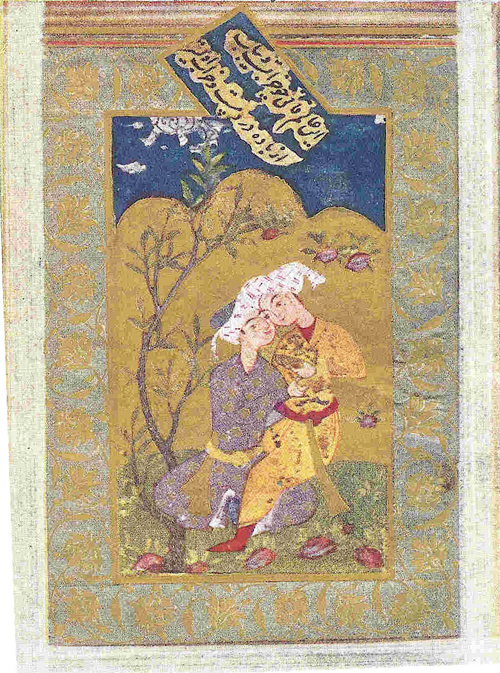



The Rubaiyat (Robāʿiyāt, ‘quatrains’) of Omar Khayyam (ʿOmar Ḵayyām) contain some of the best-known verses in the world. The book is also one of the most frequently and widely illustrated of all literary works, a remarkable feat for a work that is relatively short in length and abstract in content. The stimulus to illustrate Khayyam’s Rubaiyat came initially from outside Persia, in response to translations in the West, particularly the famous version by Edward FitzGerald (q.v.), first published in London in 1859. In subsequent years, modern Iranian artists and publishers have also taken up the illustration of the Rubaiyat .
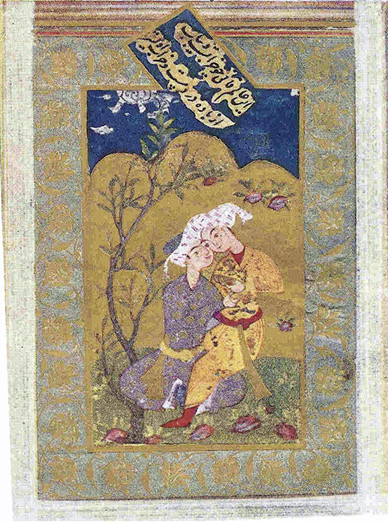
PLATE I Miniature by Behzād, claimed as one of the first illustrations of the Robāʿiyāt of Omar Khayyam. The miniature is contained in a manuscript dating ca. 1500, published in facsimile by the Indian scholar M. Mahfuz-ul-Haq in 1939.
The history of Rubaiyat illustration. A great deal of uncertainty surrounds the authorship of the verses that have been attributed to Omar Khayyam. This may partially explain why manuscripts of the poem were seldom if ever illustrated, in contrast to the many miniatures contained in manuscripts of Ferdowsi’s Šāh-nāma or Neẓāmi’s Ḵamsa (q.v.). The earliest known illustrated version of the Rubaiyat dates from around 1500, and was published in a facsimile edition by the Indian scholar M. Mafuz-ul-Haq in 1939 (Mafuz-ul-Haq, pp. 1-18). The manuscript contains several miniature paintings, including at least one attributed to the 15th-century painter Behzād (q.v.; PLATE I). Most other early manuscripts containing collections of the Rubaiyat attributed to Khayyam have, if anything, a simple form of decoration. They include the famous Ouseley manuscript in the Bodleian Library in Oxford, dated 1460-61, which was used by Edward FitzGerald as one of the main sources for his first presentation of the Rubáiyát in English in 1859 (Arberry, pp. 41-42). The earliest translations of Khayyam’s Rubaiyat published in the West do not contain illustrations. Nor do the first three editions of FitzGerald’s version of the poem. FitzGerald’s 4th edition, published in 1879, had a frontispiece Persian drawing, but the picture refers to his translation of Jāmi’s Salāmān o Absāl (see JĀMI i), which was presented in the same volume.
The first fully illustrated version of the Rubaiyat in the West is that published in Boston, Massachusetts, in 1884 by Houghton Mifflin, based on FitzGerald’s third edition, with drawings specially commissioned from the American artist Elihu Vedder (PLATE II; Martin and Mason, pp. 12-13). This lavishly illustrated edition by Vedder was reissued several times in the decade following its first appearance. Meanwhile, from the 1870s onward, there was a regular flow of new editions of the Rubaiyat, but without illustrations, including other translations into English, as well as into French, German, and other languages. It was not until 1898 that the publication of illustrated editions began to take off. There were seven different illustrated versions of FitzGerald’s Rubáiyát in that year, by six new artists; the work by two of them, Gilbert James (PLATE III) and Edmund Garrett, was included in more than one new version (Martin and Mason, p. 21). From then on, as the chart (Figure 1) shows, the trickle of illustrated editions became a flood, reaching a peak in the years 1909-10; 1909 marked the 50th anniversary of the publication of FitzGerald’s first edition and the 100th anniversary of his birth.
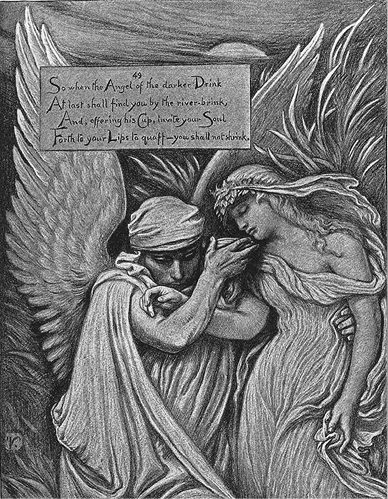
PLATE II Illustration by Elihu Vedder (1836-1923), attached to quatrain 43 in FitzGerald’s third edition, published by Houghton Mifflin in 1884.
Many of these new illustrated Rubaiyats were published in the United States as well as in the United Kingdom. The remarkable growth in interest in this one collection of verses reflects both the attraction of the verses themselves and the philosophy inherent in them (as interpreted by Edward FitzGerald), as well as the concurrent developments in printing technology that enabled book illustrations to be presented in a cheaper and more attractive form. In addition, with rising affluence, the book market was expanding, and the Rubaiyat, especially with illustrations or decorations and elegant bindings, made excellent material for attractive, popular versions, presented as gift books, special Christmas editions and calendars (Martin and Mason, pp. 8-10).
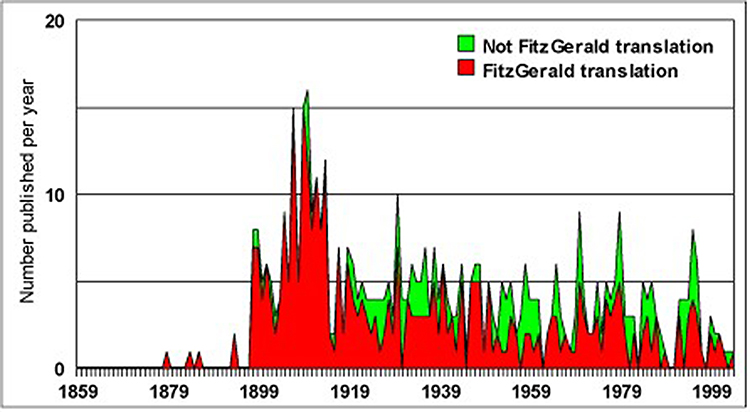
Figure 1. History of publication of illustrated editions of the Rubaiyat of Omar Khayyam from 1859 (date of FitzGerald’s first edition) to 2004. The figures cover illustrated editions by all translators and in all languages so far identified. They include new editions and reprints of earlier illustrated versions, where known; the number of reprints is believed to be underestimated.
By the end of 1909, there had been more than 100 new illustrated or decorated editions of FitzGerald’s Rubáiyát, containing the work of more than 50 different artists. Many of them were key figures in the Art Nouveau movement, including Edmund Dulac, Rene Bull, Robert Anning Bell, and Jessie King. Dulac’s famous work was among the 15 new illustrated editions in 1909 alone (PLATE IV). The chart (Figure 1) shows that the number of new illustrated Rubaiyats subsided in subsequent years, particularly in the middle years of World War I. But interest picked up again from 1917, and there are few years in the entire period up to the present day in which there has not been either a new illustrated edition of the Rubaiyat or a reissue of an existing version (Martin and Mason, p. 13); the 2001 edition illustrated by Andrew Peno is an example of a fairly recent work.
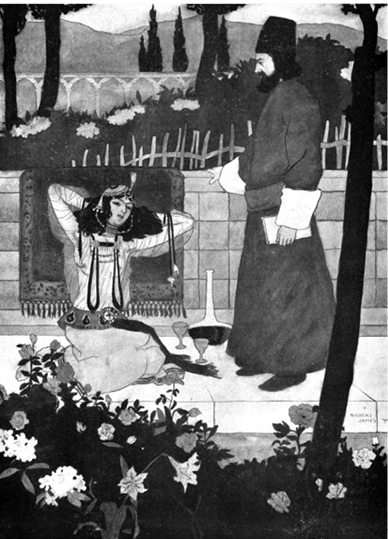
PLATE III Illustration by Gilbert James (fl. 1865-1941) for quatrain 13 in FitzGerald’s first edition, published by Leonard Smithers in 1898.
It is of particular note that, since the 1920s, the publication of illustrated versions of the Rubaiyat by translators other than FitzGerald has grown in significance. Interest in the Rubaiyat has spread round the world, with the appearance of versions in more than 70 different languages (Martin and Mason, p. 3). These editions have been illustrated less frequently than those of FitzGerald’s text, but quite a number do contain illustrations, some reissuing work that the artists originally created for FitzGerald editions; work by Dulac, James, and Willy Pogany has been used in this way. In terms of Western countries, illustrations by new artists are particularly evident in editions from France, Germany, Hungary, the Netherlands, and Spanish-speaking countries. A significant number of new editions of Khayyam’s Rubaiyat have appeared in Iran, both before and after the 1979 revolution. These usually contain the original Persian Robāʿiyāt, along with translations in various other languages, usually lavishly decorated with illustrations by modern Iranian artists (PLATE V; Martin and Mason, pp. 25-27).
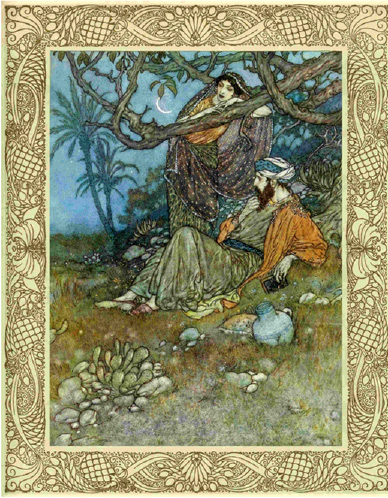
PLATE IV Illustration by Edmund Dulac (1882-1953) for quatrain 12 in FitzGerald’s second edition, published by Hodder and Stoughton in 1909.
The artists and their work. In the period since 1884, at least 220 different artists worldwide have illustrated or decorated editions of Khayyam’s verses. As might be expected, the variety of types and technique of illustration is enormous, reflecting the general trends in artistic styles and forms in the period. Traditional Victorian engravings, rich art nouveau designs, colorful art deco paintings, line drawings, and more modern abstract approaches are all well represented, in addition to the traditions of Persian miniatures and many personal idiosyncrasies.
The approach adopted to illustrating the text has also varied. Some artists attempted, or were commissioned, to illustrate or “illuminate” a number of specific quatrains (robāʿiyāt). Others aimed to show the general subject matter or feel of the poem, without emphasizing the particular images in the verses. In most cases, artists, other than the Iranians, worked from some translation or other of Khayyam’s “original” text. It is not surprising that some of the interpretations presented are uncompromisingly Western in their imagery; these include the initial version by Elihu Vedder (PLATE II). Many artists adopted what can be called an “orientalist” view of their subjects, while there are some who have retained more of a sense of traditional Persian imagery (Martin and Mason, pp. 14-15).
There are few well-known general artists among the Rubaiyat illustrators. The main exception is Sir Frank Brangwyn (1867-1956) whose artistic output ranged from major paintings and murals through book illustrations and posters to the decoration of furniture and ceramics (Horner, p. 7). His two portfolios of illustrations for the Rubaiyat, published in the early years of the 20th century were based on small oil paintings, some of which are still extant. His colorful impressionistic style has an orientalist feel to it. Sir Edward Burne-Jones (1833-98), the Pre-Raphaelite artist, also created some illustrations for a one-off copy of the Rubaiyat, hand produced by William Morris in 1872 (Braesel, pp. 48-49).
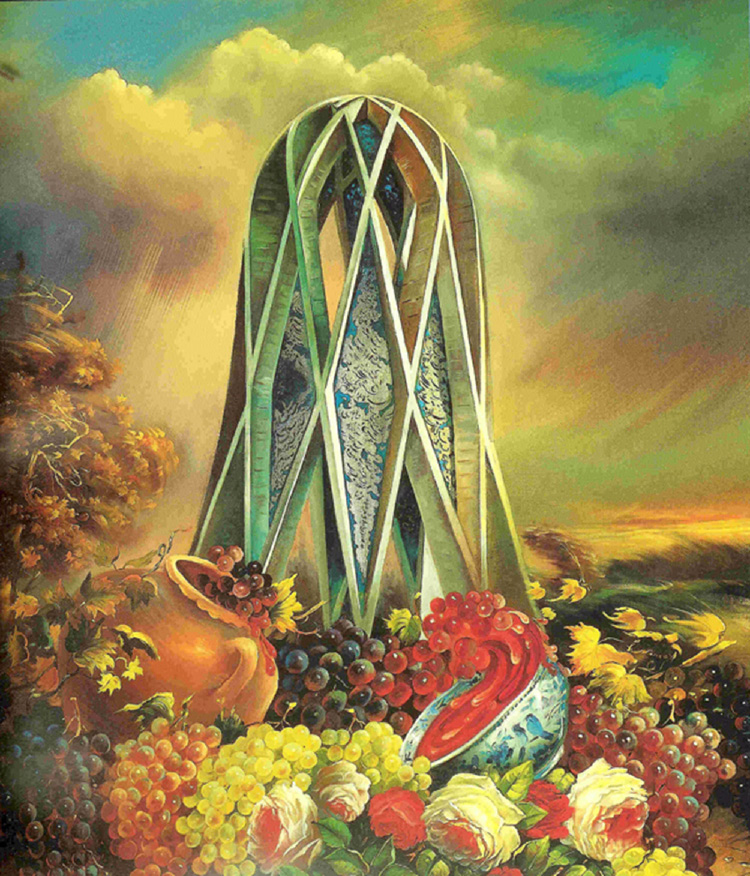
PLATE V Illustration by Ḥojjat Šakibā (born 1949), published in a multilingual edition by Gooya House in Tehran in 1999. The illustration is not related to a specific quatrain but based on the actual tomb of Khayyam in Nishapur.
Most of the other artists illustrating the Rubaiyat were specialist book illustrators, but there are some notable absentees from the list such as Aubrey Beardsley and Arthur Rackham, both well known as illustrators during the early period of production of illustrated Rubaiyats. Probably the best known among those who did illustrate FitzGerald’s version of the Rubaiyat were the following four artists: Vedder, Dulac, James, and Pogany. Each of them created very distinctive sets of illustrations, which have been frequently reissued. For example, there was a new edition with Pogany’s paintings in 1999, and Dulac’s work was reissued in the United States in 1996 (Martin and Mason, pp. 19-21).
Elihu Vedder (1836-1923) was an established artist in the United States when he was commissioned to create the first portfolio of illustrations for FitzGerald’s Rubaiyat. He spent nearly a year in Rome working on ideas for his illustrations and the resulting images have something of a classical feel about them, although his drawings have been called “some of the earliest examples of Art Nouveau in America” (Soria, in Grove Art Online; PLATE II).
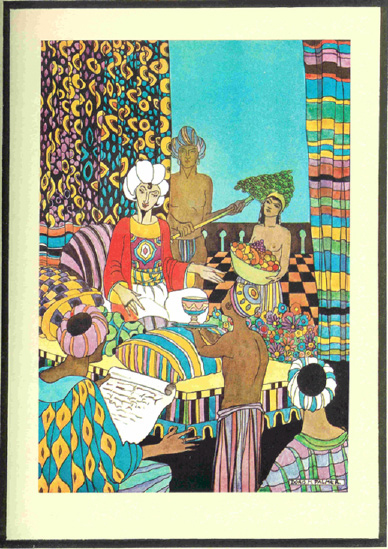
PLATE VI Illustration by Doris M. Palmer for quatrain 20 in FitzGerald’s first edition, published by Leopold B. Hill in 1921.
His work is in strong contrast to that of the next major illustrator, Gilbert James (fl. 1865-1941), whose illustrations for the Rubaiyat were first published separately, in black and white, mainly in the periodical The Sketch between 1896 and 1898 (PLATE III). Very little is known about this artist, who created three different sets of illustrations for issues of FitzGerald’s Rubaiyat, during the first decade of the 20th century. He was apparently born in Liverpool, allustrated some editions of fairy tales, and worked as well for a number of British magazines (Houfe, p. 190).
![PLATE VII Illustration by Ḥosayn Behzād included in Hossein-Ali Nouri Esfandiary’s multilingual edition of the Rubaiyat (n.p. [Japan], 1970). The illustration is related to quatrain 16 in FitzGerald’s first edition, as well as to a quatrain in the original Persian and a French translation by Abolgassem Etessam-Zadeh.](https://www.iranicaonline.org/media/khayyam_ix_fig_10_2_opt.jpg)
PLATE VII Illustration by Ḥosayn Behzād included in Hossein-Ali Nouri Esfandiary’s multilingual edition of the Rubaiyat (n.p. [Japan], 1970). The illustration is related to quatrain 16 in FitzGerald’s first edition, as well as to a quatrain in the original Persian and a French translation by Abolgassem Etessam-Zadeh.
The life and work of Edmund Dulac (1882-1953) is much better documented. Born and educated in France, he moved to London in 1906 and became a British citizen in 1912. His well-known illustrations for the Rubaiyat were first published in the anniversary year of 1909, following his earlier work on The Arabian Nights and Shakespeare’s The Tempest (Houfe, p. 123-24). Dulac’s art nouveau, orientalist paintings, epitomize, for many, the golden age of Rubaiyat illustration (PLATE IV). 1909 also saw the publication of the first set of illustrations created by the Hungarian artist Willy Pogany (1882-1955). He too had something of an orientalist approach to the imagery of the Rubaiyat, though his work is less elaborate in style. Pogany settled in the United States and produced illustrations for many other books, including two further and rather different portfolios for the Rubaiyat, published in 1930 and 1942 respectively (Greer, pp. 7-49).
Two other artists of particular note in terms of Rubaiyat illustration are Edmund Sullivan (1869-1933) and Gordon Ross (1873-1946), both of whom attempted the difficult task of illustrating every one of the 75 quatrains from FitzGerald’s first edition. In spite of their wide chronological separation (1913 and 1941 respectively), the two portfolios of black-and-white drawings are remarkably similar and have a somewhat cartoon-like character. Both sets of drawings were issued in popular, in some cases, paperback editions of the Rubaiyat .
A couple of artists of Indian origin, Mera K. Sett (dates unknown, published 1914) and Abanindro Nath Tagore (1871-1951), were early illustrators of the Rubaiyat; Sett’s black-and-white work is an example of the very symbolic way in which some artists have approached this poem. Key names in the art deco tradition who tackled the Rubaiyat in the 1920s were the British artists Anne Fish (1890-1964), Doris Palmer (d. 1931; PLATE VI), and Ronald Balfour (1896-1941). In the middle of the 20th century, there were also notable contributions from John Buckland-Wright (1897-1954), also British, who contributed delicate line drawings to a famous edition by the Golden Cockerel Press, and from Arthur Szyk (1894-1951), a well-known American artist of Polish origin (Martin and Mason, pp. 23-25). Original illustrations of continental European translations of Khayyam’s Rubaiyat have often been restrained in style, and based on line drawings. The work of P. Zenker (dates unknown, published 1924) in France, and Endre Szasz (1926-2003) in Hungary, has been frequently reissued in those countries. There are also illustrators of the Rubaiyat from as far afield as South Africa (Hope Beck; dates unknown, published 1950) and Uzbekistan (M. Karpuzas; dates unknown, published 1997).
One of the earliest of the modern illustrated editions of the Rubaiyat from Iran is Sadeq Hedayat’s (q.v.; Ṣādeq Hedāyat, 1903-51) selection of the Persian verses published in 1934. The illustrations in it, attributed to Darviš, are very traditional in style, whereas the work of artists such as Moḥammad and Akbar Tajwidi (fl. 1950s), and Ḥosayn Behzād (q.v.; 1894-1968), which appears in Iranian editions from the late 1950s onward, is more modern in feel, while retaining the format and some of the imagery of the Persian miniatures (PLATE VII). The illustrations of later Iranian artists, like A. Jamālipur (dates unknown, published 1996), Ḥojjat Šakibā (b. 1949; PLATE V), and Maḥmud Farščiān (b. 1930) are much more flamboyant and non-traditional in presentation (Martin and Mason, pp. 25-27).
The range of illustrations for the Rubaiyat is wide, and the work varies in quality as well as popularity. Some artists have produced images that seem to bear little relation to the text that contains them. Other images are not only beautiful in themselves, but also serve to interpret, to “illuminate,” the verses to which they refer. Seen from the standpoint of the early 21st century, it is the phenomenon of Rubaiyat illustration as well as the work of individual artists that is of interest. The continued publication of illustrated editions of this short work for more than 120 years is an amazing tribute to the ability of the writing of Khayyam and his translators to retain the interest of publishers and readers in the changing modern world.
Bibliography
- (please note that the names of publishers, where relevant, are placed in parenthesis after the publication date):
- A. J. Arberry, The Romance of the Rubaiyat, London, 1959.
- Michaela Braesel, “William Morris, Edward Burne-Jones and ‘The Rubaiyat of Omar Khayyam,’” Apollo 159/2, February, 2004.
- Edward FitzGerald, The Rubáiyát of Omar Khayyám (4th ed.), in The Rubáiyát of Omar Khayyám and the Saláman and Ábsal of Jámí, London, 1879 (Bernard Quaritch).
- Robin Greer, “The Published Illustrations of Willy Pogany,” The IBIS Journal 1, London, 1999 (Imaginative Book Illustration Society).
- Alan Horne, The Dictionary of 20th Century British Book Illustrators, Woodbridge, 1994 (Antique Collectors’ Club).
- Libby Horner and Frank Brangwyn, A Mission to Decorate Life, London, 2006 (The Fine Arts Society and Liss Fine Art).
- Sadeq Hedayat, Tarānahā-ye Ḵayyām, Tehran, 1934.
- Simon Houfe, The Dictionary of 19th Century British Book Illustrators and Caricaturists, Woodbridge, 1978 (Antique Collectors’ Club).
- M. Mahfuz-ul-Haq, The Rubâ’îyât of ‘Umar-i-Khayyâm, Calcutta, 1939, repr. 1986.
- William H. Martin and Sandra Mason, The Art of Omar Khayyam: Illustrating FitzGerald’s Rubaiyat, London, 2007.
- Regina Soria, “Vedder, Elihu,” in Grove Art Online (www.groveart.com), which provides access to J. Turner, ed., The Dictionary of Art (www.oxfordartonline.com/subscriber/article/grove/art/, by subscription), Oxford, 1996.