



MEʿRĀJ
ii. ILLUSTRATIONS
From the turn of the 14th century onward, depictions of the Prophet Moḥammad’s night journey (esrāʾ) and heavenly ascent (meʿrāj) were integrated into illustrated world histories and biographies, and also began to appear in animal fables like Kalila wa Demna, compendia of poetical extracts, Persian romances, heroic tales, and divination books. Fully independent and lavishly illustrated Meʿrāj-nāmas (Books of Ascension) were produced from the time of Il-khanid rule (ca. 1260-1335) until the Qajar period (1794-1925) as well. As growing evidence indicates, it seems that these latter kinds of works were utilized for Sunni or Shiʿite missionary activities (see Gruber, 2005, 2008, 2009).
The earliest surviving image of the Prophet’s ascension appears in a section on the meʿrāj as included in an illustrated manuscript of Rašid-al-Din’s Jāmeʿ al-tawāriḵ (Compendium of Chronicles), begun in Tabriz in 706/1306-7 under the patronage of Solṭān Ḡāzān (r. 1295-1304) and completed under his successor Öljeitü (Uljāytu, r. 1304-16). In this painting, the Prophet strides his human-headed flying steed al-Borāq, who holds a closed book in its hands while its tail appears to transform into an angel wielding a shield and a sword. On the right, two angels, one of whom holds a gold cup on a platter, approach the Prophet from a set of doors that seem affixed to sky. Judging from the elements in the painting and their relationship to Rašid-al-Din’s text, this image presents a moment in which the Prophet must chose between evil (the angel of death or a demon) and good (the Qurʾān), which sets him on an initiatory, correct path (al-feṭra) from the earth into the heavens. His proper course is echoed by his selection of the cup of milk and his rejection of other cups containing water, honey, and wine (EUL Or. Ms. 20, folio 55r; Talbot Rice, 1976, p. 110, fig. 36; Gruber, 2005, pp. 84-99, fig. 2.4).
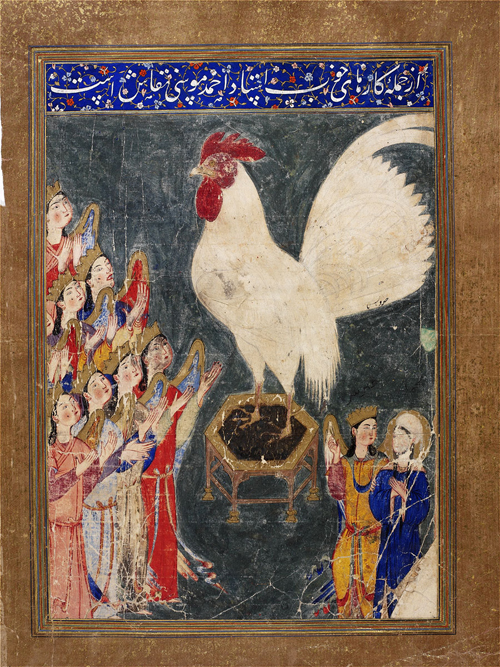
Although this painting belongs to a larger cycle of images dedicated to the Prophet’s life, the meʿrāj as a subject unto itself took off very soon thereafter with the first illustrated Meʿrāj-nāma attributed to the commission of the last Il-khanid ruler Abu Saʿid Bahādor Khan (r. 1316-35). Today, only a series of nine paintings on eight folios are preserved in a Safavid album of paintings and calligraphies (TSK H. 2154, folios 31v, 42r-v, 61r-v, 62r, 107r, and 121r; Ettinghausen, 1957; Çağman and Tanındı, pp. 67-70; Gruber, 2005, pp. 108-180; idem, 2009). Unfortunately the original Meʿrāj-nāma text—said to have been calligraphed by the hand of the Il-khanid scribe ʿAbd-Allāh Ṣayrafi (d. after 746/1345-46) to accompany these paintings (Thackston, 2001, pp. 12-13)—is now lost due to the paintings’ cropping and remounting. Later Safavid inscriptions attribute the compositions to the master painter Aḥmad Musā, who is described as having “lifted the veil off the face of depiction” and having thus initiated a novel genre of painting in Persian lands (Thackston, 2001, p. 12; Roxburgh, 2001, p. 160). The major narrative moments represented in the surviving Il-khanid paintings include the Prophet seated in Jerusalem undergoing the testing of the cups (folio 62r), his witnessing of the rooster angel in the first heaven (folio 61v, baḵši milieu.
Textual and pictorial details in the Timurid Meʿrāj-nāma suggest that the manuscript was utilized at court by Šāhroḵ to promote Sunni Islam among the Timurid ruling elite and possibly to Ming ambassadors present in Herat as well. The manuscript’s religious functions are further supported by the fact that its text is based on Maḥmud b. ʿAli al-Sarāʾi’s (fl. ca. 1325-60) Nahj al-farādis (Pathway to Heavens), a work in the Forty Hadith genre that appears to have been transcribed and illustrated—in a manner highly reminiscent of the Timurid Meʿrāj-nāma—during the rule of Šāhroḵ’s successor, Solṭān Abu Saʿid Gurgān (r. 1451-69). Although this manuscript is held in a private collection, a preliminary study (Gruber, 2008, Ch. 5) suggests strongly that it constitutes an independent meʿrāj-Hadith, therefore allowing for further discussions about the religious character of images (a specific category of Islamic painting as noted most recently in Grabar and Sims).
Other complete illustrated Meʿrāj-nāmas have also survived. One of them is very small, in a vertical layout, and contains seven paintings that are clearly within the Qajar painterly style of ca. 1850-1900 (Beinecke Pers. 8). The text is patently Shiʿite: dialogues between Moḥammad and the angels take the shape of the Shiʿite šahada (“There is no God but God, Muhammad is His Prophet, and ʿAli is His Vice-gerent”); angels are described as bearing Shiʿite inscriptions on their wings and foreheads; and Moḥammad encounters ʿAli beyond the seventh heaven, where ʿAli enumerates all of his, the imams’, and the Ahl-e Bayt’s virtues. Other Qajar illustrated manuscripts in print form (Boozari) indicate that such works were used as pedagogical tools to teach a moment in the Prophet’s life and to reinforce Shiʿite beliefs. By collating evidence drawn from Il-khanid, Timurid, and Qajar illustrated Meʿrāj-nāmas, it becomes clear that these kinds of illustrated bio-apocalyptical manuscripts could be used to promote either Sunni or Shiʿite Islam from ca. 1300 to 1900.
By the turn of the 16th century, the Timurid (and possibly the fragmentary Il-khanid) Meʿrāj-nāma arrived in Istanbul. It was kept in the Topkapı Palace Library until 1672 at the latest, at which time the Frenchman Antoine Galland purchased the volume in the book market for a paltry 25 piasters (Galland, p. 29). Between ca. 1500-1650, this “Book of Ascension”—possibly along with the Il-khanid Meʿrāj-nāma— appears to have provided inspiration for a series paintings included in the multi-volume illustrated manuscript of al-Ḍarir’s Siyar-e Nabi (Life of the Prophet) produced in 1595-96 for the Ottoman sultan Morād III (Garrett Fisher, 1984, 1981; Tanındı; Grube). Although the section on the Prophet’s ascension is quite long, only five paintings survive. These illustrate Gabriel’s arrival in Mecca (NYPL ms. 157, folio 3r), Mohammad’s journey to Jerusalem (NYPL ms. 157, folio 5r), his leading of prayer in Jerusalem (NYPL ms. 157, folio 6v), Moses’ intervention in helping Moḥammad reduce daily prayers from 50 to five (MIK I.26/78, Eskandar Solṭān, produced in Shiraz in 813-14/1410-11 (BL Add. 27261, folio 6r; Gruber, 2005, fig. 5.3) and in the illustrated Ḵamsa of 900/1494-95 made for the Timurid emir Mirzā ʿAli Fārsi Barlas, which bears a posteriori attributions to various artists active in Timurid Herat, including the master painter Kamāl-al-Din Behzād (BL Or. 6810; Gruber, 2005, fig. 5.5; Lukens-Swietochowski, p. 208).
It is precisely within ascension paintings included in poetic prefaces and not until the time of the first Safavid ruler Shah Esmāʿil I (r. 1501-24) that the facial veil emerges and becomes a standard feature of prophetic-religious iconography (on Safavid religious painting, see Rogers). The earliest original facial veil is utilized in an ascension painting included in Neẓāmi’s Maḵzan al-asrār, produced in 915/1509-10 (CBL Pers. 182, folio 5r). Within this context, the Prophet’s facial veil appears to have arisen due to propagandistic, rather than prohibitory, impulses. Shah Esmāʿil I claimed divinity for himself, and thus the use of a facial veil may have fulfilled an effective pictorial double entendre for this particular ruler who sought to fuse his identity with that of the Prophet (Gruber, 2009a, fig. 3). Subsequent Safavid meʿrāj paintings retain the facial veil, as in the superb composition of the Prophet’s ascension included in Neẓāmi’s Haft peykar (The Seven Portraits) produced in 1539-43 for Shah Ṭahmāsp I (BL Or. 2265, folio 195r; Sims, p. 152, fig. 67). It is also during and after Shah Ṭahmāsp’s reign that a lion figure—the celestial stand-in for Imam ʿAli—begins to appear in Safavid single-page ascension paintings (FIGURE 4) – which had matured within previous ascension images. As these many pictorial materials demonstrate, the theme of the Prophet’s meʿrāj has held a prominent place and has fulfilled a variety of purposes in Islamic visual culture over the course of seven centuries.
Institutional Abbreviations:
Beinecke: Beinecke Library, Yale University, New Haven, Conn.
BL: British Library, London
BnF: Bibliothèque nationale de France, Paris
CB: Chester Beatty Library, Dublin
EUL: Edinburgh University Library, Edinburgh
MIK: Museum für Islamische Kunst, Berlin
NYPL: New York Public Library, New York
SK: Süleymaniye Kütüphanesi, Istanbul
TSK: Topkapı Sarayı Kütüphanesi, Istanbul
Bibliography
Mohammad Ali Amir-Moezzi, “L’Imām dans le ciel: Ascension et initiation (aspects de l’Imāmamologie duodécimaine III),” in idem, ed., Le Voyage Initiatique en Terre d’Islam: Ascension Célestes et Itinéraires Spirituels, pp. 99-116, Paris, 1996.
Ali Boozari, “Persian Illustrated Lithographed Books on the Miʿrāj: Improving Children’s Shiʿite Beliefs in the Qajar Period,” in Gruber and Colby, eds., The Prophet’s Ascension: Cross-Cultural Encounters with the Islamic Mi’raj Tales, Bloomington, Ind., forthcoming Fall 2009.
Filiz Çağman and Zeren Tanındı, The Topkapı Sarayı Museum: The Albums and Illustrated Manuscripts, tr. and ed. J. M. Rogers, Boston, 1986.
Richard Ettinghausen, “Persian Ascension Miniatures of the Fourteenth Century,” Convegno di Scienze Morali Storiche e Filologiche, Symposium on Orient and Occident during the Middle Ages, May 27-June 1, 1956, pp. 360-83, Rome, Accademia nazionale dei Lincei, 1957; repr. in idem, Islamic Art and Archaeology: Collected Papers, ed. Myriam Rosen-Ayalon, pp. 244-68, Berlin, 1984.
Antoine Galland, Voyage à Constantinople (1672-1673), ed. Charles Schefer, Paris, repr. 2002.
Carol Garrett Fisher, “The Pictorial Cycle of the Siyer-i Nebi: a Late Sixteenth Century Manuscript of the Life of Muhammad,” Ph.D. dissertation, Michigan State University, 1981.
Idem, “A Reconstruction of the Pictorial Cycle of the Siyar-i Nabi of Murad III,” Ars Orientalis 14, 1984, pp. 75-94.
Oleg Grabar, Mostly Miniatures: an Introduction to Persian Painting, Princeton, 2000.
Ernst Grube, “The Siyar-i-Nabi of the Spencer Collection in the New York Public Library,” Atti del Secondo Congresso Internazionale di Arte Turca, pp. 149-76, Naples, Istituto Universitario Orientale, Seminario di Turcologia, 1965.
Christiane Gruber, “L’Ascension (Miʿrāj) du Prophète Mohammad dans la peinture et la littérature islamiques,” Luqman: Annales des Presses Universitaires d’Iran 39/1, Fall and Winter 2003-4, pp. 55-79.
Idem, “The Prophet Muhammad’s Ascension (Miʿrāj) in Islamic Art and Literature, ca. 1300-1600,” Ph.D. dissertation, University of Pennsylvania, 2005.
Idem, The Timurid Book of Ascension (Miʿrājnama): A Study of Text and Image in a Pan-Asian Context, Valencia, Spain, 2008.
Idem, “When Nubuvvat Encounters Valāyat: Safavid Paintings of the Prophet Muhammad’s Miʿrāj, ca. 1500-1550,” in Pedram Khosronejad, ed., Shiʿite Art and Material Culture, London, 2009b.
Idem, The Ilkhanid Book of Ascension: A Persian-Sunni Prayer Manual, London, 2009.
Idem, “The Ilkhanid Miʿrājnāma as an Illustrated Sunni Prayer Manual,” in Christiane Gruber and Frederick Colby, eds., The Prophet’s Ascension: Cross-Cultural Encounters with the Islamic Mi’raj Tales, Bloomington, Ind., forthcoming, Fall 2009.
Christiane Gruber and Frederick Colby, eds., The Prophet’s Ascension: Cross-Cultural Encounters with the Islamic Mi’raj Tales, Bloomington, Ind., forthcoming, Fall 2009.
Marie Lukens-Swietochowski, “The School of Herat from 1450-1506,” in Basil Gray, ed., Arts of the Book in Central Asia, 14-17th Centuries, Boulder, Col., 1979, pp. 179-214.
Basil Robinson, “The Miʿrādj in Islamic Art,” EI², VII, pp. 104-5.
J. M. Rogers, “The Genesis of Safawid Religious Painting,” Iran 8, 1970, pp. 125-39.
David Roxburgh, Prefacing the Image: the Writing of Art History in Sixteenth-Century Iran, Studies and Sources in Islamic Art and Architecture, Supplement to Muqarnas 9, Leiden, Boston, and Cologne, 2001.
Marie-Rose Séguy, The Miraculous Journey of Mahomet: Miraj Nameh, BN, Paris Sup Turc 190, tr. Richard Pevear, New York, 1977.
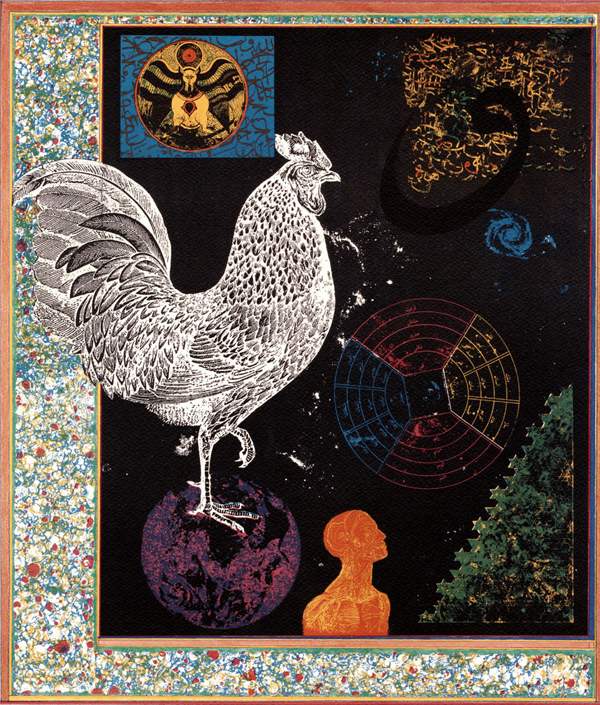
Ömer Şerifoğlu and Zeynep Şanlıer, eds., Erol Akyavaş ve Miraçnamesi, Istanbul, 2004.
Eleanor Sims, Peerless Images: Persian Painting and its Sources, New Haven, 2002.
David Talbot Rice, The Illustrations to the "World History" of Rashid al-Din, ed. Basil Gray, Edinburgh, 1976.
Zeren Tanındı, Siyer-i Nebî: İslam Tasvir Sanatında Hz. Muhammedin Hayatı, Istanbul, 1984.