



ṬEHRĀNI, ḤĀJJ MIRZĀ MOḤAMMAD (d. Tehran, ca. Jomādā II 1339/February 1921), sugar merchant and bookseller, compiler of Fawākeh al-basātin (Fruits of gardens), a philosophical, ethical, and literary miscellany notebook composed in Arabic and Persian (completed ca. late 1914).
Ḥājj Mirzā Moḥammad Ṭehrāni, also known as Ḥājj Mirzā Moḥammad “Ketāb-foruš-e Ṭehrāni” (“Tehran bookseller”), one of a number of booksellers at the time with that name and moniker, was the compiler and author of Fawākeh al-basātin, a miscellany notebook written in Tehran and completed in Ḏu’l-ḥejja 1332 (October-November 1914). The diverse reading and writing strategies in this notebook provide unique heuristic insights into Iran’s multifaceted and heterogeneous intellectual milieu in the late Qajar period. Ṭehrāni was a learned merchant primarily engaged in the sugar and book trade and occasionally the textile trade. In later years, his descendants adopted the surname Ketābiān (lit. “people dealing in books”). Surviving relatives of Ḥājj Mirzā Moḥammad remembered him as an erudite person suffering from chronic arthritis and joint pain (dard-e mafāṣel), most likely gout. Referring to an event in 1905 that became a major episode in Iran’s modern history, Ṭehrāni reportedly once related to his family that “on the day the sugar merchants were bastinadoed in the [Tehran] bazaar, had I been well enough to go to the bazaar, I too would have been caned” (personal interview with Qodsiya Qayṣari [Qayṣariya], a granddaughter of Ṭehrāni, dated 16 January 2010; Ṭehrāni, p. 14). Ṭehrāni was alluding to the public punishment of several prominent Tehran sugar merchants on 14 Šawwāl 1323 (12 December 1905) by the governor of Tehran, Mirzā Aḥmad Khan ʿAlāʾ-al-Dawla (q.v.), on the alleged grounds of inflating the price of sugar. Many historians consider this incident, which triggered a series of mass protests in opposition to the governor and other authorities and culminated in the demand for the establishment of a house of justice (ʿadālat-ḵāna) as well as the dismissal of certain officials, as the event that sparked off the Iranian Constitutional Revolution of 1906-11 (see CONSTITUTIONAL REVOLUTION ii. Events; Kasravi, pp. 58-59; Browne, p. 112; Dawlatābādi, II, pp. 10-11; Nāẓem-al-Eslām Kermāni, II, pp. 273-75; Daniel, p. 121).
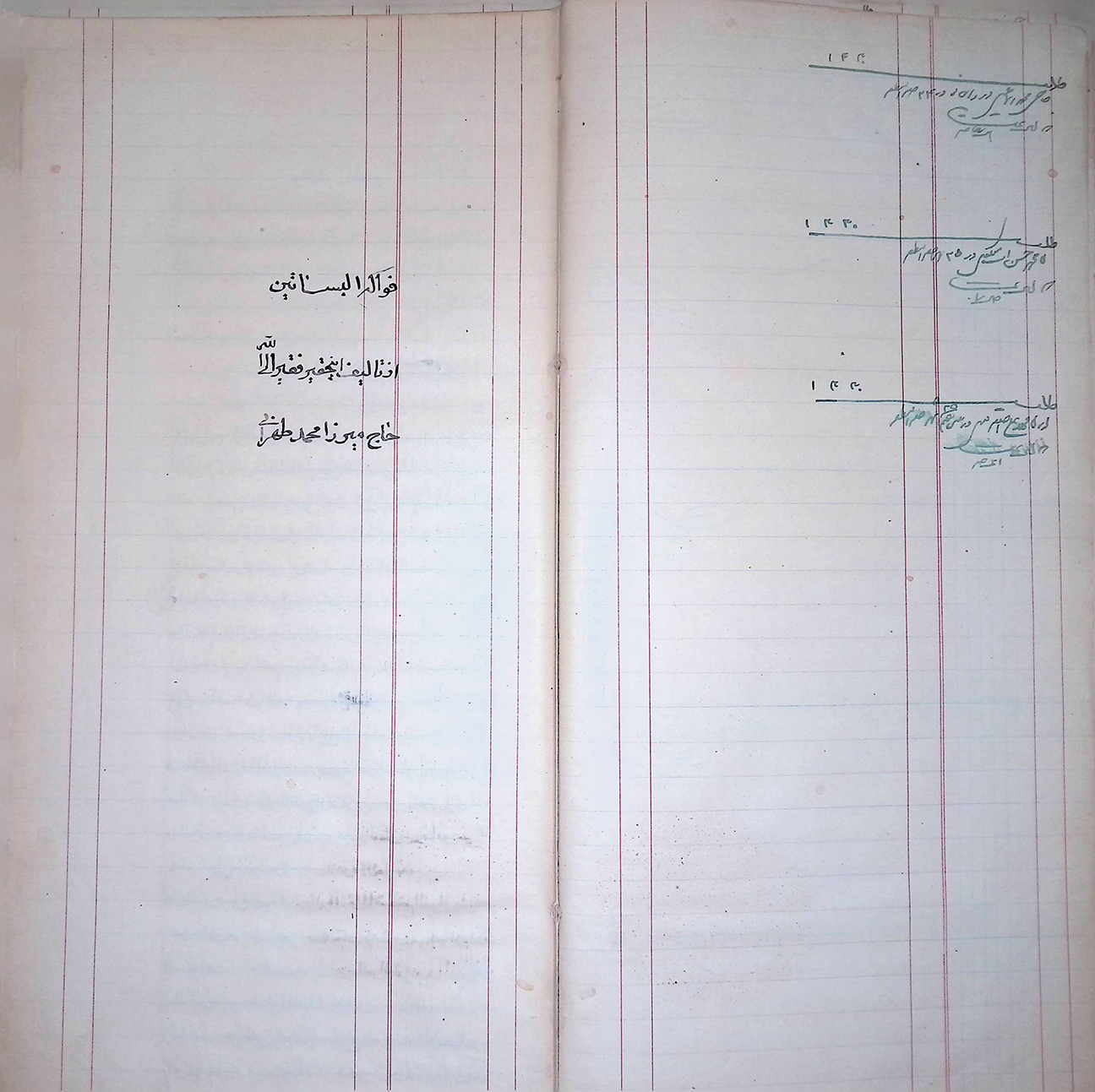
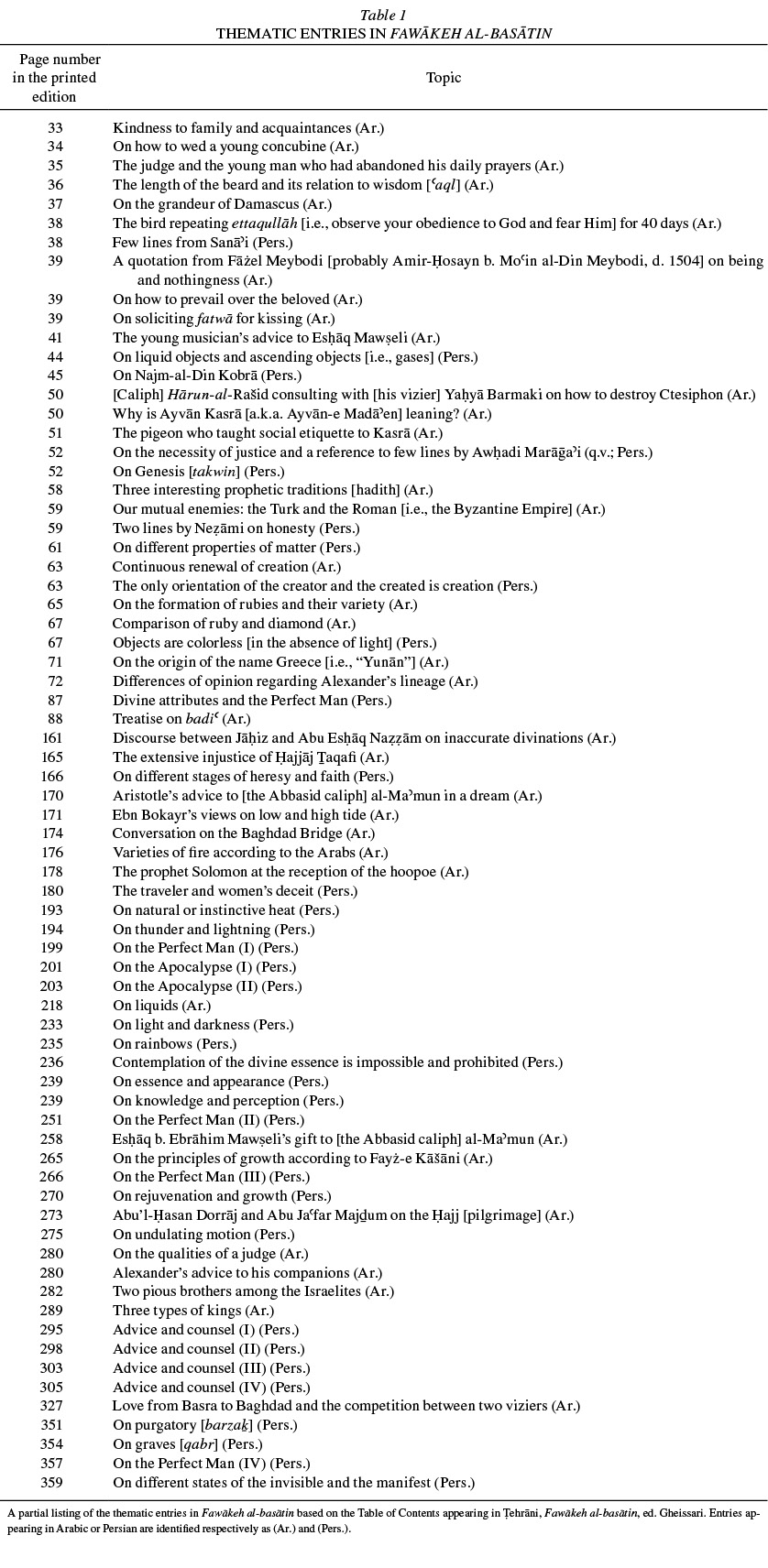
Fawākeh al-basātin. The notebook, which Ṭehrāni titled Fawākeh al-basātin, is a high quality 33.5 cm x 15.5 cm accounting ledger containing passages copied in Arabic and Persian in the same elegant manuscript-style of handwriting (see CALLIGRAPHY) throughout (Figures 1 and Figure 2). In total, there are 306 densely written pages (326 pages in the 2019 published edition). Only a few pages at the beginning and the end of the notebook, written in different handwriting and in siāq (q.v.) script, are devoted to recording various commercial transactions and business accounts (Figure 3). The remainder of the notebook consists entirely of passages related to philosophical, ethical, scientific, literary, and other topics (for a selected list of these, see Table 1). On the whole, the text is a miscellany, similar in style to the genres of kaškul (q.v.), zanbil, safina, or jong (q.v.; Gheissari, “Introduction,” in Ṭehrāni, p. 16), or the “commonplace book” (Ganjavi). Judging by the contents of the notebook, Ṭehrāni was well versed in Persian classics and had a good command of Arabic (Gheissari, “Introduction,” in Ṭehrāni, pp. 13-14).
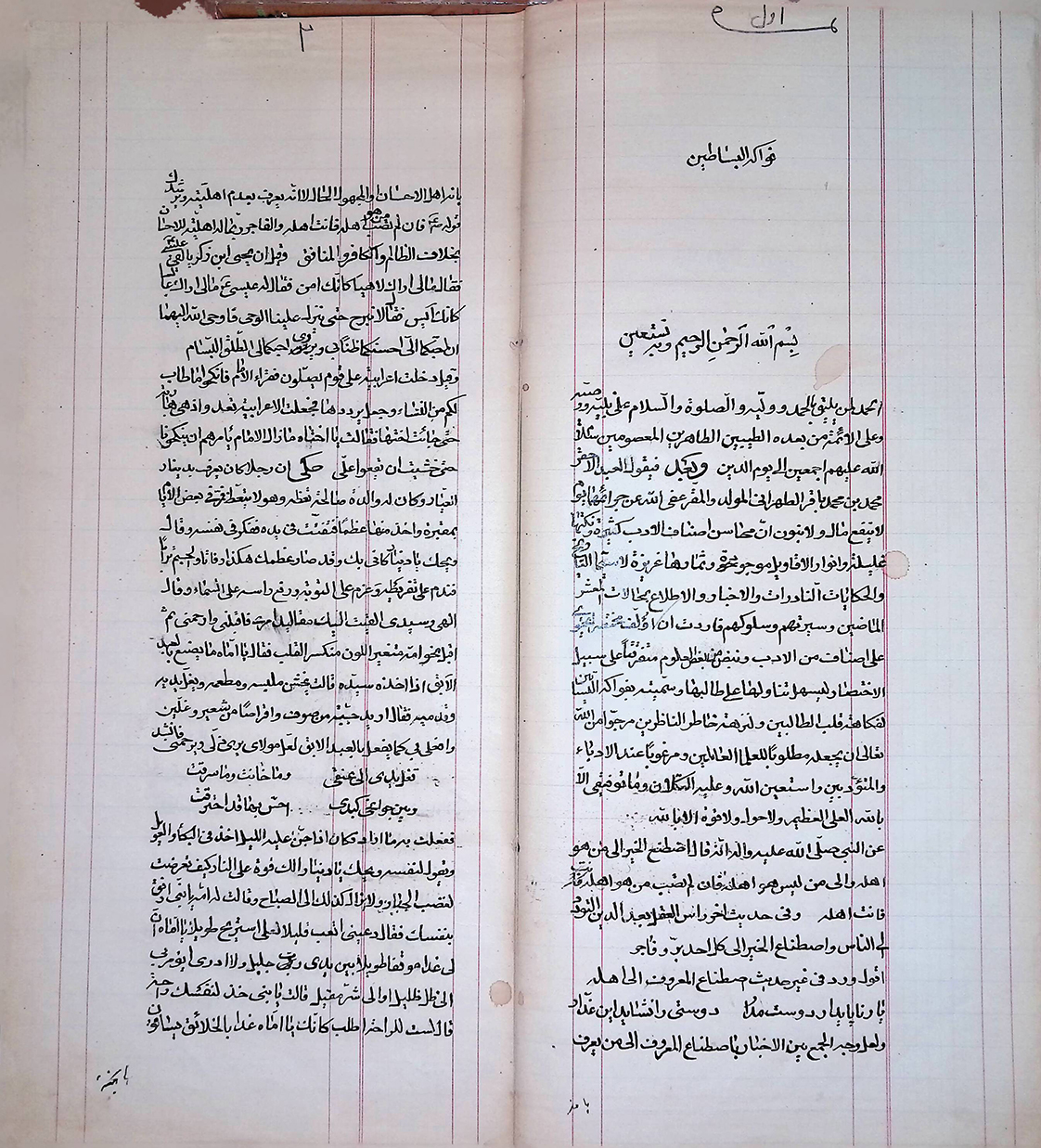
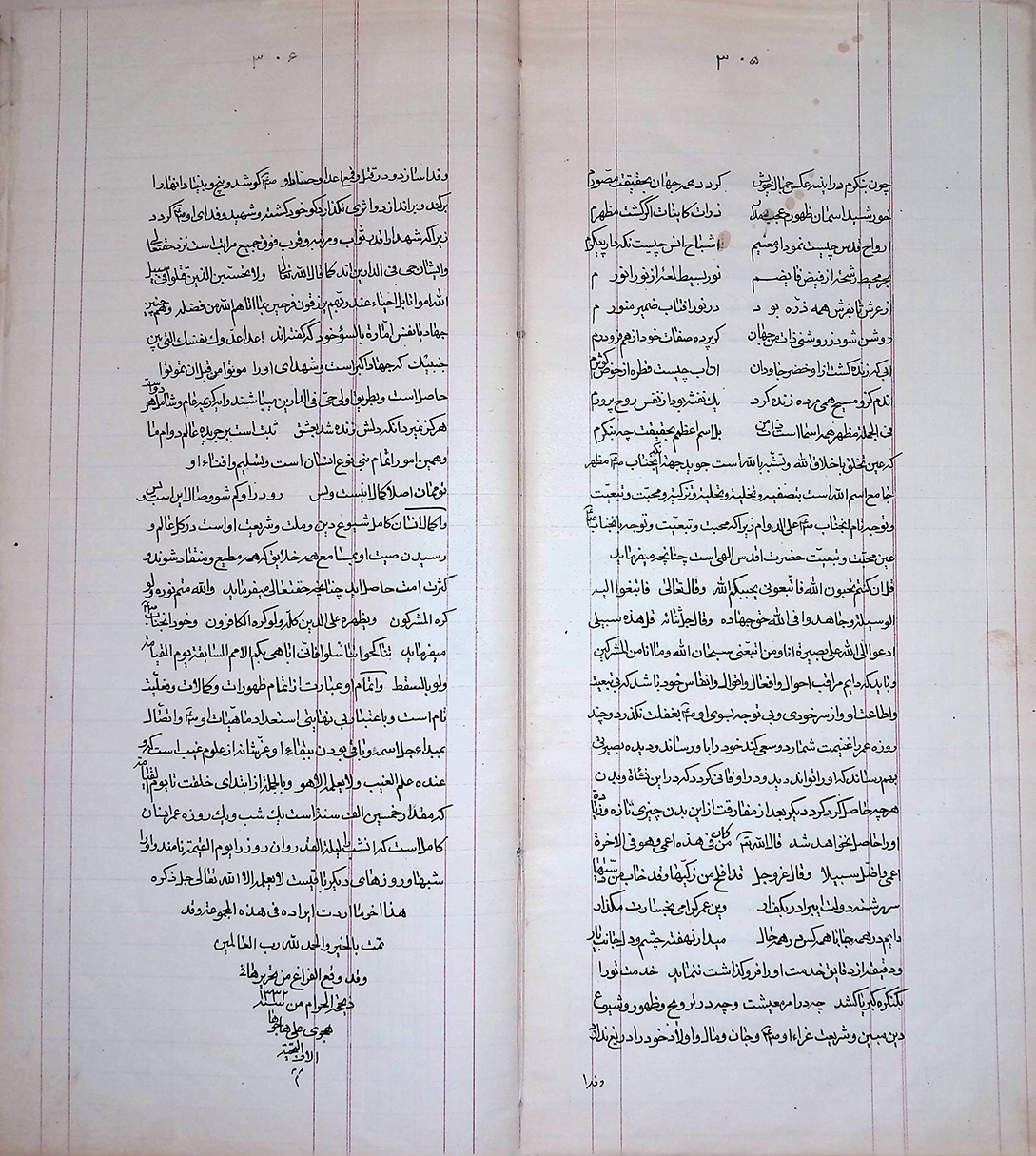
Although this notebook dates from one of the more eventful periods in Iran’s modern history, spanning the interval between the 1906-11 Constitutional Revolution and the outbreak of World War I, it contains no references to socio-political or economic developments. Nor does it provide any information about Ṭehrāni’s personal life, including his education or his family background, except for a passing mention of his father’s name, Moḥammad-Bāqer Ṭehrāni(Ṭehrāni, p. 22 [Appendix 2], and p. 33). Instead, the text consists entirely of passages pertaining to matters of faith; philosophy (chiefly metaphysics); ethical advice; and certain literary topics, such as classification of metric variations in Arabic poetry and rhetoric, for example, a short treatise (resāla) on badīʿ (q.v.); along with a few historical stories from the early ʿAbbāsid (q.v.) period (750-1258 CE) and many shorter fragments on a diverse range of subjects (see below).
A substantial portion of the text consists of passages from the Qurʾan and the Islamic prophetic traditions (see HADITH). Considerable space is also devoted to Stoic ethical proverbs, primarily drawn from the Meditations of the Roman Emperor and philosopher Marcus Aurelius (121-80 CE; r. 161-80 CE), which had been incorporated into the already rich corpus of Persian-language advice literature in Iran and in the neighboring territories after the late 19th century. Although Ṭehrāni did not note the original source of these passages, nor the Persian translation of Aurelius’s Meditations he had consulted, there can be no doubt the passages were copied from the Pand-nāma-ye Mārkus qayṣar-e Rum by ʿAbd-al-Raḥim Ṭālebuf (q.v.), published by Aḵtar press in Istanbul in 1893. This was an abridged Persian translation from a Russian translation of the Meditations. The text of the passages from the Meditations in Ṭehrāni’s notebook that allude to the ancient Greek philosophers Socrates and Phocion, among many other examples, are clear indications that Ṭehrāni relied on Ṭālebuf’s translation. Many of the proverbs taken from Ṭālebuf’s book were copied verbatim in Ṭehrāni’s notebook or in slightly modified form, occasionally also only partially reproduced. Notably, these passages from Ṭālebuf’s translation were selectively rearranged and pieced together by Ṭehrāni to construct new compounded proverbs, underscoring Ṭehrāni’s editorial agency in scripting his own preferred versions of composite Stoic proverbs. An example of this is the final section of the second entry under “advice and counsel” (pand va andarz; see ANDARZ) in Ṭehrāni’s notebook that combines a slightly modified version of proverb 3 from Ṭālebuf’s translation, followed by a slightly modified version of proverb 5, and then a modified version of the entire proverb 8, followed by the verbatim reproduction of the short proverb 13 concerning Alexander (“Eskandar Filqus”), followed by the opening lines of proverb 19, followed by an edited version of the first lines of proverb 18. Significantly, to the end of this section Ṭehrāni appended a couplet from one of the qaṣāyed (sing. qaṣida) of the 13th-century Persian poet Saʿdi (q.v.), extolling the virtue of dedication to fulfilment of one’s tasks and being productive (Ṭehrāni, pp. 302-3; Ṭālebuf, Pand-nāma, pp. 42-47. See also Ṭālebuf, Ketāb-e Aḥmad, ed. Moʾmeni, p. 234; Gheissari, “Fruits of Gardens,” n. 16). This synthesis of Roman Stoic proverbs with lines from classical Persian poetry that were expressive of similar Stoic ethos is just one of the recurring cosmopolitan “authorial” gestures in Ṭehrāni’s notebook, not overlooking the long tradition of other modes and configurations of cosmopolitan thought and literatures in the Iranian lands that were eventually absorbed into so-called native “traditions” (thoughts and practices), including the Qurʾan and Hadith passages appearing in Tehrani’s notebook.
Some of the other sources consulted by Ṭehrāni on various topics can also be identified, based on Ṭehrāni’s occasional divulgence of his sources or from the content of the copied texts. These sources include such a diverse range of works as Ḵazāʾen by Mollā Aḥmad Narāqi (d. 1829), Kaškul of Šayḵ Bahāʾi (d. 1621; see KAŠKUL-E ŠAYḴ BAHĀʾI), al-Ensān al-kāmel by ʿAbd-al-Karim Jili (q.v.; d. ca. 1424-28), and Kalemāt-e maknūna by Mollā Moḥsen Fayż-e Kāšāni (q.v.; d. 1680). The notebook also includes sections on modern sciences, albeit without Ṭehrāni’s acknowledgment of his original source(s). These excerpts range from brief observations on electricity and gas laws to the physics of fluid dynamics and a theory of colors in connection with rainbows. Written in lucid Persian, these sections of the notebook are, once again, unmistakably based on Ṭālebuf’s publications, particularly the latter’s short treatise on certain components of modern sciences titled Fizik yā ḥekmat-e ṭabiʿiya (Physics or natural philosophy), published in Istanbul in 1893 by Aḵtar press, as well as certain chapters of the two-volume Safina-ye Ṭālebi yā ketāb-e Aḥmad also published by the same press in 1893-94. Notably, the variously reproduced passages from Ṭālebuf’s publications appearing in Ṭehrāni’s notebook are restricted to topics related to science, natural philosophy, and ethics, and there are no allusions to Tālebuf’s well-known works on politics, such as those on constitutional governance and civil liberties (for Ṭālebuf’s views on these topics, see, for example, Ṭālebuf, Āzādi va siāsat, ed. I. Afšār; idem., Siāsat-e Ṭālebi, eds. Raḥim Raʾisnia et al.). In fact, the notebook is devoid of any content concerned with politics, society, and economics, apart from the few pages devoted to Ṭehrāni’s own business transactions and accounts, nor is there any mention of contemporary developments.
The notebook also contains several explicit passages from the One Thousand and One Nights (see ALF LAYLA WA LAYLA), also known as the Arabian Nights, all of which are written in Arabic. Based on the content and style of these passages, Ṭehrāni appears to have had access to the uncensored 1835 two-volume Bulāq edition of the work or its 1839-41 Calcutta version (on the Bulāq edition, see Grotzfeld, p. 51). There is no overall structure or logical framework to the notebook, the last few pages of which, similar to the first few pages, again contain siāq script accounting in different handwritings. Listed among the transacted items are qand-e ḥarira (ground sugar; see SUGAR) and āb-e-jo (fermented malt or barley water, similar to the kefir drink in its health properties), which Ṭehrāni may personally have ingested to improve his metabolic circulation and relieve joint pain (Ṭehrāni, Appendices 6 and 7, pp. 27-32). The seemingly random details appearing in these pages of siāq accounting do not provide adequate information regarding Ṭehrāni’s personal life or his overall business profile, beyond indicating the range of some of the merchandise he traded and possibly also personally consumed (Ṭehrāni, Appendices 1 and 5-7, pp. 21 and 25-32).
Nevertheless, the notebook provides valuable insights into certain Iranian intellectual currents as well as circuits of knowledge exchange and transfer during the late Qajar period, as in the case of, for instance, works produced by Ṭālebuf (d. 1911; born in Tabriz, Iran, and at the time residing in Dagestan in the Russian Empire), which were published in Istanbul by the Iranian émigré press (Aḵtar), and circulated both inside Iran and in the Iranian émigré and diasporic communities, as well as in other Persian-speaking territories and communities, from Afghanistan to the Indian subcontinent, central Asia, the Russian Caucasus, the Ottoman Empire, Egypt, and beyond (on transregional circuits of intellectual exchanges, see Gheissari, 2016). Ṭehrāni’s compilation of such an extensive assortment of cross-cultural knowledge (both temporal and spatial), as well as his intertextual collation of so-called traditional and modern modes of knowledge, is just one specimen of the many existing vectors of formation, production, circulation, acquisition, and subjective appropriation of knowledge among the more literate members of Iranian society at the time (male and female). Considering that Ṭehrāni was a bookseller by profession (as well as being a sugar merchant), many of the books (and possibly periodicals too) from which he copied and transcribed the passages in his notebook most likely found their way into the book market subsequently, rather than remaining solely in his possession. In either case, the notebook is also indicative of at least some range of the texts in circulation in the late Qajar era, whether in printed form or in the form of hand-copied jongs, safinas, kaškuls, or zanbils that were still widely produced and sold well into the middle of the 20th century, and which themselves are yet another reminder of the continued coexistence of the “old” and the “new” in Iranian society, including the manufacturing techniques and the labor market involved in the production and circulation of these different forms of texts (on print culture and booksellers, see also Marashi; Gheissari, 1998, pp. 50-51, 150 n. 71; idem, 2020).
At the same time, account should be made of the range of topics absent from Ṭehrāni’s notebook, at least in terms of direct references, even if some of these topics appear in the form of allegorical and other indirect allusions in certain tales and anecdotes throughout the notebook. The period during which Ṭehrāni recorded the information appearing in his notebook was a time of rapid proliferation of publications (books, newspapers, and periodicals) in Iran and in the Iranian émigré communities that were devoted to the coverage of political, legal, and other constructs and paradigms of rights (including electoral, religious, social, economic, educational, gender, and marital). None of these topics appear in the notebook in any direct form, nor is there any mention of contemporary political developments before, during, or in the aftermath of the Constitutional Revolution. Similarly, despite its broad thematic scope, the notebook as a miscellany text also does not contain material related to some of the more established and standard fields of theoretical and conceptual inquiry and discourse in Iranian society at the time. For instance, and in line with the long tradition of literary and ethical compilations, the entries in the notebook do not engage with matters pertaining to speculative theology (kalām). There are no shariʿa-related passages, nor is there any coverage of feqh (q.v.; Islamic religious jurisprudence), or, by extension, subjects dealing with the Islamic discourse on transmitted knowledge (manqul) or analytical reasoning (maʿqul). By the same token, while the notebook occasionally delves into speculative and ethical topics, it is, for the most part, devoid of any significant content concerning Sufi thought and discourse as well as ʿerfān (q.v.). Regardless, the vast range of sources consulted in compiling the material for and composing the passages in the notebook, the manifold styles and syntaxes of the transcribed texts, along with the notebook’s Arabic and Persian bilingual textuality, are invaluable registers for better understanding the rich textual canvas and literary capital of some groups among the generation of learned Iranians in the late Qajar period.
Bibliography
Edward G. Browne, The Persian Revolution of 1905-1909, Cambridge, 1910.
Elton L. Daniel, The History of Iran, 2nd ed., Westport, Conn., 2008 [2001].
Yaḥyā Dawlatābādi, Ḥayāt-e Yaḥyā, II, repr., Tehran, 1982 [1951].
Mahdi Ganjavi, “Fawāka al-Basātin: Montakhabāti Falsafi, Eʿteqādi, Revāʾi dar Avākher-e Qājāriya, asar-e Hājj Mirzā Mohammad Tehrāni [Fruits of Gardens by Hājj Mirzā Mohammad Tehrāni: A Philosophical Miscellany in Arabic and Persian in late Qajar Iran, c. 1914],” Iranian Studies 55/1, 2022, pp. 310-14 (review article).
Ali Gheissari, Iranian Intellectuals in the Twentieth Century, Austin, 1998.
Idem, “‘Fawākeh al-basātin,’ aṯar-e Ḥājj Mirzā Moḥammad Ṭehrāni: matn-e falsafi va eʿteqādi dar avāḵer-e Qājāriya,” in Rasul Jaʿfariān, ed., Jašn-nāma-ye ostād Sayyed Aḥmad Ḥosayni Eškevari, Tehran, 2013, pp. 723-817.
Idem, “Iran’s Dialectic of the Enlightenment: Constitutional Experience, Transregional Connections, and Conflicting Narratives of Modernity,” in Ali M. Ansari, ed., Iran’s Constitutional Revolution of 1906 and Narratives of the Enlightenment, London, 2016, pp. 15-47.
Idem, “In Memoriam: Khalil Mostowfi (b. Tabriz, 1941 – d. Tehran, 20 February 2020), Bookseller, Assessor of Manuscripts, Lithographs, and Rare Titles in Iranian Studies,” Iranian Studies, 53/3-4, 2020, pp. 685–690.
Idem, “Fruits of Gardens: Ethics, Metaphysics, and Textual Pleasures in Late Qājār Iran,” unpublished.
Heinz Grotzfeld, “Creativity, Random Selection and pia fraus: Observations on Compilation and Transmission of the Arabian Nights,” in Ulrich Marzolph, ed., The Arabian Nights in Transnational Perspective, Detroit, 2007, pp. 51-63.
Aḥmad Kasravi, Tāriḵ-e mašruṭa-ye Irān , repr., Tehran, 1977 [1937].
Nāẓem-al-Eslām Kermāni, Tāriḵ-e bidāri-e Irāniān II/1, ed. ʿAli-Akbar Saʿidi Sirjāni, 3rd ed., Tehran, 1984 [1910-12].
Afshin Marashi, “Print Culture and Its Publics: A Social History of Bookstores in Tehran, 1900-1950,” International Journal of Middle East Studies 47/1, 2015, pp. 89-108.
ʿAbd-al-Raḥim Ṭālebuf, Āzādi va siāsat, ed. Iraj Afšār, Tehran, 1978.
Idem, Fizik yā ḥekmat-e ṭabiʿiya, Istanbul, 1893.
Idem, Ketāb-e Aḥmad, ed. Bāqer Moʾmeni, 2nd ed., Tehran, 1977 [1973].
Idem, Pand-nāma-ye Mārkus qayṣar-e Rum, Istanbul, 1893.
Idem, Safina-ye Ṭ ālebi yā Ketāb-e Aḥmad, 2 vols., Istanbul, 1893-94.
Idem, Siāsat-e Ṭālebi, eds. Raḥim Raʾisnia, Moḥammad-ʿAli ʿAliniā, and ʿAli Kātebi, Tehran, 1978.
Ḥājj Mirzā Moḥammad Ṭehrāni, Fawākeh al-basātin: montaḵabāti falsafi, eʿteqādi, revāʾi dar avāḵer-e Qājāria, aṯar-e Ḥājj Mirzā Moḥammad Ṭehrāni, ed. Ali Gheissari, in collaboration with ʿAli-Reżā Abāḏari, with introduction and notes by Ali Gheissari, Qom, 2019.