



TAKHT-I SANGIN (Taḵt-e Sangin ‘Throne of Stone’), also known as the “Temple of the Oxus,” an archaeological site in southwest Tajikistan (Figure 1). Takht-i Sangin lies on the right bank of the confluence where the Vaḵš and Panj become the river Oxus (Āmu Daryā, q.v.), which forms the border with Afghanistan. The settlement, whose ancient name is unknown, occupied a narrow strip of land (4.5 km wide x 3 km long) between the river on the eastern side and the Teshiktosh (Tešik-Tāš) range to the west (Figure 2). In addition to protection offered by the water and mountains, thick mud-brick walls 1 km apart defended the settlement to the north and south. The Temple of the Oxus at the center of the settlement is one of the most famous archaeological discoveries of Hellenistic-period Bactria (q.v.).
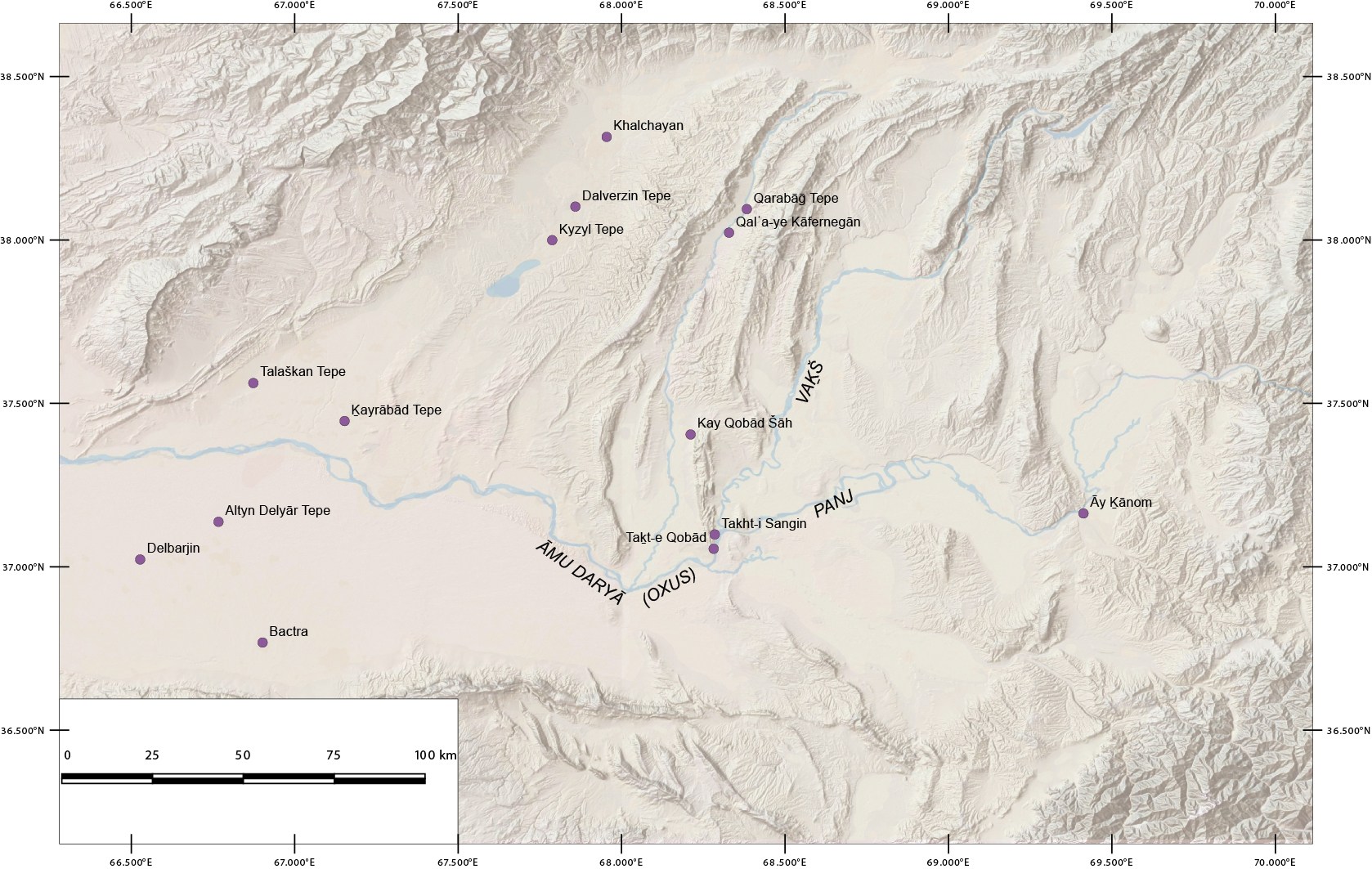
Figure 1. The location of Takht-i Sangin relative to other sites in Bactria of the late Achaemenid-Hellenistic period. Map background © OpenStreetMap contributors and the GIS User Community.
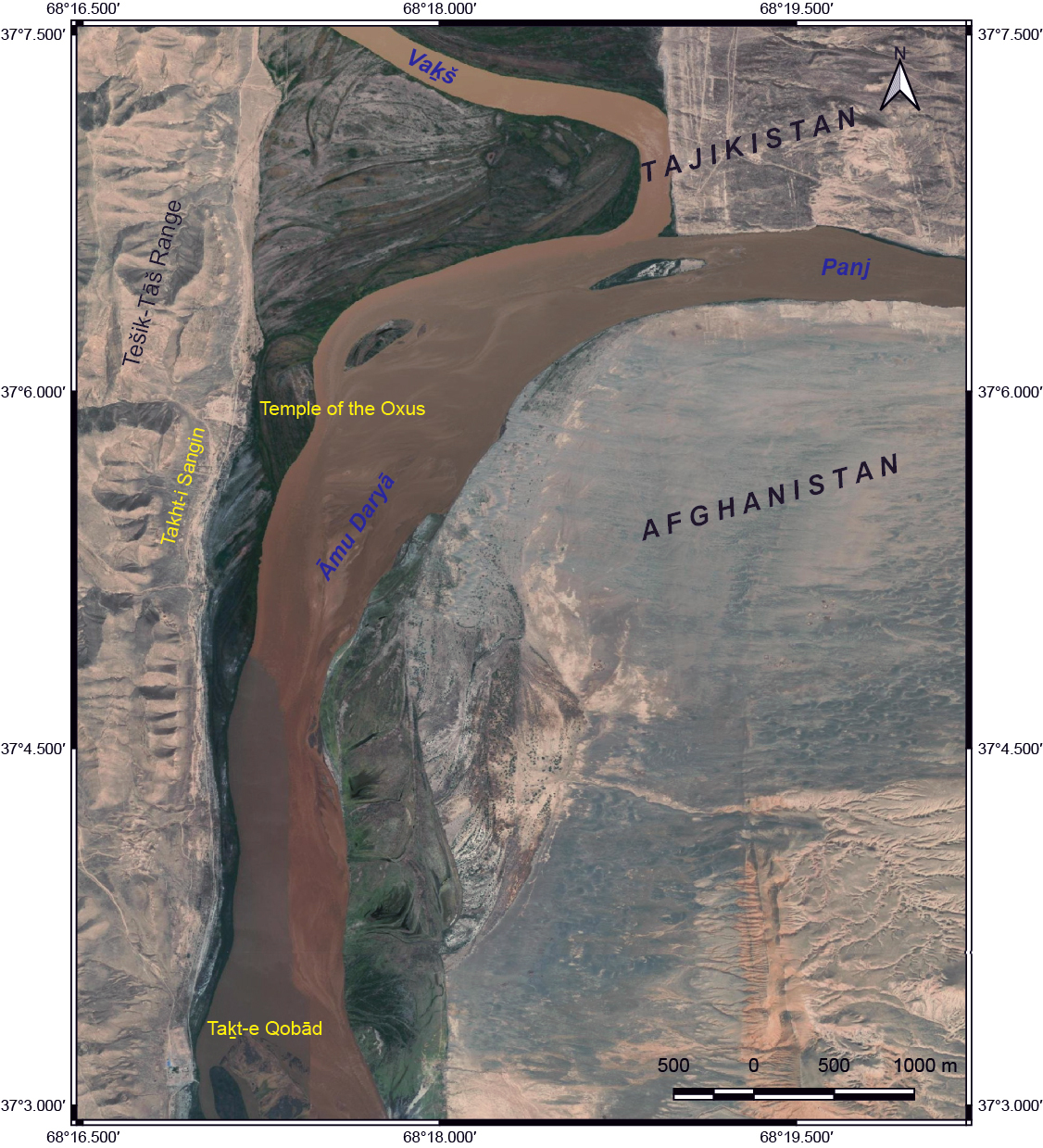
Figure 2. Aerial view of the area from the site of Takht-i Sangin to Taḵt-e Qobād. Background: Google Earth image © 2022 CNES/Airbus, Maxar Technologies.
The site was excavated under the direction of Boris Litvinskiĭ and Igor Pichikyan from 1976, ceasing in 1991 at the collapse of the USSR and outbreak of the Tajik civil war. The main focus of the excavations concerned the mud-brick structure on the monumental platform that gave the modern site its name, now identified as the Temple of the Oxus (Figure 3). Excavations resumed at the site in 1998 led by Anjelina Drujinina, focusing on the courtyard of the temple and including some exploration of the surrounding settlement.
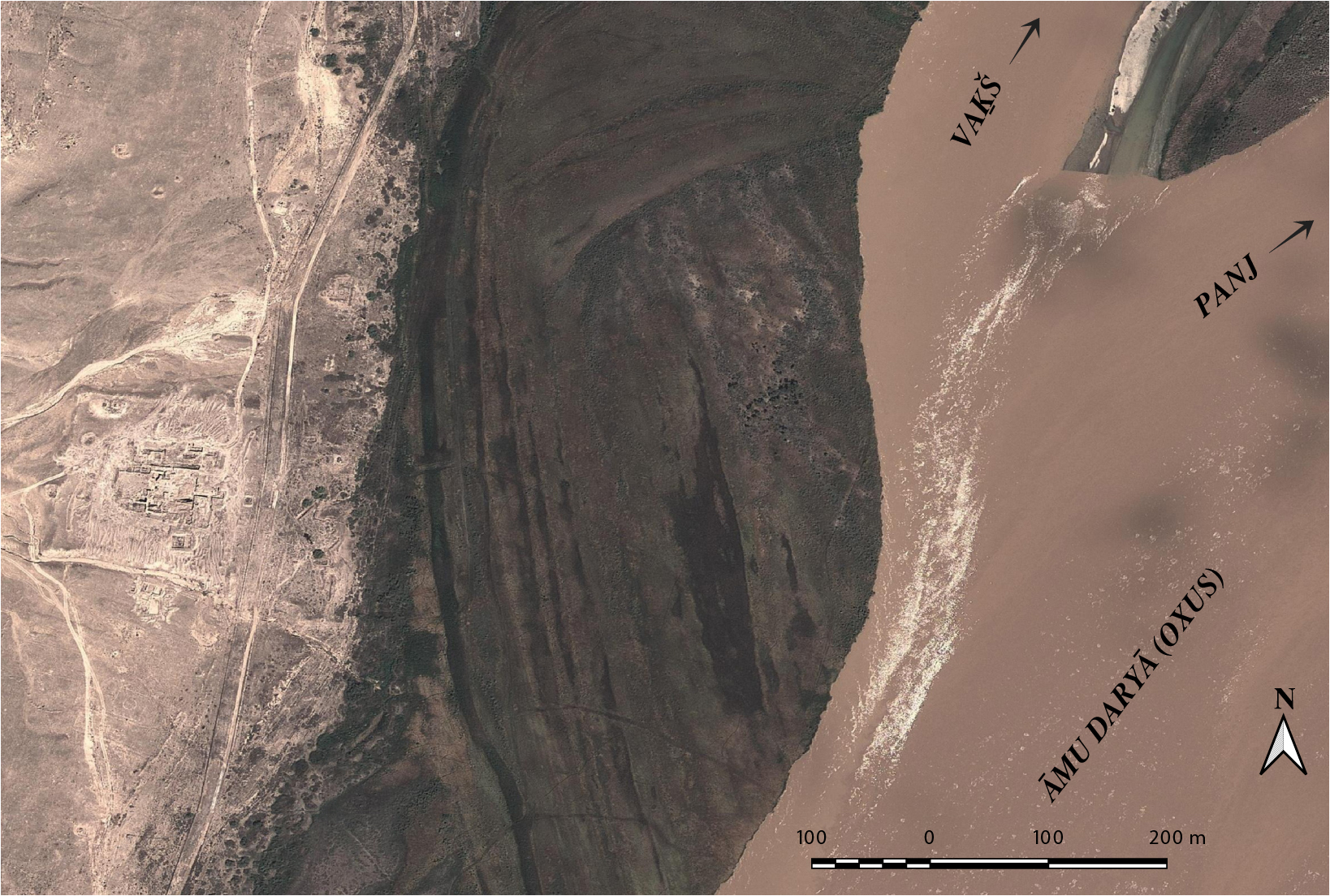
Figure 3. Aerial view of the Citadel and Temple of the Oxus, Takht-i Sangin. Background: Google Earth image © CNES/Airbus, Maxar Technologies.
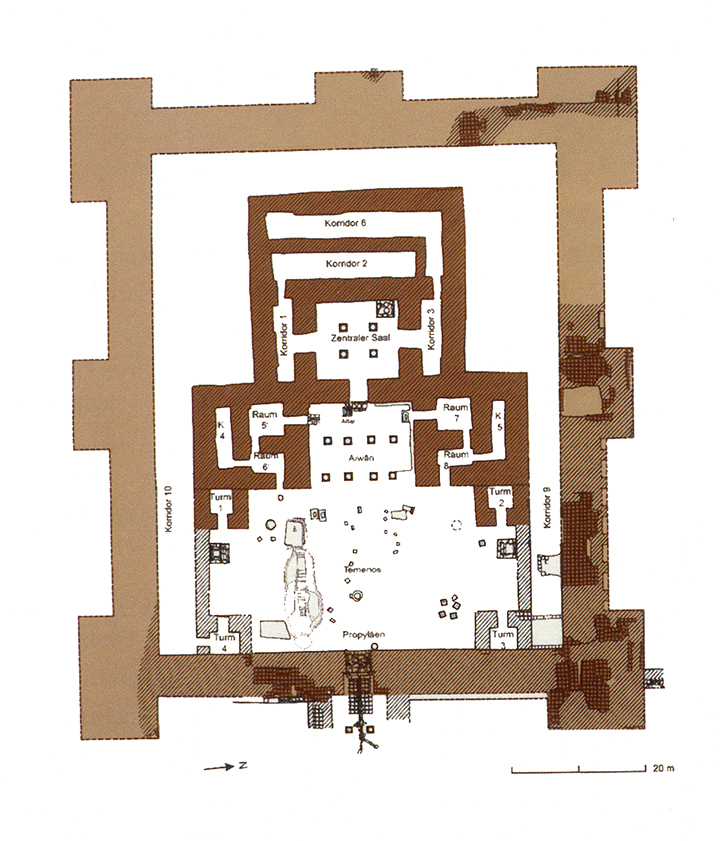
Figure 4. Floor plan of the Temple of the Oxus, Takht-i Sangin, with the Hellenistic construction phase highlighted. From G. Lindström, “Der Oxos-Tempel: Räumliche Aspekte und Kultkontinuität im Spiegel der Votivpraxis,” in S. Hansen, D. Neumann, and Tilmann Vachta, eds., Raum, Gabe und Erinnerung: Weihgaben und Heiligtümer in prähistorischen und antiken Gesellschaften, Berlin, 2016, p. 284, fig. 4. Reproduced by permission.
Constructed in the early Hellenistic period, the temple is one of the earliest identifiable enclosed sacred spaces in ancient Iran and Bactria. The site suffered periods of abandonment and damage, especially in the second half of the 2nd century BCE contemporary to the fall of the Greco-Bactrian rulers. Resumed attention to the temple likely aligns with the beginning of the Kushan (q.v.) period in the 1st century BCE, and occupation continued until the early 3rd century CE. The contrast between the size of the formidable temple structure and the relatively modest settlement at the strategic site of Takht-i Sangin has prompted suggestions of Seleucid royal involvement in the construction of the temple, designed to function as a sacred focal point for the surrounding region (Canepa; Lindström, 2016).
Exploration of the settlement has revealed mud-brick houses, most of which have stone thresholds, thick walls, and were sunk into the ground for protection from the weather (Drujinina, 2009). Some more elaborate residences contained limestone stepped torus bases typical of contemporary Iranian architecture. Kushan-period material was excavated from the necropolis.
Dominating the site is the raised platform (170-210 m x 240 m), defended by 2 m-thick stone walls that are reinforced with towers at the corners, and in turn are surrounded by a deep moat (about 3 m). In the center of the platform lies the remains of a monumental structure roughly 51 m x 51 m, built of large mud-bricks (50 x 50 x 15 cm) and facing east, to the river Oxus (Figure 4). A column base found by the entrance to the sanctuary suggests the presence of a monumental propylon. The entranceway opened onto a large courtyard (46.50 x 21.57 m) paved with mud-bricks, a tower in each corner of the courtyard, restricted by walls to the north and south added in the Kushan period. Across the courtyard, aligned on a central axis, the entrance to the temple consisted of a wide hypostyle portico supported by two rows of four columns. Often referred to as an early form of ayvān (q.v.), the entrance is flanked by two wings that comprise matching sets of a corridor (3 m wide x 12-26 m long) and two small roughly square rooms accessible via the ayvān and the courtyard. (The excavators labeled these Rooms 8 and 7 with Corridor 5 to the north; to the south, Rooms 6 and 5, with Corridor 4). Behind the portico lies the four-columned “Central Hall” (ca. 11.5 m x 12.7 m), also referred to as the “White Hall” because of the plaster coating its walls. From the Central Hall, L-shaped corridors that fold around the back of the temple are accessed from doorways in the north and south walls (Corridor 3 accessed from the northern side of the Central Hall, leading into Corridor 6; while the southern doorway Corridor 1 leads into Corridor 2).
In a similar manner to the more elaborate residential buildings, the mud-brick structure of the Temple of the Oxus was embellished with a few limestone architectural features, such as smooth column drums and double-stepped torus bases in the portico, combined with Ionic capitals (Litvinskiĭ and Pichikyan, 1998; Litvinskiĭ, 2002; Pichikyan, 1987a; 1992). Several wells and cisterns were excavated in the courtyard. Recent excavations (2004-10) uncovered a deep well in the southeastern corner of the courtyard, accessed by a stairway from the west (now at a depth of 10 m and length of 22 m) that was back-filled in the Kushan period (Drujinina et al., 2016). Evidence of bronze working was also found within the temenos (Drujinina and Boroffka, 2006; Drujinina and Lindström, 2013, pp. 174-75; Drujinina et al., 2016).
The precise focal point for cultic practice is unclear. Seven possible altars were discovered. Two stepped podia originally identified as fire altars were sheltered in Rooms 5 and 7 on either side of the courtyard, leading to the initial identification of the whole complex as a fire temple (see Litvinskiĭ and Pichikyan, 1994, fig. 11). Two roughly square and squat limestone platforms of two courses with architectural mouldings and bearing Greek letters as masons’ marks (Pichikyan, 1987b) were set opposite each other against the north and southern walls of the courtyard, close to the entrances of Towers 1 and 2. While these may have been open-air altars in the manner of Greek religious practice, and Pichikyan dates them to the late 3rd or early 2nd century BCE, a recent reconstruction proposes that they were sheltered by a portico perhaps added in the Kushan period (Lindström, 2016, fig. 3). Under the northern limestone podium were found many bones of small ruminants and fragments of brick, presenting the possibility that a brick structure here was the focus of animal sacrifice prior to the erection of the stone podia (Pichikyan, 1987b, p. 61; Litvinskiĭ and Pichikyan 2000, p. 172).
A further two possible altars are located within the temple itself: one against the back wall of the portico on the southern side of the entrance to the Central Hall, and the other in the northern corner of the Central Hall against the rear wall. This latter podium is proposed by Lindström (2016, p. 289) to be a base for a cult statue, even though it is off the central axis and so unlike anything seen elsewhere. Finally, Lindström (2016, p. 289) identifies a previously unpublished round rammed-earth (pakhsa) podium as an altar, which although not typical in shape or material for an altar in Greek religious practices, does follow expectations in its alignment centrally outside in the courtyard. The variety of forms and placements of podia, akin to the variety in architecture and votives discovered in the temple, gives an impression of varied, eclectic, and unconventional cultic practices at this sacred site, fulfilling the requirements of a varied assembly of worshippers.
Identification of the building as the Temple of the Oxus (Vaḵš) is based on several votive inscriptions discovered in the excavations. The first dedication was found in Corridor 2, in the form of a Greek inscription on a votive offering from a man called Atrosokes (see below), declaring “Atrosokes dedicated [this] as a vow to Oxus” (Litvinskiĭ, Pichikyan, and Vinogradov, 1985; Bernard, 1987). In recent years, further inscriptions naming Oxus were discovered in the excavations: on fragments of a limestone basin identified as a perirrhanterion (Drujinina, 2001; Ivantchik, 2013), and on a clay mold for a bronze vessel for one “Iromios son of Nemiskos, molrpalres” (Bactrian: keeper of the seal) (Drujinina and Boroffka, 2006, pp. 67-69; Ivantchik, 2011). Although from the symmetry of the temple’s layout and the array of possible cultic foci and apparatus, such as these wells and altars, it has been proposed that the temple hosted a dual cult, yet only Oxus is attested epigraphically.
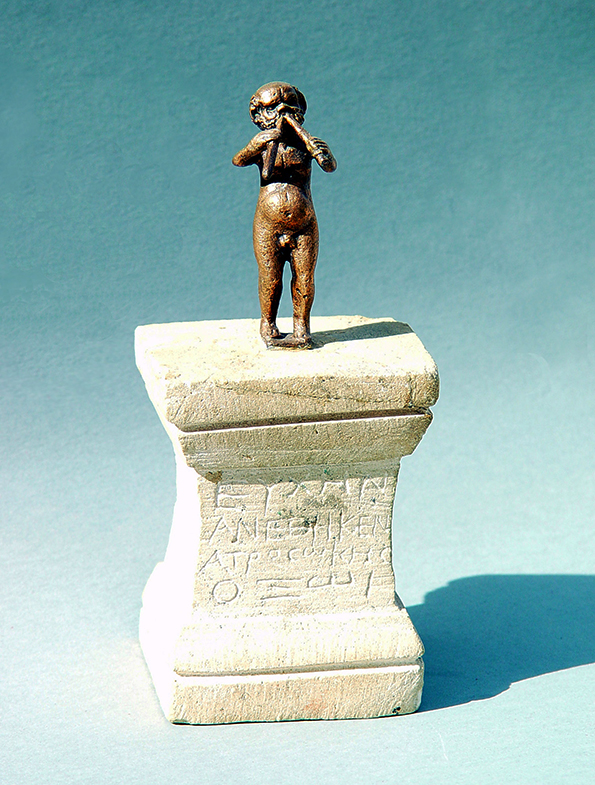
PLATE I. The votive offering of Atrosokes, Takht-i Sangin, Corridor 2, Deposit 4. Height: 16 cm. National Museum of Tajikstan Inv. Nr. M7010. Photograph © Gunvor Lindström, Deutsches Archäologisches Institut. Reproduced by permission.
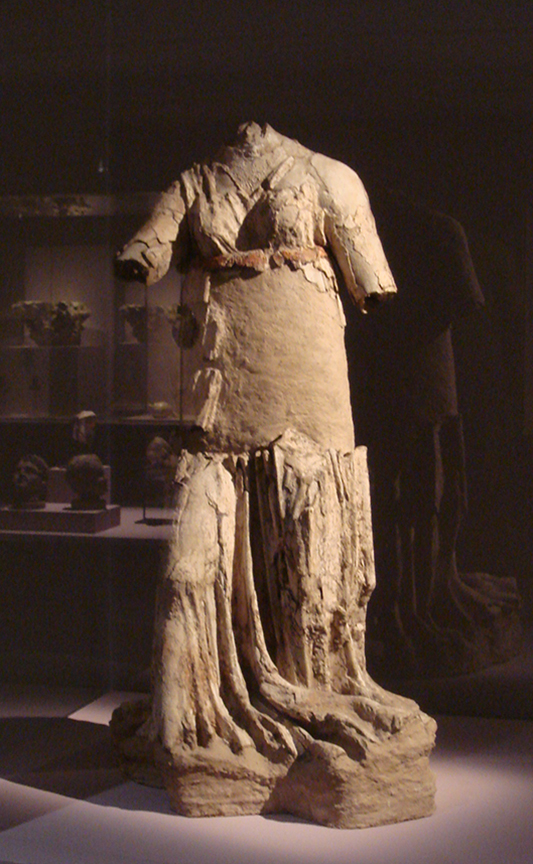
PLATE II. Unbaked clay statue of a female figure in a chiton, Temple of the Oxus, Takht-i Sangin, Corridor 6, Deposit 5, Height: 86 cm, c .200-150 BCE. National Museum of Antiquities of Tajikistan, Inv. Nr. TS 4003. 4005, 4006/1091. Photograph by ALFGRN, licensed under CC BY-SA 2.0 (www.flickr.com/photos/156915032@N07/51656290352/in/album-72157720119065111/).
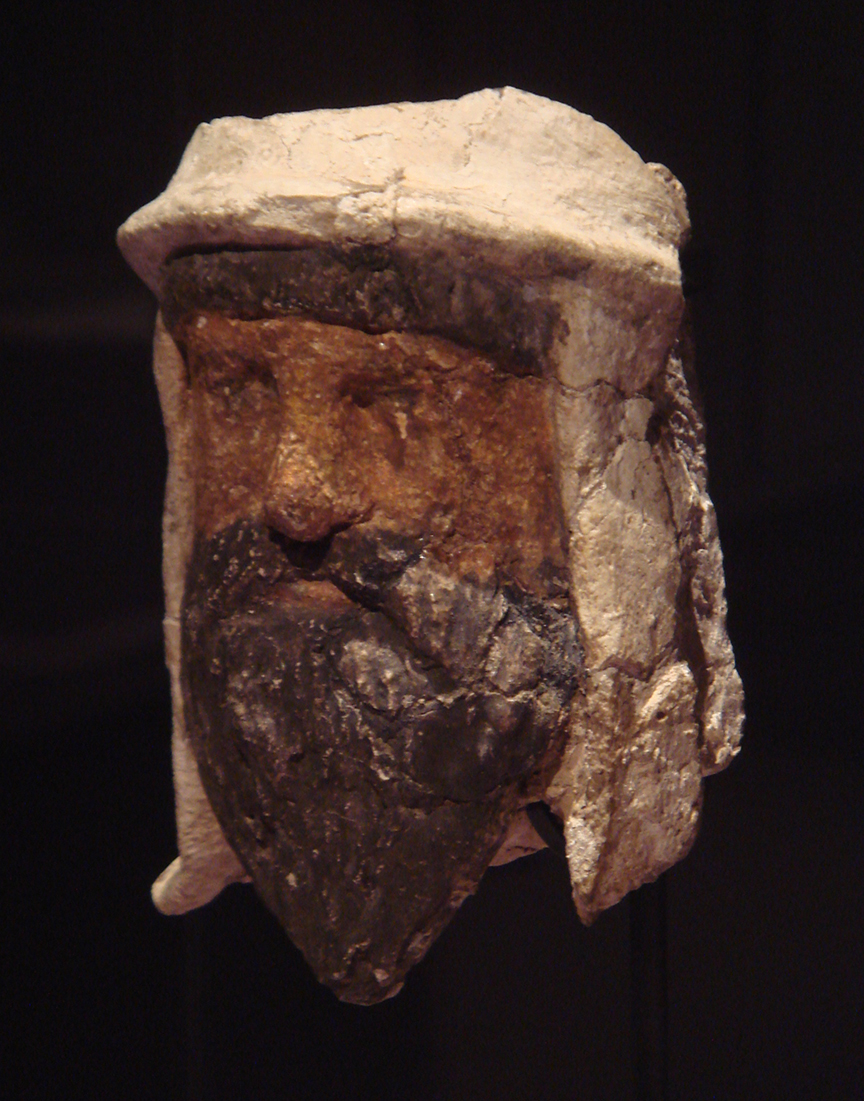
PLATE III. Painted unbaked clay head of a bearded man wearing a bašlyk, Temple of the Oxus, Takht-i Sangin, Corridor 2, Deposit 4, Height: 10.5 cm, 3rd-2nd century BCE. National Museum of Tajikistan, Inv. Nr. M 7258. Photograph by ALFGRN, licensed under CC BY-SA 2.0 (https://www.flickr.com/photos/156915032@N07/51657103231/).
Currently, there is a similar impression to that from the Temple with Indented Niches at Āy Ḵānom (q.v.), 100 km to the east, of concurrent differing methods of religious observance within the same sacred space (although Bernard, 1994, and Grenet argue that the podia in Room 5 and 7 were later additions to the ritual environment of the temple). There is no evidence of a cult statue or its podium in the sanctuary, but traces were discovered of a monumental bronze anthropomorphic figure on a base in a prominent position in the courtyard, in front and slightly south of the portico (Litvinskiĭ and Pichikyan, 2000, p. 123). Two clay heads of male figures wearing diadems, one bearing traces of gold leaf on its cheeks, suggest there may have been an aspect of Hellenistic ruler cult among the temple’s activities (Lindström, 2009, p. 351, nos. 232-33). Among other fragments indicating further statuary set up within the temenos, see a silver hand (Zeǐmal’, p. 93). The wells and cisterns discovered in the courtyard likely held ritual functions in the cult of the river god, but also could have contributed to the defensive equipment of the highly fortified site. The location and form of the temple also combine strategic and sacred characteristics in a number of other features: the moat provides a defensive aspect but also would have surrounded the temple with the sacred water, while its raised platform adds a protective element as well as emphasizing the sacred aspect of the structure in a manner typical of Iranian and Bactrian religious sites, elevating it above the surrounds. While the location on a strip of land between mountains and river is a strategic location, the temple faces east and towards the Oxus itself, in close proximity, and Lindström notes that the situation on the bend of the river allows for the rising sun to be seen through a gap where the river breaks through between two rocky outcrops (Lindström, 2016, p. 286).
Over 8,000 artifacts were found in the Temple of the Oxus (now in the National Museum of Antiquities of Tajikistan and the National Museum of Tajikistan), mostly deposited in bothroi in the long corridors behind the Central Hall. Many of these items were items of arms and armor (Litvinskiĭ and Pichikyan, 2001), whether functional, ceremonial, or miniature, among fragments of ivory flutes, jewelry, and pieces of elaborate furniture, as well as other artifacts such as statuettes and reliefs. The forms of these votive objects include Achaemenid, Parthian, Scythian, Greek, and Indian features (see Wood, 2011). The materials of the votives are varied, including ivory, bronze, silver, gold, stucco, terracotta, inlaid schist vessels of the type distinct to Bactrian sites, and examples of unbaked clay sculpture common to Bactria and Parthia comparable to those found at Mithradātkert/Old Nisa (q.v.), Khalchayan (q.v.), and Āy Ḵānom. The hoard of Achaemenid gold objects known as the Oxus Treasure, now in the British Museum, are thought by some to have originated as votives in the Temple of the Oxus, but may have come from somewhere else in the vicinity, such as the earlier fortress site downstream at Taḵt-e Qobād (Dalton).
The most famous votive object discovered in the Temple of the Oxus is the dedication made by Atrosokes (inscription mentioned above): a miniature limestone altar topped with a bronze figurine of a nude satyr playing the double pipe, usually identified as Marsyas (PLATE I). The excavators of the votive proposed that in the Hellenistic period a link was drawn between Marsyas and the god of this temple due to a visual similarity between the rivers Marsyas and Oxus (Litvinskiĭ, Pichikyan, and Vinogradov, 1985, p. 100) and noted a shared theme of river deities linking several of the votives (Litvinskiĭ and Pichikyan, 1995b). Paul Bernard further proposed that an alignment between Marsyas and Oxus was created by settlers from the Maeander valley (Bernard, 1987, pp. 109-10). A definite alignment between the appearance of this statuette and the conception of the titular deity of the temple, however, can be questioned (see Grenet on the iconography of the god Oxus). What is clear is that we have a man with an Iranian name (meaning “possessor of strong fire”), perhaps a local man, probably in the first half of the second century BCE, making a votive offering in a Greek form to a local Bactrian deity.
Among the thousands of votive objects discovered in the temple are many objects of intricate craftsmanship, too numerous to be comprehensively summarized here (see Lindström, 2013a, 2013b and 2016; Litvinskiĭ, 2010; Shenkar, 2012; Zeĭmal’). The prolific weapons dedicated at the site include numerous ivory fragments of miniature and decorative items, such as an akinakes scabbard decorated in relief with a lion attacking a stag comparable to many Achaemenid examples (Litvinskiĭ and Pichikyan, 1981, pp. 136-52); the handle of a makhaira in the form of a griffin’s head (Litvinskiĭ and Pichikyan, 1995a, p. 110, fig. 5); and a miniature scabbard bearing a relief of a cavalryman bearing down on an infantryman (Litvinskiĭ and Pichikyan, 2001, p. 262). Images of Greek deities and mythological figures include Heracles (q.v.) wrestling the river-god Achelous as a dagger handle (Litvinskiĭ and Pichikyan 1995b, p. 133, figs. 6-9) and the chape of a scabbard carved with a hippocampess (Litvinskiĭ and Pichikyan, 1995b, p. 140, fig. 13), both suitably aquatic themes for this temple; while a handle of a miniature sword was carved to represent a young Heracles or Alexander (q.v.) wearing Heracles’ lion-skin helmet (Litvinskiĭ and Pichikyan, 1980, pp. 67-77; 1995b, p. 130, fig. 1). Eros also seems a popular choice for votives at the temple: a miniature ivory Eros carrying a conch (Lindström, 2009, p. 355, no. 241), a clay Eros (also identified as an Apollo: Zeǐmal’, p. 91) and numerous gilded bronze appliques of erotes (Litvinskiĭ, 2006) were found among the corridor deposits.
Several of the artifacts found in the Temple of the Oxus show connections with objects found at Āy Ḵānom, such as the inlaid schist vessels mentioned above (Drujinina, 2004; Francfort), and fragments of a gilded silver relief showing a harnessed lion on rocky ground and a wheel, extremely reminiscent of the Cybele Disc found in the Temple with Indented Niches (Pichikyan, 1992, pp. 51-52), along with a separate silver relief of a radiate bust of Helios. As mentioned above, another feature of distinct local artistic production is the unbaked clay sculpture. In addition to the diademed heads, other clay sculptures among the votives include striding female figures wearing swirling high-belted chitons (Lindström, 2009, p. 353, no. 237; PLATE II), two heads possibly of children (Lindström, 2009, p. 352, no. 235), and the head of a bearded male figure wearing a white bašlyk (Lindström, 2009, p. 352, no. 234; PLATE III). An ivory rhyton (q.v.) protome in the form of a lion (Zeǐmal’, p. 72) is comparable to the Parthian second-century ivory rhytons from Mithradātkert/Old Nisa (Pappalardo), providing yet another tantalizing suggestion of the many connections—in artistic production and the movement of goods and people—within and beyond Bactria in the third and second centuries BCE.
Bibliography
Paul Bernard, “Le Marsyas d’Apamée: L’Oxus et la Colonisation Séleucide en Bactriane,” Studia Iranica 16, 1987, pp.103-15.
Idem, “Le Temple du dieu Oxus à Takht-i Sangin en Bactriane: Temple du feu ou pas?,” Studia Iranica 23, 1994, pp. 81-121.
Idem, “Le sanctuaire du dieu Oxus à Takht-i Sangin au Tadjikstan, ou l’esprit de l’escalier,” in Véronique Schiltz, ed., De Samarcande à Istanbul: étapes orientales, Hommages à Pierre Chuvin 2, Paris, 2015, pp. 53-70 (available at https://books.openedition.org/editionscnrs/25239#authors).
Matthew Canepa, “Seleukid Sacred Architecture: Royal Cult and the Transformation of Iranian Culture in the Middle Iranian Period,” Iranian Studies 48/1, 2015, pp. 71-98.
O. M. Dalton, The Treasure of the Oxus with Other Examples of Early Oriental Metal-Work, 3rd ed., London, 1964.
A. P. Drujinina [Druzhinina], “Die Ausgrabungen in Taxt-i Sangin im Oxos-Tempelbereich (Süd-Tadžikistan): Vorbericht der Kampagnen 1998-1999,” Archäologische Mitteilungen aus Iran and Turan 33, 2001, pp. 257-82.
Idem, “A Stone Pyxis Lid Decorated with a Zoomorphic Frieze from the Tahti-Sangin Fort: A New Find from Ancient Bactria,” Archaeology, Ethnology and Anthropology of Eurasia 3/19, 2004, pp. 98–105.
Idem, “Gussform mit griechischer Inschrift aus dem Oxos-Tempel,” Archäologische Mitteilungen aus Iran and Turan 40, 2008, pp. 121-35.
Idem, “Wohin im hellenistischen Baktrien—Wohnhäuser in der Stadt Oxeiane (Tachti Sangin),” in Sven Hansen, Alfred Wieczorek, and Michael Tellenbach, eds., Alexander der Grosse und die Öffnung der Welt: Asiens Kulturen im Wandel, Mannheim, 2009, pp. 177-81.
A. P. Drujinina and N. R. Boroffka, “First Preliminary Report on the Excavations at Takht-i Sangin 2004,” Bulletin of the Miho Museum 6, 2006, pp. 57-69.
A. P. Drujinina and G. Lindström, “Kultgefäße im Oxos-Tempel—zur Frage der Kultkontinuität im unruhigen 2. Jh. v. Chr,” in Gunvor Lindström, Sven Hansen, Alfred Wieczorek and Michael Tellenbach, eds., Zwischen Ost und West: Neue Forschungen zum antiken Zentralasien, Darmstadt, 2013, pp. 171–86.
A. P. Drujinina, T. U. Khudzhageldiyev, and Kh. Inagaki, “Otchet o raskopkakh na gorodische Takhti-Sangin V 2009-2010 gg. raboty na ploshchadi Khrama Oksa” (Report on excavations at Takht-e Sangin V 2009-2010: works at the Oxus Temple square), Raskopakh, nos. 17-18, 2016, pp. 280-383.
H.-P. Francfort, L’art oublié des lapidaires de la Bactriane aux époques achéménide et hellénistique, Persika 17, Paris, 2013.
Mathilde Gelin, “Nouvelles recherches à Takht-i Sangin,” Problemy Istorii, Filogii, Kul’tury / Journal of Historical, Philological and Cultural Studies, 2015, pp. 32-45 (available at http://pifk.magtu.ru/doc/pifk-01-2015.pdf; accessed 31 December 2021).
Frantz Grenet, “The Cult of the Oxus: A Reconsideration,” in V. P. Nikonorov and A. M. Belenitskii, eds., Tsentral’naya Aziya ot Akhemenidov do Timuridov: arkheologiya, istoriya, ètnologiya, kul’tura (Sankt-Petersburg, 2-5 novembre 2004) (Central Asia from the Achaemenids to the Timurids: Archaeology, history, ethnology, culture [St. Petersburg, November 2-5, 2004]), St. Petersburg, 2005, pp. 377-80.
Askold Ivantchik, “New Greek Inscriptions from Takht-i Sangin and the Question as to the Emergence of the Bactrian Written Language,” Bulletin of the Miho Museum 11, 2011, pp. 59-77.
Idem, “Neue griechische Inschriften aus Tacht-i Sangin und das Problem der Entstehung der baktrischen Schriftlichkeit,” in Gunvor Lindström, Svend Hansen, Alfred Wieczorek, and Michael Tellenbach, eds., Zwischen Ost und West: Neue Forschungen zum antiken Zentralasien, Darmstadt, 2013, pp. 125-42.
Gunvor Lindström, “Der Oxos-Tempel in Tacht-i Sangin,” in Sven Hansen, Alfred Wieczorek, and Michael Tellenbach, eds., Alexander der Grosse und die Öffnung der Welt: Asiens Kulturen im Wandel, Mannheim, 2009, pp. 350-71.
Idem, “Votivdeponierungen im Oxos-Tempel (Baktrien): Tradierung griechischer Kultpraxis?,” in Alfred Schäfer and Marion Witteyer, eds., Rituelle Deponierungen in Heiligtümern der Hellenistisch-Römischen Welt: Fachtagung Mainz 28.-30. April 2008, Mainzer Archäologische Schriften, Mainz, 2013a, pp. 97-114.
Idem, “Baktrien – Votive und Votivpraxis in den hellenistischen und kuschanzeitlichen Heiligtümern (3. Jh. v. Chr. – 3. Jh. n. Chr.),” in Iris Gerlach und Dietrich Raue, eds., Sanktuar und Ritual: Heilige Plätze im archäologischen Befund, Rahden, 2013b, 299-306.
Idem, “Der Oxos-Tempel: Räumliche Aspekte und Kultkontinuität im Spiegel der Votivpraxis,” in Svend Hansen, Daniel Neumann and Tilmann Vachta, eds., Raum, Gabe und Erinnerung. Weihgaben und Heiligtümer in prähistorischen und antiken Gesellschaften, Berlin, 2016, pp. 281-310.
Idem, “Southern Tajikistan,” in Rachel Mairs, ed., The Graeco-Bactrian and Indo-Greek World, London and New York, 2020, pp. 286-312.
B. A. Litvinskiĭ [Litvinsky; Litvinskij], Taxt-i Sangīn, der Oxus-Tempel: Grabungsbefund, Statigraphie und Architektur, Mainz am Rhein, 2002.
Idem, “Bronze Appliqués of Erotes from the Temple of the Oxus: The Question of Their Dating in the Light of Connections between Rome and Central Asia,” Journal of Inner Asian Art and Archaeology 1, 2006, pp. 85-88.
Idem, Khram Oksa v Baktrii (Iuzhnyi Tadzhikistan). Tom 3: Iskusstvo, Khudozhestvennoe Remeslo, Muzykal’nye Instrumenty (Oxus Temple in Bactria [southern Tajikistan]. Vol. 3: Art, artistic craft, musical instruments), Moscow, 2010.
B. A. Litvinskiĭ [Litvinsky; Litvinskiy; Litvinskij] and I. R. Pichikyan [Pichikian], “Monuments of Art from the Sanctuary of Oxus (North Bactria),” Acta Antiqua Academiae Scientiarum Hungaricae 28, 1980, pp. 25-83.
Idem, “The Temple of the Oxus,” Journal of the Royal Asiatic Society 113/2, 1981, pp. 133-67.
Idem, “The Hellenistic Architecture and Art of the Temple of the Oxus,” Bulletin of the Asia Institute 8 (The Archaeology and Art of Central Asia: Studies from the Former Soviet Union), 1994, pp. 47-66.
Idem, “An Achaemenian Griffin Handle from the Temple of the Oxus: The Makhaira in Northern Bactria,” in Antonio Invernizzi, ed., In the Land of the Gryphons: Papers on Central Asian Archaeology in Antiquity, Florence, 1995a, pp. 107-28.
Idem, “River-Deities of Greece Salute the God of the River Oxus-Vakhsh: Achelous and the Hippocampess,” in Antonio Invernizzi, ed., In the Land of the Gryphons: Papers on Central Asian Archaeology in Antiquity, Florence, 1995b, pp. 129-49.
Idem, “The Ionic Capital from the Temple of the Oxus (Northern Bactria),” Iranica Antiqua 33, 1998, pp. 233-58.
Idem, “Handles and Ceremonial Scabbards of Greek Swords from the Temple of the Oxus in Northern Bactria,” East and West 49, 1999, 47-104.
Idem, Èllinisticheskiĭ khram Oksa v Baktrii (Iuzhnyĭ Tadzhikistan): Raskopki, arkhitektura, religioznaia zhiznʹ (Hellenistic temple of the Oxus in Bactria [South Tajikistan]: Excavations, architecture, religious life), Moscow, 2000.
Idem, Èllinisticheskiĭ khram Oksa v Baktrii (Iuzhnyĭ Tadzhikistan): Baktriĭskoe vooruzhenie v drevnevostochnom i grecheskom kontekste (Hellenistic temple of the Oxus in Bactria [South Tajikistan]: Bactrian armament in the ancient Eastern and Greek context), Moscow, 2001.
B. A. Litvinskiĭ, I. R. Pichikyan, and J. G. Vinogradov, “Votiv Atrosoka iz xrama Oksa v Severnoiĭ Baktrii,” (The votive offering of Atrosokes from the Temple of the Oxus in northern Bactria), Vestnik drevnej istorii (VDI) 4, 1985, pp. 84-110.
Eleonora Pappalardo, Nisa partica: i rhyta ellenestici, Florence, 2010.
I. R. Pichikyan [Pičikian, Pitschikjan], “The Oxus Temple Composition in the Context of Architectural Comparison,” International Association for the Study of the Cultures of Central Asia. Information Bulletin 12, 1987a, pp. 42-55.
Idem, “The Greco-Bactrian Altars in the Temple of the Oxus (Northern Bactria),” International Association for the Study of the Cultures of Central Asia. Information Bulletin 12, 1987b, pp. 56-65.
Idem, Oxos-Schatz und Oxos-Tempel: Achämenidische Kunst in Mittelasien, Berlin, 1992.
Idem, “Neue Entdeckungen in Baktrien und die hellenistische Kultur,” in Bernd Funck, ed., Hellenismus: Beiträge zur Erforschung von Akkulturation und politischer Ordnung in den Staaten des hellenistischen Zeitalters: Akten des Internationalen Hellenismus-Kolloquiums, 9.-14. März 1994 in Berlin, Tübingen, 1996, pp. 77-90.
Claude Rapin, “Hinduism in the Indo-Greek Area: Notes on Some Indian Finds from Bactria and on Two Temples in Taxila,” in Antonio Invernizzi, ed., In the Land of the Gryphons: Papers on Central Asian Archaeology in Antiquity, Florence, 1995, pp. 275-91.
Michael Shenkar, “On the Temple of the Oxus in Bactria, III (Review article),” Studia Iranica 41, 2012, pp. 135-42.
Alfred Wieczorek, Svend Hansen, and Michael Tellenbach, Alexander der Grosse und die Öffnung der Welt: Asiens Kulturen im Wandel, Regensburg, 2009.
Rachel K. L. Wood, “Cultural Convergence in Bactria: The Votives from the Temple of the Oxus at Takht-i Sangin,” in Anna Kouremenos, Sujagtha Chandrasekaran, and Roberto Rossi, eds., From Pella to Gandhara: Hybridization and Identity in the Art and Architecture of the Hellenistic East, Oxford, 2011, pp. 141-52.
E. V. Zeǐmal’, Drevnosti Tadzhikistana: katalog vystavki (The Antiquities of Tajikistan: exhibition catalogue), Dushanbe, 1985.