



SIĀQ is a system of numerical notation, one of several different historical systems of Persianate numeracy. It has also been referred to as ḵaṭṭ-e siāq, ḵaṭṭ-e raqam, ḵaṭṭ-e roqumi, ḵaṭṭ-e dināri, ḥesāb-e roqum and ḥesāb-e dināri (Kazem-Zadeh, pp.10-11). It is a ciphered, positional system, but lacks a graph for zero. It appears to have been introduced in early Islamic times under one of the Umayyad caliphs (ca. 656-751 CE) when counting had already become a decimal (i.e., base ten) system, but the numerals in modern international usage, which introduced place value, had not yet spread from their south Indian origin into the Islamic world.
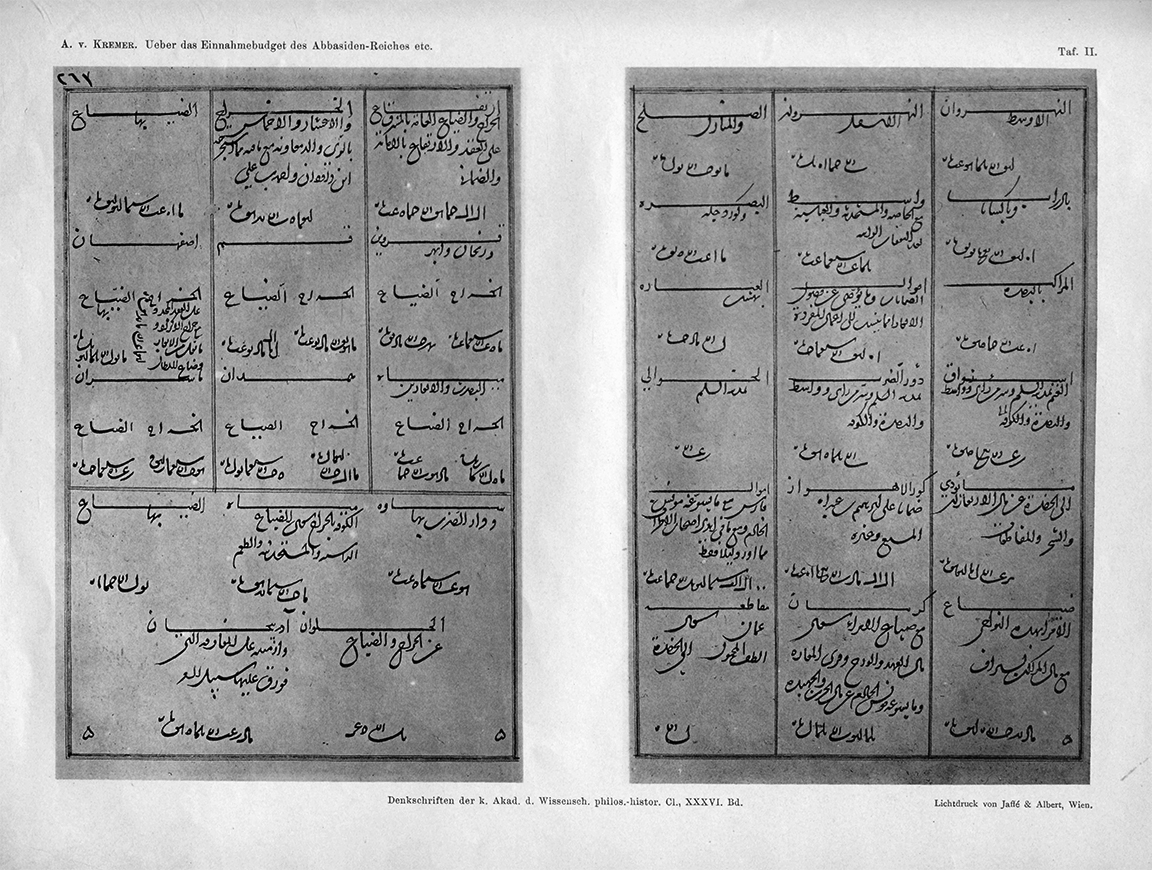
Figure 1. Folios from a 15th-century manuscript of a work by Waṣṣāf (MS Vienna, Flügel 959) showing revenues in siāq script for the year 306/918-19 under the caliph al-Moqtader and his vizier ʿAli b. ʿIsā Jarrāḥ. The registers at the lower right and left include, inter alia, data for Ahvaz, Fārs, Kerman, Ray, Qazvin, Qom, Hamadan, and Azarbaijan. From A. von Kremer, Ueber das Einnahmebudget des Abbasiden-Reiches vom Jahre 306 H. (918-919), Vienna, 1887, Taf. II.
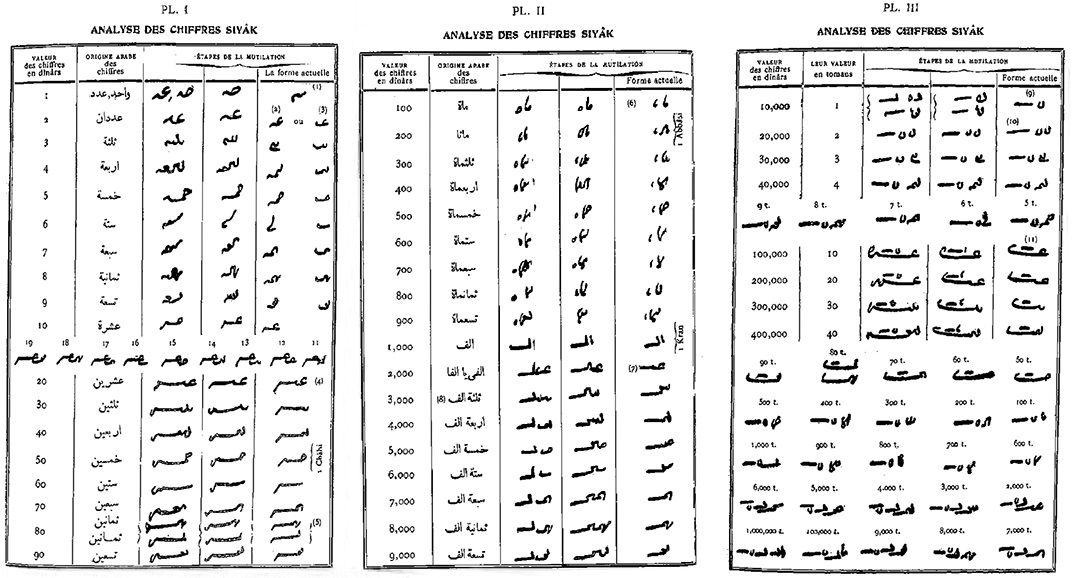
Figure 2. Chart showing development of siāq script in financial accounting (used for dinārs, šāhis, qerāns, tomāns). From H. Kazem-Zadeh, “Les chiffres siyâk et la comptabilité persane,” Revue du monde musulman 30, 1915, pls. 1-3.
Siāq was derived from the Arabic words for each of the numbers, and written from right to left in descending order of magnitude (except that units came before tens, as in Arabic usage). The origin of the term is uncertain. Arabic dictionaries list it under the same root as suq (market), but do not suggest how it was formed or came into use. Although it has been suggested that it came from a Middle Persian word for number (s’k, sāg), there is no evidence. It could have been adopted from known models in other languages.
The conditions of its use—continuous until the 20th century—were shaped by the way society was organized in the early Islamic Persianate world: It was developed by the Persian chancery scribes (see DABĪR) in the service of government centers. They shaped the writing of Arabic in the 7th century CE, and then began writing “New Persian” in the Arabic script. Though successors to the administrators of the pre-Islamic Sasanian (q.v.) empire, they were Arabizing as part of the process of Islamization, which is said to have been launched by the fifth Umayyad caliph ʿAbd-al-Malek b. Marwān in 706 CE (Hinz, p. 3). They were the literate class; the administrators of the Caliphate that succeeded it, because literacy was not established among the conquering Arabs. They were writing for each other, not for scientists or a larger intellectual, educated class. The earliest extant evidence for the use of siāq comes from the early 10th century CE, when New Persian was becoming the primary written language throughout the eastern half of the Islamic world. For them, it was like a form of shorthand that only they could easily read. The names of the numbers quickly became abbreviated, distorted, and stylized into a uniquely cursive numerical shorthand, difficult to read even for the literate, unless they were trained. It was particularly useful for keeping quantified information secret from unauthorized persons (see Kremer, plates I-III, for the financial accounts written for al-Moqtader, the ʿAbbasid Caliph, in Baghdad in 918-919; Figure 1).
The use of siāq spread throughout the Islamic world, irrespective of the local written language, and it continued in use for bureaucratic purposes under the Ottomans, Safavids, and Mughals, and under the Uzbek governments of Central Asia. It was used by merchants, landholders, irrigation officials, and others, and for matters relating to landholding and other rural accounting in some parts of the Persianate world until well into the 20th century.
Siāq was a significant advance on abjad (q.v.), which was the traditional system inherited from similar earlier versions used with other alphabets, such as Aramaic and Ancient Greek, using the numerical value of each letter of the alphabet. Abjad was used to assign simple numbers to successive objects, such as (in modern times) the pages of a preface, and was impractical for large numbers. Calculation at that time did not require numerals, because it was done on an abacus or another similar instrument, satisfying the needs of a population that was mainly illiterate.
Siāq was terminated in Turkey by Ataturk’s romanization program in 1928. It was taught in Iran as part of the standard curriculum until the early 1930s, and in India and Pakistan until the second half of the 20th century. It can be compared with the use of Roman numerals (I, V, X, C, D, M) in the Christian world through the 17th century, which (like abjad in modern times) continues to a limited extent even now, e.g., for the pages of a preface. Sometimes two systems were used together (such as the Indian numerals with siāq) in order to make falsification more difficult (for siāq graphs see Kazem-Zadeh, pp. 14-16; Figure 2).
Bibliography
H. Kazem-Zadeh, “Les chiffres siyâk et la comptabilité persane,” Revue du monde musulman 30, 1915, pp.1-51.
Alfred Freiherrn von Kremer, Ueber das Einnahmebudget des Abbasiden-Reiches vom Jahre 306 H. (918-919), Denkschriften der Kaiserlichen Akademie der Wissenschaften. Philosophisch-historische Klasse 36/2, Vienna, 1887, pp. 283-362.
Walter Hinz, “Das Rechnungswesen orientalischer Reichsfinanzämter im Mittelalter,” Der Islam 29, 1950, pp. 1-29.
Reviel Netz, “Counter Culture: Towards A History of Greek Numeracy,” History of Science 40/3, 2002, pp. 321-52.
Henrik S. Nyberg, A Manual of Pahlavi, 2 vols., Wiesbaden, 1964-74.
Brian Spooner and William L. Hanaway, “Siyaq: Numerical Notation and Numeracy in the Persianate World,” in Eleanor Robson and Jacqueline A. Stedall, The Oxford Handbook of the History of Mathematics, eds., Oxford and New York, 2009, pp. 429-47.