



MOḤAMMAD-ʿALI KHAN ŠIRĀZI, MIRZĀ (b. Shiraz, ca. 1194/1780 d. Tehran, 18 Rabiʿ II 1268/9 February 1852; Figure 1), special envoy of Persia to France (August 1847-December 1847), envoy for the exchange of ratifications of the Second Treaty of Erzurum (March 1848) and the fifth foreign minister of Qajar Persia (July 1851-February 1852).
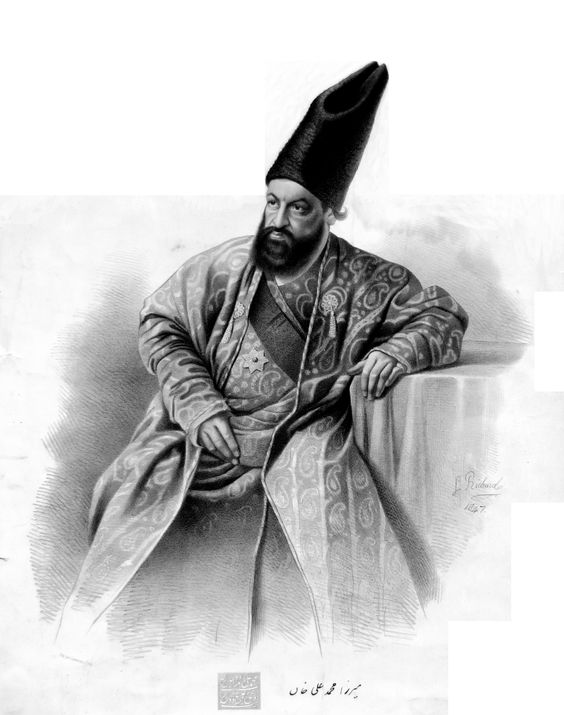
Moḥammad-ʿAli Khan Širāzi’s date of birth has been given as 1186/1772 (Bamdād, III, p. 445), but he himself said that he was seventy years old in 1264/1848 (in Ṣāleḥi, ed., p. 410), which would mean that he was born in 1194/1780. He was a son of Moḥammad Esmāʿil, the nephew of Mirzā Abu’l-Ḥasan Khan Ilči (see also ELČI), and he served as first secretary to Abu’l-Ḥasan Khan Ilči’s diplomatic missions to Russia in 1815 and to Britain in 1818-19 (Ḵāvari, p. 807; Hellot-Bellier, p. 513). The purpose of these missions was to negotiate with Russia and Britain for the return of part of the territories lost to Russia, which Gore Ouseley had promised at the time of the treaty of Golestān in October 1813. On the way to Britain, in France, Moḥammad-ʿAli Khan was so impressed with Paris that he wrote a poem in praise of the city (Nategh, p. 123). He then resided in Paris for one year and traveled a great deal in Europe (Moḥammad-ʿAli Khan, p. 78).
In 1824, after returning from Europe, Mirzā Moḥammad-ʿAli was appointed secretary to the newly established Foreign Ministry (see FOREIGN AFFAIRS) in Tehran, under the administration of Abu’l-Ḥasan Khan Ilči, with the responsibility for hosting foreign envoys (Ḵāvari, p. 807). He was promoted to deputy foreign minister (nāyeb al-wezāra) under Moḥammad Shah Qājār (r. 1834-48). After the death of Abu’l-Ḥasan Khan in 1845/1262, Mirzā Moḥammad-ʿAli occupied Abu’l-Ḥasan Khan’s position at the shah’s public audience (salām, see COURTS AND COURTIERS vii. In the Qajar Period) and received the title of khan from Moḥammad Shah Qājār (Hellot-Bellier, p. 514; Bāmdād, III, p. 445).
In June 1847, Mirzā Āqāsi, grand vizier of Moḥammad Shah Qājār, sent Moḥammad-ʿAli Khan as special envoy to France in order to strengthen the relationship between the two countries. Moḥammad Shah, having conferred Moḥammad-ʿAli Khan with his credentials, also bestowed on him the Order of the Lion and Sun First Class (nešān-e šir o ḵoršid; see DECORATIONS) in order to elevate his stature as the Persian special envoy to France (Nategh, p.124). A farmān was granted to the French envoy in Tehran, Comte Eugène de Sartiges (1809-92), in May 1847 in favor of French merchants. According to this farmān, French citizens enjoyed commercial privileges of the most favored nation, while reciprocal trade concessions were not intended for Persian merchants (Ādamiyat, pp. 552-53). Moḥammad-ʿAli Khan’s main task was thus to take the necessary steps in France to obtain the same privileges for Persian merchants in France as their French counterparts in Persia (Nategh, annex 18, pp. 276-77). He was also required to address the living and studying conditions of five Persian students sent to France in 1261/1845 by Mirzā Āqāsi to study under the supervision of Alix Desgranges (1793-1854) (Hellot-Bellier, p. 125; Moḥammad-ʿAli Khan, p. 86). Finally, Mirzā Āqāsi officially requested, through his envoy, the authorization required for Comte de Sartiges, who had been sent to Persia without a formal title, to be able to act as envoy extraordinary in Tehran on behalf of the French government (Nategh, annex 18, pp. 276-77).
Meanwhile, because of the Second Treaty of Erzurum (see BOUNDARIES i. With the Ottoman Empire), which had been signed by Mirzā Taqi Khan Farāhāni on 31 May 1847 (but not yet ratified), Moḥammad-ʿAli Khan was also ordered to remain in Istanbul for two weeks to negotiate some issues regarding the tribes straddling the Ottoman-Persian borders, the condition of pilgrims and merchants who traveled through Ottoman lands, and commissions to delineate the borders as soon as possible (Ṣāleḥi, ed., pp. 239-40).
Upon Moḥammad-ʿAli Khan’s arrival in Istanbul, the Russian and British intermediary representatives urged him to remain longer for the exchange of the ratified treaty, which was not in his possession when he arrived in Istanbul. Under pressure from British and Russian ambassadors to Tehran, Mirzā Āqāsi sent the signed treaty to Istanbul, authorizing Moḥammad-ʿAli Khan to conduct the exchange (Ṣāleḥi, ed., pp. 290-91). As Moḥammad-ʿAli Khan was not supposed to remain in Istanbul for more than two weeks, however, Comte de Sartiges and his counterpart in Istanbul, François-Adolphe de Bourqueney (1799-1869), urged him not to delay in his mission to Paris (Ādamiyat, pp. 558-59; Nategh, p. 124). After a few months’ delay, Moḥammad-ʿAli Khan finally departed for France on 26 August 1847, before the royal courier brought the signed treaty from Tehran.
On 23 September 1847, Moḥammad-ʿAli Khan was summoned to an audience with King Louis-Philippe (r. 1830-48) at the Compiègne Palace in northern France, at which he presented the shah’s letter and royal gifts, including a portrait of the shah decorated with diamonds (Moḥammad-ʿAli Khan, pp. 76-77; Hellot-Bellier, p. 518). According to the instructions of Jules Richard (Rišār Khan), a Frenchman in the service of the Persian government, Moḥammad-ʿAli Khan, during his stay in Paris, ordered a significant number of books on history, science, and literature, as well as encyclopedias, dictionaries, maps, and scientific instruments to be shipped to Persia (Hellot-Bellier, p. 520; Nategh, pp. 240-43).
Mirzā Āqāsi, under pressure from the British and Russian envoys in Tehran, repeatedly ordered Moḥammad-ʿAli Khan to return to Istanbul to finish the ratification process for the Second Treaty of Erzurum (Moḥammad-ʿAli Khan, pp. 96-97; Ṣāleḥi, ed., pp. 302, 331). After a four-month stay in France, Moḥammad-ʿAli Khan left Paris on 25 December 1847. Following three months of negotiations in Istanbul, he eventually signed, at his discretion, an explanatory note (iżāḥāt) to the treaty that was supposed to fulfill Ottoman concerns regarding some provisions of the treaty, particularly relating to sovereignty over the Shatt al-Arab and its left bank, vaguely defined in Article 2 (Schofield, 2004, pp. 32-33; Ateş, p. 136). The signing of the explanatory note, which was not accepted by the Persian government, led Mirzā Jaʿfar Khan Mošir-al-Dawla, the Persian delegate in the Erzurum delimitation commission in 1266/1850, to claim that Moḥammad-ʿAli Khan received a bribe of 4000 tomans, under the name of a royal gift, to approve the note as proposed by the Ottoman government (Mošir-al-Dawla, p. 40; Bāmdād, III, p. 445).
Nevertheless, Moḥammad-ʿAli Khan provided detailed reports of his negotiations with Russian and British intermediary ambassadors in Istanbul to Mirzā Āqāsi and informed him of the fact that his refusal to sign the note would have run the risk of an Ottoman withdrawal from the treaty (Ṣāleḥi, ed., pp. 381-82). Furthermore, Moḥammad-ʿAli Khan warned the ambassadors that his adoption of the note was “a short-term measure to prevent the failure of negotiations” and that the recognition of the note was only due to the Persian government’s approval (Schofield, 1994, p. 79; Ṣāleḥi, ed., p. 382).
Under Nāṣer-al-Din Shah Qājār (r. 1848-96), Moḥammad-ʿAli Khan remained in the position of deputy foreign minister through the premiership of Mirzā Taqi Khan Amir Kabir, who assumed personal control of foreign affairs. In Ramażān 1267/July 1851, Nāṣer-al-Din Shah Qājār deposed Amir Kabir from the Foreign Ministry and appointed Moḥammad-ʿAli Khan in his place (Waqāyeʿ-e ettefāqiya 32, 14 Ḏu’l-qaʿda 1267/9 September 1851). During his term of office, Moḥammad-ʿAli Khan was also the head of the Dār al-fonun. Amir Kabir himself selected Moḥammad-ʿAli Khan to be in charge of the college, and it was Moḥammad-ʿAli Khan who, in a letter to Maḥmud Khan Kalāntar dated 24 Moḥarram 1268/18 November 1851, mentioned Dār al-fonun for the first time (Ādamiyat, pp. 362-63). In the same letter, Moḥammad-ʿAli Khan declared that he had obtained the shah’s permission for thirty children of nobles and princes to study at the new college. Nevertheless, Moḥammad-ʿAli Khan’s office lasted for only a short period, because he died on 18 Rabiʿ II 1268/9 February 1852. His death was due to an illness that he had suffered from for some time (W
aqāyeʿ-e ettefāqiya 54, 21 Rabiʿ II 1268/12 February 1852).
Bibliography
F. Ādamiyat, Amir Kabir va Irān, Tehran, 1955; repr., 1983.
S. Ateş, The Ottoman-Iranian Borderlands: Making a Boundary, 1843-1914, New York, 2013.
M. Bāmdād, Šarḥ-e ḥāl-e rejāl-e Irān dar qorun-e 12 wa 13 wa 14 hejri, 6 vols., Tehran, 1968-72.
F. Hellot-Bellier, France-Iran: Quatre cents ans de dialogue, Paris, 2007.
Jaʿfar Khan Mohandes-Bāši Mošir-al-Dawla, Resāla-ye taḥqiqāt-e sarḥaddiya, ed. Moḥammad Moširi, Tehran, 1969.
Moḥammad-ʿAli Khan Širāzi, Ruz-nāma-ye sefārat-e Moḥammad-ʿAli Ḵān Širāzi be farānsa dar ʿahd-e Moḥammad Šāh Qājār, ed. Mehdi Mousavi, Tehran, 2020.
H. Nāṭeq [Nategh], Irān dar rāhyābi–ye farhangi 1834-1848, Paris, 1990.
N. Ṣāleḥi, ed., Asnādi az ravand-e enʿeqād-eʿahd-nāma-ye dovvom-e Arzanat al-Rum (1258-1264 Q.), Tehran, 1998.
R. Schofield, “Interpreting a Vague River Boundary Delimitation: The 1847 Erzerum Treaty and the Shatt al-Arab before 1913,” in K. McLachlan, ed, The Boundaries of Modern Iran, New York, 1994, pp. 72-92.
Idem, “Position, Function, and Symbol: The Shatt al-Arab Dispute in Perspective,” in L. G. Potter and G. G. Sick, eds., Iran, Iraq and the Legacies of War, New York, 2004, pp. 29-70.
Fażl-Allāh Širāzi Ḵāvari,Tāriḵ-e Ḏu’l-qarnayn, ca. 1834, ed., N. Afšārfar, 2 vols., Tehran, 2001.
Waqāyeʿ-e ettefāqiya 32, 14 Ḏu’l-qaʿda 1267/9 September 1851; 53, 14 Rabiʿ II 1268/5 February 1852; 54, 21 Rabiʿ II 1268/12 February 1852.