



LEUMANN, Ernst (b. Berg, 11 April 1859; d. Freiburg, 24 April 1931; Figure 1), Swiss Indologist and a pioneer of Tocharian and Khotanese (qq.v.) studies.
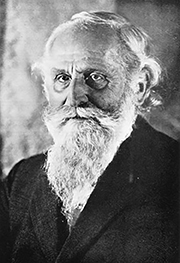
Figure 1. Ernst Leumann. Source: Wilhelm Rau, Bilder hundert deutscher Indologen, Wiesbaden, 1965.
Ernst Leumann was born in Berg, a small village in the Swiss canton of Thurgau, on 11 April 1859. While still in school, he developed an interest in comparative linguistics through his Latin teacher Friedrich Haag, later a professor at the University of Berne. In the course of his studies, he relocated – after two terms in Geneva and Zürich (1877-78) – in autumn 1878 to Leipzig, the stronghold of the so-called “Young Grammarians.” In spring 1880, he left Leipzig for Berlin, where he found in Albrecht Weber (1825-1901), Hermann Oldenberg (1854-1920), and Johannes Schmidt (1843-1901) teachers that left their mark on him. In 1882, he submitted an edition of a Jaina text as his doctoral thesis to the Philosophical Faculty of the University of Leipzig. After a short stay in Oxford, where he collaborated with Sir Charles Monier-Williams (1819-99) in compiling the latterʼs Sanskrit-English dictionary, he joined the University of Strassburg, where he was Professor of Sanskrit from 1884 till 1919. After the ceding of Alsace to France in 1919, Leumann had to leave Strassburg. He found a new home in Freiburg (Breisgau), where he lived till his death on 24 April 1931.
Leumann was editor of the series Indica, where quite a number of dissertations were published that had been completed under his guidance (e.g., the thesis of his brother Julius, who was to become head of the high school of Frauenfeld, which Leumann himself had visited). Among his pupils were several Japanese Indologists who stayed for up to ten years in Strassburg and Freiburg to be trained mainly in Buddhist Sanskrit, of which Leumann had an unsurpassed knowledge.
Aside from his seminal Indological works, most of them written in the field of Jainism, Leumann was a pioneer of Tocharian and, above all, Khotanese studies. Celebrated for his contributions to Khotanese studies, he also played an important role in the emerging field of Tocharology. Indeed, he was the first to submit a Tocharian text to scholarly investigation, based on a photograph published by the Russian orientalist Sergei von Oldenburg (1863-1934) in 1893 in the Zapiski Vostochnago Otdyleniya Imperatorskago Russkago Archeologicheskago Obshchestva—the very first facsimile of a Tocharian text (Figure 2; a transcription was published by Thomas, 1964, pp. 58-59).
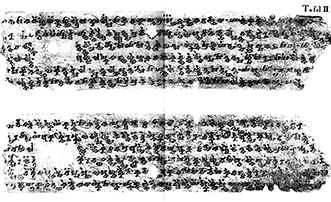
Figure 2. Facsimile of a Tocharian text published by Sergei von Oldenberg in Zapiski Vostochnago Otdyleniya Imperatorskago Russkago Archeologicheskago Obshchestva 7, 1893, p. 82.
Though this manuscript leaf was transcribed by A. F. R. Hoernle (q.v.) in his article on the “Weber Manuscripts” (1893, pp. 39-40), it was only Leumann who was able to decipher some words and phrases. This was possible as he had been sent the successive folio of the same text and succeeded in detecting the metric structure of the Buddha hymn contained therein. He also recognized that the language was an Indo-European one that did not belong to its Aryan (q.v.) branch (1908, p. 83). The great scholar of Tocharian, Walter Couvreur (1914-1996), duly acknowledged the role of Leumann in the initial stage of Tocharian studies and called the Petrovsky leaves, both of which are now in the Petrovsky collection in St. Petersburg, “Leumann-fragment” (1945/48, p. 563). In the publications of Emil Sieg (1866-1951) and Wilhelm Siegling (1880-1946), however, Leumann’s name is mentioned only in passing.
In Khotanese studies, Leumann played a much more decisive role. He was the first to decipher and investigate this language, which he recognized as “Aryan.” Its decipherment took place, according to Walther Schubring (p. 71), during the Ninth International Congress of Orientalists, which was held in London in September 1892. Intensive study to this end began soon after the publication of Marc Aurel Steinʼs (q.v.) Ancient Khotan (1907), which contained photographs of three leaves of a Saṃghāṭasūtra manuscript. With the help of Kaikioku Watanabe (1872-1933), a Japanese Buddhist monk who had studied under Leumann from 1900 to 1910 in Strassburg and who would later edit the Taishō Tripiṭaka (1924-34), Leumann succeeded in tracing Chinese translations of that text. This enabled him to investigate the Khotanese version. Watanabe traced translations of almost all text manuscripts that Leumann had had sent to him by Carl Salemann (q.v.) from St. Petersburg and by Hoernle from Oxford (as he did for the “Hoernle” Sanskrit texts from Khotan [Hoernle, 1916, p. 3]). Leumann gratefully acknowledged, at the end of his first major contribution to Khotanese, the help he had received from his Japanese student (1908, p. 106). Further, he dedicated his first book on Khotanese (1912) to Watanabe and Salemann. Again it was Salemann who sent him in 1909 that part of a text which had gone to St. Petersburg and that Leumann called “Manuscript E” (see BOOK OF ZAMBASTA). An edition of this text was published in 1933-36, only after Leumannʼs death, by his son Manu (1889-1977), the celebrated linguist of the University of Zurich.
Beginning with his first study of the “Book of Zambasta,” as it is called today, which appeared in 1912 – chapter one of his Zur nordarischen Sprache und Literatur (1912) dealing with the metrics of ʻEʼ – Leumann would be preoccupied with this edition for almost the next thirty years. This edition, which due to the absence of Chinese or Tibetan translations can be said to represent an achievement of the very first order, was partly flawed by Leumannʼs mistaken views about the metrical system of Khotanese. He firmly believed that it was related to the Greek hexameter and therefore continued an Indo-European system. Though various scholars objected that Khotanese metrics are a mere adaptation of an Indian metrical system, Leumann stuck to his view.
As early as his 1908 article, Leumann claimed to have found a third (separate) branch of the Aryan languages, one that existed beside Iranian and Indic (1908, p. 84). He adhered to his view till his death despite the fact that Hoernle had recognized Khotanese as an Iranian language back in 1901 (pp. 32-33), that Sten Konow (q.v.) had demonstrated that this view was correct (1912, pp. 553-64), and that Heinrich Lüders (1869-1943) had shown that Khotanese was akin to the language of the Śakas (1919). It was only his son, Manu, who complemented the title of the edition of Das Nordarische Lehrgedicht des Buddhismus with a bracketed insert “(sakische).” For all that, Leumannʼs Khotanese studies testify to “long years of painstaking study, … an intimate knowledge of … languages and literature and … sagacity and ingeniousness” (Konow, 1934, p. 6), qualities that he abundantly demonstrated in his Indological studies.
Bibliography
“Über eine von den unbekannten Literatursprachen Mittelasiens”, Mémoires de lʼAcadémie Impériale des Sciences de St.-Pétersbourg, 8. Sé.: Classe historico-philologique 4/8, 1900, pp. 1-28.
“Zwei mittelasiatische Entzifferungsprobleme,” Internationale Wochenschrift für Wissenschaft, Kunst und Technik. Jg. 1, 1907, col. 671-76; 703-10.
“Über die einheimischen Sprachen von Ostturkestan im frühen Mittelalter,” Zeitschrift der Deutschen Morgenländischen Gesellschaft 61, 1907, pp. 648-58; 62, 1908, pp. 83-110.
Zur nordarischen Sprache und Literatur: Vorbemerkungen und vier Aufsätze mit Glossar, Strassburg, 1912.
Maitreya-samiti, das Zukunftsideal der Buddhisten: Die nordarische Schilderung in Text und Übersetzung, Strassburg, 1919.
Buddhistische Literatur. Nordarisch und Deutsch: I. Teil: Nebenstücke, Leipzig 1920.
Neue Metrik: Erster Teil, Berlin and Leipzig, 1920.
“Norarische Verba mit und ohne Präfix,” in Willibald Kirfel, ed., Beiträge zur literaturwissenschaft und geistesgeschichte Indiens: Festgabe Hermann Jacobi, Bonn 1926, pp. 74-88.
“Die nordarischen Abschnitte der Adhyardhaśatikā Prajñāpāramitā,” Journal of the Taisho University 7, 1930, pp. 47-87.
“ʻSuppletivwesenʼ im Nordarischen,” Zeitschrift für vergleichende Sprachforschung auf dem Gebiete der Indogermanischen Sprachen 57/3-4, 1930, pp. 184-200.
Das nordarische (sakische) Lehrgedicht des Buddhismus: Text und Übersetzung von Ernst Leumann. Aus dem Nachlass herausgegeben von Manu Leumann, Leipzig, 1933-36.
Sakische Handschriftenprobe: Als Privatdruck herausgegeben von Manu Leumann, Zürich, 1934.
Other Works cited.
Walter Couvreur, Vooraziatisch-Egyptisch Genootschap Ex Oriente Lux – Jaarbericht No. 10, Leiden, 1945-48.
A. F. Rudolf Hoernle, “Weber Manuscripts,” Journal of the Asiatic Society of Bengal 62, 1893, pp. 39-40.
Idem, “A Report on the British Collection of Antiquities from Central Asia (With 3 Tables and 13 Plates),” Journal of the Asiatic Society of Bengal, Extra-Number 1, 1901, pp. 1-55.
Idem, Manuscript Remains of Buddhist Literature Found in Eastern Turkestan, Oxford 1916.
Sten Konow, “Ernst Leumann, Zur nordarischen Sprache und Literatur,” Göttingische Gelehrte Anzeigen 9, 1912, pp. 551-65.
Idem, “The Late Professor Leumann’s Edition of a New Saka Text,” Norsk Tidsskrift for Sprogvidenskap 7, 1934, pp. 5-55.
Heinrich Lüders, “Die śākischen Mūra,” Sitzungsberichte der Preussischen Akademie der Wissenschaften 1919, pp. 734-66 (repr. in Philogica Indica, Göttingen, 1940, pp. 463-93).
Sir Charles Monier-Williams, A Sanskrit-English Dictionary : Etymologically and Philologically Arranged with Special Reference to Cognate Indo-European Languages, Delhi, 1960.
Sergei von Oldenburg, “Kashgarskaya rukopis’ N. F. Petrovskogo” (Kashgar manuscript N. F. Petrovsky), Zapiski Vostochnago Otdyleniya Imperatorskago Russkago Archeologicheskago Obshchestva 7, 1893, pp. 81-82.
Walther Schubring, “Ernst Leumann,” Zeitschrift der Deutschen Morgenländischen Gesellschaft 87, 1934, pp. 69-75.
Sir Aurel Stein, Ancient Khotan: Detailed Report of Archaeological Explorations in Chinese Turkestan, Carried out and Described under the Orders of H. M. Indian Government, Oxford, 1907.
Werner Thomas, Tocharisches Elementarbuch. Bd. 2: Texte und Glossar, Heidelberg, 1964.