



KYZYLTEPA, an Iron Age site (lat 38o 03′ N, long 67o 43′ E) located near the village of Yangiaryk in the Altyn-Say region of the upper Surxondaryo (Sorḵān-Daryā) valley, southern Uzbekistan. Kyzyltepa, and more than ten small settlements surrounding it, formed one of the largest and most important Iron Age archeological complexes in Central Asia.
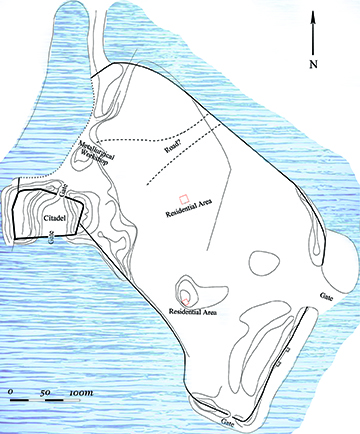
Figure 1. Preliminary site plan of Kyzyltepa (courtesy of the author).
The site has been identified as the capital of Paraetacene, a district which was conquered by Alexander the Great (q.v.) during his Sogdian campaign (Rtveladze, 2002, pp. 133, 139; 2019, pp. 132-35), or the city of Gazaba, where Alexander married his Central Asian wife Roxane (see RHOXANE ii. ALEXANDER’S WIFE) in 327 BCE (Rapin, 2017a, p. 102; 2018, pp. 257, 288, 293, 295).
Excavations at Kyzyltepa and surrounding countryside were carried out in the 1970s by A. S. Sagdullaev and Z. A. Khakimov, and again in the 2010s under the co-directorship of Xin Wu and Leonid Sverchkov (Sagdullaev, 1987; Sagdullaev and Khakimov, 1976, pp. 24-30; 1978, p. 538; Khakimov, 1972a, p. 55; 1972b, p. 286; Beljaeva and Khakimov, pp. 35-51; Pugachenkova, 1972, pp. 47-49; 1973, pp. 467-68; Pugachenkova and Rtveladze; Rtveladze, 1974, p. 82; Sverchkov et al., 2013; Wu et al., 2017). These studies revealed that Kyzyltepa was a large fortified site consisting of a Citadel and a lower city of approximately 13-14 hectares within its wall. Ceramics date the site to two major periods of occupation. The early period, dating to the Achaemenid (q.v.) period, was only found in the Citadel area. The late period––found in all areas of the site––was dated to the early Hellenistic period (Sverchkov et al., 2013; Wu et al., 2017).
Once thought to be a defensive structure, the Citadel, measuring approximately 100 x 75 m, is in fact a monumental building with religious and possibly also administrative function(s) (Wu et al., 2017, pp. 315, 317). It encompasses a cultic structure, likely a fire temple (see ĀTAŠKADA), at its southwestern corner and a sunken courtyard flanked by two tiers of mudbrick terraces with ayvāns. The lower city, consisting of a metal workshop, ceramic workshops, and traces of occupation layers, was surrounded by moats and walls with protruding towers (Figure 1).=
The most significant discovery at Kyzyltepa is the cultic structure within the Citadel (Figure 2). It may represent one of the earliest known Zoroastrian fire temples. This structure, built at the highest point of the site on a natural loess hill, had three consecutive phases. In its initial phase, the building contained only a sanctuary room, which was dominated by a large square altar (7 × 7 m) with a podium attached to it on the south. A fire hole and pure ashes on the burnt surface suggest the altar was used in rituals involving fire. Several layers of mud surfaces indicate the altar’s surface was renewed frequently.
Next to the altar were two pits containing residues of burning, such as ash, slag, and burnt mud chunks. On the northern side of the altar there was a rectangular bathtub cut into the ground for ritual cleansing. In the southwestern corner of the room was a square platform and attached podium. A pit with pure ash and sand below the podium suggests that the platform may also have had a ritualistic function.
In the second stage of the cultic structure, the layout inside the shrine remained largely unchanged; however, a large building with a two-tiered platform, or the Citadel, was built around it.
In the third stage, the sanctuary room was partially reconfigured (Figure 3). A small fire altar (see FIRE ALTARS) of rectangular shape (ca. 2 × 1.4 m) was built in the southern part of the shrine. The altar, made of pure loess, had a deep fire hole. Its surface, which was very hard and dark gray to black in color, indicates a long exposure to fire. The difference between the two altars suggests different functions for these installations: The small altar was perhaps used to maintain a constantly lit fire, whereas the larger one was used for religious ceremonies during which fire was used. A big, coarse, low-fired terracotta pan, found on the podium attached to the big fire altar, was perhaps used to transfer the kindled fire. A constantly lit fire is a hallmark of Zoroastrian fire temples; so too are haoma (q.v.) drinks prepared by Zoroastrian priests during rituals. A stone pestle found next to the terracotta pan may have been used for such a purpose (for specific implements employed in Zoroastrian rituals see ĀLĀT).
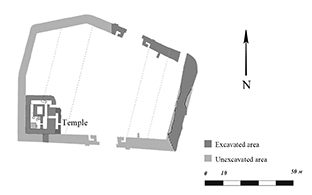
Figure 2. Preliminary plan of the cultic structure (Phase 2) and the Kyzyltepa Citadel. Modified based on Sverchkov et. al., 2013: p. 61, fig. 22, and Sverchkov and Wu, 2019, p. 115, fig. 16.
Although the evidence is not definitive at present, if indeed this sanctuary that has housed fire altars for over a hundred years, including altars that show consistent exposure to fire over time, can be shown to represent a fire temple, the sanctuary at Kyzyltepa may represent one of the earliest Zoroastrian fire temples known to date.
At the end of the third phase, Kyzyltepa was destroyed. A partition wall, built across the sanctuary, cut the cella and big fire altar into halves. The entire southern section of the room was filled in with carefully laid mudbricks and earth (see Mokroborodov, p. 350; Wu et. al., pp. 309-10, 316, for a similar practice). A small green stone slab was placed upright outside the southern doorway to perhaps signal the “ritual death” of this section of the building (see Wu and Lecomte, p. 325, for a similar practice). The section to the north of the partition wall continued to function for a while, until it too was sealed off with mudbricks and pakhsa (pisé). It is possible that, after the burial of the sanctuary, the place continued to serve as a sacred fire platform (Sagdullaev, 1990, p. 32, see Rapin, 2017b, pp. 443-44, for a similar phenomenon).
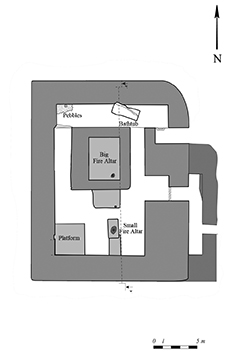
Figure 3. Preliminary plan of cultic structure (Phase 3) at Kyzyltepa. Modified based on Sverchkov and Wu, 2019, p. 116, fig. 17.
To summarize, Kyzyltepa was initially built as a sacred site centered around a possible fire temple. It also served as a major node in the Achaemenid imperial network (Wu, p. 209). At the end of the Achaemenid period, the site was violently destroyed, perhaps by Alexander the Great. Immediately after the destruction, a lower city with a defensive system was built. Thus, Kyzyltepa also offers important information for understanding the transition from the end of the Achaemenid to the early Hellenistic periods.
Bibliography
T. V. Beljaeva and Z. A. Khakimov, “Drevnebaktriĭskie pamyatniki Mirshade,” in G. A. Pugachenkova, ed., Iz istorii antichnoĭ kul’tury Uzbekistana, Tashkent, 1973, pp. 35-51.
Z. A. Khakimov, “Iz arkheologicheskikh otkritiĭ 1972 g.,” Uspekhi sredneaziatskoĭ arkheologii 2, 1972a, p. 55.
Idem, “Gorodishche Kyzyl-Tepe,” in Tezisy dokladov na sektsiyakh, posvyashchennykh itogam polevykh issledovaniĭ 1971 g. , Moscow, 1972b, p. 286.
Viktor V. Mokroborodov, “Kindyktepa: a Temple of the Mid-first Millennium BC in Southern Uzbekistan,” in Johanna Lhuillier and Nikolaus Boroffka, eds., A Millennium of History: The Iron Age in Southern Central Asia (2nd and 1st Millennia BC). Proceedings of the Conference Held in Berlin (June 23-25, 2014). Dedicated to the Memory of Viktor Ivanovich Sarianidi, Berlin, 2018, pp. 343-51.
Galina A. Pugachenkova, “Novyĭ pamyatnik drevnebaktriĭskoj kul’tury,” Uspekhi Sredneaziatskoĭ arkheologii 1, 1972, pp. 47-49.
Idem, “Raboty v Shurchinskom raĭone Uzbekistana,” Arkheologicheskie Otkrytiya 72, 1973, pp. 467-68.
G. A. Pugachenkova and È. V. Rtveladze, Severnoĭ Baktrii-Tokharistan, Tashkent, 1990.
Claude Rapin, “Alexandre le Grand en Asie Centrale: Géographie et Stratégie de la Conquête des Portes Caspiennes à l’Inde,” in C. Antonetti and P. Biagi, eds., With Alexander in India and Central Asia: Moving East and Back to West, Oxford, 2017a, pp. 37-121.
Idem, “Sanctuaires sogdiens et cultes avestiques de l’époque de Gava à l’époque hellénistique (Koktepe et Sangir-tepe),” in W. F. M. Henkelman and C. Redard, eds., Persian Religion in the Achaemenid Period / La religion perse à l’époque achéménide, Classica et Orientalia 16, Wiesbaden, 2017b, pp. 417-60.
Idem, “On the Way to Roxane 2: Satraps and Hyparchs between Bactra and Zariaspa-Maracanda,” in J. Lhuillier and N. Boroffka, eds., A Millennium of History: The Iron Age of Southern Central Asia (2nd and 1st Millennia BC), Berlin, 2018, pp. 257-98.
È. V. Rtveladze, “Razvedochnoe izuchenie baktriĭskikh pamyatnikov na yuge Uzbekistana,” Drevnyaya Baktriya, Leningrad, 1974, pp. 74-85.
Idem, Aleksandr Makedonskiĭ v Baktrii i Sogdiane: istoriko-geograficheskie ocherki, Таshkent, 2002.
Idem, Aleksandr Makedonskiĭ v Transoksiane. Pokhody: Istoricheskaya geografiya, St. Petersburg, 2019.
A. S. Sagdullaev, Usad’by drevneĭ Baktrii, Tashkent, 1987.
Idem, “K izucheniyu kul’tovykh i pogrebal’nykh obrjadov yuga Sredneĭ Azii èpokhi rannego zheleza,” Drevnyaya i srednevekovaya arkheologiya Sredneĭ Azii, Tashkent, 1990, pp. 29-38.
A. S. Sagdullaev and Z. A. Khakimov, “Arkheologicheskoe izuchenie gorodishcha Kyzyl Tepe (Po itogam rabot 1973-1974 gg.),” in V. M. Masson, ed., Baktriĭskie drevnosti, Leningrad, 1976.
Idem, “Raboty Mirshadinskogo otryada,” Arkheologicheskie Otkrytiya 77, 1978, p. 538.
Leonid M. Sverchkov and Xin Wu, “Khram Ognya V-IV vv. do n. è.: Kizyltepa,” Scripta Antiqua 8, 2019, pp. 97-128.
Leonid M. Sverchkov, Xin Wu, and Nikolaus Boroffka, “Gorodishche Kizyltepa VI-IV vv. do n. è.: Novye Dannye, Scripta Antiqua 3, 2013, pp. 31-74.
Xin Wu, “Exploiting the Virgin Land: Kyzyltepa and the Effects of the Achaemenid Persian Empire on its Central Asian Frontier,” in J. Lhuillier and N. Boroffka, eds., A Millennium of History: The Iron Age in Southern Central Asia (2nd and 1st Millennia BC), Berlin, 2018, pp. 189-214.
Xin Wu and Olivier Lecomte, “Clay Sealings from the Iron Age Citadel at Ulug Depe,” Archäologische Mitteilungen aus Iran und Turan 44, 2012, pp. 313-28.
Xin Wu, Leonid M. Sverchkov, and Nikolaus Boroffka, “The 2010-2011 Seasons of Excavations at Kyzyltepa (VI-IVth Centuries BCE), Southern Uzbekistan,” Iranica Antiqua 52, 2017, pp. 283-362.