



KOH-I-NOOR (Kuh-e Nur; lit. “Mountain of Light”), the most celebrated diamond in the world, with rich legendary and historical associations. The origins of the Koh-i-Noor and its history before the conquest of Delhi in 1739 by Nāder Shah Afšār remain unclear. According to legend, it was discovered in the bed of the river Godavery in 3200 BCE, and was worn by Carna, Rajah of Anga, who figures in the legendary wars of the Mahabharata (Streeter, p. 119). Actual references to the existence of this diamond were first recorded after the defeat and death in 1526 of Sultan Ebrāhim Lodi and his ally Bikramajit, the raja of Gwalior, at the hands of Ẓahir-al-Din Moḥammad Bābor (r. 1526-30), the founder of the Mughal dynasty in India. In his memoirs, Bābor refers to a diamond which the family of Bikramajit, residing then in Agra, gave to his son Homāyun as a token of gratitude for having spared their lives: “They presented Homayun with many jewels and gems, among which was a famous diamond Sultan Alauddin had acquired…It must weigh 8 mithcals” (tr. Thackston, p. 328). The “Alauddin” referred to by Bābor is Sultan ʿAlāʾ-al-Din Ḵalji (r. 1296-1316), who is said to have extorted the diamond from the Hindu ruler of the South Indian state of Malwa in 1306, before later giving it to the ruler of Gwalior as a reward for his services to him (Sen, p. 34).
Among those who have identified the Koh-i-Noor with Bābor’s diamond, the most notable are the mineralogist Nevil Story Maskelyne and the 19th-century London jeweler Edwin Streeter. “The eight misqals of Babur,” stated Maskelyne, “afford a far more hopeful estimate of the weight of this diamond…The Persian misqal, or half dirhem, weighs 74.5 grain Troy, eight of these equal 596 grains, or 187.58 carats. The Koh-i-Noor in the Exhibition of 1851 weighed 186 carats” (Maskelyne, p. 555). Meanwhile Streeter wrote: “That the diamond here referred to is the ‘Koh-i-Nur,’ there can be no reasonable doubt; nor indeed has the fact ever been seriously called into question” (Streeter, p. 117). In the opposite camp, we find the mineralogist Valentine Ball, who believed that the Koh-i-Noor was in fact a part of “the Moghul,” the great stone seen by Tavernier at the court of Emperor Awrangzēb (Ball, Appendix, p. 132).
If the Koh-i-Noor was in fact Bābor’s diamond, its history leads us first to Persia, where its owner Homāyun, the son and successor of Bābor, lived in self-exile at the court of Shah Tahmāsp I (r. 1524-76). In 1544, he offered the diamond to his host as a token of gratitude. The next episode in its history took place in the Deccan, after Shah Tahmāsp supposedly sent the Koh-i-Noor as a gift to Borhān Neẓām Shah (r. 1508-53), the Shiʿite ruler of Aḥmadnegār. However, the diamond was sold somewhere in the Deccan by Shah Tahmāsp’s envoy and never reached its destination (H. Beveridge, pp. 381-83; Amini, pp. 55-56; Ḵoršāh, fol. 60a). It has been suggested that the diamond was later bought by Moḥammad-Saʿid Mir Jomla, the Persian-born vizier of the sultan of Golconda, and presented by him to the Mughal ruler Shah Jahān, when he entered the service of the latter as grand vizier in July 1656. Subsequently, it remained in the treasury of the Great Mughals, until Nāder Shah Afšār extorted it from Moḥammad Shah after the conquest of Delhi in 1739. It is at this point that the diamond is supposed to have been given the name under which it has become famous. According to legend, Moḥammad Shah tried to hide the diamond in the folds of his turban, but Nāder Shah was informed of its whereabouts by one of the Indian emperor’s concubines, and so he reminded his counterpart that according to an ancient tradition they were to exchange their turbans as a sign of friendship and fraternal ties. Once Moḥammad Shah had complied, Nāder Shah went to his tent, unfolded the turban, and, on finding the stone, grew so amazed that he exclaimed: kuh-e nur! (“mountain of light!”).
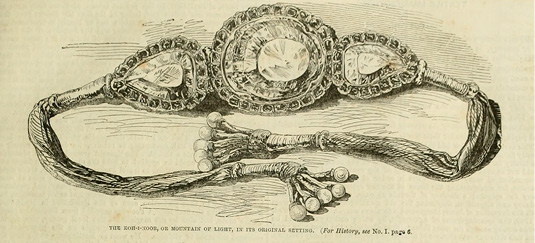
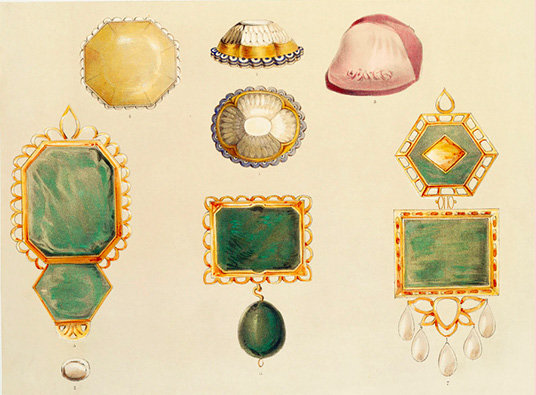
The diamond remained in the possession of Nāder Shah’s successors until the day when his grandson Šāhroḵ, then the ruler of the province of Khorasan, was tortured cruelly by a powerful local chief who wanted him to reveal its hiding-place. Having been rescued at the last minute by Aḥmad Shah Dorrāni (see AFGHANISTAN x), a former general of his grandfather’s army and later the founder of the kingdom of Afghanistan, he gave it to him as a sign of his gratitude. The diamond, weighing 186 carats, remained in Kabul for more than sixty years, during which it witnessed the cruel tragedies that tore apart the descendants of Aḥmad Shah. It was in the possession of the grandson of the latter, Zamān Shah, when he was deposed, blinded, and locked up by his brother Maḥmud in the citadel of Bala Hissar in Kabul. Despite the ordeals he had to undergo, the fallen monarch nevertheless managed to preserve the stone from the clutches of his torturers and, with the complicity of one of his jailers, had it concealed behind plaster in the wall of his cell. Shortly afterwards, Maḥmud himself was deposed and thrown into prison by his third brother, Shah Shojāʿ. The latter immediately released Zamān Shah, who gave him the stone as a sign of gratitude. Six years later, Maḥmud fled from prison and recaptured the crown, as a result of which his brothers sought refuge with Ranjit Singh, the maharaja of the new Sikh kingdom of the Punjab. The latter tried everything in his power to extort the diamond from his guests, going as far as depriving them and their family of food until they surrendered it. When he succeeded, he had it set in an arm-band which he wore for official ceremonies (Figures 1 and Figure 2). When Ranjit Singh died in 1839, his three sons Kharak Singh, Sher Singh and Dhalip Singh, inherited the Koh-i-Noor in succession, and it henceforth became a symbol of sovereignty. Meanwhile, as a result of the Anglo-Sikh wars of 1848 and 1849, Britain gained sovereignty over the Punjab. On 29 March 1849, the Regency Council and the Maharaja Dhalip Singh ratified the document by which the Punjab was surrendered to Great Britain, under the terms of Article 3 of which the Koh-i-Noor was presented to Queen Victoria. At that time, Lord Dalhousie, the governor general of India and the person responsible for the conquest of this new territory, wrote a letter to the queen in which, referring to the Koh-i-Noor, he said: “the Governor General rejoices that it has found its fitting resting place in Your Majesty’s Crown” (Broughton Papers, vols. 856-57, Governor General to Queen, 7 April 1849).
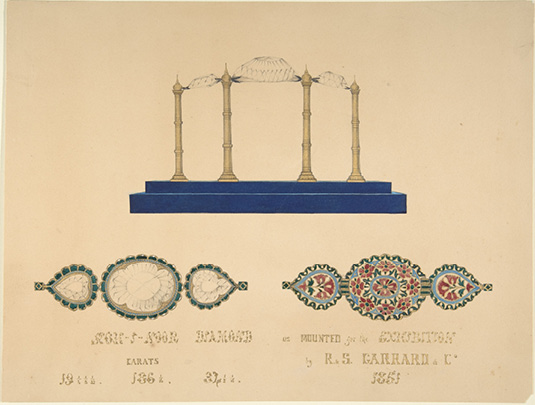
The Koh-i-Noor was exhibited at the Great Exhibition of 1851 (Figure 3), held at the Crystal Palace, a building made of iron and glass that stood to the south of Hyde Park, between Kensington Drive and Rotten Row. The Koh-i-Noor was exhibited in a kind of glass bird cage, placed on a wooden column surmounted by a replica of the British Crown. For the Times, the Koh-i-Noor was decidedly the “Lion” of the exhibition. And yet, added the journal, “the diamond does not satisfy. Either from the imperfect cutting or the difficulty of placing the lights advantageously, or the immovability of the stone itself, which should be made to revolve on its axis, few catch any of the brilliant rays that it reflects when viewed at a particular angle.” Other journals and some people shared this opinion, including Queen Victoria and Prince Albert, who thought that the brilliance of the diamond could be further enhanced if it were cut. Specialists consulted on the subject were in favour of recutting the diamond to enhance its brilliance. But they felt this could not be achieved without jeopardising the size of the stone. Finally, on the suggestion of Messrs Garrard, the court jewellers, experts from Amsterdam were called in. They felt that the difficulties could be overcome with care and skill. A small steam engine was installed in Garrard’s workshop, located at 25 Haymarket, to carry out the job. On Thursday 15 July 1852, the Duke of Wellington rode from Hyde Park comer to Garrard’s workshop on his old white horse. He had expressed the desire to inaugurate the work by personally recutting one of the facets of the Koh-i-Noor. The entire operation was completed in thirty-eight days. It cost 8,000 pounds. The Koh-i-Noor now weighed 108.93 carats, having lost 43 percent of its original weight. Victoria had the diamond set in her “small crown.” After 1937, it served as the main ornament in the crown of Queen Elizabeth The Queen Mother.
Bibliography
Manuscript Sources.
Ḵoršāh b. Qobād Ḥosayni, untitled manuscript, British Library, London, MS Or. 153.
Broughton Papers, British Library, London, Papers of Sir John Hobhouse (later Lord Broughton).
Published Works.
Iradj Amini, The Koh-i-Noor Diamond, 2nd ed., New Delhi, 2001.
Ẓahir-al-Din Moḥammad Bābor, Bābor-nāma: Waqāyeʿ, ed. E. Mano, 2 vols., Kyoto, 1995.
Valentine Ball, tr., Travels in India by Jean Baptiste Tavernier, Baron of Aubonne, London, 1889.
A. S. Beveridge, tr., The Bābur-nāma in English (Memoirs of Bābur) Translated from the Original Turki Text of Ẓahiru’d-dīn Muḥammad Bābur Pādshāh Ghāzi, 2 vols., London, 1922.
Henry Beveridge, “Babar’s Diamond: Was It the Koh-i-Nur?” Asiatic Quarterly Review, April 1899, pp. 370-89.
Eric Bruton, Legendary Gems or Gems that Made History, Ipswich, 1986.
Stephen Howarth, The Koh-i-Noor Diamond, London, 1980.
Anna Malecka, “Koh-i Noor Diamond and Babur’s Stone: Issue of identity,” Iran 58, 2020, pp. 84-92.
Idem, “Naming of the Koh-i-Noor and the Origin of Mughal-Cut Diamonds,” Journal of Gemmology 35, 2017, pp. 738-50 (available at http://dx.doi.org/10.15506/JoG.2017.35.8.738 ).
N. B. Sen, Glorious History of the Koh-i-Noor: The Brightest Jewel in the British Crown, New Delhi, 1953.
Siddhartha V. Shah, “Romancing the Stone: Victoria, Albert, and the Koh-i Noor Diamond,” West 86th: A Journal of Decorative Arts, Design History, and Material Culture 24/1, 2017, pp. 29-46 (available at https://doi.org/10.1086/693797)
N. Storey-Maskelyne, “The Koh-i-Nur – A Criticism,” Nature 44, no. 1145, 8 October 1891, pp. 555-59.
Edwin W. Streeter, The Great Diamonds of the World: Their History and Romance, London, 1882.
Wheeler M. Thackston, ed. and tr., The Baburnama: Memoirs of Babur, Prince and Emperor, New York and Oxford, 1996.