



KISH FREE TRADE ZONE (KFTZ; Menṭaqa-ye āzād-e tejāri-e kiš), an area located on the island of Kish (q.v.; Kiš). The KFTZ was the first of what are currently (as of 2022) seven active free trade zones in Iran, the others being Qešm Island in the Persian Gulf (established in 1990); Čāh-bahār (q.v.), a seaport on the Sea of Oman (1991); Aras, in the northwest near the border (2003); Anzali (q.v.), near the Caspian Sea in Gilān (2003); Arvand in Ḵuzestān (2004); and Māku in West Azarbaijan (2011). The roots of Kish’s free trade project extend back to the mid-1950s. At that time, businessmen protested the high costs and delays in unloading of ships due to insufficient port capacities and bottlenecks in transportation networks especially in the Persian Gulf. The state’s response was to appoint a brigadier general to head Iran’s customs (Ḥaydarzāda, p. 7). Meanwhile, Iranians living on the Arab coast of the Gulf also called on the Iranian government to invest in cross-border trade and building infrastructure (Masʿudi, pp. 76-78). These concerns and ideas were ultimately channeled into discussions about creating economic zones and free ports. The roots of Iran’s economic zones were therefore part of a mid-20th century proliferation of such zones as vehicles for economic development, which were adopted in such places as Puerto Rico, Ireland, Jamaica, Mexico, Taiwan, Mauritius, and India (Neveling, pp. 23-40).
However, Kish was not specifically mentioned in the initial projects discussing free ports in Iran. Iran’s second multi-year development plan (1955-62) established a Special Commission on Free Ports (1957) that suggested Bandar-e ʿAbbās (q.v.) and two ports near Ābādān (q.v.)—Ḵosrowābād and Minu (formerly Ḥāj Ṣalbuḵ) island—as possible free trade ports (Sāzmān-e barnāma wa budja-ye ostān-e Bušehr, p. 42). Given the existing infrastructural endowments of Ābādān and Bandar-e ʿAbbās and their proximity to urban centers, labor markets, and industrial and petrochemical centers, there was a clear economic rational for establishing a free port or zone in these cities. Yet these early suggestions were not implemented.
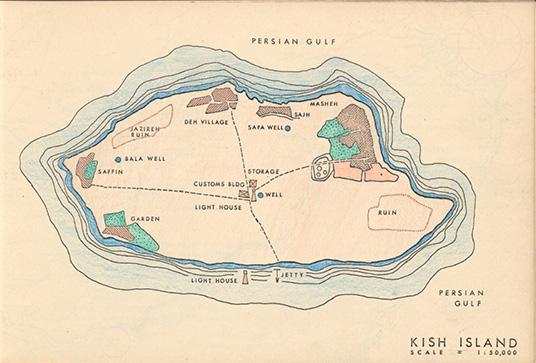
Meanwhile, in 1962, several officials from the SAVAK purchased land on Kish island from absentee landlords on behalf of the government (Hāšemi, 1984, pp. 269-80; idem, 1985, Tape 2). It was apparently at this point that the idea of converting Kish into a distinct jurisdictional entity was discussed. In Esfand 1342 Š./March 1964, an official in the Ministry of Economics and Finance stated: “It is possible that Kish Island will be announced as a free port” (Maliḥi, pp. 20-21). In 1967, the Iranian government commissioned Taliesin Associated Architects of the Frank Lloyd Wright Foundation to conduct a feasibility study for converting Minu and Kish islands into tourist resorts (Figure 1). The study, initially based on a consultancy by David Fischer, a retired U.S. Air Force officer, focused on converting Minu island, adjacent to Ābādān, and Kish as places to attract Western, Arab, and Iranian business travelers and leisure tourists (Taliesin Associated Architects, p. 9). The study alluded to plans to convert Bandar-e Lenga (q.v.) into a free port in order to supplement the tourism and commercial center envisioned for Kish (Taliesin Associated Architects, p. 11). By the end of the decade (1968), a series of studies had been completed by the Office of Regional Development and Agricultural and Irrigation Planning, an entity within the Plan and Budget Organization (Sāzmān-e barnāma wa budja). These studies focused on the development of ports in the southern islands and concluded that, because of the warm climate in the winter, the islands of Kish and Qešm were ideal commercial and tourist sites (Figure 2), and given the summer resorts by the Caspian Sea in the north, they would “complete the use of the nation’s seas” (Maliḥi, p. 21). The report, backed by the analysis of the feasibility study conducted by Taliesin, went on to encourage the government to invest in the islands and, in view of the commercial and tourism potential, also encouraged the private sector to do the same. In 1969, Moḥammad-Reżā Shah visited Kish for a picnic with his trusted confidant, Asad-Allāh ʿAlam, the minister of the royal court, who commented: “Here we are building a new Imperial palace, and not mere amusement. The island lies at the very heart of the Gulf …” (ʿAlam, tr., p. 103). The Shah began to visit the new palace on Kish frequently, especially during the Iranian New Year’s holiday in March. To administer the estimated $100 million investment in what was initially described as a “Touristic Free Port,” the shah founded the Kish Development Organization. Funded by Bānk-e ʿOmrān or the Development Bank (20 percent) and the SAVAK (80 percent), the organization’s board of directors included the head of SAVAK, the Development Bank, and the minister of court ʿAlam (Ḥaydarzāda, p. 8).
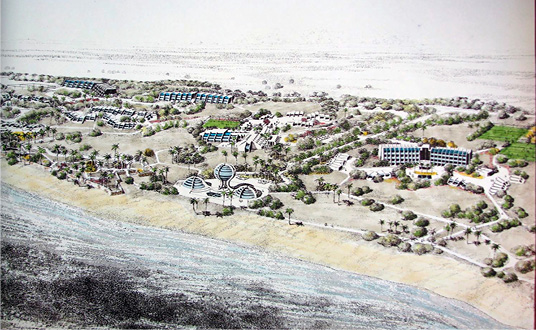
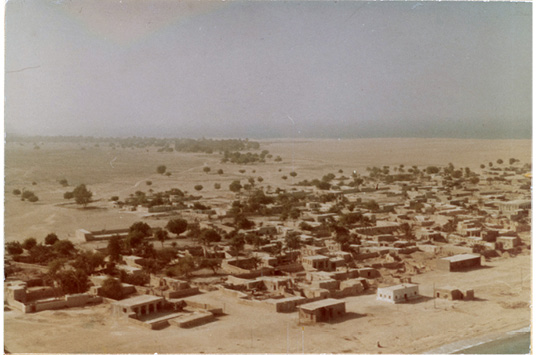
Thanks to the increasing oil revenue and collaboration with various international firms, the plans drawn up in the 1970s involved a host of projects, including relocating the village of Masheh (Māša; PLATE I) in order to accommodate the building of a winter palace for the shah, palaces for other members of the royal family, luxury villas, several hotels, two shopping centers, a Ladbroke-run casino, and an airport accommodating the landing of the new Concorde airplane (Maliḥi; Moʿtażed, 2007a; Tabatabai and Afrassiabi, pp. 35-58.). On the eve of the revolution, the exorbitance and exclusivity of these projects received criticism from regime loyalists as well as dissidents (Nahavandi, Tape 14). Kish symbolized embezzlement, waste, and cronyism in local and international media accounts (Randal; Harney, p. 104).
After the 1979 Revolution, the Development Organization of Kish was disbanded, and various government ministries administered the island (Afšār Sistāni, pp. 52-53; Tabatabai and Afrassiabi, pp. 57-93). However, with the ceasefire in the Iran-Iraq war (q.v.) in 1988, the project was resurrected anew when the island was converted into a free trade zone in 1989 and the Kish Free Trade Organization was founded (Joḡrāfiā-ye jazāyer-e irāni, p. 116). Two additional zones were established by 1991 on the nearby island of Qešm and the port city of Čāh-bahār located on the Sea of Oman, near the Pakistani border. In addition, a High Council of Free Trade-Industrial Zones (Šurā-ye ʿāli-e manāṭeq-e āzād-e tejāri-ṣanʿati) was established in 1992 and was charged with the overseeing and management of all current and future zones. As stipulated by a law passed by the Majles on 21 June 1993 each free trade zone is managed and operated by its own authority (Jumhuri-e Eslāmi-e Irān, Article 5).
These free trade zones were part of the Islamic Republic’s first Five-Year Plan (1989-1994). This plan encompassed the post-Iran-Iraq War reconstruction initiative launched by President ʿAli-Akbar Hāšemi Rafsanjāni and aimed to dismantle the state-regulated war economy and replace it with one that would be friendlier to private sector interests, foreign investment, and an emerging post-revolutionary middle class. Thus, unlike the monarchy, which had envisaged the Kish project in terms of creating a playground for jet-setting international tourists and close allies of the court, the Islamic Republic, commensurate with its larger populist and revolutionary mandate, described the goals of the projects in terms of economic development and industrialization in “deprived regions” in Iran’s geographic and economic margins. The basic package of incentives provided in the zones included 100 percent ownership by foreign firms of any subsidiaries operating in the zones, capital and profit allowed to enter and exit the zones freely, a fifteen-year tax exemption on income and assets, waving of export duties for goods produced in the zones, and labor laws far less restrictive than similar laws used elsewhere in Iran (see Hakimian, pp. 851-74). The express aim of the project was to create employment, technology transfer, and increase exports.
It is difficult to assess the performance of KFTZ (or any of such zones). Data on investments, exports, imports, employment, and other indices are not publically available or comprehensive. However, what qualitative and quantitative information is available in government reports, journalistic accounts, interviews with officials, and a few academic studies make it clear that in terms of foreign investment, creation of jobs, and exports it has been disappointing. For instance, while imports to Kish were more than $135 million in 2001, exports did not exceed $4 million and do not seem to have increased favorably (Joḡrāfiā-e jazāyer-e irāni, pp. 152-54, Tables 48-50; Hakimian, p. 864; Sāzmān-e manṭaqa-ye āzād-e Kiš). Meanwhile, foreign investment in the KFTZ increased in the mid-1990s, but since then it has stabilized at a little over $300 million. Over a decade after the establishment of the free trade zones, even the general secretary of the High Council of Free Trade Zones acknowledged that there was little foreign investment and a lack of consensus on how to attract it (“Goft-o-gu”). There have been several announcements of high profile joint ventures, such as the Flower of the East Hotel, convention center, and golf course, but the actual realization of these projects has been either slow in being executed or has been completely abandoned (Tabatabai and Afrassiabi, pp. 97-103). In terms of tourism, Kish has done better, with the number of foreign tourists, which has been steadily increasing and by 2006 almost comprised a quarter of all visitors to the island; visitors from Dubai constitute 80 percent of all foreign visitors (Joḡrāfiā-e jazāyer-e irāni, pp. 161-69; Hakimian, pp. 866-67). One reason for this is that some migrant workers in Dubai use Kish as a destination for their “visa runs” to renew their 30-day tourist visas in Dubai. KFTZ, along with its counterpart in Qešm, has become a platform for legal and illegal imports, which contradict the logic of the zones being a vehicle for manufacturing and exporting of goods (Adelkhah, pp. 34-35; Keshavarzian, 2007, pp. 187-227; Stewart). In view of the proliferation of economic zones in the region and across the developing world, Kish’s provisions are less unique and attractive than they would have been in the 1980s and 1990s.
Thus, as concluded by Hassan Hakamian (p. 867), “Iran’s experience has been anything but successful: the free zones have failed to achieve their principal stated objectives of attracting FDI, diversifying the economy and contributing to employment creation. Even Kish has emerged at best as a center for domestic trade and tourism, a far cry from the zones’ original objective of helping Iranian exports reach international markets.” There are many reasons for this, including lack of government investment in infrastructure, Kish’s distance from major industrial and transportation centers on the mainland, and competition from major free trade and port facilities in the southern Persian Gulf region.
In conclusion, it is useful to consider why the KFTZ, which had been established by the former monarchical regime, was retained by the revolutionary government (Keshavarzian, 2010, pp. 263-89). The previous regime’s interest in Kish was driven by a mix of geostrategic anxieties and a form of rent-seeking by the regime insiders. First, in the 1960s, peace and order in the Persian Gulf, which had been maintained by the British, was disrupted by Britain’s gradual departure from the Arab littoral of the Persian Gulf, by the rise of Arab nationalism in Iraq (after the 1958 revolution), and by the attractiveness of Jamāl ʿAbd-al-Nāser’s pan-Arabist, anti-monarchical, and anti-US message on the Arabian peninsula (Hāšemi, 1984, pp. 275-76; Masʿudi, pp. 20-22, 105-8). Fearing that the vacuum left behind by the British departure would result in threats to Iran’s interests (e.g., disputed lands, borders, and shipping lanes), in the 1960s and 1970s Moḥammad-Reżā Shah expanded his involvement in affairs across the Persian Gulf (Joḡrāfiā-ye jazāyer-e irāni, p. 116). The development of Kish into a touristic and trade zone was a vivid marker of Iran’s sovereignty and presence at the Straits of Hormuz. The project, moreover, directly enriched and bought the loyalty of a small coterie of powerful individuals and employed large numbers of international consultants and firms. The Development Organization of Kish (Sāzmān-e ʿomrān-e jazira-ye Kiš) was closely supervised by the shah and tied to two of the regime’s cornerstones, namely SAVAK and the Bānk-e ʿOmrān. For example, Denis Wright, the British ambassador from 1963 to 1971, described the head of Kish before the revolution and his daughters as receiving large sums of money in the “curious set-up” (Wright, Tape 6). The Islamic Republic, on the other hand, was also attracted to Kish for a combination of international relations and domestic political coalitions. Iran’s pre-existing geostrategic concerns were augmented in the wake of the Iran-Iraq war and the new regime’s leadership found itself needing to develop its port and trade facilities away from the border with Iraq and northern Gulf region. Meanwhile, at a moment when Akbar Hāšemi Rafsanjāni (president of Iran 1989-97) sought to liberalize commerce and Dubai was increasing its regional commercial activities, Kish was an attractive conduit for the new mercantile interests involved in the informal and grey economy of the post-revolutionary era (Erami and Keshavarzian).
Bibliography
Fariba Adelkhah, “Le Retour de Sindbad: L’Iran dans le Golfe,” Les études du CERI 53, 1999, pp. 34-35.
Iraj Afšār Sistāni, Jazira-ye Kiš: morvārid-e Ḵalij-e Fārs, Tehran, 1998, pp. 2-53.
Asad-Allāh ʿAlam, Yāddāšthā-ye ʿAlam, ed. ʿAli-Naqi ʿĀliḵāni, 7 vols., n.p., 1992-2014; abridged tr., Alinaghi Alikhani and Nicholas Vincent, as The Shah and I: The Confidential Diary of Iran’s Royal Court, 1969-1977, ed. Alinaghi Alikhani, New York, 1991.
Joḡrāfiā-ye jazāyer-e irāni-e Ḵalij-e Fārs (Kiš, Hendorābi), Tehran, 2004, pp. 3-175.
“Goft-o-gu: manāṭeq-e āzād be ʿarṣa-ye reqābat šoda-and,” Šarq 25, Āḏar, 2004.
Hassan Hakimian, “Iran’s Free Trade Zones: Back Doors to the International Economy?” Iranian Studies 44, 2011, pp. 851-74.
Desmond Harney, The Priest and the King: Eyewitness Account of the Iranian Revolution, London, 1999, p. 104.
Nargis Erami and Arang Keshavarzian, “When Ties Don’t Bind: Smuggling Effects, Bazaars, and Regulatory Regimes in Postrevolutionary Iran,” Economy and Society 44/1, 2015, pp. 110-139.
Manučehr Hāšemi, Dāvari: soḵan-i dar kār-nāma-ye Sāvāk, London, 1984, pp. 269-80.
Idem, interview recorded by Shahrokh Meskoob, 17 February 1985, London, England, in Iranian Oral History Collection, Harvard University, Tape 2.
Moḥammad-Reżā Ḥaydarzāda, “Az ʿAsalowya tā Kiš: barresi-e tariḵča-ye ijād-e manaṭeq-e āzād-e tejāri dar Irān,” Māh-nāma-ye manāṭeq-e āzād 1, Esfand 1369 Š./March 1991, p. 7.
Jomhuri-e Eslāmi-e Irān, Dabirḵāna–ye šorā-ye ʿāli-e manāṭeq-e āzād-e tejāri-ṣanʿati, Qanun va moqararāt manaṭeq-e āzād-e tejāri-ṣanʿati, Tehran, Bahār 1383 Š./Spring 2005.
Arang Keshavarzian, Bazaar and State in Iran: The Politics of the Tehran Marketplace, Cambridge, 2007.
Idem, “Geopolitics and the Genealogy of Free Trade Zones in the Persian Gulf,” Geopolitics 15/2, 2010, pp. 263-89.
Maryam-al-Sādāt Maliḥi, Radd‑e pā-ye amwāj: tāriḵ-e tawsaʿa-ye jazira-ye Kiš 1300-1377, Tehran, n.d., pp. 20-21.
ʿAbbās Masʿudi, Didār az šayḵ nešinhā-ye Ḵalij-e Fārs, n.p., 1345/1966.
Ḵosrow Moʿtażed, “Kiš: vilāhā-ye barā-ye hezār nur-e čašmi,” Manāṭeq-e āzād 187, 2007a, pp. 46-51.
Idem, “Kiš: jazira-i ke qarār bud kāmelan faransavi šavad,” Manāṭeq-e āzād 179, 2007b, pp. 48-52.
Idem, “Tāriḵ-e Kiš dar ʿaṣr-e Pahlavi,” Manāṭeq-e āzād 180, 2007c, pp. 46-50.
Houchang Nahavandi (Hušang Nahāvandi), interview recorded by Shahrokh Meskoob, 11 April 1986, Paris, France, in Iranian Oral History Collection, Harvard University, Tape 14.
Patrick Neveling, “The Global Spread of Export Processing Zones and the 1970s as a Decade of Consolidation,” in Knud Andersen and Stefan Müller, eds., Contesting Deregulation: Debates, Practices and Developments in the West since the 1970s, Oxford, 2017, pp. 23-40.
Jonathan Randal, “Corruption in Iran,” Washington Post, 19 November 1978.
Sāzmān-e barnāma va budja-ye ostān-e Bušehr, Barresi‑e ważʿiyat-e Banāder-e ostān-e Bušehr, 1993.
Sāzmān-e manṭaqa-ye āzād-e Kiš, “Gozāreš-e ʿamalkard-e 25 māha-ye Sāzmān-e manṭaqa-ye āzād-e Kiš,” an undated report.
Christopher S. Stewart, “The Axis of Commerce,” Condé Nast Portfolio 2/9, September 2008, p. 112 (available at Gale Academic OneFile, https://link.gale.com/apps/doc/A186594628/AONE?, accessed 10/9/22).
Nasrin Tabatabai and Babak Afrassiabi, Kish: Iran Island, Indecisive by Design, Rotterdam, 2012.
Taliesin Associated Architects of the Frank Lloyd Wright Foundation, Minoo and Kish Islands: Potentially Important Resorts for Modern Iran. Tourist Feasibility Study for the Imperial Government of Iran, Ministry of Interior, Stage I, November, 1967.
Denis Wright, interview recorded by Habib Ladjevardi, 11 October 1984, Haddenham, England, in Iranian Oral History Collection, Harvard University, Tape 6.