



KINNEIR, SIR JOHN MACDONALD (b. Scotland, 3 February 1782; d. Tabriz, 11 June 1830), English East India Company officer and envoy to Persia, and author of two books relating to Persia.
John Macdonald Kinneir was born on 3 February 1782 in Carriden, situated in the parish of Bo’ness (Borrowstounness) and Carriden in county Linlithgow, Scotland. His parents were John Macdonald, the comptroller of customs at Bo’ness, and Cecilia Maria Kinneir, who had married in March 1776 (Scots Magazine 38, p. 163). Throughout his life, Kinneir generally went by the surname Macdonald, which was also the name he used when enlisting in the armed forces of the English East India Company (q.v.; hereafter, EIC), even though he later published two books and a map under the name John Macdonald Kinneir, including his mother’s surname. Otherwise, he signed his correspondence as Macdonald only. After his death, some sources also referred to him as John Kinneir Macdonald.
Early life and career. Kinneir began his military career commanding a small company of local recruits and then participated in the suppression of the Irish Uprising of 1798 (“Memoir of Sir John Macdonald Kinneir,” p. 144). He was nominated to a cadetship in the EIC army in 1802 by a director of the company, Sir William Bensley (d. 1809; Chichester, 2021a). After a brief delay in London, he arrived in Madras (Chennai), India, in late 1803 or early 1804. Despite the dangerous conditions caused by the Napoleonic Wars, Kinneir had hoped to travel to India overland, but he eventually travelled by sea (Kinneir, “Sir John Macdonald Kinneir Papers”). He was appointed to the 1st Battalion Madras Native Infantry as ensign, but rose to the rank of lieutenant in September 1804 (Phillimore, p. 418). The battalion was disbanded in 1806, at which time he was assigned as military secretary to the officer commanding in Malabar and Canara (Karavali), stationed in Cannanore (Kannur). Following the re-formation of his original battalion as the new 1st Battalion 24th Madras Native Infantry in January 1807, he re-joined his regiment at the rank of lieutenant (Chichester, 2021a). In 1807, ill-health forced him to briefly leave India and seek sea air. He visited Canton, China, where the EIC had a trading post; arriving there near the end of October of that year. On his return to India, in December 1807, he stopped on the island of Penang (off the Malay Peninsula and controlled by the EIC; also known as Prince of Wales Island) (Kinneir, “Sir John Macdonald Kinneir Papers”).
After returning to India, he was assigned as a political assistant to John Malcolm (q.v.) on the latter’s second mission as EIC envoy to the Qajar court in 1808, dispatched by the governor-general of British India, Lord Minto. Malcolm’s diplomatic mission arrived in Bušehr in May 1808 (see MALCOLM, SIR JOHN). Even though this mission proved unsuccessful, and Malcolm returned to India in July, Kinneir and some other members of the mission remained in Bušehr, until Malcolm’s return in 1810 on his third mission as EIC envoy to the Persian court. While in Bušehr, Kinneir acted as a supernumerary political assistant (Phillimore, p. 419). As a disciple of Malcolm, Kinneir was an adherent of the school of thought that saw Persia as key to protecting Britain’s expanding empire in India against other major European powers—a stance he retained for the remainder of his life. He also shared Malcolm’s low opinion of the so-called “Persian character,” Kinneir perceiving the flaws associated with this “character” to be the result of living under unjust rule (Kinneir, 1813, pp. 22-23).
During Malcolm’s third diplomatic mission to Persia, Kinneir was dispatched on a survey mission during the period from March to May 1810. Along with lieutenant William Monteith (Chichester, 2021b), he surveyed the route from Bušehr to Basra and then on to Shiraz (Phillimore, p. 175). On leaving Persia later in 1810, Kinneir undertook further survey missions, travelling from Isfahan to Baghdad in the Ottoman empire and then visiting Smyrna (Izmir) and Constantinople (Istanbul), before sailing to England via Spain and Portugal (Kinneir, 1813). On their first attempt to proceed from Baghdad, Kinneir and Monteith were attacked by a group of Arabs, leaving them injured and forcing them to return to Baghdad (Phillimore, p. 419). On Kinneir’s return to England, he wrote up his findings from his survey mission which would be published in 1813 as A Geographical Memoir of the Persian Empire, Accompanied by a Map. Also while in England, in 1813, he married Amelia Harriet Campbell, third daughter of general Sir Alexander Campbell, who held the position of Commander-in-Chief of the Madras army until his death in 1824 (“Memoir of Sir John Macdonald Kinneir,” p. 144). Amelia’s older sister, Isabella, was married to John Malcolm. Now family, Malcolm would continue to support Kinneir closely for the remainder of his career.
Kinneir made the return journey to India in 1813, having been given permission to undertake his proposed intelligence mission for determining the possible routes by which a hostile European power might invade British India through Persia. He made a dangerous overland journey, travelling through Sweden, Poland, Germany, and Hungary, then on to Constantinople, all amid the continuing Napoleonic Wars. Once he had finally arrived in Constantinople, he made a detour to Cyprus, before returning to Constantinople once more. Due to bouts of ill-health and his sudden recall to Madras, he was unable to continue his journey through Persia and he returned to India via Iraq, travelling down the Tigris from Mosul to Baghdad, and then to Basra, before sailing to Bombay (Mumbai) (Kinneir, 1818, p. viii). Back in India in 1814, he was appointed town major of Fort St. George in the Madras presidency as well as political agent to the Nawab of the Carnatic (Chichester, rev. ed. Falkner, s.v. “Kinneir”; “Memoir of Sir John Macdonald Kinneir,” p. 145). In 1818, he was promoted to the rank of captain in the EIC army (Phillimore, p. 418). In the same year, his second major work, Journey through Asia Minor, Armenia and Koordistan in the Years 1813 and 1814, was published, presenting the findings of his survey mission undertaken on his way back to India.
Kinneir’s appointment as the British envoy to Persia, 1826. In 1823, the British foreign secretary, George Canning, decided to transfer day-to-day responsibility for Britain’s diplomatic relations with Persia from London to Calcutta (Kolkata). In March 1824, Kinneir, then at the rank of major (Phillimore, pp. 418-19), was appointed the EIC envoy to the Qajar court (IOR, “Appointment of Major John Macdonald as Envoy”). He was to replace the existing British chargé d’affaires in Tehran, Henry Willock, who had held the post since 1815 as representative of the British crown. The Persian government, however, initially objected to Willock’s replacement by an EIC envoy, given its downgrading of diplomatic relations between the British empire and Persia, with Fatḥ-ʿAli Shah (q.v.) refusing to receive an envoy who was not a direct representative of the king (Alexander, pp. 77-78). Kinneir’s candidacy had been recommended to the governor-general, Lord Amherst, by his brother-in-law John Malcolm (Kaye, II, p. 431). In the ensuing delay and the long preparation for the diplomatic mission, a number of Malcolm’s relatives—hence also Kinneir’s relations by marriage—were assigned to the mission. These included Malcolm’s second cousin, Captain John Campbell (q.v.), as second secretary (with Willock expected to serve as first secretary once the mission arrived in Tehran), and Captain Benjamin Shee, the illegitimate nephew of Malcolm, as a member of the military mission intended to serve as advisers to the Persian army (see ARMY iv(b). QAJAR PERIOD; Potts, p. 131). Kinneir’s brother, Lieutenant Ronald Macdonald, was to serve as commander of the diplomatic escort. Other members of the mission included Lieutenant James Edward Alexander, who later wrote an account of the mission’s proceedings in Persia.
In early 1825, the shah finally acquiesced to receiving Kinneir as the new British representative in Tehran. It was not until March 1826, however, that Kinneir, by then promoted to the rank of lieutenant colonel (Phillimore, p. 418), and the rest of the party set sail from Bombay, arriving in Bušehr in April. On 15 May, he travelled north through Shiraz, and, after an illness in August, finally arrived at the shah’s camp in Solṭāniya in September of that year (IOR, “Dispatches and Correspondence Concerning the Arrival of the East India Company Envoy to Persia”). Reviving Malcolm’s practice of extravagant gift-giving, having earlier rationalized the necessity of lavish embassies in the Persian context (Kinneir, 1813, pp. 28-29; Wright, 1977, p. 35), Kinneir presented the shah with a wide variety of gifts worth 12,000 tomans. These included chandeliers, mirrors, a gold-inlaid gun, a pair of pistols, cashmere shawls, a clock, and a telescope (Alexander, pp. 212-13).
Kinneir’s arrival in Persia coincided with renewed military hostilities between Persia and Russia in the Caucasus (see RUSSIA i. RUSSO-IRANIAN RELATIONS UP TO THE BOLSHEVIK REVOLUTION), with the Qajar crown prince ʿAbbās Mirzā (q.v.) attempting to reclaim part of the territories previously lost to Russia under the 1813 Golestān Treaty (q.v.). From the outset, Kinneir realized the futility of ʿAbbās Mirzā’s ambition in light of Russia’s clear military advantage. Accordingly, Kinneir ordered the EIC military personnel attached to the Qajar army, such as Captain Shee, to abstain from fighting, and endeavored to expedite the cessation of hostilities (Potts, p. 132; Lang, p. 319). To this end, he also secured the release of around 250 Russian prisoners held in Tehran by petitioning the shah on behalf of the Russian emissary, Lieutenant I. Noskov (Andreeva, pp. 60-61).
To similar ends, Kinneir refused to extend a British subsidy in support of Persia’s war effort (IOR, “Letter from the East India Company Envoy to Persia”). Under the Preliminary Anglo-Persian Treaty of 1809, when Britain was fighting the Napoleonic Wars and Persia was at war with Russia, Britain (through the EIC) had pledged to provide an annual subsidy of 200,000 tomans (approximately £150,000) to the Persian government in times of military conflict with an aggressor European state. By 1813, Persia and Russia had concluded a peace treaty (see GOLESTĀN TREATY), with a substantial amount of the British subsidy to Tehran remaining unpaid (around 120,000 tomans). Britain and Persia had renewed the 1809 treaty in 1814. The Persian government, therefore, sought to collect the remaining amount of the subsidy in the ensuing years. Arriving in Persia as envoy in 1826, Kinneir was tasked with making the payment (Alexander, pp. 76-80, 214, 289). However, in light of the renewed conflict with Russia, in order to pressure the shah into terminating Persia’s losing war effort, Kinneir not only refused the shah’s request for the payment of a new British annual subsidy in keeping with the terms of the 1814 Anglo-Persian treaty (Kinneir maintained that Persia had initiated the latest war with Russia), but Kinneir also refrained from releasing the previous amount owed until hostilities had ceased. Moreover, on the basis of directions from the British government, Kinneir negotiated with the shah for the abrogation of the clauses (3rd and 4th) in the 1814 treaty which stipulated the payment of the subsidy (IOR, “Extracts from the Private Journal of Col. Macdonald”; Wright, 1977, p. 18). The shah, reluctantly, was persuaded to accept the removal of these clauses on the basis of a 200,000 toman payment from the British government, which was then much-needed by the Qajar treasury (Great Britain, Parliament, “Minutes of Evidence,” pp. 190-91).
In addition to financial pressure, Kinneir resorted to other tactics in order to dissuade the crown prince ʿAbbās Mirzā from continuing the war effort. On occasion, Kinneir used the crown prince’s Irish doctor, John Cormick (q.v.), as leverage; instructing Cormick to withhold treatment to the ailing ʿAbbās Mirzā until the prince acquiesced to Kinneir’s demands. Even though ʿAbbās Mirzā felt let down by Kinneir in general and abandoned by London and Calcutta, relations between the envoy and the crown prince remained largely cordial (Ekbal, p. 71).
At the height of the war in October 1827, with the Russian forces capturing Tabriz (Persia’s largest city at the time and the seat of the Qajar crown prince), Kinneir, who was largely based in the city but was at this time elsewhere, immediately hurried back to Tabriz to meet the commander of the Russian forces, General Ivan Paskevich, offering to mediate between the two sides (Lang, p. 320). After initially refusing this offer, the Russians eventually acquiesced the following month (see also GREAT BRITAIN iii. BRITISH INFLUENCE IN PERSIA IN THE 19TH CENTURY). Kinneir worked steadfastly to moderate Russia’s terms in the peace negotiations and to ensure the Qajar court’s fulfillment of its obligations, by assuming the responsibility of overseeing Persia’s payment of the war indemnity to Russia, after succeeding to lower the amount of the reparations by almost half (IOR, “Enclosure 75/19 to letter of 9 Dec 1827”).
Following the conclusion of the Treaty of Torkmānčāy between Russia and Persia on 22 February 1828, at which Kinneir was present (IOR, “Extracts from the Private Journal of Col. Macdonald”), he remained in Tabriz, where he was largely preoccupied with reporting on rising tensions between Russia and the Ottoman empire. Early the following year, the ill-fated Russian representative in Persia, Alexander Sergeevich Griboedov (q.v.), who was on good terms with Kinneir, informed him that Henry Willock had introduced himself at the Russian court as the British envoy to Persia (Kinneir, “Papers of Sir John MacDonald Kinneir of Sanda (1782-1830)”; Harden, March 1971; Ingram, p. 296). This reignited the rivalry in matters related to Persia between the so-called Malcolm-Kinneir political camp, with Malcolm in Bombay at the time, and Willock and his influential circle of backers in Calcutta. Kinneir immediately wrote to all quarters to correct this error, while also seeking to have Willock recalled from Persia. After much counter-maneuvering from both sides, the authorities in India consented in December 1829 to have Willock dismissed from his post, although Kinneir would not live to learn this (Ingram, pp. 296-98).
Meanwhile, Kinneir intervened to avert the potential resumption of hostilities between Russia and Persia. In February 1829, after learning from ʿAbbās Mirzā of Griboedov’s murder during a mob attack on the Russian mission in Tehran, Kinneir immediately sent his brother Ronald to Tehran to investigate the tragedy and ensure the safety of the sole surviving member of the Russian mission, Ivan Sergeyevich Maltsov. To this end, Kinneir even threatened to withdraw the British mission from Persia (Lang, p. 330). To mediate between the two sides once again, following the departure of Andreas K. Amburger, the Russian consul in Tabriz, Kinneir took on the responsibility of representing Russians residing in Persia (Lang, p. 331). He also helped to make plans for the care of Griboedov’s pregnant Georgian widow, Nina Chavchavadze, whom Griboedov had entrusted to Kinneir and his wife when leaving Tabriz for Tehran (Harden, July 1971, p. 448; Lang, pp. 323-24). Initially, her husband’s fate was kept from her, and Kinneir arranged for her to return to Tbilisi in Amburger’s company, where she was finally informed of Griboedov’s death. In May 1829, Kinneir’s wife Amelia left Tabriz for England due to ill-health, travelling via Tbilisi, where she visited Nina, and later made a stop in St. Petersburg, where she witnessed the embassy of Ḵosrow Mirzā (q.v.), one of ʿAbbās Mirzā’s sons, who was leading the Persian mission to offer an official apology for the murder of Griboedov and his staff and to pay an associated indemnity.
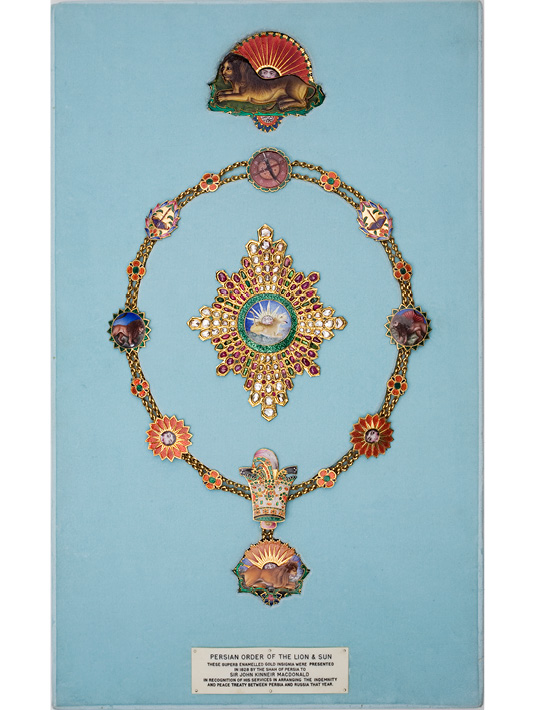
PLATE I. Order of the Lion and Sun, with badge signed by Moḥammad Jaʿfar and dated 1242/1826-27, presented by Fatḥ-ʿAli Shah to Sir John Kinneir Macdonald. Gold, with translucent and opaque enamels; set with precious stones; 8 x 9 cm badge, 35.6 x 25.4 cm collar, 15.2 x 12.5 cm star. The Nasser D. Khalili Collection of Islamic Art, JLY 1631. © Khalili Family Trust.
In Tabriz on 11 June 1830, Kinneir himself died, at the age of 48, following an illness of a few months. During his illness, the shah and the crown prince had been gravely concerned about his health. Following Kinneir’s death, ʿAbbās Mirzā ordered the bazaars to close for three days, for all public festivities to be postponed, and for members of his court to don mourning attire. Kinneir was buried, according to his own wishes, in the grounds of the Armenian cathedral of Etchmiadzin (then in the Russian empire). His elaborate funeral procession set off from Tabriz on 16 June, escorted by his replacement, John Campbell, his staff, the new Russian ambassador and his staff, along with many high-ranking Persian officials. This procession was followed by artillery and 450 members of ʿAbbās Mirzā’s personal guard. A 48-gun salute was performed, marking each year of Kinneir’s life. After the funeral procession reached Yerevan (see EREVAN), then in Russian Armenia, having been captured from Persia in 1827, a guard of Russian soldiers escorted the funeral party to the Etchmiadzin cathedral, where Kinneir was laid to rest the following morning in the burial ground usually reserved for Armenian pontiffs. Later, the court of directors of the EIC erected a headstone over his grave (Wright, 1998, p. 171). Amelia Macdonald Kinneir died in Boulogne-sur-Mer, France in 1860. The couple had no children.
In September 1826, shortly after his arrival in Persia, Kinneir had been awarded the first-class Order of the Lion and Sun, nešān-e šir o ḵoršid (see DECORATIONS), by the shah for his service to the Qajar state (IOR, “Translation of a Firmaun from His Majesty Futtey Ali Shah addressed to Lieut Colonel Macdonald Envoy”). He was granted British royal permission to wear the order in public in September 1829 (London Gazette, p. 1686). This decoration is now held by The Nasser D. Khalili Collection of Islamic Art and is currently (2022) on display at the Victoria and Albert Museum in London (Vernoit, pp. 102-4; PLATE I). In 1829, Kinneir was made a Knight Bachelor and later a Companion of the Order of the Bath (Phillimore, p. 418). He was also awarded the Order of Saint Anna by Tsar Nicholas of Russia, as well as the gift of a diamond snuffbox (United Kingdom National Archives, “Will of Sir John Macdonald Kinneir”). Such recognition from all three sides of the political triangle within which Kinneir was mediator is testament to his diplomatic skills during the Russo-Persian crises of the late 1820s.
Kinneir also left behind lasting physical marks of his time in Persia: one being the carving of his name into the ruins of Persepolis on two occasions; the other, also at Persepolis, being the removal of a segment of palace facade from the platform. First visiting the site with Malcolm in 1810, his name was carved onto the Gate of All Nations, along with the rest of the diplomatic party (see PERSEPOLIS GRAFFITI: FOREIGN VISITORS). On his return to Persia as envoy in 1826, he carved his name on the Palace of Darius, as did other members of his mission. Below his name appears the name of his wife inside a decorative cartouche. Later in 1826, Kinneir oversaw the excavation of one of the palace facades at Persepolis (Alexander, p. 140) and, in May 1827, deputed the EIC soldier Josiah Stewart to extract part of a relief exposed during his party’s visit. Kinneir’s wife sent the resulting “Sphinx” fragment to Lady Amherst, wife of Lord Amherst; the British Museum then purchased it in 1938 (BM 129831, Reg. ME 1938,0110.1; see Allen, pp. 227-31).
Kinneir’s publications in connection with Persia. In addition to his military and diplomatic career, Kinneir has been described as a traveler and a writer. However, his travels and writing were closely linked to his military career, and his two most significant publications were produced while he was serving in the EIC army, before he was appointed envoy. In 1813, Kinneir’s first book, A Geographical Memoir of the Persian Empire, Accompanied by a Map, was published by John Murray in London. The work, dedicated to Sir John Malcolm, provides geographic, climatic, political, and cultural information about Persia. The result of research not only by Kinneir, but also by others engaged in Malcolm’s second mission to Persia, the bulk of the work comprises description of the provinces of Persia and ends with a long appendix of routes between various Persian cities and towns. This work served as a reference for the many subsequent European and other travelers to Persia, being one of the first comprehensive guides to the country. Likewise, the accompanying map was the most detailed of Persia available at the time, notwithstanding the errors it contained. A Geographical Memoir was also widely cited by Malcolm when compiling his History of Persia, published in 1815.
Kinneir’s second book, Journey Through Asia Minor, Armenia and Koordistan in the Years 1813 and 1814; with Remarks on the Marches of Alexander, and Retreat of the Ten Thousand was published, again by John Murray, in 1818. In this work, Kinneir provided an account of his mission from England across Europe to India, to survey and examine the feasibility of various routes by which rival European powers might be able to invade British India through Persian territory, as he states in the introduction to the work. His account begins from Vienna, rather than with his unsuccessful attempt to travel through Russia, with the bulk of the work being devoted to description of what is today Turkey and Iraq. In a number of appendices Kinneir records inscriptions, routes, bearings and astronomical calculations relating to his journey. He also includes a record of travels he made during the period 1808-14. Kinneir managed to complete the work despite the loss of most of his notes when his vessel was attacked in the Persian Gulf in 1814 (Kinneir, 1818, p. ix).
Bibliography
Lindsay Allen, “Come Then Ye Classic Thieves of Each Degree: The Social Context of the Persepolis Diaspora in the Early Nineteenth Century,” Iran: Journal of Persian Studies 51, 2013, pp. 207-34.
Elena Andreeva, Russia and Iran in the Great Game: Travelogues and Orientalism, London, 2007.
Henry Manners Chichester, “Kinneir, Sir John Macdonald (1782-1830),” in Oxford Dictionary of National Biography, revised by James Falkner, https://doi.org/10.1093/ref:odnb/15637, 2021a.
Idem, “Monteith, William (1790-1864),” in Oxford Dictionary of National Biography, revised by James Falkner, https://doi.org/10.1093/ref:odnb/19043, 2021b.
Kamran Ekbal, Der Briefwechsel Abbas Mirzas mit dem britischen Gesandten MacDonald Kinneir im Zeichen des zweiten russisch-persischen Krieges (1825-1828). Ein Beitrag zur Geschichte der persisch-englischen Beziehungen in der frühen Kadscharenzeit, Freiburg, 1977.
Great Britain, Parliament, House of Commons, Select Committee on the East India Company, “Minutes of Evidence Taken before the Select Committee on the Affairs of the East India Company : And Also an Appendix and Index,” vol. VI, England, 1832.
Evelyn Jasiulko Harden, “Griboedov and the Willock Affair,” Slavic Review 30/1, March 1971, pp. 74-92.
Idem, “An Unpublished Letter of Nina Aleksandrovna Griboyedova,” The Slavonic and East European Review 49/116, July 1971, pp. 437-49.
Reżāqolī Hedāyat, Tārīkh-i rawżat al-ṣafā, Tehran, 1959.
[IOR] India Office Records and Private Papers, British Library, London. Idem, “Appointment of Major John Macdonald as Envoy,” July 1823-April 1824, IOR/F/4/847/22628.
Idem, “Copies of Letters from the East India Company Envoy to Persia, Lieutenant-Colonel John Macdonald Kinneir, to the Government of India,” IOR/L/PS/9/70/132, in Qatar Digital Library (https://www.qdl.qa/archive/81055/vdc_100038378586.0x000313, accessed 19 July 2022).
Idem, “Dispatches and Correspondence Concerning the Arrival of the East India Company Envoy to Persia, Lieutenant-Colonel John Macdonald Kinneir, in Persia,” IOR/L/PS/9/70/93, in Qatar Digital Library (https://www.qdl.qa/archive/81055/vdc_100038378586.0x0002ec, accessed 19 July 2022).
Idem, “Enclosure 75/19 to letter of 9 Dec 1827,” IOR/L/PS/9/71/126, in Qatar Digital Library (https://www.qdl.qa/archive/81055/vdc_100038378586.0x0003f4, accessed 19 July 2022).
Idem, “Extracts from the Private Journal of Col. Macdonald“, in Qatar Digital Library (https://www.qdl.qa/archive/81055/vdc_100038378586.0x00047b, accessed 19 July 2022).
Idem, “Letter from the East India Company Envoy to Persia, Lieutenant-Colonel John Macdonald Kinneir, in Tabreez, to the Secret Committee of the East India Company,” IOR/L/PS/9/70/222, in Qatar Digital Library (https://www.qdl.qa/archive/81055/vdc_100038378586.0x00036d, accessed 19 July 2022).
Idem, “Secret and Confidential Letter from the East India Company Envoy to Persia, Lieutenant-Colonel John Macdonald Kinneir, in Khoee, to the Chairman of the Court of Directors of the East India Company,” IOR/L/PS/9/71/64, in Qatar Digital Library (https://www.qdl.qa/archive/81055/vdc_100038378586.0x0003b6, accessed 19 July 2022].
Idem, “Translation of a Firmaun from His Majesty Futtey Ali Shah addressed to Lieut Colonel Macdonald Envoy,” IOR/L/PS/9/71/74, in Qatar Digital Library (https://www.qdl.qa/archive/81055/vdc_100038378586.0x0003c0, accessed 19 July 2022).
Idem, “Translation of a letter addressed by Lt. Colonel J Macdonald Envoy to HRH. Abbas Meerza,” IOR/L/PS/9/71/255, in Qatar Digital Library (https://www.qdl.qa/ archive/81055/ vdc_100038378586.0x000475, accessed 19 July 2022).
Edward Ingram, “Family and Faction in the Great Game in Asia: The Struggle over the Persian Mission, 1828-1835,” Middle Eastern Studies 17/3, July 1981, pp. 291-309.
John William Kaye, The Life and Correspondence of Major-General Sir John Malcolm, London, 1856.
John Macdonald Kinneir, A Geographical Memoir of the Persian Empire, Accompanied by a Map, London, 1813.
Idem, Journey Through Asia Minor, Armenia and Koordistan in the Years 1813 and 1814; with Remarks on the Marches of Alexander, and Retreat of the Ten Thousand, London, 1818.
Idem, “Papers of Sir John MacDonald Kinneir of Sanda (1782-1830),” Edinburgh University Library, GB 237 Coll-798.
Idem, “Sir John Macdonald Kinneir Papers,” British Library, MSS Eur C283, 1803-08.
David M. Lang, “Griboedov’s Last Years in Persia,” American Slavic and East European Review 7/4, December 1948, pp. 317-39.
London Gazette, 11 September 1829, p. 1686.
Firuza Melville, “Alexander Sergeevich Griboedov: Russian Imperial James Bond Malgré Lui. In Memory of the 225th Anniversary of His Birth,” in Rudi P. Matthee and Elena Andreeva, eds., Russians in Iran: Diplomacy and Power in the Qajar Era and Beyond, London, 2018, pp. 49-74.
“Memoir of Sir John Macdonald Kinneir” (reproduced from Bombay Courier), in Asiatic Journal, new series, 4/14, 1831, pp. 144-46.
Reginald Henry Phillimore, ed., Historical Records of the Survey of India II: 1800-1815, Survey of India: Dehra Dun, India, 1950.
Daniel Potts, “Benjamin Basil Shee, Knight of the Lion and Sun of Persia (1803-1840),” Iran 58/1, pp. 131-47.
Fażl-Allāh Širāzi Ḵāvari, Tāriḵ-e Ḏu’l-Qarnayn, ed. Nāṣer Afšārfar, 2 vols., Tehran, 2001.
Stephen Vernoit, Occidentalism: Islamic Art in the 19th Century, in collaboration with Nasser D. Khalili Collection of Islamic Art and Muassasat Nur al-Husayn, New York, 1997.
United Kingdom National Archives, Kew, “Will of Sir John Macdonald Kinneir,” 12 August 1830, PROB 11/1775/64.
Denis Wright, The English Amongst the Persians: During the Qajar Period 1787-1921, London, 1977.
Idem, “Burials and Memorials of the British in Persia,” Iran: Journal of Persian Studies 36, 1998, pp. 165-73.