



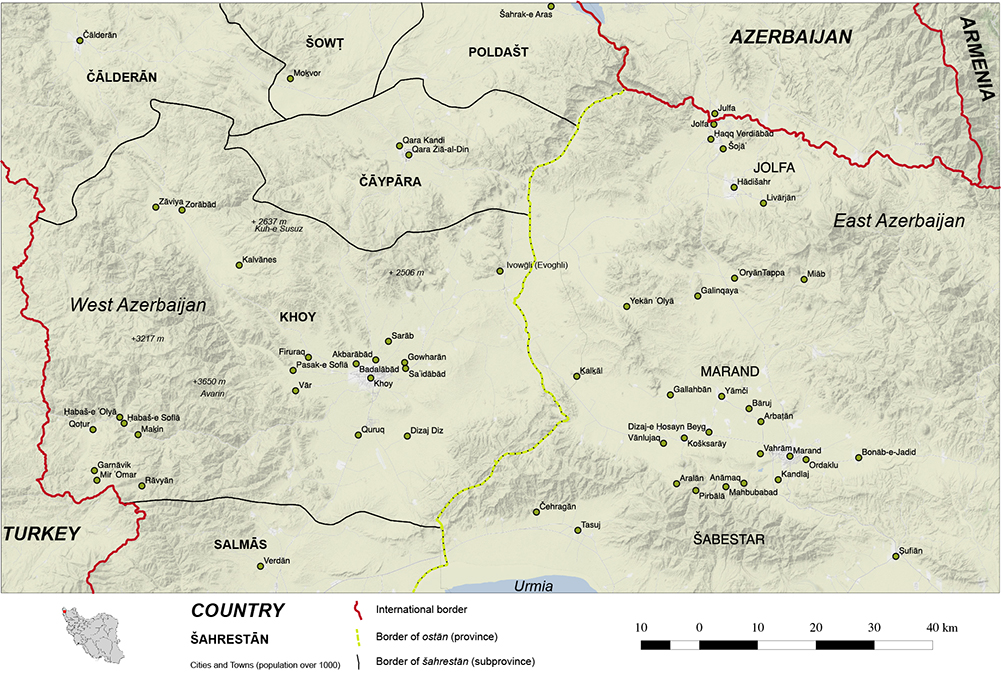
KHOY (Ḵoy; also Khowy or Khvoy), a city and subprovince (šahrestān) in West Azarbaijan province, Iran (38° 33′ N and 44° 57′ E; Figure 1). Khoy is approximately 41 km north of Lake Urmia and 54 km from the current border with Turkey. Khoy is located on a small plain in a fertile agricultural region with higher rainfalls than much of Iran. It was described by James Morier in 1816 as a place with fine earth in contrast to the clay soils in the nearby mountains (Morier, p. 297). High mountains surround the plain, including Avarin, which has an elevation of 3,650 meters, approximately 30 km west of the city. The urban population was 225,931 in 2016, with a total of 348,664 in the entire šahrestān (SCI).
Khoy developed as a trading center in a frontier zone between Iran and Anatolia. From the late 13th/19th century, its commercial significance declined as overland routes to the Ottoman Empire and Europe received less traffic. In contemporary times, Khoy has retained its status as an agricultural producer, with important industries including meat, dairy, and honey in the šahrestān. Natural gas is shipped to Naḵjavān in the Republic of Azarbaijan via a pipeline, completed in 2005, from Khoy to Julfa on the Aras River.
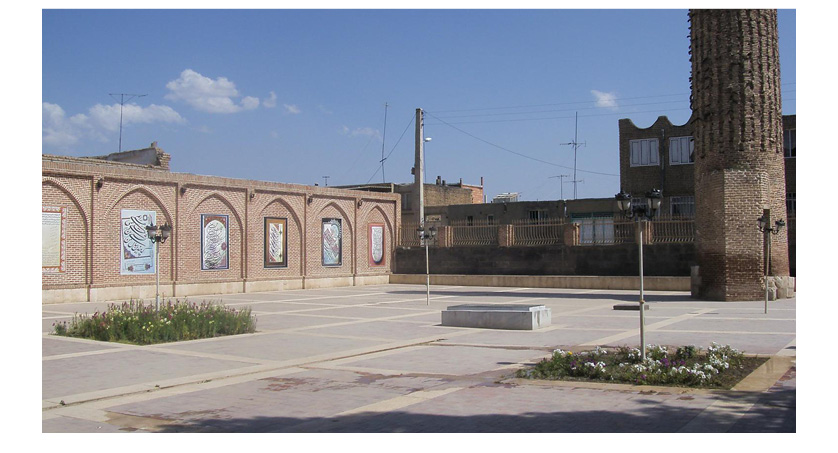
The city has been home to numerous literary and religious intellectuals, including the 7th/13th-century Sufi Šams-e Tabrizi, whose tomb is located in Khoy (PLATE I). It was also the ancestral home of the historian ʿAbd-al-Razzāq Beg Donboli (d. 1243 AH/1827 CE), though he spent most of his life in Shiraz and Tabriz.
There is evidence of settlement near Khoy dating to the 7th or 8th century BCE, though the historical record is clearer for the Islamic period (see Asl and Jafari, pp. 22-23). Pre-Islamic remains include ash hills attested as late as the early 20th century in the northeast of the city. After the Arab conquest of Azarbaijan in 20/640-41, Khoy survived as a small town between the regions of Armenia, Azarbaijan, Ārrān (Šervān), and Byzantine Anatolia. In the 3rd/9th century, the geographers Ebn Ḵordādbeh (p. 119) and Yaʿqubi (p. 272) described Khoy (Ḵowayy) as a district in Azarbaijan. A century later, the author of Ḥodud al-ʿālam placed Khoy within Armenia, perhaps due to its large Christian population, and noted local production of carpets and wood (Ḥodud al-ʿālam, p. 160). By the 7th/13th century, Khoy was a walled city in which many silken goods were produced (Qazvini, p. 527).
Khoy’s location in the borderlands between Iran, the Caucasus, and Anatolia provided opportunities for growth in this period, while also leaving it vulnerable to attack. In 413/1022-23, after acquiring lands around Amida (modern Diyarbakır, Turkey) and defeating the Bagrationi (see BAGRATIDS) Georgian king, George I, the Byzantine emperor Basil II marched against the city, only turning back due to winter snows. After absorbing the lands of the Artsruni dynasty of Eastern Anatolia, Basil attacked Khoy in response to raids by either Turkmens or the Rawwadid (q.v.) rulers of Azarbaijan (Holmes, pp. 483-85). Turkmen armies moved north from Mesopotamia and occupied Khoy in 435/1043-44. The Saljuq migration into Anatolia in the decades that followed created new patterns of trade, with Khoy occupying a crucial point on the east-west road into the Rum Sultanate (Riāḥi, 1999, p. 43). The 6th/13th-century Mongol destruction of the city was followed by a slow revival of building and economic activity. The caravan route into Anatolia remained intact, and Il-khanid subjugation of the Rum Saljuqs allowed a reemergence of traffic in the region. Under the last Il-khanid ruler, Solṭān Abu Saʿid, coins were minted within the city (Riāḥi, 1993, pp. 73-74).
The Castilian ambassador Ruy González de Clavijo spent three days in Khoy in 806/June 1404 on his mission to the court of Timur in Samarqand. Clavijo remarked on the area’s fertility and agriculture, noting its orchards, gardens, and wheat cultivation. By this time, Khoy was surrounded by a brick wall with guard towers. He encountered a mission from Solṭān Aḥmad Jalāyer (see JALAYERIDS), which brought exotic animals as gifts to Timur (Clavijo, pp. 196-97). This episode demonstrates the city’s continued role as a key connecting point in east-west travel. Clavijo returned to Khoy on his return journey, commenting on raiding in the region by Qarā ʿOṯmān Āq Qoyunlu, which compelled the Castilians to take the road directly north to Māku (Clavijo, p. 348).
During the rule of the Turkmen dynasties in the 9th/15th century and the Safavids in the 10th/16th century, Khoy became a contested region, first in Āq Qoyunlu succession struggles, and subsequently in the Ottoman-Safavid wars. Uzun Ḥasan Āq Qoyunlu defeated Ḥasan-ʿAli b. Jahānšāh Qarā Qoyunlu at nearby Marand in 873/1468-69. A larger battle occurred ten years later when a faction supporting the succession of fourteen-year-old prince Yaʿqub b. Uzun Ḥasan formed among the disaffected military elites of Diyarbakır, marching into Azarbaijan to contest the rule of his brother, Solṭān Ḵalil. In July 1478, the two sides fought a decisive battle near Khoy, decided by the charge of Bayandor b. Rostam, opening the road to Tabriz to Yaʿqub (Woods, pp. 139-41). Khoy became a winter camp and gathering point for armies under Esmāʿil I Ṣafawi before the Čālderān campaign in 920/1514.
During the Safavid period, the city faced frequent attacks during conflicts with the Ottoman Empire; this era also marked the emergence of the Kurdish Donboli tribe as the leading political faction in Khoy, a status it maintained to the early 13th/19th century. Kurdish tribes often held governorships of Khoy, together with nearby Salmās from the time of Shah Ṭahmāsp I (r. 930-84/1524-76); among these groups, the Donboli appeared as frontier guardians from the time of Ḥāji Beg Donboli (d. 955/1548-49). Despite the Donboli’s active defense of Khoy, the city fell several times to Ottoman attack (Riāḥi, 1999, pp. 120-21). Khoy was destroyed in 1045/1636-37, reviving only after permanent peace was agreed three years later (Riāḥi, 1999, p. 98).
After the collapse of Safavid rule in 1135/1722, the Ottomans occupied Khoy and most of Azarbaijan from 1724 to 1730. For more than one month, the raʾis of the Donboli, Šahbāz Khan, defended the city, causing a delay in the Ottoman advance on Tabriz. After executing Šahbāz Khan’s son, Mortażāqoli Khan Donboli, in connection to the flight of prominent Donbolis to the Ottoman Empire, Nāder Shah subsequently offered clemency to his sons through the mediation of Mollā ʿAbd-al-Nabi of Khoy. He made one son, Šahbāz Khan II, governor (ḥākem) in 1159/1746 (Riāḥi, 1999, pp. 138-42).
Under the Donbolis, Khoy enjoyed a period of heightened political and economic power, enabled by deepening economic ties with the Ottoman Empire and able management of the shifting political alliances of the post-Safavid period. Šahbāz Khan II supported Āzād Khan Afḡān in Azarbaijan, and also fought alongside him against a Georgian force in Yerevan in 1750-51 (Butkov, part 1, p. 238). Six years later, he shifted his support to the invading Qajars of Astarābād, with whose help he reestablished the fortifications of the city at its present location, though ramparts and towers were added by ʿAbbās Mirzā during the First Russo-Persian War. Furthermore, the Qajars placed Tabriz under the authority of the governor of Khoy. Despite Šahbāz Khan’s status as a hostage at the Zand court in Shiraz after 1176/1763, the family retained these governorships. Merchants of Khoy and Tabriz increased their activity in the caravan trade in this period, overtaking Armenian networks in the silk and cotton trades to Erzurum in Anatolia (see Zarinebaf-Shahr, pp. 185, 196-97).
The Donbolis maintained a functionally independent administration as one of the leading powers of Azarbaijan from 1779 until 1792, balancing local and imperial interests to secure and extend their influence despite internal instability. They supported the Zand succession claims of ʿAli-Morād Khan and used his support to place a cooperative Afšār governor in control of Urmia. The Donbolis faced a series of internal conflicts with the return of exiles from Shiraz, resulting in the assassination of Aḥmad Khan in 1200/1786 and the subsequent counter-coup that restored his son, Ḥosaynqoli Khan, to power. The latter offered obedience to Āqā Moḥammad Khan Qājār in 1205/1792, ending the period of political autonomy, but elevating the Donbolis to regional governorship.
Donboli internal politics became entangled in the Russian-Qajar rivalry that resulted in two wars in the reign of Fatḥ-ʿAli Shah. The notables of the city expelled Ḥosaynqoli Khan in 1213/1798 in favor of his brother Jaʿfarqoli. Jaʿfarqoli was removed and the city sacked in 1213/1799 by ʿAbbās Mirzā. Arriving in May 1806, Pierre Amédée Jaubert noted the damage from this campaign, stating that the city lacked great mosques or public buildings, though he observed signs of prosperity in Khoy’s tree-lined streets and caravanserais (Jaubert, p. 148). Over the next three decades, ʿAbbās Mirzā, governing the region from Tabriz, reduced the power of the Donbolis, moving them into bureaucratic positions under Qajar prince-governors (Werner, p. 147; for a similar process in Urmia, see Kondo).
During the First Russo-Persian War (1804-13), the Russian general Tsitsianov advocated for extending Russian frontiers south of the Aras River to include Khoy (Atkin, p. 95). The exiled Jaʿfarqoli Khan appealed to Tsitsianov for protection in 1804, settling in Šakki, where he later served as governor (Akty, p. 857). The Ḵoyski family, a branch of the Donboli that he established, formed part of the military and administrative elite of the Russian South Caucasus. Jaʿfarqoli Khan’s great-great-grandson, Fatḥ ʿAli Khan Ḵoyski later served as prime minister of the Azarbaijan Democratic Republic after the Russian Revolutions of 1917. The failure of the 1826 Iranian campaign against Šuši made Khoy a target for Ivan Paskevich’s Russian army, though ʿAbbās Mirzā gathered his forces there. Khoy fell in 1827 and was returned to Iran in the Treaty of Torkamānčāy in 1828.
Under the later Qajars, Khoy saw rising agricultural and industrial prosperity, though these were limited due to Kurdish raiding and a major earthquake in 1259/1843. ʿAbbās Mirzā established a fulling mill at Khoy by 1830, as part of his promotion of industry in Azarbaijan. However, the city suffered almost complete destruction due to the earthquake, which killed more than 1,000 residents, and took several years to rebuild. Despite declining overland trade, Khoy extended its links to Anatolia via new roads in the late 1880s, linking it to Bayezit. A Russian proposal for a railroad never materialized (Clark, pp. 243, 294). Jalāli Kurdish raiding in the frontier zones evolved into a major threat during the 1880 rebellion of Shaikh ʿObayd, which was ended when a force from Khoy defeated the rebels near Urmia (Clark, p. 201). This raiding continued through the Constitutional period.
The Constitutional Revolution, which arrived in Khoy through the outreach of the Anjoman (q.v.; provincial council) of Tabriz, ended in Russian occupation with the Anglo-Russian Convention. The Anjoman dispatched pro-Constitutional preachers to regional cities; one of the most influential, Sayyed Jawād Nāṭeq, traveled to Khoy in 1907, where he mediated an agreement between village leaders and landlords that ended various obligations owed by the peasantry (Afary, p. 170). In 1907, the efforts to establish revolutionary councils in Māku led to attacks on rural communities by Jalāli horsemen supporting the deposed governor (Kasravi, pp. 440-45). After a long-delayed response from central authorities, two regiments from Khoy marched against these forces, ending in defeat with more than fifty troops killed and 140 captured.
Khoy suffered occupation and separatist and communal violence during the two World Wars. Russian forces occupied the city during the 1911 invasion in support of the deposed Moḥammad-ʿAli Shah and clashed violently with bāzār merchants there a year later. Khoy served as their headquarters from 1914. Communal violence was enflamed by the uprising of Šakāk Kurds led by Esmāʿil Simitqu (Simqo) from 1918-22. Simitqu killed the Assyrian Patriarch Mar Shimun XIX in 1918 in violation of his offer for talks. After suffering defeat by Assyrian forces in Salmās, he occupied Khoy and massacred Assyrians in the city (Joseph, p. 147). An Assyrian force also moved against Khoy without success in 1918. Simitqu’s rebellion was suppressed by the new Pahlavi forces in 1922, bringing stability that lasted until the Soviet occupation during the Second World War. During this period, the separatist Democratic Party of Azarbaijan, with Soviet support, sent six representatives from Tabriz to establish a party office in Khoy during the summer of 1942 (Dādrasi, p. 101). The city returned to Iranian control after the Soviet withdrawal in 1946.
After the defeat of the Democratic Party of Azarbaijan, the decades between the end of the Soviet occupation and the Islamic Revolution of 1978-79 in Khoy were characterized by efforts of central authorities to reestablish control of the region and to direct economic modernization, the latter especially from the 1960s. The presence of security forces continued, disrupting activities of the Tudeh party in the 1950s (Dādrasi, p. 106). In 1958, Moḥammad Reżā Shah visited Khoy to promote development plans across the north that included Khoy, which had begun its economic recovery from the war as stability returned, but remained a largely agricultural economy (Dādrasi, pp. 129-31). Officials promoted the land reforms of the White Revolution in villages around Khoy to advance the referendum on its implementation in 1963 (Dādrasi, p. 140).
Opposition to Mohammad Rezā Shah emerged around the Hāji Bābā Mosque in Khoy, which was closely connected to merchants of the city’s bazaar, starting in the early 1960s (Dādrasi, pp. 137-40). This institution became a center of revolutionary organizing in the late 1970s and, as in much of Iran, a combination of preaching there and closures of the bazaar played significant roles in opposition from early spring 1978 (Dādrasi, p. 183). After a series of strikes, Khoy saw street violence in early 1979 that spilled into the village of Badalābād, north of the city; leaders of strikes, of market closures, and opposition preachers formed an Islamic Revolution Committee in Khoy after the end of Pahlavi rule (Dādrasi, pp. 194-96).
Bibliography
Janet Afary, The Iranian Constitutional Revolution, 1906-1911: Grassroots Democracy, Social Democracy, and the Origins of Feminism, New York, 1996.
Akty sobrannye Kavkazskoĭ arkheograficheskoĭ komissieĭ II, Tiflis, 1868.
Lida Balilan Asl and Elham Jafari, “Khoy’s Expansion from Early Islam to Late Qajar According to Historical Documents,” International Journal of Architecture and Urban Development 3/2, 2013, pp. 21-30.
Muriel Atkin, Russia and Iran, 1780-1828, Minneapolis, 1980.
Petr G. Butkov, Materialy dlya novoĭ istorii Kavkaza, c- 1722 po 1803 god-, St. Petersburg, 1869.
James D. Clark, Provincial Concerns: A Political History of the Iranian Province of Azarbaijan, 1848-1906, Costa Mesa, 2006.
Ruy González de Clavijo, Embajada a Tamorlán, ed. Francisco López Estrada, Madrid, 1999.
Naqi Dādrasi, Enqelāb-e eslāmi dar Ḵoy, Tehran, 2009-10.
Suleyman Elik, Iran-Turkey Relations 1979-2011: Conceptualizing the Dynamics of Politics, Religion and Security in the Middle-Power States, London, 2012.
Ḥodud al-ʿālam men al-šarq elā al-maḡreb, ed. Manučehr Sotudeh, Tehran, 1962.
Catherine Holmes, Basil II and the Governance of Empire (976-1025), Oxford, 2005.
Eldar E. Ismaĭlov, Persidskie printsy iz doma Kadzharov v Rossiĭskoĭ Imperii, Moscow, 2009.
Pierre Amédée Jaubert, Voyage en Arménie et en Perse
fait dans les années 1805 et 1806, Paris, 1821.
John Joseph, The Modern Assyrians of the Middle East: Encounters with Western Christian Missions, Archaeologists, and Colonial Powers, Leiden, 2000.
Aḥmad Kasravi, Tāriḵ-e mašruṭa-ye Irān, tr. Evan Siegel, as History of the Iranian Constitutional Revolution II-III, Costa Mesa, 2015.
Nobuaki Kondo, “Qizilbash Afterwards: The Afshars in Urmiya from the Seventeenth to the Nineteenth Century,” Iranian Studies 32/4, pp. 537-56.
[Ebn Ḵordāḏbeh] Abu’l-Qāsem ʿObayd-Allāh b. ʿAbd-Allāh b. Ḵordāḏbeh, Ketāb al-masālek wa’l-mamālek, ed. M. J. de Goeje, Leiden, 1889.
Vanessa Martin, Iran Between Islamic Nationalism and Secularism: The Constitutional Revolution of 1906, New York, 2013.
ʿAli-Reżā Moqaddam, Ḵoy diār bā ṣafā, Tehran, 2010.
James Justinian Morier, A Journey through Persia, Armenia, and Asia Minor to Constantinople in the Years 1808 and 1809, Philadelphia, 1816.
Behruz Naṣiri and Zahrā ʿĀšerzāda, Farhang-e nāmāvarān-e Ḵoy, az sada-ye awwal tā čahārdah-e hejri-e qamari, Khoy, 2003.
Zakariyā b. Moḥammad b. Maḥmud Qazvini, Āṯār al-belād wa aḵbār al-ʿobād, Beirut, 2005.
Moḥammad-Amin Riāḥi, Tāriḵ-e Ḵoy sargoḏašt-e seh sālah-e manṭaqa-ye por ḥādeṯa-ye šomāl-e ḡarb-e Irān va ravābeṭ-e siāsi va tārikhi-e Irān bā aqvām-e hamsāyah, Tehran, 1993.
Idem, Tāriḵ-e Ḵoy
(Sayr-e taḥwwolāt-e ejtemāʿi wa farhangi-e šahrhā-ye Irān dar ṭayy-e qorun), Tehran, 1999.
[SCI] Statistical Center of Iran (Markaz-e āmār-e Irān), 2016 National Population and Housing Census, Population and Households by Provinces and Cities, data available at http://irandataportal.syr.edu/census/census-2016.
Christoph Werner, An Iranian Town in Transition: A Social and Economic History of the Elites of Tabriz, 1747-1848, Wiesbaden, 2000.
John E. Woods, The Aqquyunlu: Clan, Confederation, Empire, Minneapolis, 1976.
Aḥmad b. Abi Yaʿqub Yaʿqubi, Ketāb al-boldān, ed. M. J. de Goeje, Leiden, 1892.
Fariba Zarinebaf-Shahr, “Tabriz Under Ottoman Rule (1725-1730),” Ph.D. diss. University of Chicago, 1991.