



The revolution that overthrew Omayyad rule and led to the establishment of the ʿAbbasid caliphate was incubated in Khorasan, and it marked a major watershed in the history of that province, just as it would in the larger Islamic world. Under the Omayyads, the overriding historical dynamic of Khorasan had been that of a frontier contact zone (or “shatterzone” in the terminology of one recent work; Haug, p. 26), with the provincial administration and armies primarily engaged in defending against nomadic invasions from the north and subduing numerous non-Islamic local rulers, often backed by Chinese power, along the eastern marchlands. After the revolution, the historical narrative reflected a political dynamic between center and periphery, with an increasingly unified array of Islamized local elites resisting the voracious demands of a centralizing caliphal bureaucracy and achieving greater and greater degrees of political autonomy in what was becoming more of an Islamic commonwealth than an ʿAbbasid empire.
THE ʿABBASID REVOLUTION AND THE RISE OF ABU MOSLEM
The conditions for the first stage of the ʿAbbasid revolution resulted from the “third civil war” (Wellhausen, pp. 370-96) that erupted following the death of the Omayyad caliph Hešām in 125/743 and the assassination of his successor Walid II in 126/744. As the struggle for power in Syria and Iraq raged, Khorasan was largely left to its own devices, and the Omayyad establishment there was fractured by internecine strife among the Arab elites.
Hešām had appointed Naṣr b. Sayyār Layṯi Kenāni as governor in 120/737-38 (Ṭabari, II, pp. 1660-62). Naṣr, then more than seventy-years old, had experience in the military and fiscal affairs of Khorasan going back to the time of Qotayba b. Moslem (d. 96/715). As governor, he resumed raids across the Oxus (Āmu Daryā, q.v.) and, in 121/738, introduced a series of fiscal reforms that ostensibly aimed at relieving tax burdens on Arabs and non-Arab converts under the protection of Arab tribes (the mawāli), but avoiding deficits by more rigorously imposing tribute, the land tax (ḵarāj), and the demeaning poll tax (jezya, q.v.) on the “polytheists” (mošrekin), who may well have included many nominal converts not affiliated like the mawāli with Arab tribes (see Ṭabari, II, pp. 1688-89; Dennett, pp. 110-13). He also unabashedly gave preference to his own tribal bloc, the Możar, and was said to have appointed over a four-year span only Możaris to office (Ṭabari, II, pp. 1664-65). The main intent of Naṣr’s reforms seems to have been to create an expanded and tightly controlled Arab administration in Khorasan, disentangling it from the administration of Iraq and reporting directly to the caliph.
Although Khorasan is said to have prospered under Naṣr’s governorship (Ṭabari, II, p. 1665), opposition to him grew despite, or more likely because of, the policies he had introduced. One source of opposition would naturally be from the partisans of the house of ʿAli b. Abi Ṭāleb (q.v.), who were not inclined to support Omayyad rule under any circumstances. They, as well as less dedicated sympathizers, were outraged by Naṣr’s treatment of Yaḥyā b. Zayd, ʿAli’s great-grandson. The young Yaḥyā had fled to Khorasan after the failure of the revolt in Kufa against Hešām led by his father, Zayd b. ʿAli b. Ḥosayn (d. 122/740). Yaḥyā went into hiding first in Saraḵs and then in Balḵ (q.v.), but Naṣr, under pressure from the governor of Iraq, Yusof b. ʿOmar, had his agents hunt Yaḥyā down and ordered him to return to Iraq and face certain death at the hands of Yusof b. ʿOmar. After Yaḥyā attempted to stay in Khorasan, Naṣr’s forces attacked and killed him and put his decapitated corpse on display in Jowzjān (q.v.) in 125/743 (on these events, see Ṭabari, II, 1667-88, 1698-1716, 1770-74; Balāḏori, II, pp. 520-46; Eṣfahāni, pp. 152-58).
After Hešām’s death, there were intrigues by other rivals to replace Naṣr as governor, but he evaded them until his governorship was affirmed by the caliph Yazid III in 126/744 (Ṭabari, II, p. 1855). Naṣr arrested the most likely of the candidates who had tried to replace him, Jodayʿ b. ʿAli Kermāni, a leader of the Azd tribes and protégé of the former governor and Naṣr’s nemesis, Asad b. ʿAbd-Allāh Qaṣri (d. 120/737-38). Kermani quickly escaped and raised an army of supporters who took up camp near Marv and prepared to fight Naṣr (Ṭabari, II, 1858-66). Naṣr then persuaded Yazid III to grant an amnesty to Ḥāreṯ b. Sorayj, a perennial religio-political rebel (who at one time had even allied with the Türgesh against the Omayyads), in the hope of winning him as an ally against Kermāni (Ṭabari, II, 1867-69). Instead, Ḥāreṯ returned from Samarqand and also took up a position near Marv; he rallied his own supporters; denounced tyranny, oppression, and corruption; preached for governance in accord with the Qurʾan and the Sunna; and, after refusing to recognize the accession of Marwān II (r. 127-32/744-50) as caliph, cooperated with Kermāni against Naṣr (Ṭabari, II, 1888-90). The latter retreated to Nishapur in 128/746. As Naṣr had perhaps anticipated, it was less than a month before Ḥāreṯ and Kermāni had a falling out; in their fight, Hāreṯ was killed in Rajab 128/April 746 and his decapitated corpse crucified at Marv (Ṭabari, II, 1932-33). Naṣr then resumed his efforts to dislodge Kermāni from Marv, returning to the city and encamping near Kermāni’s position in 129/747. Throughout all of this, Naṣr had warned his adversaries of the dangers that would result from the Arab establishment being divided against itself and appealed for unity. He was soon proven correct by the arrival on the scene of a new and quite unexpected contender in the person of Abu Moslem Ḵorāsāni (q.v.), who raised the black banners of revolt in a village outside Marv in Ramażān or Šawwāl 129/June 747.
Abu Moslem’s declaration of revolt marked the second stage of the ʿAbbasid revolution, but one that is shrouded, like Abu Moslem himself, in a cloud of mystery. In general, the traditional sources would have us believe that the revolution was the fruit of a conspiracy carefully cultivated over nearly thirty years by a tightly organized, covert, sectarian faction known as the Hāšhemiya. In what was for a while the official version of how the sect got its name, the Hāšemiya were propagandizing for rule by a member of the Prophet Moḥammad’s clan of Hāšem, specifically Moḥammad b. ʿAli, the grandson of the Prophet’s paternal uncle ʿAbbās, and were directed by him as leader of the ʿAbbasid family from their place of exile in Ḥomayma (a village south of the Dead Sea). An alternative explanation was that the Hāšemiya represented an extremist offshoot of the Kaysāniya (q.v.) propagandizing mostly in Kufa (q.v.) but with little effect, on behalf of Abu Hāšem ʿAbd-Allāh b. Moḥammad b. al-Ḥanafiya (a descendant of the third son of ʿAli b. Abi Ṭāleb by a woman of the Banu Ḥanifa). The childless Abu Hāšem, persecuted by the Omayyads, took refuge in Ḥomayma with Moḥammad b. ʿAli and, near death in 98/716-17, turned over his claim to the caliphate, his esoteric knowledge, and his organization to Moḥammad b. ʿAli (for details and sources, see Daniel, 1979, pp. 26-29; Sharon, 1983, pp. 121-40; Agha, 2003, pp. 4-6).
After a period of mostly ineffective organizing in Kufa, Moḥammad b. ʿAli was persuaded by one of the recruits, Bokayr b. Māhān (q.v.; d. 128/745-46), to shift the focus of the mission (daʿwa ‘call’; see DAʿĪ) to Khorasan. He sent Bokayr to begin organizing there in or around the year 100/718-19 (103/722 is a more credible date; Ṭabari, II, p. 1988, and it may have been even later). Bokayr established a network of clandestine revolutionary cells led by twelve naqibs ‘chiefs’ and seventy daʿis ‘missionaries’ (an unusually detailed account of these and other elements of the revolutionary apparatus may be found in Aḵbār, pp. 213-23). So far as can be told, the propaganda of the daʿis used a vague call for rule based on the Qurʾan, the Sunna, and veneration of the family of the Prophet Moḥammad (see AHL-E BAYT), with the objective of bringing about the reign of a Chosen One (al-reżā) from among his relatives (slogans expressing such sentiments appeared later on in the oath of allegiance used by Abu Moslem, in speeches to the troops, and on coinage; Ṭabari, ii, p. 1989; Aḵbār, pp. 323-24). As for the identity of the sect’s leader, the missioners were admonished not to reveal his name publicly. This was typical of many post-Kaysāniya movements, and perhaps a necessary precaution as Shiʿite revolts to that date had shown that those on behalf of a declared candidate were doomed to fail. However, the call for al-reżā, while not naming him, was also perhaps more than just a defensive tactic—it was likely rooted in the belief that the Chosen One would be manifested at the proper time through a process of consensus (šurā) rather than inheritance (waṣiya) and would reign more than rule (see Crone, 1989; Agha, 2003, pp. 101-6).
The initial efforts to recruit partisans in Khorasan was rather inept, as the governor Asad b. ʿAbd-Allāh identified and arrested a number of the propagandists in 107/725 (Ṭabari, II, pp. 1501-3). After that, the revolutionary cells were directed for three years by an illiterate Kufan, Kaṯir b. Saʿd. Among those attracted to the movement was one ʿAmmār (or ʿOmāra) b. Yazid (or Yazdād), better known by the name he gave himself (or was called), Ḵedāš. Reportedly a Christian convert from Kufa then living near Marv, Ḵedāš proved himself a skillful and charismatic preacher: Instead of simply being recruited, Ḵedāš ousted Kaṯir and not only commandeered the movement but transformed it, substituting the esoteric, perhaps neo-Mazdakite, teachings of the din al-Ḵorramiyya (Ṭabari, II, pp. 1503, 1588; Balāḏori, III, pp. 116-17; Ebn al-Aṯir, V, pp. 196-97; see ḴORRAMIS) for those of Moḥammad b. ʿAli and the Hāšemiya. The probability is that Ḵedāš dominated the daʿwa from the time Kaṯir returned to Kufa (ca. 111/729) until he was arrested, tortured, and killed on orders from Asad b. ʿAbd-Allāh in 118/736-37. Whatever Ḵedāš was preaching must have been effective, as that is also a period in which the movement reportedly gained many followers, and even Bokayr b. Māhān is said to have recognized Ḵedāš as chief daʿi (Ṭabari, II, p. 1588-89). Moḥammad b. ʿAli, however, denounced Ḵedāš and remained estranged from the Hāšemiya of Khorasan until 120/738, when Solaymān b. Kaṯir Ḵozāʿi restored relations and was recognized by Moḥammad b. ʿAli as the leader of the Khorasani daʿwa (Ṭabari, II, 1639-40).
Moḥammad b. ʿAli died in 125/743 and was succeeded as imam of the Hāšemiya by his son Ebrāhim. Bokayr b. Māhān visited Khorasan to convey this news to the leaders of the daʿwa, some of whom later met with Ebrāhim during the ḥajj and accepted his authority. On the return from Khorasan, Bokayr was arrested and briefly jailed in Kufa until ransomed by the head of the Kufan Hāšemiya, Abu Salama Ḵallāl. It was in the Kufan jail that Bokayr and Abu Salama supposedly met the young Abu Moslem, then the servant of another of the prisoners, brought him into the movement, and took him to Ebrāhim in Ḥomayma, where he became a mawlā of the family. Ebrahim and Bokayr began dispatching Abu Moslem on missions to Khorasan, and in 128/745-46 (apud Ṭabari, II, p. 1937) ordered him to take over the leadership of the daʿwa there. The astonished veteran missioners resisted and wanted to know “from what egg has this nameless upstart hatched or from what nest has he fallen?” (Aḵbār, p. 269). Nonetheless, they eventually accepted Ebrāhim’s instructions, and it was under the leadership of Abu Moslem that the overt revolt was prepared and launched.
Abu Moslem’s execution of the revolt can only be described as brilliant strategically and tactically, coupled with some strokes of luck. With the major Arab armies occupied with each other in Marv, Abu Moslem was free to send out envoys to rally partisans all over Khorasan (Ṭabari, II, p. 1962) and pick off the isolated garrisons one by one. It is fairly clear that Nasr’s supporters were either expelled or fled from Marv al-ruḏ, Herat, Āmol, Nasā, Abiward, Balḵ, and Ṭālaqān. Many of the uprisings in those places appear to have involved exceptional mass violence and massacres (see, e.g., Aḵbār, p. 284; Theophanes, pp. 654-55, tr. p. 114; Ḵalifa, p. 413; Dinawari, p., 361; Ebn ʿAbd Rabbeh, VI, pp. 477-79; Daniel, 1979, pp. 51-54; Agha, 2000, pp. 344-45; idem, 2003, pp. 75-86). The scattered pro-Omayyad forces—a motley coalition said to include members of all three of the tribal groups at odds with each other in Marv as well as mawāli and local Iranian rulers from the districts of Ṭoḵārestān—regrouped at Termeḏ, but they were decisively routed by Abu Moslem’s general, Abu Dāwud Ḵāled b. Ebrāhim Šaybāni. Crucially, the ʿAbbasid envoys and propagandists circulating throughout the countryside were free to direct new recruits, often described as “slaves,” to Abu Moslem’s encampment. Dinavari (p. 361) describes a flood of supporters coming on horses, donkeys, and on foot from all over greater Khorasan to join Abu Moslem, all dressed in black and armed with blackened staves called kāfer-kubāt ‘infidel bashers’ (on the significance of which, see Crone, 2000, pp. 180-83). Naṣr attempted to dislodge Abu Moslem in mid-Šawwāl 129/late-June 747, but underestimated his opponent’s strength and failed.
As Abu Moslem’s army grew, he moved to a new fortified camp near the village of Māḵwān in Ḏu’l-Qaʿda 129/July 747. The situation in Marv was relatively simple: No one side could prevail alone but had to find allies. The conflict thus became mostly one of propaganda in which Naṣr could appeal to Arab unity, but in which Abu Moslem held almost all the trump cards. First of all, he was able to capitalize on the pro-ʿAlid sentiments in Khorasan that had been inflamed by the killing of Yaḥyā b. Zayd. Yaḥyā was related on his mother’s side to Moḥammad b. al-Ḥanafiya, so Abu Moslem and the Hāšemiya were able to use vengeance for Yaḥyā as a rallying cry for their revolt. Second, as has often been noted, the Hāšemiya propaganda was remarkably similar to that of Ḥāreṯ b. Sorayj, from the use of the black banners to its religious appeal to its willingness to join with non-Arabs. After Ḥāreṯ’s death, some of his followers (including his son) appear to have joined Naṣr, but it is likely many more went over to Abu Moslem. Whatever effect Naṣr’s appeal for Arab unity was beginning to have, it abruptly ended when, in the course of truce negotiations, Naṣr stood by while Ḥāreṯ’s son attacked and killed Jodayʿ Kermāni and crucified his corpse next to a fish (an insulting symbol for his tribe). Astonishingly, Naṣr continued to believe Arabism would somehow win over the Kermāni faction, but his efforts to forge a truce quickly failed. Abu Moslem was able to bring Kermāni’s forces firmly into his alliance; he flattered Kermāni’s son by calling him “amir,” but when Abu Moslem asked for his orders ʿAli b. Jodayʿ prudently responded to just keep doing what he had been doing (Ṭabari, II, 1976). ʿAli b. Jodayʿ also helped persuade a Kharijite rebel, Šaybān b. Salama, who had turned up at Marv, to withdraw to Saraḵs, where he was eventually killed by Abu Moslem’s followers (Ṭabari, II, 1995-97; Aḵbār, pp. 309-10). In one last, desperate gambit, Naṣr tried to make a deal with Abu Moslem against ʿAli b. Jodayʿ, but this was bluntly rejected (Ṭabari, II, p. 1986).
By Rabiʿ I 130/November 747, Naṣr was holed up in Marv, with turmoil in the hinterland, his hope for an Arab coalition in tatters, no prospects of aid from Syria or Iraq, Abu Moslem’s forces steadily growing, ʿAli b. Jodayʿ’s faction occupying part of the inner city, and ʿAbbasid propagandists active there. Fighting between two parties—exactly which ones is not clear—broke out, probably in Rabiʿ II 130/December 747. Abu Moslem then ceremoniously entered the capital on 9 Jomāda 130/27 January 748 (according to Ṭabari, II, p. 1987), without resistance, posing as a peacemaker, taking up residence at the government palace, accepting the oath of allegiance from the people, and executing Naṣr’s most important officials.
Naṣr fled the next day to one of the suburbs and then, after having been warned of Abu Moslem’s intention to kill him, on with his Możari supporters to Nishapur. He was pursued by a revolutionary army under the command of Qaḥṭaba b. Šabib Ṭāʾi, assisted (or watched) by two of Abu Moslem’s trusted agents, Ḵāled b. Barmak (see BARMAKIDS) and Abu’l-Jahm b. ʿAṭiya. Qaḥṭaba encamped at Abivard for the winter, and then defeated a detachment of Naṣr’s troops at Ṭus, forcing Naṣr to retreat from Nishapur to Qumes in Šaʿbān 130/May 748. Many of his remaining followers then abandoned him and went to join the Omayyad governor of Jorjān, Nobāta b. Ḥanẓala, who had brought Syrian reinforcements there in such large numbers that the Khorasanis were intimidated when they encountered them (Ḏu’l-Qaʿda 130/July 748). The speech Qaḥṭaba gave to encourage the “men of Khorasan” (Ṭabari, II, pp. 2004-6) is of particular interest because, if genuine, it can only be understood as being addressed to an army made up predominately of non-Arab Muslims, who were being given an opportunity not only for vengeance on those who “had burned the House of God” but on the “lowliest nation” (aḏall omma), which had defeated their ancestors, seized their land and women, enslaved their children, and then ruled oppressively. This may explain the exceptional violence reported about this battle, in which Nobāta and ten thousand of his troops were killed and thousands more of the surviving garrison massacred after an attempted rebellion.
After that disaster, Naṣr left Qumes for Ḵowār near Ray to await the arrival of another Omayyad army, this one under the leadership of ʿĀmer b. Żobāra Morri. Qaḥṭaba got there first, and Naṣr then fled toward Hamadan, dying along the way at Sāwa (Rabiʿ II 131/December 748). Ebn Żobāra was gathering his “army of armies” near Isfahan and was attacked by Qaḥṭaba’s forces at Jābalq in Rajab 131/March 749. The Omayyads were defeated, Ebn Żobāra killed, and vast spoils were taken from his army’s camp. The Battle of Jābalq essentially completed and secured the ʿAbbasid victory in the East. Qaḥṭaba remained for a month in the area of Isfahan, where Abu Moslem sent reinforcements totaling 15,000, all said to have been recruited from the villages of Khorasan (Aḵbār, p. 351). Qaḥṭaba then advanced to Nehāvand (q.v.); after a siege, the Syrian troops were given safe passage to retreat, but those who had come from Khorasan with Naṣr were massacred (Ṭabari, III, pp. 6-9).
From Nehāvand, Qaḥṭaba moved on to Qermāsin, Ḥolwān, and Ḵāneqin. His objective was Kufa and linking up with the daʿwa organization there, but there were two more obstacles: The army of the governor of Iraq, Yazid b. ʿOmar b. Hobayra, and the army of the caliph, Marwān II. The latter delayed in the Jazira and never posed much of a threat, while Ebn Hobayra took up a defensive position near the famous old battlefield of Jalulāʾ (q.v.). After much maneuvering, Qaḥṭaba crossed the Euphrates and launched a successful surprise attack on Ebn Hobayra in Moḥarram 132/August 749, and Kufa was occupied by the ʿAbbasid forces two days later. Qaḥṭaba himself, however, had mysteriously—or suspiciously—disappeared during the fighting, and his body was found later; he had apparently drowned while crossing the Euphrates. He was succeeded as commander by his son Ḥasan. The victorious ʿAbbasid forces waited in Kufa for Abu Salama, Bokayr b. Māhān’s successor as the leader of the Kufan daʿwa and now styled the amir or wazir āl Moḥammad, to reveal to them the as yet unknown identity of the Chosen One.
However, Qaḥṭaba was not alone in his untimely demise: The reputed Imam Ebrāhim b. Moḥammad b. ʿAli had been arrested by agents of Marwān II. He was held in confinement in Ḥarrān, where he died the very same month as Qaḥṭaba. Other members of the ʿAbbasid family had taken refuge in Kufa by Ṣafar 132/September 749, and sources claim that one of them, Abu’l-ʿAbbās (the future caliph al-Saffāḥ), had been designated as successor in Ebrāhim’s testament. Yet it was only in Rabiʿ I 132/late October 749, after news that the Imam was in Kufa was leaked to the Khorasanis, who had been clamoring to pay allegiance to the Chosen One and were on the verge of mutiny, that Abu Salama finally brought Abu’l-ʿAbbās out of hiding and had him proclaimed as caliph. (On Qaḥṭaba’s campaign and this last stage of the revolution, see Sharon, 1990, pp. 179-256; on the machinations in Kufa, see in particular Agha, 2003, pp. 120-35, who views Abu Moslem as the mastermind pulling the strings of what amounted to an ʿAbbasid coup.)
This much abbreviated account of the revolt in Khorasan necessarily glosses over many variations, inconsistencies, and other problems in the sources. There is likely some core of truth behind the narrative, given how embarrassing some of its elements, which must have been too well known to suppress, were for the ʿAbbasid caliphs, but there is also much that needs to be questioned. It has to be remembered that the information in the traditional sources has been filtered through two lenses: The shifting basis on which the ʿAbbasids tried to legitimize their rule, and the tendency in most sources to view events from the perspective of the center rather than the periphery. When that is taken into account, the story on the whole seems contrived to make the reign of the ʿAbbasids seem pre-ordained, their authority uncontested, and their probity untarnished, in particular by exaggerating the degree of ʿAbbasid control over the Hāšemi daʿwa, by diminishing and demeaning the role of other actors, and by obscuring the actual nature of the revolt. As a result, there is much that is open to interpretation or that strains credulity. To what extent did the ʿAbbasid family really control or direct the daʿwa? Did the ʿAbbasids revolutionize and liberate Khorasan, or did Khorasan lift the ʿAbbasids from obscurity to the caliphate? What exactly did Ḵedāš preach and to which audience? Is it plausible that an unknown and inexperienced young man was plucked from a dungeon in Kufa, plopped down in the political maelstrom of Khorasan, and then proceeded to outmaneuver all contenders and demolish the edifice of Omayyad power in Khorasan in barely six months?
Among modern historians, the notion of a decades long, centrally directed, carefully controlled ʿAbbasid revolutionary conspiracy in Khorasan has been steadily eroded (Shacklady, p. 108; Sharon, 1983, pp. 227-29; Agha, 2003). The presence of a daʿwa organization with loose ties to a Kufan offshoot of the Kaysāniya is possible or even probable, but did its inner circles have an actual commitment to a member of the ʿAbbasid family? The whole point of the idea of al-reżā was that a candidate from among the family of the Prophet would emerge and be selected by consensus (šurā) after the movement succeeded. It is quite possible that the missioners did not reveal the identity of their Chosen One, not to protect him, but because they had no idea or firm commitment about whom that might be. Moshe Sharon argues that the clandestine organization was small and pro-ʿAlid, and the Hāšhemiya did not become ʿAbbasid before 125/743 (Sharon, 1983, p. 229). Said Saleh Agha goes even further and suggests that it was not until Abu Moslem settled on Ebrāhim as imam and then only nominally, as Abu Moslem was using Ebrāhim for his own purposes rather than the other way around (Agha, 2003, pp. 4-5). Indeed, one could well say the movement was not definitively ʿAbbasid until Abu Salama produced the refugee al-Saffāḥ as imam.
If the movement was open as to leadership, then it is likely that it was equally malleable when it came to its ideology, which has been extensively sanitized in the sources. In that case, Ḵedāš appears not as a heretical outlier but as a core figure of the daʿwa and a precursor to the success of Abu Moslem himself. It is not entirely clear whether Ḵedāš was converted and brought into the daʿwa by Hāšemi circles in Kufa, or recruited into the organization after his move to Marv, or insinuated himself into it with a view of taking it over. However, there is little reason to doubt that he was the de facto leader of the movement for nearly a decade, that he breathed life into it by winning over large numbers of new supporters (and veteran members of the daʿwa organization as well), and that he did so by preaching something very different from the earlier, vague, quasi-Shiʿite propaganda. It is likely that this very success is what brought him to the attention of the authorities and led to his execution on the orders of the governor (Balāḏori’s unique claim, III, p. 117, that he was attacked and killed by ʿAbbasid loyalists is a transparent effort to bolster the notion of Moḥammad b. ʿAli’s orthodoxy and authority over the daʿwa).
The authorities apparently saw Ḵedāš as a Shiʿite because of what he had said about Abu Bakr and ʿOmar (Ṭabari, II, p. 1589; Sharon, 1983, p. 172 also views him as “a loyal follower of the House of ʿAlī”; this assessment is rejected by Crone, 2012, pp. 495-97). The laconic account in Ṭabari of Ḵedāš’s substituting the din al-Ḵorramiya, specifically the sharing of women, for the teachings of the ʿAbbasid imam is fleshed out by Ebn al-Aṯir (V, p. 196): There was no strict requirement for fasting, ritual prayer, or pilgrimage, all of which could be fulfilled through devotion to the imam. This was further justified on the principle of Qurʾan 5:96, “There is no shame on those who believe and do good deeds” (in that case, because of past dietary practices). As for the sharing of women, Patricia Crone (2012, p. 83) has made the important point that Ḵedāš was not promoting it so much as making an exception or dispensation for it (using the juristic term raḵḵaṣa, to grant a concession because of exigent circumstances), essentially reaching a pragmatic accommodation with a local, “nativist” religion (other tenets of which are elucidated in Crone, 2012, pp. 279-438). In all of this, Ḵedāš was setting a low threshold for what constituted conversion to Islam—a very different standard from the nearly contemporary demand by the governor Ašras b. ʿAbd-Allāh Solami in 110/728-29 that, to be counted as a Muslim and avoid the poll tax, it was necessary to be circumcised, perform the obligatory rituals, and recite a chapter of the Qurʾan (Ṭabari, II, p. 1508).
The Ḵedāš phenomenon is strikingly similar to the accusation in a letter of the Omayyad secretary ʿAbd-al-Ḥamid b. Yaḥyā, dated to 128/745-46, that an “evil one” in Khorasan had agitated an upstart rabble (nābeta) of people of obscure origin, the lower classes, and “slaves” (ariqqā’) who “laid claims to Islam while remaining ignorant of it”—not surprisingly, since they had just recently been worshipping fires and idols (Qadi, pp. 32-34). The letter does not name the “evil one,” who presumably was Abu Moslem, and it indeed seems that Abu Moslem was able to swell the ranks of his army rapidly by making a special effort to proselytize the masses and “slaves” (ʿabid), asking simply if they were Muslims before accepting them (Aḵbār, pp. 280-81). It is well known that he deliberately obscured his own background by identifying himself only in terms of religion, Islam, and place, Khorasan. He applied the same egalitarian standards to all those enrolled in the pay register of his army, recording only personal names and home villages. Other distinctions such as ethnicity were swept away by fusing the cause of vengeance on the ruling Omayyad Arabs for their persecution of the family of the Prophet with a much broader general resentment of Omayyad oppression and the promise of a vague Islamic utopia for all.
The extent to which the ʿAbbasid daʿwa in Khorasan should thus also be seen as a successful effort at mass conversion to Islam has important implications for the hotly debated question of the social basis for the revolution. If the ʿAbbasid movement was above all an Islamic one, and thus its followers were Muslims, then where did they come from? It has been suggested that significant conversion of the Khorasani population to Islam occurred only after the ʿAbbasid revolution, in which case most of the supporters of the daʿwa in Khorasan must have been primarily Arabs (Bulliet, 1979, p. 43). If “conversion” meant meeting the kind of tests imposed by Ašras, the proposition would likely be true, but certainly not in terms of “conversion” according to the standards used by Ḵedāš or Abu Moslem. That there was a large pool of aggrieved, non-Arab, people who considered themselves oppressed Muslims and were ripe for recruitment by the daʿwa is suggested by the report that in 121/738-39 Naṣr b. Sayyār’s tax collector re-imposed the poll tax on 80,000 “polytheists” who had been exempted from it (Ṭabari, II, p. 1689), presumably by claiming to be Muslims.
Naṣr b. Sayyār, along with at least some of his contemporaries, saw his opponents as neither Arab tribesmen nor their mawāli but as “Magians and louts” (Aḵbār, p. 324), whose religion was not that of the Prophet or the Qurʾan but simply “the destruction of the Arabs” (Balāḏori, III, p. 132). This was propaganda to be sure, but how much truth was behind it? Nineteenth-century Orientalists such as G. van Vloten, followed by more than a few Iranian nationalist historians, in much the same fashion as Naṣr, saw the revolution as an uprising of Iranians in the guise of Shiʿism to take revenge on the Arabs, a view moderated in the more rigorous study by Julius Wellhausen as one that “did not originate with the Iranian nation, but with a sect of a fairly circumscribed locality from which the Arabs were not excluded” (p. 535); in other words, that it was primarily a movement of the mawāli of Kufa and Marv, Iranians by nationality and shopkeepers and artisans by trade (p. 514), attempting to overthrow “not the Arabs per se, but the ruling Arabs” (p. 535), and that the majority of Abu Moslem’s followers “consisted of Iranian peasants and of the Mawali of the villages of Marw” (p. 532) along with some Arabs connected to them by religion. Since then, as noted by Étienne de la Vaissière (2018, p. 110) the pendulum of scholarly opinion “has moved toward the idea of a mainly Arab revolution, only to go back in the opposite direction in more recent works” (for the “Arab” case, see Shaban, 1970; Sharon, 1983, 1990; Elad, 2000, and for the “Iranian” or mass uprising case, Daniel, 1979, 1996; Zakeri, 1995; Agha, 2003). The variation in interpretations is hardly surprising given the tendentious nature of the sources, where so much is uncertain and almost any statement can be taken as fact by one historian and dismissed as fiction by another. However, some empirical data is being brought to bear on these debates. There is a veritable bonanza of prosopographical information to be found in the sources, especially the anonymous Aḵbār al-
ʿAbbas, and this has been exhaustively studied by Saleh Abbas Agha (2003, pp. 223-379, esp. p. 316). As he notes, the rank and file of the movement remain anonymous, but of the known membership in Khorasan the upper echelons seem to be split more or less equally between Arabs and mawāli, while the lower ranks are composed overwhelmingly of new converts (62 percent) and mawāli. Using archaeological findings and other sources, de la Vaissière (2018) makes an important distinction between early phases of the movement, when significant Arab participation was possible and perhaps likely, and the overt revolutionary phase, which must have had the extensive support of Iranian converts or those “on the verge of converting” (p. 144).
Abu Moslem and Khorasan
When Qaḥṭaba b. Šabib reached Ray in the winter of 131/748, Abu Moslem moved his capital from Marv to Nishapur and was already minting coins that year calling himself the amir āl Moḥammad (Guest, p. 555; Ṭabari, III, p. 60 uses the title amin rather than amir). Whatever the truth about Abu Moslem’s background and initial role in the daʿwa organization might be, there can be no doubt he took this title seriously and moved quickly, relentlessly, and effectively to consolidate authority over Khorasan in his hands. Indeed, as the situation in Khorasan stabilized, he was able to extend his rule to other areas including Yazd (Aḥmad Kāteb, pp. 59-60; Bafqi, pp. 37-38) , Fārs (where he executed Abu Salama’s appointees and ousted a governor sent by the ʿAbbasid caliph; Ṭabari, III, pp. 71-72), and Sistān (Tāriḵ-e Sistān, tr., pp. 106-9), and he concluded an alliance with the Eṣbahbaḏ of Ṭabarestān (Aḵbār, p. 333; Ebn al-Aṯir, V, p. 397). He was also able to initiate a number of campaigns that brought areas beyond the Oxus firmly under his control. There is also evidence of revitalization in the many construction projects carried out by him or at his direction in Nishapur, Marv, and Samarqand, including government buildings, mosques, and markets as well as the city wall of Samarqand (Ḥākem Nišāburi, pp. 217-18; Herzfeld, p. 172; Haug, p. 157; Karev, 2015, pp. 113-14), all indicating he was in control of the area’s finances and using the resources for its development.
Abu Moslem still had to deal with two other aspiring revolutionaries, both of whom had fled to Khorasan from Iraq after failed efforts there. One was the Kharijite Šaybān b. Salama, who had arrived at Marv about the same time as Abu Moslem had declared his revolt. For a while, Šaybān cooperated with Jodayʿ Kermāni against Naṣr b. Sayyār, but then he withdrew to Saraḵs to wait out the conflict. In Šaʿbān 130/April 748, after Šaybān arrested and killed negotiators sent by Abu Moslem, he was attacked and killed by one of Abu Moslem’s commanders (Ṭabari, II, 1996-97; Aḵbār, p. 321).
A serious problem for Abu Moslem was the arrival in Khorasan of ʿAbd-Allāh b. Moʿāwiya, the great-grandson of ʿAli b. Abi Ṭāleb’s brother Jaʿfar. After a failed revolt in Kufa in 127/744, he had moved to Fārs and established an ephemeral government there. Defeated by the Omayyad general Ebn Żobāra in 129/746-47, he then made his way to Khorasan. One might think ʿAbd-Allāh would have been well-received by Abu Moslem: He was another reputed legatee of Abu Hāšem, his ideology was virtually identical to that of the Hāšemiya, he used the same slogans, and, curiously enough, at least three senior members of the ʿAbbasid family had served in his administration in Fārs. When he turned up in Herat, he told Abu Moslem’s agent that he was there because he had heard the revolutionaries were calling for al-reżā min āl Moḥammad. However, the agent reported him to Abu Moslem, who ordered his arrest and then, it seems, had him smothered, probably in 131/748-49 (Balāḏori, II, p. 66; Ebn al-Aṯir, V, pp. 372-73). While Abu Moslem had not hesitated to champion the cause of the martyred Yaḥyā b. Zayd, the appearance of a credible living candidate to be the Chosen One at a critical moment in the overt revolution was a threat that had to be handled quickly and discretely.
Toward the end of 131/June 749 or shortly thereafter, Abu Moslem turned on his erstwhile allies, ʿAli and ʿOṯmān, the sons of Jodayʿ Kermāni. ʿOṯmān was promised the governorship of Ḵottal (q.v.), but he was ambushed and killed on the way. Abu Moslem had feigned deference to ʿAli after the fall of Marv, and the latter accompanied him to Nishapur. Once there, ʿAli and his closest supporters were lured to a meeting on the pretext of receiving honors and government appointments, but instead they were all murdered (Ṭabari, II, pp. 1999-2000; Ebn al-Aṯir, V, p. 385; Balāḏori, III, p. 131).
There had been stiff resistance among the older generation of the daʿwa leadership to Abu Moslem, and a purge of them soon began. First to be executed was Lāhez b. Qorayẓ, accused of alerting Naṣr b. Sayyār to the plot to kill him (Ṭabari, II, p. 1995). In 132/749-50, Abu Moslem either plotted or acquiesced in a plan to murder the chief of the Kufan daʿwa, Abu Salama, and sent one of his agents to carry out the assassination. During the subsequent visit by a delegation sent to Khorasan by al-Saffāḥ, including his brother Abu Jaʿfar, Abu Moslem beheaded Solaymān b. Kaṯir for “plotting treachery to the Imam” (Ṭabari, III, pp. 60-61). We are not given any convincing explanation of what the nature of the conspiracy might have been, but it is telling that, after witnessing this, Abu Jaʿfar warned al-Saffāḥ that Abu Moslem “does what he pleases,” and the title of caliph would be meaningless as long as Abu Moslem was alive (Ṭabari, III, p. 61).
It was probably early in his tenure in Nishapur that Abu Moslem had to deal with two other very different types of religious opposition. One was a revolt by a breakaway neo-Ḵedāšite faction of the daʿwa known as the Ḵālediya after its leader Abu Ḵāled. The group claimed that after the death of the Imam Ebrāhim the office had reverted to the family of ʿAli b. Abi Ṭāleb. Abu Moslem attacked them and forced them to flee and go into hiding across the Oxus. The group continued to be active until 141/758-59, when Abu Ḵaled was captured and killed (Aḵbār, pp. 403-4).
The other problem for Abu Moslem in this period was the agitation surrounding a Zoroastrian “false prophet,” Behāfarid (q.v.). This event was hardly mentioned in the Arabic historical sources, but it figures in heresiographies and Persian sources (e.g., Ebn al-Nadim, p. 407, tr. Dodge, II, p. 822; Baḡdādi, pp. 354-55, tr. pp. 220-21; Šahrastāni, I, p. 283; Biruni, pp. 210-11, tr., pp. 193-94; Gardizi, pp. 119-20; Ḵᵛāfi, pp. 280-81). Behāfarid was a native of Zuzan in the district of Ḵᵛāf (Ebn al-Nadim says a village near Nishapur) who had spent seven years in China, presumably as a merchant. On his return, he supposedly staged a fake death and resurrection, wearing a green silk shirt he had acquired in China, to dupe peasants into thinking he had returned from heaven. He produced a holy book in Persian instructing his followers to have daily prayers facing the sun, not to drink wine or eat carrion, not to engage in close-kinship marriages or have large dowries, and to pay a seventh of their property and income for the upkeep of roads and bridges. It is not clear whether his movement constituted an actual revolt, but he must have tapped into enough local support to be seen as a threat to the social order. Zoroastrian priestly officials, the mubaḏs and herbaḏs, complained to Abu Moslem that Behāfarid was corrupting both Zoroastrianism and Islam. Abu Moslem, who seems to have been on good terms with the Zoroastrian elite in Nishapur, sent a force to attack Behāfarid and his followers. They fled to the mountains of Bādḡis, but Behāfarid was captured, brought to Nishapur, and executed. Behāfarid has been seen as the leader of a “Mithraic revolt” (Pourshariati, p. 451) or as a Zoroastrian reformer adapting to an Islamic environment (Crone, 2012, pp. 149-51). However, the influence of Islam on his teachings and practices, as well as his claim to be a monotheist, is obvious; indeed, there is a report that he had been converted to Islam by missioners of the ʿAbbasid daʿwa (Ebn al-Nadim, p. 407, tr., p. 822). After his execution, his body was displayed at the main mosque of Nishapur (recently constructed by Abu Moslem). The heresiographer Baḡdādi acknowledged that Behāfarid’s teachings were “superior” to those of the “original Magians” but still outside the pale of acceptability because they originated after the rise of Islam (tr., p. 221). In a sense, Behāfarid, much like Ḵedāš, could be viewed as attempting to accommodate local beliefs and practices with Islam and thus posed a rival threat Abu Moslem could not ignore.
The last major threat to Abu Moslem’s domination of Khorasan was in 132 or 133/750 with the outbreak of a revolt in Bukhara led by Šarik b. Šayḵ Mahri. Šarik was apparently one of many people who had joined the daʿwa to support the nebulous call for al-reżā but was now disenchanted by the installation of an ʿAbbasid, rather than an ʿAlid, caliph as well as the bloody purges that followed the revolution (Ṭabari, III, p. 74; Gardizi, p. 120; Naršaḵi, tr., pp. 62-65). He rallied a large number of followers from Ḵᵛārazm and Transoxiana, most likely drawn from the Arabs who had earlier been supporters of Kermāni and Ebn al-Kermāni. Abu Moslem gathered his forces at Āmol on the Oxus and sent a detachment under Ziād b. Ṣāleḥ to attack Šarik, but there was a stalemate until the local ruler, Qotayba b. Ṭoḡšāda the Boḵār-ḵodā, sided with Ziād and ordered the non-Arab population to put on ʿAbbasid black and besiege Šarik. Šarik was captured on a foraging mission and killed, and Bukhara was captured after a violent battle.
After the fall of Bukhara, Abu Moslem’s forces were able to subjugate or pacify other areas across the Oxus, including Ḵottal, Farḡāna, Šāš (Čāč), and Keš (qq.v). In these areas, many of the local rulers were hostile to Abu Moslem, and a coalition of them appealed to T’ang China for help. A large Chinese force was sent to assist the Eḵšid (q.v.), the Sogdian ruler of Farḡāna, against the king of Šāš, and Abu Moslem retaliated by sending Ziād, his governor in Samarqand, to attack the Chinese and their allies; the main battle took place at Aṭlaḵ (Ṭarāz or Talas) in July 751 and ended in the complete rout of the Chinese coalition. Rarely mentioned by the Muslim historians (an exception is Ebn al-Aṯir, V, p. 449), the battle was of decisive importance in breaking Chinese influence in the region and beginning the process of the integration of Transoxiana into Khorasan (see Barthold, pp. 195-96; Gibb, pp. 97-98; Karev, 2002, pp. 11-16; Haug, pp. 154-58). In its aftermath, a number of the local rulers were executed or they and their families deported; even Qotayba b. Ṭoḡšāda, who had rendered critical assistance in the war with Šarik b. Šayḵ, was executed on a charge of apostasy (Naršaḵi, tr. p. 10). The reasons for this are not clear, but it may be that Abu Moslem was signaling a new policy under which these areas were no longer regarded as autonomous frontier principalities but dependencies of Khorasan, and the local rulers could no longer be compromised by pro-Chinese or un-Islamic loyalties (see discussion in Karev, 2012, pp. 20-21).
Following up on these successes in Central Asia, according to a unique account (Maqdesi, VI, p. 74, tr. p. 75), Abu Moslem was planning to invade China itself, and his activities in Transoxiana were certainly compatible with preparations for such an enterprise. If so, his plans were upset by the tensions that had been building up with the ʿAbbasids in Iraq for some time: the Abu Salama affair; Abu Jaʿfar’s visit to Khorasan; the execution of Solaymān b. Kaṯir; disagreement over dealing with the surrender of the Omayyad governor Ebn Hobayra; disputes over the appointment of governors in western Persia and Sind. In 135/752-53, Ziād b. Ṣāleḥ declared a revolt against Abu Moslem, using the same slogan as had Šarik b. Šayḵ (Balāḏori, III, 168-69; Ṭabari, III, pp. 81-82). It is possible that he simply became overly ambitious following his victories in Central Asia, but there are numerous indications that he was inspired to revolt because of intrigues by the ʿAbbasid ruling family in Iraq, who were more than fearful of Abu Moslem. It seems the caliph al-Saffāḥ had secretly sent a letter to Ziād offering him the governorship of Khorasan and encouraging him to kill Abu Moslem if he found an opportunity (Ṭabari, III, 82). On advancing to Āmol, Abu Moslem was informed that the man who had carried the caliphal letter to Ziād, Sibāʾ b. Noʿmān (another former supporter of Jodayʿ Kermāni) was in his entourage; Sibāʾ was flogged and beheaded. Ziād’s commanders defected almost at once to Abu Moslem, and Ziād fled to the dehqān (q.v.) of a town near Samarqand, but the dehqān killed him and sent his head to Abu Moslem, which he, in turn, made an insolent point of sending on to al-Saffāḥ. Abu Moslem subsequently discovered correspondence by ʿIsā b. Māhān (a notorious ʿAbbasid agent) trying to stir up discord between two of Abu Moslem’s key commanders. ʿIsā was left to the mercy of the army, and several of the officers put him in a sack and clubbed him to death (Ṭabari, III, pp. 83-84).
In 136/753-54, Abu Moslem requested permission to visit the caliph Abu’l-ʿAbbās al-Saffāḥ at his court at Anbār in Iraq, ostensibly to obtain the caliph’s consent to perform the ḥajj. Whether his objective was simply to clear the atmosphere of distrust that had developed, or the arena of his ambitions was being expanded (perhaps aiming very high indeed; see Agha, 2003, p. 71) can only be a matter of speculation. His preparations were as usual meticulous: He entrusted the governorship of Khorasan to one of his most loyal commanders, Abu Dawud Ḵāled b. Ebrāhim; stationed troops along the road from Nishapur to Ray (where he also established his treasury); and marched to Anbār with as many men as the caliph would agree to let him bring. The subsequent events outside Khorasan need not be discussed in detail here. In brief, Abu Moslem hoped to add to his prestige by leading the ḥajj, but al-Saffāh claimed to have already promised that to his brother, and Abu Moslem’s fiercest enemy, Abu Jaʿfar al-Manṣur. Al-Saffāḥ died unexpectedly, at the age of thirty-three, while Abu Jaʿfar and Abu Moslem were on the pilgrimage. Abu Jaʿfar had already been plotting to kill Abu Moslem (Ṭabari, III, pp. 85-86) but now had to turn his attention to securing his own accession to the caliphate, as his claim was contested almost at once by his powerful uncle, ʿAbd-Allāh b. ʿAli, commander of the forces that had defeated the Omayyads in Syria. Abu Moslem is also said to have tried to advance another and presumably more pliable candidate, al-Manṣur’s cousin ʿIsā b. Musā, who declined (Ṭabari, III, p. 100). Al-Manṣur thus needed Abu Moslem to thwart ʿAbd-Allāh b. ʿAli, while Abu Moslem needed to try to appease al-Manṣur. The uneasy alliance lasted only until ʿAbd-Allāh was defeated and placed under house arrest in Jomādā II 137/November 754, as Abu Moslem and al-Manṣur immediately started quarreling over the division of the spoils. Abu Moslem’s close advisors urged him to return to Khorasan, where he would have a loyal army and could do as he pleased, while al-Manṣur sought to keep him away by offering the governorship of Syria and Egypt, by flattery, and finally by threats. At the same, the caliph made overtures to Ḵāled b. Ebrāhim, offering him the governorship of Khorasan for help in persuading (or preventing) Abu Moslem from returning to the province. In the end, whether out of over-confidence or by being trapped by the mythos of loyalty to the Chosen One that he himself had helped create, Abu Moslem ultimately decided to present himself for an audience with al-Manṣur and was promptly assassinated ca. 24 Šaʿban 137/12 February 755 (Ṭabari, III, p. 115).
An anticipated revolt of the Khorasanis in the ʿAbbasid army in response to Abu Moslem’s murder did not materialize, thanks to the combined effects of confusion, fear, isolation, and bribery; only some of the disgruntled soldiers eventually had to be expelled (Ṭabari, III, p. 117). There were, however, repercussions in Khorasan. The first of several rebellions to avenge Abu Moslem was led by Sonbāḏ, who either had been left in charge of Abu Moslem’s treasury in Ray or took this occasion to seize it. There are numerous conflicting accounts of exactly who Sonbāḏ was, where he came from, and how he initiated his revolt. He is often described as a native of the Nishapur area, perhaps even a high-ranking official (Yaʿqubi, Taʾriḵ, II, p. 441; Maqdesi, VI, p. 82; Balʿami, II, p. 1093; Neẓām-al-Molk, tr. p. 279); one late source claims his incitement there of violence against the Arab and Iranian elites won the approval of Abu Moslem, who persuaded him to convert and to join the daʿwa (Tāriḵ-e alfi, ff. 247b-248a). At the time of Abu Moslem’s murder, he was either stationed in Ḥolwān and rebelled after he had been detained on his way back to Khorasan (Balāḏori, III, p. 246), or he was still in Nishapur, where he was encouraged by refugees from Abu Moslem’s army to avenge his death (Yaʿqubi, II, p. 442). Most of his followers actually seem to have come from the Jebāl, and it was at Ray that Sonbāḏ apostasized, laid claim to the title Firuz Eṣbahbaḏ, and attacked the Muslim population (Ṭabari, III, p. 119). Al-Manṣur sent an army under Jahwar b. Marrār ʿEjli against him; Sonbāḏ was routed and fled to Ṭabarestān, where he was murdered (Daniel, 1979, pp. 126-30; Crone, 2012, pp. 32-40). After massacring the local Zoroastrian population, Jahwar refused to turn over Abu Moslem’s treasury or the spoils to the caliph and then rebelled, supported by a mostly Iranian army, but was eventually defeated, imprisoned, and killed (Ṭabari, III, p. 122).
ABBASID ADMINISTRATION OF KHORASAN
As birthplace of the ʿAbbasid Revolution, Khorasan now came into even greater prominence within the Islamic ecumene. It was from the province’s association with the ʿAbbasids that hadiths or traditions came into circulation like the one attributed to the Prophet: “Khorasan is God’s quiver; when He becomes angry with a people, he launches at them the Khorasanis” (cited in Herzfeld, pp. 107, 120). As an indicator of feelings of stability and permanence among the Muslims there, one may note the mention of Islamic buildings being constructed in Khorasan, with Abu Moslem’s government headquarters (dār-al-emāra), mosque, and market at Marv, and his mosque with wooden columns at Nishapur (Herzfeld, p. 172; Ḥākem Nišāburi, pp. 217-18). This new prominence of the region also brought large numbers of Khorasanis, Arabs, and Persian mawāli westwards to the new center of the caliphate, Iraq, and its eventual seat there at Baghdad, and the province necessarily basked in ʿAbbasid favor at this time. In a sermon (ḵoṭba) delivered at Hāšemiya, the forerunner of al-Manṣur’s new capital Baghdad, this second caliph eulogized them as “O people of Khorasan, you are our party (šiʿa), our helpers (anṣār), and the supporters of our cause (da ʿwa)” (Masʿudi, VI, p. 203). Among the Khorasanian families who came westwards at this time was the originally Buddhist family of the Barmakids (q.v.) of Balḵ. Ḵāled b. Barmak had joined the ʿAbbasid da ʿwa and was rewarded by the first caliph of the new line, Abu’l-ʿAbbās Saffāḥ, with the control of military finances, thus inaugurating the family’s meteoric but short-lived rise to power and glory at the ʿAbbasid court (Sourdel, I, pp. 129-81; Mottahedeh, pp. 68-71). Many of the caliphs’ Khorasani guards and civilian officials, called the abnāʾ al-dawla (see ABNĀʾ), settled at Baghdad in the quarter of Ḥarbiya to the north of the city. The abnāʾ al-dawla continued to be the mainstay of the caliphate until al-Maʾmun (q.v.; r. 198-218/813-33) and then his brother and successor al-Moʿtaṣem (r. 218-27/833-42) started to recruit contingents of Iranian free troops from Central Asia, the Šākeriya (<Pers. čāka r, q.v.), and Turkish slave troops (ḡelmān, mamālik) purchased in Transoxiana, alongside the older military units of the remnants of the original Arab moq āt ela and the Khorasani abnāʾ al-dawla (Crone, 1980, pp. 158 ff.).
In Khorasan itself, however, ʿAbbasid rule was hardly unperturbed. Various groups were disillusioned with the outcome of a revolution that inevitably fell far short of the apocalyptic, messianic, or millenarian expectations it had aroused; or frustrated by the installation of an ʿAbbasid caliphate rather than a Fāṭemid/Ṭālebid one; or alienated by the assassination of Abu Moslem (or at least using his death as an excuse to rebel). Beyond that, there were basic realities the revolution had not changed or that returned with al-Manṣur’s policies: Khorasan was again a province of the caliphate in the west, and it was usually in the hands of Arab governors designated by the caliph. Those governors not infrequently provoked revolts or became rebellious themselves. A system continued under which some cities and towns were governed by appointees of the central government, while others and remote districts were dominated by local magnates (either the indigeneous ones or replacements drawn from the daʿwa leadership, but now mostly Islamicized). Relations between the central government, backed the abnāʿ, and the local elites, the wojuh or moluk Ḵorāsān, were perennially uneasy.
When Abu Moslem went to Iraq, he had left Khorasan in the hands of Abu Dāwud Ḵāled b. Ebrāhim, who seems to have been an Abu Moslem loyalist, although it is possible that he switched his alliance to al-Manṣur. According to Ṭabari (III, p. 107), after Abu Dāwud had been offered the governorship of Khorasan by al-Manṣur, he admonished Abu Moslem not to oppose al-Manṣur and to return to Khorasan only with the caliph’s permission. However, Balāḏori (III, pp. 226-27) indicates that Abu Dāwud was outraged by Abu Moslem’s murder and reviled the caliph. This was reported to al-Manṣur, who intrigued with the chief of Abu Dāwud’s bodyguard, Abu ʿEṣām, to bring about his death. Other sources indicate that a disturbance of some kind against Abu Dāwud was stirred up in the army at Marv, and during the commotion Abu Dāwud died by falling accidentally, or perhaps not so accidentally, from a parapet (Ṭabari, III, p. 128; Balāḏori, III, p. 227; Maqdisi, tr., VI, p. 83). Gardizi, however, states (p. 123) that Abu Dāwud was killed in 140/757 by the sapid-jāmagān ‘wearers of white’ (a group known in other contexts as religious extremists seeking vengeance for Abu Moslem).
Shortly after Abu Dāwud’s death, al-Manṣur appointed ʿAbd-al-Jabbār b. ʿAbd-al-Raḥmān Azdi (q.v.), an early member of the daʿwa organization and a prominent officer in the revolutionary army, as governor. The sources give a bewildering and contradictory array of accounts of ʿAbd-al-Jabbār’s policies in Khorasan (see Moscati, 1947; Daniel, 1979, pp. 159-62; Crone, pp. 108-10), but they generally involve purges of opponents under the guise of rooting out ʿAlid sympathizers (although he was himself accused of being a Shiʿite), the imposition of heavy taxes, tyrannical behavior, and perhaps some tribal vendettas. To begin with, ʿAbd-al-Jabbār may well have been following, albeit overzealously, the instructions of the caliph to impose centralized control over the province and eliminate ʿAlid partisans, but when a litany of complaints from the local elites (or slanders by his political opponents at the caliphal court) caused al-Manṣur to recall him, ʿAbd-al-Jabbār resisted and ultimately rebelled openly. According to the most detailed sources (Balāḏori, III, pp. 227-30; Gardizi, pp. 123-24), he allied with the “wearers of white” (Ar. mobayyeża or Pers. sapid-jāmagān) and seems to have promoted their sectarian leader, Barāz-banda, as a kind of counter-caliph who called himself “Ebrāhim al-Hāšemi.” Barāz was apparently a disciple of Esḥāq “the Turk” (see EṢḤĀQ TORK), who had been sent by Abu Moslem to proselytize among the Turks and who, after Abu Moslem’s assassination, taught that Abu Moslem was not dead but in concealment until he would return to re-establish the true religion. As suggested by Patricia Crone (2012, p. 110), ʿAbd-al-Jabbār may thus have been attempting to forge an anti-ʿAbbasid coalition of ʿAlid and Abu Moslem supporters in Khorasan. It that context, it is worth noting that a good many of those purged by ʿAbd-al-Jabbār came from one of the most pro-ʿAbbasid tribal groups in Khorasan, the Ḵozāʿa (who would supply a significant number of later governors of the province). The threat was serious enough for al-Manṣur to designate his son, Moḥammad al-Mahdi, as viceroy for the eastern provinces, based in Ray; al-Mahdi assembled an army to attack ʿAbd-al-Jabbār. Barāz/Ebrāhim was killed in the fighting, and ʿAbd-al-Jabbār was defeated and captured in Rabiʿ I 142/July 759 (Gardizi, p. 124). He was sent to al-Manṣur, who had him executed in a particularly brutal manner (Yaʿqubi, Taʾriḵ, II, p. 446; Ṭabari, III, p. 135).
Al-Mahdi remained at Ray as the overlord of Khorasan until 144/761-62, when he returned to Iraq (Ṭabari, III, p. 143). His tenure there and the struggle with ʿAbd-al-Jabbār was important in that it gave the future caliph an opportunity to cultivate ties with reliable members of the Khorasani army and to recruit his own retinue of Khorasani supporters, who would be settled in the Roṣafa quarter of Baghdad. After the experience with ʿAbd-al-Jabbār, al-Manṣur and al-Mahdi were also more cautious, or fortunate, in their selection of governors for Khorasan and faced no such insubordination from them. However, ʿAbbasid relations with the Khorasani elites continued to be vexed by issues such as the struggle against the Ḥasanid brothers, Moḥammad and Ebrāhim b. ʿAbd-Allāh, who clearly had many sympathizers in Khorasan (see, e.g., Ṭabari, III, p. 183), and the removal of al-Manṣur’s nephew, ʿIsā b. Musā, from a previously agreed upon line of succession, first by al-Manṣur in 147/764-65 in favor of al-Mahdi and again in 158/774-75 by al-Mahdi in favor of his son Musā al-Hādi. The Khorasani abnāʾ in Iraq disliked ʿIsā b. Musā and clamored for the change in succession (Yaʿqubi, Taʾriḵ, II, p. 457), but ʿIsa b. Musā had been closely associated with Abu Moslem and remained popular with the pro-Abu Moslem groups and other factions in Khorasan itself (Amabe, p. 90). At least three Khorasani notables had to be arrested and brought from Khorasan in chains in 153/770 because of their support for ʿIsā b. Musā (Ṭabari, III, p. 371).
The controversies surrounding the deposition of ʿIsā b. Musā and accession of al-Mahdi were at least a factor in two major revolts that broke out in Khorasan, although both revolts also reflected broader patterns of dissent going back to Sonbāḏ and Behāfarid. The first was the revolt of Ostāḏsis in the rural district of Bāḏḡis, north of Herat and near an important silver mine. People from the area had become at least nominal Muslims during the time al-Mahdi was in Khorasan (Gardizi, p. 125), and Ostāḏsis may have converted during the governorship of Abu ʿAwn ʿAbd-al-Malek b. Yazid (ca. 143-46/760-64), with whom he was on friendly terms. Yaʿqubi (Taʾriḵ, II, p. 457) indicates the revolt began after the deposition of ʿIsā b. Musā, when Ostāḏsis refused to pay allegiance to al-Mahdi. Gardizi (p. 125) says it began after a raid on Kabul in which men from Bāḏḡis had participated, apparently in a dispute over the division of the spoils. Ṭabari (III, pp. 354-58) dates the revolt to 150/767-68, but that probably reflects a later phase of the revolt rather than its beginnings. Again according to Ṭabari, the revolt reached huge proportions, drawing in other areas and dissidents and conquering “most of Khorasan,” as Ostāḏsis and his army of 300,000 followers defeated one ʿAbbasid commander after another. As in other cases, Ostāḏsis is said to have added a religious dimension to the revolt by claiming prophecy and promulgating the doctrines of the Behāfaridiyya; this despite the reports of conversion to Islam and the presence of a qāżi in his army. Ostāḏsis was defeated by Ḵāzem b. Ḵozayma in 150/767-68; he, his family, and remaining followers took refuge in a mountain fortress until persuaded by Abu ʿAwn to surrender. Most of the rebels were released; Ostāḏsis was put in chains and perhaps sent to Baghdad to be executed (Yaʿqubi, Taʾriḵ, II, pp. 457-58), though this is not certain (Gardizi, p. 125, says Abu ʿAwn honored the promise of protection and Ostāḏsis was not harmed).
Just as the revolt of Ostāḏsis had broken out not long after the first deposition of ʿIsā b. Musā, the revolt of Yusof b. Ebrāhim Barm began not long after the second deposition. Little is known about Yusof, but the revolt is explicitly described as a rejection of al-Mahdi and his policies (Ṭabari, III, p. 470) and a call for government based on the principle of commanding good (al-amr be’l-maʿruf, see AMR BE MAʿRUF; Yaʿqubi, Taʾriḵ, II, p. 478); in which case, Jahšiāri’s description of him (p. 278) as a kāfer ‘infidel’ is hard to accept. The revolt seems to have originated in the area of Jowzjān and spread to Bušanj (Fušanj, q.v.), Ṭālaqān, and Marv al-ruḏ. Yusof was defeated in 160/776-77 after many of his followers defected; he was sent to Roṣāfa, where he was executed in much the same manner as ʿAbd-al-Jabbār had been (for details, see Daniel, pp. 166-67; Amabe, p. 92; Crone, 2012, pp. 157-59).
By far the most important of the anti-Abbasid revolts to break out in Khorasan during this period was that of the “veiled prophet,” Hāšem b. Ḥakim (or Hāšem-e Ḥakim) Moqannaʿ (q.v.). The revolt followed a pattern similar to preceding ones of a recruit to the ʿAbbasid revolution later breaking with it and organizing a local resistance supposedly tinged with an esoteric religious ideology. Said, perhaps incorrectly, to be a native of Balḵ residing in a village near Marv (Maqdesi, VI, p. 97, tr. p. 96; Naršaḵi, p. 90, tr. p.66), he supported the daʿwa and became an officer (sarhang) in Abu Moslem’s army, secretary (dabir) to Abu Dāwud, and then the minister (wazir) for ʿAbd-al-Jabbār. After the fall of ʿAbd-al-Jabbār, he either went into hiding or was arrested and imprisoned for a while in Baghdad. When he appeared again in Marv, he began organizing a daʿwa of his own that proved particularly successful, thanks to the missionary activities of his father-in-law, ʿAbd-Allāh b. ʿAmr, in the districts of Sogdia. The governor Ḥomayd b. Qahṭaba ordered Hāšem’s arrest, but he managed to escape across the Oxus to strongholds in the area of Keš (q.v.), probably around 157/773-74. There, he was supported by numerous dehqāns, the sapid-jāmagān (probably anti-ʿAbbasid, pro-Abu Moslem villagers), Turks, and even the king of Bukhara, Bonyāt b. Ṭoḡšāda.
The sources record an array of fantastic religious teachings as well as tricks used by Hāšem to gather followers: He claimed to be a prophet and then a god; he taught a doctrine of metempsychosis (tanāsoḵ), i.e., the transmission of a divine spirit through ʿAli and Abu Moslem to himself; he created the illusion of a false moon rising at his command from a well in Naḵšab; he wore a veil or mask to shield his followers from the radiance of his face; etc. They depict him as both a lowly tradesman (a fuller) and a skilled engineer, magician, and necromancer; they claim he used his veil as a means of disguising his physical deformities; and they describe his fortress as a luxurious retreat where he could pass the time drinking wine and enjoying his large harem made up of the most beautiful daughters of the dehqāns. Such accusations may be evidence more of the hysteria caused by the perceived threat posed by Moqannaʿ and his movement, especially among major Arab landholders such as the sons of Naṣr b. Sayyār in Samarqand, than historical realities (although many scholars take them at face value, and Crone, 2012, pp. 132-33, finds aspects of Maitreya Buddhism in them). In fact, there is a coin minted in the name of “Hāšem, the waliy of Abu Moslem” (the meaning of waliy—successor, avenger, devotee?—is suggestive but ambiguous in this context) calling only for “faithfulness and justice” (amara Allāh be’l-wafāʾ wa’l-ʿadl), a moderate, and quite Islamic, slogan not very dissimilar to those used by Yusof Barm, ʿAbd-al-Jabbār, Šarik b. Šayḵ, Abu Moslem, Ḥāreṯ b. Sorayj, and others (on the coin, see Kochnev).
What is certain is that Moqannaʿ was able to direct a kind of guerilla warfare that kept the ʿAbbasid establishment in the greater part of Sogdia paralyzed and terrorized for years. The local resistance to Moqannaʿ having largely failed, the appeals of the populace to al-Mahdi finally persuaded him (ca. 159/775-76) to designate Jebraʾil b. Yaḥyā as governor of Samarqand, beginning the first of several campaigns against Moqannaʿ and the sapid-jāmagān. The latter were gradually driven back from Bukhara and Samarqand, and Moqannaʿ was besieged by Saʿid Ḥaraši in his last fortress at Sanām near Keš in 163/783-84 (or perhaps a little later). Large numbers of the defenders surrendered after being reduced to the point of starvation, and when the outer wall of the fortress fell, Moqannaʿ had his remaining family and followers drink poison and then committed suicide, supposedly throwing himself into an oven that had been heated sufficiently to incinerate his remains (on Moqannaʿ, with references to sources, see Daniel, 1979, pp. 137-47; Crone and Jafari Jazi; Crone, 2012, pp. 106-13, 128-35).
The revolt of Moqannaʿ can be seen as the last significant effort by the radical wing of the daʿwa movement in Khorasan to delegitimize the ʿAbbasid caliphate after the assassination of Abu Moslem and to resist the counter-revolution initiated by al-Manṣur. However, a struggle continued in Khorasan over the policies of taxation and centralization backed by the caliphs and the abn
āʾ, but opposed by the new elites in Khorasan itself. There can be little doubt about the expanding burden of taxation and the efficiency of its extraction under the ʿAbbasids, as attested in contemporary Arabic documents that have been uncovered at Mt. Mugh (Khan, 2007b, pp. 203-9). Accounts of the administration during this period typically describe “bad” governors imposing burdensome taxes and acting oppressively until the complaints of the populace lead to the appointment a “good” governor who reduces the taxes and addresses local concerns. For example, Mosayyab b. Zohayr (ca. 163-66/780-82) taxed ruthlessly (probably to fund the war with Moqannaʿ) until a popular outcry forced his recall and the appointment of Fażl b. Solaymān Ṭusi, who abolished a number of the taxes and began public work projects. Ḡeṭrif b. ʿAṭāʾ, maternal uncle of Hārun al-Rašid (q.v.; r. 170-93/786-809), issued a new coinage for Bukhara that had to be used for paying taxes, effectively raising the tax rate by 600 percent (Naršaḵi, pp. 50-51, tr. pp. 36-37); interfered in the local politics in Farḡāna; and stirred up discontent in other areas of Khorasan. He was replaced by Fażl b. Yaḥyā Barmaki, a model of the “good” governor,” who returned to policies intended to appease the local population (for various listings of the governors of Khorasan, see Table 1).
The crisis came with Hārun al-Rašid’s appointment in 180/796 of ʿAli b. ʿIsā b. Māhān (q.v.), whose father had been executed by Abu Dāwud for opposing Abu Moslem and was himself a notorious champion of the abnāʾ, enemy of ʿIsā b. Musā, and opponent of the Barmakids. Even allowing for a degree of exaggeration in the sources, the avarice, corruption, and tyranny driving ʿAli b. ʿIsā’s exploitation of Khorasan were appalling. Not only did he extort huge sums in revenue and antagonize the most prominent of the local elites (Ṭabari, III, pp. 713-14), but he also proved rather ineffective in dealing with the unrest it caused, such as the incursion into Khorasan by the Sistāni Kharijite Ḥamza b. Āḏarak (q.v.) in 182/798 and numerous other rebellions. In 183/799, reports about ʿAli b. ʿIsā’s misgovernance caused Hārun al-Rašid to summon him to court for interrogation, but ʿAli secured his return to Khorasan by showering the caliph with lavish gifts and pointing out how much he had increased the revenue from Khorasan in comparison to his predecessors (Ṭabari, III, pp. 648-49; note, too, the extended account in Bayhaqi, pp. 533-42). By 189/804-5, ʿAli b. ʿIsā had again exasperated the Khorasani magnates and brought ruin to the province (Ṭabari, III, p. 703; Bayhaqi, p. 536).
A group of Khorasani notables pleaded for a new governor to be appointed, but it was not until some of them hinted that ʿAli b. ʿIsā might use his wealth to revolt that al-Rašid took action. He moved to Ray, where ʿAli b. ʿIsā came to shower the caliph and his family and officials with rare and valuable gifts. Reassured, al-Rašid confirmed ʿAli b. ʿIsā in his post and returned him to Khorasan. ʿAli b. ʿIsā’s subsequent attempt to punish a wayward officer in the Samarqand garrison, Rāfiʿ b. Layṯ (probably the grandson of Naṣr b. Sayyār), became the spark that ignited a new blaze of revolt. Rafiʿ escaped from jail and was hailed by the people of Samarqand as their leader. He repulsed an attack by ʿAli b. ʿIsā, and ʿAli b. ʿIsa’s son was killed by the people of Nasaf with the help of the local ruler of Šāš in 191/807 (Ṭabari, III, p. 712). Rafiʿ’s revolt rapidly spread throughout Transoxiana and beyond; according to Yaʿqubi (Taʿriḵ, II, p. 528), it prevailed not only in Samarqand but in Bukhara, Šāš, Farḡāna, Ḵojand, Ošrušāna, Ṣaḡāniān, Balḵ and Ṭoḵarestān, Ḵottal, and other districts, and it received support from Tibetans and Ḵarloḵ (Qarluq) and Oḡuz Turks (see also Beckwith, pp. 158-59).
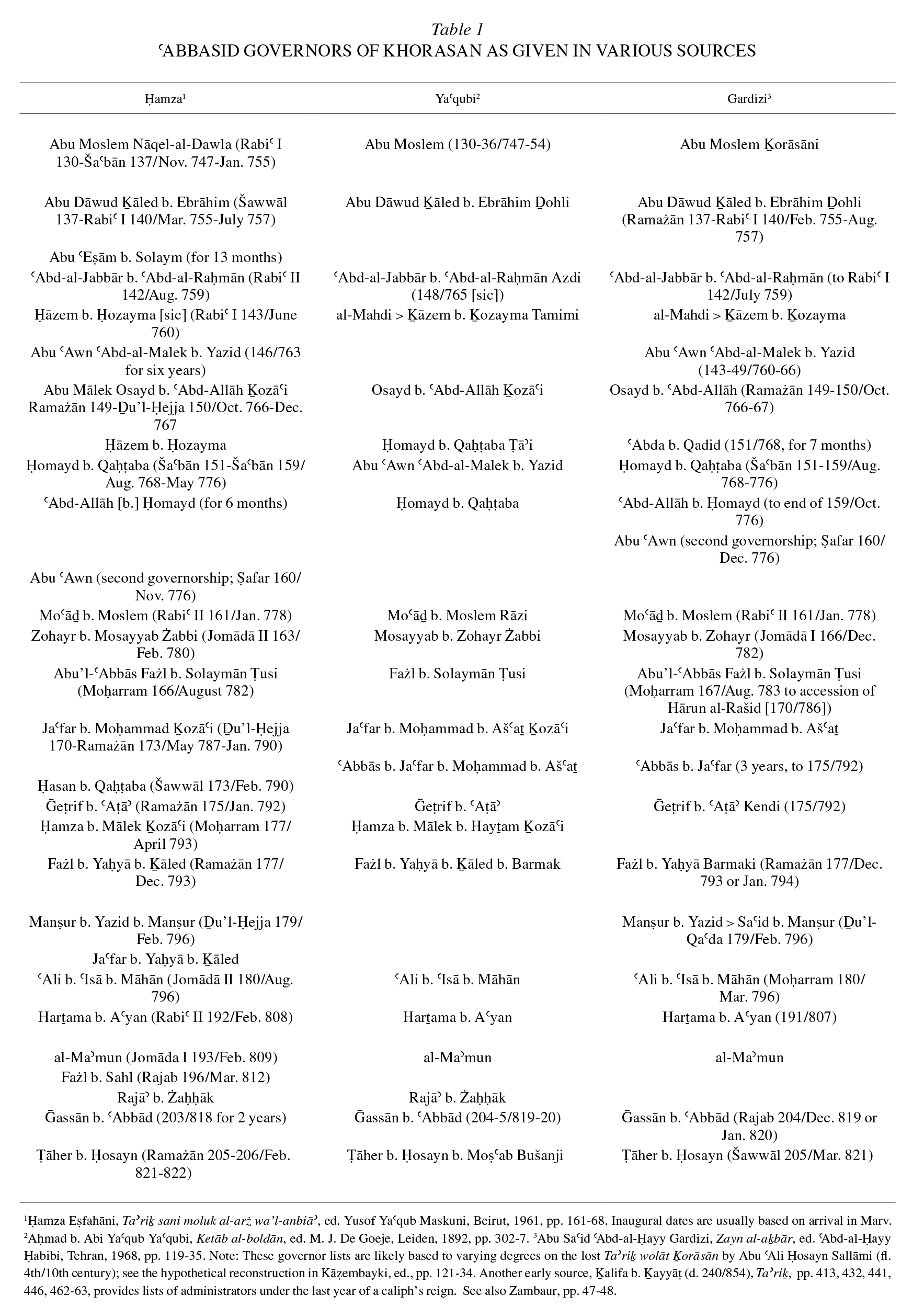
Table 1 ʿABBASID GOVERNORS OF KHORASAN AS GIVEN IN VARIOUS SOURCES
As the rebellion threated the whole of Khorasan, Hārun al-Rašid’s chief of the post (i.e., spy), the eunuch Ḥammawayh, informed him that the movement was not aimed at the ʿAbbasid caliphate but purely at ʿAli b. ʿIsā’s malfeasance with the goal of bringing about his removal from office (Ṭabari, III, p. 718). Al-Rašid then decided to dismiss ʿAli b. ʿIsa and replace him with Harṯama b. Aʿyan; the purported texts of the letters he wrote ordering punishment for ʿAli b. ʿIsa and instructing Harṯama to appease the Khorasanis are preserved in Ṭabari’s history, as are Harṯama’s letters describing his actions and the caliph’s response (III, pp. 716-18, 724-30). Harṯama went to Khorasan under the pretext of helping ʿAli b. ʿIsā fight Rafiʿ; caught by surprise, ʿAli b. ʿIsā was then presented with the caliph’s letter of dismissal, arrested, publicly rebuked, sent to Baghdad to be imprisoned, and his fortune confiscated. Harṯama tried to persuade Rafiʿ’s allies in Sogdia and Ṭoḵarestān to withdraw their support, but without much success, and Rafiʿ himself rejected an offer of pardon (suggesting that the rebellion now involved more than just opposition to ʿAli b. ʿIsā).
Meanwhile, Hārun al-Rašid had set out for Khorasan in 192/808 to deal in person with the multiple problems there, reaching Jorjān in Ṣafar 193/November-December 808 and taking possession of the property confiscated from ʿAli b. ʿIsā. Hārun then moved to Ṭus and sent his son ʿAbd-Allāh al-Maʾmun and a number of army commanders on to Marv. About the same time, Harṯama launched a new military campaign that retook Bukhara; Rafiʿ’s brother, Bašir, was captured there and sent to Hārun in Ṭus; Hārun denied him clemency and had him hacked to pieces (Ṭabari, III, pp. 733-35). Hārun himself died shortly thereafter in a village near Ṭus, where he was buried.
Already in 186/802, Hārun had instituted an administrative reorganization and succession agreement often called the Meccan Protocols (because the relevant documents were posted in the Kaaba). Under its terms, Hārun would be succeeded as caliph by his son Moḥammad al-Amin. Al-Amin’s older half-brother, ʿAbd-Allāh al-Maʾmun (q.v.), would be next in line for the succession and was designated in the meanwhile as the autonomous viceroy over the eastern provinces, from Ray and Hamadan to the further reaches of Khorasan and its dependencies. The agreement was unworkable from the start, and al-Amin and al-Maʾmun, guided by their respective mentors, Fażl b. Rabiʿ and Fażl b. Sahl b. Zādānfarruḵ (q.v.), sought to undo it. It was no doubt to guarantee that al-Maʾmun assumed the position promised him that Fażl b. Sahl arranged for him to accompany Hārun to Ṭus and thence, along with the chief army officers, to Marv. For his part, al-Amin covertly sent instructions for the abnāʾ and Jaziran troops accompanying al-Maʾmun to fight Rafiʿ b. Layṯ to return to Baghdad if Hārun died, and most of them complied. He also returned ʿAli b. ʿIsā b. Māhān to office, made changes to the succession agreement in favor of his son Musā, demanded territorial and financial concessions, and finally, in 195/810, abrogated and burned the texts of the Meccan Protocols and demanded al-Maʾmun return to Baghdad. ʿAli b. ʿIsā was again appointed governor of Khorasan and set out with an army to dislodge al-Maʾmun by force.
The young al-Maʾmun felt threatened on all sides (Ṭabari, III, p. 815), but he was in a stronger position in Khorasan than it might appear: Hārun al-Rašid, on his deathbed, had summoned the wojuh of Khorasan and the army to pledge allegiance to al-Maʾmun and they readily agreed, calling him “our nephew and the [descendant] of the Prophet’s uncle” (Azdi, p. 318). Indeed, al-Maʾmun had personal connections to the province. Fażl b. Sahl reminded al-Maʾmun that he was “among [his] maternal uncles” (Ṭabari, III, p. 773)—apparent confirmation of the report that al-Maʾmun’s mother Marājel was the daughter of Ostāḏsis (see Madelung, 2002), as well as Gardizi’s identification (p. 133) of Ḡāleb b. Ostāḏsis, one of his officers, as his maternal uncle. Beyond that, al-Maʾmun followed policies designed to appeal to religious scholars as well as Shiʿite groups (calling himself Imam, dispensing justice, praising the Sunnah), Arab tribal leaders, “military commanders, kings, and descendants of kings” (Ṭabari, III, p. 774). There is no doubt that many of the Khorasani magnates, such as Ḥosayn b. Moṣʿab of Bušanj, who had been abused and threatened by ʿAli b. ʿIsā and forced to take refuge in Mecca with Hārun al-Rašid, regarded al-Maʾmun as one of their own and supported him wholeheartedly, especially after the jarring insult of ʿAli b. ʿIsā’s return to power. Others were won over by al-Maʾmun’s judicious policies and reduction of taxes. Apparently among them was Rafiʿ b. Layṯ, who heard reports about al-Maʾmun’s good behavior and accepted an amnesty arranged by Harṯama and Asad b. Sāmānḵodā (q.v.) (Ṭabari, III, p. 777; Naršaḵi, pp. 104-5, tr. p. 76). On the advice of his vizier Fażl b. Sahl, al-Maʾmun was also able to stabilize and pacify the frontier districts of Central Asia (Beckwith, pp. 158-59). Al-Maʾmun also had the advantage of being able to block the roads from Iraq to Khorasan while maintaining a network of informants at al-Amin’s court, among them the son of ʿIsā b. Musā.
As ʿAli b. Isā advanced toward Ray, al-Maʾmun sent a relatively small force led by Ṭāher b. Ḥosayn to oppose him. Ṭāher was the son of Ḥosayn b. Moṣʿab and was no doubt eager to fight ʿAli b. ʿIsā, as were other Khorasani notables with scores to settle, such as ʿAli b. Hešām b. Farr-Ḵosrow, son of another of ʿAli b ʿIsā’s victims. Beyond that, Ṭāher’s forces were made up of what appears to have been a personal retinue of Turks, Khwarazmians, and Bukharans he had probably recruited during the campaigns against Rafiʿ b. Layṯ. The crucial battle took place outside Ray in 195/811. ʿAli b. ʿIsā, who had seriously underestimated Ṭāher’s resolve, was defeated and killed. The announcement of the victory, along with ʿAli’s head, was sent to Khorasan, where the news was met with relief and jubilation, and al-Maʾmun was hailed as caliph (Ṭabari, III, p. 825). This marked the beginning of a fierce civil war leading to the siege of Baghdad and the death of Moḥammad al-Amin, while attempting to surrender to Harṯama, at the hands of Ṭāher’s troops in Moḥarram 198/September 813.
Al-Maʾmun remained at Marv, now effectively the capital of the ʿAbbasid caliphate, until 202/818. Fażl b. Sahl was given authority over the east, with the title of Ḏu’l-Reʾāsatayn (holder of the dual offices of military and administrative command). Fażl reversed policy for the frontier principalities, conducting campaigns against the Kābol-šāh, who surrendered and became a Muslim (the tribute he sent is described in Azraqi, pp. 225-26); Otrārbanda, ruler of Fārāb; the Ḵarloḵ Turks; and the Tibetans (Beckwith, p. 160). However, Fażl’s achievements were overshadowed by developments in Baghdad and the west, where Fażl’s far less competent brother Ḥasan faced increasing difficulties, including an ostensibly pro-ʿAlid revolt led by the renegade Abu’l-Sarāyā on behalf of Moḥammad b. Ebrāhim, known as Ebn Ṭabāṭabā (see Kennedy, pp. 207-11). Despite these problems, Ḥasan b. Sahl kept Ṭāher b. Ḥosayn isolated and marginalized by sending him off to fight rebels in Syria, but Harṯama b. Aʿyan slipped back to Marv in Ḏu’l-Qaʿda 200/June 816 to warn al-Maʾmun of the problems brewing in Iraq and to persuade him to return to Baghdad. Fażl b. Sahl was able to convince al-Maʾmun that Harṯama was stirring up discord for his own purposes; Harṯama was then imprisoned and murdered in jail (Ṭabari, III, pp. 996-98; Yaʿqubi, Taʾriḵ, II, p. 546).
The resurgence of the ʿAlids must have factored into one of the most controversial policies initiated by al-Maʾmun in Khorasan: the designation in 201/817 of ʿAli b. Musā al-Kāẓem as his successor, reaching back into the early ideology of the daʿwa to give him the title of al-Reżā (see Tor, 2001; Madelung, 1981; Buyukkara). The architect of this policy was assumed, perhaps unjustly, to be Fażl b. Sahl, who, along with his brother Ḥasan, was hated in Iraq as much as ʿAli b. ʿIsā had been in Khorasan. The news of this change led senior members of the ʿAbbasid family to proclaim Ebrāhim, son of al-Mahdi, as a counter-caliph in Baghdad. Fażl continued to keep al-Maʾmun in the dark about affairs in Iraq, but ʿAli al-Reżā managed to alert him to the seriousness of the situation (Ṭabari, III, p. 1025). In 202/817-18, al-Maʿmun decided to take matters into his own hands and travel back to Baghdad. At Saraḵs in Šaʿbān 202/February 818, Fażl b. Sahl was attacked and killed by some of al-Maʾmun’s followers; al-Maʾmun had them executed and their heads sent to Ḥasan b. Sahl, presumably as a preemptive measure to avoid alarming him. Then, ca. Ṣafar 203/September 818, while al-Maʾmun was visiting the grave of his father, Hārun al-Rašid, near Ṭus, ʿAli al-Reżā died unexpectedly and was buried next to Hārun, with al-Maʾmun himself presiding over the service (Ṭabari, III, 1030; Yaʿqubi, Taʾriḵ, II, pp. 550-51). Once again, the caliph’s involvement and objectives are a matter of dispute, but al-Reżā’s death was certainly used to try to pave the way for the caliph’s return to Baghdad. Al-Maʾmun finally reached the city in Ṣafar 204/August 819, where he was received by the ʿAbbasid family, army officers, and Ṭāher b. Ḥosayn.
According to Yaʿqubi (Taʾriḵ, II, p. 550), al-Maʾmun had left the administration of Khorasan in the hands of Rajāʾ b. Abi’l-Żaḥḥāk, a relative of Ḥasan b. Sahl, who proved to be a weak administrator. He was then replaced by Ḡassān b. ʿAbbād, a paternal cousin of Fażl b. Sahl (Ṭabari, III, p. 1043). Yaʿqubi praises his competence and says he won over the local princes (Taʾriḵ, II, p. 550); other sources suggest Ḡassān was not particularly effective either (Ṭabari, III, p. 1042-43), but this may have been part of an effort to discredit him. Ṭāher b. Ḥosayn, who had become extremely powerful and influential in Iraq, had designs on the office, and Aḥmad b. Abi Ḵāled, now al-Maʾmun’s chief advisor, recommended Ṭāher be sent to Khorasan to prevent a possible Turkish rebellion. The appointment of Ṭāher in 205/821 would usher in a significant new chapter of Khorasani history.
Bibliography
- Moḥammad b. ʿObayd-Allāh Abu’l-Maʿāli, Bayān al-adyān, ed. ʿAbbās Eqbāl, Tehran, 1933.
- Aḥmad Kāteb, Tāriḵ-e jadid-e Yazd, Yazd, 1939. A
- ḵbār al-dawla al- ʿabbāsiya wa fihi aḵbār al- ʿAbbas wa waladihi, ed. ʿAbd-al-ʿAziz Duri and ʿAbd-al-Jabbār Moṭṭalebi, Beirut, 1971.
- Abu Zakariyā Yazid b. Moḥammad Azdi, Taʾriḵ al-Mawṣel, ed. ʿAli Ḥabiba, Cairo, 1967.
- Abu Walid Moḥammad b. ʿAbd-Allāh Azraqi, Aḵbār Makka, ed. Rošdi Malḥas, Mecca, 1965.
- Moḥammad Mofid Mostawfi Bafqi, Jāmeʿ-e mofidi, ed. Iraj Afšār, Tehran, 1964.
- ʿAbd-al-Qāher b. Ṭāher Baḡdādi, al-Farq bayna’l-feraq, ed. M. ʿAbd-al-Ḥamid, Cairo, 1964, part tr. A. S. Halkin, as Moslem Schisms and Sects, Tel Aviv, 1935.
- Aḥmad b. Yaḥyā Balāḏori, Ansāb al-ašrāf II, ed. Wilferd Madelung, Berlin and Beirut, 2003.
- Idem, Ansāb al-ašrāf III: al- ʿAbbās b. ʿAbd -al-Moṭṭaleb wa waladoh, ed. ʿAbd-al-ʿAziz Duri, Beirut, 1978.
- Abu ʿAli Moḥammad Balʿami, Tāriḵ-nāma-ye Ṭabari gardānida-ye mansub ba Balʿami, ed. Moḥammad Rowšan, 3 vols., Tehran, 1987.
- Abu’l-Fażl Moḥammad Bayhaqi, Tāriḵ-e Bayhaqi, ed. ʿAli-Akbar Fayyāż, Mashhad, 1971; tr. C. Edmund Bosworth with full revision by Mohsen Ashtiany, as The History of Beyhaqi: The History of Sultan Masʿud of Ghazna, 1030-1041, 3 vols., Boston, 2011.
- Abu’l-Rayḥān Moḥammad Biruni, al-Āṯār al-bāqiya ʿan al-qorun al-ḵāliya, ed. E. Sachau, Leipzig, 1878, tr. E. Sachau, as The Chronology of Ancient Nations, London, 1879.
- Abu Ḥanifa Dinavari, al-Aḵbār al-ṭewāl, ed. A. ʿĀmer, Cairo, 1960.
- Abu ʿOmar Aḥmad Ebn ʿAbd Rabbeh, Ketāb al-ʿeqd al-farid, ed. Aḥmad Amin et al., 7 vols., Cairo, 1940-53.
- ʿEzz-al-Din Ebn al-Aṯir, Ketāb al-kāmel fi’l-taʾriḵ, ed. C. J. Tornberg, 13 vols., Beirut, 1965.
- Abu’l-Faraj Moḥammad Ebn al-Nadim, Ketāb al-Fehrest, ed. Reżā Tajaddod, Tehran, 1971, tr. Bayard Dodge, as The Fihrist, 2 vols., New York, 1970.
- Abu Saʿid ʿAbd-al-Ḥayy Gardizi, Zayn al-aḵbār, ed. ʿAbd-al-Ḥayy Ḥabibi, Tehran, 1968.
- Abu ʿAbd-Allāh Ḥākem Nišāburi, Tāriḵ-e Nišābur, tr. Moḥammad b. Ḥosayn Nišāburi, ed. Moḥammad-Reżā Šafiʿi-Kadkani, Tehran, 1996.
- Ḥamza Eṣfahāni, Taʾriḵ sani moluk al-arż wa’l-anbiāʾ, ed. Yusof Yaʿqub Maskuni, Beirut, 1961.
- Ḥodud al- ʿālam men al-mašreq ela’l-maḡreb, ed. Manučehr Sotuda, Tehran, 1962; tr. with commentary Vladimir Minorsky, as Hudūd al-ʿĀlam : The Regions of the World, London, 1970.
- Abū ʿAbd-Allāh Moḥammad Jahšīārī, Ketāb al-wozarāʾ wa’l-kottāb, Cairo, 1938.
- Majd-al-Din Ḵᵛāfi, Rawżat al-ḵold, ed. M. Farruḵ, Tehran, 1967.
- Moṭahhar b. Ṭāher Maqdesi, Ketāb al-badʾ wa’l-taʾriḵ, ed. and tr. M. Cl. Huart, as Le livre de la création et de l’histoire, 6 vols., Paris, 1899-1919.
- Abu’l-Ḥasan ʿAli Masʿudi, Moruj al-ḏahab wa maʿāden al-jawhar, ed. and tr. Charles Barbier de Meynard and Abel Pavet de Courteille, as Les prairies d’or, 9 vols., Paris, 1861-1917.
- Abu ʿAbd-Allāh Moḥammad b. Aḥmad Moqaddasi, Aḥsan al-taqāsim fi maʿrefat al-aqālim, ed. M. J. de Goeje, Leiden, 1877.
- Abu Bakr Moḥammad Naršaḵi, Tāriḵ-e Boḵārā, tr. Abu Naṣr Aḥmad Qobāvi, ed. Moḥammad-Taqi Modarres Rażawi, Tehran, 1972; tr. R. N. Frye, as The History of Bukhara, Cambridge, Mass. 1954.
- Neẓām-al-Molk, Siāsat-nāma, ed. H. Darke, 2nd ed., Tehran, 1985.
- Moḥammad b. ʿAbd-al-Karim Šahrastāni, Ketāb al- melal wa’l-neḥal, 3 vols., Cairo, 1968.
- Abu Manṣur ʿAbd-al-Malek Ṯaʿālebi, Laṭāʾef al-maʿāref, ed. Ebrāhim Ebyāri and Ḥasan Kāmel Ṣayrafi, Cairo, 1960; tr. C. E. Bosworth, as The Book of Curious and Entertaining Information, Edinburgh, 1968.
- Idem, Yatimat al-dahr fi maḥāsen ahl al- ʿaṣr, ed. M. M. ʿAbd-al-Ḥamid, 4 vols., Cairo, 1956-58.
- Moḥammad b. Jarir Ṭabari, Taʾriḵ al-rosol wa’l-moluk, ed. M. J. De Goeje et al., 3 vols. in 15, repr. Leiden, 1964; tr. by various scholars as The History of al-Ṭabari, 40 vols., Albany, N.Y., 1985-2007.
- Tāriḵ-e alfi, MS British Library, London, Add. 16681.
- Taʾriḵ al-ḵolafāʾ, facs. ed. P. A. Gryaznevich, as Istoriya khalifov anonimnogo avtora XI veka, Moscow, 1967.
- Tāriḵ-e Sistān, ed. Moḥammad-Taqi Malek-al-Šoʿarāʾ Bahār, Tehran, 1935; tr. Milton Gold, as The Tārikh-e Sistān, Rome, 1976.
- Theophanes the Confessor, Chronographia I, ed. Johannes Classen, Bonn, 1839, part. tr. Harry Turtledove, as The Chronicle of Theophanes, Philadelphia, 1982.
- Aḥmad b. Abi Yaʿqub Yaʿqubi, Ketāb al-boldān, ed. M. J. De Goeje, Leiden, 1892; tr. Gaston Wiet, as Les pays, Cairo, 1937.
- Idem, Taʾriḵ al-Yaʿqubi, ed. M. Th. Houtsma, as Historiae, 2 vols., Leiden, 1883.
- Ẓahir-al-Din ʿAli Bayhaqi (Ebn Fondoq), Tāriḵ-e Bayhaq, ed. Aḥmad Bahmanyār, Tehran, 1938.
- Studies.
- Saleh Said Agha, “A Viewpoint of the Murjiʾa in the Umayyad Period: Evolution through Application,” Journal of Islamic Studies, 1997, pp. 1-42.
- Idem, “The Arab Population in Ḫurāsān during the Umayyad Period: Some Demographic Computations,” Arabica 46, 1999, pp. 211-229.
- Idem, “Abu Muslim’s Conquest of Khurāsān: Preliminaries and Strategy in a Confusing Passage of the Akhbār al-dawla al- ʿ Abbāsiyya,” JAOS 120, 2000, pp. 333-47.
- Idem, “Did Qaḥṭabah b. Shabib al-Ṭāʾī Hail from Kūfah?,” Studia Islamica 92, 2001, pp. 187-93.
- Idem, The Revolution which Toppled the Umayyads: Neither Arab nor ʿAbbāsid, Leiden, 2003.
- Fukuzo Amabe, The Emergence of the ʿAbbāsid Autocracy: The ʿAbbāsid Army, Khurāsān and Adharbayjān, Kyoto, 1995.
- Sean W. Antony, “Chiliastic Ideology and Nativist Rebellion in the Early ʿAbbāsid Period: Sunbādh and Jāmāsp-Nāmah,” JAOS 132, 2012, pp. 641-55.
- V. Vladimirovich Barthold, Turkestan Down to the Mongol Invasion, London, 1968.
- Christopher I. Beckwith, The Tibetan Empire in Central Asia, Princeton, 1987.
- Clifford Edmund Bosworth, Sīstān under the Arabs: From the Islamic Conquest to the Rise of the Ṣaffārids (30-250/651-864), Rome, 1968.
- Idem, “The Ṭāhirids and Arabic Culture,” Journal of Semitic Studies 14, 1969, pp. 45-79.
- Idem, “The Ṭāhirids and Ṣaffārids,” in Richard N. Frye, ed., The Cambridge History of Iran IV: From the Arab Invasion to the Saljuqs, Cambridge, 1975, pp. 90-135.
- Richard W. Bulliet, The Patricians of Nishapur: A Study in Medieval Islamic Social History, Cambridge, Mass., 1972.
- Idem, Conversion to Islam in the Medieval Period: An Essay in Quantitative History, Cambridge, Mass. 1979.
- M. Ali Buyukkara, “Al-Maʾmūn’s Choice of ʿAli al-Riḍā as His Heir,” Islamic Studies 41, 2002, pp. 445-46.
- Patricia Crone, Slaves on Horses: The Evolution of the Islamic Polity, Cambridge, 1980.
- Idem, “On the Meaning of the ʿAbbāsid Call to al-Riḍā,” in C. E. Bosworth et al., eds., The Islamic World: Essays in Honor of Bernard Lewis, Princeton, 1989, pp. 95-111.
- Idem, “Were the Qays and Yemen of the Umayyad Period Political Parties?,” Der Islam 71, 1994, pp. 1-57.
- Idem, “The ʿAbbāsid Abnāʾ and Sasanid Cavalrymen,” JRAS 8, 1998, pp. 1-19.
- Idem, “The Significance of Wooden Weapons in al-Mukhtār’s Revolt and the ʿAbbāsid Revolution,” in I. R. Netton, ed., Studies in Honour of Clifford Edmund Bosworth I, Leiden, 2000, pp. 174-85.
- Idem, “Abū Tammām on the Mubayyiḍa,” in Omar Ali-de-Unzaga, ed., Fortresses of the Intellect: Ismaili and other Islamic Studies in Honour of Farhad Daftary, London, 2011, pp. 167-88.
- Idem, The Nativist Prophets of Early Islamic Iran: Rural Revolt and Local Zoroastrianism, Cambridge, 2012.
- Patricia Crone and M. Jafari Jazi, “The Muqannaʿ Narrative in the Tārikhnāma,” BSOAS 73, 2010, pp. 157-77, 381-413.
- Farhad Daftary, The Ismāʿīlīs: Their History and Doctrines, Cambridge, 1990.
- Elton L. Daniel, The Political and Social History of Khurasan under ʿAbbasid Rule 747-820, Minneapolis and Chicago, 1979.
- Idem, “The Anonymous ‘History of the ʿAbbasid Family’ and Its Place in Islamic Historiography,” IJMES 14, 1982, pp. 419-34.
- Idem, “The ‘Ahl-al-Taqādum’ and the Problem of the Constituency of the ʿAbbasid Revolution in the Merv Oasis,” Journal of Islamic Studies 7, 1996, pp. 150-79.
- Idem, “Arabs, Persians, and the Advent of the ʿAbbasids Reconsidered,” JAOS 117, 1997, pp. 54-48.
- Daniel C. Dennett, Conversion and the Poll Tax in Early Islam, Cambridge, Mass., 1950.
- D. Dunlop, “A New Source of Information on the Battle of Talas or Atlakh,” Ural-Altaische Jahrbücher 36, 1964, pp. 326-30.
- Amikam Elad, “Aspects of the Transition from the Umayyad to the ʿAbbasid Caliphate,” Jerusalem Studies in Arabic and Islam 19, 1995, pp. 89-132.
- Idem, “The Ethnic Composition of the ʿAbbāsid Revolution: A Reevaluation of some Recent Research,” Jerusalem Studies in Arabic and Islam 24, 2000, pp. 246-326.
- Richard N. Frye, “The Role of Abū Muslim in the ʿAbbāsid Revolt,” Muslim World 37, 1947, pp. 28-38.
- Idem, “Development of Persian Literature under the Samanids and Qarakhanids,” in Yádnáme-ye Jan Rypka: Collection of Articles on Persian and Tajik Literature, Prague, 1967, pp. 69-73.
- Idem, “The Sāmānids,” in idem, ed., The Cambridge History of Iran IV: From the Arab Invasion to the Saljuqs, Cambridge, 1975, pp. 136-61.
- H. A. R. Gibb, The Arab Conquests in Central Asia, London, 1923.
- Rhuvon Guest, “A Coin of Abū Muslim,” JRAS 3, 1932, pp. 555-56.
- Robert Haug, The Eastern Frontier: Limits of Empire in Late Antique and Early Medieval Central Asia, London and New York, 2019.
- Minoru Inaba, “Between Zābulistān and Gūzgān: A Study on the Early Islamic History of Afghanistan,” Journal of Inner Asian Art and Archaeology 7, 2016, pp. 209-25.
- Yury Karev, “La politique d’Abū Muslim dans le Māwarāʾannahr: Nouvelles données textuelles et archeeologiques,” Der Islam 79, 2002, pp. 1-46.
- Idem, Samarqand et le Sughd à l’époque ʿabbāsside : Histoire politique et sociale, Paris, 2015.
- Moḥammad ʿAli Kāẓembayki, ed., Aḵbār wolāt Ḵorāsān le’l-Sallāmi, Tehran, 2011 (useful collection of quotations in other works from this lost history of Khorasan).
- Hugh Kennedy, The Early ʿAbbasid Caliphate: A Political History, London, 1981.
- Geoffrey Khan, Arabic Documents from Early Islamic Khurasan, London, 2007a. I
- dem, “Newly Discovered Arabic Documents from Early ʿAbbasid Khurasan,” in Petra Sijpesteijn et. al, eds., From al-Andalus to Khurasan, Leiden, 2007b, pp. 201-15.
- Boris Kochnev, “Les monnaies de Muqannaʿ,” Studia Iranica 30, 2001, pp. 143-50.
- Étienne de la Vaissière, Sogdian Traders: A History, Leiden and Boston, 2005.
- Idem, Samarcande et Samarra: É lites d’Asie centrale dans l’empire abbasside, Paris, 2007.
- Idem, ed., Islamisation de l’Asie Centrale: Processus locaux d’acculturation du VIIe au XIe siècle, Paris, 2008.
- Idem, “The ʿAbbāsid Revolution in Marw: New Data,” Der Islam 95, 2018, pp. 110-46. A. K. S. Lambton, Landlord and Peasant in Persia: A Study of Land Tenure and Land Revenue Administration, London 1953.
- Jacob Lassner, The Shaping of ʿAbbāsid Rule, Princeton, 1980.
- Idem, “Abū Muslim al-Khurāsāni: The Emergence of a Secret Agent from Khurāsān, Irāq, or was it Iṣfahān?,” JAOS 104, 1984, pp. 165-75.
- Idem, “Abū Muslim, Son of Salīṭ: A Skeleton in the ʿAbbasid Closet?,” in Moshe Sharon, ed., Studies in Islamic History and Civilization in Honour of Professor David Ayalon, Jerusalem and Leiden, 1986a, pp. 91-104.
- Idem, Islamic Revolution and Historical Memory: An Inquiry into the Art of ʿAbbāsid Apologetics, New Haven, 1986b.
- Wilferd Madelung, “New Documents Concerning al-Maʾmūn, al-Faḍl b. Sahl and ʿAlī al-Riḍā,” in Wadad al-Qadi, ed., Studia Arabica et Islamica: Festschrift for Iḥsān ʿAbbās, Beirut, 1981, pp. 333-46.
- Idem, “The Early Murjiʾa in Khurāsān and Transoxiana and the Spread of Hanafism,” Der Islam 59, 1982, pp. 32-39.
- Idem, “Was the Caliph al-Maʾmun a Grandson of the Sectarian Leader Ustādhsis?,” in S. Leder et al., eds., Studies in Arabic and Islam, Leuven, 2002, pp. 485-90.
- Josef Marquart/Markwart, Ērānšahr nach der Geographie des Ps. Moses Xorenacʿi, Abhandlungen der Königlichen Gesellschaft der Wissenschaften zu Göttingen, phil.-hist. Kl., N. F. 3/2, 1901.
- Irène Mélikoff, Abū Muslim: Le “Porte-Hache” du Khorassan dans la tradition épique turco-iranienne, Paris, 1962.
- George C. Miles, Numismatic History of Ray, New York, 1938.
- Sabatino Moscati, “La Revolta di ʿAbd al-Ḡabbār contro il califfo al-Manṣūr,” Rendiconti Reale Accademia dei Lincei ser. 8/2, 1947, pp. 613-15. I
- dem, “Studi su Abū Muslim,” Rendiconti Lincei ser. 8/4, 1949-50, pp. 323-35, 474-95, ser. 8/5, 1950-51, pp. 89-105.
- Roy Mottahedeh, “The ʿAbbāsid Caliphate in Iran,” in Richard N. Frye, ed., The Cambridge History of Iran IV: From the Arab Invasion to the Saljuqs, Cambridge, 1975, pp. 57-89.
- Tilman Nagel, Untersuchungen zur Entstehung des ʿAbbasid ischen Kalifates, Bonn, 1972.
- A. C. S. Peacock, “Khurasani Historiography and Identity in the Light of the Fragments of the Akhbār Wulāt Khurāsān and the Tārīkh-i Harāt,” in A. C. S. Peacock and D. G. Tor, eds., Medieval Central Asia and the Persianate World: Iranian Tradition and Islamic Civilisation, London and New York, 2015, pp. 143-60.
- Parvaneh Pourshariati, “Local Histories of Khurāsān and the Pattern of Arab Settlement,” Studia Iranica 27, 1998, pp. 41-82.
- Idem, Decline and Fall of the Sasanian Empire: The Sasanian-Parthian Confederacy and the Arab Conquest of Iran, London and New York, 2008.
- Wadad al-Qadi, “The Earliest ‘Nābita’ and the Paradigmatic ‘Nawābit’,” Studia Islamica 78, 1993, pp. 27-61.
- Gholam Hossein Sadighi, Les mouvements religieux iraniens au IIe et au IIIe siècle de l’hégire, Paris, 1938.
- M. A. Shaban, The ʿAbbā sid Revolution, Cambridge, 1970.
- Idem, “Khurāsān at the Time of the Arab Conquest,” in Clifford Edmund Bosworth, ed., Iran and Islam: In Memory of the Late Vladimir Minorsky, Edinburgh, 1971, pp. 479-90.
- H. Shacklady, “The ʿAbbasid Movement in Khurāsān,” Occasional Papers of the School of ʿAbbasid Studies 1, 1986, pp. 98-112.
- Moshe Sharon, Black Banners from the East: The Establishment of the ʿAbbāsid State, Jerusalem, 1983.
- Idem, Revolt: The Social and Military Aspects of the ʿAbbasid Revolution, Jerusalem, 1990.
- Dominique Sourdel, Le vizirat ʿa bbāside de 749 à 936 (132 à 324 de l’Hégire), 2 vols., Damascus, 1959-60.
- Deborah Gerber Tor, “An Historiographical Re-examination of the Appointment and Death of ʿAlī al-Riḍā,” Der Islam 78, 2001, pp. 103-28.
- Idem, Violent Order: Religious Warfare, Chivalry, and the ʿAyyar Phenomenon in the Medieval Islamic World, Würzburg, 2007.
- Faruq Umar, The ʿAbbāsid Caliphate 132/750-170/786, Baghdad, 1969.
- Julius Wellhausen, Das arabische Reich und sein Sturz, Berlin, 1902; tr. Margaret Graham Weir, as The Arab Kingdom and its Fall, Calcutta, 1927.
- Ḡolām Ḥosayn Yusofi, Abu Moslem: sardār-e Ḵorāsān, Tehran, 1966.
- ʿAbd al-Ḥusayn Zarrīnkūb, “The Arab Conquest of Iran and Its Aftermath,” in Richard N. Frye, ed., The Cambridge History of Iran IV: From the Arab Invasion to the Saljuqs, Cambridge, 1975, pp. 1-56.