
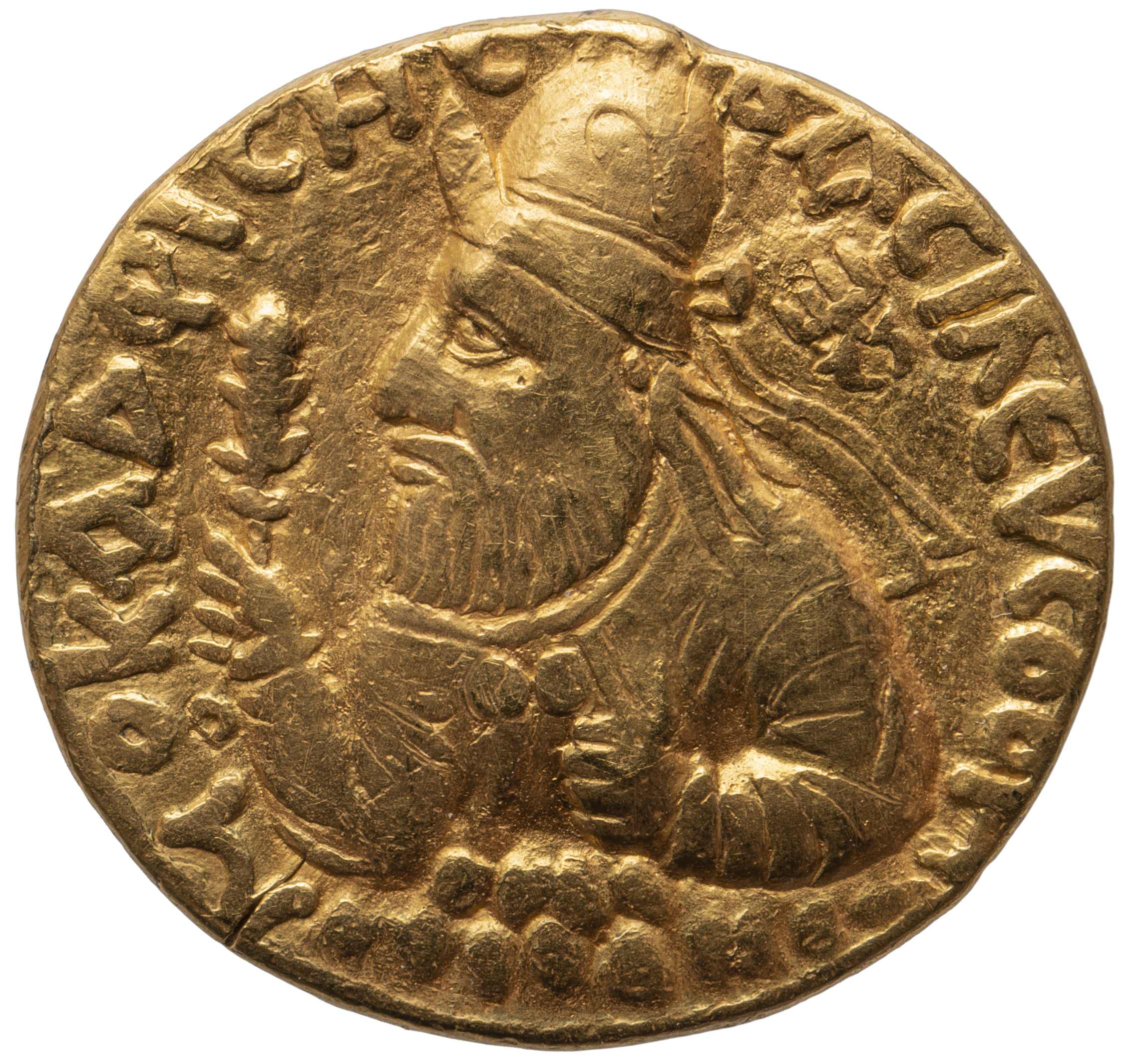



KADPHISES, VIMA, the third king of the Kushan dynasty, reigned during a significant period in the development of Kushan imperial institutions. Our understanding of his reign primarily comes from inscriptions, most notably those of Rabatak and Khalatse, as well as his extensive coinage. These sources are crucial for reconstructing his genealogy, chronology, and political ideology. No contemporary narrative accounts survive, and Chinese historical texts make no explicit mention of him.
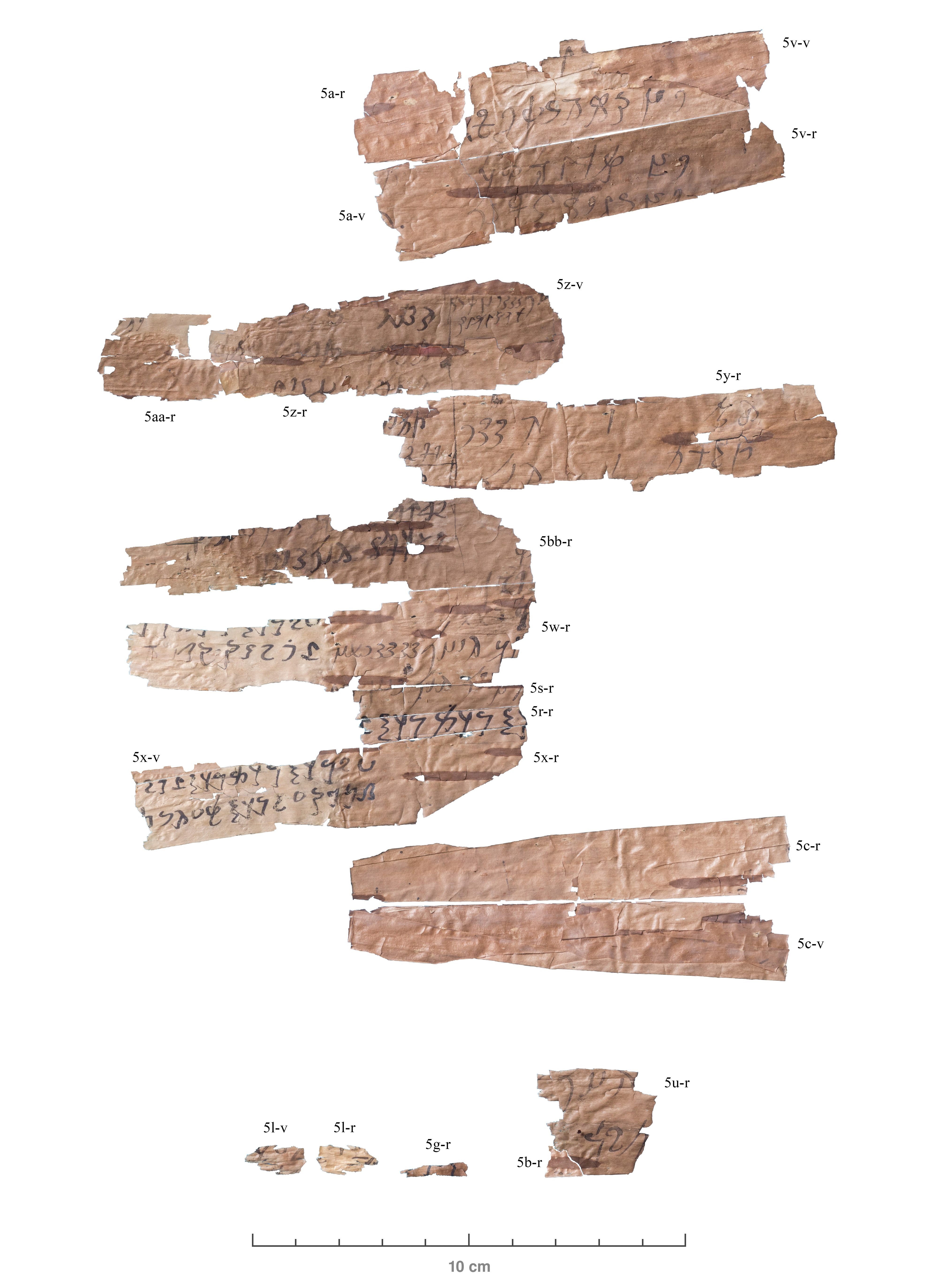
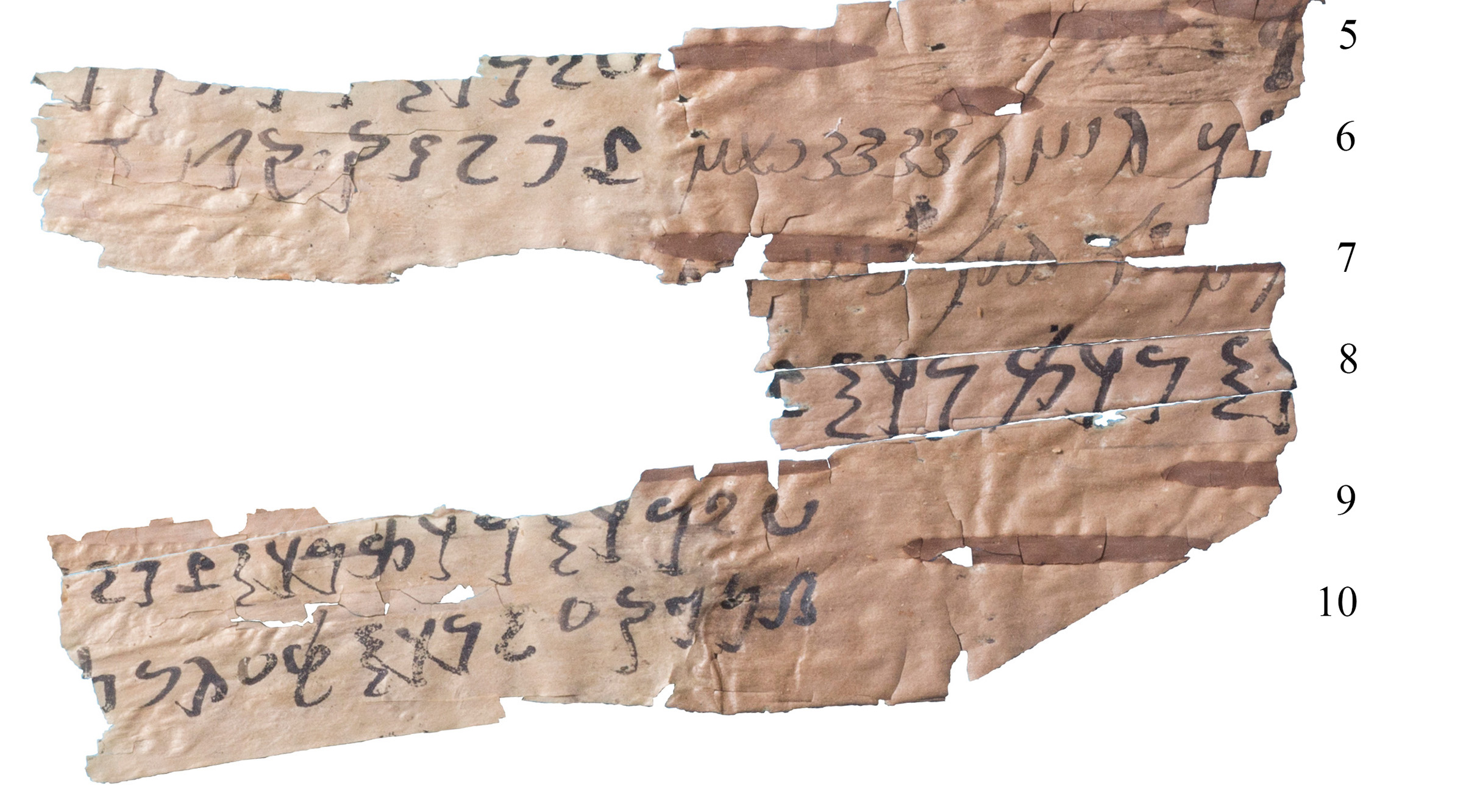
Epigraphic evidence establishes the position of Vima Kadphises within the Kushan dynasty. The Rabatak inscription identifies him as the son of Vima Takto and the father of Kanishka, and it preserves his royal titulature in the Bactrian language as OOHMO KAΔΦIΣHΣO ϷAO (Sims-Williams and Cribb, 1995, 96, 80). A Gandhari/Kharoṣṭhī record from Khalatse also names him as Devaputra Maharaja Uvima Kavthisa and provides a rare fixed chronological reference for his reign, dating to around 112 CE (year 287 of the Yavana era; Konow, 1929, 79–81). More recently, his name has also been identified in Kharoṣṭhī administrative documents written on birchbark (Figure 1.a and Figure 1.b), where his titulature can be reconstructed from multiple references in a list of donations, presenting him as maharajasa rajatirajasa devaranasa svayabalasa maharajasa gremakataphsasa, translating as “of the great king, king of kings, having splendor through the gods, who is his own army, the great king Grema Kataphsa/Katapha” (Allon, 2019, 20). Based on this combined epigraphic evidence, Vima Kadphises’ reign is generally dated to ca. 113–127 CE.
Vima Kadphises inherited a large territory, extending southward from Bactria in the north to Mathura in northern India. His territory expanded to the west and south of present-day Afghanistan, incorporating Herat and Gandhara (Bracey, 2009, 25). His reign bridges the early consolidation of Kushan imperial power and the fully developed empire of Kanishka. While direct evidence of his military or administrative actions remains limited, the scale and wide distribution of his coinage—from Central Asia across the Hindu Kush to Western Punjab and northern India (Jongeward and Cribb, 2015, 55)—suggests effective political control and growing economic integration across these regions.
Vima Kadphises was the first Kushan king to reform the monetary system, introducing gold coinage to Kushan territory. His gold issues were struck in four denominations (Göbl, 1984, 58; Jongeward and Cribb, 2015, 55). In addition to gold, he introduced copper coinage in three denominations, which replaced the silver and debased silver currency that had previously circulated under earlier dynasties (Bracey, 2009, 50). The limited variation in obverse and reverse types, together with the relatively small number of dies, suggests centralized minting practices, possibly limited to a single mint or with separate mints for gold and copper coinage. This evidence also implies a comparatively brief reign (Bracey 2009, 25-74; Jongeward and Cribb, 2015, 53; Cribb and Bracey, 2025, 48). His successors nevertheless maintained and further developed his monetary innovations, while also increasing the role of gold in the imperial economy and long-distance trade.
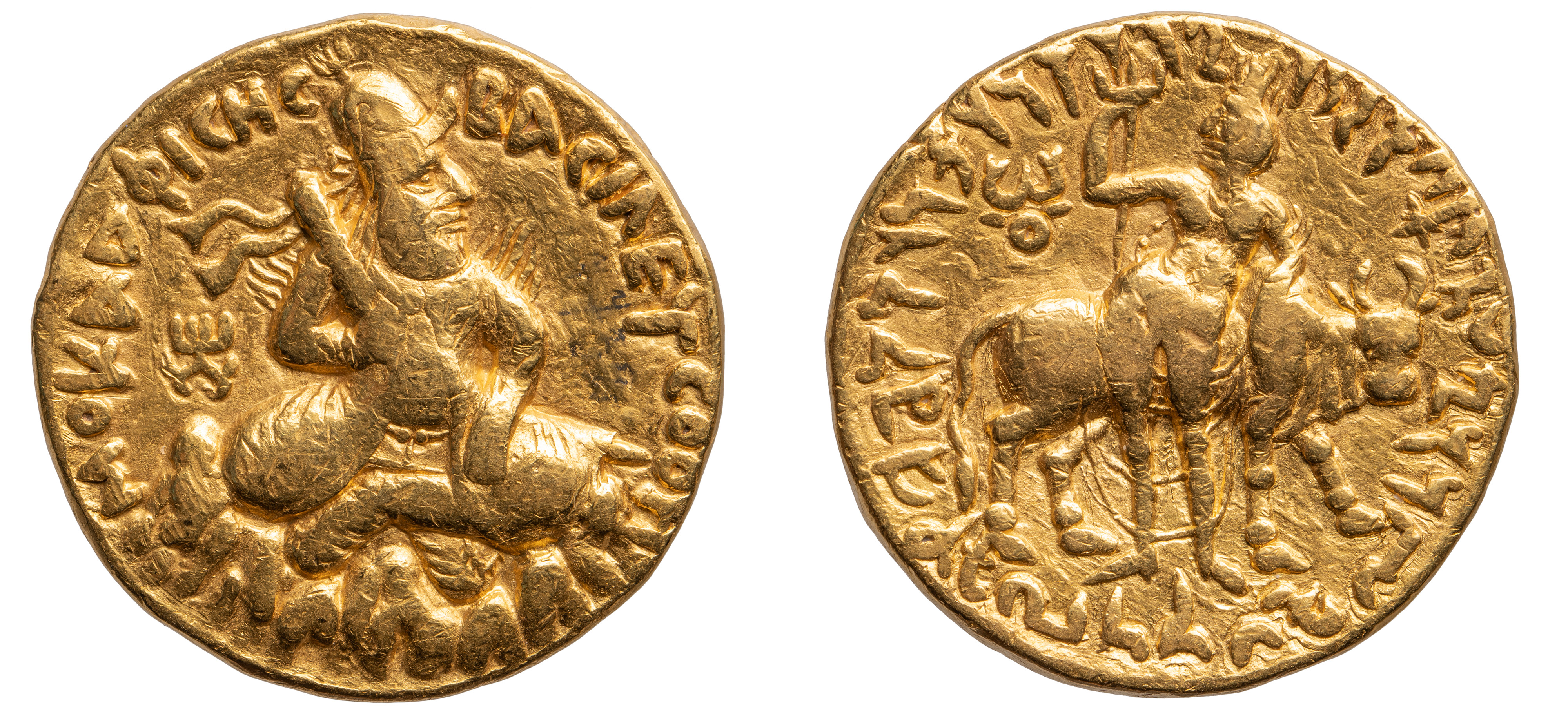
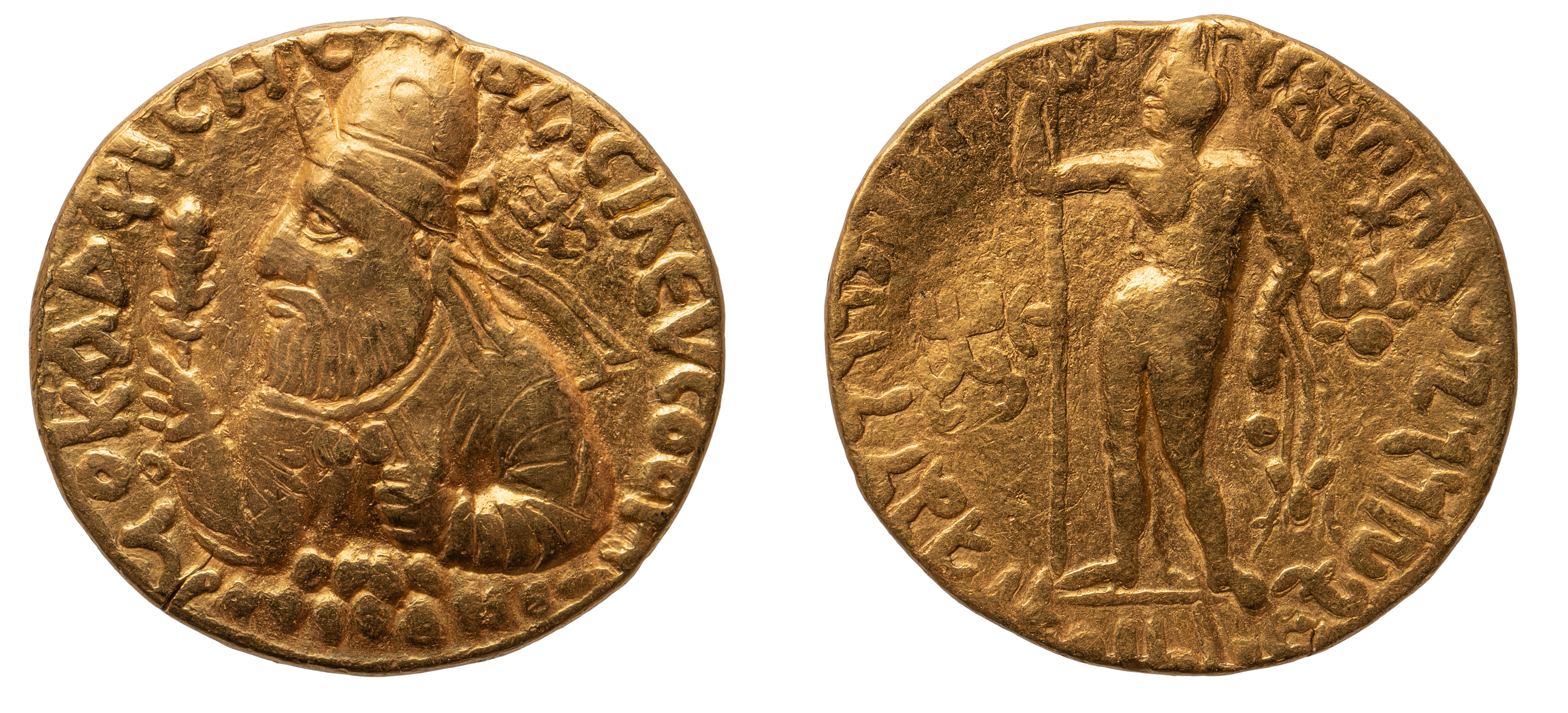
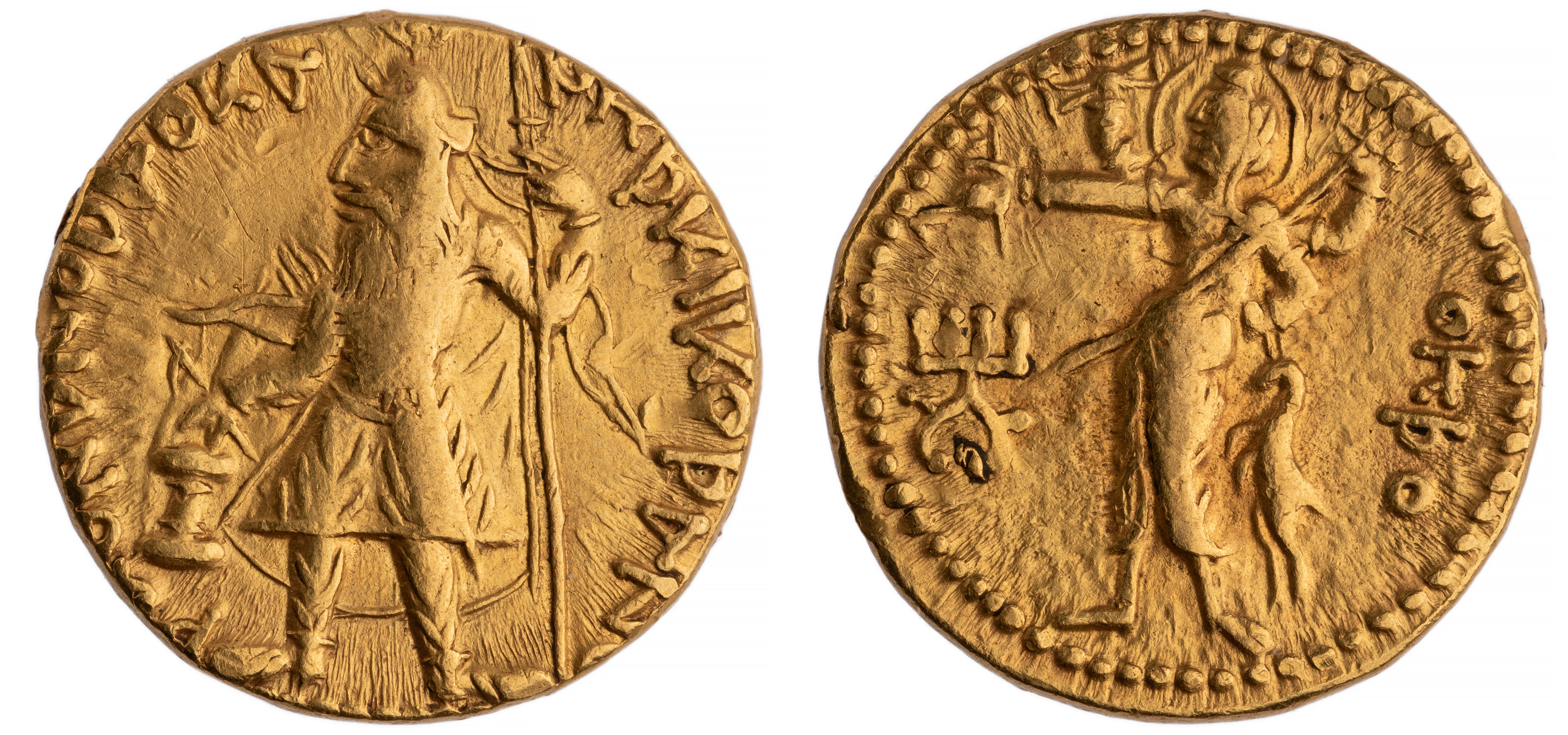
Vima Kadphises’ coinage is equally significant from a visual perspective. The gold issues depict the king on the obverse in various ceremonial poses (for typology see Jongeward and Cribb 2015, 56–60; Cribb and Bracey, 2025, 49–50). Unlike earlier issues, which relied heavily on Hellenistic, Indo-Greek, or Indo-Parthian models, Vima Kadphises’ coins introduce a distinctly Kushan visual pattern in their obverse designs. Rather than adopting earlier portrait conventions, the obverse features the king in either half- or full-length form, emphasizing his presence and authority (Figure 2 and Figure 3).
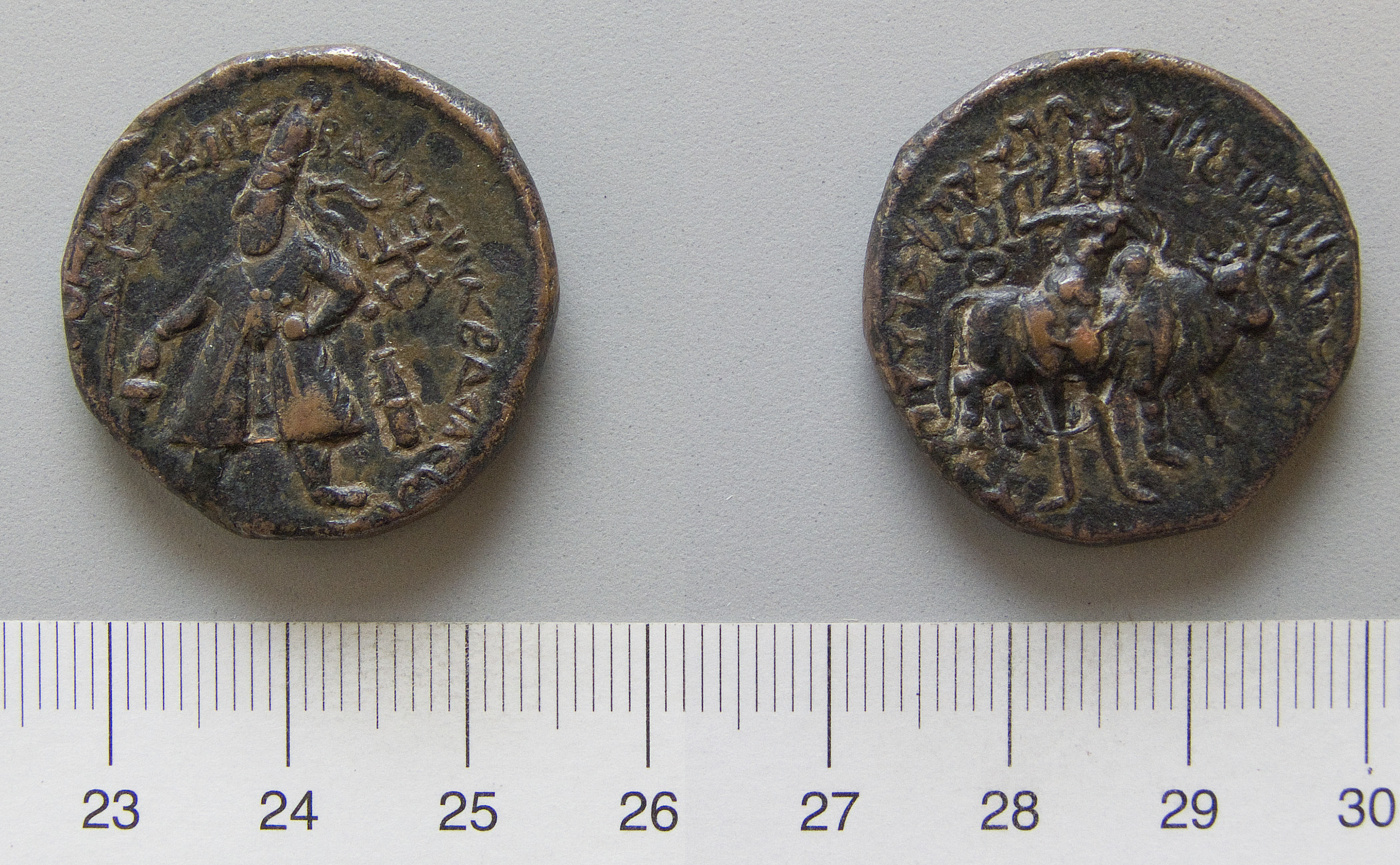
On his copper issues, he is depicted in Central Asian dress—a belted tunic, caftan, and boots—standing frontally with his head turned left, while sacrificing at a fire altar (Figure 4). A trident and club appear in the adjacent fields. The consistent representation of the ruler performing an offering visually connects him to the deity on the reverse, reinforcing the reciprocal relationship between royal authority and divine protection that became standard in later Kushan coinage (Taasob, 2020, 103).
The reverse of both gold and copper coinage is dedicated to god Oēšo (Wēś), who became a principal religious figure on Kushan coins. He is depicted with attributes such as a trident, a bull, a water vessel, an animal skin, an elephant goad, a thunderbolt (as a separate element), and a flaming halo. Oēšo is represented with two or four arms and occasionally with multiple heads. He sometimes appears in composite forms reflecting a syncretic iconography that integrates Iranian, Indian, and Hellenistic elements. Many of these features continued to appear on later Kushan coinage. Oēšo’s appearance across multiple denominations, including didrachms likely used in everyday transactions, indicates that he occupied a central place within early Kushan religious imagery, rather than functioning as a narrowly defined court cult (Taasob 2020, 100–103; for an alternative view, see Jongeward and Cribb 2015, 55).
The identification of Oēšo (Wēś) has long been debated. Many scholars associate the figure with the Indian god Śiva on iconographic grounds, citing attributes that parallel later Śaivite imagery, such as the trident, bull, water vessel, animal skin, nudity, and erect phallus (e.g., Fischer, 1957; Humbach, 1975, 46, Rosenfield, 1967, 93; Göbl, 1983, 257–64; MacDowall, 1987, 184; Lo Muzio, 1995–96; Cribb, 1997, 11–66; Fussman, 1998, 593, n. 55; Grenet, 2015, 207). Further support for this view comes from interpretations of the Kharoṣṭhī legends, specifically the royal epithets sarvaloga’iśvara and mahiśvara, which are understood as Śaivite titles and “worshiper of Śiva” (Bopearachchi 2015, 64; 2008, 44; Humbach 2014). However, others have emphasized alternative translations of the legends and broader linguistic considerations, arguing that such titles express imperial sovereignty rather than religious affiliation (Tanabe, 1991-1992, 65; Tanabe, 1997, 267). They propose a reading of lokaïśvarajasa mahaïśvarasa as “the over-king amongst kings, the great lord (mahā-īśvara), son of the lord of the world” (Falk, 2010, 76, n.36). Based on phonetic similarities between the Bactrian form Oēšo and Iranian Vaiiuš, as well as comparative religious analysis, another interpretation identifies Oēšo with the Iranian wind god VĀYU (Humbach, 1975, 399–408; Boyce, 1993, 37; Tanabe 1997, 267). This attribution is also linked to the rare depiction of lateral heads, which some interpret as alluding to Vayu’s dual nature as both the “good wind” (Väy i veh) and the “bad wind” (Väy i vattar) (Tanabe, 1997, 267). The absence of an explicit divine name in the Kharoṣṭhī legends of Vima Kadphises’ coinage and in the Rabatak inscription precludes a definitive identification of the deity and indicates that the imagery was produced within a flexible religious framework. Therefore, the deity’s attribution depends, in part, on comparison with the coinage of his successors, in which the name OHϷO is explicitly inscribed (Figure 5). Recent scholarship has emphasized that Wēś was an Eastern Iranian god, whose syncretic visual representation incorporated Iranian, Indian, and Hellenistic elements. When depicted alongside the king at a fire altar, Wēś primarily symbolized divine sanction and imperial legitimation (Taasob, 2020, 103).
Vima Kadphises’ monetary reforms, iconographic innovations, expanded royal titulature, and the systematic pairing of ruler and deity on coinage mark a crucial stage in the formation of Kushan imperial ideology. His reign thus represents a bridge between early Kushan dynastic rule and the more elaborate imperial system of the second century CE. Standardized coinage and institutionalized religious imagery—hallmarks of later Kushan rulers—emerged from these developments, shaping both numismatic and religious iconography across northern India and Central Asia.
Bibliography
Allon, Mark. “A Unique Gāndhārī Monastic Ledger Recording Gifts by Vima Kadphises.” Journal of the International Association of Buddhist Studies 42 (2019): 1–46.
Bopearachchi, Osmund. “Les premiers souverains kouchans. Chronologie et iconographie monétaire”. Journal des savants 1 (1). (2008): 3–56.
___. From Bactria to Taprobane. Vol. 1. New Delhi, Manohar: 2015.
Boyce, Mary. “Great Vayu and Greater Varuna.” Bulletin of the Asia Institute 7 (1993): 35–40.
Bracey, Robert. “The coinage of Wima Kadphises.” Gandharan Studies 3 (2009): 25–74.
Cribb, Joe and Robert Bracey. Kushan Coins and History: A Type Catalogue of Kushan, Kushano-Sasanian and Kidarite Hun Coins Based on the Collection of the British Museum. London: British Museum Press: 2025.
Cribb, Joe. “Shiva images on Kushan and Kushano-Sasanian coins.” In Studies in Silk Road Coins and Culture: Papers in honor of Professor Ikuo Hirayama on his 65th Birthday, edited by Joe Cribb and Helen Wang, 11–66. Kamakura: Institute of Silk Road Studies. 1997.
Falk, Harry. “Names and Titles from Kuṣāṇa Times to the Hūṇas – The Indian Material”. In Coins, art and chronology II: The First Millennium C.E. in the Indo-Iranian Borderlands, edited by Michael Alram, Deborah Klimburg-Salter, Minoru Inaba, and Matthias Pfisterer, 73–89. Wien: Österreichische Akademie der Wissenschaften, 2010.
Fischer, Klaus. “Neue Funde und Forschungen zur indischen Kunst in Arachosien, Baktrien und Gandhara.” Archäologischer Anzeiger 72 (1957): 416–436.
Fussman, Gerad. “L’inscription de Rabatak et l’origine de l’ère saka.” Journal Asiatique 286, no. 2 (1998): 571–651.
Göbl, Robert. “Pars pro toto? Zur Frage der notwendigen Bandbreite von Untersuchungen mit numismatischer Basis.” Litterae Numismaticae Vondobonenses 2 (1983a): 257–264.
___. System und Chronologie der Münzprägung des Kušānreiches. Wien: Österreichische Akademie der Wissenschaften: 1984b.
Grenet, Frantz. “Zoroastrianism among the Kushans.” In Kushan Histories: Literary Sources and Selected Papers from a Symposium in Berlin, December 5 to 7, 2013, edited by Harry Falk, 203–239. Bremen: Hempen Verlag, 2015.
Humbach, Helmut. “Vayu, Siva und der Spiritus Vivens in ostiranischen Synkretismus.” Acta Iranica 4 (1975): 397–408.
___. “Wind, an Old Iranian Deity.” Electronic Journal of Vedic Studies 21, no. 2 (2014): 5–7.
Jongeward, David, Joe Cribb, and Peter Donovan. Kushan, Kushano-Sasanian, and Kidarite coins: A catalogue of coins from the American Numismatic Society. New York: The American Numismatic Society: 2015.
Konow, Sten. Corpus Inscriptionum Indicarum. Vol. 2, Kharoshṭhī Inscriptions, Part II. Calcutta: Government of India, Central Publication Branch: 1929.
Lo Muzio, Ciro. “OHÞO: A Sovereign God.” Silk Road Art & Archaeology 4 (1995-96): 160–174.
MacDowall, David. W. “The development of Buddhist symbolism on the coinage of the Northwest.” In Investigating Indian Art: Proceedings of a Symposium on the Development of Early Buddhist and Hindu Iconography Held at the Museum of Indian Art Berlin in May 1986, edited by Marianne Yaldiz and Wibke Lobo, 179–190. Berlin: Museum für Indische Kunst; Staatliche Museen Preussischer Kulturbesitz: 1987.
Rosenfield, John. M. The Dynastic Arts of the Kushans. Berkeley: University of California Press: 1967.
Sims-Williams, Nikolas, and Joe Cribb. “A New Bactrian Inscription of Kanishka the Great.” Silk Road Art and Archaeology 4. (1995-96): 75–142.
Taasob, Razieh. “Representation of Wēś in early Kushan coinage: Royal or local cult?” Afghanistan 3, no. 1 (2020): 83–106.
Tanabe, Katsumi. “OHÞO: Another Kushan wind god.” Silk Road Art and Archaeology 2 (1991/92): 52–71.
___. “‘Shiva’ has ‘Gone with the wind’ — OHÞO: =Vayu restated.” al-Rāfidān 18 (1997): 263–280.