



GEOGRAPHY
iv. CARTOGRAPHY OF PERSIA
The equivalent terms for carte and map in pre-modern Persian and Arabic were ṣūrat (configuration) and occasionally šakl (form), rasm (drawing), or naqš (painting, figure). In contemporary Persian naqša denotes map, while ḵarīṭa in contemporary Arabic and harita in modern Turkish (< Gk xarti) is used (Harvey, 1980, p. 10; idem, 1992, 9. 7; Harley and Woodward, I, p. xvi; Maqbul Ahmad, pp. 1077-78). The current Persian term for cartography is naqša-negārī.
Cartography was usually defined as “the art and science of representing the Earth’s physical features graphically” (Encyclopaedia Britannica II, p. 600; Bagrow, p. 22; Crone, p. xi), but in recent decades a broader outlook has emerged. In 1964, for instance, the British Cartographic Society defined cartography as “the art, science and technology of making maps, together with their study as scientific documents and works of art.” In this context cartography covers all types of maps and globes representing the earth (terrestrial), including religious maps (e.g., qebla), any heavenly body (celestial), and astrological diagrams (Harley and Woodward, p. xv; Wallis, pp. 1-90).
The political boundaries of Persia have been subjected to drastic changes in the course of history. This article deals with the more stable political boundaries of Persia in any historical epoch referred to here.
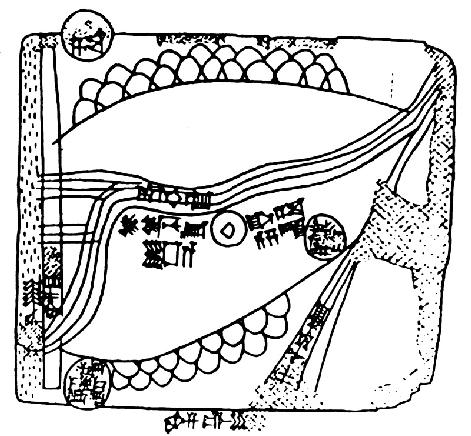
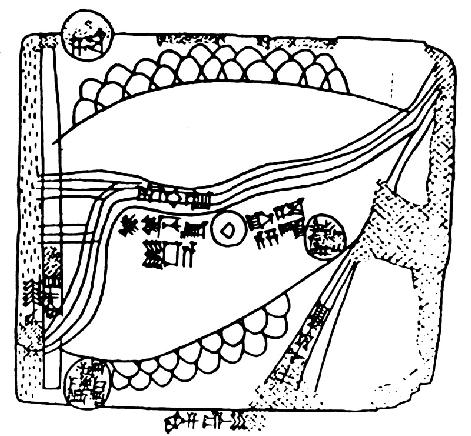
Ancient times. The world’s oldest known topographical map is a Babylonian clay tablet from about 2300 B.C.E. found at Nuzi in northeastern Iraq (Figure 1). It is a relatively advanced picture map, showing two ranges of hills, as seen from the side, and the rivers they flank, by a series of parallel lines. The site covered by this map may have lain between the Zagros mountains and the hills running through Kirkuk (Harvey, pp. 49-50; Harley and Woodward, I, p. 114; Figure 1). The famous Babylonian world map from about 600 B.C.E., preserved in the British Museum, shows a number of cities and places in ancient Persia (Harley and Woodward, I, pp. 111-12).
A systematic study of the skies for calendarial and astrological purposes was begun probably in the earliest period of Babylonian history, some 3,000 years B.C.E. These studies produced star data of amazing quality and accuracy that are still of value to scientists (Brown, pp. 18-21; Harley and Woodward, I, p. 114). Apart from a number of clay tablets that have been found in this region, very little is known about the pre-Islamic cartography in Persia.
Greco-Roman mapping of Persia. The flourishing classical Greco-Roman cartography (6th cent. B.C.E. to 2nd cent. C.E.) may have benefited from the cartographic traditions of ancient Middle East, although it has not yet been possible to tell how far the early Greeks had been aware of, or influenced by, Persian and Babylonian mapping (Harley and Woodward, I, p. 503). Aristagoras (ca. 500 B.C.E.) had a map on which the regions to be crossed on the way from Ionia to Persia were shown. This map was probably originally derived from the map of Anaximander (ca. 611-546 B.C.E.), but it probably also drew on the road measurements compiled by the Persians for their imperial highways (Harley and Woodward, I, p. 193; for the Persian royal roads see Herodotus, II, p. 109).
The original maps of this period have not survived. Judging from the much later reconstructed versions of them, one can determine that many cartographers, like Hecataeus (fl. 500 B.C.E.), a scholar of Miletus (Bunbury, I, map facing p. 148), and Dicaearchus (late 4th cent. B.C.E.), a disciple of Aristotle (Cortesao, I, fig. 16), Eratosthenes (3rd cent. B.C.E.; Smith, world map), Strabo (64 B.C.E. to 21 C.E. or later; Bunbury, II, map facing p. 238; see Figure 2), and many others, depicted the Persian Gulf as a wide bay, or an almost rectangular gulf, and the Caspian Sea as a deeper bay or a nearly round gulf, both lying either on the east side of the map or on the two opposite sides (south and north) and branching out of the encircling ocean. The rivers Tigris, Euphrates, and Indus are always clearly shown, and the Iranian plateau, lying in the center of these world maps, is usually not to scale. Some othe maps, however, such as the world map of Herodotus (Encyclopaedia Britannica II, p. 471), show the Caspian as an inland sea.
Ptolemaic maps of Persia. It is believed that the original maps of Ptolemy have not survived. The oldest Greek codices that reached medieval Europe were from the 12th and 13th centuries with maps reconstructed from the texts, or partly derived from the original maps. The first Latin translation of the Geographia /Cosmographia, directly from Greek, was completed in 1406. Further manuscript copies appeared mainly during the first half of the 15th century (Ptolemy, 1990, intro by L. Pagani). The first printed edition of Geographia with maps appeared in Bologna in 1477, followed by more than fifty editions in Latin and some vernacular European languages, published mainly in Italy and Germany, until 1730 or later, with facsimile copies still being printed (Tooley, pp. 6-7).
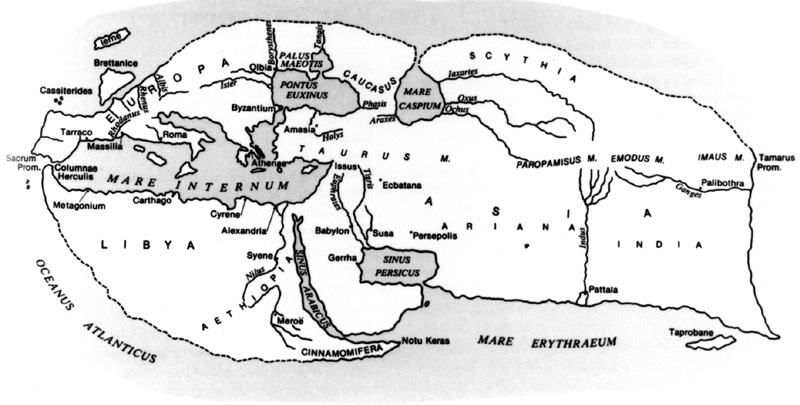
All the world maps of Ptolemy show the Persian Gulf (Sinus Persicus) in a nearly rectangular shape, placed almost on the correct latitude, and the Caspian (Mare Hyrcanum) as an inland sea and in an almost oval shape. Persia itself occupies a central position, similar to that in the earlier Greek maps. The large scale regional fifth map of Asia shows Persia with its mountains, fairly correct, rivers, cities, etc. (PLATE IV), Solṭanīya, Qom, Kāšān, Isfahan, Gomron (Bandar ʿAbbās), etc., based on Adam Olearius.
French maps. Nicholas Sanson (1600-1667) initiated the great school of French cartography which lasted until the late 18th century, shifting the center of map production from the Low Countries to France (Tooley, 1982, p. 40). He included a map of Persia in his atlas Cartes générales de toutes les parties du mund (Paris, 1658). J. B. B. d’Anville (1697-1782) drew an improved map of the Persian Gulf in 1758, using the new British surveys and the information compiled by Kaempfer in 1712 (Lazar, II, p. 594). He also produced a map of the Caspian Sea in 1754 and one of Persia in about 1794. Many other French cartographers also produced new maps of Persia, such as Pierre du Val (1618-83), Nicholas de Fer (1646-1720), Guillaume de L’Isle (1675-1726), George Louis Le Rouge (fl. 1740-80), Gilles Robert de Vaugondy (1723-86), and Rigobert Bonne (1727-95).
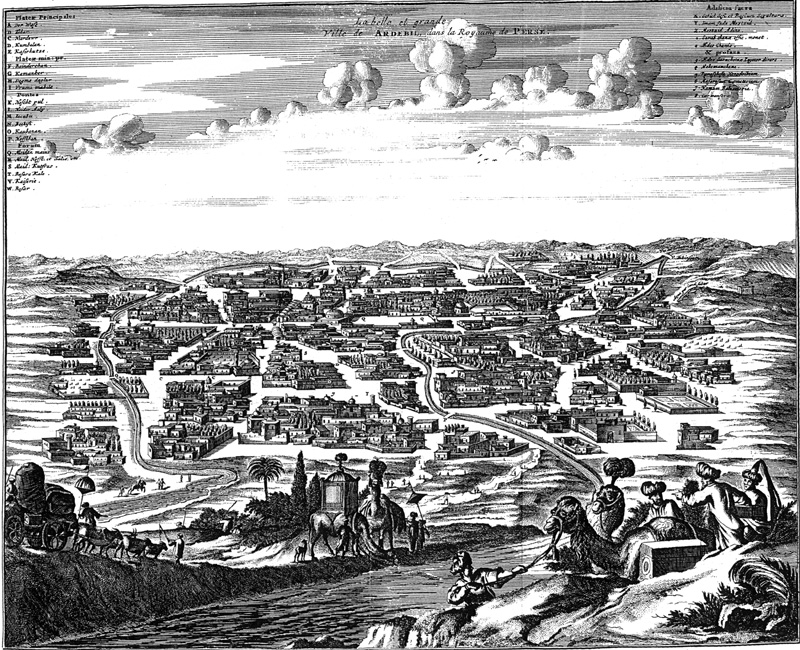
German maps. German cartographers seem to have been the first European mapmakers to recognize the native name of the country, Iran. “Imperium Timuri 1405” is the title of a historical map by an anonymous German mapmaker, printed in 1740. On this map the term “Iran” is exclusively employed as the name of the empire. Some other German cartographers, being aware of the native name of the country, printed both terms “Iran” and “Persia” in their maps. For instance, the map of Carl Christian Franz Redefeld (1788-1874), incorporated in Meyers grosse Hand Atlas (1846), and the map drawn by Hermann Habenicht (1844-1917), included in Stieler’s Hand Atlas (1881), both carry the title Iran … , with the term Persia used on the face of these maps (Alai, 1995, pp. 16-17). Johann Baptist Homann (1663-1724) and his rival Georg Mattäus Seutter (1678-1757) both produced elaborate and decorative maps of Persia (Homann, World Atlas, Nuremberg, 1725; Seutter, Atlas novus, Augsburg, 1730), showing the provinces of the country and the Caspian Sea close to its real shape, based on the new surveys of 1720. Adam Olearius travelled in Persia in the years 1635-39, leading a trade mission from his country, Schleswig-Holstein. He learned Persian and translated Saʿdī’s Golestān into German. He also produced a rather detailed “New Map of Persia” and the neighboring regions in 1646, using a copper plate 52 x 38.5 cm. On this map, mountains and rivers are depicted more accurately and the oval shape of the Caspian Sea changed to rectangular, much closer to its real shape. Many new names of Persian cities (e.g., Tabrīz, Ardabīl, Qazvīn, and Hamadān) appeared on this map.
English maps. English mapmakers hardly matched their counterparts in Europe until the end of the 18th century, when England became the premier maritime and commercial power and made great contributions to cartography. This success was supported by scientific advancements made by the Trigonometrical (later Ordinance) and Admiralty Hydrographic Office surveys (Tooley, 1982, p. 47). Thus, the English mapping of Persia was rather limited until the late 18th century.
John Speed (1552-1629) incorporated in 1627 a decorative map of Persia in the first English world atlas, The Prospect of the Most Famous Parts of the World. This map, entitled “The Kingdom of Persia,” showed on its bordering panels panoramic views of four Persian cities and illustrations of eight national characters in local costume (PLATE VI). Other maps worth mentioning are: a map of Tabrīz and neighborhood drawn by Moḥammad-Reżā Mohandes and Colonel Qarājadāḡī in 1297/1880 (1:8,300; 100 x 97 cm), a new map of the expanded Tehran (some 21 km city wall with 12 gates) made by ʿAbd-al-Ḡaffār Najm-al-Molk in 1309/1891 (1:4,000, 132 x 97 cm), a map of Tehran county by made by ʿAbd-al-Razzāq Baḡāyerī in 1328/1910 (1:200,000, 118 x 74 cm), and a map of Isfahan drawn by Captain Sayyed Reżā Khan in 1302 Š./1923 (1:3,200, 135 x 129 cm).
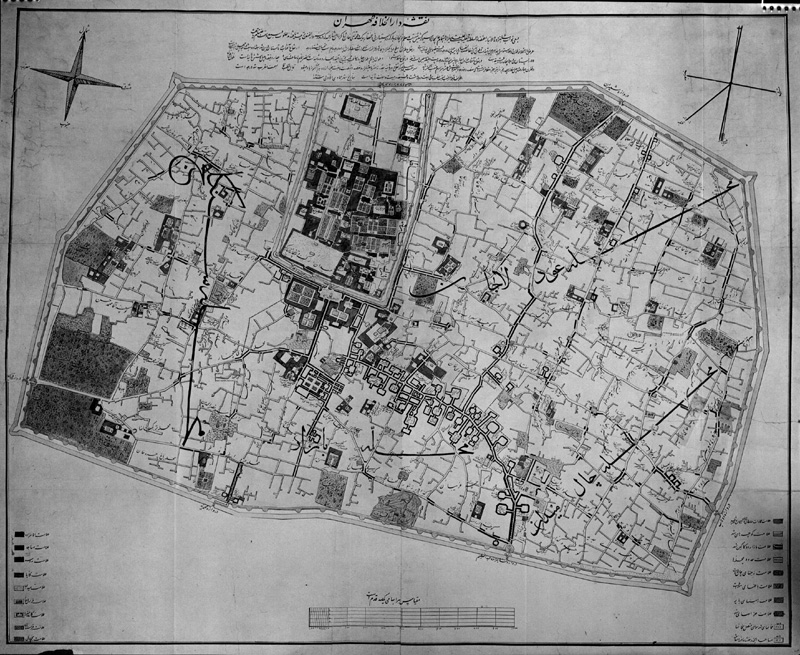
Although these and similar maps contained legend, description, etc., and proved practical and useful, they were mainly based on European surveys, and rather resembled a leisurely activity by some individuals and officials. Genuine progress started when the Geographical Department of the Armed Forces (Dāyera-ye joḡrāfīāʾī-e setād-e arteš), and later the National Survey Organization (Sāzmān-e naqša-bardārī-e kešvar), a section of the Plan and Budget Organization (Sāzmān-e būdja wa barnāma), were formed under the Pahlavis (1304-57 Š./1925-79). The former carried out an aerial survey of the whole country and produced in 1320-21 Š./1940-41 a new topo graphical map of Persia on twenty sheets (1:1,000,000), each covering an area of 4° x 4°. During 1948-60, this Geographical Department compiled a larger map (1:253,440) on 131 sheets, each covering an area of 1° x 1°. The latter, a civilian organization, improved the general survey of the country by employing satellite photography and produced in 1992 the largest (1:25,000) topographical map of Persia. It divided the country into 132 blocks, each covering an area of 1° x 1°. Each block is mapped on ninety-six sheets (ca. 55 x 48 cm each with legend and index), making a total of 12,672 sheets with a grand surface of ca. 3,345 m2. On this map, many geographical names were replaced by the ones imposed by the Islamic government in 1979 and later.
A “Historical Atlas of Persia” (Aṭlas-e tārīḵī-e Īrān) was published by the University of Tehran in 1350 Š./1971, comprising twenty-six two-page historical maps and three others, with descriptions in Persian, English, and French. Some private cartographic institutions were also founded during the Pahlavi period and later. They produced all sorts of maps and atlases, mainly using the material of the Army Geographical Department and the National Survey Organization. Saḥāb Geographic and Drafting Institute (Moʾassasa-ye joḡrāfīāʾī wa kārtogerāfī-e Saḥāb; founded 1315 Š./1936), and the newly established Gītā-šenāsī Geographic and Cartographic Organization (Sāzmān-e joḡrāfīāʾī wa kārtogerāfī-e gītā-šenāsī) are two such private institutions.
Bibliography
C. Alai, “Oriental Medieval Maps of the Persian Gulf,” The Map Collector 60, 1992, pp. 2-8.
Idem, “The World Map of Qazwini,” International Map Collectors’ Society 52, 1993, pp. 19-23.
Idem, “Iran or Persia? What do the Maps Say?” The Map Collector 70, 1995, pp. 12-17.
L. S. Bagrow, Die Geschichte der Kartographie, Berlin, 1951; tr. D. L. Paisley as History of Cartography, rev. and enlarged R. A. Skelton, Cambridge, Mass., 1964.
Abū Rayḥān Bīrūnī, Ketāb al-tafhīm le-awāʾel ṣenāʿat al-tanjīm, MS London, British Library, Or 8349; Pers. version, ed. J. Homāʾī, Tehran, 1318 Š./1939.
Joan Blaeu, Blaeu’s The Grand Atlas of the 17th Century World, with intro., captions, and selection of maps by J. Goss, New York, 1990.
W. C. Brice, ed., An Historical Atlas of Islam, Leiden and Edinburgh, 1981.
Encyclopaedia Britannica, 15th ed., 30 vols, Chicago, 1981.
L. A. Brown, The Story of Maps, New York, 1977.
E. H. Bunbury, A History of Ancient Geography among the Greeks and Romans from the Earliest Ages till the Fall of the Roman Empire, 2nd ed., 2 vols, New York, 1959.
J. Burgess, “The New Map of Persia,” The Scottish Geographical Magazine 9, 1893, pp. 454-60.
T. Campbell, “Understanding Engraved Maps,” The Map Collector 46, 1989, pp. 2-10.
A. S. Cook, Survey of the Shores and Islands of the Persian Gulf, 1820-1829, 5 vols, Slough, England, 1990.
A. Cortesao, History of Portuguese Cartography, 2 vols, Lisbon, 1969-71.
G. R. Crone, Maps and Their Makers: An Introduction to the History of Cartography, 5th ed., Folkestone, England, 1978.
G. Curzon, “Memorandum on the Society’s New Map of Persia,” Proceedings of the Royal Geographical Society and Monthly Record of Geography 14/1, 1892, pp. 69-78.
M. Faršād, Tārīḵ-e-ʿelm dar Īrān, 2 vols, Tehran, 1365 Š./1986.
S. Gole, Indian Maps and Plans, New Delhi, 1989.
J. B. Harley and D. Woodward, The History of Cartography, 2 vols., Chicago, 1987-94.
P. D. A. Harvey, The History of Topographical Maps: Symbols, Pictures and Surveys, London, 1980.
Idem, Medieval Maps, London, 1991.
Pierre Amédée Jaubert, Voyage en Arménie et en Perse, fait dans les années 1805-1806 …, Paris, 1821.
Y. Kamal, Monumenta Cartographica Africae et Aegypti, Cairo, 1926-51; ed. F. Sezgin, Frankfurt, 1987.
J. H. Kramers, Analecta Orientalia, 2 vols, ed. H. P. Block, Leiden, 1954-56.
M. Lazar, “Persien (Persia),” in I. Kretschmer, ed., Lexikon zur Geschichte der Kartographie, 2 vols, Vienna, 1986.
S. Maqbul Ahmad, “Kharīṭa,” in EI2 IV, pp. 1077-83.
K. Miller, Mappae Arabicae: Arabische Welt und Landerkarten des 9-13 Jahrhunderts in arabischer Urschaft, 6 vols., Stuttgart, 1926-31; with corrigenda by H. Gaube, Beihefte zum Tubinger Atlas des Vorderen Orients, Reihe B 65, Wiesbaden, 1986.
A. Miquel, “Ibn Ḥawqal,” EI2 III, pp. 786-88.
M. Moʿīn, Farhang-e farsī, 6 vols, Tehran, 1342-52 Š./1963-73.
National Geographic Atlas Of The World, 6th rev. ed., Washington, D.C., 1992.
Abraham Ortelius, Theatrum orbis terrarum, tr. as An Epitome of Ortelius: His Theatre of the World, London, 1616.
Claudius Ptolemy, Cosmographia, Bologna, 1477, facsimile ed., Amsterdam, 1963.
Idem, ClaudiiPtolemaeCosmographia tabulae/Maps from Ptolemy’s Geography, intro. by L. Pagani, tr. S. Knight, Wigston, Leicester, England, 1990.
M. Pūrkamāl, ed., Aṭlas-e tārīḵī-e Īrān/Historical Atlas of Persia, Tehran, 1350 Š./1971.
E. Savage-Smith, Islamic Celestial Globes, Washington, D.C., 1985.
R. W. Shirley, The Mapping of the World, London, 1984.
R. A. Skelton, ed., Theatrum orbis terrarum: A Series of Atlases in Facsimile,1stSeries3,Amsterdam, 1964.
W. Smith, Atlas of Ancient Geography, London, 1874.
Tabula Peutingeriana: Codex Vindobonensis 324, Graz, Austria, 1976.
The Times Concise Atlas of The World, London, 1995.
R. V. Tooley, Tooley’s Dictionary of Mapmakers, Amsterdam, 1979.
Idem, Maps and Mapmakers, 6th ed., London, 1982.
H. M. Wallis and A. H. Robinson, eds., Cartographical Innovations: An Introductory Handbook of Mapping Terms to 1900, Tring, England, 1987.
E. Yarshater, “Īrān-rā dar zabānhā-ye ḵārejī če bāyad ḵᵛānd?” Rahāvard, nos. 20-21, 1989, pp. 70-75.