




ii. IN MODERN TIMES
Fāryāb (also Pāryāb), common Persian toponym meaning “lands irrigated by diversion of river water” (see ĀBĪ). It is presently borne by twenty-one villages in Persia, most of them in the south, eighteen under the form Fāryāb, three under Pāryāb (Pāpolī Yazdī, pp. 121, 385). Several medieval settlements of varying importance were also known by that name: mere villages in Sogdiana and western Khorasan (Barthold, Turkestan3, p. 138; Ḥāfeẓ-e Abrū, II, pp. 57, 203); a small town and district in southern Fārs (Le Strange, Lands, pp. 257 n., 296); and a much larger city in Gūzgān (northern Afghanistan), present-day Ḵayrābād, near Dawlatābād(-e Maymana; q.v.; Le Strange, Lands, p. 425; Barthold, p. 33; Ball, I, pp. 150-51). The striking fact that none of these old Fāryābs has retained its former name underlines the vulnerability and instability of settlements built along rivers and liable to destructive floods (for an example in Kermān, see Sykes, pp. 269-70). It was, however, the Mongol invasion of 617/1220 that ruined Fāryāb in Gūzgān.
The name of that once prosperous city was revived in 1344 Š./1965, when the high governorate (ḥokūmat-e ʿalā) of Maymana, which had remained an independent administrative division in Afghanistan since the annexation of the Uzbek khanate of Maymana in 1293/1876, was elevated to the rank of province (welāyat) under the name Fāryāb. The province was, however, about twice as large as the former administrative division because it also incorporated two major districts (ḥokūmat) detached from the province (nāʾeb al-ḥokūmagī) of Torkestān: Darzāb-Gorzīvān and Andḵūy-Dawlatābād. In the early 1980s the district (woloswālī) of Darzāb was again detached from Fāryāb and returned to the neighboring province Jōzjān. At present Fāryāb province covers 21,141 km2. Straddling the boundaries between several major geohistorical regions, mainly Turkestan and Khorasan, it lacks real unity. The northern part isin the western extremity of the Afghan Turkestan lowlands, on the edge of the Kara Kum desert, including the big oasis of Andḵōy /Andḵūy (q.v.) and some of the lowest elevations in Afghanistan (257 m on the border with Turkmenistan); Turkic-speaking populations (Uzbek, Turkmen) predominate. The westernmost area (Qayṣār) is an outpost of Bādḡīs (q.v.), the eastern extremity of greater Khorasan, largely repopulated by Paštūn colonists. The southern region, or Kōhestān, extends over the central Band-e Torkestān (q.v.) ridge, with elevations of more than 3,000 m and sparsely distributed Persian-speaking villages. The provincial capital, Maymana, is strategically located at the intersection of the roads linking all these regions.
Other than Maymana, the only localities with urban status in the province are Andḵūy (13,000 inhabitants in 1358 Š./1979) and Dawlatābād (q.v.). The population, recorded at 541,706 settled inhabitants in the census of 1358 Š./1979, is so unevenly distributed (Table 1, below) that the comparatively high provincial density of twenty-six inhabitants per km2 has only limited geographical significance. Furthermore, Fāryāb is among the Afghan provinces with the highest number of nomads (ca 4,000 families, or 25,000 persons, mainly Paštūn (Table 1, below).
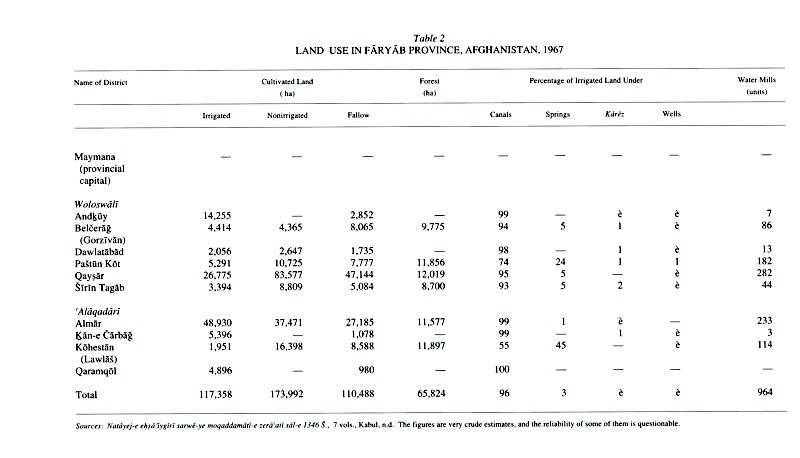
For a summary of the most important available data about population and land use, see the following tables:
Table 1. Population of Faryāb Province, 1978-79.
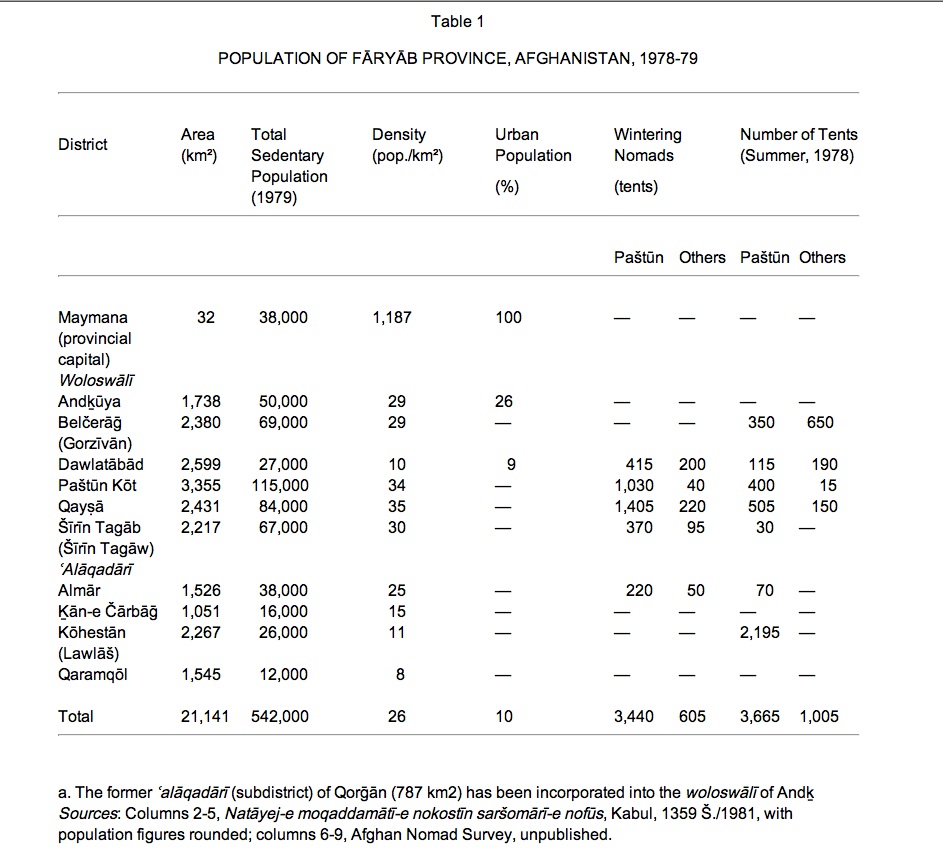
Table 2. Land use in Faryāb Province, 1967.
Bibliography
W. Ball, Archaeological Gazetteer of Afghanistan, 2 vols., Paris, 1982.
W. Barthold, An Historical Geography of Iran, tr. S. Soucek, Princeton, N.J., 1984.
Ḥāfeẓ-e Abrū, Tārīḵ II. Baḵš-e joḡrāfīā-ye Ḵorāsān, tr. D. Krawulsky as Ḫorāsān zur Timuridenzeit nach dem Tārīḫ-e Ḥāfez-e Abrū, 2 vols., TAVO, Beihefte 46/1-2, Wiesbaden, 1984.
M.-Ḥ. Pāpolī Yazdī, Farhang-e ābādīhā wa makānhā-ye maḏhabī-e kešvar, Mašhad, 1367 Š./1988.
P. M. Sykes, Ten Thousand Miles in Persia or Eight Years in Iran, London, 1902.