




i. ECONOMIC, POLITICAL, AND CULTURAL RELATIONS THROUGH 1900
From early times monsoon winds have permitted rapid maritime travel between East Africa and Western Asia. Persian relations with the African coastal regions were largely via this maritime trade network (Hourani, pp. 4-6, 38, 79-82). Although large-scale Persian settlement in East Africa is unlikely and the only known Persian inscription in East Africa comes from an imported glazed tile, now lost, decorating a tomb at Tongoni (Freeman-Grenville and Martin, p. 116), Persian cultural and religious influences nonetheless were felt. Ki-Swahili, the language of the East African coastal regions, contains Persian loan words (q.v.), mainly nautical terms. Archeological evidence from East Africa shows economic connections with the ports of southern Persia from the 3rd to the 15th centuries C.E., and African traditional history connects the founding of some of the East African ports with Shiraz.
Sasanian interest in East Africa seems to have been largely directed toward the Red Sea and the northern coast of Somalia. Competition between Ethiopian and Persian merchants for the lucrative Indian trade may have been one cause of the Persian campaigns in Yemen during the reign of Ḵosrow I (r. 531-79), which campaigns led to Sasanian control of the Red Sea route to the Indian Ocean (Cosmas Indicopleustes apud Wolska-Conus, pp. 141, 159, 197; Procopius, de bello Persico 1.20.9-12). Persia may also have been after slaves, who in the pre-Islamic period were obtained from the Horn of Africa. Duan Chengshi, in Yuyang za zu (ca. 850 C.E.), describing an earlier period, also refers to “Possu” (probably here meaning “Persian”) merchants on the coast of Bobali (possibly northern Somalia) who formed caravans of several thousand men to obtain ivory and ambergris (Duyvendak, pp. 13-14). Before trading, these merchants were forced to draw blood and swear an oath. Persian ceramics of the 3rd/ 5th centuries C.E. have been found at the site of Ras Hafun (probably ancient Opone) in northern Somalia (Smith and Wright, pp. 125, 138-40), though 5th century ceramics, very similar to those from Ras Hafun, have been claimed from Chibuene in southern Mozambique and from the island of Ngazidja in the Comoro archipelago (Sinclair, p. 190). The 4th/10th-century Ḥodūd al-ʿālam (tr. Minorsky, pp. 163-64, with commentary), the only surviving early Persian geographical text with detained evidence on East Africa, describes the coast, termed Zangestān, as lying opposite Fārs, Kermān, and Sind; the people are described as extremely black, with curly hair and the nature of wild animals. Three towns are noted: M.ljān (possibly Unguja, the original name of Zanzibar Island), the port visited by foreign merchants; Sofāla, the royal capital, in modern Mozambique; and Hwfl (a corruption of Waqwāq?), the richest in goods. Gold is important, and ancient gold mines are well known from the basement rock complex of southern Africa (Summers, pp. 11-17, 31-104; settlement sites in the interior, such as Mapungubwe/K2, were in contact with the coast by at least the 10th century C.E. and probably much earlier (Hall, pp. 74-90).
Masʿūdī (Morūj, ed. Pellat, I, pp. 112-13, 124-25; II, p. 113), who last visited East Africa in 304/916 on a ship owned by two brothers from Sīrāf, suggests that regular voyages were made from Oman and Sīrāf to the Belād al-Zanj, and in particular to the port of Qanbalū (most likely Pemba Island). Masʿūdī (who was writing after the Zanj revolt) suggests ivory was the main export. Jāḥeẓ suggests (Rasāʾel, written ca. 235/850, para. 210-213) that many Zanj slaves came from Lanjuya (Unguja, Zanzibar Island) and Qanbalū. These claims are supported by recent archaeological work that has yielded 6th-century-C.E. radiocarbon dates from Unguja Ukuu on Zanzibar and 3rd-4th/9-10th century occupation at Ras Mkumbuu and Mtambwe Mkuu on Pemba. Other African exports were ambergris and timber, especially mangrove poles. Ebn Ḥawqal (tr. Kramers, p. 277) records that Sīrāf was built with sāj (teakwood) and other kinds of wood from East Africa.
The ports in the Lamu archipelago, though not mentioned in the literary sources, are known from archeological evidence to have also played a central part in the maritime trade. Excavations at Manda (Chittick, pp. 65-106) and Shanga (Horton, forthcoming) have produced ceramic assemblages very similar to those from Sīrāf, including numerous unglazed storage jars that were actually made in Sīrāf as well as the more widely distributed Sasanian-Islamic glazed jars and white-glazed wares. Chinese stonewares have also been found at these levels.
By the 5th/11th century the Indian Ocean trade had shifted to the ports at the head of the Persian Gulf, in particular Kīš and Hormoz (Ricks, pp. 352-55), which traded East African products to India, the Far East, and the West. In East Africa, the shift was marked by the appearance of sgraffito pottery manufactured in the Makrān. During the late 7th/13th century, the main center of the East African trade moved to the South Arabian coast. Though some Persian Gulf pottery found its way to East Africa in the 9th/15th century, by the time of Portuguese contact, East Africa was trading directly with either Aden or the ports of western India, not with the Persian Gulf itself.
African traditional history recognizes early connections with the Persian Gulf. The most pervasive are stories of origin from Shiraz. The Ketāb al-solwa fī aḵbār Kelwa (BM Or. 2666; excerpts and summary in Freeman-Grenville, 1962, pp. 45ff.) tells of the voyage of seven ships manned by a father who, after a dream, left Shiraz with his six sons for East Africa, founding towns at Mandakha, Shaugu, Yanbu, Mombasa, Pemba, Kilwa, and Hanzuan. Another tradition recorded by the Portuguese in the 16th century tells of a migration of seven brothers from Laçah [al-Ḥasā in eastern Arabia], but it is unclear whether this is another version of the same story or a distinct tradition (J. de Barros, Decadas da Asia, ed. A. Baiao, Coimbra, 1930, I/8/4; trans. in Freeman-Grenville, 1962, pp. 31-32).
Chronicles from Mombasa, Vumba, and the Comoros give local elaborations of the Shirazi origin myth; the coastal peoples who claimed these origins often termed themselves “Shirazi,” and a political party—the “Afro-Shirazi” party—was formed in 1957. Explanations for this myth—no modern scholar accepts that any substantial migration took place from Shiraz—range from the extensive trade links with Sīrāf/Shiraz to religious and political factors. Allen (pp. 116-18, 179) suggests that the Shirazi myth is an Islamization of indigenous origin myths, particularly those associated with Shungwaya. Alternatively, the African courts may have looked to Buyid Shiraz as a model. Hints of this come from the descriptions of court practice and apparel. These were observed by Ebn Baṭṭūṭa in Mogadishu (pp. 179-96; tr. Defrèmery and Sanguinetti, II, pp 179-96; tr. Gibb, II, pp. 373-83), where state processions in which the ruler dressed in turban and cloak, shaded by ceremonial parasols, were preceded by a band, and followed by barefoot court officials including viziers and amirs. The Song annals (Song Shu 490, f 20 verso) describe a delegation of Africans from Zangistan who reached China in the late 11th century. The annals call the African ruler by the Buyid title Amīr-e amīrān (Chin. Ameiluo Ameilan; Hirth and Rockhill, p. 127; see AMĪR-AL-OMARĀʾ). This use of Shirazi practice may explain the observance of the Persian New Year, “Siku ya Mwaka,” on Zanzibar (Gray, 1954; 1962, p. 20), although this could equally well be linked to seafarers’ use of Now-Rūz (Nairuzi) in the navigational calendar (Tibbetts, pp. 361-66). The surviving titles such as Sheha (locally elected chief) and dīvānī (ruler) have also been cited as evidence for Persian links, but are more likely the result of the adoption of general Arabic terms for government offices by Swahili Muslims.
Islamization of the East African coast may have followed trade contacts with Sīrāf/Shiraz. A 10th-century mosque at Shanga is very similar to family mosques in Sīrāf (Horton, 1991, p. 43). The floriated and plaited Kufic inscriptions on meḥrābs at Kizimkazi (Plate LV) and Tumbatu in Zanzibar resemble inscriptions carved at Sīrāf in the 11th and 12th centuries (Whitehouse, p. 56), although the style of the polyloped arch seems to draw more upon North African or Spanish influences; local coral is used for the Zanzibar inscriptions . Two Persians were recorded on Arabic inscriptions from Mogadishu during the 13th century: Abū ʿAbd-Allāh b. Moḥammad b. Aḥmad al-Nīsabūrī al-Ḵorāsānī on a tombstone, dated 614/1217, and Ḵosrow b. Moḥammad al-Šīrāzī on a meḥrāb inscription at the ʿArbaʿa Rokūn mosque, dated 667/1268-69 (Freeman-Grenville and Martin, pp. 102-03).
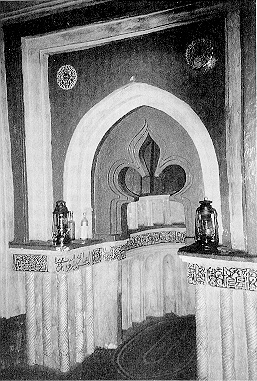
The last period of Persian influence came in the 19th century when Saʿīd bin Solṭān (1806-56), the Omani ruler of Zanzibar, took two Persian wives. The first—Šāhzāda, daughter of Ḥosayn-ʿAlī Mīrzā Farmānfarmā, the governor of Fārs—came from Shiraz. She went to Zanzibar in 1832 and left with the dissolution of the marriage in 1833. The second marriage was in 1849 to a daughter of Īraj Mīrzā, an alleged son of Moḥammad Shah; this, too, was dissolved a few years later.
Palaces built in Zanzibar to accommodate Persian tastes fashionable at the time, including baths, have survived. Those at Kidichi, probably built in 1832, were elaborately decorated in stucco by masons brought from Persia (Zanzibar Guide, p. 64). Saʿīd b. Solṭān relied on Baluchi mercenaries, recruited at Gwadur and Mukulla, to secure Zanzibar and the coastal regions. They were garrisoned at the fort in Zanzibar but acted more as police than as a standing army. They rarely numbered more than eighty.
Bibliography
(For cited works not given in detail, see “Short References.”)
J. de V. Allen, Swahili Origins. Swahili Culture and the Shungwaya Phenomenon, London, 1993.
H. N. Chittick, Manda. Excavations at an Island Port on the Kenyan Coast, Nairobi, 1984.
J. J. L. Duyvendak, China’s Discovery of Africa, London, School of Oriental and African Studies Occasional Paper, 1949.
G. S. P. Freeman-Grenville, The Medieval History of the Coast of Tanganyika, Oxford, 1962.
Idem, “Shi’i Rulers at Kilwa,” Numismatic Chronicle, 7th ser., 1978, pp. 187-90.
Idem and B. G. Martin, “A Preliminary Handlist of the Arabic Inscriptions of the East African Coast,” JRAS, 1972, pp. 98-122.
H. A. R. Gibb, tr., The Travels of Ibn Battuta. AD 1325-1354 II, London, 1962.
J. Gray, “Nairuzi, or Siku ya Mwaka,” Tanganyikan Notes and Records XXXVIII (Dar es Salaam), 1954, pp. 1-23; XXXXI, 1954, pp. 68-72.
Idem, A History of Zanzibar from the Middle Ages to 1856, London, 1962.
M. Hall, The Changing Past. Farmers, Kings, and Traders in Southern Africa, 200-1860, Cape Town and Johannesburg, 1987.
F. Hirth and W. W. Rockhill, Chau Ju-kua. His Work on the Chinese and Arab Trade in the 12th and 13th Centuries, entitled Chu-fan-chi, St. Petersburg, 1911.
M. C. Horton, “Primitive Architecture and Islam in East Africa,” Muqarnas 8, 1991, pp. 103-06.
Idem, Shanga. A Muslim Trading Settlement on the East African Coast, Nairobi, forthcoming.
A. Hourani, Arab Seafaring in the Indian Ocean in Ancient and Medieval Times, Princeton, 1951.Al-Jāḥeẓ, Rasāʾel, ed. H. Sandabi, Cairo, 1933.
T. M. Ricks, “Persian Gulf Seafaring and East Africa, Ninth-Twelfth Centuries,” African Historical Studies 3/2, 1970, pp. 339-57.
P. P. J. Sinclair, “Archaeology in Eastern Africa. An Overview of Current Chronological Issues,” Journal of African History 32, 1991, pp. 179-219.
M. C. Smith and H. T. Wright, “The Ceramics from Ras Hafun in Somalia. Notes on a Classical Maritime Site,” Azania 23, 1982, pp. 115-43.
R. Summers, Ancient Mining in Rhodesia, National Museum of Rhodesia, Memoir 3, Salisbury, 1969.
G. R. Tibbetts, Arab Navigation in the Indian Ocean before the Coming of the Portuguese, London, 1971.
D. Whitehouse, “Siraf. An Islamic City and Its Rôle in Art,” Storia della Città 7, 1978, pp. 54-58.
W. Wolska-Conus, La topographie chrétienne de Cosmas Indico-pleustes. Théologie et sciences au VIe siècle, Bibliothèque byzantine. Études 3, Paris, 1962.
Zanzibar Guide, 2nd ed., Zanzibar, 1949.