



BEMBO, AMBROSIO (1652-1705), Italian traveler who visited Iran and many other places in India and the Middle East.
Scion of a great Venetian family, Ambrosio Bembo served in the unsuccessful defense of Crete against the Ottomans in 1669. At the age of nineteen in August 1671, he accompanied his uncle Marco to his new post as the Venetian consul in Aleppo. Although he was deeply interested in the political and social activities of the great Syrian city, he grew bored and after fourteen months of living in Aleppo longed for more adventures. In January 1673, he set out for India in the company of two Franciscan friars and did not go back to Venice until 15 April 1674. Some time later he completed an account of his journey, an English translation of which by Clara Bargellin, was published in 2007 under the title The Travels and Journal of Ambrosio (the tr. cited in references below). On his return trip home, Bembo was accompanied by a French artist, Guillaume-Joseph Grélot, who eventually provided Bembo with fifty-one line drawings to illustrate his text with highlights of his trip (Bembo, ed. Invernizzi; idem, tr. Bargellini; Welch, 2003).
Bembo made an arduous winter journey from Aleppo to Diyarbakir and then traveled by riverboat down the Tigris to Baghdad (tr., pp. 92-125, fig. 15). From there, he and the two friars proceeded to Basra and the trading town of Bandar-e Kong on the Persian Gulf, where they were able to board a Portuguese ship bound for Gujarat (tr., pp. 125-59). Bembo spent more than a year traveling on the west coast of India from Diu and Daman to Goa. As would also be the case in Iran, he benefited from the extensive network of Christian missions (Augustinians, Capuchins, Carmelites, Dominicans, Franciscans, Jesuits, and Theatines) that provided him with news, correspondence, advice, and introductions. In general, this is the least interesting part of his memoir. He traveled along the coast, recorded his visits with colonial officials, and chose, perhaps wisely, not to venture into the interior, where the vicious struggle between the Mughal emperor Awrangzēb (r. 1658-1707) and the Maratha leader Šivāji (r. 1674-80) made overland travel uncertain and dangerous (tr., pp. 159-272).
In February 1674, Bembo left India and reached Bandar-e Kong on 19 May. He traveled overland north to Lār, which he found remarkable for its many cisterns, and then in late May to Shiraz (tr., pp. 272-98), which he admired for its cleanliness, pleasant climate, arts, and beautiful gardens. Food was excellent, and the bazaars were rich and active. Its glasswork and steel mirrors appealed to him, and he took back to Venice a vial of Shirazi perfume. In addition to 40,000 Muslim households, there were other communities of Jews, Armenians, and Nestorians. A broad avenue led northwest from the Bāḡ-e Šāh to the Bāḡ-e Ferdows and was lined with the mansions of the aristocracy. Bembo stayed in Shiraz for a month and left for Isfahan on 3 July in the company of a number of Dutch, French, and English merchants (tr., pp. 298-305).
On 5 July, Bembo left his group to visit Persepolis, “an ancient and very extraordinary ruin that is commonly called the palace of Darius” (tr., p. 307; Figures 19-21). He provides precise descriptions of both the Achaemenid site and the nearby Sasanian relief sculptures of Naqš-e Rostam (tr., pp. 315-16).
His journey north from Persepolis was difficult, but he admired the caravanserai and towering houses of Yazdḵvāst (now Izadḵvāst): “because of the narrowness of the place, [it] has houses one on top of the other” (tr., p. 320). Two days later, his party came to the then completely ruined city of Qomeša: “There are vestiges of many tombs in the form of towers where one sees many stone lions. There are also remains of many bazaars and caravanserais, of which ten still stand… I saw many ruins of ancient houses and buildings” (tr., pp. 320-21). Further to the north on the Isfahan road, they came to the large Safavid caravanserai of Mahyãr, one of several that Bembo admired.
Isfahan delighted him. The gardens and palaces of the Safavid nobility lined the Čahārbāḡ avenue, and Grélot provided a detailed drawing of one of them, namely the Āyina-ḵāna or “Palace of Mirrors” (tr., fig. 30). He was not alone in admiring Isfahan’s celebrated Čahārbāḡ. In Isfahan at the same time was the Anglo-French traveler Jean Chardin (q.v.; d. 1713), whose travel account, Voyages en Perse, is rivaled on its informative aspect only by Pietro Della Valle’s (q.v.; d. 1652) Viaggi di Pietro della Valle. During his two-month stay in Isfahan (18 July-22 September), Bembo also made the acquaintance of the Capuchin missionary, Father Raphaël du Mans (q.v.; d. 1696), a long-time resident of Isfahan, who was famed for his superb command of Persian and his deep knowledge of mathematics (tr., p. 326; see, e.g., du Mans, p. cx). But Bembo found Chardin arrogant and devious. Chardin had hired Grélot on very unfavorable terms and refused to pay him until they should return to Europe. Even though he was short of cash, Bembo was so offended by Chardin’s behavior that he hired Grélot himself (tr., pp. 360-61). As a result, the French artist traveled with Bembo from Isfahan to Venice (tr., p. 13, quoting Grélot) and eventually provided Bembo’s manuscript with fifty-one illustrations.
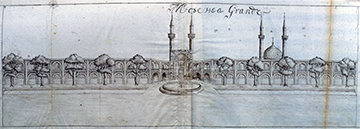
Figure 1. Isfahan, Maydān-e Naqš-e Jahān, south side, drawn by G.-J. Grélot, 1674.
Despite the many weeks he had spent in Isfahan (tr., figs. 22-32), Grélot was inexplicably careless in his drawings of some of the city’s most memorable buildings; for instance, the minarets of the Royal Mosque (Masjed-e Šāh; tr., fig. 27) are made Ottoman in form, while the arches around the plaza Naqš-e Jahān (Maydān-e Naqš-e Jahān) are rounded rather than ogive (Figure 1). A four-page panoramic drawing of Isfahan (tr., fig. 22) has no legend, and none of its structures is clearly identifiable. Even there, the domes lack the distinctive Safavid profile and instead resemble Ottoman domes. Neither the medieval Masjed-e Jāmeʿ nor the Safavid plaza is evident, and the overall impression is of woods and palaces. Both before and after his trip to Iran, Grélot spent many months in Constantinople; his long acquaintance with its architecture may have made him automatically render his drawing of the buildings in Ottoman terms.
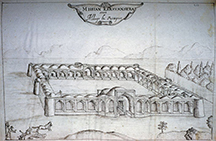
Figure 2. Messian, caravanserai, drawn by G.-J. Grélot, 1674.
Bembo was impressed by the city’s size, by the beauty of its trees, by the number of excellent bazaars, bathhouses, and caravanserais, as well as by Isfahan’s diverse population that included Arabs, Turks, Indians, Russians, Poles, French, English, Portuguese, and Dutch. Here, as elsewhere on his journey, Bembo demonstrated deep interest in religious doctrine and practice as well as sectarian differences. He was also a close observer of the city, noting that while the main streets were beautiful and carefully laid out, the side streets were filthy and in disrepair. Most striking to him was the city’s vast central Maydān-e Naqš-e Jahān, which he compared favorably with the best ones in Europe. Like other visitors, he noted the placement of the shah’s palace on the west side of the Maydān, the Royal Mosque on the south side, the small single-domed Masjed-e Šayḵ Loṭf-Allāh on the east side, and the entrance to the royal bazaar on the north. Bembo noted that the king, Shah Solaymān (q.v.; r. 1666-94), supported a number of European artists with housing, food, and funding (tr., pp. 321-63).
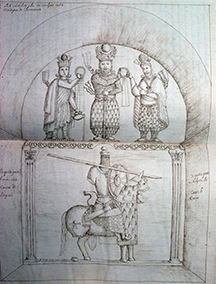
Figure 3. Ṭāq-e Bostān, grotto, investiture of Ḵosraw II, drawn by G.-J. Grélot 1674.
Bembo and Grélot left Isfahan on 22 September for Baghdad. A week later, they stayed at the caravanserai in Messian, and Grélot drew the arches accurately (Figure 2). They made several later stops to inspect pre-Islamic ruins in Kangāvar, Bisetun, and Ṭāq-e Bostān, which Grélot meticulously drew (tr., pp. 368-82, figs. 35-41; Figure 3). Their last stop in Iran was the town of Sumbar on the Kangir River (tr., p. 389, fig. 44), that is, modern Sumār on the Gangir, Ilam province (Jaʿfari, p. 431). Bembo expressed his sorrow in leaving Iran, “where I had been courteously welcomed and treated with every civility” (tr., p. 391). Traveling by way of Baghdad, they reached Aleppo on November 22 and were back in Venice on 15 April 1674 (tr., p. 421).
Bembo’s memoir is a remarkable document for its illustrations as well as its informative text. The young Venetian was neither merchant, diplomat, missionary, nor scholar, though he may have been an aspiring author traveling in the footsteps of Pietro della Valle. At the outset of his journey, he was only nineteen years old, and he had a youth’s appetite for adventure, experiences, and food. He also had a well-developed aesthetic sense and obviously loved the buildings he saw, particularly in Isfahan. He traveled in order to learn, and his book also documents an admirable frugality; he even provided it with a two-page account of his expenses, so that other travelers would know how much such a journey would cost. His book is a major contribution to our knowledge of Iran in the 17th century.
Bibliography
Ambrogio Bembo, Viaggio e giornale per parte dell’ Asia di Quattro anni incirca fatto de ma Ambrosio Bembo Nobile Veneto, ed. Antonio Invernizzi, Turin, 2005; tr. Clara Bargellini, as The Travels and Journal of Ambrosio Bembo, ed. Anthony Welch, Berkeley, 2007.
Michele Bernardini, “Italy iv. Travel Accounts” in EIr. XIV, pp. 250-59l
Jean Chardin,
Voyage en Perse, 10 vols., Amsterdam, 1711.
Pierto Della Valle, Viaggi di Pietro della Valle il Pellegrino, 4 vols., Rome, 1650-63.
Raphaël du Mans, Estat de la Perse en 1660, ed. Charles Henri Schefer, Paris, 1890.
Guillaume-Joseph Grélot, Relation nouvelle d’un voyage de Constantinople, Paris, 1680.
Antonio Invernizzi, “Ambrosio Bembo e Guillaume Grelot alle Porte dell’Asia,” in Edward Dabrowa, ed., Ancient Iran and its Neighbours: Studies in Honour of Prof. Jósef Wolski on Occasion of His 95th Birthday, Krakow, 2005, pp. 111-21.
ʿAbbās Jaʿfari, Rudhā va rudḵāna-ye Irān II, Tehran, 2005.
Jacopo Morelli, “Ambrosio Bembo,” in idem, Dissertazione intorno ad alcuni viaggiatori eruditi veneziani poco noti, Venice, 1803, pp. 50-79.
Francis Richard, Raphaël du Mans, missionnaire en Perse au XVIIe siècle, 2 vols., Paris, 1995.
Anthony Welch, Shah ʿAbbas and the Arts of Isfahan, New York 1973, pp. 104, 117.
Idem, “Safavi Iran as Seen through Venetian Eyes,” in Andrew Newman, ed., Society and Culture in the Early Modern Middle East: Studies on Iran in the Safavid Period, Leiden and Boston, 2003, pp. 97-121.