



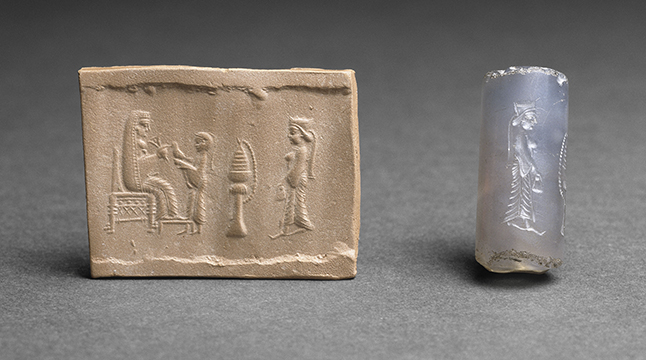
ACHAEMENID VISUAL REPRESENTATIONS OF WOMEN. Representations of women from the Achaemenid Empire are most often found on seals and pendants (which could be used as seals; Figure 1). The women depicted there share the following characteristics: They have curvy bodies, and wear their hair in a long braid or under a veil. They are dressed in a long dress with wide sleeves, while often but not always holding a lotus flower (for examples see Boardman, figs. 289, 294, 297, and also the Daskyleion and Wadi Daliyeh archives in Kaptan, DS 83, DS 101; Leith, WD 6, 52). However, seals are not the only medium to carry this image (for a more comprehensive discussion of representations of women in Achaemenid times, see Bakker).
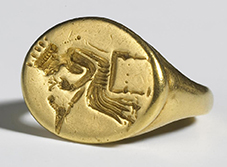
Lotus is also present on the inside of a silver box from Erzingan (Dalton, fig. 19), on a tapestry from Pazyryk (Rudenko, fig. 138), and on gold sheet and rings from the Oxus treasure (Dalton, figs. 89, 93, 103, 104; Figure 2).
Images of women that show only part of the characteristics described above are also present in the Achaemenid Empire. In Cyprus, a longstanding tradition of votive figurines shows women holding flowers (Buchholz, p. 245, fig. 8), and in Levantine context we find terracotta plaques depicting women with veils holding flowers (Moorey, pp. 210, 214, figs. 3, 4).
The image has long been seen as an example of “Graeco-Persian” art. Since only a few images come from well defined contexts, and the provenances currently known suggest no central place of manufacture, the term “Graeco-Persian” seems inappropriate.
The lotus present on many of these representations is a symbol with a long history in the Ancient Near East. It was used widely in depicting both males and females, and for different purposes. One quite common image of a woman seen frontally, holding a lotus, is present on funerary stele and clay plaques found on Cyprus, the Levantine coast, Sardinia and Egypt from the 7th to 4th centuries BCE (see Moscati, p. 193 and Moorey).
There has been some debate over the meaning and function of the lotus flower in Ancient Near Eastern art. In Egypt, lotuses seem to have been a symbol of regeneration and fertility (Lexikon Der Ägyptologie, vol. III, s.v. “Lotos”). They were not used to denote divine power since both mortals and divinities were shown with a lotus (Moorey, p. 216), but they have been interpreted as symbols of earthly power (Beck, pp. 180-81; Keel and Uehlinger, p. 245).
It is unclear however, how the meaning of the lotus related to the sex of its subject. Most of the modern interpretations are based on males with lotuses, and interpretations are usually very local: they are based on a particular occurrence of the lotus in a particular place (see for instance Yon, p. 109).
Peter Calmeyer linked the image of women holding flowers in Achaemenid art to a tale by Chares of Mitylene (q.v.; apud Atheneaus XIII.575), which according to Chares was very popular in Achaemenid times. In it, a prince and princess want to marry but are thwarted by the princess’s father. In the end, the princess shows her father she wants to marry her choice by giving the prince a golden cup. Calmeyer then refers to a similar story by Ferdowsi in which the princess dreams of giving the prince a posy and suggests the cup is a Greek variation on the theme (Calmeyer, pp. 60-61).
Shapur Shahbazi, in an article on the symbolism of flowers in Sassanian times, also links the image of women giving flowers to men to Ferdowsi. He uses another tale told by Ferdowsi about the hero Goštāsp (q.v.), in which the princess selects Goštāsp as her husband by giving him flowers (Shahbazi, p. 62; see KATĀYUN).
In both explanations the flower would symbolize love and marriage. The archaeological material, however, seems to support a more complex answer.
In addition to women, men are also depicted holding a lotus in Achaemenid art. They are seated, usually in the middle of a banquet or audience. For example, on the famous relief from Persepolis showing an audience scene, the king holds a lotus (Pritchard, fig. 463). Interestingly, there are also representations of women holding a lotus in audience scenes. On a seal from the de Clercq collection, a woman is shown seated, veiled and crowned, holding a lotus (Briant, p. 265, fig. 30b). In this context, where men and women are shown in a similar context, the meaning of the lotus could well be the same for both sexes. Here, the lotus is connected to power and social status.
In other instances of depictions of women, however, the lotus seems to be a strictly female attribute. When she is depicted together with a man, the lotus is always in her hands, and not in his (see Kaptan, DS 83). The man has his own attribute in these scenes, predominantly a spear or bow and arrows. When men are not represented together with women, they also have these attributes and additionally are shown riding chariots and horses (see Kaptan, DS 71-77). It seems that in this instance, the lotus is a female artefact, representing purely female values.
The meaning of the clay plaques from the Levant mentioned earlier, although still debated, seems to confirm this. It is thought to be closely related to private life and household life (e.g., the plaques showing women holding flowers were placed with the household rubbish), and to the Near Eastern goddess who governed these, Inanna/Ishtar/Astarte (Moorey, p.204, Wiggerman, pp. 52-3).
The images themselves also hold a clue as to what their meaning is. The image of the women in a wide sleeved dress, with a braid hanging down her back and a lotus in her hands, is new to the Achaemenid period. The same goes for the image of a man with a cap, trousers and tunic, shooting or riding. The virtues of this kind of man are omnipresent in the Empire. The king as head of all men and as king of the Persian Empire epitomizes these virtues, as a hunter and warrior (see Briant, chap. 6). The image of women that accompanies the image of men could therefore also be connected to an ideal, promoted like the ideal man throughout the Empire. The standardization of both the images of men and women is striking but makes sense if the image itself is seen as an ideal and not a reality.
Bibliography
J. Bakker, “The Lady and the Lotus: Representations of Women in the Achaemenid Empire,” Iranica Antiqua 42, 2007, pp. 207-20.
P. Beck, “The Art of Palestine during the Iron Age II: Local Ttraditions and External Iinfluences (10th-8th Centuries BCE),” in C. Uehlinger, ed., Images as Media: Sources for the Cultural History of the Near East and the Eastern Mediterranean (1st Millenium BCE), Fribourg, Switzerland, 2000, pp. 165-83.
J. Boardman, Greek Gems and Finger Rings: Early Bronze Age to Classical, London and New York, 2001.
P. Briant, Histoire de l’Empire Perse: De Cyrus à Alexandre, Paris, 1996.
H. G. Buchholz, “Kyprische Bildkunst zwischen 1100 und 500 v. Chr.” in C. Uehlinger, ed., Images as Media: Sources for the Cultural Hhistory of the Near East and the Eastern Mediterranean (1st Millenium BCE), Fribourg, Switzerland, 2000, pp. 215-65.
P. Calmeyer, “Textual Sources for the Interpretation of Achaemenian Palace Decorations,” Iran 18, 1980, pp. 55-63.
O. M. Dalton, The Treasure of the Oxus with Other Examples of Early Oriental Metal-Work, 3rd. ed., London, 1964.
D. Kaptan, The Daskyleion Bullae: Seal Impressions from the Western Achaemenid Empire (Achaemenid History XII), 2 vols., Leiden, 2002.
O. Keel and C. Uehlinger, Gods, Goddesses, and Images of God in Ancient Israel, Edinburgh, 1998.
M. J. W. Leith, “Greek and Persian Images in Pre-Alexandrine Samaria: The Wadi ed-Daliyeh Seal Impressions,” Ph.D. diss., Harvard University, 1990.
“Lotos,” in W. Helck and E. Otto, eds., Lexikon der Ägyptologie, vol. III, Wiesbaden, 1972-92, III, pp. 1091-96.
P. R. S Moorey, “Novelty and Tradition in Achaemenid Syria: The Case of the Clay ‘Astarte Plaques’,” Iranica Antiqua 37, 2002, pp. 203-18.
S. Moscati, L’Arte dei Fenici, Milano, 1990.
J. B. Pritchard, The Ancient Near East in Pictures Relating to the Old Testament, Princeton, 1954.
S. I. Rudenko, Frozen Tombs of Siberia: The Pazyryk Burials of Iron Age Horsemen, London, 1970.
A. S. Shahbazi, “Studies in Sassanian Prosopography III: Barm-e Dilak Symbolism of Offering Flowers,” in V. Sarkhosh Curtis, et al., eds., The Art and Archaeology of Ancient Persia: New Light on the Parthian and Sasanian Empires, London and New York, 1998, pp. 58-65.
F. Wiggerman, “Nackte Göttin (Naked Goddess) A: Philologisch,” Reallexikon der Assyriologie 9, 1998, pp. 46-53.
M. Yon, Salamine de Chypre V: Un dépôt de sculptures archaïques (Ayios Varnavas, site A), Paris, 1974.