



ḴIᾹBᾹNI, SHAIKH MOḤAMMAD (b. ca. 1297/1879-80, Ḵāmena, d. 14 September 1920, Tabriz; Figure 1), cleric, nationalist, constitutionalist revolutionary (1908-9), member of the Second Majles (1909-11), elected to the Fourth Majles, leader of the Democrat party of (Iranian) Azarbaijan, and founder of the short-lived Ᾱzādisetān autonomous province in 1920 (see also Azarbaijan iv. ISLAMIC HISTORY TO 1941).
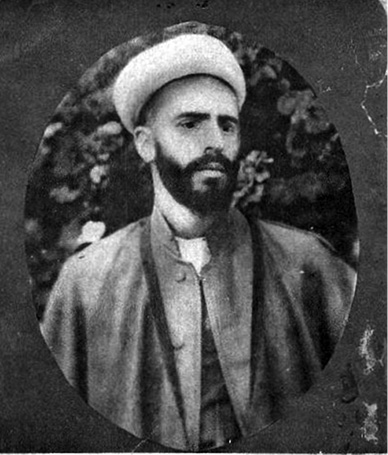
Early life. There is scant information about Moḥammad Ḵiābāni’s personal life. He was born in Ḵāmena, Azarbaijan province. His father, Ḥāji ʿAbd-al-Ḥamid, was a merchant engaged in Russian trade, who had resided for thirty years in the Russian city of Petrovskoye (Makhachkala), the capital of Dāḡestān (q.v.). There is no biographical information on Moḥammad’s mother, Roqayya Solṭān. The family moved to Tabriz when Moḥammad was nine years old, taking up residence in the Ḵiābān ward. After completing maktab (see EDUCATION iii), which he had begun at the age of six, Moḥammad accompanied his father on one of his regular trips to Petrovskoye, where Moḥammad’s older brother Ḥosayn acted as the family’s business agent and their paternal uncle also resided. In Petrovskoye, Moḥammad received training in the family business, which consisted of exporting assorted products from Persia (ranging from carpets to nuts, dried fruit, regional handmade textiles, and henna) and importing goods from Russia (such as samovars, clocks, paper, and chinaware). Here, Moḥammad acquired some knowledge of Russian, in which he would progress during later visits. Returning to Tabriz after a few years while in his mid-teens, he primarily devoted himself to religious studies, while continuing in the family trade. His seminary education consisted of subjects such as Arabic, Hadith, logic, mathematics, traditional astronomy (hayʾat; see ASTROLOGY AND ASTRONOMY IN IRAN), and history. When he was about seventeen, his father arranged for him to join a commercial convoy transporting the wares of some merchants from Tabriz to Istanbul. From Istanbul, Moḥammad proceeded to Tbilisi and then joined his father and brother in Petrovskoye for some time. These early travels and exposure to conditions in some provinces of two of Persia’s more “Westernized” imperial neighbors, while Moḥammad was still in his teens and had not yet traveled to his own country’s capital, were a formative period in his introduction to wide-ranging cultural practices and social values. Returning to Tabriz, he resumed his studies at the seminary (see EDUCATION v. THE MADRASA IN SHIʿITE PERSIA), completing his religious studies under the tutelage of Ḥājj Mirzā Abu’l-Ḥasan Angaji (q.v.). Meanwhile, he continued his studies in traditional astronomy and mathematics with Mirzā ʿAbd-al-ʿAli Monajjem-bāši. Moḥammad began carrying out clerical duties under the guidance of Ḥāji Sayyed Ḥosayn Ḵāmenaʾi, who hailed from Moḥammad’s birthplace and was the prayer leader of the Jāmeʿ mosque in Tabriz. It was under Ḵāmenaʾi’s supervision that Moḥammad qualified for ejtehād (q.v.), authorizing him to lead prayers on his own and to be addressed by the honorific title of shaikh. Moḥammad occasionally substituted for Ḥāji Ḵāmenaʾi at the mosque for leading general prayers, and he married his benefactor’s daughter. Following his father-in-law’s death, Moḥammad served as the noon-time prayer leader at the Jāmeʿ mosque for nearly three years, while leading morning and evening prayers at the Karim Khan mosque and teaching traditional sciences at the Ṭālebiya school. It was around this time that he acquired his sobriquet “Ḵiābāni” (his later surname), after the Ḵiābān district where the Karim Khan mosque was located and where he lived. Now in his late twenties and primarily known as Shaikh Moḥammad Ḵiābāni, even though some people still referred to him as Shaikh Moḥammad Ḵāmenaʾi after his birthplace, he is reputed to have been a popular preacher in the city. Around 1912-13, after the suppression of the constitutional movement and the closure of the Second Majles, in which Ḵiābāni served as a delegate, he married his second wife and cousin Ḵayr-al-Nesāʾ Nikpendār, usually just referred to as Ḵānom Ᾱḡā. From his two marriages, Ḵiābāni had four sons and two daughters. (For these details, see Nāhidi-Ᾱḏar, pp. 7-14, 18-22, 25-35; Bādāmči, pp. 23-4; Ᾱḏari, pp. 10-11; Kasravi, 1944, p. 24; Raʾisniā and Nāhid, pp. 193-94; Tagieva, tr., pp. 27-28; Rāvāsāni, p. 226; Tabatabai Khatambakhsh, pp. 26-27; Ḵiābāni-Aṣl, 2006; idem, 2010; Hairi, p. 24.)
Political involvement. By most accounts, while sympathetic to the constitutional movement that got underway in Persia after the summer of 1906, Ḵiābāni’s actual participation in the Constitutional Revolution of 1906-11 occurred long after the founding of the Majles in late 1906. He was among the clerics in Tabriz who, in 1908, joined the constitutionalist bloc in opposition to the royalist camp of Moḥammad-ʿAli Shah (r. 1907-9), following the constitutionalist insurgency in Tabriz in the aftermath of the Russian-backed royalist coup of 23 June 1908 and the closure of the First Majles. In reaction to the coup, the constitutionalist forces in Tabriz staged an armed uprising. While many Shiʿi clerics in the city denounced the insurgency, Ḵiābāni followed the example of the leading pro-constitutionalist cleric Mirzā ʿAli Āqā Ṯeqat-al-Eslām and actively supported the insurgents. Ḵiābāni took up arms at the barricades and distinguished himself as a foremost constitutionalist religious and political preacher and combatant in the city, while leading occasional prayers at Karim Khan and Samsām Khan mosques. In recognition of his activities and growing popularity in the constitutionalist community, on 30 September 1908 he was admitted into the provincial revolutionary anjoman (q.v.; council) of Tabriz, the Anjoman-e eyālāti-e Tabriz, and rapidly emerged as an outspoken member of the Anjoman (Anjoman, 9 Ramażān 1326/5 October 1908, p. 3; Bādāmči, pp. 24-25; Nāhidi-Ᾱḏar, pp. 93, 95; Kasravi, 1971, pp. 675-76; Raʾisniā and Nāhid, pp. 195-96, 199-203; Ᾱḏari, p. 10; Tagieva, tr., p. 27; Tabatabai Khatambakhsh, pp. 28-33; B. Ḵiābāni, pp. 3-4). On 23 December 1908, Ḵiābāni proposed that the Anjoman establish a bureau tasked with enforcing order and security throughout the province and to set up a treasury committee responsible for procuring funds for the activities of the Anjoman and the armed resistance to royalist forces (Anjoman, 7 Ḏu’l-ḥejja 1326/31 December 1908, pp. 3-4). In 1917, under very different circumstances, Ḵiābāni revived the scheme of a provincial anjoman and its auxiliary committees operating independently of central authorities.
Following the overthrow of Moḥammad-ʿAli Shah on 16 July 1909, the thirty-year-old Ḵiābāni was elected as a Tabriz delegate to the Second Majles, which convened on 20 December 1909. It was at this stage that Ḵiābāni transitioned from being primarily a constitutionalist anti-imperialist to embracing a combined platform of nationalism, constitutionalism, and socio-economic reforms and social justice. He often sided with the minority, but nonetheless influential, [Social-]Democrat faction in the Majles, which was affiliated with the radical Social-Democrat party (see EJTEMĀʿIUN-E ʿAMMIUN) outside the Majles (Bādāmči, p. 25; Kasravi, 1971, p. 113; Nāhidi-Ᾱḏar, pp. 101, 106; Raʾisniā and Nāhid, p. 203). This partisan association was fully cemented with the intensification of joint Russian and British meddling in Persia’s domestic affairs, particularly attempts in 1911 to sabotage efforts by Persia’s team of American financial advisers led by William Morgan Shuster, followed by the subsequent Russian ultimatums. The Russian ultimatum of 29 November demanded the immediate dismissal of Shuster and his American team, as well as a British employee of the Persian treasury, a Mr. Lecoffre, on grounds of their defiance of Anglo-Russian interference in Persian affairs. Backed by the threat of military occupation of the Persian capital, this latest ultimatum set a 48-hour deadline for Tehran’s compliance. Whereas the Baḵtiāri-led cabinet of Prime Minister Ṣamṣām-al-Salṭana eventually favored accepting the terms of the ultimatum, the Majles overwhelmingly opposed such a move. Ḵiābāni emerged as an outspoken advocate in the Majles of the uncompromising stance of the Democrat faction against continued Anglo-Russian intervention, formally joining the ranks of the Democrats and urging the public to resist Anglo-Russian aggression by any means necessary. He delivered a celebrated parliamentary speech that propelled him from a somewhat minor, provincial political personality in Tehran to a publicly acclaimed politician on the national stage. On 1 December 1911, during an emergency session of the Majles attended by the foreign minister Woṯuq-al-Dawla, Ḵiābāni lambasted the ultimatum and the cabinet’s readiness to accede to its terms. In a primarily theoretical speech, he declared the age of imperialism was long over and Iranians were fully entitled to their territorial sovereignty and national self-determination (Moḏākerāt-e Majles, second term, session 329, 9 Ḏu’l-ḥejja 1329/1 December 1911, pp. 1917-18). The same day he delivered another spirited speech in condemnation of Anglo-Russian intervention to an enthusiastic crowd outside the Majles, who reportedly chanted his name incessantly. On 16 December, with the deadline for the original Russian ultimatum having long passed, St. Petersburg extended its deadline by six more days, and Russian troops moved to Qazvin on the road to Tehran. In a Majles performance that earned Ḵiābāni further public acclaim, he reprimanded the cabinet on 21 December for its allegedly continued irresolute posturing, instead of outright rejection of the Russian demands (Moḏākerāt-e Majles, second term, session 332, 29 Ḏu’l-ḥejja 1329/21 December 1911, pp. 1931-32; Etteḥādiya, 1982, pp. 328-31; Bādāmči, pp. 25-26; Kasravi, 1971, pp. 477, 491; Nāhidi-Ᾱḏar, pp. 107-11; Raʾisniā and Nāhid, pp. 208-12; Tabatabai Khatambakhsh, pp. 37-40; Rāvāsāni, p. 226). On 24 December, the Baḵtiāri-dominated cabinet and the regent (Nāṣer-al-Molk) staged a military putsch, closing down the Second Majles, which had already exceeded its term, and acceding to Russian demands, thereby terminating the Constitutional Revolution. This was followed by a Baḵtiāri-orchestrated clamp down on Democrats and other radical constitutionalist-nationalist groups, with Russian forces engaging in a “Reign of Terror” in Tabriz and other locations in northern Persia (Browne).
World War I. Going underground in Tehran for weeks to avoid capture or assassination following the closure of the Second Majles and the subsequent extensive crackdown against constitutionalist forces by the Baḵtiāri-dominated government in Tehran and by Russian forces in northern provinces, Ḵiābāni and his family moved to Mashhad, where they briefly hid with relatives, before crossing the border into Russia and settling in Petrovskoye, where Ḵiābāni’s brother and uncle lived. In 1914, Ḵiābāni clandestinely arranged with a relative for his family’s return to Tabriz, with Ḵiābāni himself secretly returning to the city later in the year. Tabriz, then Persia’s second largest city and the traditional seat of Qajar crown princes (Moḥammad-Ḥasan Mirzā at the time), was already under indirect Russian control after late 1911, with the formal Russian occupation of the city getting underway in 1915 as part of Anglo-Russian military operations in Persia during World War I. Fearful of being discovered and captured by agents of the notorious Russian-backed governor of Tabriz, Ṣamad Khan Šojāʿ-al-Dawla (an old adversary of Ḵiābāni), Ḵiābāni’s acquaintances managed to arrange an amnesty for him from the governor. In return, Ḵiābāni pledged to refrain from political activity and devote himself solely to preaching and commerce. Ultimately failing to secure a post as prayer leader, he devoted his time to trade (Bādāmči, pp. 26-7; Kasravi, 1971, pp. 676-77; Raʾisniā and Nāhid, pp. 212-14; Nāhidi-Ᾱḏar, pp. 111, 115; Tagieva, tr., pp. 28-29; Ᾱḏari, pp. 37-38; Tabatabai Khatambakhsh, p. 41).
Resumption of political activity, the Azarbaijan branch of the Democrat party, and ‘Tajaddod’ newspaper. Although Ḵiābāni attended occasional covert political gatherings after returning to Tabriz in 1914, he did not resume full-fledged political activism until after the Russian Revolution of March 1917. Following the March Revolution (the February Revolution according to the old Russian calendar), some Russian soldiers stationed in Tabriz and other cities in the province publicly celebrated the overthrow of the Tsarist regime, championed democratic rights, and formed Russo-Persian friendship committees. Segments of the population in Tabriz greeted the news of events in Russia by calling for the restoration of Persia’s constitution, with local crowds at times joined by anti-Tsarist Russian soldiers. It was in this climate that, on 7 April 1917, Ḵiābāni, along with Moḥammad-ʿAli Bādāmči, Mirzā ʿAli Khan Postḵāna, and Mirzā ʿAli Čāyči, formally revived the Tabriz branch of the Democrat party, previously known as the Social-Democrat Party, with which they had all been affiliated at some point before the suppression of the party in December 1911. On 9 April, Ḵiābāni and his associates launched the newspaper Tajaddod (q.v.; “Renewal”), which billed itself the official organ of the Democrat Party of Azarbaijan (Ferqa-ye Demokrāt-e Ᾱḏarbāyjān; see CONSTITUTIONAL REVOLUTION v. POLITICAL PARTIES OF THE CONSTITUTIONAL PERIOD), as the party now came to be called. In practice, over the coming years, Tajaddod (1917-18, 1919-20) served as the mouthpiece of Ḵiābāni’s faction within the revived provincial branch of the party. Ḵiābāni was the paper’s proprietor and its initial nominal editor, with various individuals responsible for its actual editing, including Abu’l-Qāsem Foyużāt and Abu’l-Fatḥ ʿAlawi in 1917-18. Shortly, other branches of the party were founded across the province (Tajaddod, 16 Jomādā II 1335/9 April 1917; Nāhidi-Ᾱḏar, pp. 128, 141-43; Bādāmči, pp. 27-28; Kasravi, 1944, pp. 63-64; idem, 1971, pp. 677-78, 682, 686-87; Tagieva, tr., pp. 29-32; Ᾱḏari, pp. 91-99; Raʾisniā and Nāhid, pp. 217-18, 220-21; Rāvāsāni, p. 227). At the time, the only organized remnant of the former national branch of the Democrat party existed as the Berlin-based and German-backed Persian Nationalist Committee, founded in 1915 and led by Sayyed Ḥasan Taqizāda (q.v.); its members inside Persia operated uneasily alongside other militant Iranian nationalist groups primarily engaged in armed operations against British forces in southern Persia until the end of World War I. In May 1917, Ḵiābāni briefly traveled to Tbilisi as the representative of the (Azarbaijan) Democrat party to forge closer ties with anti-Tsarist elements in the Russian Caucasus (Tagieva, tr., pp. 32-34).
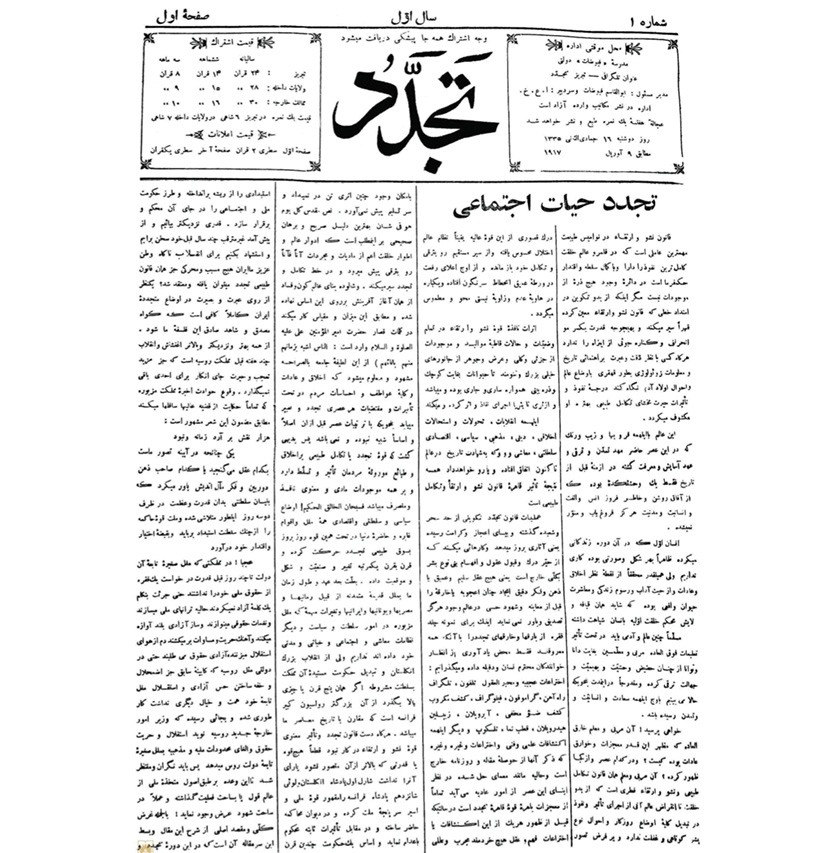
Figure 2. Front page of the first issue of the Tajaddod newspaper (16 Jomādā II 1335/9 April 1917). Source: The National Library and Archives of the Islamic Republic of Iran.
By this time, Azarbaijan was experiencing food scarcity, cholera, and widespread lawlessness. Tajaddod’s vigorous rebuke of the authorities for their inability to redress the crises led to the growing popularity of the Democrat party, with Ḵiābāni and his colleagues routinely stirring the crowds in condemnation of the authorities through public oratory, while intimidating those considered hostile or disloyal to their platform and tactics. Some sources, without providing incontrovertible evidence, have accused Ḵiābāni and/or his inner circle (notably Esmāʿil Nowbari and ʿAli Ḥariri) of arranging most, if not all, of the high-profile assassinations in Tabriz from 1917 to 1920 of exploitative individuals and/or those opposed to the Democrat Party (Kasravi, 1971, pp. 689-93, 701-4; idem, 1944, pp. 67-68, 72; Katouzian, 1999, pp. 159-60), overlooking the existence of other groups and individuals in the city who were also settling personal or ideological scores, including a small clique of pro-Bolshevik and ʿAdālat party-affiliated communists. During this period political chaos and terrorism were commonplace in other parts of the country as well. Other sources have far too readily refuted allegations of involvement in these assassinations by Ḵiābāni; they categorically dismiss these allegations as mere partisan smear campaigns or, at most, attribute some of the assassinations to rogue elements among Ḵiābāni’s associates, who were allegedly acting without Ḵiābāni’s knowledge. These sources cite as proof Ḵiābāni’s and Tajaddod’s expressed condemnation during 1917-18 of terror, political adventurism, and physical-force politics (Nāhidi-Ᾱḏar, pp. 159-63; Ᾱḏari, pp. 142-48; Raʾisniā and Nāhid, pp. 226-28). In a highly popular move, in June the Democrat party successfully campaigned for the dismissal of the governor of Azarbaijan, Taqi Khan Rašid-al-Molk, who was replaced with Šarif-al-Dawla Kāšāni (later ʿAli-Moḥammad Bani-Ᾱdam), whom the party also soon opposed (Tagieva, tr., p. 34).
The first province-wide congress of the party took place in Tabriz on 23 August 1917, attended by 480 delegates. Electing Ḵiābāni as the leader of the provincial party, the congress approved a platform and drew up its first annual program. A central tenet of the party was Persia’s sovereignty and the unequivocal status of Azarbaijan as an inseparable territory of Persia—a key principle repeatedly stated until Ḵiābāni’s death and the closure of the party in September 1920. In its annual program, the party called on the central government to hold nationwide elections for the Fourth Majles. The previous, short-lived, Third Majles had convened in December 1914 and adjourned in November 1915, following Persia’s wartime occupation by British and Russian forces. Furthermore, the party proposed the formation of provincial and local anjomans across the country to coordinate the elections, promote electoral participation, and educate the public about the constitution and the rights of citizens. Among other clauses, the party platform demanded strict hierarchical discipline within the party. It also expressed solidarity with the March 1917 Revolution in Russia and advocated Russo-Persian friendship (Bādāmči, pp. 28, 35; Nāhidi-Ᾱḏar, pp. 143-45; Tabatabai Khatambakhsh, pp. 40-45; Ᾱḏari, pp. 148-49, 157; Tagieva, tr., pp. 35, 116-17). Under the auspices of recently formed anjomans in Tabriz and other parts of the province, Ḵiābāni and his associates focused their efforts on dealing with the urgent food shortage, establishing security, solidifying their own power base, and preparing for Majles elections. In terms of national politics, the party’s primary emphasis was the implementation of the 1906 constitution, reconvening of the Majles, and an end to foreign intervention in Persia’s affairs, as the rival Ottoman and British armies were still occupying parts of the country (Ᾱḏari, pp. 104-5). The party set up its own relief committees in various localities, tasked with specific duties. These ranged from purchasing wheat and grains from villages and supplying them to bakeries at set cost and with price ceilings for the provision of affordable bread, to such activities as the collection, by various means, of “donations” from affluent families to cover the expense of providing affordable bread and other food supplies or extending rent subsidies to poor families (Kasravi, 1971, pp. 693-95, 698-701, 744-46; Raʾisniā and Nāhid, pp. 223-24). While some wealthy landowning and mercantile families willingly assisted, or even volunteered to aid, the party’s relief efforts, others were alarmed by these operations and feared the eventual confiscation of their property. The lower social classes were largely appreciative of the range of civic services provided by the local anjomans and their affiliated committees. In effect, the anjomans were fulfilling duties that officials representing the central government were either unable to carry out or willfully neglected. These operations of the party echoed the example of the Tabriz provincial anjoman during the civil war of 1908-9; Ḵiābāni and most other leaders of the party were veteran revolutionaries of the civil war era. The anjomans also intimidated successive governors of the city who opposed the party or failed to properly fulfill their duties in the estimation of the party. These included Šarif-al-Dawla Kāšāni and Moḥtašam-al-Salṭana Esfandiāri (q.v.; Katouzian, 2006, pp. 101-2). Despite all efforts, disorder and food scarcity persisted throughout the province. In the coming months, to combat lawlessness on the main transport roads and in towns and cities, the anjomans formed armed units, having seized a large munitions depot in Šarafḵāna abandoned by withdrawing Russian forces. Much of the remaining arsenal was auctioned off to raise funds for the party’s operations, and the remainder was handed over to the province’s Tehran-appointed governor for preventing the capture of the arms cache by warring ethnic and tribal factions (Kasravi, 1944, p. 68; idem, 1971, pp. 684-86, and passim; idem, 1997, pp. 115-17; Nāhidi-Ᾱḏar, pp. 165-72; Tagieva, tr., p. 52). The existence of the party’s armed units, which never exceeded more than a few hundred in Tabriz and its environs, has led some historians to postulate that Ḵiābāni all along planned an armed uprising in the city, which finally materialized in 1920 (Katouzian, 2006, pp. 101-2, 112; idem, 1999, pp. 160-61), notwithstanding the general unruly and violent circumstances in the province in 1917 and the changed fortunes of Ḵiābāni, the party, and anjomans during the Ottoman occupation of the city in 1918, among many other dynamic developments in the intervening period. Meanwhile, refugees from other parts of the province poured into Tabriz and a few other cities that provided sanctuary, fleeing famine, inter-ethnic, inter-religious or tribal violence, or the pillaging carried out by mutinous remnants of Russian soldiers or by the advancing Ottoman forces (Kasravi, 1971, pp. 706-42, 747-48; Nāhidi-Ᾱḏar, pp. 145-46; Ᾱḏari, pp. 112-21, 127-28).
The Russian Revolution of October 1917 (November according to the Gregorian calendar) was initially greeted by Ḵiābāni and his cohorts as a harbinger of grassroots social restructuring in Russia and serving as further impetus for similar reforms in Persia, as well as a beacon of hope for the implementation of long-term cordial relations between the two countries. Soon after the October Revolution, the Bolshevik authorities renounced the Anglo-Russian Agreement of 1907 (q.v.; it had divided Persia into Russian, British, and purportedly neutral spheres of influence), as well as many (though not all) of the capitulation rights ceded by Persia to the Tsarist regime since the early 19th century. But the emergence of small pro-Bolshevik circles in Azarbaijan and the subsequent formation of the Bolshevik-led ʿAdālat party in Baku, which set up affiliate cells across the border in Persia, including in Azarbaijan, alarmed Ḵiābāni and his associates. These Bolshevik networks were seen as rival organizations seeking to co-opt and marginalize the Democrat party. They were also seen by Ḵiābāni and his associates as politically obsequious to Russian Bolsheviks and, hence, subservient to a foreign power (B. Ḵiābāni, pp. 99-101; Tagieva, tr., pp. 47-50; Atabaki, 2000, pp. 42-43, 116, 120). This accounts for Ḵiābāni’s reluctance under dire circumstances in 1920 to accept an offer of alliance from Mirzā Kuček Khan and the Jangali movement (q.v.). With the latter at the time having set up the Soviet Socialist Republic of Persia under Russian-Bolshevik patronage (June 1920-October 1921), Ḵiābāni rejected the offer of an alliance (Tagieva, tr., pp. 94-95, 122-23; Nāhidi-Ᾱḏar, pp. 258-59), even though such an alliance may have at least prolonged, if not salvaged, Ḵiābāni’s autonomous provincial government of Ᾱzādisetān (see below). Yet there are signs that Ḵiābāni himself later broached the idea of an alliance with the Jangali insurgency just before his death in September 1920, under unknown terms (Faḵrāʾi, pp. 370-71; Rāvāsāni, pp. 331-32).
By late autumn of 1917, the Democrat party and its mouthpiece Tajaddod were clamoring for the resignation of the government of Premier ʿAyn-al-Dawla (q.v.) and the appointment of a new cabinet in consultation with vaguely defined “progressive” movements in various provinces. Organizing large protests in Tabriz and other cities, the party especially objected to the presence in the cabinet of the likes of Amin-al-Molk and the brothers Woṯuq-al-Dawla and Qawām-al-Salṭana (Kasravi, 1971, pp. 696-98; Nāhidi-Ᾱḏar, pp. 175-82; Raʾisniā and Nāhid, pp. 228-32). In addition, the party condemned what it regarded as deliberate procrastination by the government in Tehran to hold nationwide Majles elections; which would be further delayed and then suspended after a succession of short-lived cabinets until Woṯuq-al-Dawla assumed office in August 1918. Majles elections got underway in Tehran sporadically after October 1917, with many Democrat candidates in the capital unaffiliated with Ḵiābāni’s group, and later firmly opposed to him, winning seats (including Taqizāda, who was still in Berlin). However, elections in many other provinces, including Azarbaijan, were indefinitely delayed, raising further suspicion in Ḵiābāni’s circle that authorities in Tehran contrived to prevent their presence in the new Majles (Bahār, pp. 27-30, 116-18, 119-21; Etteḥādiya, 1996, pp. 187-94; Sālur, pp. 4927, 5063, 5113). For its part, the Democrat party rapidly expanded its range of socio-political and economic activities and services, winning greater popular recognition as an alternative administrative hub in the province vying with the central government.
The Ottoman occupation of Tabriz (July-October 1918) and the disruption of the Democrat party’s activities. Russia formally withdrew from World War I in late 1917, concluding an armistice with the Central Powers at Brest-Litovsk in March 1918. With the Russian Civil War raging (1918-20), ethno-nationalist uprisings broke out in parts of the newly-established Russian Federation and other former territories of the Russian Empire, including in the Caucasus where the anti-Bolshevik Musavat (Mosāwāt) party founded the short-lived Azarbaijan Democratic Republic in May 1918, with its capital in Ganja (q.v.). The creation of this republic proved consequential for Ḵiābāni and his Democrat party on two grounds. With Ottoman forces already present in southern Caucasus, the collapsing Ottoman Empire, in a desperate attempt to boost its chances of survival in the ongoing war against the Allies, sought to capitalize on developments in the Caucasus by multiplying its campaign of building a “pan-Islamic” and/or “pan-Turk” anti-Allied front in the region. This resulted in a large-scale Ottoman military incursion into Iranian Azarbaijan as both an alternative Ottoman route to the Caucasus and as a potential region itself for recruitment of additional pan-Islamic and pan-Turk sympathizers. The Ottoman invasion of northwest Persia would disrupt the activities of the Democrat party (see below). On the other hand, the Musavat party’s re-naming of the formerly Russian-controlled region historically known as Arrān (q.v.; see GOLESTĀN TREATY; Azarbaijan i. GEOGRAPHY) the republic of “Azarbaijan,” identical to the name of the existing province across the border in Persia (and the continued use of the new territorial designation after the Bolshevik takeover of the territory following the collapse of the Musavat-led republic), resulted in the decision by Ḵiābāni and his associates in 1920 to rename their own province Ᾱzādisetān, in what was a highly controversial and politically mystifying move (see below).
In late July 1918, the already encroaching Ottoman forces in northwestern Persia reached Tabriz. These forces were welcomed by segments of the population, including some former supporters of Ḵiābāni. But the leadership of the Democrat party refused to collaborate with the occupying force, even if offering no active resistance. In August, Ḵiābāni, Bādāmči, Nowbari, and others were detained, with the three Democrat leaders banished to Urmia, where they remained in confinement for the next two and a half months, before being transferred to Ottoman territory as Ottoman forces withdrew from Persia, fleeing British operations against them. After two weeks of incarceration in Ottoman territory, Ḵiābāni and his two colleagues were allowed to return to Tabriz (Kasravi, 1944, pp. 70-72; idem, 1971, pp. 748-50; Bādāmči, pp. 28-31; Nāhidi-Ᾱḏar, pp. 145-47; Raʾisniā and Nāhid, pp. 235-36; Atabaki, 2001, p. 76).
Revival of the provincial Democrat party
(July 1919). Returning to Tabriz in November 1918, as World War I drew to a close, Ḵiābāni and his colleagues found it difficult to regroup and reorganize. Some former Democrat party activists had sided with the Ottomans and abandoned the party in the interim, while a faction of those who had remained loyal to the party were now highly critical of the former imperious conduct of Ḵiābāni’s circle in the party. The latter, in opposition to Ḵiābāni’s followers in the party (called Tajaddodiun [Renewalists] after the party’s newspaper), came to be known as Tanqidiun (Critics). The assertion by Aḥmad Kasravi (q.v.), belonging to the Tanqidiun camp, that this group constituted the majority faction in the party when it first resumed its activities in July 1919 (Kasravi, 1944, p. 79; idem, 1997, pp. 132-33) is not substantiated by most other sources. In addition to inner-party rifts, the newly appointed deputy-governor of the province Yusof Khan Mokarram-al-Molk (later surnamed ʿAdl) was averse to the party’s resumption of activities and resorted to extensive harassment and intimidation of Ḵiābāni and his associates; he also hounded them in connection with the high-profile assassinations in the city prior to the Ottoman occupation, including the murder of the city’s former emām-e jomʿa (q.v.). Nowbari was forced to flee the province, while Ḵiābāni and Bādāmči were saved from the same fate by Mokarram-al-Molk’s replacement in June 1919 with Moḥammad-Wali Khan Tonekāboni (Sepahsālār), who took over as the governor of the province. Under the circumstances, Ḵiābāni and his circle did not publicly resume their political activities until 13 July 1919, as the city prepared for the long-delayed Majles elections. On that day, a large gathering was organized in the courtyard of Tajaddod’s office, which was also resuming publication, with Ḵiābāni addressing the crowd and announcing the revival of the provincial party (Bādāmči, pp. 31-32; Kasravi, 1971, pp. 842-43; idem, 1944, pp. 72-73). In the revived party, Ḵiābāni’s circle surmounted the internal challenge of the dissenting minority faction, which included Kasravi, a leading castigator of Ḵiābāni’s leadership style. Another source of inner-party contention was Ḵiābāni’s appointment of Taqi Rafʿat, a former editorial member of Tajaddod, as the paper’s new chief editor, despite Rafʿat’s collaboration with the occupying Ottoman forces in 1918. Under Ottoman propaganda supervision, Rafʿat had edited the Azeri Turkish newspaper Aḏarābādagān (Kasravi, 1971, pp. 843-48; idem, 1944, pp. 73-75; Rāvāsāni, pp. 228-30).
The Majles elections were not completed until late summer of 1919, by which time relations between the provincial Democrat party and the authorities in Tehran had reached a crisis point. Many pro-government and other newspapers in Tehran, and the “anti-Ḵiābāni” Democrat bloc in the capital committed to a strong centralized government, engaged in fierce condemnation of Ḵiābāni and his party (Nāhidi-Ᾱḏar, pp. 165-66, 178-80, 182; Ᾱḏari, pp. 169-73). In the Majles elections, Ḵiābāni and his Democrat colleagues secured six of the nine seats for Tabriz along with some other seats won across the province (Nāhidi-Ᾱḏar, pp. 186-88; Ᾱḏari, pp. 217, 222-25, 227). But the convening of the fourth Majles was further delayed by a series of other developments, including events that transpired in Azarbaijan the next year. By the time the Majles opened in 1921, Ḵiābāni had been killed and his associates were on the run. Before the last of the Majles elections around the country wound down in late August, the Anglo-Persian Agreement of 1919 (q.v.) was signed in Tehran on 9 August by the Premier Woṯuq-al-Dawla. The Agreement immediately drew the ire of many Iranians who regarded it as a blueprint for the creation of a British protectorate over Persia. Curiously, the Democrat party of Azarbaijan maintained a silent posture on the matter, with only an ambiguous statement in Tajaddod that so long as the Agreement was not ratified by Majles in keeping with the constitution of the country, the party would refrain from commenting on it (Bādāmči, p. 32; Kasravi, 1944, p. 75). This absence of organized “open opposition” to the Agreement in Tabriz, despite the “great disfavor” with which most residents of the city greeted the news, was confirmed in a report by the American consul, Gordon Paddock (see the report transmitted by the American minister in Tehran, John Lawrence Caldwell, to the Secretary of State, 31 August 1919, Papers, p. 702).
The “Ḵiābāni revolt” and the autonomous government of Āzādisetān (7 April 1920–13 September 1920). The precise outline of developments leading to the uprising in Tabriz on 7 April 1920 remains unclear. Kasravi, belonging to the faction in the provincial Democrat party opposed to Ḵiābāni at the time, and fleeing the city after the 1920 revolt on grounds of concern for his safety, hypothesized that Ḵiābāni had long planned to stage an uprising for seizing the reins of power in the province. According to Kasravi, the uprising was to serve as a prelude to what Kasravi regarded as Ḵiābāni’s fantasy of ultimately inspiring a nationwide campaign for securing Persia’s territorial integrity; however, as even Kasravi admitted, he had no knowledge of the objectives of the uprising or of Ḵiābāni’s long-term aspirations (Kasravi, 1971, p. 865; idem, 1944, pp. 81-86; Katouzian, 2006, pp. 101-2; idem, 1999, p. 161). Historians of differing ideological strands sympathetic to Ḵiābāni’s revolt have also chiefly presumed the existence of extensive prior preparation for the rising, without offering any conclusive evidence; some among these historians even refer to the events of April 1920 as Ḵiābāni’s “second uprising,” implying that events of 1917 in Tabriz had marked the initial revolt (Nāhidi-Ᾱḏar, pp. 145-47, 199-208; Tagieva, tr., pp. 66-69; Ᾱḏari, pp. 245-46, 258-63; Raʾisniā and Nāhid, pp. 235-36; Rāvāsāni, p. 228). The supposition of an armed revolt long in the making was bolstered by Ḵiābāni’s own characteristically obscure and boastful statements after 7 April (B. Ḵiābāni, pp. 23-28, and passim). While there is no corroboration of any long-term planning or a prior agenda for the rising, Ḵiābāni and his associates clearly considered the revolt post factum as a continuation of Persia’s interrupted Constitutional Revolution (B. Ḵiābāni, pp. 25, 47, and passim).
The main development culminating in the uprising of 7 April, with the uprising occurring almost exactly three years after Ḵiābāni had first revived the Democrat party in Azarbaijan, was a standoff between Ḵiābāni’s Democrat bloc and two of Persia’s existing Swedish gendarme officers now assigned by Tehran as commanders of the Tabriz police force (see GENDARMERIE; SWEDEN ii. SWEDISH OFFICERS IN PERSIA, 1911-15). Opposition, on disparate grounds, among different segments of the city’s population to the appointment of the Swedish officers generated a spontaneous and imprecise united front between pro-Ḵiābāni Democrats and other disaffected elements in the city that finally triggered the uprising. Ḵiābāni and his comrades suspected the Swedish officers were under instructions from Tehran to curb the activities of the provincial Democrat party. Meanwhile, the existing (Iranian) high-ranking commanders of the police force in the city were disinclined to relinquish their authority to the Swedish officers.
Another player in the events leading up to the revolt was the commander of the armed forces in Azarbaijan, Sardār Enteṣār (later Moẓaffar Aʿlam, q.v.), who was then also serving as the acting-governor of the province and desired to secure the actual governorship. He had acquired a mixed reputation across the province for, on the one hand, ending the most recent round of pillaging and murder by the forces of Esmāʿil Khan Ṣimqo (or Semitqu or Simko), while, on the other hand, being extremely lenient in his treatment of the defeated Ṣimqo. During the standoff between the Swedish officers and the Democrat party, Sardār Enteṣār opted not to take any action against Ḵiābāni, evidently regarding him as a potential future advocate vis-à-vis the authorities in Tehran who opposed Sardār Enteṣār’s candidacy for governorship. Tehran already had appointed ʿAyn-al-Dawla as the new governor, with the latter reviled by many in the province because of his role as a commander of the royalist forces during the civil war of 1908-9. On his way to Tabriz, ʿAyn-al-Dawla had halted his passage in Zanjān following news of tensions in Tabriz, reaching the city only after Ḵiābāni and his associates had staged an uprising. Meanwhile, Amin-al-Molk (Esmāʿil Marzbān), who had served in both the Woṯuq-al-Dawla and ʿAyn-al-Dawla cabinets, was dispatched to Tabriz as the deputy-governor, much to the chagrin of Sardār Enteṣār, who was also aware of the deep antipathy of Ḵiābāni’s Democrat faction toward Amin-al-Molk. The supercilious conduct of the senior Swedish officer Major Bjurling, and his unprecedented action of detaining the wife of a suspect in a crime as a bargaining chip, merely exacerbated the situation. Bjurling’s action also enraged the more traditional populace in the city and many Shiʿi clerics, who viewed the arrest of a suspect’s wife as an assault on Islamic gender norms and segregation. The conservative Shiʿi clerics also decried the authority of non-Muslim Swedish officers over the Muslim population of the city in general. The pro-Bolshevik circles were also suspicious of the Swedish officers’ objectives in the city. Exacerbating the situation was the financial privation of regular army and police recruits in the city who had not received their wages in months (Kasravi, 1971, pp. 860-68; idem, 1997, pp. 134-42; Bādāmči, pp. 33-4; Edmonds, pp. 287-90, 300-3, 305-6; Ᾱḏari, pp. 276-80). Meanwhile, Woṯuq-al-Dawla appeared to be indefinitely delaying the opening of the Fourth Majles, with Ḵiābāni and his colleagues convinced that the delay was in part intended to prevent the presence in the Majles of the elected Democrat delegates from Azarbaijan. In addition, there are indications that Ḵiābāni and his associates were increasingly alarmed at the growing Bolshevik leverage in the city (ʿAdālat party activists and sympathizers), who were in contact with Kurt Wüstrow, the pro-Bolshevik German consul in Tabriz from 1918 to 1920 (Kasravi, 1971, pp. 858-59, and passim; Edmonds, pp. 287, 300).
Ḵiābāni’s showdown with the Swedish officers was, in effect, a confrontation with the central government of Woṯuq-al-Dawla, who had appointed the officers. Events soon assumed their own dynamic and unpredictable contour, as Ḵiābāni called on disgruntled segments of the city’s population to gather in the courtyard of Tajaddod’s office on 7 April, and to arrive armed if possible (Kasravi, 1971, pp. 856-66; Nāhidi-Ᾱḏar, pp. 198-200; Ᾱḏari, pp. 262-63). As the crowd gathered on 7 April, a delegation, including Bādāmči, was sent to negotiate with Amin-al-Molk for the release of a man incarcerated a few days earlier and a number of party sympathizers detained previously. Failing to secure Amin-al-Molk’s intercession, Ḵiābāni and his associates arranged for a group of armed volunteers along with others in the crowd to proceed to the police detention center and free the individuals in question, who were eventually released (Kasravi, 1971, p. 866; Nāhidi-Ᾱḏar, pp. 199-206; Ᾱḏari, pp. 262-63, 281-86; Raʾisniā and Nāhid, pp. 245-46; Tabatabai Khatambakhsh, pp. 102-5). Following this development, the Swedish officers left the city, marking a victory for Ḵiābāni’s camp in the Democrat party, who, with the assistance of Sardār Enteṣār, now assumed control of the security forces and the de facto administration of the city. The sequence of events is also highly revealing of Ḵiābāni’s manipulation of chauvinistic religious and xenophobic sentiments among the population when condemning the jurisdiction of Swedish officers over Muslims, despite the party’s advocacy of equality before the law regardless of religion, as well as its promotion of religious tolerance and coexistence. The latter stance of the party was the reason the Armenian community in the city sent a deputation to the new autonomous provincial government established by Ḵiābāni and his comrades, expressing gratitude for the protection of their community (Ᾱḏari, p. 269-70; cf. ALE‘K‘S). In fact, articles appearing in Tajaddod suggest that Ḵiābāni was by now largely committed to secular principles, even if the new autonomous government outlawed prostitution, gambling, and the sale of beer and liquor on ostensibly moral grounds (Nāhidi-Ᾱḏar, p. 220; Tagieva, tr., p. 78; Ᾱḏari, p. 354).
By 9 April, the bazaar had closed in support of the revolt, and larger crowds, including students, joined Ḵiābāni’s supporters. Within days, party branches followed suit across the province, with only a few towns remaining under Tehran’s direct control or in the hands of unruly tribal leaders, as in the case of Amir Aršad of the Ḥāji-ʿAlilu (q.v.) tribe in Qarādāḡ (or Qarājadāḡ; now Arasbārān; see AHAR; Kasravi, 1971, p. 889; Tagieva, tr., pp. 84-86; Tabatabai Khatambakhsh, pp. 111-13). However, it was Tabriz, the center of the rising, that remained the focus of the power struggle with Tehran. On 9 April, the police force in Tabriz also sided with the autonomous administration. In the ensuing days, many veteran mojāheds (armed revolutionary volunteers) of the 1906-11 era and/or members of the former armed units affiliated with the revived Democrat party’s anjomans in 1917-18, joined Ḵiābāni’s supporters, further augmenting the citizens’ militia (gārd-e melli ‘national/people’s guards’). Later, Ḵiābāni briefly considered recruiting Colonel Moḥammad-Taqi Khan Pesyān (q.v.) as the chief of the province’s planned new gendarme force (Nāhidi-Ᾱḏar, p. 226).
The post-insurrection objectives and policies of the autonomous government of Āzādisetān. The rationale offered by the party for the uprising in the immediate aftermath of the event was outlined in a manifesto, in Persian and French, posted throughout the city on 9 April 1920 and relayed to other parts of the country and to representatives of foreign powers. The manifesto stated that the new authorities in Tabriz sought to ensure public safety and the full implementation of a constitutional system of government. Ḵiābāni recapped these points in his subsequent speeches (Bādāmči, pp. 33-34; Kasravi, 1971, pp. 868-70, 887; Ᾱḏari, pp. 263-64; Tagieva, tr., p. 69; B. Ḵiābāni, pp. 25-26, and passim). The frequently ambiguous thematic forays and often cryptic tone of the (edited) texts of Ḵiābāni’s regular public speeches appearing in Tajaddod during the subsequent weeks further indicate the lack of a previously coordinated plan or methodical platform for the rising. If anything, alongside the broader campaign for promoting social justice, anti-imperialism, anti-feudalism, educational rights, and women’s rights, among other reforms, Ḵiābāni appears to have taken advantage of the circumstances to disseminate particular universalist principles of Enlightenment thought and to ingrain in his audiences the concept of self-reflective autonomous modern citizens simultaneously committed to the rights of the individual and a vaguely defined democratic (national) social contract. Tajaddod’s editorial team, under Taqi Rafʿat’s supervision since July 1919, added their own conceptual and discursive touches of “modernity” to Ḵiābāni’s speeches (B. Ḵiābāni, pp. 9-14, 18-22, 31-36, and passim; Bādāmči, p. 57; Nāhidi-Ᾱḏar, passim; Ᾱḏari, passim). By most accounts, the printed texts of Ḵiābāni’s orations, which were generally delivered in Azeri Turkish and presumably in a lexicon more readily accessible to the masses, were extensively amended by Rafʿat and his team prior to their publication in Persian, clearly with Ḵiābāni’s approval (Edmonds, p. 288; Kasravi, 1971, pp. 871-72; Nāhidi-Ᾱḏar, pp. 208-10). While Ḵiābāni’s detractors and admirers have commented on the wide range of civic services carried out by the autonomous government, what is frequently overlooked or only trivially addressed in these commentaries is the experimentation in Iranian Enlightenment praxis undertaken by Ḵiābāni and his associates (Rafʿat and his editorial team most notably), who perceived of themselves as Persia’s equivalent to France’s Jacobins of 1789. (On multiple trajectories of Iranian Enlightenment in the earlier part of the 20th century, see Ansari, ed.) The edited texts of Ḵiābāni’s speeches and other articles in Tajaddod indicate a calculated project of psychic transformation of the population (intellectual, sociocultural, and political), not altogether dissimilar to the Martiniquan Franz Fanon’s later anti-colonial project of the “New Man.” Ḵiābāni’s circle was also in degrees attentive to the “Woman Question.” By this time, in addition to Azeri and Ottoman Turkish, Persian, Arabic, and some knowledge of Russian, Ḵiābāni reportedly had acquired some degree of proficiency in French and was additionally acquainted with some works of European philosophy (Kasravi, 1971, p. 845; Nāhidi-Ᾱḏar, pp. 22, 26). It is impossible to gauge the impact or reach of Ḵiābāni’s Enlightenment endeavor, even by the most conservative reckoning.
The party adopted the recommendation of Esmāʿil Amirḵizi (q.v.), a close associate of Ḵiābāni and a veteran of the Constitutional Revolution, to change the name of the province from Azarbaijan to Ᾱzādisetān (“freedom-attaining”). The rationale for this highly controversial step, even among Ḵiābāni’s supporters, was to dissociate the province from the former Arrān, which had been renamed “Azarbaijan” in May 1918. Ḵiābāni’s adversaries railed against the re-designation of the province’s name and mocked the choice of neologism (Kāva, 21 May 1920, pp. 2-3; 16 August 1920, pp. 2-3). Amirḵizi’s new name for the province, which was to imply the province had historically nurtured people striving in the path of freedom, as in the time of the civil war during the Constitutional Revolution, has been frequently confused by subsequent commentators with Āzādistān/Āzādestān (“land of the free”); particularly as the postage stamps issued by the autonomous province (see below) display “Ᾱzādisetān” in Persian, but “Azadistan” in the Roman script. This misapprehension has further confounded the objectives of the autonomous government in some historical accounts, which cite the purported renaming of the province as the Land of the Free as clear proof of Ḵiābāni’s secessionist objective because of the use of the term “Land,” which according to these accounts is indicative of Ḵiābāni’s desire to establish a separate territorial state; notwithstanding the recurrent insistence by the autonomous government of its fundamental commitment to the preservation of Persia’s territorial integrity. (For the correct pronunciation of the new name of the province, see Kāva, 16 August 1920, p. 2; Bahār, pp. 49, 53; Hedāyat, p. 317; Makki, I, p. 35; Kasravi, 1971, p. 873; B. Ḵiābāni, pp. 26, 75, 79; Ᾱḏari, pp. 282, 299; Raʾisniā and Nāhid, pp. 247-48, 268-69; Rāvāsāni, pp. 223-24.) One of the songs performed in the autonomous government’s public ceremonies by schoolchildren to the tune of “La Marseillaise” began with the lines: barḵiz ey šir-e āzādisetān / āzādi az now misetān (Rise up ye lion of freedom-attaining [province] / attain freedom yet again; Raʾisniā, 2004, p. 44). In Ḵiābāni’s public speeches and in the pages of Tajaddod, the province’s former name, Azarbaijan, continued to be used alongside that of Ᾱzādisetān.
The short-lived autonomous province issued its own postal stamps by modifying the surviving stockpile of stamps originally produced by the Tabriz revolutionary anjoman during the 1908-9 civil war but never circulated. The original design consisted of the tricolor flag of Persia and the caption “provisional postal stamp [for] internal [use in] Azarbaijan,” and the stamps appeared in four denominations of 50, 100, 200, and 500 dinars. To this design was now added an overprint (in blue or violet ink) with either their new monetary values (3 and 6 šāhis) or the name “Ᾱzādisetān” in both Persian and Roman scripts appearing diagonally (cf. Nāhidi-Ᾱḏar, p. 220; Hedāyat, p. 317; Makki, I, p. 35; see also “PHILATELY i. THE POSTAGE STAMPS OF IRAN”). Like their originals, the new stamps never entered circulation. The original stamps had been printed during a time when constitutionalists in Tabriz had risen up against the central authorities in Tehran without any secessionist intent, paralleling Ḵiābāni’s lack of separatist aspiration. Similar to the design of the stamps, the flag of Persia was used at official ceremonies of the autonomous government, which is further indication of the provincial government’s commitment to preserving the territorial integrity of the entire country (B. Ḵiābāni, pp. 42-44).
The autonomous government was adamant on its provisional nature, its continued existence as an integral part of Persia, and its commitment to a national government in consultation with the Majles and within the parameters of the country’s existing constitutional laws, albeit, evidently in a loosely centralized and federated arrangement. It was not a republican form of regional government within the territorial framework of Persia (cf. Tagieva, tr., pp. 97-99, 116; Ᾱḏari, pp. 99, 106-7), even as it was willing to embrace the future establishment of a republican state in Persia, in place of monarchy, should such a transition be supported by the majority of the country’s population (B. Ḵiābāni, pp. 47, 97-101; Ᾱḏari, p. 341; Tagieva, tr., p. 106, 132).
While promoting principles of democracy, the new authorities were far from democratic. Ḵiābāni and Tajaddod acknowledged this fact, attributing it to the threat posed by reactionary forces. Kasravi, who fled to Tehran, described the repressive climate faced by critics after the uprising. Some other prominent opponents of the autonomous government were detained and subsequently exiled or intimidated into leaving the province, including by means of physical attacks (Kasravi, 1944, p. 83; idem, 1971, pp. 876-79, 880; idem, 1997, pp. 148-51). No ideological opponents appear to have been killed premeditatively, despite Ḵiābāni’s more virulent public orations, as in the case of a speech published in Tajaddod on 30 May under the heading “Traitors should be killed” (B. Ḵiābāni, pp. 88-91). All outdoor public assemblies, excluding religious gatherings, unless organized by Ᾱzādisetān authorities, were declared illegal (Ᾱḏari, pp. 265, 326). Following the autonomous government’s assumption of power, on 9 April a public committee (or Directoire) was formed, with its twenty members in charge of various civic bureaus, ranging from cultural to financial and public safety (Nāhidi-Ᾱḏar, pp. 206-8; Tagieva, tr., p. 99). Ḵiābāni, however, was the undisputed hegemon of the committee, often making decisions independently of other members, and was addressed in the pages of Tajaddod as “the leader of the uprising” (lider-e qiām, using the English designation “leader”; Ᾱḏari, p. 473), in what was effectively a “Ḵiābānist” cult of personality (Nāhidi-Ᾱḏar, p. 198). It is not known whether in the long run the Ᾱzādisetān administration planned to continue its confrontation with the central authorities singlehandedly, or if it was meant to serve as a model of non-compliance with Tehran to be adopted by like-minded groups in other provinces until the restoration of a constitutional central government. What is certain is that the autonomous government neither intended to, nor had the means for, an armed intervention in the capital.
The British military command in Persia initially feared Ḵiābāni’s revolt might pave the path for a Bolshevik takeover of (Iranian) Azarbaijan. The British were engaged in fighting the Bolshevik-backed faction of the Jangali insurgency in the Caspian littoral province of Gilān (while also conducting military operations against the Bolshevik state in the Russian Civil War). Soon after the creation of the autonomous province, Cecil J. Edmonds (q.v.), the political officer of the British expeditionary North Persia Force, broached with Kasravi the subject of a plot to overthrow Ḵiābāni’s government. Kasravi rejected the plan (Kasravi, 1944, pp. 82-83; idem, 1971, pp. 875-76; Swietochowski, pp. 96-98), but it is claimed that Kasravi and his dissenting Democrat associates had earlier independently, and unsuccessfully, attempted to oust Ḵiābāni; hence, the autonomous government’s crackdown against Kasravi and his Tanqidiun coterie (Nāhidi-Ᾱḏar, pp. 251-52; Tagieva, tr., pp. 79-81; Ᾱḏari, pp. 313-15). Edmonds eventually arranged for a direct meeting with Ḵiābāni on 1 May, after which Edmonds concluded the autonomous government was neither pro-Bolshevik, nor specifically anti-British. In his estimation, the Ᾱzādisetān government primarily sought to enforce law and order in the province and was not a threat to Persia’s territorial integrity. He was convinced Ḵiābāni and his associates had rendered it needless to station British forces in the province. From the British military standpoint, a government in Azarbaijan committed to pacification of regional brigands and hostile to both Bolshevik and any potentially revived Ottoman influence in the province was a welcome development, at a time when London was engaged in military operations in Russia and in the remaining territory of the Ottoman Empire in Anatolia, and the North Persia Force was attempting to crush the Bolshevik-backed insurgency in Gilān province, next door to Azarbaijan (see RUSSIA ii. IRANIAN-SOVIET RELATIONS; GILĀN viiia. IN THE CONSTITUTIONAL REVOLUTION OF 1905-11). Concrete proof of Ḵiābāni’s antipathy toward Bolsheviks came on 3 June 1920, with the death of the pro-Bolshevik German consul, Kurt Wüstrow, in a skirmish between the pro-Bolshevik camp in the city assembled at the consulate and the police force of the autonomous province. Wüstrow was either killed or committed suicide, and the large cache of weapons stored at the consulate was confiscated by the autonomous government (Edmonds, pp. 287, 289, 300, 303; Kasravi, 1971, pp. 858-59, 873-74, 876, 879, 883-86; Ᾱḏari, pp. 316-17, 389-91; Sabahi, pp. 90-93; Swietochowski, p. 97; cf. Nāhidi-Ᾱḏar, pp. 252-55, 258-61; Sālur, pp. 5644, 5648, 5659-60). For his part, Woṯuq-al-Dawla took no military action against the Ᾱzādisetān government, whether this was due to private advice from British military observers in the country or the prime minister’s desire to resolve the crisis peacefully if possible. Woṯuq-al-Dawla’s government at this time was preoccupied with the Jangali insurgency in the north and grappling with the general financial and administrative malaise gripping much of the country, and the premier was personally besieged by mounting accusations of treason for having signed the preliminary draft of the (unratified) Anglo-Persian Agreement of 1919. The only armed force in Tabriz that remained independent of the Ᾱzādisetān government at this stage was the Cossack Brigade, under the supervision of (anti-Bolshevik) Russian officers appointed by Tehran. On 21 June, Ḵiābāni instructed the Cossack forces to withdraw to their quarters outside the city limits and only enter the city unarmed. Permitting the Cossack forces to remain outside the city with their arsenal and under the authority of the central government proved to be the Achilles’ heel of the Ᾱzādisetān government (Kasravi, 1971, p. 886; Nāhidi-Ᾱḏar, pp. 226-28). On 23 June, Ᾱzādisetān administrative headquarters was relocated from the Tajaddod building to ʿᾹli Qāpu, the residence of the crown prince (who was in Tehran at the time) and headquarters of the province’s governors. The crown prince’s harem, and along with them the ineffective Tehran-appointed governor ʿAyn-al-Dawla, who had reached the city after the uprising and kept a low profile, left for Tehran (Kasravi, 1971, p. 887).
During its short existence, the autonomous government officially recognized 1 May as International Workers’ Day, founded a number of schools with modern curricula across the province, including free schools for seniors, funded new hospital facilities and an orphanage, encouraged the development of manufacturing, initiated a number of municipal reforms, oversaw the availability of basic food necessities with price ceilings imposed on them, established a new police-training academy, and was planning to distribute agricultural land among the peasantry by extending loans for the purchase of private lands, as well as the allotment of state-owned ḵāleṣa land to peasants (Nāhidi-Ᾱḏar, pp. 218-26; Tagieva, tr., pp. 108-12, 114-15; Ᾱḏari, p. 463; Tabatabai Khatambakhsh, pp. 113-17). In keeping with the Ᾱzādisetān administration’s vision of cultural edification, the authorities devoted much effort toward the selective dissemination of modern sociocultural values and endorsed modernist literary styles in the pages of Tajaddod and the newly launched eponymous literary-cultural magazine Āzādisetān (see ĀZĀDISTĀN). The fact that both of these Tabriz publications appeared in Persian language, and the new name of the province was also in Persian, is further indication of the absence of ethno-nationalist secessionist impulse on the part of Ḵiābāni and his associates. Although Āzādisetān, edited by Rafʿat, only appeared in three issues (with the fourth issue being printed when the autonomous government collapsed), it was nonetheless stylistically unprecedented and sparked a great deal of literary debate in the country, with vehement condemnations in some circles of the modernist poetry styles of Rafʿat and other leading contributors to the paper, such as Šams Kasmāʾi. Among the foremost critics of these literary experimentations were Kāva , published in Berlin, and the Tehran publication Dāneškada (qq.v.; Sepānlu, pp. 47-48, 252-57; Karimi-Hakkak, pp. 113-17; Soroudi, pp. 32-34; Kasravi, 1997, pp. 122-24; Nāhidi-Ᾱḏar, pp. 228-32; Tagieva, tr., pp. 73-76, 78). Kāva famously mocked Rafʿat’s poetry as stylistically belonging to the category of “Ḵān-wāleda,” in reference to the Valide Han neighborhood in Istanbul, which was favored by the Iranian residents of the city, and Rafʿat having lived in Istanbul (Kāva, 21 May 1920, pp. 3-4). The authors of this piece in Kāva are identified by Iraj Afšār as being Sayyed Ḥasan Taqizāda and Sayyed Moḥammad-ʿAli Jamālzāda (see Jamalzadeh; Taqizāda, p. 501). Another notable feature of the autonomous government’s modernist project was the advocacy of greater rights for women, with Rafʿat writing articles on the subject in Āzādisetān under the pseudonym “Femina” and Rafiʿ Khan Amin using the alias “Feminist” (Nāhidi-Ᾱḏar, pp. 221, and passim; Tagieva, tr., pp. 76-78). The material printed in these two publications, even disregarding the language and terminology employed, would have been out of the reach of the ordinary public. Some of the funding for Tajaddod and Āzādisetān came from admission fees and donations collected at theatrical and musical performances (including “garden parties”), which were another component of the authorities’ cultural initiatives. Based on the performance advertisements in Tajaddod, it appears these events were intended for male-only audiences. At these events, with crowds at times singing “La Marseillaise,” funds were also raised for other projects, including a commemorative rug bearing the image of Howard C. Baskerville (q.v.) to be sent to his mother as a token of appreciation for Baskerville’s ultimate self-sacrifice for Persia’s welfare. Baskerville was the American teacher at the Presbyterian missionary school in Tabriz, who had joined the constitutionalist forces defending the city during the civil war of 1908-9 and was killed in his first sortie against the opposing royalist forces on 19 April 1909 (Kasravi, 1971, pp. 880-81, 887-88; Ᾱḏari, pp. 306, 309-11, 322-25; Tagieva, tr., pp. 111-12; Nāhidi-Ᾱḏar, p. 220; B. Ḵiābāni, pp. 41-42).
The collapse of the Āzādisetān government, Ḵiābāni’s death, and his contested legacy. On 3 July 1920, Mošir-al-Dawla (Ḥasan Pirniā) succeeded Woṯuq-al-Dawla as prime minister. This cabinet transition in Tehran smoothed the way for negotiations between the central government and the Ᾱzādisetān administration, given Ḵiābāni’s personal confidence in Mošir-al-Dawla’s integrity and propensity for reforms. However, the two sides soon reached a deadlock, with Ḵiābāni insisting on Tehran’s remittance of funds to the province and the autonomous government remaining in full control of the province’s administration, and the new cabinet in Tehran requiring that it at least dispatch a governor to the province for consultation about the province’s affairs (Kasravi, 1971, pp. 890-91; B. Ḵiābāni, pp. 64, 67; Makki, I, pp. 42-53). The Ᾱzādisetān authorities now publicly expressed apprehension that Tehran would resort to military action against the provincial government. Yet no steps were taken by Ḵiābāni and his coterie to create an effective armed force as a deterrent or defensive measure (Kasravi, 1971, p. 890). Eventually, Mošir-al-Dawla appointed Mehdiqoli Khan Moḵber-al-Salṭana Hedāyat (q.v.) as the governor of the province. Hedāyat had served two prior brief stints as the governor of Azarbaijan. Within a short time after his arrival in Tabriz on 2 September, the Ᾱzādisetān government came to a surprisingly speedy end, underscoring the autonomous government’s inadequate defensive preparations, the absolute dependence of its governing body on Ḵiābāni’s leadership role and charisma, and the administration’s inadequately entrenched ideological support base among the populace, despite its programs of improving the lives of the lower social classes. While no attempt was made by Ᾱzādisetān authorities to thwart Hedāyat’s journey to Tabriz, Ḵiābāni and his colleagues refrained from officially receiving the governor when he arrived in the city with only a small entourage, albeit to a warm public reception. Instead, the provincial authorities boycotted the governor and restricted his ability to conduct duties.
With the main body of gendarme forces loyal to the autonomous government away from Tabriz at the time and engaged in operations against Amir Aršad in Qarādāḡ, on 12 September Hedāyat initiated his scheme for overthrowing the provincial government. He withdrew to the headquarters of the Cossack Brigade loyal to the central government, stationed in the outskirts of the city and already joined by Cossack reinforcements from other regions of the province as arranged by Hedāyat (namely from Ardabil [q.v.] and Marāḡa). Ironically, rather than being alarmed by this development, on the very same day the autonomous government dispatched the remainder of the gendarmes in the city to suppress the Šāhsevan (q.v.) tribal disorder on the main trade route a few miles away, leaving the city defended by only a poorly equipped police force and the few hundred citizens’ militia, the latter seemingly inclusive of the roughly three hundred “Ḵiābāni Guards” protecting ʿᾹli Qāpu, Tajaddod’s office, and Ḵiābāni and other members of the Public Committee. The next day, the Cossack forces entered the city, meeting with only sporadic resistance that was quickly quashed. Hedāyat now took up residence at ʿᾹli Qāpu. A band of Cossacks in pursuit of Ḵiābāni discovered him early the next morning (14 September) at a neighbor’s basement, where he was killed. Hedāyat would insist Ḵiābāni had committed suicide. Ḵiābāni’s corpse was publicly paraded through the streets and taken to ʿᾹli Qāpu before burial. On the same day, a proclamation was distributed throughout the city in the name of Hedāyat, debunking the autonomous government’s commitment to democracy and the welfare of the population. The proclamation blamed the autonomous government for disorders, repression, economic and financial travails across the province, and refusal to strive toward the country’s unification in collaboration with Hedāyat. Although the numbers cannot be verified, some supporters of the autonomous government were killed in the coming days by the Cossack forces, who also plundered the homes of Ḵiābāni and other members of Ᾱzādisetān’s Public Committee and destroyed Tajaddod’s office. Rafʿat fled the city, as did Bādāmči and some other prominent Democrats, with Rafʿat committing suicide in a nearby village on 15 September. Rafʿat was the only member of Ᾱzādisetān’s top cadre, beside Ḵiābāni, to die during the suppression of the autonomous province (Bādāmči, pp. 35-39; Kasravi, 1971, pp. 891-94; Hedāyat, pp. 311-20; Tagieva, tr., pp. 124-29; Nāhidi-Ᾱḏar, pp. 266-67, 270-71, 274-78, 281, 284; Ᾱḏari, pp. 489-92; Raʾisniā and Nāhid, pp. 257, 261-63, 267; Tabatabai Khatambakhsh, pp. 129-34, 138-39; Makki, I, pp. 41-42; Sālur, pp. 5714-15, 5719; Karimi-Hakkak, p. 136; Barzegar, 70-73; Cronin 2010, pp. 118-19; Taqizāda, pp. 358-59). Sporadic resistance by the more militant followers of Ḵiābāni’s movement continued across the province for some months, as in the case of reprisals against government forces in a few towns and the countryside by armed revengist groups (Enteqāmiun) led by Zayn-al-ʿĀbedin Qiāmi, or ʿAbbās-ʿAli Zarnaqi, or Ḥabib-Allāh Khan Ᾱqāzāda. In desperation, some former supporters of the Ᾱzādisetān government joined ranks with notorious elements, such as the brigand leader Ṣimqo. Such alliances were devoid of political substance and primarily served as acts of self-preservation and/or vindictive retaliation against Hedāyat’s authority, with Ṣimqo engaging in extensive plunder of Urmia in the winter of 1920 (Kasravi, 1971, pp. 895-96; Nāhidi-Ᾱḏar, p. 288; Tagieva, tr., pp. 137-38; Tabatabai Khatambakhsh, p. 135).
News of Ḵiābāni’s death generated a great deal of public dismay and condemnation across the country, even among some of his political opponents. Ḵiābāni was buried without ceremony at Emāmzāda Ḥamza cemetery in the Sorḵāb district of Tabriz, known as the burial ground of many of the city’s poets and other luminaries. He was survived by two daughters, four sons, and his second wife; it is not known if his first wife also survived him. After the opening of the Fourth Majles in 1921, the deputies, including some former adversaries of Ḵiābāni, arranged a state pension for his family, and his remains were later exhumed and interred at Šāh ʿAbd-al-ʿAẓim in Ray (q.v.; Bādāmči, p. 39; Ᾱḏari, pp. 489-92, 495; Kasravi, 1971, p. 895; idem, 1997, pp. 167-68). Rumors also circulated of British involvement in the decision to physically eliminate Ḵiābāni, with the various rumors ultimately implicating Hedāyat and the premier Mošir-al-Dawla of a premeditated plot to kill Ḵiābāni. A year after Ḵiābāni’s death, Mošir-al-Dawla would still be defending himself and Hedāyat against such allegations. Responding to the latest round of charges, particularly an article appearing in the fourth issue of Moḥammad Farroḵi Yazdi’s (q.v.) recently launched pro-Bolshevik Ṭufān newspaper, Mošir-al-Dawla denied culpability in Ḵiābāni’s death during a session of the Fourth Majles, from which the late Ḵiābāni and five of his Democrat colleagues who had been elected as Majles deputies for Tabriz in 1919 were conspicuously absent (Moḏākerāt-e Majles, fourth term, session 24, 4 Moḥarram 1340/7 September 1921, pp. 120-21; Makki, I, pp. 42-54).
Very little information is available on the Ᾱzādisetān movement in other parts of the province outside Tabriz. Despite general historical approbation of Ḵiābāni’s involvement in the Constitutional Revolution from 1908 to 1911, his post-1917 political activities remain a highly contentious topic, with frequently polemical and ideologically skewed historical accounts. The ethno-separatist and communist government established in (Iranian) Azarbaijan from November 1945 to December 1946 by Jaʿfar Pišavari (Azarbaijan v. HISTORY FROM 1941 TO 1947), adopted as its own the name of Ḵiābāni’s party, i.e., the Democrat Party of Azarbaijan (Ferqa-ye Demokrāt-e Ᾱḏarbāyejān). Pišavari also sought to exploit Ḵiābāni’s legacy (as mixed as such a legacy was by then), by spuriously claiming to be fulfilling Ḵiābāni’s mission, as in the case of a speech by Pišavari shortly before the formation of his separatist People’s Government of Azarbaijan (Āḏarbāyejān, 17 September 1945, p. 1; cf. Ḥasan Arsanjāni’s Majles speech in Moḏākerāt-e Majles, fifteenth term, session 16, 28 Šahrivar 1326/20 September 1947, p. 2035). Pišavari’s movement was also joined by a few former militant participants in Ḵiābāni’s movement, including ʿAli Šabestari, Jaʿfar Kāviān, Zayn-al-ʿĀbedin Qiāmi, and Ṣādeq Pādagān (Abrahamian, pp. 294-95, 300, 308-10, 312, 315; Atabaki, 2000, chap. 4-6, and passim). Some other defenders of Ḵiābāni’s post-1917 policies have unconvincingly attempted to align Ḵiābāni with particular ideological strands embraced by these commentators themselves. For example, Şövkət Əzizaǧa-Qizi Taǧiyeva (Tagieva), from the former Soviet Union and later the Republic of Azarbaijan, claimed an underlying ideological affinity between Ḵiābāni and the Bolshevik platform, with this assertion subsequently repeated by Sayyed ʿAli Ᾱḏari, among others (cf. “The 1917-1920 Uprising”; Əhməd, pp. 14-16, 43-44, 48, 50, 75, 93-95; Nāhidi-Ᾱḏar, pp. 2-5). On the other hand, some Islamist circles in the Islamic Republic of Iran, including Ḥojjat-al-Eslām Sayyed Hādi Ḵosrowšāhi (in his Nahżat-e Āzādisetān va Šayḵ Moḥammad-e Ḵiābāni, Tehran, 2011), have constructed an Islamist version of Ḵiābāni. A commemorative (1 rial) postage stamp with Ḵiābāni’s image was issued by the Islamic Republic of Iran in 1984. Since immediately after his death, Ḵiābāni has also been variously memorialized in poetry and works of fiction. These range from a poem by the erstwhile zealous opponent of Ḵiābāni’s Democrat party, Moḥammad-Taqi Bahār, to poems by ʿᾹref Qazvini (qq.v.), Farroḵi Yazdi, and Waḥid Dastgerdi, to works of fiction such as the novel based on Ḵiābāni’s life by Abbas Pənahi Makulu (ʿAbbās Panāhi-Mākulu) from the Soviet Republic of Azarbaijan, published posthumously in Baku in 1979 as Xiyabani: roman (tr. into Persian by Ḡ. Ṭabāṭabāʾi-Majd in 2003) or passages in Šahrnuš Pārsipur’s 1989 Ṭubā va maʿnā-ye šab.
Bibliography
Ervand Abrahamian, “Communism and Communalism in Iran: The Tudah and the Firqah-i Dimukrat,” International Journal of Middle East Studies 1/4, 1970, pp. 291-316.
ʿAli Ᾱḏari, Qiām-e Šayḵ Moḥammad Ḵiābāni dar Tabriz, 2nd ed., Tehran, 1968.
ALE‘K‘S, “Khiabani and the Armenians (1920),” in C. Chaqueri, ed., The Armenians of Iran: The Paradoxical Role of a Minority in a Dominant Culture. Articles and Documents, Cambridge, Mass., 1998, pp. 297-301.
Ali M. Ansari, ed., Iran’s Constitutional Revolution of 1906 and the Narratives of the Enlightenment, London, 2016.
Touraj Atabaki, Azarbaijan: Ethnicity and Autonomy in Twentieth-Century Iran, rev. ed., London, 2000.
Idem, “Recasting Oneself, Rejecting the Other: Pan-Turkism and Iranian Nationalism,” in W. van Schendel and E. J. Zürcher, eds., Identity Politics in Central Asia and the Muslim World: Nationalism, Ethnicity and Labour in the Twentieth Century, London, 2001, pp. 65-84.
Moḥammad-ʿAli Bādāmči, “Šayḵ Moḥammad Ḵiābāni,” in Ḥ. Kāẓemzāda-Irānšahr et al., eds., Šarḥ-e ḥāl o eqdāmāt-e Šayḵ Moḥammad-e Ḵiābāni…, Berlin, 1926.
Moḥammad-Taqi Bahār, Tāriḵ-e moḵtaṣar-e aḥzāb-e siāsi-e Irān I: Enqerāż-e Qājāriya, Tehran, 1978.
Mehdi Bāmdād, Šarḥ-e ḥāl-e rejāl-e Irān dar qorun-e 12 o 13 o 14-e hejri IV, Tehran, 1993, pp. 197-98.
Ali Barzegar, “Mehdi Qoli Hedayat: A Conservative of the Late Qajar Era,” Iranian Studies 20/1, 1987, pp. 55-76.
Edward G. Browne, The Reign of Terror at Tabriz: England’s Responsibility, London, 1912.
Stephanie Cronin, “An Experiment in Revolutionary Nationalism: The Rebellion of Colonel Muhammad Taqi Khan Pasyan in Mashhad, April-October 1921,” Middle Eastern Studies 33/4, 1997, pp. 693-750.
Idem, Soldiers, Shahs and Subalterns in Iran: Opposition, Protest and Revolt, 1921-1941, New York, 2010.
Cecil John Edmonds, East and West of Zagros: Travel, War and Politics in Persia and Iraq 1913-1921, ed. Y. Richard, Leiden, 2010.
Vüqar Mikayıloğlu M. Əhməd, Şeyx Məhəmməd Xiyabani, Baku, 2010.
Manṣura Etteḥādiya (Neẓām-Māfi), Peydāyeš o taḥawwol-e aḥzāb-e siāsi-e mašruṭiyat, dawra-ye yakom o dovvom-e Majles-e šurā-ye melli, Tehran, 1982.
Idem, Majles o enteḵābāt: az Mašruṭa tā pāyān-e Qājāriya, Tehran, 1996.
Ebrāhim Faḵrāʾi, Sardār-e jangal: Mirzā Kuček Ḵān, 9th ed., Tehran, 1978.
Abdul-Hadi Hairi, “Khiyābānī, Shaykh Muḥammad,” EI
2 V, 1986, pp. 25-26.
Mahdiqoli Hedāyat (Moḵber-al-Salṭana), Ḵāṭerāt o ḵaṭarāt, Tehran, 1996.
Ahmad Karimi-Hakkak, Recasting Persian Poetry: Scenarios of Poetic Modernity in Iran, Salt Lake City, 1995.
Aḥmad Kasravi, Zendagāni-ye man, Tehran, 1944. Idem, Tāriḵ-e hejdah-sāla-ye Āḏarbāyejān II, 5th ed., Tehran, 1971.
Idem, Qiām-e Šayḵ Moḥammad Ḵiābāni, ed. M.-ʿA. H. Kātuziān, Tehran, 1997.
Homa Katouzian, “The Revolt of Shaykh Muḥammad Khiyābāni,” Iran 37, 1999, pp. 155-72.
Idem, “Ahmad Kasravi on the Revolt of Sheikh Mohammad Khiyabani,” in T. Atabaki, ed., Iran and the First World War: Battleground of the Great Powers, London, 2006, pp. 95-120.
Bahrām Ḵiābāni, ed., Noṭqhā-ye Šayḵ Moḥammad Ḵiābāni, Tehran, 1958.
Farāmarz Ḵiābāni-Aṣl, “Čehra-i nāšenāḵta az Šayḵ Moḥammad-e Ḵiābāni,” Eʿtemād-e melli (Tehran), 27 July 2006, pp. 8-9.
Idem, interviewed by S. Sayf-al-Dini, Šarq (Tehran), 18 April 2010; 19 April 2010.
Ḥosayn Makki, Tāriḵ-e bist-sāla-ye Irān, 2 vols., Tehran, 1984.
Moḏākerāt-e Majles: Ruznāma-ye rasmi-e kešvar-e šāhanšāhi-e Irān, Tehran (terms, sessions, and dates are given in the text).
ʿAbd-al-Ḥosayn Nāhidi-Ᾱḏar, Jonbeš-e āzādistān-e Šayḵ Moḥammad-e Ḵiābāni: enqelāb-e sevvom-e Mašruṭiyat, Tabriz, 2000.
Papers Relating to the Foreign Relations of the United States, 1919: Volume II, Washington, D.C., 1934.
Raḥim Raʾisniā, “Sāher va…,” Āḏari 1/4, Summer 2004, pp. 34-45.
Raḥim Raʾisniā and ʿAbd-al-Ḥosayn Nāhid, Do mobārez-e jonbeš-e Mašruṭa: Sattār Ḵān o Šayḵ Moḥammad-e Ḵiābāni, 2nd ed., Tehran, 1976.
Šāpur Rāvāsāni, “Zendagi o mobārezāt-e Šayḵ Moḥammad-e Ḵiābāni dar rāh-e āzādi o esteqlāl-e Irān,” Eṭṭelāʿāt-e siāsi-eqteṣādi, no. 256, 2009, pp. 222-43.
Houshang Sabahi, British Policy in Persia, 1918-1925, London, 1990.
Qahramān Mirzā Sālur (ʿAyn-al-Salṭana), Ruznāma-ye ḵāṭerāt VII, ed. M. Sālur and I. Afšār, Tehran, 1999.
Moḥammad-ʿAli Sepānlu, Nevisandagān-e pišrav-e Iran, 3rd ed., Tehran, 1990.
Sorour Soroudi, “The Dispute of ‘the Old and the New’ in Persian Poetry,” Asian and African Studies 10/1, 1974, pp. 25-38.
Tadeusz Swietochowski, Russia and Azarbaijan: A Borderland in Transition, New York, 1995.
Mohammad-Taqi Tabatabai Khatambakhsh, “The Role of Shaykh Muḥammad Khiyābānī and the Democratic Movement of Azarbaijan in the Socio-Political History of Iran 1910-1920,” Ph.D. diss., University of Edinburgh, 1984.
Şövkət Əzizaǧa-Qizi Taq̆iyeva (Tagieva), 1920-ci il Təbriz üsyāni, Baku, 1990; tr. by P. Zāreʿ as Šawkat ʿAli-Qizi, Tabriz-e ṭufāni: qiām-e Šayḵ Moḥammad-e Ḵiābāni, Tabriz, 2011.
Sayyed Ḥasan Taqizāda, Zendagi-e ṭufāni: ḵāṭerāt-e Sayyed Ḥasan-e Taqizāda, ed. I. Afšār, 2nd ed., Tehran, 1993.
“The 1917-1920 Uprising in Persian Azarbaijan,” part 1, Central Asian Review 6/3, 1958, pp. 347-58; part 2, 6/4, 1958, pp. 432-47 (anonymous).