



ḴOʾI, ABU’L-QĀSEM (1317-1413/1899-1992; Figure 1), a Najaf-based religious scholar of Iranian origin and prominent marjaʿ-e taqlid amongst Shiʿite communities worldwide.
Abu’l-Qāsem Ḵoʾi is a typical illustration of an Iranian religious scholar who made a career in the Shiʿite seminaries of Iraq. He was born on 15 Rajab 1317/19 November 1899 in the city of Ḵoʾi (see KHOY) in Iranian Azarbaijan. His family was of clerical and sayyed background, however not one of the most famous families that had produced myriads of scholars over generations. Ḵoʾi received his preliminary religious education at the hand of his father, Sayyed ʿAli-Akbar, and enrolled in the ḥawza of Najaf (see IRAQ xi. SHIʿITE SEMINARIES IN IRAQ) after the family migrated there in the early 1910s. Over the years, Abu’l-Qāsem Ḵoʾi progressed through the stages of the curriculum. At the baḥṯ al-ḵārij level (lit. the “externals”), he studied with such prominent mojtaheds of the time as Shaikh Fatḥ-Allāh “Šayḵ-al-Šariʿa” Eṣfahāni, Shaikh Mehdi Māzandarāni, Shaikh Żiyāʾ-al-Din ʿErāqi, Shaikh Moḥammad-Ḥosayn Ḡarawi Eṣfahāni “Kompāni,” and Shaikh Moḥammad-Ḥosayn Nāʾini, until he himself achieved the status of mojtahed at the age of thirty-two.
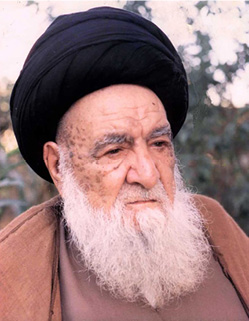
Figure 1. Āyat-Allāh al-ʿOẓmā Abu’l-Qāsem Ḵoʾi. Photograph in the public domain.
In the following decades, Ḵoʾi continued to consolidate his name as a scholar and teacher in Najaf. His excellence was well established by the time of the death of the Iraqi marjaʿ Moḥsen Ḥakim (d. 1970), earning him the endorsement of Najaf’s scholarly community for his marjaʿiya. While other high-ranking scholars of Iraq and Iran also held the position of marjaʿ, Ḵoʾi became the most widely followed religious authority amongst Shiʿite communities worldwide.
Ḵoʾi was recognized for the quality and breadth of his knowledge and scholarship. He wrote on the main religious sciences of feqh (q.v.), oṣūl al-feqh, and Qurʾanic exegesis (q.v.) such as his Bayān fi tafsir al-Qorʾān (The Prolegomena to the exegesis of the Qurʾan), which offered critical takes on the collection and canonization of the sacred text (Sachedina, pp. 15-20). Ḵoʾi also developed a particular interest and expertise in ʿelm al-rejāl, the discipline dedicated to the study of the transmitters of traditions. His 24-volume Moʿjam rejāl al-Ḥadiṯ (Biographical dictionary of the narrators of the Traditions) proposed a new methodology by which he evaluated more than 15,000 transmitters (Takim); one biographical entry in volume 23 was dedicated to Ḵoʾi himself. Like any other marjaʿ, Ḵoʾi also published treatises of practice (resāla ʿamaliya) containing his rulings on various aspects of religious practice to be used by his followers.
Ḵoʾi’s contributions as a teacher became another pillar of his scholarly legacy. He taught hundreds of scholars (for a list, see al-Šarif, pp. 677-95), while many others are considered his indirect students. The notes of his baḥṯ al-ḵārij lectures that were compiled and published as taqrirāt by his most promising students (for a list, see Ḥamāda, pp. 262-63) provide an insight not only of his interpretation of the subjects he covered but also of how he taught them. Ḵoʾi’s classroom was also a breeding ground for the next generation of marājeʿ. Several of his former students rose to the position following his death, for instance ʿAli Sistāni (b. 1930), Esḥāq Fayāż (b. 1930), Bašir Najafi (b. 1942), and Saʿid Ḥakim (d. 2021) in Najaf; Moḥammad Ruḥāni (d. 1997), Mirzā-Jawād Tabrizi (d. 2006), and Ḥosayn-Wahid Ḵorāsāni (b. 1921) in Qom; or Lebanon’s Moḥammad-Ḥosayn Fażl-Allāh (d. 2010). To this day, a past teacher-student relationship with Ḵoʾi remains a source of “scholarly capital” claimed by most Najaf-educated marājeʿ (Corboz, 2019, p. 454).
Ḵoʾi also supported the training of scholars and preachers outside his own classroom. Several educational institutions were established in his name. In the 1980s, at a time when much uncertainty loomed over the Iraqi seminaries under Baʿthist rule, Ḵoʾi’s main representative in Iran built two theological colleges, Madinat al-ʿElm (City of Knowledge) in Qom and the Grand Ayatollah Ḵoʾi School in Mashhad, as well as a smaller religious school in Isfahan. Although Ḵoʾi’s projects in Iran did not remain immune from state interference, and increasingly so under Supreme Leader ʿAli Ḵāmenaʾi (Corboz, 2015a, pp. 97-8), they have been marks of his enduring educational legacy, also after his death. Ḵoʾi’s patronage was not limited to the main Shiʿite centers of learning in Iran and Iraq but also offered educational opportunities to aspiring religious scholars further afield, in Pakistan, India, and Thailand for instance.
The establishment of religious schools was only one facet of the wide patronage network Ḵoʾi sustained as marjaʿ and recipient of vast amounts of ḵoms (q.v.; religious tithes) paid by his followers. His local representatives helped the needy and also established more permanent institutions such as Moḥammad-Ḥosayn Fażl-Allāh’s orphanage Mabarrāt al-Emām al-Ḵoʾi in southern Beirut. Founded in 1989 toward the end of Ḵoʾi’s life, the Imam Al-Khoei Benevolent Foundation (q.v.) was a unique initiative aimed at centralizing the management of his religious funds and charitable projects, as well as to ensure their maintenance after him. Headquartered in London, this international foundation has responded to the growth of Shiʿite communities in the West by opening several Islamic centers and private schools in the United Kingdom, France, and North America. It has also administered religious, educational, and social projects in South Asia and South-East Asia.
Politically, Ḵoʾi is often presented as the antithesis of his contemporary Ayatollah Khomeini (q.v.), whose doctrine of Islamic government under the guardianship of the jurist (welāyat-e faqih) he did not subscribe to. Rather, he maintained the more conventional view that the authority of religious scholars over the affairs of the Muslim community was limited and not equal to the general authority held by the Prophet and the Imams. Accordingly, qualified scholars could assume such functions as issuing legal opinions, adjudicating legal disputes, and serving as guardian of those unable to fend for themselves, but not the mandate of political governance (Mavani, p. 811; on Ḵoʾi’s conception of judgeship, see Gleave, pp. 108-9).
Yet the characterization that is often put forth of Ḵoʾi as a quietist can be misleading. While he may not have had a sustained record of political, let alone revolutionary, activism, he did not remain aloof from political affairs altogether. Rather, his career was marked by “moments of activism” (Corboz, 2015a, p. 120) in response to political developments in Iran and Iraq, as well as to events unfolding elsewhere in the Middle East and in South Asia.
Ḵoʾi was particularly critical of the Iranian monarchy during the early 1960s. He denounced the secularizing reforms associated with the White Revolution and what he perceived as the Bahāʾi and Zionist domination of Iranian society and government. He usually privileged a diplomatic approach to the state by sharing his concerns and advice through private missives. Put differently, he did not seek open confrontation nor to incite popular mobilization against the monarchy. This may explain his ambivalent attitude to Khomeini’s opposition movement. Ḵoʾi readily condemned the government’s repression of the demonstrations of 15 Ḵordād/5 June 1963 and subsequently sent several messages requesting the release of Khomeini and other Iranian scholars who had been imprisoned. He also reacted, though less strongly than before, to the decision to exile Khomeini. However, the two ayatollahs had few interactions during the fifteen years Khomeini spent in Najaf, nor did they discuss politics (Corboz, 2015b, p. 228). In general terms, Ḵoʾi’s involvement in the affairs of Iran waned during this period.
Ḵoʾi’s reaction to the unfolding of the Iranian revolution was similarly inconsistent. According to reporting at the time by the Sāzmān-e eṭṭelāʿāt wa amniyat-e kešvar National Intelligence and Security Organization, commonly known as SAVAK), Ḵoʾi made some gestures in solidarity with the protest movement during the spring of 1978. By September, he however expressed concern at the human cost (Corboz, 2015a, pp. 169-70). Much controversy arose when Queen Faraḥ Dibā of Iran visited him in Najaf later in the autumn. While his supporters later justified this on grounds that he was tricked into this meeting, his detractors continued to hold it against him (Corboz, 2015a, pp. 170-71). After the success of the revolution, Ḵoʾi issued a statement in favor of the March 1979 referendum on the Islamic Republic (for a copy, see al-Jazāʾiri, p. 90), but he did not otherwise express his views on the specific system of cleric-run government which was eventually put in place, nor on its domestic or international policies. Significantly, he remained neutral during the Iran–Iraq War (1980-88) despite the efforts of both warring sides to obtain some sign of support from him.
Based in Iraq, Ḵoʾi also had to assess how to engage the Baʿthist regime at a time of mounting state pressures on the religious establishment and Iraq’s Shiʿite population more broadly. As an Iranian national who could easily be deported—a fate suffered by so-called Shiʿa of Iranian descent in the early 1970s—he chartered a cautious course of action. Throughout the Iran–Iraq War, he resisted the intimidation campaign intended to have him endorse the Iraqi war effort, such as the confiscation of his funds, the arrest and execution of members of his entourage, and other measures of “containment” (Kadhim, pp. 16-36). At least on one occasion, in January 1987, Ḵoʾi sent a letter to Saddam Hussein himself in which he qualified the pressures against the ḥawza as intolerable and urged the Iraqi president to lift them or otherwise to have him leave Iraq (for a copy, see al-Jazāʾiri, p. 99). Regardless of the effect of this message, which cannot be ascertained, Ḵoʾi is generally credited for having ensured the survival and independence of the ḥawza of Najaf in particularly trying times.
During the Gulf crisis of 1990-91, Ḵoʾi condemned implicitly the Iraqi invasion of Kuwait with a fatwā (q.v.) that forbade the purchasing of looted goods from Kuwait. More famous are two edicts he issued at the height of the popular uprising of March 1991. At a time when Baghdad had lost control over most of the Shiʿite south, his edict that appointed a committee of religious and tribal dignitaries to supervise the local affairs of the city of Najaf was a particular affront to Baʿthist authority. As soon as the uprising was put down, Ḵoʾi was forced to appear on state television with Saddam Hussein and then placed under house arrest, where he died the following year on 8 Ṣafar 1413/8 August 1992.
Ḵoʾi marked his era not only during his lifetime but also through his legacy. His writings and the scholars he trained have kept alive his intellectual tradition. Numbers of his followers have continued to refer to his religious rulings, a practice Ḵoʾi accepted (Mottahedeh, p. 17). The educational and charitable institutions established in his name in various parts of the world have remained active, a philanthropic network that has further expanded through the work of the Al-Khoei Foundation. Ḵoʾi’s approach to politics helped the ḥawza of Najaf maintain its independence in challenging times and also remains a model for many current and probably future Shiʿite religious authorities.
Bibliography
ʿAli Bahādeli, Wamadāt men ḥayāt al-Emām al-Ḵoʾi, Beirut, 1992.
Elvire Corboz, Guardians of Shi’ism: Sacred Authority and Transnational Family Networks, Edinburgh, 2015a.
Idem, “Khomeini in Najaf: The Religious and Political Leadership of an Exiled Ayatollah,” Die Welt des Islams 55/2, 2015b, pp. 221-48.
Idem, “Iraq’s Sources of Emulation: Scholarly Capital and Competition in Contemporary Shiʿism,” Middle East Critique 28/4, 2019, pp. 445-65.
Robert Gleave, “Political Aspects of Modern Shi’i Legal Discussions: Khumayni and Khu’i on Ijtihâd and Qada’,” Mediterranean Politics 7/3, 2002, pp. 96-116.
Ṭarrād Ḥamāda, Al-Emām Abu’l-Qāsem al-Ḵoʾi: zaʿim al-ḥawza al-ʿelmiya, London, 2004.
Moḥammad-Jawād Jāsem Jazāʾeri, Al-Sayyed Abu’l-Qāsem al-Ḵoʾi: roʾā-ho wa mawāqefo-ho al-siāsiya, [Najaf], [2017] (available at http://www.alkhoei.net/01-AllFiles/Texes/pdf/bohoth-elmie-0022.pdf).
Abbas Kadhim, The Hawza Under Siege: A Study of the Ba’th Party Archive, IISBU Occasional Paper 1, Boston, 2013.
Yousif al-Kho’i, “Grand Ayatollah Abu al-Qassim al-Kho’i: Political Thought and Positions,” in Ayatollahs, Sufis and Ideologues: State, Religion and Social Movements in Iraq, ed. Faleh Abdul-Jabar, London, 2002, pp. 223-30.
Elhām Ḥamza Mansi, “Šaḏarāt men ḥayāt al-Sayyed Abu’l-Qāsem al-Ḵoʾi (1899-1992),” Basic Education College Magazine for Educational and Humanities Sciences 17, 2014, pp. 424-50 (available at https://www.iasj.net/iasj/download/21d6765437d23e8d).
Hamid Mavani, “Ayatullah Khomeini’s Concept of Governance (Wilayat al-Faqih) and the Classical Shi’i Doctrine of Imamate,” Middle Eastern Studies 47/5, 2011, pp. 807-24.
Moʾassesa-ye ḵayriya-ye Āyat-Allāh al-ʿOẓmā–ye Ḵoʾi, ed., Yād-nāma-ye ḥażrat-e Āyat-Allāh al-ʿOẓmā-ye Ḵoʾi, Qom, 1372/1993.
Roy Parviz Mottahedeh, The Quandaries of Emulation: The Theory and Politics of Shi’i Manuals of Practice, The Ninth Farhat J. Ziadeh Distinguished Lecture in Arab and Islamic Studies, Seattle, 2011.
Jawdat Qazwini, Taʾriḵ al-Qazwini fi tarājem al-mansiyin wa‘l-maʿrufin men aʿlām al-ʿErāq wa ḡayrehem (1900-2000), vol. I, Beirut, 2012, pp. 296-305.
Abdulaziz A. Sachedina, “Translator’s Introduction: Al-Khu’i and the Twelver Shi’ites,” in Abu al-Qasim al-Musawi al-Khu’i, The Prolegomena to the Qur’an, introduction and translation by Abdulaziz A. Sachedina, New York, 1998, pp. 3-22.
Saʿid Šarif, “Talāmiḏat al-Emām al-Ḵoʾi,” in Al-Emām al-Ḵoʾi: al-marjaʿ al-šiʿi al-akbar, ed. Moḥammad Saʿid Ṭorayḥi, Oud-Beijerland, n.d., pp. 677-95.
Liyakat Takim, “The Methodology of Ayatullah al-Khū’i in his Muʿjam al-Rijāl,” Islamic Perspective 16/2, 2016, pp. 137-48.
Moḥammad Saʿid Ṭorayḥi, ed., Al-Emām al-Ḵoʾi: al-marjaʿ al-šiʿi al-akbar, Oud-Beijerland, n.d.