



ii. MONUMENTS AND INSCRIPTIONS
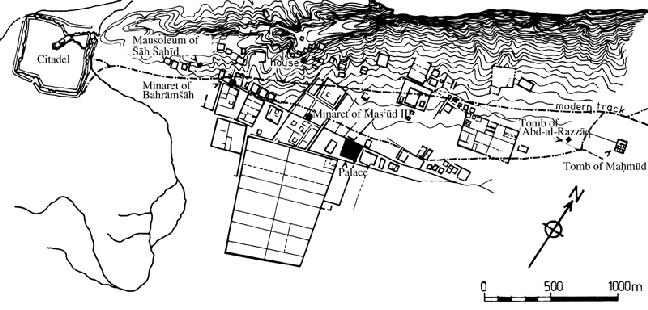
The earliest known monuments of Ḡaznī belong to the Ghaznavid period (366-583/977-1187), the best representative of which are the two minarets standing east of the citadel, close to two large mounds resembling mosques (Bombaci, 1959, p. 7; Figure 1). Each minaret bears a dedicatory inscription containing respectively the names of Masʿūd III (492-509/1099-115) and Bahrāmšāh (512-52/1118-157). They are built of brick and present two similar polygonal star-shaped basements that were originally surmounted by cylindrical shafts (Vigne, p. 125; Survey of Persian Art III, fig. 337; PLATE I). The shafts collapsed between the end of the 19th and the beginning of the 20th century, and the remains were subsequently covered by a tin roof.

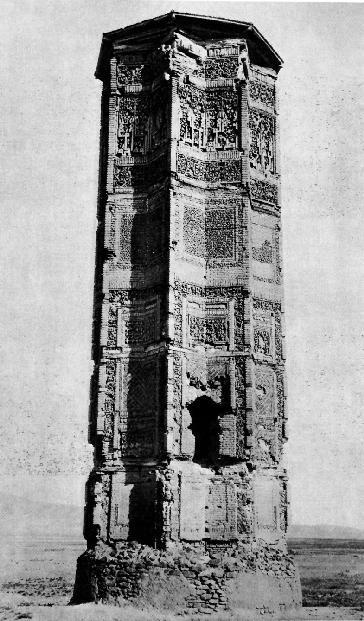
Three different types of inscriptions are carved on Masʿūd’s minaret, whose decoration remained incomplete when he died. The first inscription, in bordered kufic, decorates the upper part of the basement. The name and titles of the sultan follow the besmellāh formula (q.v.). Next is a fragmentary cursive inscription on a narrow band framing some panels and containing the entire chapter 48 (Sūrat al-fatḥ) of the Qurʾān. The last one, in square kufic, containing the name of the sultan and some of his titles, decorates the lower part of the basement (Pinder-Wilson, 1985, pp. 90-91).
The only inscription carved on the upper part of Bahrāmšāh’s minaret is in bordered kufic similar to that of Masʿūd’s minaret; it starts with the basmala followed by the sultan’s name and titles (Sourdel-Thomine, 1953).
During the excavation campaigns (1957-64) the Italian Archaeological Mission brought to light the remains of a magnificent palace in the plain of Dašt-e Manāra at some 300 m east of Masʿūd’s minaret (Scerrato). The archaeologists ascribed the palace to Masʿūd III both on the basis of its proximity to his minaret and the two cursive inscriptions carved respectively on a fragmentary meḥrāb arch and a marble architectural element. The first contains the name of the sultan, the latter that of the architect and the date of construction (Ramażān 505/March 1112; Bombaci, 1966, pp. 3-4), i.e., towards the end of Masʿūd III’s reign. The palace, with a four-ayvān courtyard, built of brick with marble panels and pavements, constituted a real royal town with a mosque, some residential, commercial, and military quarters, public areas, and gardens. Of the more than 510 original marble panels (70 cm high) of the base of the walls surrounding the main court, 44 came to light. Each panel has three parts; the upper part, about 10 cm high, bears an inscription in Persian verses carved in foliated kufic (one of the oldest examples of Persian epigraphy; see epigraphy iii). The central part, about 58 cm high, shows elaborate palmettes that fill the typical Ghaznavid trefoil arches. The lower part, approximately 6 cm high, bears a narrow band of vegetal scrolls. The ornament of these marble panels sometimes shows quadrupeds and birds (Bombaci, 1966).
Literary sources describe the intense building activity of the Ghaznavid rulers, but no other remains have been discovered until now (Bombaci, 1958). Several factors contributed to the rapid disappearance of the buildings: numerous devastating assaults (beginning with the fire set by the Ghurid ʿAlāʾ-al-Dīn Ḥosayn in 545/1150-51), powerful earthquakes (esp. in 1505, 1832, 1842, 1874, and 1902; Stenz, pp. 41-50), the tendency of each Ghaznavid ruler to abandon the residence of his predecessor, and the effect of cold climate on brick-structures. The historian Abu’l-Fażl Bayhaqī (q.v.) reports that the residence of Masʿūd I was in ruin only twenty years after its construction (ed. Fayyāż, p. 499). The traveler Ebn Baṭṭūṭa visited Ḡazna in the 14th century and was surprised by the desolate landscape around it (III, p. 88). In 910/1504 the Mughal Ẓahīr-al-Dīn Moḥammad Bābor seized Ḡaznī and described it as a “very humble place.” He mentioned the tombs of Maḥmūd, Masʿūd, Ebrāhīm, as well as many anonymous “blessed” ones (Bābor-nāma, tr., Beveridge, pp. 218-19).
From 1957 to 1966 the Italian Archaeological Mission uncovered many tombs scattered over the several small cemeteries and shrines (zīārāts) located in particular to the east of the citadel. The white marble monuments distinguish a conspicuous group of individual tombs, thus constituting evidence for the uninterrupted evolution in the construction of tombs and the related inscriptions since the beginning of the Ghaznavid period (Giunta). The tombs consist of two or more superimposed and scaled-down architectural elements forming a truncated pyramid. Each tomb is composed of a basement and a crested top element connected by one or more intermediate element.
The tombs of the Ghaznavid period, generally without cenotaphs, consist of low basements surmounted by prismatic elements and a rich variety of stepped socles and crested top components. In contrast, the funerary architecture of the Ghurid (q.v.) period was always provided with high cenotaphs, while the prismatic elements changed in height, width, and length, and the stepped socles disappeared. Since the 15th century, the tombs became simpler and the intermediate elements progressively disappeared. The funerary architecture of Ḡaznī has no close parallels in any other region of the Islamic world. It is noteworthy, however, that pictures of similar tombs can be found in some 13th-century manuscripts (Rice, pls. iv-vii; Ateş, pls. 11, 15, figs. 31, 42-44; Melikian-Chirvani, figs. 62-63, 65).
The inscriptions, carved in relief, generally occupy the four sides of each element of the tomb. The epitaphs follow a standard scheme which changes according to the dynasties. During the Ghaznavid period the most complete formula includes the besmala, the šahāda, the formula hāḏā qabr (this is the tomb of), the name of the deceased together with his genealogy and titles, the date of death, some koranic verses, and invocations for the deceased. The tombs of the Ghurid period lack the name of the deceased, while the šahāda occupies the two longitudinal faces of the top element. The āyat al-korsī (Qurʾān 2:255) was often repeated on the elements of the tomb. In late tombs the epitaphs generally contain the name of the deceased and some koranic verses. The majority of Ḡaznī tombs are dateless, but they can be dated on the basis of those bearing dates or clear attributions.
The tombs are of great interest both for their structure and their ornamental and epigraphic features. Under the Ghaznavids kufic reached very eleborated forms acquiring a high decorative character. Four types of kufic were adopted: simple kufic with some decorative devices (since the end of the 10th cent.); square kufic (since the 11th cent.), bordered kufic in which the letters are often prolongated and generate two half palmettes or half leaves (since the mid-11th cent.); and foliated kufic whose angular letters bear leaves, scrolls, and half palmettes (since the beginning of the 12th cent.). Many ornamental elements are freely inserted in the spaces above or beside the letters. Kufic is not documented in the funerary inscriptions of the Ghurid period.
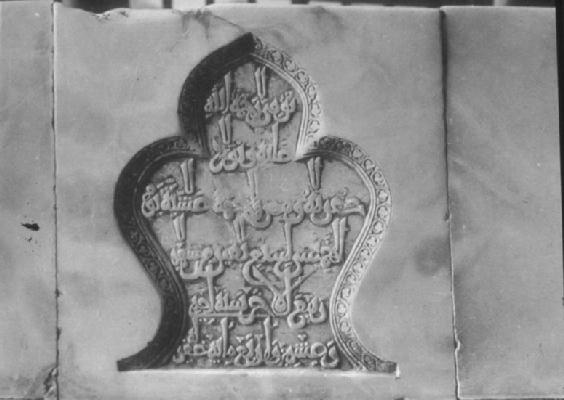
Since the first half of the 11th century the Ghaznavids also used the cursive script for funerary epigraphy as in one of the twenty-four inscriptions carved on the tomb of Maḥmūd (d. 421/1030) and in that of an unknown person who died in 447/1055. Both inscriptions contain six lines framed by a trilobed arch (PLATE II). These two inscriptions, together with another one carved on marble from the Ghaznavid mosque at Rāja Gīrā in the Swāt Valley and dated 440/1048-49 (Nazir Khan, pp. 153-66), are probably the earliest monumental cursive inscriptions in the Islamic world.
Bibliography
F. R. Allchin and N. Hammond, eds., The Archaeology of Afghanistan from Earliest Times to the Timurid Period, London, New York, and San Francisco, 1978.
O. Aslanapa, Turkish Art and Architecture, London, 1971.
A. Ateş, “Un vieux poème romanesque persan: récit de Warqah et Gulshāh,” Ars Orientalis 4, 1961, pp. 143-52, pls. 1-15.
A. D. H. Bivar, “Naghar and Iryāb: Two Little-Known Islamic Sites of the North-West Frontier of Afghanistan and Pakistan,” Iran 26, 1986, pp. 131-38, fig. 1, pl. i.
S. S. Blair, The Monumental Inscriptions from Early Islamic Iran and Transoxiana, Leiden etc., 1992.
A. Bombaci, “Ghaznavidi,” in Enciclopedia Universale dell’Arte VI, 1958, pp. 5-16.
Idem, “Introduction to the Excavations at Ghazni: Summary Report on the Italian Archaeological Mission in Afghanistan,” East and West 10, 1959, pp. 3-22, figs. 1-17.
Idem, “Les Turcs et l’art ghaznavide,” First International Congress of Turkish Arts, Ankara 1959, Ankara, 1961, pp. 67-70.
Idem, The Kūfic Inscription in Persian Verses in the Court of the Royal Palace of Masʿūd III at Ghazni, Rome, 1966.
E. Diez, Persien: Islamische Baukunst in Churāsān, Gotha, 1923.
S. Flury, “Das schriftband an der Türe des Maḥmūd von Ghazna (998-1030),” Der Islam 8, 1918, pp. 214-27.
Idem, “Le décor épigraphique des monuments de Ghazna,” Syria 6, 1925, pp. 61-90, figs. 1-11, pls. v-xxiv.
E. Galdieri, A Few Conservation Problems Concerning Several Islamic Monuments in Ghazni (Afghanistan): Technical Report and Notes on a Plan of Action, Rome, 1978.
R. Giunta, Les inscriptions de la ville de Ġaznī (Afghanistan), Ph.D. diss, Université de Provence, 1999.
J. A. Godard, “L’inscription du minaret de Masʿūd III à Ghazna,” Athār-è Īrān 2/1, 1936, pp. 367-69, fig. 236.
A. Grohmann, “The Origin and Early Development of Floriated Kūfic,” Ars Orientalis 2, 1957, pp. 183-213, figs. 1-34, pls. i-x.
A. Grohmann, Arabische Palaographie II: Das schriftwesen. Die lapidarschrift, Vienna, 1971.
ʿA.-Ḥ. Ḥabībī, Tārīḵ-e ḵaṭṭ wa neveštahā-ye kohan-e Afḡānestān, Kabul, 1971.
G. J. Jalālī, Ḡazna wa ḡaznavīān, Kabul, 1351/1932.
A. S. Melikian-Chirvani, “Le roman de Varqe et Golšāh,” Arts Asiatiques 22, 1970, pp. 1-262, figs. 1-65.
D. Monchi-Zadeh, “Notes on the Kūfic Inscription of the Royal Palace of Masʿūd III at Ghazni,” Orientalia Suecana, 16, 1967, pp. 113-26.
A. A. Naimi, “Les monuments historiques et les mausolées de Ghazni,” Afghanistan 7/2, 1952, pp. 9-18.
M. Nazir Khan, “A Ghaznavid Historical Inscription from Uḍegrām, Swāt,” East and West 35, 1985, pp. 153-66, figs. 1-7.
R. Pinder-Wilson, Ghaznevid and Ghurid Minarets, Kabul, 1981.
Idem, “The Minaret of Masʿūd III at Ghazni,” Studies in Islamic Art, London, 1985, pp, 89-102, pls. 1-7.
G. A. Pugacenkova, “La genèse centre-asiatique des minarets indiens,” Cahiers d’Asie Centrale 1-2: Inde-Asie centrale, Routes du commerce et des idées, Aix en Provence, 1996, pp. 127-32.
D. S. Rice, “The Oldest Illustrated Arabic Manuscript,” BSO(A)S 22, 1959, pp. 207-20, pls. i-ix.
M. Reżā, Rīāż al-alwāḥ (Inscriptions from Ghazni), Kabul, 1967.
U. Scerrato, “The First Two Excavation Campaigns at Ghazni, 1957-1958.
Summary Report on the Italian Archaeological Mission in Afghanistan,” East and West 10, 1958, pp. 23-55, figs. 1-60.
J. Sourdel-Thomine, “Deux minarets d’époque seljoukide en Afghanistan,” Syria 30, 1953, pp. 108-36, figs. 1-4.
Idem, “L’art ġūride d’Afghanistan à propos d’un livre récent,” Arabica 7, 1960, pp. 273-80.
Idem, “Ghaznawides: art et monuments,” EI2 II, pp. 1053-55.
Idem, “Ḳabr,” ibid., IV, pp. 352-55. Idem, “A propos du cénotaphe de Mahmūd à Ghazna (Afghanistan),” in A. Daneshvari, ed., Essays in Islamic Art and Architecture in Honour of Katharina Otto-Dorn, Malibu, Calif., 1981, pp. 127-35, figs. 1-4.
E. Stenz, “Earthquakes in Afghanistan,” Afghanistan 1, 1946, pp. 41-50.
Idem, “A Manuscript from the Library of the Ghaznavid Amir ʿAbd al-Rashid,” in R. Pinder-Wilson, ed., Paintings from Islamic Lands, London, 1969, pp. 17-21.
Y. Tabbaa, “The Transformation of Arabic Writing: Part 2. The Public Text,” Ars Orientalis 26, 1994, pp. 117-47, figs. 1-30.
G. T. Vigne, A Personal Narrative of a Visit to Ghazni, Kabul, and Afghanistan and of a Residence at the Court of Dost Mohamed with Notices of Runjit Sing, Khiva and the Russian Expedition, Lahore, 1982.