
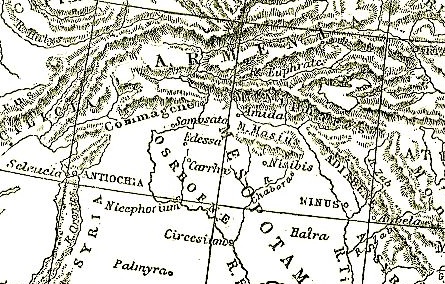



EDESSA (Aram. and Syr. Urhai/Orhāi; Ar. Rohāʾ), now Urfa in southeastern Turkey, former capital of ancient Osrhoene (Antiochus IV Epiphanes (175-64 B.C.E.), to Antiochia on the Callirhoe (a local fishpond), but after his reign it reverted to Edessa and Urhai.
The fact that coins were minted at Edessa under Antiochus IV suggests a degree of autonomy and importance in the Seleucid period. Greeks were never predominant in the population, however, as attested by the epithet “half-barbarian” (Gk. mixobárbaros; Malalas, pp. 418-19). Arab influence was strong in the region, and when Seleucid power declined in the late 2nd century B.C.E. Edessa became the capital of a small kingdom, ruled by the so-called “Abgar dynasty,” generally allied with the Parthians, and under strong Parthian cultural influence. Pliny the Elder (5.85) called the inhabitants of Osrhoene “Arabes,” and the ruler was also known as “phylarch” or “toparch” of the Saracens (Festus, 14). It was upon entering Edessa in 114 C.E. that the Roman emperor Trajan received the title Arabicus. From that time onward Edessa came increasingly within the Roman sphere.
In the Roman civil wars of 193-94 Edessa supported Gaius Pescennius Niger, governor of Syria, who made peace with the Parthians before being defeated by Septimus Severus (193-211). At some time between 195 and 199 Severus created two new provinces out of the conquered territories beyond the Euphrates, to serve as buffers for the province of Syria. According to a fragmentary inscription from the ruined fortress at Eski Hasr, about 70 km west-northwest of Edessa, it had been built “between the province of Osrhoene and the kingdom of Abgar” (Wagner), evidence that Abgar VIII (177-212) had retained his domain, though it must have been reduced to a small area around Edessa. The kingdom of Osrhoene was finally abolished in 249 (Michael, V/5, pp. 77-78).
Christianity must have been established in Edessa before the end of the 2nd century C.E., as a “church” was among the buildings destroyed in a disastrous flood in about 216 (Chronicle, pp. 1-2). The city had its martyrs (Guria and Shamona being the best known) during the persecutions under Diocletian (284-305). After they ceased Christianity quickly became the dominant religion in Edessa, which was a favorite stopping place for pilgrims on their way to nearby Carrhae. Abgar IX (214-40) was a patron of the gnostic teacher Bardesanes, who played an important role in the life at court. A letter from Mani (d. 274) to the community at Edessa, cited in the Cologne Mani Codex, indicates that Man-icheans were also active in the city even during his lifetime.
Although the Sasanian Šāpūr I (240-70) won a great victory near Edessa in 260, capturing the Roman emperor Valerian, in his inscription at Kaʿba-ye Zardošt near Persepolis the city is not listed among those captured in that campaign. This omission and the fact that he had to bribe his way past the garrison at Edessa during his withdrawal suggest that the city either held out against him or was under his control for only a short time. After Galerius Maximianus’ victory over the Persians in 298 Edessa became the capital of the new province of Osrhoene. Its military importance was emphasized by the Roman turncoat Antoninus, who pointed out to Šāpūr II (309-79) in 359 that, if Edessa were not captured, his rear would not be secure (Ammianus Marcellinus 18.5.7). While Nisibis was the major fortress in the Mesopotamian limes, Edessa served as a base, providing fresh supplies of men and material to the forward position. It was probably during Diocletian’s reorganization in 293 that a state factory was built there to provide arms and equipment for the troops deployed on the frontier (Malalas, p. 307; Notitia Dignitatum [east] 11.23). Edessaδs own defenses were never tested by the Persian army during the reign of Šāpūr II. There is no indication that it had a regular garrison, apart from soldiers seconded to serve on the staff of the commander of the province (dux Osrhoenae).
When the Roman emperor Jovian surrendered Nisibis to the Persians in 363 a flood of refugees, mainly Christians, poured into Edessa. Among them was the poet Ephraim the Syrian, who helped to found a seminary popularly known as the “school of the Persians.” In the christological controversies of the late 4th century the school took the side of Nestorius and, as the population of Edessa increasingly adopted the Monophysite view, was finally forced to move to Nisibis, which was still held by the Persians. Edessa withstood a fierce siege in 544 (Procopius, De Bello Persico 2.26.5-2.27.46) but fell to Ḵosrow II Parvēz (590-628, with interruption) in his sweep across Mesopotamia in 609 (Chronicon, p. 699). A number of leading Monophysites were deported to Persia (see DEPORTATIONS ii). The Byzantine emperor Heraclius retook Edessa in 628 and restored orthodoxy. In 18/639 the Byzantine general Ptolemaius surrendered the city to the advancing Arabs.
For some centuries after the Muslim conquest Edessa was inhabited by a substantial Christian population, despite the damage inflicted by sieges, sacks, and predatory governors. In about 421/1030 the town was retaken by the Byzantines, who held it until 479/1086, when it was recaptured by the Saljuqid Malekšāh (465-85/1072-92); he lost it to an Armenian adventurer a few years later. In 492-538/1097-1144 the city was the capital of the Crusader county of Edessa. In 658/1260 it surrendered to the Mongols, becoming one of the westernmost towns of the Il-khanid and Timurid empires. It was taken from the Āq Qoyunlū by Shah Esmāʿīl I (907-30/1501-24).
Urfa (1965 population 73,400) is now the capital of the Turkish province of the same name.
See also ABGAR.
Bibliography
Chronicle of Edessa, ed. I. Guidi et al., CSCO 1, Louvain, 1955.
Chronicon Paschale, ed. L. Dindorf, Bonn, 1832.
H. J. W. Drijvers, “Hatra, Palmyra und Edessa,” ANRW II/8, 1978, pp. 799-906.
E. Honigmann [C. E. Bosworth], “al-Ruhā,” in EI2 VIII, pp. 589-91.
Ioannis Malalas, Ioannis MalalaeChronographia, ed. L. Dindorf, Bonn, 1831.
E. Meyer, “Edessa,” in Pauly-Wissowa V/2, cols. 1933-38.
Michael the Syrian, Chronique de Michel le Syrien, ed. J. B. Chabot, 3 vols., Paris 1899-1904.
J. B. Segal, Edessa the Blessed City, Oxford, 1970.
J. Wagner, “Provincia Osrhoenae. New Archaeological Finds Illustrating the Military Organization under the Severan Dynasty,” in S. Mitchell, ed., Armies and Frontiers in Roman and Byzantine Anatolia, BAR 156, Oxford, 1983, pp. 103-30.