
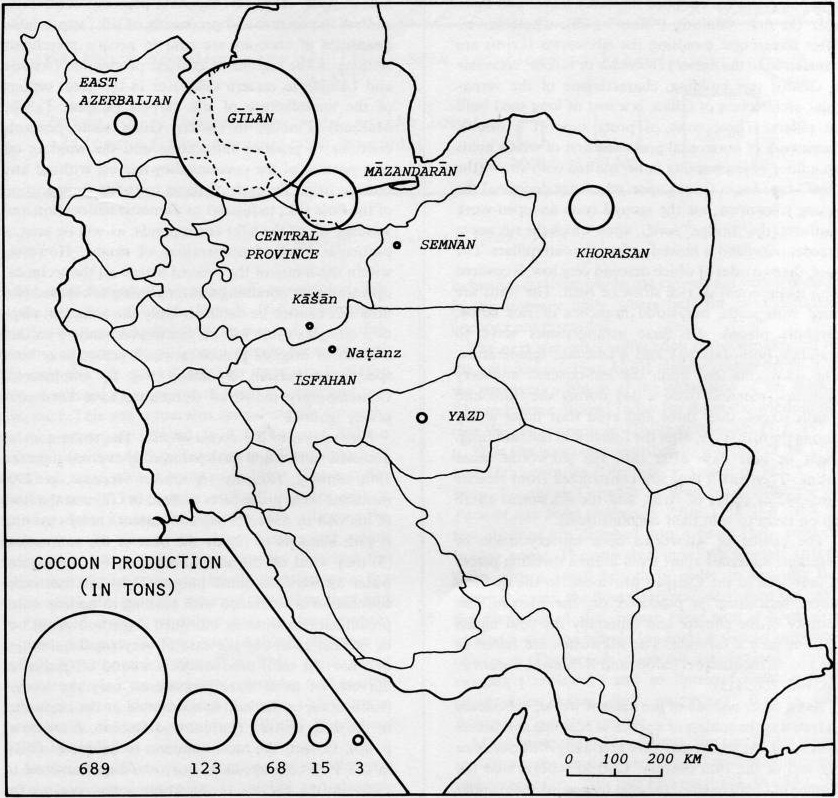



Achaemenid, Parthian and mid-Sasanian Iran. The silk trade and use of silk in luxurious textiles are mentioned with some frequency in the Roman and Byzantine sources, but there are no comparable accounts by Iranian authors (See Otto von Falke, Kunstgeschichte der Seidenweberei I, Berlin, 1913, pp. 25-31; H. J. Schmidt, Alte Seidenstoffe, Braunschweig, 1958, pp. 30-32, 37). Silk weaving is said to have been practiced in Iran in Achaemenid times; and Kallixenos of Rhodes is said to have seen Persian silks embroidered with animals at a banquet given by Ptolemy Philadelphus (Schmidt, Seidenstoffe, p. 51); these would have been made with imported yarn. Nothing survives of this period, although the Achaemenid-style carpet found at Pazyryk witnesses to the skill of Achaemenid weavers (S. I. Rudenko, Frozen Tombs of Siberia, Berkeley and Los Angeles, 1970, pp. 298-302, pl. 174). Early Han silk fabrics comparable to those found at Palmyra (P. Pfister, Textiles de Palmyre, Paris, 1934, 1937, 1940) and 4th to 6th century Chinese silks must have been imported, but the Iranian climate has destroyed their traces. As in the Roman empire and Byzantium, Iranian weavers must have used imported silk yarn. Procopius relates that, in the mid-6th century, silkworms and the secret of their culture were given to the emperor Justinian. Sericulture can be assumed to have reached Iran, possibly from Soḡd (see further below), at the same time or a little earlier.
It now appears that the Western type of drawloom evolved in the Syrian wool-weaving centers in the 2nd-3rd century A.D., perhaps under stimulus of imported Chinese silks. One of the few documented events in the history of Iranian silk weaving is the establishment by Šāpūr I or II of a silk weaving industry in Ḵūzestān (Ṯaʿālebī, Ḡorar, p. 530; Yāqūt, II, p. 496; Masʿūdī, Morūǰ II, p. 186). The weavers coming from eastern Byzantine centers probably brought newly evolved drawloom techniques, but they probably continued, for some time, to use imported yarn or to work with silk unraveled from imported textiles. A controversy has arisen as to whether the weavers were moved to Iran by Šāpūr I or II. R. Pfister, in his study of one of the earliest non-silk fabrics found at Antinoopolis in Egypt, argued for the early date of this event (“Les premières soies sassanides,” Études d’orientalisme publiées par le Musée Guimet à la memoire de Raymonde Linossier II, Paris, 1932, pp. 461-79). This line of reasoning and the early dating he proposed were adopted by Doro Levi in the discussion of Sasanian motifs in his influential Antioch Mosaic Pavements (I, Princeton, 1947, p. 479). J. F. Flanagan has shown more recently, however, that there were errors in the technical analyses on which Pfister based his early dating of the experimental Iranian fabric from Antinoopolis (in The Relics of Saint Cuthbert, ed. C. F. Battiscombe, Oxford, 1956, pp. 485-86); moreover Pfister did not have a clear perception of the stylistic development of Sasanian art. Historical sources may have confused the construction of the Kārūn dam by Roman prisoners (probably under Šāpūr I) and the movement of Syrian weavers; the Syriac sources suggest these two things were unrelated and happened in different reigns (N. Pigulevskaja, Les villes de l’état iranien, Paris, 1963, pp. 159-69).
Because certain of the patterns used in silks excavated at Antinoopolis reflect the formal design or even the actual motifs of Han silks, these textiles probably constitute the earliest surviving group of Sasanian silks; thus a 5th century date for the commencement of Iranian sericulture may be preferred. In this group of Antinoopolis silks the patterns are in registers, frequently with an alteration of three different design elements (a basic scheme of Han silks that probably derived from the characteristic Chinese warp-faced or warp-patterned weave). The motifs and style used are comparable to mid-Sasanian works of art in other media (see Plate XI/1; see Deborah Thompson, Catalogue of the Late Antique and Medieval Textiles at Dumbarton Oaks, in preparation, no. 162; cf. Schmidt, Seidenstoffe, pp. 42-46). A debt to such Sasanian silks has been demonstrated for a group of Coptic wool hangings from Antinoopolis (Ernst Kitziner, “The Horse and Lion Tapestry: A Study in Coptic and Sasanian Textile Design,” Dumbarton Oaks Papers 3, 1946, pp. 1-72). Examples of “Antinoopolis silks” are found in church treasuries and were excavated in smaller numbers at other Egyptian sites such as Aḵmīn (See, e.g., Falke, Seidenweberei, pp. 31-33; E. Chartraire, Les tissus anciens du trésor de la Cathédrale de Sens, Paris, 1911, nos. 3, 6-9; R. Forrer, Römische und Byzantische Seidentextilien aus dem Gräbefelde von Achmim-Panopolis, Strasbourg, 1891, pls. VIII, IX).
Late and post-Sasanian silks. More rarely found in Egyptian excavations were silks with large-scale patters of single animals; these are undoubtedly late and post-Sasanian (mid-6th to mid-7th and a little later). Characteristically, the patterns of this textile group are shared with Sasanian decorative art in other media (metalwork, stucco, and seals) and with Sasanian wool textiles. These silks have long been classified as Sasanian; indeed they have been regarded as exemplifying Sasanian decorative art without regard to distinctions between early, middle, and late Sasanian art, because textiles with this kind of pattern are depicted in the rock reliefs of Ṭāq-e Bostān. (These are best published in E. Herzfeld, Am Tor von Asien, Berlin, 1920, pp. 121-39; and S. Fukai and K. Horiuchi, Taq-i Bustan I, Plates, Tokyo, 1969.) A small number of such silks were found at Antinoopolis, and some made their way into early church burials (see, e.g., P. Lauer, Le Trésor du Sancta Sanctorum, Monuments Piot, Paris, 1906, pls. I, II, fig. 18; Chartraire, Sens, no. 15; Victoria and Albert Museum, Catalogue of Early Medieval Woven Fabrics, by A. F. Kendrick, London, 1925, no. 1000, pl. I; and R. Ghirshman, Persian Art: The Parthian and Sasanian Dynasties, New York, 1962, fig. 375). The last two citations refer to fragments of one silk with sēnmurws from the relics of Saint Lupus; other sēnmurw silks were found in church treasuries (Jacques Dupont, “Le linceul de Saint-Rémi,” Bulletin de Liaison du Centre International d’Étude des Textiles Anciens [BCIETA] no. 15, January, 1962, pp. 38-39; F. Guicherd and G. Vial, “Dossier de recensement [linceul de Saint-Rémi],” pp. 41-47; idem, “Dossier de recensement [coussin d’Aupaïs],” pp. 48-50). The textile reliefs at Ṭāq-e Bostān also include diaper patterns, which were traditional in ancient Near Eastern design; the specifically late Sasanian patterns with large single (or paired) motifs, usually in roundels, were more influential in medieval silk designs. Silks in this style continued to be made into the succeeding period and are sometimes difficult to date precisely. R. B. Serjeant refers to a silk fabric called ḵosravānī and suggests it was made in the Sasanian palace workshop; possibly these late Sasanian silks with roundels were given this name (“Material for a History of Islamic Textiles up to the Mongol Conquest,” Ars Islamica 9, 1942, p. 64, citing Alf layla wa layla I, Beirut, 1914, p. 133; Serjeant’s study is hereafter referred to by his name and the volume numbers of Ars Islamica).
Excavated wall paintings from Central Asian sites, e.g., Panjikent, Tepe Balalyk, Varakhsha, and Afrāsīāb, as well as from Ḵerbat al-Mafǰar near Jericho, offer a range of patterns in this style for comparison with extant textiles and the reliefs of Ṭāq-e Bostān (see bibliography below).
Typical late Sasanian silks manifest scaling—the manipulation of the pattern (binding) warp in groups of three rather than singly, as in the earlier “Antinoopolis silks” and their counterparts in European churches. This technique speeds up the weaving process, because a larger segment of line is produced with each passage of the shuttle; it results in a jagged outline and contributed to the enlargement of patterns (J. F. Flanagan, “Early Figured Silks: The Effect of the Scale Harness on Early Islamic Silks,” The Burlington Magazine 68, 1936, pp. 145-46; idem in Saint Cuthbert, pp. 487-88). Plate XI/2 is an example of a scaled late Sasanian silk. Perhaps the most famous scaled Sasanian silk is the boar’s head fragment found by Sir Aurel Stein in a late 6th century context at Astana (Innermost Asia, Oxford, 1928, pl. LXXVI). It is quite possible that such large-scale patterns were not originally developed in Iran. The basic format with pearled borders reflects that of Chinese mirrors; other features may be specifically Sogdian (M. W. Meister, “The Pearl Roundel in Chinese Textile Design,” Ars Orientalis 8, 1970, pp. 255-67; A. A. Ierussalimskaya, “On the Formation of the Sogdian School of Artistic Silk Weaving,” in Srednyaya Aziya i Iran, Leningrad, 1972, pp. 1-56). Once adopted, however, this textile format was subjected to a stylistic development in late Sasanian and early Islamic Iran that made it the most important source of textile design, in overall scheme and individual motifs, in western Asia and Europe until the Mongol conquest.
Although the Iranian climate does not favor the preservation of silks or other fabrics, discoveries by Soviet scholars in the Caucasus have begun to supplement our knowledge. Two silk caftans or surcoats have been found, one with a sēnmurw silk (Ierussalimskaya, “A Newly Discovered Silk with the Sēnmurw Pattern,” Soobshcheniya Gosudarstvennogo Ermitazha [Soobshcheniya] 24, 1972, pp. 11-15), and one with a geometric horse-and-rider pattern, unlike contemporary or earlier Egyptian, Syrian, and Byzantine silks with horsemen (idem, “The ” Chelyabinsk” Fabric, a Post-Sasanian Silk,” Trudy Gosudarstvennogo Ermitazha [Trudy] 10, 1969, pp. 99-100; idem, “Le tissu de soie au Bahram Gour du sépulcre de Mochtchevaya Balkha,” Trudy 5, 1961, pp. 40-50; idem in Soobshcheniya 24, 1963, pp. 35-39).
East Iranian silks of the 8th and 9th century are marked by a taste for geometrical design that may derive from the angular line of the earlier scaled silks. The large Zandanīǰī group, preserved in numerous European churches and museums, of which one with a Sogdian inscription betrays its origin in the town of Zandana near Bokhara, exemplify such a taste (D. G. Shepherd and W. B. Henning, “Zandanīǰī Identified?” Aus der Welt der islamischen Kunst. Festschrift für Ernst Kühnel, ed. R. Ettinghausen, Berlin, 1959, pp. 15-40; see also Schmidt, Seidenstoffe, pp. 100-06; Plate XII/1). The elephant silk from the abbey of Saint-Josse inscribed with the name of Qāʾed Abū Manṣūr Boḵtagīn is in a more elaborate but even more emphatically geometrical style (M. Bernus, H. Marchal, G. Vial, “Dossier de recensement,” BCIETA 33/1, 1971, pp. 22-57.
Medieval and post-medieval literature of silk. In contrast to the missing physical evidence, there are abundant references to the manufacture and trade in Iranian silk fabrics; but it is risky to relate the trade- and place-names of these goods to the silks now preserved. Particularly difficult is the use of the word dībāǰ “brocade.” This textile term has a specific and limited meaning to experts but has long been used loosely by non-specialists, probably with a generic meaning of “figured silk” (Serjeant, Ars Islamica 10, p. 72, n. 9; cf. Vocabulary of Technical Terms, CIETA, Lyon, 1964, p. 4; I. Emery, The Primary Structures of Fabrics, Washington, D.C., 1966, pp. 171-72). The outstanding collection of medieval written sources remains that of Serjeant (Ars Islamica 9, 1942, pp. 54-92; 10, 1943, pp. 71-90; 11/12, 1946, pp. 98-145; 13/14, 1948, pp. 75-117; 15/16, 1951, pp. 29-85; see also, concerning Iran, S. D. Goitein, A Mediterranean Society; The Jewish Communities of the Arab World . . . I, Berkeley and Los Angeles, 1967, p. 103). Serjeant organized his survey according to established workshops (ṭerāz, Ars Islamica 10) and then geography. A summary of the pertinent information concerning Iranian silk textiles and fiber production follows. (References to ṭerāz establishments and most unspecified textiles are excluded. For primary sources in each case see Serjeant, as indicated.)
The silk goods from Ḵūzestān include brocade (dībāǰ) from Tostar/Šūštar; sūsanǰerd (Sūs and Qorqūb); Qaḷʿa-ye Šūštar; striped silk (raqm al-Qorqūbī</em>); kingly silks (ḵazz molūkī</em>); heavy silks (ḵozūz ṯaqīla) from Sūs; ḵazz silks and eżrīǰ (red silks) and silks used in turbans (from Sūs); silk veils (maqāneʿ</em>); silk garments from several cities, including Rāmhormoz and Jondayšāpūr. Fārs was a source of ḵazz-silks and brocade (Shiraz is specified for both); qazz-silk curtains (especially Sīnīz); curtains or veils of ḥarīr; qazz-silk robes and garments (Sīnīz and Fasā); ebrīsam-silk curtains (Fasā); ḵazz-silk robes (Ṭārom); sūsanǰerd (especially Fasā and Sīnīz, although the latter was noted for its fine linens; Serjeant, Ars Islamica 10, pp. 71-90). Mostawfī mentions Bešāvūr as a production center for silk in Il-khanid times (Serjeant, ibid., p. 89).
Ṭabarestān was noted for carpets and robes and as a heavy producer of silk yarn; specific mention of woven silk and garments of it is made by Eṣṭaḵrī and Ebn Ḥawqal (Serjeant, Ars Islamica 11/12, pp. 100-03). Other, probably all-silk, textiles—satin (aṭlas), ʿattābī, brocade, seqlāṭūn, abrīsam, parda (curtains)—are mentioned by Ebn Esfandīār (Serjeant, ibid., p. 102). Silk saddle cushions are mentioned by the same author as a specialty of the province in the time of espahbads (ibid., p. 98). Gorgān was noted for its woven silks, garments of ḥarīr, brocade, and large silk production. It is also mentioned for its black silk textiles and garments and raw silk. Astarābād is said to have been a source of woven silk as well as two silk textiles, mobram, and zaʿfūrī, with many weavers of qazz-silk. After the Mongol conquest, silk was still available in these two cities, according to Mostawfī (ibid., pp. 104-05).
In the Jebāl, Ray was a noted textile center, but many of its specialties bear names that do not reveal their fiber—e.g., the famous monayyar cloth, which was reputed to have two warps. (A number of possibilities exist in attaching the name to known silk fabrics; it could refer to double cloth, or to the figured, lampas, silks with extra series of inner warps.) Silk (ḥarīr) production and export are mentioned by Ebn al-Faqīh and Jāḥeẓ. The fine curtains (sotūr) and cloth (ṯawb) made and exported in Isfahan may have been of silk. ʿAttābī and silk cloaks are also mentioned for Isfahan, as is seqlāṭūn in the Ḥodūd al-ʿālam (Serjeant, ibid., pp. 106-09).
In Khorasan abrīsam silk is mentioned in connection with Nīšāpūr and Marv, and the abrīsam and qazz-silk industry of Marv is said to have been the origin of the silk industry of Ṭabarestān and Gorgān. The Marv silks were of fine quality, much exported and imitated (ibid., pp. 111-14). Nīšāpūr was a center for cloth weaving of various kinds and for exported silk (ibid., pp. 115-16). In addition to the more usual dībāǰ, qazz-silk, ʿattābī, and seqlāṭūn, other fabrics are mentioned as specialties—tāḵatanǰ and raḵtanǰ; it is not known whether these two were of silk. After the Mongol conquest, silk garments of naḵḵ and velvet (kamḵā) were said by Ebn Baṭṭūṭa to have been woven there for export (ibid., p. 116). Other towns in Khorasan are mentioned for their silk textiles; woven qazz-silk and garments of it at Nesā and Abīvard; brocade and tafetta at Herat (Maqdesī, Ṯaʿālebī, Ṭabarī; ibid., pp. 117-19). The abrīšam silk of Farḡāna was produced at Balḵ before its destruction by the Mongols (ibid., p. 118). Ebn Baṭṭūṭa reported that much silk was produced at Jām; in the Il-khanid period, silk production was carried out at Toršīz, Tūn, Zīrkūh, Jonābād, Zāva, and Ḵᵛāf, while a famous silk (ḥarīr) called Ṭabas silk was said to have been exported from Ṭabasayn (ibid., pp. 119-20).
No monographic study comparable to Serjeant’s has been made of post-Mongol Iran, although the sources are more numerous than for the earlier period. Much of what exists is intertwined with descriptions of costume and interiors, e.g., the work of Neẓām-al-dīn Maḥmūd Qārī of Yazd, the so-called poet of clothes (Browne, Lit. Hist. Persia III, pp. 351-53), and that of Vaččā and Abu’l-Moṭahhar al-Azdī. (For the last two see Muhammad Ferid Ghazi, “Un group social: ” les raffinés”,” Studia Islamica 11, 1959, pp. 41-71, especially p. 55; also Abu’l-Moṭahhar al-Azdī, Hikāyat Abi’l-Qāsim, ed. A. Mez, Heidelberg, 1902.) Later descriptions of locales famous for silk production also provide information (e.g., Sayyed ʿAbdallāh Šūštarī, Taḏkera-ye Šūštar, ed. M. Bakhsh and M. Husain, Calcutta, 1914, pp. 7-8, cited by Serjeant, Ars Islamica 10, p. 74, n. 29). Accounts by European travelers are useful for the Safavid period (e.g., R. de Mans, Estat de la Perse en 1660, ed. C. Schefer, Paris, 1890, p. 186, describing textile workers and goods in Isfahan; see Serjeant, Ars Islamica 11/12, p. 109).
Medieval Silk Textiles. The gaps between the few types of early Iranian medieval silks, the scarce Il-khanid silks, and the numerous Safavid silks were bridged somewhat by the commercial excavation of a tomb tower, Naqqāraḵāna at Ray, in 1924-25. A considerable number of fragmentary silks were brought to light. Of the corpus now given the Ray label, a few may be of late ʿAbbasid date; some use Buyid formulations (Plate XII/2) and are in a style known previously only in a few fragments from late 19th-century collections (e.g., Boston, Museum of Fine Arts, acc. no. 04.1621; see A. C. Weibel, Two Thousand Years of Textiles, New York, 1952, no. 113); some reflect the technique and patterns of Byzantine silks and are probably imports; some are comparable to works of Saljuq style; and a few appear to be later, for technical and stylistic reasons. In the last group are silks that became known several years later than the first silks from the site; a few of them may be of dubious origin (see Thompson, Catalogue, no. 178). For an important contribution that helps to distinguish the relatively limited number of questionable textiles, see Nobuko Kajitani, “The Physical Characteristics of Silk Generally Classified as ” Buyid”,” Irene Emery Roundtable on Museum Textiles. 1974 Proceedings. Archeological Textiles, Washington, D.C., 1975, pp. 191-204. Buyid and Saljuq textiles will continue to come to light in unquestionable circumstances that are comparable with silks of the Ray corpus, e.g., a textile in a binding datable to the 12th century (Erzbischof Garegin Howsepian, “Ein Leinwand aus der Sassanidenzeit im Einband der Etschmiadzin Handschrift Nr. 1759,” Hamdes Amsorya N.F. 49, 1959, cols. 252-63 [Armenian], pp. 351-52 [German summary]); this textile, neither linen nor Sasanian, appears to be silk of a relatively archaic, possibly 11th-century style.
Under Erich Schmidt in the 1930s, the Ray Expedition of the University of Pennsylvania Museum and the Museum of Fine Arts, Boston, unearthed hundreds of smaller silk fragments in the same burial ground at Ray. None of these has been published, but plans are under way at the University of Pennsylvania to publish the finds of the Ray Expedition. (An unpublished report on some of these silks by Florence E. Day is on file in the Philadelphia Museum of Art.) One fragment found by the Ray Expedition is from the same inscribed textile as Dumbarton Oaks acc. no. 30.1 illustrated in Plate XIII/1 (see H. W. Glidden in Thompson, Catalogue, no. 177, b); it is probably Saljuq of the 11th century and illustrates one of the ascension legends popular at that time in both East and West.
Some of the first silks from Ray were exhibited in 1931 (London, Royal Academy of Arts, Catalogue of the International Exhibition of Persian Art, 7th January to 28th February 1931, 2nd ed., pp. 26-28, nos. 38, a, b, h, k, l-q; 39, 40). Subsequently some Ray silks, with others given the same attribution, were published by P. Ackerman in the Survey of Persian Art (III, pp. 1995-2042); by A. U. Pope (and Ackerman) in Masterpieces of Persian Art (Westport, 1945, pp. 72f.); and by Weibel (Textiles, nos. 102-12, 115-20). A certain amount of disbelief greeted the Ackerman, Pope, and Weibel volumes; the doubts of reviewers (M. Aga-Oglu, review of Pope, Masterpieces, The Art Bulletin 29, 1947, p. 58; M. S. Dimand, review of ibid., Gazette des Beaux-Arts 32, November-December, 1947, pp. 187-88; Florence E. Day, review of Weibel, Textiles, Ars Orientalis 1, 1954, pp. 241-42) were exacerbated by these uncritical publications. A cloud rested over the “Ray silks,” which have often been referred to as the “Buyid silks.” This uneasiness was not dispelled by the continued appearance on the market of different types of silks with the Ray label, as well as of more fragments of the original silks. A major collection of the former, formerly that of M. Matossian, was published by G. Wiet (Soieries persanes, Mémoires de l’Institut d’Egypt 52, Cairo, 1948); its publication added to the controversy surrounding the “Ray silks” (review by F. E. Day, Ars Islamica 15/16, 1951, pp. 231-44; rebuttal by R. Ghirshman, Artibus Asiae 14, 1951, pp. 246-48; further reply by Day, Ars Islamica 15/16, 1951, pp. 250-51).
There can be no doubt that silks from other sources, many of which are genuine, were given the Ray attribution by dealers, further clouding the authenticity of the silks excavated in 1924-25. A study in 1973 of 39 silks in the Abegg-Stiftung Bern by the conservator, M. Lemberg-Flury, a chemist with background in European dyeing, J. Hofenk-de Graaff, and G. Vial, weaving analyst of the Centre International d’Étude des Textiles Anciens, attempted to settle the question. This publication (BCIETA 37, 1973) received a monographic reply by D. G. Shepherd, who has studied the “Ray silks” for many years (“Medieval Persian Silks in Fact and Fancy [A Refutation of the Riggisberg Report],” BCIETA 39/40, 1974, pp. 1-135). Her study contains technical appendices by various specialists on the characteristics and condition of the thread and yarn of the Ray silks, including microphotographs. Further bibliography is given below; see also Thompson, Catalogue, chap. 15 (intro.).
Post-Mongol conquest silks. Few silks survive datable between the silks of Saljuq style from Ray (Naqqāraḵāna) and the large body of Safavid silk textiles. One reason for this, already mentioned, is climate. Another has to do with the development of an active silk textile industry in Europe, superseding the former European dependence on luxury silk imports from Byzantium and the Islamic countries. The general disruptions arising from the Mongol invasions also interrupted trade with Europe. The result is the absence of silks attributable to Iran of this period in European royal and church treasuries, unlike the situation in the earlier period. The Il-khanid decorative arts, like the 13th and 14th-century Italian silks, were strongly marked by influences from China, thereafter a source in Iran of design borrowings. In the post-Mongol period, the schemes of textile patterns finally changed from the dominant large-roundel format developed in the late Sasanian period to ones featuring greater overall foliation, arabesques, gridwork, and serpentine and diagonal frameworks, as well as individual motifs taken from Chinese design.
Safavid silk textiles are in a limited number of weaves. Among them are compound cloths and twills, brocaded in various bindings; cut and uncut solid and voided velvets; and (warp) satin. They include some which are sumptuous in the extreme, with gold and silver wefts used for large areas of the background (N. A. Reath and E. B. Sachs, Persian Textiles, New Haven, 1937, pp. 5-6). Many patterns consist of relatively small repeats arranged overall in a variety of schemata; such silks were used for garments. Other silks suited for hangings and covers feature a limited number of repeats on a larger scale (including the types already mentioned, with metallic backgrounds) or may be of voided silk velvet. In some larger repeat patterns and inscribed textiles, the influence of earlier and contemporary Turkish and Indian silks is apparent. Quite a few Safavid silks contain inwoven names, evidently those of their master weavers, an indication of the high reputation they enjoyed (P. Ackerman, “Some Problems of Seljuk and Safavid Textiles,” Mémoires, IIIe Congrès International d’Art et d’Archéologie Iraniens, Leningrad, Septembre, 1935, Leningrad, 1939, pp. 1-5, especially p. 4). The colors of Safavid silks are more numerous and delicate than the colors of pre-Mongol silks, sometimes with pastel shades in the latest examples that may betray influence from silks imported from France. Many silks are purely decorative, but a number depict generic and literary scenes as repeating motifs (Plate XIII/2). A study of the scenes selected for use on textiles would probably cast considerable light on the popular literary and folk preferences of the Safavid age.
Silk was used in the greatest Safavid royal knotted-pile carpets (while none survive, silk carpets are known in the literature of pre-Mongol Iran). Safavid weavers also made silk velvet carpets, for they excelled in the weaving of velvet (Reath and Sachs, nos. 78, 79, 86).
The silk textiles of the post-Safavid and Qajar periods have received little systematic attention; as in the case of the other arts of this period, the inevitable European influences previously tended to discourage students. The field presents real possibilities for study, and the recent scholarly interest in Qajar art will probably attract attention to silks of this period.
Non-drawloom woven textiles using silk. Work still remains to be done on the material in extant collections to classify the silk tapestry weavings from medieval Iran. Such textiles were undoubtedly made, although they were probably less common than drawloom weaves; for an example of a silk tapestry insertion attributed to 9th or 10th century Iran, see G. Migeon, “Les tissus archaïques musulmans,” Art et Décoration 55, January-June, 1929, p. 141. All-silk ṭerāz (ṭarāz) were woven in Iran, but this highly perishable group has few survivors; it is possible that a survey of collections would uncover more examples of the type. One such rarity is said to have been excavated at Ray (Dumbarton Oaks Collection, acc. no. 26.2; Thompson, Catalogue, no. 215).
See also Silk Trade.
Bibliography:
Bibliography
See also: Mid-Sasanian silks: A. Geijer, “A Silk from Antinoe and the Sasanian Textile Art,” Orientalia Suecana 12, 1963, pp. 3-36.
Idem, “An Iranian Riding Coat Reconstructed,” BCIETA 27, January 1968, pp. 22-23.
Late and post-Sasanian silks: L. I. Albaum, Balalyk-tepe, Tashkent, 1960.
N. V. Diakonova, “Sasanidskie tkani,” Kul’tura i iskusstvo narodov vostoka 7, 1969, pp. 81-109.
G. Frumkin, Archaeology in Central Asia, Leiden and Cologne, 1970, pp. 123-24. pls. XLVIII-L (Afrāsīāb wall paintings).
E. Holmes [Peck], Form and Decoration of Late Sasanian Textiles, A Study of the Costumes and Selected Motifs on the Sasanian Reliefs of Taq-i Bustan, M.A. dissertation, New York University Institute of Fine Arts, 1965.
Ghirshman, Art, pp. 226-37.
Oleg Grabar in R. W. Hamilton, Khirbat al Mafjar, Oxford, 1959, pp. 298-99.
V. A. Livshits, “Soghdian Inscriptions in Afrasiab Wall Paintings,” Tezisy dokladov, 1965.
R. Pfister, “Le rôle de l’Iran dans les textiles d’Antinoé,” Ars Islamica 13/14, 1948, pp. 59-64.
V. A. Shishkin in Kratkie soobshcheniya Instituta Arkheologii 80, 1960 (Central Asian wall paintings with textile patterns in general).
Idem, Afrasiab, sokrovishchnitsa drevneĭ kul’tury, Tashkent, 1966.
Idem, Varakhsha, Moscow, 1963. Shishkin and D. Varkhotova, in Vokrug Sveta I, 1966 (Afrāsīāb).
The Silk Route: Fabrics from the Han to the T’ang Dynasty, Museum of Sinkiang-Uighur Autonomous Region, Peking, 1972 (photographs of textiles from recent Central Asian excavations).
A. U. Yakubovskaya, M. M. Diakonov, P. I. Kostrov, Zhivopis’ drevnego Pyandzhikenta, Moscow, 1954.
Medieval silks: L. Ashton, “Textiles; Some Early Pieces,” The Burlington Magazine 57, January 1931, pp. 22-27.
H. B. Burnham, “The Preparation of Silk Yarns in Ancient China,” BCIETA 27/1, 1968, pp. 49-53 (the warps of some “Ray silks” were prepared in a similar manner).
S. D. Goitein, Studies in Islamic History and Institutions I, Leiden, 1966, pp. 265-66.
F. Guicherd, “Lampas bouyide,” BCIETA 18, 1963, pp. 18-23 (in which the probable use of tannin and dyeing after washing is inferred).
J. Hofenk-de Graaff, “About Dyestuff Analysis of the Buyid Silks,” BCIETA 38/2, 1973, pp. 39-40.
E. Kühnel, “Some Observations on Buyid Silks,” Survey of Persian Art, pp. 3080-89.
M. Lemberg (-Flury), “Opening of the Discussion about the Buyid Silks,” BCIETA 38/2, 1973, pp. 17-19.
M.-Th. Picard-Schmitter, “Scènes d’apothéose sur des soieries provenant de Raiy,” Artibus Asiae 14, 1951, pp. 306-41.
Idem, “La condamnation de 31 soieries de la Collection Abegg est-elle définitive,” BCIETA 38/2, 1973, pp. 62-86.
(M. Saltzman,) “Statement of Professor Saltzman,” BCIETA 38/2, 1973, pp. 44-46 (comments on Hofenk-de Graaff’s analyses).
H. Schmidt, “Persian Silks of the Early Middle Ages,” The Burlington Magazine 57, 1930, pp. 284-94.
Idem, “Seldschukische Seidenstoffe auf der Persischen Kunstausstellung in London,” Belvedere 3, 1931, pp. 81-86.
D. G. Shepherd, “A Pall from the Tomb of ʿAlī ibn Muḥammad,” Bulletin of the Cleveland Museum of Art [BCMA] 49, 1962, pp. 72-79.
Idem, “Three Textiles from Raiy,” BCMA 50, 1963, pp. 65-70. Idem, “Technical Aspects of the Buyid Silks,” Survey of Persian Art, pp. 3090-99.
Idem, “En défense des soieries persanes,” BCIETA 37/1, 1973, pp. 139-42.
Idem, “The Archaeology of the Buyid Silks,” TM Roundtable 1974, pp. 175-90.
G. Vial, “Dossier de recensement,” BCIETA 25, 1967, pp. 55-68.
Idem, “Exposé sur les tissus ” boyyides”,” BCIETA 38/2, 1973, pp. 22-32.
Idem, “Réponse provisoire à l’article de Madame Picard,” BCIETA 38/2, 1973, pp. 112-16.
C. K. Wilkinson, “Discussion of the so-called Buyid Silks—Remarks,” BCIETA 38/2, 1973, pp. 51-52.
Crafts: H. E. Wulff, The Traditional Crafts of Persia, Cambridge, Mass., 1966, pp. 172-228 (useful discussion of traditional textile techniques, but Wulff’s textile vocabulary and description of technical evolution contain errors that may mislead non-specialists).
Maurice Lombard, Les textiles dans le monde musulman du 7 e au 12 e siècle, Paris, 1978.