



ii. Trade and production of silk and its use in crafts
Historical background. Silk, originally from China, has been known in Iran since ancient times; the “Silk Road” linking the two countries is well named, for from the 4th century B.C. until around the 7th century A.D. silk was the most important article of trade between them. The security of this famous caravan route, which linked China to the Mediterranean by way of the basin of the Tarim, Soḡd, Marv, and Persia and practically monopolized the silk trade between East and West, was maintained in turn by the Seleucids, the Parthians and the Sasanians (see G. F. Hudson, Europe and China: A Survey of their Relations from the Earliest Times to 1800, London, 1931, pp. 86f.; J. Needham, Science and Civilization in China I, Cambridge, 1954, pp. 181ff.; B. Laufer, Sino-Iranica, Chicago, 1919, pp. 537-39).
But the cultivation of the silkworm only spread into Iran toward the end of the Sasanian period, probably by the 6th century A.D. This innovation may have come from Khotan, where a Chinese princess, fiancée of the king, is said to have introduced silkworm eggs in 419 and taught the art of their cultivation (R. J. Forbes, Studies in Ancient Technology, Leiden, 1956, IV, p. 53). The budding sericulture found a favorable terrain in Iran, which possessed its own variety of mulberry (Morus nigra). Moreover, it seems probable that the tow provided by pierced cocoons was already spun before the introduction of techniques for raising the silkworm, just as it is spun today (N. Rondot, Les soies, Paris, 1885, I, p. 357). Sericulture expanded first into the region bordering the Caspian Sea, Ṭabarestān, then into central Iran. According to Eṣṭaḵrī’s report, taken up again by Ebn Ḥawqal, silk was produced in most of the regions of the plateau in the 4th/10th century. However, the peasants continued to have silkworm eggs brought from Marv.
Silk production was one of the first things that attracted European merchants to Iran. At the time of Marco Polo, the traders of Genoa, then at the summit of its glory, had recently included the Caspian provinces within the sphere of their activity. Italian sources of the 13th and 14th centuries thus mention seta ghella (the silk of Gīlān), seta masandroni (the silk of Māzandarān), and seta strativana (that of Astarābād; see Marco Polo, La description du monde, ed. in modern French by L. Hambis , Paris, 1955, p. 25; I. P. Petrushevsky in Camb. Hist. Iran V, pp. 504-05). In the middle of the 16th century occurred the unfortunate attempt by Anthony Jenkinson and other British agents of the Moscovy Company to gain control of the silk market of Gīlān by establishing a new commercial itinerary through the Caspian Sea and the Russian empire (J. Hanway, An Historical Account . . . , London, 1762, I, pp. 2-8). Throughout the 17th century, the Dutch dominated the main part of silk exports, by way of the Persian Gulf. After a new British attempt by Elton and Hanway in the 18th century, the Caspian regions passed under the political and economic influence of Russia in the 19th century. Exports to Europe by way of Baku intensified and numerous Armenian, Greek, Russian, Italian and French commercial firms were established in Gīlān. At first limiting themselves to the purchase of raw silk, towards the end of the 19th century they increased their influence over the regional economy by controlling the trade in silkworm eggs, organizing production through a system of loans and advances to the landowners and peasants, and processing the cocoons. From 1892 onward, the principal commercial houses began to purchase by preference fresh cocoons rather than raw silk. Then they carried out the suffocation in their own installations before exporting the dry cocoons to the principal European centers of silk weaving (G. Ferrand, “Perse, La sériculture et le commerce des cocons au Guilan,” Le moniteur officiel du commerce, no. 964, 19 Decembre 1901, pp. 522-25; F. Lafont and H. L. Rabino, L’industrie séricicole en Perse, Montpellier, 1910, pp. 18, 91). Not long ago exported to distant markets, today Iranian silk is consumed exclusively by the domestic economy. A government office for sericulture (Edāra-ye nowḡān va kerm-e abrīšam) was created in 1937. It monopolizes the sale of eggs and controls the greatest part of the marketing of the cocoons.
It is difficult to have a very precise idea of the quantities of raw silk produced and exported since the 17th century, since notable discrepancies are observed among the estimates of various authors, estimates which were brought together by Curzon in 1892 (Persia and the Persian Question, repr. London, 1966, pp. 366-68) and by Lafont and Rabino in 1910 (L’industrie séricicole, pp. 128-31). One reason for these discrepancies is the difficulty in converting the traditional systems of measurement; thus, for the period 1864-77, Lafont and Rabino seem to have confused the man-e šāh (6 kg), used locally, with the man-e tabrīzī (3 kg), resulting in a doubling of Curzon’s figures. However, the overall tendency is clear enough to be incontestable. The production of silk reached its apogee in the 17th century. In 1637 the whole of the Persian empire (extending far beyond the present-day Iran) produced 1944 tons; of this amount 782 tons were from Gīlān (A. Olearius, The Voyages and Travels . . . , London, 1672, p. 324). According to J. Chardin (Voyages du Chevalier Chardin en Perse et autres lieux de l’Orient, Amsterdam, 1735, III, p. 123), in 1669-70 production reached 22,000 bales of 276 pounds or 2,970 tons, of which 1,350 tons were from Gīlān, whose silk was valued the highest, before that of Šīrvān (“Carabac,” 270 tons) and Māzandarān (270 tons). The troubles of the 18th century brought about a sharp drop in production—only 200 tons in Gīlān (Hanway, An Historical Account, p. 289)—and the almost total disappearance of sericulture from the neighboring region of Māzandarān (W. R. Holmes, Sketches on the Shores of the Caspian, Descriptive and Pictorial, London, 1845, p. 95).
Silk production gained renewed vigor during the first half of the 19th century. In order to respond to the growing demand of the European market, forested areas were cleared in the Caspian provinces to establish mulberry plantations (Holmes, Sketches, p. 96). Gīlān’s production reached 1000 tons in 1854 and 1864; the great part of this was exported to foreign countries, but not insignificant quantities found their way to the cities of the plateau famous for their textile industries, such as Isfahan, Kāšān, and Yazd. From the beginning of the 19th century to the 1860s, the domestic market absorbed from 1/5 to 1/3 of the total exports of Gīlān (J. B. Fraser, Travels and Adventures . . . , London, 1826, p. 358; Seidlitz, “Handel und Wandel an der Kaspischen Süd-Küste,” Petermanns Mitteilungen 15, 1869, p. 256).
This upsurge in silk production was brutally interrupted by the ravages of pébrine, a disease of caterpillars, which appeared in Europe in 1845 and spread into Iran in the 1860s. In 1877 the production of silk in Gīlān was no more than 99 tons. It is not impossible that pébrine was introduced intentionally into Iran by European merchants of silkworm eggs in order to prevent a surge in prices and a reorganization of the international market to the advantage of those producing countries untouched by the disease (H. L. Churchill, “Report by Consul Churchill on the Silkworm Disease in Ghilan,” Reports from her Majesty’s Consuls on the Manufactures, Commerce etc. . . . of their Consular Districts Published During the Year 1876, part 1, London, 1877, pp. 69-71). The fall in production brought about grave problems in the Caspian provinces. Unable to pay their taxes, the inhabitants of the villages took refuge in mosques while an atmosphere of riot prevailed in Rašt (K. E. Abbott, “Persia, Ghilan, Report upon the Trade and Resources of the Province of Ghilan for the Year 1869,” Commercial Reports from Consuls, part 1, London, 1871, pp. 234-36). The peasants survived by turning to the cultivation of other crops: tobacco, introduced successfully around 1875, and especially rice, favored by a great demand in the Russian market. Up until this point silk had been Gīlān’s “staple produce” (Fraser, Travels, p. 358; H. H. Ongley, “Report by Mr Acting-Consul Henry H. Ongley on the Trade and commerce of Ghilan for the Year 1866,” Commercial Reports Received at the Foreign Office from her Majesty’s Consuls During the Year 1867, London, 1867, pp. 295-300); now its place was largely overtaken by rice. In the silk raising districts of central Iran, the cultivation of the opium poppy replaced silkworm raising.
The pébrine crisis also ended the local production of silkworm eggs and thus brought about the disappearance of Iranian races of the silkworm (Lafont and Rabino, L’industrie, pp. 30-32). The introduction of Japanese eggs, and more especially those of Brussa in Turkey, produced by the cellular method of Pasteur, permitted a rebirth of sericulture beginning in 1890. Lafont indicates that in 1908 the annual production stabilized at around 500 tons. However, henceforth sericulture was only a complementary activity, as it has remained down to our own day. Since World War I the invention of synthetic fibers and the competition of natural silk of the Far East have kept the Iranian production at a modest level.
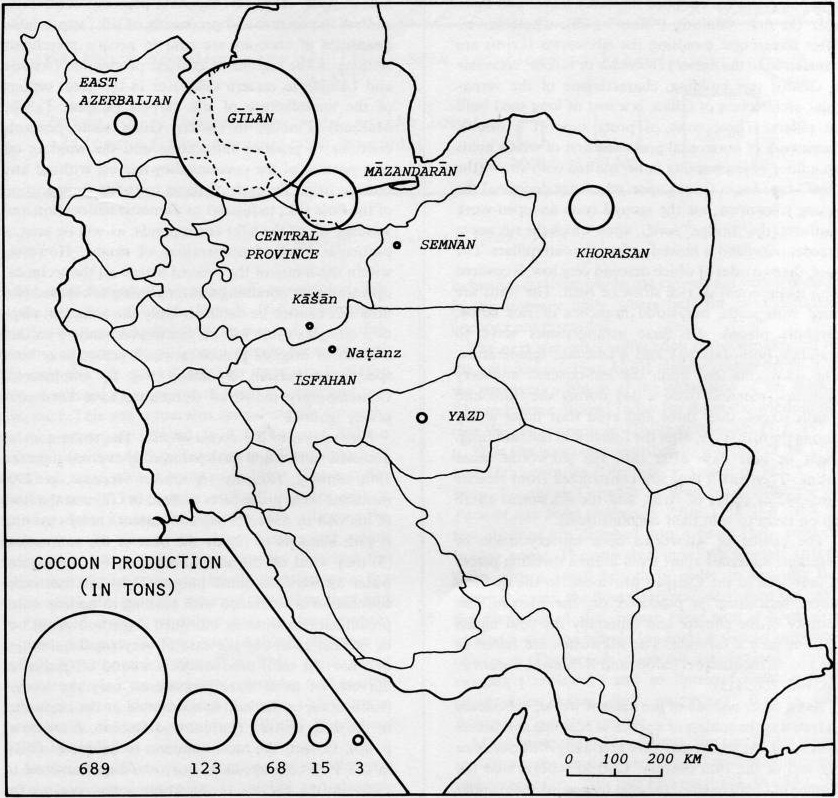
Today Gīlān remains the principal region of sericulture, furnishing 80 per cent of the national production, which varies between 200 and 400 tons per year (Figure 14), as a function of the rather rapid fluctuation in price. Māzandarān follows with 12-13 per cent. In these two rice producing provinces, sericulture is well integrated into the agricultural calendar at the end of spring, a stagnant period in the masculine work of rice cultivation. The rest of production is divided among the mountainous regions of northern Iran (eastern Azarbaijan and especially Khorasan) and a few oases of central Iran (Kāšān, Naṭanz and Yazd).
The raising of the silkworm. The techniques of raising the silkworm remain similar to those described by Chodzko in the middle of the 19th century (“Le Ghilan ou les marais caspiens,” Nouvelles annales des voyages et des sciences géographiques, 5th series, vol. 6, July 1850, pp. 69-74) and by Lafont and Rabino at the beginning of the 20th (L’industrie, pp. 68-88).
The raising of silkworms rests upon the cultivation of mulberry, chiefly the white variety (Morus alba), in homogeneous plantations or in rows at the boundaries of plots. When a share-cropping system was employed, the traditional formula which governed sericulture was equal division of the harvest between landowner and peasant (K. E. Abbott, Narrative of a Journey . . . , fol. 27); or, at the end of the 19th and beginning of the 20th centuries, division of the production of cocoons into three parts: one part going to the provider of the eggs, the second to the landowner, and the third to the peasant. This kind of contract was called moṯallaṯa “three-way partnership” (Lafont and Rabino, L’industrie, p. 21).
The cycle of raising silkworms lasts about forty-five days, beginning at the outset of Ordībehešt (April 21-May 21), when the first mulberry leaves appear. The boxes of selected eggs (nowadays of Japanese stock) purchased from the Office of Sericulture, are placed in a warm place to accelerate the hatching of the larvae. At the end of seven or eight days, the eggs hatch and the tiny caterpillars are placed in receptacles (qālebī) made of a mixture of earth and cow manure. The caterpillars are fed chopped mulberry leaves and then, after the first molting (“sleep” ḵᵛāb), whole leaves. After the second molting the silkworms (kerm) are transferred to the nursery (telembār or talībār; teləmbār in Gīlān); this building, characteristic of the vernacular architecture of Gīlān, is a sort of long shed built on pillars: Three rows of posts support a double framework of horizontal posts, the first of which holds up a floor of intersecting laths, quilted with straw (the “bed” kat; ket in Gīlān) upon which are deposited the young silkworms; on the second rests an open-work platform (the “bridge” pord), upon which the silkworm breeder (nowḡānī) is moved to feed the caterpillars. The roof, the two sides of which descend very low, is covered with a dense mat of rice straw or rush. The walls are lined with reeds, box-wood branches or rice straw, carefully placed. All these arrangements serve to maintain both darkness and a constant temperature. The silkworms feed upon the leaf-covered mulberry branches, renewed twice a day during the third and fourth stages, then three and even four times a day during the fifth stage, after the fourth and last molting. Eight or nine days after this, the silkworms cease eating. Then small huts are constructed from slender branches or stalks of ferns, and the silkworms climb up on them to spin their cocoons (pīla).
The raising of silkworms in a nursery made of vegetable materials apart from human dwelling places is only seen in the Caspian provinces. In the districts where sericulture is practiced on the plateau, the severity of the climate and especially the cold nights prevent such a formula. The silkworms are raised in the houses themselves (Lafont and Rabino, L’industrie, pp. 102, 106, 111).
As in other regions of the ancient world, sericulture in Iran was the subject of a series of customs and beliefs which, for the most part, have gradually died out since the end of the 19th century. Curzon reports that the women of Gīlān hatched the eggs by placing them under their clothing against their skin (Persia, p. 366). They avoided approaching the nursery during their menstrual periods (Olearius, Voyages, p. 313). The people claimed that the presence of a black snake (Coluber aquaticus) in the nursery guaranteed the success of the harvest (Abbott, Narrative, fol. 27).
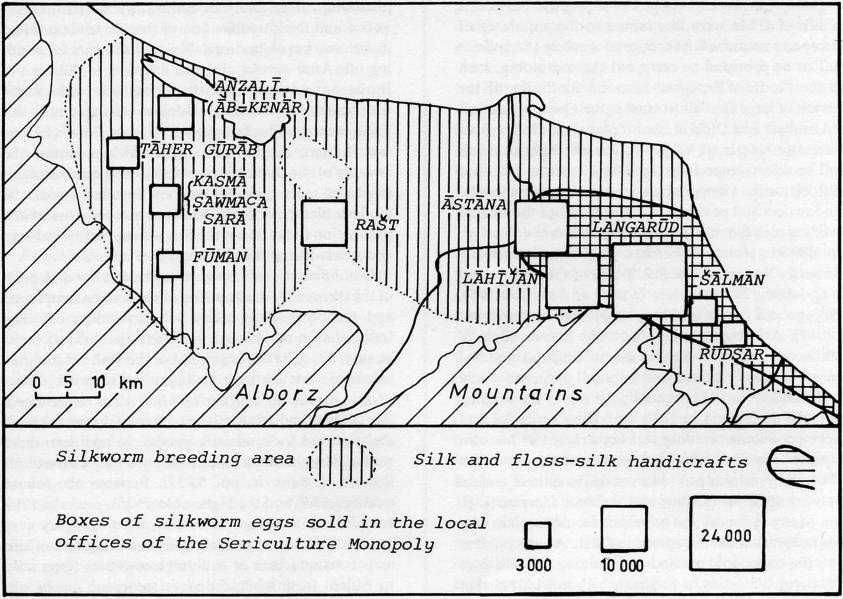
Once the silkworms have formed cocoons, harvesting of the cocoons (pīlačīnī) begins, a task which mobilizes friends and neighbors in an atmosphere of collective rejoicing. The cocoons are removed from the branches, summarily cleaned, and then sorted and packed. Healthy cocoons are separated from rejects: defective, spotted (lakkadār, šalla, šaʿrsīāh), pierced. From these damaged cocoons the women prepare floss silk (kaǰ; kəǰ in Gīlān) by a technique that will be explained below. As for the healthy cocoons, most of them are sold at a guaranteed price to the local bureau of the Office of Sericulture. The personnel of these bureaus, which number ten in Gīlān (FIGURE 15), carry out the suffocation, then sort the cocoons once more before sending them to the great government spinning-mill in Rašt. However, the state does not completely control the market and processing of silk; appreciable quantities of cocoons are sold to private merchants residing in the regions of greatest production (Āstāna and Lāhīǰān in eastern Gīlān) or in the great centers of the manufaccture of silk carpets (Kāšān, Tabrīz, Mašhad). Finally, in eastern Gīlān some peasants continue to practice suffocation and the winding off of a portion of the cocoons they harvest without any outside help. To each of these methods (preparation of the floss silk; industrial or domestic suffocation and winding off of the silk) corresponds, as will be seen, a particular kind of preparation of skeins. However, within the limits of the present article all the technical operations for obtaining and employing silk thread and floss silk cannot be detailed. Only the principal steps of a complex cycle will be mentioned, while a certain number of original processes which are or have been specific to Persian craftsmen will be emphasized. Contemporary industrial techniques have been purposely ignored.
Preparation of the skeins of silk. The techniques of domestic suffocation have perceptibly evolved since the 18th century. Hanway (Historical Account, p. 290) mentions three procedures utilized in Gīlān at the time of his visit in 1744: “They suffocate it (1) by covering with blankets or (2) by the heat of the sun, unless (3) they wind off the silk immediately for then warm water answers the same purpose.” In this last case, suffocation is combined with soaking in boiling water preliminary to winding off. Such a method could not be utilized except in the case of very small quantities or when the total production is wound off just after harvest. Of these three procedures, only the second (suffocation in the sun) is mentioned at the beginning of the 20th century (Lafont and Rabino, L’industrie, p. 90). In fact, the most common technique in Gīlān in the 19th century, as in our own day, has been to suffocate the chrysalids by keeping the cocoons for about twenty hours in a “smoke room” (dūd-oṭāq), where a mixture of wood and rice bran is burned.
The introduction of industrial suffocators into Gīlān at the initiative of Greek, French, Italian, Armenian and Russian merchants dates back to the end of the 19th century, a period when foreign merchants controlled not only the silk market but also its production (the sale of selected eggs, export of dry cocoons and raw silk, etc.). This new apparatus spread rapidly throughout the province. Toward 1910 Lafont and Rabino counted one hundred suffocators in Gīlān, almost all of which were owned by foreign firms. Theses suffocators were of two types: suffocator-dryers, with a rotating drum (using hot and dry air), allowing the cocoons to be treated in a few hours; and steam suffocators, more rudimentary devices that had the advantage of never causing the silk to deteriorate, but from which the cocoons emerged wet; then they had to be dried over a period of two or three months in vast hangars (Lafont and Rabino, L’industrie, pp. 91-93; Ferrand, “Perse,” p. 524). A perfected apparatus based on the same principles (suffocation with hot air or steam) treats cocoons today in the factories of the state monopoly (Wulff, Traditional Crafts, p. 183).
At the completion of suffocation, the cocoons are once again sorted according to quality and cleaned. These diverse operations, performed today as at the beginning of the century with minute care in the industrial establishments, are carried out with less rigor in the domestic units, where only the most defective cocoons are discarded.
The next step after suffocation is the winding off of the cocoons (abrīšam-kašī</em>); closely connected to it is the perennial problem of the dimension of the skeins. The technique utilized today for domestic winding off (see the photograph in Objets et Mondes 11/1, 1971, p. 32) is similar to that described by travelers of the 17th and 18th centuries (Olearius, Voyages, p. 313; C. Le Brun, Voyage de Corneille Le Brun par la Moscovie en Perse et aux Indes Orientales, Paris, 1718, I, p. 165). A few cocoons are dropped into a basin (ṭašt, tīān) of boiling water. The operator, usually a woman, strikes them with a small broom in order to separate the external layers, the floss (“frisons,” lās</em>); then she pulls the filaments of silk, passes them over a hook and around a winding wheel (čar, čarḵ) activated by means of a crank. The threads of raw silk are obtained without twisting (“croisure”) and so “present many defects (inequalities, knots, fluff, gumming)” (Lafont and Rabino, L’industrie, p. 46).
Much more than these defects, the size of the skeins (kalāf) was the constant preoccupation of the European merchants of the 18th and 19th centuries. In effect, the winding reel traditionally employed in Gīlān was much larger in diameter than the old winding reels used in England, France and Italy. Consequently, the skeins of silk of Gīlān were ill adapted to the apparatus of European manufacturers. Special winders (“tavelles”) had to be provided to carry out the unwinding, such as the “tours d’Espagne” reserved for “silks of the Levant of large size” illustrated in the Encyclopédie (ed. d’Alembert and Diderot, Amsterdam, ca. 1765, vol. of plates, s.v. soiezie, pl. VI, p. 39). The merchants, consuls and travelers—especially the British—of the 18th and 19th centuries attempted many times to convince the landowners and peasants of Gīlān to adopt the smaller winding reels (see notably Hanway, Historical Account, pp. 289-91; Holmes, Sketches, p. 100; and especially Abbott, “Report on the Silk Trade of Ghilaun,” cited in C. Issawi, The Economic History of Iran 1800-1914, Chicago and London, 1971, p. 233; Abbott, Narrative, fol. 14). Abbott, declaring that “The Persian skein of silk is too long for general use in England and the thread is usually uneven and knotty,” proposed vainly to the Gīlānīs in 1842 to modify the size of the winding reel. He tried again in 1844, providing a smaller and more productive winding reel constructed at his own expense. However, the introduction of this new type of winding reel was not followed up, in spite of certain isolated attempts (Lafont and Rabino, L’industrie, p. 46). Many technical and economic factors explain why this innovation did not spread in Gīlān. As was pointed out, the traditional method of obtaining raw silk does not involve twisting, a process which not only makes the thread more regular, but also partially airs and dries it (see E. Pariset, Les industries de la soie, Lyon, 1890, pp. 94-96). This reduces the risk of gumming, i.e., the sticking together and blackening of the threads through contact with the cross bars of the winding reel. In such a method, the use of winding reels of small diameter is no obstacle to the quality of the skein. In contrast, in Gīlān, where twisting is not practiced and the climate is particularly humid, the risks of gumming are much more important. Winding the filament on a small reel would result in the formation of skeins of bad quality, with many spots of gumming. The persistent use of a winding reel of large dimension is not, as certain people have imagined, a phenomenon resulting from inertia, but an appropriate technological response. Indeed, this is what Hanway understood very well, paying heed to the explanation of the Gīlānī peasants: “In moist weather the silk wound on a large wheel is not so apt to stick or to be gummed together in those parts where it lays on the bars, or divisions of the wheel, where it is often rendered black and so hard that it cannot without great difficulty be separated” (Historical Account, pp. 289-90). It should be added that with the use of a small reel, as the Gīlānīs explained to Abbott, “So much more labour and time would be required that it would not be practicable on a large scale because, on account of the excessive dampness of the climate, the cocoons become injured if not quickly wound off” (Abbott, “Report,” in Issawi, Economic History, p. 233).
From the middle of the 19th century, concern for obtaining thread more in conformity with European norms and the intensification of the silk trade resulted in the creation of “industrial” establishments for winding off. After several abortive attempts, a “filature in European style” was constructed in Rašt in the 1890s with equipment provided by Maison Berthaud of Lyon. The system it utilized was called “à la tavelette” (Lafont and Rabino, L’industrie, p. 47), which permitted the twisting of the thread. Around 1910 this establishment employed more than 300 workers. In other words, the modern filature of Rašt, which processes most of the production today, is not the first attempt at centralizing and mechanizing the winding off of silk.
The different qualities of silk. The quality and price of the skeins vary as a function of the cocoons employed and the precautions taken before winding off. The traditional nomenclature records the differences in quality. Thus, at the beginning of the 20th century, six principal varieties were distinguished in order of decreasing value: šaʿrbāfī, aʿlā, tāǰerī, tāʾī, ʿalāqa-bandī (for lacemaking) and dovīl (derived from double cocoons and reserved for crude silk goods); in addition, there were a large number of subvarieties (see Lafont and Rabino, L’industrie, pp. 50-52). Between the lowest quality (dovīl) and the highest (šaʿrbāfī), prices in 1909 varied by a factor of two. The latter category was reserved for export to the great Persian centers of silk carpet manufacture or to foreign countries (especially to Milan, from whence derives the name mīlānī silk [Chodzko, “Le Ghilan,” p. 86]). In addition, different varieties could be employed for specialized purposes in the manufacture of a single product. Thus, of the three categories distinguished nowadays, the first grade (dāna) is employed in making the piles of silk carpets, the second (haštī) for making silk warps for carpets, and the third and crudest grade (pūdī) for the threads of the weft that separate the rows of pile in silk carpets (Wulff, Traditional Crafts, p. 183).
Preparation of skeins of floss silk. The methods employed for fabricating yarn from pierced cocoons and waste are related to those employed for other textile fibers such as cotton and wool. A continuous filament is not wound off; a tuft of discontinuous threads is twisted, drawn out, and then spun (reštan). The cocoons are first plunged in boiling water, an operation which cleans them and separates the threads from foreign matter. The tangled clump of threads is dried and then spun by women with a spindle (kəǰdūk in Gīlān). The skeins are formed by winding the yarn around a small wooden frame (ačkāvazən) made of three sticks. One should note that contrary to the winding of silk, making floss silk yarn, and more generally employing it in domestic handcrafts, remain activities wide-spread throughout eastern Gīlān.
Dyeing. Diverse operations are necessary to achieve effective dyeing, notably degumming and mordanting. Degumming, designed to make the threads supple and render them more permeable to the dye, consists of soaking the skeins in a mixture of water and ashes. The main mordant used is alum (zāǰ). As for dyes, before the widespread use of chemical substances (anilines), they were derived mainly from plants. For example, gall nuts (māzū) were employed for black, indigo (nīl) for blue, madder (rūnās) for red, and turmeric (zarḍčūba) or dyer’s weed (esperak) for yellow. The best red color was derived from the female cochineal insect (qermez-dāna). As for bleaching, it comprises two operations: the immersion of the silk in a decoction of stems and roots, then washing in lye (Lafont and Rabino, L’industrie, p. 54). These diverse very delicate operations are carried out in the ateliers of professional dyers.
Preparation of bobbins and setting up the warp. Having been dyed, the skeins are first unwound and then rewound in order to form the bobbins which are utilized for preparing the weft or setting up the warp. Once the thread is wound around the spindle of a winder (čar, čarḵ), it is doubled by twisting the threads coming from different cage spools (for Yazd, see Wulff, Traditional Crafts, p. 183; for Gīlān, M. Bazin and C. Bromberger, Gilāŋ , Paris, 1981, pp. 60-61). An additional winding may be necessary to form the small shuttle-bobbins (māsūra) adapted to the shuttle (mākū) used by the weavers.
The techniques of preparing the warp (čella, tān, tūn) vary considerably in different regions. The simplest method, attested in Gīlān, consists of winding threads coming from different bobbins around pegs. Another procedure, described by Wulff (Traditional Crafts, p. 184) and observed in Yazd, constructs the warp around pegs fixed on the wall of a house, while the bobbins rest on the ground. Finally, in Isfahan rotary warp winding frames (čarḵ-e čeheltābī) are employed.
Weaving. The traditional looms utilized for weaving fabrics of pure or mixed silk or floss silk also present a great variety throughout Iran. Here only three types will be mentioned, types whose distribution once more illustrates the technical lag between the silk producing regions (the provinces of the north) and the silk consuming regions (the cities of central Iran). Of these three types, the simplest is the pāčāl employed in Gīlān for weaving the čādoršab (or čādəršab</em>; a fabric with geometric motifs that women tie around their waist when they work or over their shoulders to carry a child). It is a loom of relatively simple construction, with treadles and two rows of heddles (vard). It includes a warp beam upon which the warp is fixed and from which it is unwound as the work advances, while the operator winds the woven cloth around the breast beam (for more details of the morphology and function of this loom, see Bazin and Bromberger, Gilān, p. 62). Much more complex are the looms traditionally employed in the cities of the interior, such as the celebrated draw loom (dastgāh-e naqšbandī) and the velvet loom (dastgāh-e maḵmalbāfī). The first, for which a dual Chinese and Syrian origin has been recognized (Wulff, Traditional Crafts, pp. 174-75) and the functioning of which was fully mechanized at the beginning of the 19th century by Charles-Marie Jacquard of Lyon, permits the weavers to go beyond the stage of producing geometric designs to achieve any sort of figurative design. A supplementary harness, operated by a worker perched above the loom, permits the weavers to cause the thread of the warp to appear or disappear according to different combinations at each shed and thus to form the most varied decorations. As for the velvet loom, employed notably in Isfahan, Kāšān, and Tehran, in certain of its details it resembles the draw loom, i.e., in its use of a double warp and its application of the draw harness to produce embossed velvet (Wulff, Traditional Crafts, p. 209).
Textile products. Although it is the principal region of silk production, Gīlān has never been a great center for the crafts connected with silk weaving, a fact which is corroborated by the rather rudimentary techniques that have traditionally been used there for winding off and weaving. In contrast, the great urban centers distinguish themselves by a flourishing and diversified production. The inventories taken by Fraser (Travels, pp. 354-68) or by Lafont and Rabino (L’industrie, pp. 57-60) throw this difference into high relief. Knotted silk carpets and highly reputed brocades are the traditional specialties of Arāk (Ṣolṭānābād), Isfahan, Kāšān, Kermān, Tabrīz, and Yazd. In this last city, 1800 weaving factories employing about 9000 workers were counted in the 1850s before the silkworm crisis. In the same way, the main centers for the manufacture of silk velvet were all the cities of Iran’s interior, including Isfahan, Kāšān, Mašhad and Tabrīz. A large portion of the silk fabrics (often mixed with cotton) that were produced in these cities were used for clothing and household furnishings (curtains, hangings, etc.).
In short, the principal products of Gīlān never attained the fame of those of central Iran, except for embroidery (goldūzī), a specialty of Rašt. Among these products one can mention striped and checkered taffetas, long (a cloth which one knots around the waist at the public bath), unicolored sashes (exported to Georgia), and kəǰīnī (fabrics of floss silk, often mixed with cotton, employed for making the clothing of the popular classes, such as the celebrated čādəršab</em>; see the inventory of these traditional products in Chodzko, “Ghilan,” pp. 78-79).
These brief remarks concerning silk commerce and crafts connected with it confirm the unique position of Gīlān, the main producing center, within the Iranian space. A region of specialized crops, throughout its history this province has been dominated economically by near or far countries and by the central provinces of Iran itself.
See Silk Road and Silk Trade.
Bibliography
All the reports of the British consuls residing in Rašt in the second half of the 19th and beginning of the 20th centuries mention sericulture and furnish details on its production and trade; here only the reports richest in information have been cited.
In addition to the works mentioned in the text, see: K. E. Abbott, “Report on the Silk Trade of Ghilaun,” ms. Foreign Office 60/90, partially published by C. Issawi, The Economic History of Iran 1800-1914, Chicago and London, 1971, pp. 233-35.
Abbott, Narrative of a Journey from Tabriz along the Shores of the Caspian Sea to Tehran, 1843-1844, ms. Foreign Office 60/108, fol. 25-29, partly quoted in Issawi, op. cit., p. 226.
M. Bazin and C. Bromberger (with the collaboration of A. Askari and A. Karimi), Gilān et Āzarbāyjān oriental: cartes et documents ethnographiques, Paris, 1981, pp. 57-63; map 31.
A. Chodzko, “Le Ghilan ou les marais caspiens,” Nouvelles annales des voyages et des sciences géographiques, 5th series, VI, March, 1850, p. 257; July, 1850, pp. 78-79, 85-87.
H. A. Churchill, “Report by Consul Churchill on the Trade and Commerce of Ghilan for the Year 1877,” Reports from her Majesty’s Consuls . . . During the Year 1878, London, 1879, pp. 693-702.
Idem, “Report for the Years 1892-93 on the Trade of the Consular District of Resht,” Diplomatic and Consular Reports on Trade and Finance, Persia, annual series, no. 1325, London, 1894, 18 pp.
G. N. Curzon, Persia and the Persian Question, repr., London, 1966, I, pp. 366-70. R. J. Forbes, Studies in Ancient Technology, Leiden, 1956, IV, pp. 49-58.
J. B. Fraser, Travels and Adventures in the Persian Provinces on the Southern Banks of the Caspian Sea, London, 1826, pp. 120-321, 355-76.
J. Hanway, An Historical Account of the British Trade over the Caspian Sea with a Journal of Travels from London through Russia, Germany and Holland, London, 1762, I, pp. 1-42, 190.
W. R. Holmes, Sketches on the Shores of the Caspian, Descriptive and Pictorial, London, 1845, pp. 95-104: “Account of the Silk-worm.” Keyhān, Joḡrāfīā, III, pp. 212-26.
F. Lafont, “Perse. La sériculture,” Bulletin mensuel de l’Office de Renseignments Agricoles, August 1908, pp. 992-1005.
Marco Polo, La description du monde, ed. in modern French by L. Hambris, Paris, 1955, pp. 25-39.
G. Melgunof, Das südliche Ufer des kaspischen Meeres, Leipzig, 1869, especially pp. 256-58, 286-88.
A. Olearius, The Voyages and Travels of the Ambassadors sent by Frederick, Duke of Holstein for the Great Duke of Muscovy and the King of Persia, trans. J. Davies, London, 1672, pp. 312-13.
E. Pariset, Les industries de la soie, Lyon, 1890, pp. 198-99, 203-09.
H. L. Rabino, “Trade of the Persian Caspian Provinces (Consular District of Resht and Astarabad), Report from 1907 to 1909,” Diplomatic and Consular Reports, Persia, annual series, no. 4398, London, 1910, especially pp. 19-21, 31.
N. Rondot, Les soies, Paris, 1885, I, pp. 357-70.
“Soie,” Encyclopédie, ed. d’Alembert and Diderot, Amsterdam, ca. 1765, XV, pp. 268-70.