



Water-powered mills are still common in Afghanistan and a few windmills remain in use. Noria continue to irrigate parts of the northeast and sāqīya are widespread, though now only powered by animals instead of the wind as in medieval times when the Arab writer ʿAlāʾ-al-dīn Ḡozūlī (d. 815/1412) wrote: “In Afghanistan all the mills and waterwheels are driven by the North wind, and made to face it” (Mez, op. cit., p. 467).
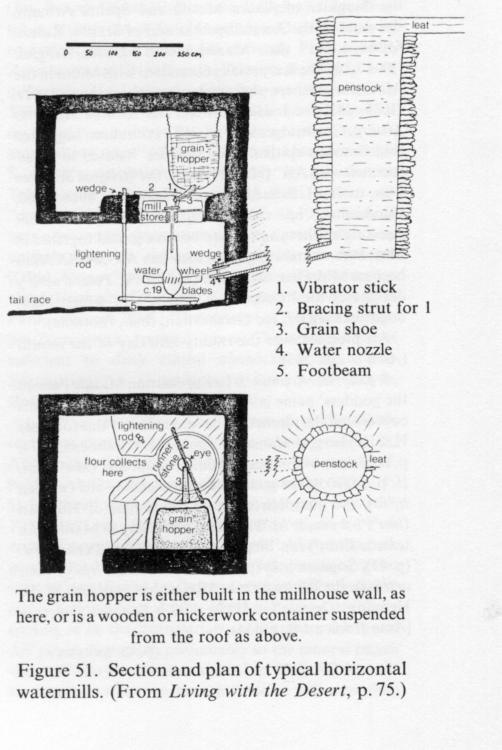
Most Afghan watermills are horizontal, turned by water from streams or kārīz, but the stone-lined wells favored in Iran are often replaced here by a hollowed out tree trunk carrying the water from the leat down to the wheel. The fall varies from 2 m in the Harī-rūd valley to as much as 12 m at Band-e Amīr in central Afghanistan, where the natural dam creates a splendid head of water for watermills. Millhouses are generally small and frequently built of stone rather than mudbrick. The grain hopper is seldom incorporated in the structure of one wall, as in Iran, but is a wicker basket or broad wooden funnel positioned above the stones more like European mill. The small capacity and slow work-rate of many of these mills suit the local economy, as has already been observed in Iran.
According to Elphinstone’s informants in 1809 windmills had once existed in southeast Afghanistan, but he himself penetrated only to Peshawar and this statement should be treated with caution, since the region is not exposed to the 120-day-wind and no other authorities corroborate it (M. Elphinstone, An Account of the Kingdom of Caubul II, Oxford, 1972, pp. 401-42). Afghan windmills were to be found in the modern provinces of Herat, Farāh and Nīmrūz, in the path of the same wind as in Iran. The country north of Herat towards Turkmenistan is still called Bādḡīs, which the medieval geographer Yāqūt (I, p. 462) explains as “Bādḵīz, i.e., where the wind rises.” Windmills were a striking feature of both sides of the Harī-rūd valley west of Herat (C. M. Macgregor, Narrative of a Journey . . . on the Northwestern Frontier of Afghanistan in 1875, London, 1879, p. 243) and in the country north of the Hamūn-e Helmand (A. C. Yate, England and Russia Face to Face in Asia, Edinburgh, 1887, pp. 100, 101, 129). Canvas sails recalling those in Demašqī’s description were observed in use in Afghan Sīstān a century ago (F. J. Goldsmid, Eastern Persia, London, 1876, p. 320). A windmill was photographed as far south as Mushki Chah, in modern Pakistan, in 1901
(A. H. Savage-Landor, Across Coveted Lands, New York, 1903, p. 350).
Few of these windmills function any longer, but a detailed record of those at Ḡurīān was made by K. Ferdinand shortly before they were abandoned. There are certain features which distinguish many Afghan windmills, especially those in the Harī-rūd valley, from their Iranian counterparts. Single or carefully paired mills are more common than rows, though the row of thirteen at Ḡūrīān also had an unusual arrangement whereby every other mill was smaller and placed somewhat above its neighbors. The desire to utilize the wind’s power to the full is emphasized by the pronounced angling of the front wall and by the curved eastern wall which creates something approaching a turbine chamber for the windwheel. The long, projecting western wall is bowed inwards noticeably, is decorated with pierced brickwork and—like the eastern wall—is stepped down towards the south. The mill houses consist of only one bay, over the stones, and there is little room for storage and no winnowing passage. Surprisingly, the entrance to these mills, as at Ḡūrīān is often from the north, the windward side. Some of the paired mills are architecturally impressive, with the north front composed of four rounded, blind arches, above which rise the angled walls that still gather as much wind as possible to grind at least some of the corn grown in the Harī-rūd valley (Forbes, op. cit., illustration p. 115).
Bibliography
A brief historical summary and a detailed description of the machinery and operation of the Neh windmills occurs in H. E. Wulff, The Traditional Crafts of Persia, Cambridge, Mass., 1966, pp. 277-91.
However, many of the characteristics of Afghan windmills carefully recorded in 1960 by K. Ferdinand, “The Horizontal Windmills of Western Afghanistan,” Folk 5, 1963, pp. 71-89; 8-9, 1966, pp. 83-88, apply more closely to the windmills of Khorasan investigated by the author in 1977 and referred to in Living with the Desert (see below), pp. 88-102.
The medieval descriptions of mills are most accessible in Le Strange, Lands, A. Mez, The Renaissance of Islam, Patna, 1937, pp. 451-67, and E. Wiedemann, Aufsätze zur arabischen Wissenschaftsgeschichte, Hildescheim, 1970, pp. 216-21, 276-303.
A recent first-hand record of watermills also forms part of E. Beazley and M. Harverson, Living with the Desert, Working Buildings of the Iranian Plateau, Warminster, 1982 (with a comprehensive bibliography).
Figure 52. Structure and lay-out of a Persian windmill based on mills recorded at Nīštafūn in 1977. (From Living with the Desert, p. 89.)

PLATE XXIX. Windwheel on working at Nīštafūn, 1977, viewed from leeward side.

PLATE XXX. Reed mat sails on a village near Neh, 1977, noticeable for its unusual windshaft, crooked spokes, and ramshackle rigging.

PLATE XXXI. Wickerwork hopper in an Afghan watermill, 1977.

PLATE XXXII. Vitruvian millwheel outside Isfahan, 1962.
