



i. In Iran
History. Information establishing the precise era in which rice was introduced along the Caspian littoral and on the Iranian plateau does not exist; however, there is circumstantial evidence for hypothesizing that rice was, to use Wulff’s phrase (p. 242), a “relative newcomer” not widely grown before the Islamic period. Laufer (pp. 372-73) supported this hypothesis with the following arguments: (a) There is no word for rice in the Avesta; (b) Greek authors, in particular Aristobulus who accompanied Alexander and was quoted by Strabo (VII, p. 29), wrote about rice cultivation in Babylonia, Susiana, and Bactria but not on the plateau or in the
Caspian provinces; (c) Chinese travelers during the Sasanian period mentioned rice cultivation in Farḡāna and Parthia but not in Persia itself, and (d) the first writings by Iranian authors to provide substantial accounts of rice farming date from the 2nd/8th century.
These arguments, while serving as grounds for a plausible hypothesis, do not constitute proof. The sources mentioned by Laufer are too laconic for concluding beyond all doubt that rice was not grown on the plateau or in the Caspian provinces during the Achaemenid and Sasanian periods. Moreover, why would rice cultivation, which had spread from India toward the eastern shores of the Mediterranean centuries before the Christian era, not have reached these regions? The authors of the rice map in the Atlas of Food Crops (pp. 35-36) suggest that rice was grown in the Caspian areas of Iran in the 4th century b.c.
Regardless of when rice was brought into Persia, two points are beyond dispute. First, both the varieties of rice grown in the region and the terminology related to rice cultivation are evidence that rice farming reached Persia from southeast Asia and the Indian subcontinent. Berenj, the generic term itself, derives from the Sanskrit vrīhí. Furthermore, all the varieties grown belong to the species Oryza sativa, which originated in southeast Asia. Second, the cultivation of rice and other tropical crops (cotton, sugarcane, oranges, and mulberries) in Persia thrived in response to urban growth and the demand generated under the first caliphates (Lombard, p. 40). Sources from 7th/13th-century Il-khanid Iran corroborate that rice was grown in Azerbaijan, Fārs (near Korbāl, Fīrūzābād, etc.), Ḵūzestān (Petrushevsky, pp. 500-01), and the Caspian provinces, the very regions that are still the principal areas of production.
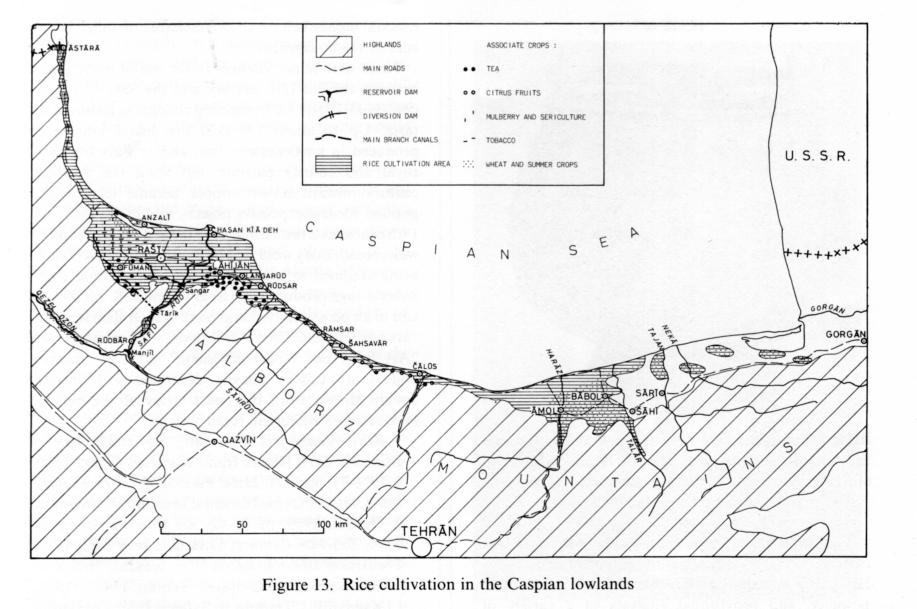
Production. Rice is now grown in varying degrees in nearly all provinces of Iran (see Figure 13). In 1361 Š./1982, 397,000 ha, about 2,5 percent of all farmland, were used for rice. Paddy fields amounted to about 52 percent of farmland in Gīlān, 16 percent in Māzandarān, 3 percent in Fārs and less than 1 percent in the rest of the country.
Rice farming is a marginal activity in arid regions where, because of the inhospitable climate, it is limited to a few areas with an adequate water supply: namely the lower Aras and Qezel Ozon valleys; the upper Isfahan oasis; a few oases in Khorasan and in Sīstān and Baluchistan; various parts of the alluvial plain of Ḵūzestān, in particular the swampy areas of Dašt-e Mīšān watered by the Karḵa (Nezam-Mafi, pp. 106-09); the Marvdašt plain and other basins in Fārs, a province where this crop has expanded conspicuously in the last years (120,000 tons of paddy in 1361 Š./1982).
Production is concentrated in the Caspian provinces, which, in 1361 Š./1982 (as in 1309 Š/1930; see Kayhān, p. 150), yielded about 85 percent of the nation’s total crop. Only these provinces have enough water, thanks to an abundant annual precipitation of 1,200-1,900 mm in the lowlands and to a dense network of rivers and streams. Though favorable, the natural conditions in Gīlān and Māzandarān are not optimal, owing to the cold winter weather that limits the growing season to one crop a year and to spring and summer temperatures that are below the ideal for rice to germinate, tiller, ear, and mature. Furthermore, in small areas like Fūmanāt, traditional irrigation cannot make up for insufficient precipitation.
Gīlān was until recently the foremost producer of rice in Iran, yielding every year between 40 and 50 percent of the national harvest, but was surpassed by Māzandarān in 1361 Š./1982, getting only 429,000 tons of paddy whereas the neighboring province yielded 491,000. In Gīlān, nearly all low-lying, irrigable land is used for rice; on alluvial strips of slightly higher ground, hamlets with scattered buildings stretch out between unirrigated fields and patches of forest. The nearly monocultural Safīdrūd delta in Raft and Lāhījān districts accounts for 60 percent of the province’s production, whereas on the eastern and western marginal plains rice is combined with various specialized crops (Figure 14).
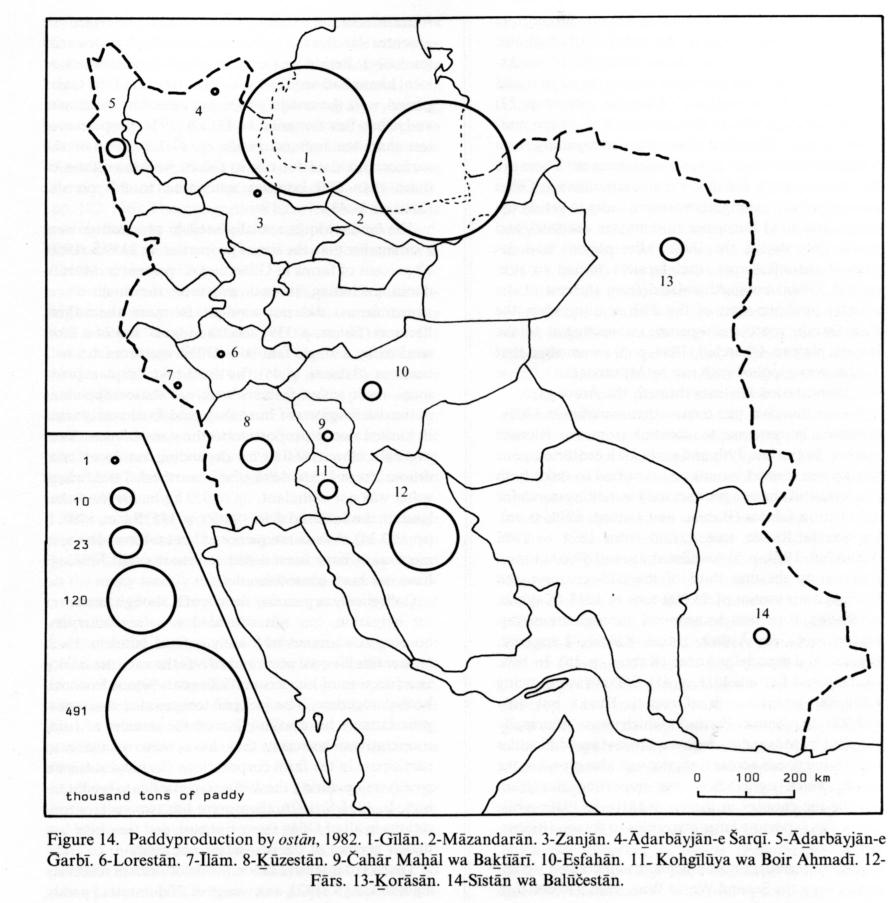
Until recently, Māzandarān was only second to Gīlān and yielded 35 to 40 percent of Iran’s total crop, before it took the first rank from 1361 Š./1982 onward. In the western half of this province, rice is the major crop, along with citrus fruit from Rāmsar to Čālūs and with cereals, melons, sunflowers, etc., in central Māzandarān (see Ehlers, pp. 331-34), where the two districts of Āmol and Bābol account for half of the province’s production. Toward the east, which becomes more arid the farther one goes, paddy is grown sporadically in areas where wheat and cotton predominate. It is difficult to ascertain whether or not the recent increase in Māzandarān’s harvest reflects an unusual combination of circumstances.
Anyway, Gīlān’s predominance was rather recent; in 1911, Rabino and Lafont (p. 38) noted, “Although rice is better from Gilan than from Mazandaran or Astarabad, the last two provinces supply the capital and the center of Persia with rice.” Likewise, Abbott (p. 23) and Churchill (1878, p. 754) noticed that, in the mid-19th century, Gīlān had to import rice regularly from Māzandarān in order to meet local demand. There are two basic reasons for this: First, landholders in Gīlān gave priority to raising silkworms in order to satisfy the rising demand of European markets (see abrǰšam), and it was only during the 1860s, after pébrine had destroyed the silkworms, that farmers turned to rice; second, Gīlān remained isolated from the rest of the country until the start of the 20th century when the Rašt-Qazvīn route was opened, connecting it to the Iranian plateau. Churchill (1894, p. 5) commented that Tehran was supplied with rice by Māzandarān because of transportation facilities through the Āmol gap.
Rice cultivation, like many other activities in Gīlān, increased in response to demand from the Russian market. In the late 19th and early 20th centuries, poor quality rice (čampā, rasmī) was exported to Baku both as a food stuff and as a product used in making starch for light cotton fabrics (Rabino and Lafont, 1911, p. 16). Exports to Russia rose sixfold from 1874 to 1892 (Churchill, 1894, p. 5), oscillated around 50,000 tons a year during the first third of the 20th century, and reached a maximum of 95,000 tons in 1915 (Kayhān, pp. 95-96). Rice was transported through numerous centers in Gīlān: Āstārā, Ḥasan Kīādeh, Langarūd, Rūdsar, and especially Anzalī (Rabino, p. 16). In 1892 (Rabino, and Lafont, 1911, p. 41), Gīlān was exporting 8,899,600 qerāns worth of rice to Russia but only 589,000 to “inner Persia,” which was principally supplied by Māzandarān. Given the cost and difficulties of carrying goods across Iran, rice was also grown in the south, which nonetheless was importing rice from outside the country in the early 1310s Š./1930s while Gīlān was exporting large quantities to Russia (Brjezitsky, p. 66).
Iranian production as a whole has increased significantly since the Second World War, from 450,000 tons of paddy in 1329 Š./1950 to more than a million during the 1350s Š./1970s; however, demand has increased even faster because the population has grown rapidly and an urban model of rice consumption has been adopted throughout society. Once an exporter, Iran has had to import rice, for instance, 191,000 tons in 1352 Š./1974-75 and 283,000 in 1354 Š./1975-76 (Brun and Dumont, p. 4). After a sharp drop in production during the short period of the Revolution (741,000 tons in 1978 and 919,000 tons in 1979, no complete data for 1980 and 1981), Iran has come back to more than one million tons since 1361 Š./1982, but is still obliged to import rice.
Socioeconomic organization of rice growing.
Though subject to the same land tenure system as the rest of Iran, the rice-growing regions along the Caspian stand out in many respects. Before 1339 Š./1960, small, privately owned farms were extremely rare in Gīlān and Māzandarān, rice fields nearly always belonged to absentee landlords, represented locally by stewards (mobāšer). Beside vast estates, which state officials or local khans had acquired usually at the end of the Qajar period, were the smaller properties owned by merchants and urban functionaries. In 1313 Š./1934, properties of less than ten hectares made up 42.7 percent of the surface area used for rice in Gīlān, whereas estates of more than 200 hectares amounted to 9.7 percent (Sahami, p. 43).
The landholdings actually used in production were even smaller than the size of properties. In 1339 Š./1960, 83 percent of farms in Gīlān and 65 percent in Māzandarān (including, in each province, the much larger wheat farms) did not amount to more than three hectares (Ehlers, p. 339); the “standard” size of a farm worked by a single family in Gīlān was from 1.5 to 2 hectares (Sahami, p. 45). In these two Caspian provinces, most tenant farmer were not sharecroppers as in the drier regions of Iran; they paid fixed yearly rents in husked rice in proportion to the size of farms. Rent averaged about 660 kg/ha depending on local conditions: from 225 to 440 kg/ha in northern Ṭāleš, where water was not abundant, up to 952 kg/ha for the richer lands in the Safīdrūd delta (ʿAṭāʾī, p. 125; Bazin, 1980, I, pp. 123-24). As a consequence of land reform, deeds in most cases have been ceded to tenants, but holdings have not been consolidated.
Collectively organizing farm work, though necessary for irrigation, has not extended to other activities; housing is scattered in loosely defined hamlets. Each farmer tills his own plots and selects the varieties of rice as a function of his personal calendar. Nor is livestock herded together. The independent-minded and energetic farmers have willingly used the services of rural cooperatives; however, they have been reluctant to participate in the farm corporations (šerkat-e sahāmī-e zerāʿī) set up during the 1970s to consolidate landholdings. In 1355 Š./1976, there were but two such corporations in all of Gīlān (near Fūman), and they held less than 1 percent of the province’s rice fields.
Thanks to intensive labor, yields of rice are relatively high. In 1352 Š./1973, an average of 27 quintals of paddy per hectare were obtained in Gīlān (Bazin, 1980, I, p. 138). ʿAṭāʾī (p. 113) calculated that 244 workdays were put into each hectare. This large labor requirement explains why tenant farmers, even before land reform, enjoyed a greater share of the harvest in these rice-growing areas than in drier regions of Iran. Women do the most toilsome chores using rudimentary tools or none at all. Their wages were noticeably higher than men’s for their “productivity and effectiveness of transplanting and weeding operations was considered to be better than that of men” (Rashid, pp. 13-14). The social status of women in Gīlān and Māzandarān which is higher than that of women elsewhere in Iran undoubtedly owes much to their decisive role in rice production.
Medium-sized rice farms (more than 1.5-2 ha) and large estates worked by their owners have had to resort to migrant labor; landless workers and small farmers formed a small part of the work force; the rest were recruited from outside the Caspian lowlands. Since the mid-19th century, the main migration occurred when rice fields had to be prepared for planting. Every winter, several tens of thousands of men left their villages in eastern Azarbaijan (in particular, the districts around Ardabīl and Ḵalḵāl) and came to work in full teams on the rice estates in the Caspian lowlands (Bazin, 1980, II, pp. 122, 126). These migrations have lessened nowadays owing both to the utilization of power-driven cultivators and to the attraction of new labor markets in Tehran and other big cities.
Beside the wives of poorer rice farmers, transplanting and weeding still employ women who come from the less well-off neighborhoods of towns or from the livestock-raising districts in the Caspian mountains. Under contract for from six to eight weeks, these female hands (kerečī) are—like the men hired to plow—given room, board, fixed amounts of rice as well as money, and, sometimes, a measure of cloth to replace the clothes ruined by the dirty, toilsome work. Reaping calls for much less outside labor, since men and women work together.
The part of the crop sold by farmers passes through the extremely dense marketing network in the Caspian lowlands. Rice traders (ʿallāf) have an essential position in the many weekly markets and in the large bāzārs of towns and cities. They often increase profits by buying crops before harvest (salaf-ḵarī).
During the last years of Moḥammad-Reżā Shah’s reign, authorities tried to centralize the collection of rice in rural cooperatives. Efforts did not meet with much success, for many poor farmers were indebted to private traders whereas better-off farmers preferred storing surpluses in order to sell them at the best moment on the free market.
Varieties of rice grown in Iran. There is not enough information to draw up an exhaustive taxonomy of the varieties and subvarieties of rice grown in Iran. At the start of this century, Rabino and Lafont (pp. 145-54) counted in the Gīlakī and Māzandarānī lexicons 60 subvarieties, which fell into five major categories recognized by the size and shape of the grain: čampā (short and thick), rasmī (longer and wider) and, in order of length and thinness, ʿanbarbū, mawlāʾī (with one end of the caryopsis cloven), and ṣadrī (Rabino and Lafont, p. 146). With the exception of mawlāʾī, which is usually said to be a subvariety of ṣadrī, these are still the principal varieties and categories in vernacular classifications. Varieties ranging between čampā and ṣadrī in size, which have been grown since the start of the century in the Caspian provinces and which are now prevalent, include: ḡarība, ḥasanī, āqāʾī and bīnām. Characteristics that enable farmers to distinguish among subvarieties are: (a) the time that the transplanted seedlings need to mature—early (zūdras or garm “hot”) rices mature in 110 days whereas late (dīrras or sard “cold”) ones have a growth cycle lasting from 150 to 160 days (Vérot, p. 6); (b) the color of the chaff (fal, fəl in Gīlakī)—white (safīd), red (sorḵ), black (sīāh) or, seldom, yellow (zard); (c) whether or not there is a tassel (domb, dom) or the tassel’s color—black, yellow, etc. (see Bromberger, p. 162). Subvarieties are usually identified by enumerating their distinctive characteristics; for instance, a rasmī(-e) safīd-e zūdras-e domdār is an early rasmī with a white husk and a beard. Other names refer to geographical or historical origins. For instance, the subvariety čampā-ye Šīrāz domdār was probably imported from Shiraz, and the variety itself may take its name from the ancient Indochinese kingdom of Champa, well-known for its early rice (Bazin, 1980, I, p. 128). The generic term ṣadrī brings to mind the title of the grand vizier of Persia, Mīrzā Āqā Khan Nūrī Ṣadr-e Aʿẓam, who introduced this variety into Gīlān from Peshawar during the 1850s. Other terms for rice refer to its shape (ḵanjarī, shaped like a dagger), smell (ʿanbarbū “amber perfume”), or taste (šekarī).
A rice farmer plants from three to six different subvarieties the same year; choice is based upon three factors: the amount of water required by the subvariety, whether it is for local consumption or to be marketed, and the season. In comparison with hot varieties, cold ones give a higher yield but require more water; they have to be irrigated six or seven times as opposed to four or five. Late subvarieties, most of which have long grains, are planted in areas where water is abundant. Traditionally, ṣadrī has been grown in the Safīdrūd delta, whereas čampā and intermediate varieties were planted in the neighboring regions of Māzandarān, Gorgān, Fūmanāt, and Ṭāleš where the water supply is limited (Vérot, p. 7; Rashid and Shaeri, p. 10; Bazin, 1980, I, p. 129). The second factor is the destination of the crop. Ṣadrī and mawlāʾī are grown to be sold (their grains do not stick together during cooking and the taste is appreciated), whereas the medium-sized varieties (ḡarība, ḥasanī, etc.) and, above all, čampā are usually kept for home consumption in the form of kata (since the grains, when boiled, become a paste). Prices reflect these differences of quality: Ṣadrī costs twice as much per kilogram as čampā (Bromberger, p. 162; Bazin, 1980, I, p. 128). The third factor is the farming calendar; chores can be spread out by combining several early and late varieties.
Varieties and subvarieties have appeared and disappeared with remarkable rapidity. In 1910, Rabino and Lafont (p. 145) wrote, “Fifty or sixty years ago, Gīlān only had two varieties of rice: amberbou and tchampa”; and counting only six subvarieties of ṣadrī, they mentioned neither dom-sīāh nor dom-sorḵ nor dom-zard, which are the best known varieties today. During the last decade, čampā has clearly lost out to new and better rices, notably ḥasanī, ḡarība, āqāʾī and bīnām. Several factors account for the rapidity of these changes. First of all, seeds are carefully selected; this seems to be true throughout the world, for rice farmers are, in Grist’s words (p. 60), “prone to cultivate any paddy which strikes them as different.” Consequently, more and more subvarieties have appeared, especially of ṣadrī, within a period of a hundred years. Second, production conditions have been improved; the modernization of irrigation has led to more land being planted in ṣadrī. Furthermore, the utilization of chemical fertilizers has reduced the considerable differences that used to exist between the yields of čampā and ṣadrī-type rices. The third factor is changing food consumption patterns. Even in the Caspian region, more and more people eat čelow prepared from long or medium-sized grains instead of kata which is traditionally prepared with čampā, undoubtedly the first variety of rice grown in Gīlān.
Cultivation. Since available sources are not adequate for providing as full an account of regional disparities inside Iran, the techniques used to grow rice will be described in the areas about which information is available: in particular, Gīlān.
The main problem during the growth cycle of rice is the water supply. In Fūmanāt, for instance, an estimated 9,000 m3 of water are needed per hectare of paddy, in other words, 900 mm of precipitation. Rainfall from April to August, during the rice-growing season, only amounts to 350 mm and even in rainier districts irrigation is indispensable.
In the Caspian provinces, water for the irrigation system traditionally comes from three sources. On the numerous watercourses, dams made of branches and stakes are built to channel water toward the principal canal which is then divided and subdivided into many smaller ducts. Water for irrigation also comes from springs at the edge of the plain; in 1973, in the Ṭāleš and Fūmanāt areas, 20 percent of the rice fields were irrigated in this way. Finally, reservoirs (estaḵr, sal) are also used, a method that, though making it possible to regulate the water supply, takes up room: viz., 11,000 hectares in central Māzandarān (Ehlers, p. 332).
Modern systems of irrigation have been gradually installed, beginning in the late 1950s in the Safīdrūd area. A regular supply of water from the Manjīl dam-reservoir and from the Tārīk and Sangar dams is fed into the dense network of channels in the central Gīlān plain. Plans for modernizing irrigation in central Māzandarān as well as in western and eastern Gīlān were under study in the late 1970s.
The way irrigation is organized is still the same, regardless of whether the water flows through traditional or modern channels. A water marshal (mīrāb), assisted by an apprentice (mīrāb-šāgerd), supervises distribution, maintenance work, etc. The water marshal works under the Water Administration, which levies an irrigation tax that varies according to the source of the water.
Elsewhere in Iran only land with good irrigation can be tilled for rice. In the Isfahan area, paddy is planted in the upper oasis, in Lenjān district, which benefits from traditional regulations about the distribution of water from the Zāyandarūd (Planhol, p. 394). Fields are mainly irrigated from streams and rivers (Aras, Safīdrūd, Zāyandarūd, Kor, Kārūn, Dez, Karḵa, etc.) or sometimes springs (in the Bayżā and Abarj districts on the edge of the Marvdašt plain (Kortum, p. 213). Rice is irrigated throughout its especially complicated cultivation cycle—usually during preparatory work in the fields, as well as after transplanting, weeding, and caring (Rabino and Lafont, 1911, p. 6).
Tasks involved in preparing the fields (bījār, bəjār) extend from winter to early spring and consist of plowing the fields three times, traditionally with a short, light swivel plow (Gīlakī kāvəl, gājeme) drawn by an ox (varzo) or on rare occasions by a horse (Bazin and Bromberger, pp. 18-25). Since about 1960, power-driven cultivators, Japanese-made “tillers” adapted to work in rice fields, have appeared; however, they are used in some regions more than others. Near Rašt, in the delta village studied by Rashid (p. 14), 99 percent of the farmers were using them in 1973, whereas in Fūmanāt, Lahījān, and elsewhere traditional techniques still prevailed.
After the second plowing (dobāra), repair work (marzbandī) is done with long spades (gərbāz, kəlīk) on the small dikes (marz) that mark off plots (kala) and keep irrigation water in the field.
Right after the third plowing (ūrān), fields are harrowed to break up the muddy soil. This operation (pīškāvəī) takes its name from the device used to perform it: a bent plank drawn by an ox and equipped with a handle with which the farmer can keep the harrow firmly pushed against the ground. Various other tools are used to finish harrowing. Afterward, fields are manured, and chemical fertilizers are applied along with traditional substances (straw, green fertilizers, ashes, dung from cattle and fowl, etc.).
At the start of the spring, seeds are dampened and then placed for germination in sacks (gūnī) or in rice-straw baskets (čīpī) hung from the beams of porches in homes. In Ḵūzestān and Fārs provinces (Wulff, p. 271) and along the lower Qezel Ozon in Ṭārom district, once germinated, seeds are sown straightaway in fields. Elsewhere, they are sown in seedbeds (tūmbəjār), a practice that dates from ancient times in the Near East. In Gīlān, seedbeds, laid out on the carefully prepared and manured ground, are located near homes or inside enclosures in the fields. In the northwest of the province, the seedbeds of several farms in a hamlet are laid out side by side (jamaʿāta tomājor). To protect them from birds, scarecrows, bells, or other noise-making instruments are used (Rabino and Lafont, 1911, p. 16).
The difficult chore of transplanting (nešā) is performed by women. About three weeks after sowing, when the seedlings are 10 cm high, they are uprooted, placed on wooden trays, and carried to the fields where the women plant them in rows “two or three seedlings together in recently cleared fields and up to seven or eight in the old fields where there is less tillering” (Rabino and Lafont, 1910, p. 162). Transplanting machines have been introduced, but hardly at more than the experimental level.
Women also weed (vījīn) the rice fields, which is more difficult than transplanting and must be done twice during the month of Ḵordād (21 May-20 June). Apart from repeated irrigations, weeding is the last operation before reaping. After earing the paddy also has to be protected from boars and cattle; therefore, fences (čapar, paṛčīn) are built around fields. If need be, a watchman is stationed on a platform (bījār kūtam) in the middle of the fields in order to ward off wild boars at night.
Harvest extends from late July till early November, depending on the area and the variety of rice. Men and, if need be, women do the reaping (berenj-bīnī) using a small sickle with a slightly curved blade (dara) to cut handfuls (mošta, qabża) of rice. The rice is carefully sheaved and stacked following strict rules specific to each locality; usually twelve handfuls make a sheaf (darz), and 50 sheaves, a stack (kūva). Such rules once facilitated sharing the crop between tenants and landlords; they are still the basis on which the volumes and weights of rice are directly related to the size of fields. For instance, a darz is a unit of volume (12 handfuls), a unit of weight (that can be divided into fractions of the bār, a “horseload,” that ranges from 120 to 150 kg), and a unit of surface area (1/1000 of the jarīb of 10,400 m2 that is generally used in Gīlān; Bazin and Bromberger, pp. 54-55). Once counted (and in former times, divided into shares) the paddy is carried away by horses or by men aided by a shoulder stick (čāṇčū).
The sheaves are stored in various structures (on the morphology and regional distribution of such structures, see Bromberger, pp. 165-67, 179; Bazin, 1980, I, pp. 139-41, pl. XIX-XX; and Bazin and Bromberger, pp. 25-28). The prevalent type of installation in the western Gīlān plains is a long, low storehouse (telembār, kūrūj). In the Caspian provinces, there are several variants of storehouses built on stakes (kūndəj, kūtī): West of the Anzalī lagoon, roofs are rounded and elongated; in central Gīlān, storehouses are pyramid-like; and in eastern Gīlān and western Māzandarān, they are shaped like houses, cubical buildings covered by roofs with four equal sections. In Māzandarān, sheaves are usually stacked on a simple platform on stakes (kūppa) and then covered with straw for protection. In areas where rice farming is a marginal or a relatively recent activity, for example, in northern Ṭāleš, in the Rostamābād area in the Safīdrūd valley below Rūdbār, and probably also in most rice-growing districts in the dry interior, the sheaves are stored in homes, in a room called darzaka in Ṭālešī.
Of all these structures, which are often found side by side in the same locality, only the storehouses on stakes, hence raised above the damp ground and thus protected from pests, are an efficient means for keeping sheaves. A central flue (hawākeš) is made in the middle of the mow to ventilate and dry the sheaves; thus the crop can be stored as speculative stocks for several months or even years till the best time, usually the spring, to sell it off. In many areas of Gīlān, only the wealthier farmers, who work more than two hectares of paddy field, own raised storehouses, which thus are a sign of social differentiation.
A practice peculiar to the Caspian provinces is to complete the drying process by smoking (dūd dādan) the rice; this, it is said, facilitates storage, gives the rice an unmistakable aroma, and keeps the grains from sticking together during cooking. There are two methods of rice smoking: 1. Sheaves may be hung in a place heated by the slow-combustion of a mixture of wood and rice chaff, as drying them too fast would increase the risks of their breaking during husking. 2. The grains of paddy (jo), once separated from the stalks, are spread out on racks covered with loam or placed in vessels (kālevī) made from cow manure and then smoked (Bromberger, p. 170). The latter method, though less efficient, does have an advantage: the straw (kūləš) can be reused as fodder, as roofing, or for various utensils (baskets, brooms, string, etc.).
In central Gīlān, for example, the sheaves are threshed by using a flail (jākū, gūčīn), in northwestern and eastern Gīlān by having horses or cows tread on them. Women then pass the panicles (qūša) between the two parts of a split reed in order to remove the remaining grains. The rice is then winnowed and sieved. Today, threshing machines (ḵarmankūb-e motorī) compete with traditional methods; however, only the wealthiest farmers are able to acquire these machines and they rent them to neighbors (Rashid, p. 15; Bazin, 1980, I, p. 141).
Formerly, to rid the grain of its glume and glumella, heavy wooden pestles with iron tips were employed. Rabino and Lafont (1911, pp. 20-23) and Wulff (pp. 290-91) described two sorts of pestles, similar to those used in Vietnam (Cerighelli, pp. 125-26): (a) the pā-dang, a device driven by foot, used to husk and polish rice for home consumption; and (b) the āb-dang, a hydraulic pestle belonging to a specialized miller, used on the rice owed to a landlord or for the market. In both cases, rice was pounded twice to be husked and then a third time with meerschaum to be polished; the broken grains were then sifted out.
Nowadays these traditional methods have been supplanted by industrial rice mills (kārḵāna-ye berenjkūbī), an undeniable technical improvement since the percentage of broken grain has been reduced from 40-44 percent to 6-7 percent (Vérot, p. 6). However, the economic dependency of farmers has worsened.
This inventory of techniques for producing and processing rice in the Caspian regions of Iran, although it must be completed by information about the inland provinces, does show that traditional methods and the use of modern machines vary depending on the local area and, within any given area, depending on the social group.
Rice in the Iranian diet. Although čelow kabāb is now a major national dish, rice has not always been the staple food for the whole country; in drier regions, bread has been the traditional staple. The consumption of rice is important for regional and social reasons. That rice is an essential part of the traditional diet in the Caspian provinces is confirmed by what is said about it, the ways in which it is prepared, and the quantities eaten during meals. Anecdotes emphasize the differences between the people from the Caspian region who eat rice and those from inland Iran who eat bread. According to Rabino and Lafont (1910, pp. 139-40), “[The Guilek] does not eat bread; he considers it to be a food not fit for his constitution.” Nevertheless, consumption of bread as a part of one’s meal has spread recently, albeit unevenly, in the Caspian regions.
In Māzandarān and Gīlān, rice used to be eaten at all three daily meals (Lovett, p. 1071; Curzon, I, pp. 359-60), as is still done, for instance, in southern Ṭāleš, which is less affected by urban consumption patterns (see the dietary chart in Bazin and Bromberger, chart 38 and p. 79). In this area, an adult male eats, on the average, nearly a kilogram of rice per day. Figures for Māzandarān were 27 ounces, about 760 grams, according to Lovett in 1881 (p. 1071) and about a kilogram according to Rabino and Lafont (1911, p. 30). These estimates, which need to be refined as a function of the season and of the social group, have been corroborated by recent surveys in the wetter areas of Gīlān (Bazin, 1980, I, p. 144).
A Caspian rice farmer eats almost as much rice as an Indochinese peasant but in quite different ways. In Iran, only polished white rice (berenj) is eaten, whereas, in most Far Eastern lands, the rice consumed is more nutritious. Eating polished rice alone could result in beriberi; what is missing in proteins and vitamins is replaced by serving other foods with the rice. While rice amounts to 90 percent of a peasant’s diet in the Far East, it only accounts for from 40 to 65 percent in the Caspian provinces where fewer and fewer farmers eat rice at all three meals. Elsewhere in Iran, rice is a “luxury” food that is consumed in ever larger quantities the higher one climbs the social ladder. Bread is still the staple for peasants and the urban poor (Bazin, 1973, pp. 246-50), who prepare rice for guests or on special occasions, or eat it in restaurants.
The three major rice dishes differ in terms of the way they are cooked, the ingredients—including the variety of rice—that are used, and the circumstances in which they are served.
The simplest and fastest way to cook rice is to make kata, the traditional rice dish of Gīlān. Once washed, the rice is cooked in a vessel containing one and a half times its volume of water. When the water is absorbed, clarified butter (rowḡan) may be added, and the vessel is covered till the rice finishes cooking. The unmolded kata is compact; the top is crisp and slightly brown. Kata is cut with a knife and rolled with the fingers into balls.
For breakfast, kata is served in several ways: heated and soaked in sugared milk like a porridge; with cherry (ālbālū) or bergamot (bādrang) jam; or with cold leftovers seasoned with cheese or garlic. At the noon and evening meals, kata is eaten with meat, fish, or stews (ḵᵛoreš) of various sorts (Bazin and Bromberger, p. 83). Čelow differs from kata not in its ingredients (plain rice and a little clarified butter) but in the cooking process, which takes much more time and care. Washed in lukewarm water, the rice is soaked overnight. It is then thrown into boiling water for parboiling. Drained and rinsed with the water used to cook it, it is shaped into a cone in a pot in which a mixture of rowḡan and water has been heated. The cooking pot is covered and placed on a medium fire that is eventually lowered. These operations (soaking, parboiling, steaming) and the choice of long ṣadrī-type rices serve to keep the grains from sticking together. If the rice is cooked at the right temperature, a crisp, golden brown crust (tah-dīg) will form at the bottom of the pot. Čelow is generally eaten with stews (then called čelow-e ḵᵛoreš) or broiled lamb (čelow-kabāb). The former is a dish prepared at home and reserved for special occasions in the Caspian provinces. Čelow-kabāb, which is partly prepared by men, is a favorite dish in restaurants. The rice is mixed with butter or even an egg yolk or a little turmeric (zarḍčūba) and sprinkled with sumac (somāq) and served with a raw onion or herbs (sabzī).
Unlike kata and čelow, polow is made by mixing rice with various ingredients during cooking, and it is usually served by itself. The rice for polow is first cooked in the same way as čelow, while meat, vegetables, fruit, spices, etc., are fried together and then placed in alternating layers with the rice; the mixture is then steamed. Among the many preparations are: sabzī-polow (with herbs), bāqelā-polow (with beans), ʿadas-polow (with lentils), māš-polow (with vetches), estānbolī-polow (with tomato sauce), ālbālū-polow (with sour cherries), kešmeš-polow (with raisins), qaysī-polow (with apricots), māhī-polow (with fish, a dish especially appreciated along the Caspian seashore), taḥčīn-polow (with broiled lamb and yogurt).
Beside being prepared as a main course, rice is also used to make various sweets that are the specialties of the northern provinces: e.g., nān-e berenjī (“rice bread” made with a mixture of wheat and rice flours and seasoned with fenugreek, ḵolpa, whence the name ḵolpanān); ferenī (a dough mixed with crushed almonds, sugar, and saffron); and jūkūlkū (a mixture of grape juice, crushed walnuts, cumin, and broken, prematurely harvested ṣadrī grains; Rabino and Lafont, 1911, pp. 32-33).
Nowadays, the same food habits are spreading throughout Iran: bread for breakfast and rice for lunch or dinner. However, the Caspian provinces still differ from the drier regions of the country.
Rice cultivation has left its mark upon social and cultural activities in Gīlān and Māzandarān. In architecture, rice straw is used to make roofs; rice chaff is mixed with clay for building; and the very layout of buildings is also related to rice. In handicrafts, rice stalks are used to make string and brooms. The constraints of rice cultivation explain the small sizes of farms and of plots, the complex organization of the irrigation system, and the division of labor between the sexes, which differs significantly from that in inland regions. Rice even figures in certain traditional forms of justice: the fel-e dūd punishment described by Rabino and Lafont (1911, p. 35), which consisted of shutting someone guilty of a misdemeanor up in a room filled with smoke from a rice-chaff fire.
Although rice has become diffused recently throughout inland Iran, where it is a prestigious food, it is a staple at the heart of cultural life in the Caspian regions.
Bibliography
K. E. Abbott, Narrative of a Journey from Tabriz along the Shores of the Caspian Sea to Tehran, ms., Foreign Office, 1843-44, fols. 23 and 50.
M. ʿAṭāʾī, “Gozāreš-e eqteṣādī dar bāra-ye berenj-e Gīlān wa sāyer-e gāllāt-e ān,” Taḥqīqāt-e eqteṣādī 5-6, 1963, pp. 64-148.
M. Bazin, “Quelques données sur l’alimentation dans la région de Qom,” Studia Iranica 2/2, 1973, pp. 243-53.
M. Bazin, Le Tâlech, une région ethnique au nord de l’Iran, Paris, 1980, 2 vols., I, pp. 111-44, and II, pp. 53-56 and 119-26.
M. Bazin and C. Bromberger, Gilân et Âzarbâyjân oriental, cartes et documents ethnographiques, Paris, 1982, pp. 17-30, 79-84, and maps 5 to 15 and 38.
J. Bertin, J. J. Hémardinquer, M. Keul, W. G. L. Randles, Atlas des cultures vivrières/Atlas of Food Crops, Paris, 1971, map “Riz”/“Rice” and bibliography p. 35-36.
M. Brjezitsky, “La culture du riz dans le nord de la Perse,” Riz et riziculture 10/2, 1936, pp. 65-80.
C. Bromberger, “Dis-moi quelle est ta grange . . . Variations micro-régionales et différenciation socio-économique des techniques de conservation du riz dans la province du Gilân (Iran),” in Les techniques de conservation des grains à long terme, Paris, I, 1979, pp. 161-84.
T. Brun and R. Dumont, “Iran: des prétentions impériales à la dépendance alimentaire,” Peuples méditerranéens 2, January-March, 1978, pp. 3-24.
R. Čerāḡī, ed., Ṣedā-ye šālīzār, Rašt, 1369 Š./1990. R. Cerighelli, Cultures tropicales I: Plantes vivrières. Nouvelle encyclopédie agricole, Paris, 1955.
H. A. Churchill, “Report by Consul Churchill on the Trade and Commerce of Ghilan, Mazenderan, and Asterabad for the Year 1876,” Reports from Her Majesty’s Consuls on the Manufactures, Commerce etc . . . of their Consular Districts Published during the Year 1877, London, Foreign Office, 1878, pp. 748-61 (especially p. 754).
H. A. Churchill, “Report for the Years 1892-93 on the Trade of the Consular District of Rasht,” Diplomatic and Consular Reports on Trade and Finance, Persia, Annual Series, no. 1325, London, Foreign Office, 1894, pp. 5-6.
G. N. Curzon, Persia and the Persian Question, London (new ed. 1966), 2 vols., I, pp. 359-60.
R. Du Pasquier, “Riziculture en Iran,” Riz et riziculture, 1960, no. 1, pp. 5-10.
E. Ehlers, “Nordpersische Agrarlandschaften. Landnutzung und Sozialstruktur in Ghilan und Mazanderan,” Geographische Rundschau 13/9, 1971, pp. 329-42 (especially pp. 330-35).
K. S. Eškevarī, “Goḏar-ī dar šālīzārhā-ye Gīlān,” Honar o mardom 117, 1351 Š./1972, pp. 39-45.
J. B. Fraser, Travels and Adventures in the Persian Provinces on the Southern Banks of the Caspian Sea, London, 1826, pp. 119-20.
D. H. Grist, Rice, London, New York, and Toronto, 1953.
Keyhān, Joḡrāfīā III, pp. 93-98. G. Kortum, Die Marvdasht-Ebene in Fars. Grundlagen und Entwicklung einer alten iranischen Bewässerungslandschaft, Kieler Geogr. Schriften 44, Kiel, 1976, pp. 189, 212-13, 285-90.
M. Lombard, L’Islam dans sa première grandeur (VIIIe-XIe siècles), Paris, 1971, pp. 40 and 162-63.
B. Lovett, “Report by Consul Lovett on the Trade and Commerce of the Province of Asterabad for the Year 1881,” Reports from Her Majesty’s Consuls . . . during the Year 1882, pt. 2, London, Foreign Office, pp. 1066-74.
M. Nezam-Mafi, Une région agricole de l’Iran. Le Khouzistan, Lausanne, 1962, pp. 106-09.
R. Pantanali, “La coltivazione del riso nella Persia,” Bollettino della Società Geografica Italiana, 1959, pp. 122-25.
I. P. Petrushevsky, “The Socio-Economic Condition of Iran under the Il-Khāns,” in Camb. Hist. Iran V, pp. 483-537 (especially pp. 500-01).
X. de Planhol, “L’oasis d’Isfahan d’après P. Fesharaki,” Revue géographique de l’Est, 1969, 3-4, pp. 391-96.
H. L. Rabino, “Trade of the Persian Caspian Provinces (Consular District of Rasht and Astarabad) for the Years 1907-09,” Diplomatic and Consular Reports, Persia, Annual Series, no. 4398, London, Foreign Office, 1910, pp. 16, 30, 39, 49.
H. L. Rabino and D. F. Lafont, “La culture du riz en Guilan (Perse) et dans les autres provinces du Sud de la Caspienne,” Annales de l’Ecole nationale d’agriculture de Montpellier 10, 1910, pp. 130-63, and XI, 1911, pp. 1-52.
Research Group, “A Study of Rural Economic Problems of Gilan and Mazandaran,” Taḥqīqāt-e eqteṣādī 4/11-12, January, 1967, pp. 135-204.
A. Rashid and H. Shaeri (assisted by M. A. Momeni), The Rice Economy of an Iranian Village. A Case Study of Pir Moosa in Resht Shehrestan, Grains and Industrial Crops Marketing Section, Center for Agricultural Marketing Development, Tehran, September, 1977, S 2 no 51.
C. Sahami, L’économie rurale et la vie paysanne dans la province sud-caspienne de l’Iran, le Guilan, Paris, Publications de l’Institut de géographie de Clermont-Ferrand 28, 1965, pp. 42-59.
C. Salmanzadeh, Agricultural Change and Rural Society in Southern Iran, Wisbech (Cambridge), 1980, pp. 143-49 and 254.
M. Vérot, La riziculture dans la region caspienne, COTHA-SOGREAH, n.p., n.d. H. E. Wulff, The Traditional Crafts of Persia, Their Development, Technology and Influence on Eastern and Western Civilizations, Cambridge (Mass.) and London, 1966, pp. 242, 262, 271, 282-91.