




For Muslims in the classical period, any silver coin was a dirham, and a dirham was also a monetary unit that might or might not be represented by a circulating coin. A dirham was also a small weight unit, usually not the same as the weight of a monetary dirham.
Under the Sasanian emperors, numerous mints throughout Persia issued large quantities of silver drahms (Plate XXIX.a), while scarcely any silver coins were issued elsewhere in the world. These coins have the image and name of the Sasanian emperor on the obverse and on the reverse a Zoroastrian fire altar with two attendants and inscriptions in Pahlavi giving the date and mint.
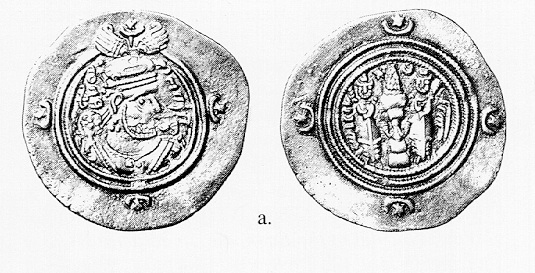
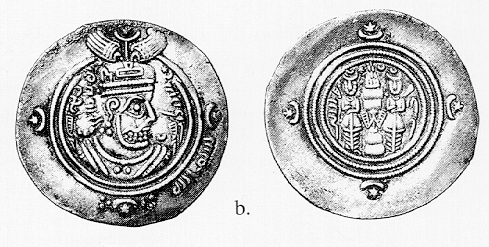
Since the Arabs knew and used Sasanian coins, it was natural that they allowed minting of silver coins like those of the Sasanians to continue when they conquered Persia in the mid-7th century. At first, the coins had no indication of Arab authority, but all coins issued after the death of the last Sasanian emperor have an additional brief Arabic inscription in the margin such as bism Allah “in the name of God” (Plate XXIX.b). About 50/670 it began to be customary to substitute the name of an Arab official, written in Pahlavi script, for the name of the Sasanian emperor (Plate XXIX.c).

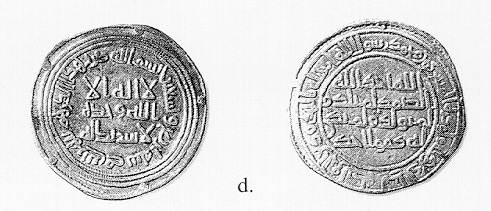
In 80/699 new Arabic Islamic dirhams were invented at Damascus and introduced at about thirty mints throughout Persia (Plate XXIX.d). These coins are anonymous, bearing only Islamic religious inscriptions in Arabic, principally the šahāda (There is no god but God alone; none is associated with Him), and the date and mint of issue. These inscriptions remained standard throughout the Omayyad period (until 132/750) and were retained with some additions and changes until the 16th century.
The weight standard of the new dirhams was 7/10 of the old Sasanian standard. In the 7th century, as the 9th century Arab historian Balaḏorī explains (Fotūḥ, p. 465), weight standards in Persia were expressed as a relationship to the meṯqāl, in a formula such as “dirhams weight of ten” meaning that ten dirhams at such a standard weighed ten meṯqāls, while ten “dirhams weight of seven” weighed seven meṯqāls. Since in his account the original dirhams were “weight of ten,” it follows that the meṯqāl in 7th century Persia was the weight of the heaviest circulating silver coins, or just over 4 grams (there were minor local variations in this standard). There were, however, other weight standards such as “weight of eight” (8/10 meṯqāl) and “weight of five” (1/2 meṯqāl). The standard of the new Islamic dirham was fixed in Persia, perhaps as a compromise, at “weight of seven” or 7/10 of the old standard, usually between 2.80 and 2.85 grams though there are heavier dirhams, up to 2.95 grams, resulting from local variation.
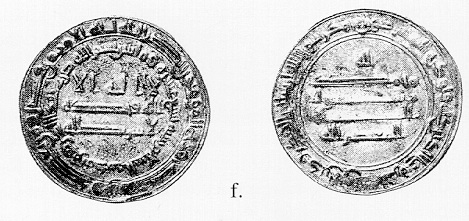
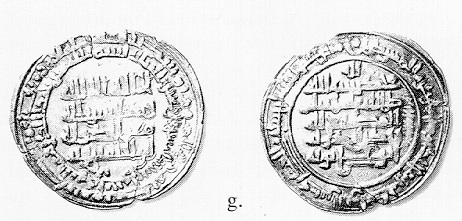
Commencing with the ʿAbbasid caliphate (132/750), a series of changes in the appearance and weight standard of the dirham were made, ending with the beginning of the reign of al-Moʿtaṣem (218/833), when the dirham, as well as the gold dinar, was fixed in the form it would retain until the 11th century. The earliest was the introduction of Moḥammad Rasūl Allāh (Moḥammad [is] the messenger of God) as the standard reverse central inscription, in place of a longer inscription that had characterized Omayyad dirhams. Starting in 145/762, dirhams began to bear the names of caliphs and other officials (Plate XXIX.e). A second obverse marginal inscription, the Koranic verse beginning le’llāh al-amr men qabl wa men baʿd (command is God’s, in the past and in the future), was first used in 199/814 and became standard about 206/821. Al-Moʿtaṣem amd his successors established the rule that no one but the caliph and his heir could be named on coins (Plate XXIX.f), but later viziers and amir-al-omarāʾs (q.v.) at the center and certain powerful governors in the provinces were allowed to be named as well. All the independent secular rulers of the 4th to 7th centuries, such as the Saffarids, Samanids, Buyids, Ghaznavids, and Saljuqs, used the classical ʿAbbasid design and inscriptions on their coins, but added the rulers’ names and titles to those of the caliph (Plate XXIX.g). Otherwise their coinage in Persia followed the ʿAbbasid pattern (see DĪNĀR for the full inscriptions of the standard type, which was the same for gold and silver).

Also during the 8th and 9th centuries, the definition of the meṯqāl was changed to make it equal to the weight of the Islamic gold dinar (as had already been true in Egypt and Syria). The weight standard of the dirham continued to be defined as 7/10 of this meṯqāl of 4.25 grams, and the 7:10 ratio between the weight of the silver dirham and the gold dinar became a tenet of Muslim Šarīʿa law. The value of the two coins was, however, never fixed. The dinar and dirham were two separate currencies, with their relative value set in the marketplace.
Around the beginning of the 11th century, dirhams in Persia became increasingly debased in alloy and scarce, finally disappearing completely. There are virtually no Saljuq dirhams, for example. The economic reasons for this are not clear, but it seems that silver had become relatively scarce throughout the world. For Persia and its neighbors in particular, the shortage of silver might be connected with the enormous export of dirhams from eastern Persia across Russia to Scandinavia to pay for northern imports. This export, however, had gone on for some two centuries without slackening; its sudden termination at the beginning of the 11th century must also be explained by the exhaustion of some major source of silver, such as the mines of Panjhīr/Panjšīr in Afghanistan.
In the late 12th century, silver coinage resumed in Syria and Anatolia, and in 629/1231-32 at Baghdad. By 642/1244-45, the Mongols initiated silver dirham coinage at their Persian capital, Tabrīz. In subsequent years, silver coinage spread gradually to other Persian cities, but a uniform silver dirham coinage at nearly every urban center began only with the general monetary reform of the Il-khan Ḡāzān and his vizier Rašīd-al-Dīn Fażl-Allāh in 696/1296-97 (Rašīd-al-Dīn, Jāmeʿ-al-tawārīḵ, Baku, pp. 490-94). In the new system, the weight of the dirham was set at that of the meṯqāl, about 4.30 grams, and the dinar, formerly a gold coin of 4.25 grams, was defined as six silver dirhams. The gold coins of the Il-khans were called meṯqāls and were not fixed in relation to the dinar of six dirhams.
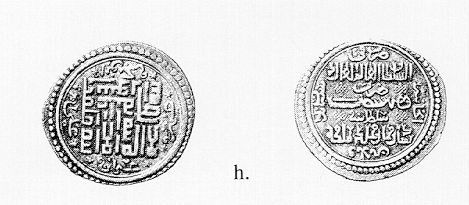
Throughout the 14th century, under the Il-khans and their successors, successive reductions in the weight standard of the dirham followed rapidly. To distinguish these various weight standards, the dirhams of the Il-khans and their successors show a variety of designs (Plate XXIX.h), in contrast to the uniformity of the classical dirham type. By the middle of the 14th century, a coin denominated as six dirhams, or one dinar, weighed and was worth less than the original one-dirham coin of 1296. Timur’s conquest of Persia swept all this away and introduced a new silver coin called the tanka. The term dirham was not used thereafter in Persia for coinage, being replaced by such denominations as šāhī and rīāl. It survived only in literary and legal contexts.
As a weight unit, in later medieval and modern Persia the dirham varied between 3.2 and 3.3 grams.
See also COINS AND COINAGE.
Bibliography
(For cited works not given in detail see “Short References.”) S. Album, “Studies in Ilkhanid History and Numismatics. I. A Late Ilkhanid Hoard (743/1342),” Studia Iranica 13, 1984, pp. 49-116.
Idem, “Studies in Ilkhanid History and Numismatics. II. A Late Ilkhanid Hoard (741/1340) as Evidence for the History of Diyar Bakr,” Studia Iranica 14, 1985, pp. 43-76.
Idem, “The Coinage of Nūr-Āward, Atabeg of Lur Buzurg, 751-57 H./A.D. 1350-56,” American Numismatic Society Museum Notes 22, 1977, pp. 213-39.
Idem, A Checklist of Popular Islamic Coins, Santa Rosa, CA, 1993.
M. L. Bates, “Islamic Numismatics,” Middle East Studies Association Bulletin 12/2, May 1978, pp. 1-16; 12/3, December 1978, pp. 2-18; 13/1, July 1979, pp. 3-21; 13/2, December 1979, pp. 1-9.
M. R. Cowell and N. M. Lowick, “Silver from the Panjhīr Mines,” Metallurgy and Numismatics 2, London, 1988, pp. 65-74.
S. H. Gaube, Arabo-Sasanidische Numismatik, Braunschweig, 1973.
R. Göbl, Sasanian Numismatics, Braunschweig, 1971.
Lane-Poole, Catalogue of Oriental Coins in the British Museum, London, 1875-90.
G. C. Miles, “Dirham,” in EI2 II, pp. 319-20.
Idem, “Numismatics,” in Cambr. Hist. Iran IV, pp. 364-77.
J. Masson Smith, Jr., “The Silver Currency of Mongol Iran,” Journal of the Economic and Social History of the Orient 12, 1969, pp. 16-41.
J. Walker, A Catalogue of the Muhammadan Coins in the British Museum. I. A Catalogue of the Arab-Sassanian Coins (Umaiyad Governors in the East, Arab-Ephthalites, ʿAbbasid Governors in Tabaristan and Bukhara, London, 1941; II. A Catalogue of the Arab-Byzantine and Post-Reform Umaiyad Coins, London, 1956.
Plate XXIX.b. Dirham, Dārābgerd mint, with name of Ḵosrow, dated 30th year of Yazdegerd III (C.E. 661-62), American Numismatic Society 1975.238.40.
Plate XXIX.c. Dirham, Garmkermān (Bardasīr) mint, with name of ʿAmr b. Laqīṯ, governnor of Kermān, dated 83/702-03, American Numismatic Society 1975.238.1.
Plate XXIX.d. Dirham, Ray mint, dated 94/712-13, American Numismatic Society 1952.80.12.
Plate XXIX.e. Dirham, Ray mint, with name of al-Mahdī Moḥammad son of the commander of the believers, dated 145/762-63, American Numismatic Society 1958.222.10.
Plate XXIX.f. Dirham, Madīnat-al-Salām (Baghdad) mint, with name of ʿAbbasid caliph al-Moʿtaṣem, dated 219/834-35, American Numismatic Society 1921.53.10.
Plate XXIX.g. Dirham, Sūq al-Ahwāz mint, with names of Buyids Moʿezz-al-Dawla and Rokn-al-Dawla and ʿAbbasid caliph al-Moṭīʿ, dated 342/953-54, American Numismatic Society 1980.35.37.
Plate XXIX.h. Dirham, Solṭānīya mint, with name of Il-khan Abū Saʿīd dated 33 Il-khani era (sana ṯāleṯ wa ṯalāṯīn īlḵānīya; 1333-34), 1974.26.108. Collection of American Numismatic Society. Scale 1:1.