




Aramaic is the comprehensive name for numerous dialects of a Northwest Semitic language closely related to Hebrew and Arabic, first attested in inscriptions dating from the ninth to eighth centuries B. C., and still spoken today.
Early history. The Arameans, the speakers of all those dialects, are first directly mentioned in cuneiform texts from the end of the twelfth century B. C. where they are said to belong to the Akhlame group of people. In the course of time, various names such as Chaldean, Nabatean, Syrian, and Assyrian, came into use for Aramaic-speaking peoples; most of them used imprecisely. During the early centuries of the 1st millennium B.C., Aramaic-speaking groups in increasing numbers pushed successfully into the settled areas of Mesopotamia and Syria. The extent of their settlement in Mesopotamia and of the slow expansion of their political influence there is greatly obscured by the continued cultural and political hegemony of the Assyrians and Babylonians, but there is enough evidence to suggest that before the middle of the 1st millennium they had become the dominant element of the population (cf. M. Dietrich, Die Aramäer Südbabyloniens in der Sargonidenzeit, Neukirchen-Vluyn, 1970; S. A. Kaufman, The Akkadian Influences on Aramaic, Chicago, 1974). In Syria, Aramaic-speaking groups succeeded in founding a number of city states and federations around Aleppo and Damascus that dominated the history of the region for about three centuries, though in conflict with, or as vassals of, the rulers of Mesopotamia. In addition to their own inscriptions and references to them in cuneiform texts, some of the history of those states is also known from references in the Bible. Whatever political importance the Arameans gained anywhere in the Near East during the early stages of their known history remained comparatively minor and without much consequence. Yet the Arameans have played a most significant role in world history by virtue of the fact that Aramaic was chosen as the international written language of the Achaemenid empire and, as a result, became the language of the basic literature of important Near Eastern religions, among them Judaism, Christianity, and some highly influential forms of Gnosticism.
Aramaic in the Achaemenid empire. When Aramean groups infiltrated Mesopotamia, they brought with them, together with their language, their alphabetical writing derived from the Phoenician script. This Aramaic writing was obviously superior to the complicated cuneiform system of writing as a vehicle for easy and convenient written communication. The various groups in Mesopotamia and Syria no doubt spoke a variety of distinct dialects, but already by the 8th century at latest, one rather uniform written form of Aramaic had been developed, probably in Assyria, although it has also been argued that it had its origin in the Aramaic spoken in Syria (cf. B. Mazar, in The Biblical Archaeologist 25, 1962, pp. 98-120; R. Degen, Altaramäische Grammatik, AKM 38, 3, Wiesbaden, 1969). The only representative of a very different dialect of Aramaic known to us appears in the inscriptions of the North Syrian kingdom of Śamʿal/Yʿdy; the vocalization of Yʿdy is unknown, but the name is conventionally pronounced Yaʿudi, and the dialect is referred to as Yaʿudite or Samalian (P.-E. Dion, La langue de Yaʿudi, Corporation for the Publication of Academic Studies in Religion in Canada, 1974). Certain dialectal differences are clearly distinguishable in the preserved written materials and their number is growing; but, until about the beginning of the Christian era, they remain largely submerged and concealed from us under the uniform appearance of the written language. When the Achaemenids extended their rule westward, they adopted this language as the vehicle for written communication between the various regions of the vast empire with its different peoples and languages. The use of a single official language, which modern scholarship has dubbed Official Aramaic or Imperial Aramaic, can be assumed to have greatly contributed to the astonishing success of the Achaemenids in holding their far-flung empire together for as long as they did.
Among the major discoveries of Official Aramaic writings are papyri and leather documents found in Egypt, most of which date from the 5th century B.C. The Elephantine papyri, named after the island in the Nile opposite Aswan where they were discovered, include the archives of a Jewish military colony established there to serve as a southern outpost of the Achaemenid empire. They contain the Jewish community’s official correspondence in the year 407 with Bagōhī, the Iranian governor of Judea, concerning the restoration of the Jewish temple in Elephantine which had been destroyed three years earlier in the course of political unrest in Egypt. Most of the documents are sales, marriage, and other contracts and legal briefs, but the archives have also preserved for us part of the Aḥiqar story, a representative of the type of wisdom literature cultivated by the Arameans of Mesopotamia, and there are large fragments of the Aramaic version of the famous Bīsotūn inscription of Darius I. It was no doubt this Aramaic version that was used to spread the Great King’s message throughout the empire (cf. A. Cowley, Aramaic Papyri of the Fifth Century B.C., Oxford, 1923; E. G. Kraeling, The Brooklyn Museum Papyri, New Haven, 1953; B. Porten, Archives from Elephantine, Berkely, Los Angeles, 1968; P. Grelot, Documents araméens d’Ēgypte, Paris, 1972; J. C. Greenfield and B. Porten, The Bisitun Inscription of Darius the Great, Aramaic Version, Corp. Inscr. Iran. I, V, Texts I, London, 1982).
Another papyrus find consists of private letters intercepted on their way from northern Egypt to Aswan. The correspondents bear Egyptian, Akkadian, and Aramaic names, and the letters were possibly written by ethnic Arameans. Like the Elephantine papyri, these are instructive for the religious and ethnic history of the empire (cf. E. Bresciani and M. Kamil, “Le lettere aramaiche di Hermopoloi,” Atti, Accademia Nazionale dei Lincei, Classe di scienze mor., stor. e filol. 8, 12, 5, 1966, pp. 359-428; B. Porten and J. C. Greenfield, in ZATW 80, 1968, pp. 216-31).
Especially noteworthy is a group of leather documents dealing with the administration of the Egyptian domains of the satrap and royal prince (bar baytā = vispuhr) Aršāma, who himself normally resided in Babylon and Susa. Aršāma no doubt spoke Old Iranian; the people affected by the document were often Egyptians and spoke Egyptian; but the language of communication was Aramaic. The documents give us an insight into the ways in which the affairs of the provinces of the empire were administered on a level corresponding to that of the highest government authorities. The manifold problems in handling of workers and craftsmen, their duties, various ethnic origins, travels through the empire, and the influence on them of political disturbances are among the subjects touched upon, presenting us with a unique picture of Achaemenid political reality not available elsewhere. (See G. R. Driver, Aramaic Documents of the Fifth Century B.C., Oxford, 1954.) On the outside, the documents carry the names of the sender and addressee(s) and, for purposes of record and easy identification, a brief summary of the contents. The texts attempt to be concise and exact. A good example, showing the expected strong Persian influence and of particular interest for the ancient history of the production of works of art, is Driver No. IX: “From Aršama to Neḥtḥūr, the chief treasurer (knzsrm, Old Pers. ganza0, or proper name?), and his colleagues. And now: A sculptor (ptkrkr, OIr. *patikarakara) named (šmh, Aram. loan tr. from OIr. nāmaka) Ḥnzny, my servant, whom Bagasarū (OIr.) had brought to Susa—give him, and his household, the same provisions (ptpʾ, OIr. *piθpa) as other jewelers (bd/rykrn, OIr. *badīkara?) of my workforce (grd, OIr. garda through Babylonian), so that he can make (equestrian?) sculptures (ptkrn, OIr. patikara) to be in your house (?), and make the sculpture (patikara) of a horse with its rider, as he has done formerly in my house, and other sculptures (patikara). Send (messengers) to bring (them) to me quickly and immediately. Artōhī (OIr.) cognizant of this order (yḍʿ ṭʿm[ ʾ], Aram. loan tr. from OIr.?); Rašt (OIr.), scribe.”
Another direct witness to the role of Official Aramaic in the Achaemenid empire is the Aramaic portion of the Hebrew Bible. The Aramaic texts in the Book of Ezra 4:8-6:18 and 7:12-26 reproduce, probably quite literally, the exchange of official documents concerning the necessary permits from the central government required for the rebuilding of the temple in Jerusalem and the return of Jewish exile groups from Mesopotamia to Palestine. The edifying Aramaic tales in the Book of Daniel 2:4-7:28, which in their preserved form date from the 2nd century B.C., also reflect the dominant position of Official Aramaic in the political setting in which they were originally conceived.
Aramaic texts from the center of the Achaemenid empire are so far few. A very large number of repetitive formulaic inscriptions on fragments of stone mortars, pestles, and plates from the 5th century were discovered in Persepolis. Although key words in them still defy interpretation, they appear to indicate the producer of the object on which the inscription was written (apparently part of an annual corvée contribution), as well as the administrative officials, the sgan (chief), ganzabara (treasurer), and upa-ganzabara (sub-treasurer), for whom or under whose control they were produced in a given year. A representative example reads: “In the (particular building or section) of the Fortress (Persepolis) under the control of NN, the chief NN made this plate, large, nine fingers wide, for (to be delivered to) NN the treasurer, who is in N. Corvée of the year n.” (cf. R. A. Bowman, Aramaic Ritual Texts from Persepolis, Chicago, 1970; B. Levine, in JAOS 92, 1972, pp. 70-79.)
A few inscriptions that have come to light in Anatolia also allow us glimpses of minor details of Achaemenid provincial administration and history. Among those most recently discovered are the stela from Daskyleion in northwest Anatolia (cf. F. M. Cross Jr., in Bulletin of the American School of Oriental Research 184, 1966, pp. 7-10, and R. S. Hanson, ibid., 192, 1968, pp. 3-11) and the important trilingual (Greek, Lycian, and Aramaic) inscription from Xanthos in the southwest corner of Anatolia, found in 1973 (cf. A. Dupont-Sommer and others, Fouilles de Xanthos IV: La stèle trilingue du Létôon, Paris, 1979). The eastern limits of the influence of Official Aramaic are marked by six inscriptions found in Pakistan (Taxila) and Afghanistan Pul-i Daruntah (Pol-e Darūnta, Kandahar I and II, Laḡmān), dating from the reign of Aśoka in the 3rd century B.C. (cf. A. Dupont-Sommer, Une nouvelle inscription araméenne d’Asoka trouvée dans la vallée du Laghman. Communication à l’Académie des Inscriptions et Belles-Lettres, 20 mars, 1970, Paris, 1970; G. D. Davary and H. Humbach, Eine weitere aramäoiranische Inschrift der Periode des Aśoka aus Afghanistan, Mainz and Wiesbaden, 1974, Akad. f. Wiss. u. d. Lit., Phil.-hist. Kl., 1974, 1; G. D. Davary, in Stud. Ir. 10, 1981, pp. 55f.). Other significant later evidence for the influence of Official Aramaic has been discovered in ancient Nisa near Ashkhabad in Turkmenistan, where a vast number of ostraca were uncovered, most of them dealing with the storage of wine (see Corp. Inscr. Iran. II, II: Parthian Economic Documents from Nisa, Plates 1, pp. 1-6, and Texts 1, pp. 1-4). Like other relics of the Arsacid period, the Nisa ostraca have now been linguistically classified as Parthian, although the Aramaic component appears to be more prominent in them than in the other Arsacid documents. Future archeological exploration is likely to discover more inscriptional material in Aramaic script and thus further elucidate ancient Iranian history.
Later dialects. The great similarity of the later Aramaic dialects can be explained only by the assumption that Official Aramaic, the written form of the language, also made decisive inroads into the way Aramaic was spoken in Achaemenid times, at least by the more educated speakers of the language. From early Christian times on, clear distinctions between the dialects used in Mesopotamia and Syria-Palestine become fully established. The major dialectal division is generally designated as one between Eastern Aramaic and Western Aramaic, roughly in keeping with the geographical distribution. This distribution implies that the Western Aramaic dialects were used in areas under the sway of the Roman and Byzantine empires, while the Eastern Aramaic dialects developed in the western part of the Arsacid and Sasanian realms or in contested border regions between Iran and Rome. Ctesiphon, the Persian capital, was located in the heart of the territory inhabited by speakers of Eastern Aramaic. Since, however, those Arameans had long been used to a life without real national independence, political tensions in the area were expressed more in terms of religious divisions than ethnic or linguistic ones.
A border region dialect of Aramaic is Palmyrenian, attested by many inscriptions from the city of Palmyra (whose native name, known since the first half of the 2nd millennium B.C., was, and is, Tadmar/Tadmōr/Tadmur) and from Palmyrenians sojourning in the Roman empire. The inscriptions date from the time of Palmyra’s economic and political ascendancy, the 1st century B.C. to the 3rd century A.D., when the city was a powerful element in the continuous struggle between the Roman and Persian empires. Some Palmyrenian inscriptions were also found at Dura-Europos, a caravan and garrison city on the middle Euphrates, which flourished for a while and, like Palmyra, lost its importance after 271-72 A.D.; the international character of its population is reflected in the great variety of religious cults represented there and of the languages recorded in inscriptions which, in addition to Aramaic (Palmyrenian, Syriac), Greek, and Latin, also include Middle Persian and Parthian.
Nabatean (nabaṭī) is an ethnic and social designation used widely in medieval Islamic times for the local, mostly Aramean population of southern Mesopotamia. However, the dialect properly called Nabatean is the written form of Aramaic used in the Nabatean kingdom centered around Petra in Jordan, whose independence came to an end in 106 A.D. In addition to numerous monumental inscriptions, the dialect is now also known from a few papyrus documents. (Most of them are as yet unpublished, cf., for the time being, J. Starcky in Revue Biblique 61, 1954, pp. 161-81). Since the Nabateans were ethnically mostly Arabs and speakers of Arabic, the later inscriptions, from after the end of Nabatean independence, show increasing Arabic influences and contribute in a small way to our knowledge of pre-Islamic Arabic. The Nabatean development of the Aramaic script evolved further into the Arabic script of the Muslim Arabs. The transition from Nabatean to Arabic writing is shown here in Table 2 (cf. also F. Rosenthal, in H. D. Colt. ed., Excavations at Nessana I, London, 1962, pp. 198-210; A. Grohmann, Arabische Paläographie, II. Teil, Graz and Vienna, 1971.)
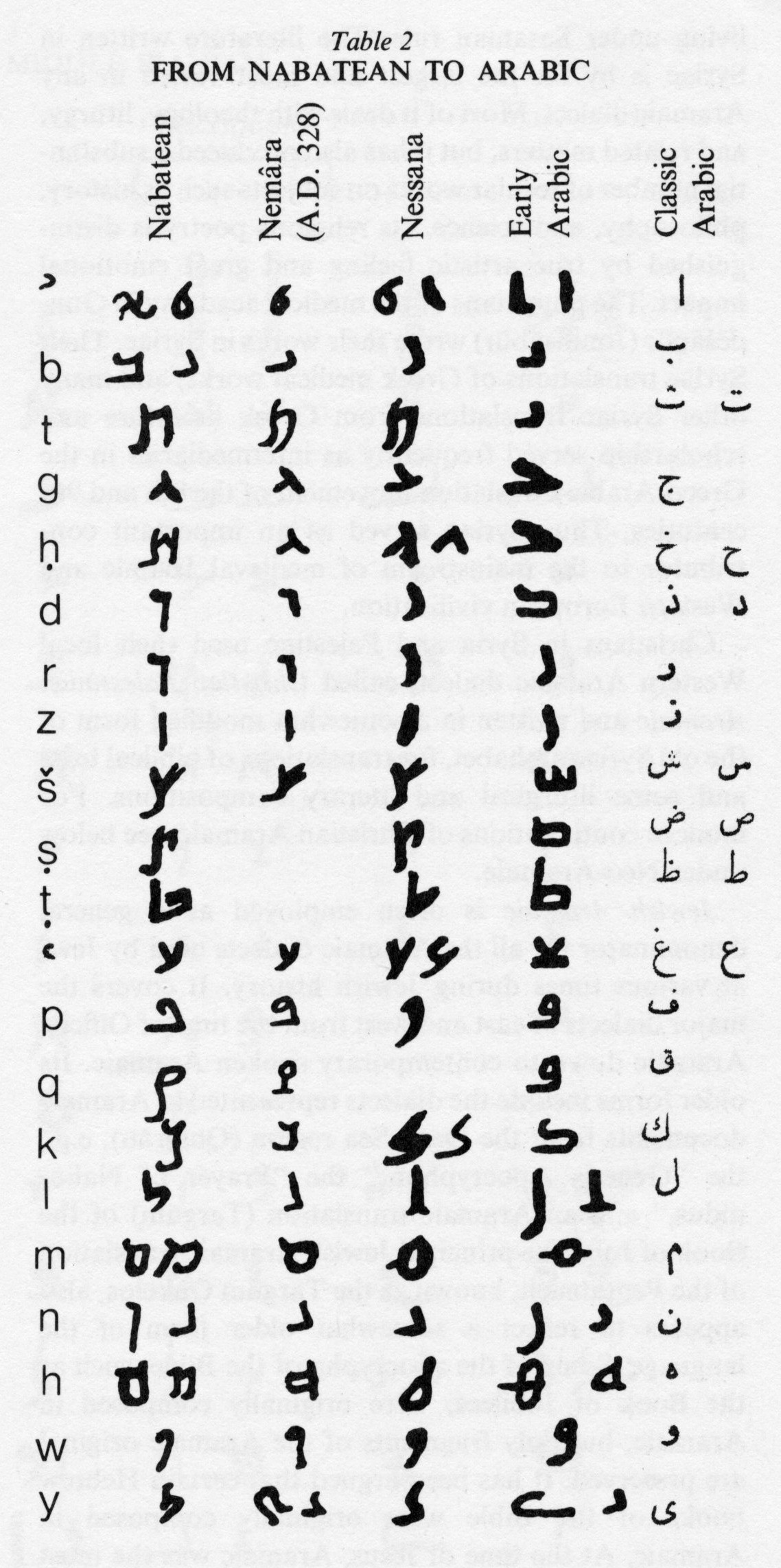
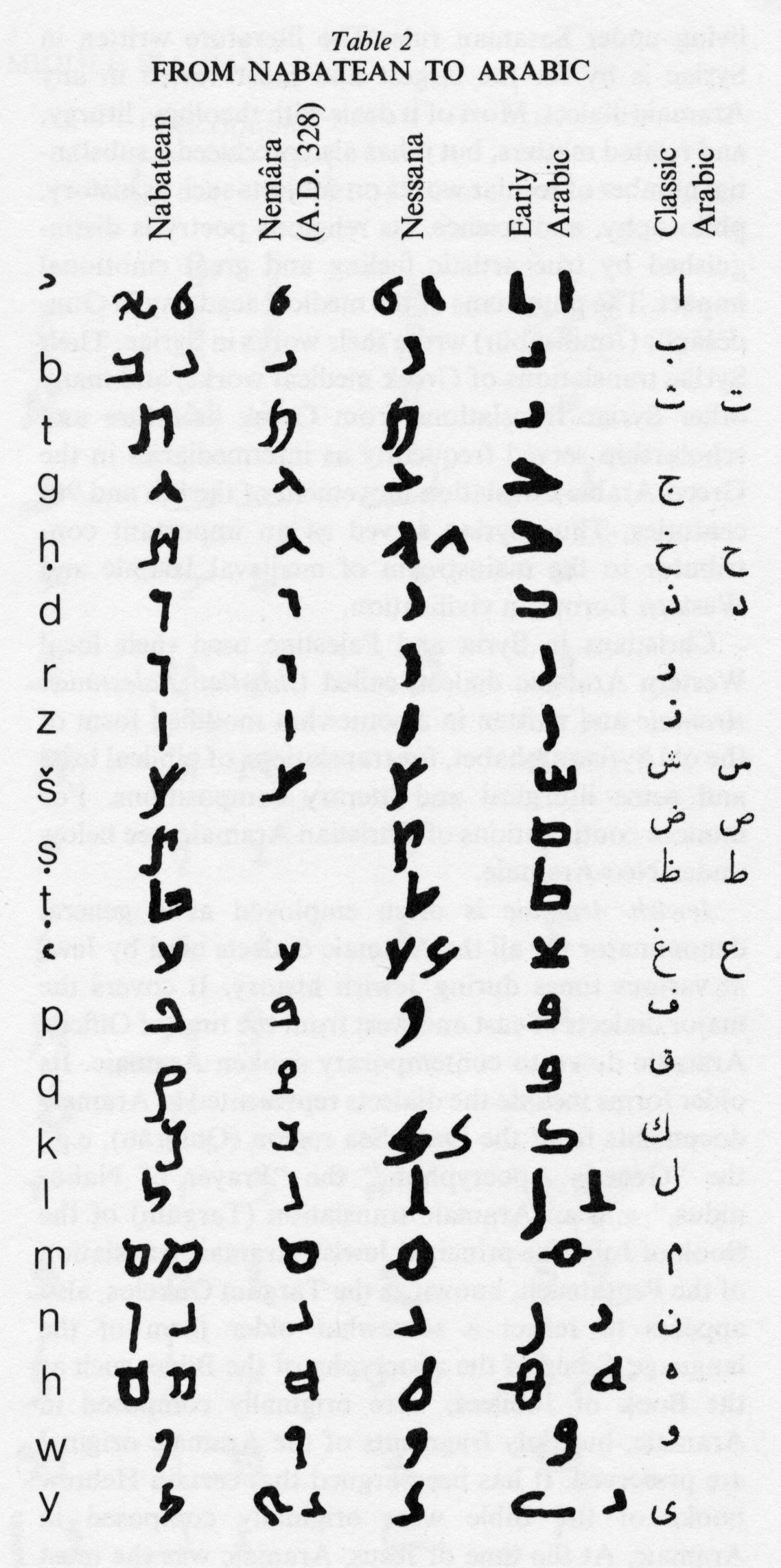
Table 2. From Nabatean to Arabic
Hatran is known from inscriptions discovered in Hatra northwest of ancient Assur and mainly dated in the 2nd century A.D. The name of the most prominent local ruler, Sanaṭrūq (Sanatruk/Sanatruces) reflects the dominance of the Arsacids in the area, as do occasional Parthian loanwords such as pzgrybʾ “heir apparent.” Hatran is the earliest directly attested dialect of Eastern Aramaic, which is otherwise known in its earlier stages only from certain peculiarities dimly noticeable in some old inscriptions and the Uruk incantation text written in cuneiform writing but in the Aramaic language.
Syriac, the slightly archaizing Eastern Aramaic dialect of the city of Edessa (Orhāy, ar-Ruhā, Urfa), is the most important Aramaic dialect used by Christians. It is the earliest and basic language of Oriental Christianity and was spoken by the large number of Christians living under Sasanian rule. The literature written in Syriac is by far the largest and most varied in any Aramaic dialect. Most of it deals with theology, liturgy, and related matters, but it has also produced a substantial number of secular works on subjects such as history, philosophy, and science. Its religious poetry is distinguished by true artistic feeling and great emotional impact. The physicians of the medical academy in Gundēšāpūr (Jondīsābūr) wrote their works in Syriac. Their Syriac translations of Greek medical works, and many other Syriac translations from Greek literature and scholarship served frequently as intermediaries in the Greco-Arabic translation movement of the 8th and 9th centuries. Thus Syriac served as an important contributor to the mainstream of medieval Islamic and Western European civilization.
Christians in Syria and Palestine used their local Western Aramaic dialect, called Christian Palestinian Aramaic and written in a somewhat modified form of the old Syriac alphabet, for translations of biblical texts and some liturgical and literary compositions. For modern continuations of Christian Aramaic, see below under Neo-Aramaic.
Jewish Aramaic is often employed as a general denominator for all the Aramaic dialects used by Jews at various times during Jewish history. It covers the major dialects of east and west from the time of Official Aramaic down to contemporary spoken Aramaic. Its older forms include the dialects represented in Aramaic documents from the Dead Sea region (Qumrān), e.g., the “Genesis Apocryphon,” the “Prayer of Nabonidus,” and an Aramaic translation (Targum) of the Book of Job. The principal Jewish Aramaic translation of the Pentateuch, known as the Targum Onkelos, also appears to reflect a somewhat older form of the language: Some of the apocrypha of the Bible, such as the Book of Jubilees, were originally composed in Aramaic, but only fragments of the Aramaic original are preserved. It has been argued that certain Hebrew books of the Bible were originally composed in Aramaic. At the time of Jesus, Aramaic was the most widely spoken Semitic language in Palestine, and it has been contended that important parts of the Gospels were originally conceived in Aramaic and translated from Aramaic originals. The Western Aramaic dialect of the Jews is represented in the Palestinian Targums and the Palestinian Aramaic dialects of the Jerusalemian Talmud. These Western forms are almost identical with Christian Palestinian Aramaic and Samaritan, the Western Aramaic dialect used by the Samaritans for their Aramaic translation of the Bible and a number of midrashic and liturgical works. The Eastern Aramaic dialect of the Jews is called Babylonian Talmudic. It is the language used by the rabbis in the Sasanian empire for their discussions of the law and preserved in the Babylonian Talmud (cf. J. Neusner, A History of the Jews in Babylonia, 5 vols., Leiden, 1965-70).
The gnostic religion of the Manicheans started out as an Aramaic-speaking sect in 3rd-century southern Mesopotamia but soon switched to other languages as more suitable vehicles for religious proselytizing. What is preserved of Manichean literature is written principally in Iranian and Coptic and not in their original Aramaic dialect. The same applies to the very few remains of the literature of the Sabians of Ḥarrān (cf. F. Rosenthal, in A Locust’s Leg, Studies in Honour of S. H. Taqizadeh, London 1962, pp. 220-32). However, a related gnostic sect, the Mandeans, whose preserved literature also had its start in Sasanian times, left a number of highly interesting religious writings in their Eastern Aramaic dialect referred to as Mandaic. Fundamental among those works is the Ginza Rabba “The Great Treasure.” The Mandeans are represented today by small numbers of adherents in Southern Mesopotamia and Iran, the only true remnant of the once powerful gnostic religions. A modern continuation of their Aramaic dialect has survived until our times (cf. E. S. Drower, The Mandaeans of Iraq and Iran, Oxford, 1937; R. Macuch, Handbook of Classical and Modern Mandaic, Berlin, 1965).
Neo-Aramaic is the generic designation for a great variety of Aramaic dialects spoken today. Older written witnesses for the existence of Neo-Aramaic go back as far as the 16th century, but most of our knowledge of these dialects comes from the study of the spoken forms initiated in the last century. Eastern Neo-Aramaic, that is, modern forms of Eastern Aramaic (other than Mandaic), is spoken by Christians and Jews in Iran and Kurdistan. Emigration from their original habitats during the first half of the 20th century has scattered large numbers of the native speakers of these dialects all over the world, but many remain in Iran, Iraq, and other Near Eastern countries as well as in the neighboring parts of the USSR (Armenia, Georgia). The Christian dialects were first standardized and reduced to writing in the Nestorian Syriac script by American missionaries in the region of Reżāʾīya (Urmia) in the last century. A considerable amount of religious, scholarly, literary, and journalistic material has been and continues to be published in the Syriac, Cyrillic, and Latin scripts, principally in Iran, the USSR, and the United States: While these Eastern Neo-Aramaic dialects are very closely related to each other, a quite different dialect, with phonetic and historic features close to the western, Jacobite form of Syriac, is spoken in Jabal Senǰār west of Mosul. It is known as Ṭūrōyo, i.e. “mountain” (Jabal) dialect (cf. I. Garbell, The Jewish Neo-Aramaic Dialect of Persian Azarbaijan, The Hague, 1965; H. Jacobi, Grammatik des Thumischen Neuarämaisch, AKM 40, 3, Wiesbaden, 1973; H. Ritter, Ṭūrōyo, Beirut, 1967-1971.) Western Neo-Aramaic is the modern continuation of the Aramaic spoken by Christians in Syria and Palestine. It has survived in three villages of the Anti-Lebanon and is known as the Maʿlūla dialect, after the name of the principal one of those villages (cf. A. Spitaler, Grammatik des neuaramäischen Dialekts von Maʿlūla, AKM 23, 1, Leipzig, 1938).
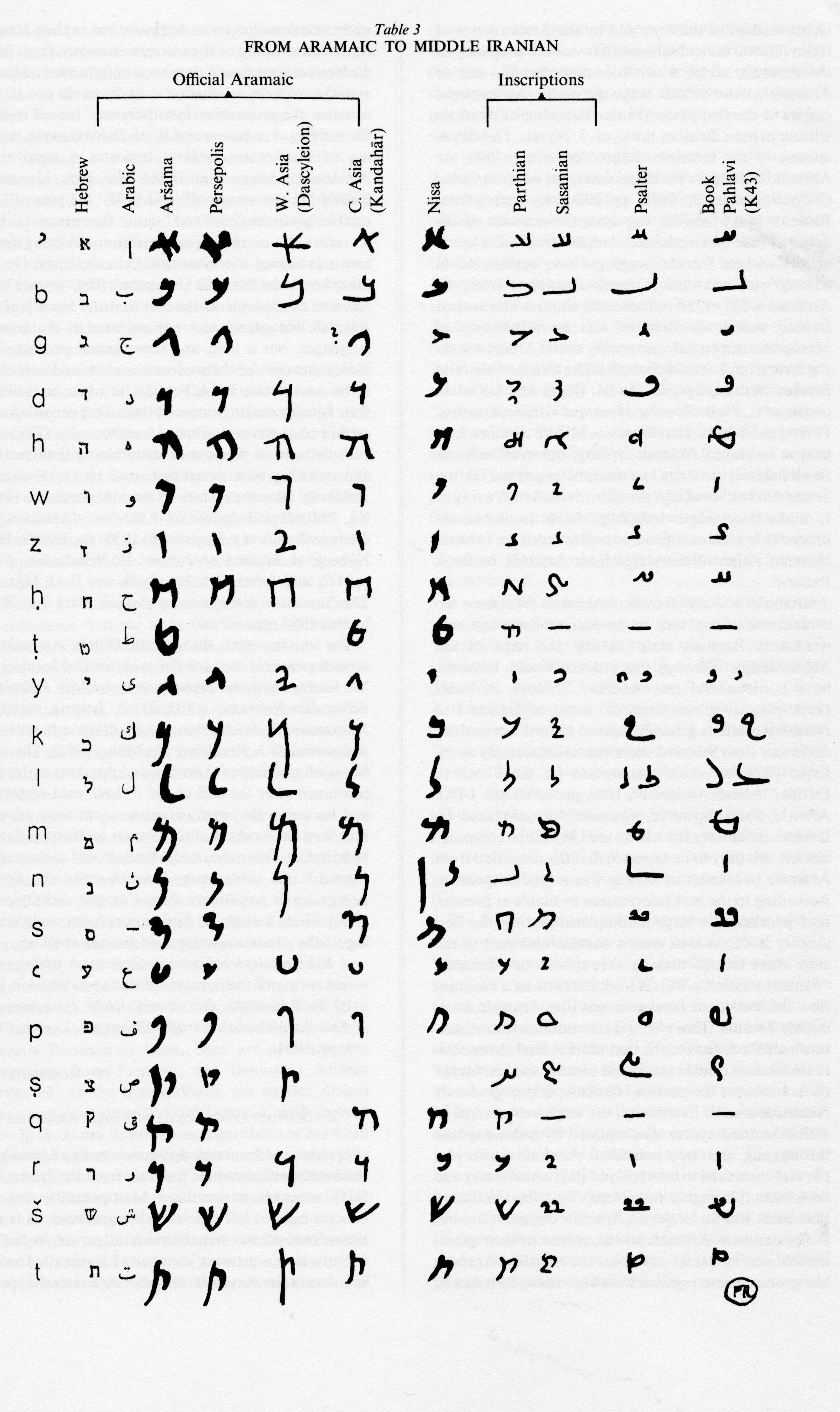
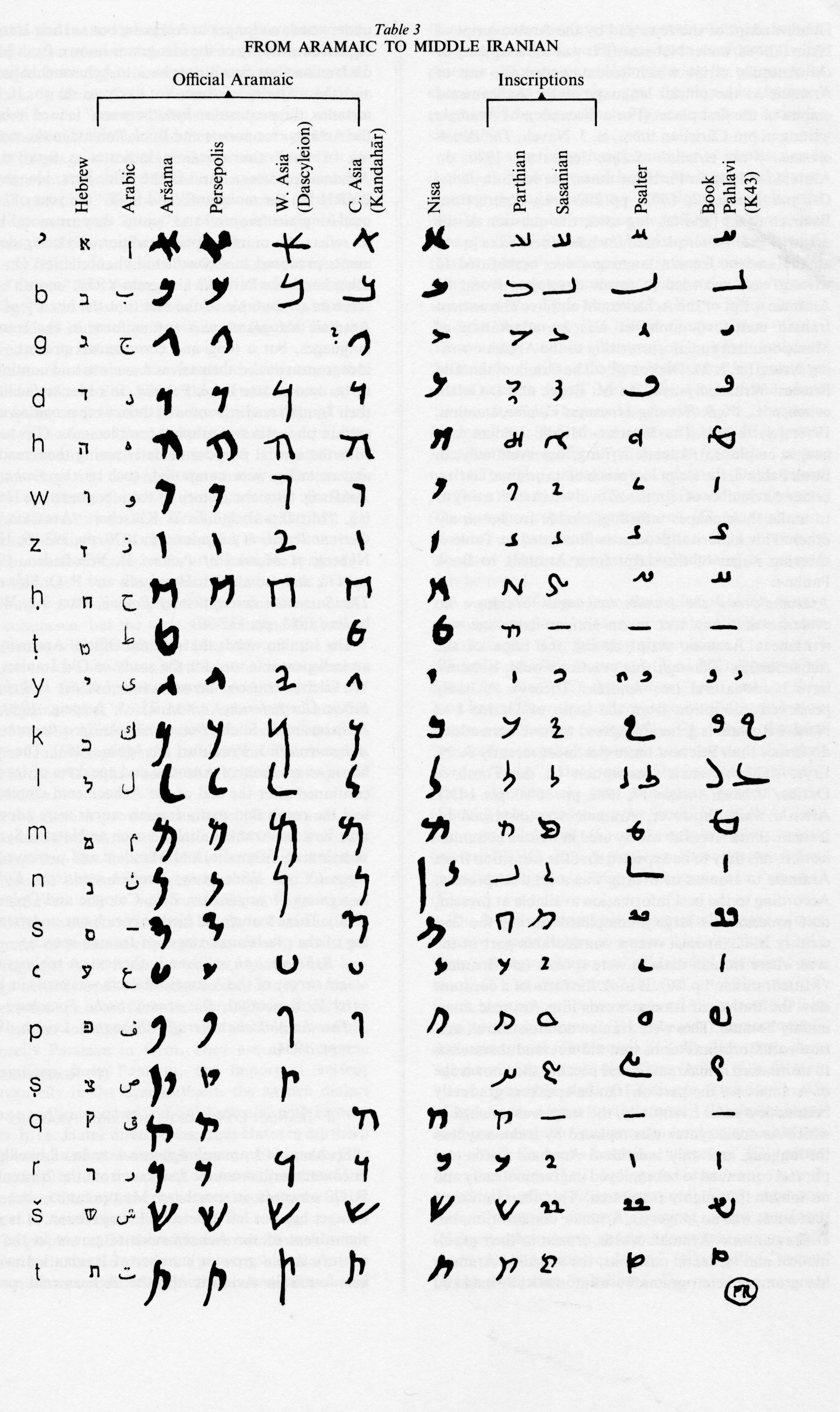
Table 3. From Aramaic to Middle Iranian
Aramaic and Iranian writing. The Aramaic development of alphabetical writing is represented by the Hebrew script of the Jews and by the Arabic script of Islam (above, under Nabatean). It was the simplicity of the Aramaic script which recommended the use of Aramaic as the official language of the Achaemenid empire in the first place. (For a discussion of Aramaic writing in pre-Christian times, cf. J. Naveh, The Development of the Aramaic Script, Jerusalem, 1970; on Aramaic writing in Parthian times, see idem in Israel Oriental Studies 2, 1972, pp. 292-304.) Apart from Bactrian (and leaving aside the question of the origin of Brāhmī script, used for Khotanese Saka [q.v.]) all the ancient Iranian languages ever committed to writing were recorded in forms developed from the Aramaic script of the Achaemenid empire. The ancient Iranian cuneiform alphabet was an adaptation of Mesopotamian cuneiform writing to the Aramaic writing system (cf. I. M. Diakonoff, “The Origin of the ” Old Persian” Writing System,” in M. Boyce and I. Gershevitch, eds., W. B. Henning Memorial Volume, London, 1970, pp. 98-124. The Western Middle Iranian languages employed Aramaic writing; but eventually, in Book Pahlavi, the script lost much of its original clarity, because a number of letters had evolved in such a way as to make their shapes indistinguishable from one another. This historical process is illustrated in Table 3, showing stages of the script from Aramaic to Book Pahlavi.
Aramaic and the Iranian languages. We have no evidence that any text in an Iranian language was written in Aramaic script during the reign of the Achaemenids; although this practice would, it seems, have been natural (see Andreas Theory). A badly preserved inscription from the tomb of Darius I at Naqš-e Rostam is generally agreed to have been added no earlier than Seleucid times (see most recently R. N. Frye, “The ” Aramaic” Inscription on the Tomb of Darius,” Iranica Antiqua 17, 1982, pp. 85-90, pls. I-IX). After a while, however, Aramaic was displaced by Iranian. Since it was so widely used in written communication, it is only to be expected that the transition from Aramaic to Iranian in writing was a gradual process. According to the best information available at present, that process was largely completed during the 2nd century B.C., at least over a considerable part of the area where Iranian dialects were spoken (cf. Henning, “Mitteliranisch,” p. 30). It took the form of a constant slow infiltration of Iranian words into Aramaic texts, mainly because there were Iranian administrative, cultural, and technical terms that did not lend themselves to translation into Aramaic and because the knowledge of Aramaic on the part of Iranian-speakers gradually became less sure. Eventually, the stage was reached in which Aramaic syntax was replaced by Iranian syntax throughout, and only individual Aramaic words and phrases continued to be employed ungrammatically and no longer thoroughly integrated. This then indicated that a text was no longer an Aramaic composition, but an Iranian one. Aramaic words, frozen in their grammatical and syntactic positions, the so-called Aramaic ideograms or heterograms, were automatically read and understood, no longer in Aramaic, but as their Iranian equivalents. Many of the ideograms known from Middle Iranian texts clearly date back to Achaemenid times, and the majority of them are likely to do so. If, for instance, the preposition byn “between” is used in both the Aršāma documents and Book Pahlavi in the meaning of “in,” this certainly indicates a survival of Achaemenid usage. And if the Mid. Pers. ideograms BYRḤ “in the month of” and ŠNT “the year of” are used for plain “month” and “year,” they are most likely to reflect the uninterrupted tradition of dating documents practiced in Achaemenid chancelleries. On the other hand, the Parthian ideogram YRḤʾ “month” can serve as an example of the fact that the history of the Aramaic ideograms was not uniform in the Iranian languages, but a long and complicated process. The ideograms showed themselves tenacious and continued to be used in late Book Pahlavi. In order to facilitate their Iranian reading, some of them were provided with certain phonetic and graphic complements. Glossaries with the special purpose of determining their reading and meaning were composed, such as the Frahang ī Pahlawīg. (For the history of the ideograms see Henning,“Mitteliranisch;” E. Y. Kutscher, “Aramaic,” in Current Trends in Linguistics 6, 1970, pp. 393-99; H. S. Nyberg, A Manual of Pahlavi II, Wiesbaden, 1974, pp. 1-7; and see also H. Humbach and P. O. Skjærvø, The Sassanian Inscription of Paikuli, Part 3.2, Wiesbaden, 1983, pp. 132-39).
The Iranian words that entered Official Aramaic are an indispensable tool for the study of Old Iranian (cf. W. Eilers, Iranische Beamtennamen in der keilschriftlichen Überlieferung, AKM 25, 5, Leipzig, 1940; F. Altheim and R. Stiehl, Die aramäische Sprache unter den Achaimeniden I, Frankfurt am Main, 1963). The symbiosis of speakers of Aramaic and speakers of Iranian continued after the end of the Achaemenid empire. It had the result that many Iranian words were adopted into Eastern Aramaic dialects such as Hatran, Syriac, Babylonian Talmudic, and Mandaic and preserved by them (cf. G. Widengren, Iranisch-semitische Kulturbegegnung in parthischer Zeit, Cologne and Opladen, 1960). These loanwords further enrich our understanding of the pre-Islamic stages of Iranian speech.
Bibliography
Given in the text. A bibliographical survey of the Aramaic dialects was made in 1938 by F. Rosenthal, Die aramaistische Forschung seit Theodor Nöldeke’s Veröffentlichungen, Leiden, 1938, repr. 1964.