




i. WOODWORK
Gereh-sāzī refers to two related techniques of woodworking: either a lattice frame, which could be left plain or filled with wooden insets, colored glass, or other materials and was used for balustrades and window screens; or a mosaic panel, composed of hexagons, stars, and other geometric shapes and used to decorate the sides of menbars and ceilings in mosques, palaces, and private houses.
Both techniques must have been common at least from the 14th century, but due to the ravages of time, insects, and fire few early pieces have survived. One of the earliest examples of a wooden lattice to survive is the balustrade guarding the stairs and platform of the jujube menbar made by Maḥmūdšāh b. Moḥammad Naqqāš Kermānī and donated to the Friday Mosque at Nāʾīn in Rajab 711/October-November 1311 (Smith, figs. 1, 3, 4, 6). One of the earliest examples of the star-and-polygon technique is the side panels on a menbar dated 771/1369 and transferred in 1935 from the Friday Mosque in Sūrīān in Fārs to the Iran Bastan Museum (Moṣṭafawī, p. 8; Golmohammadi, p. 78). The Timurid menbar in the Gowhar-Šād Mosque (q.v.) in the sanctuary of Imam Reżā at Mašhad (see Diez, fig. 8) displays both techniques, an open lattice for the balustrade and mosaic panels for the sides.
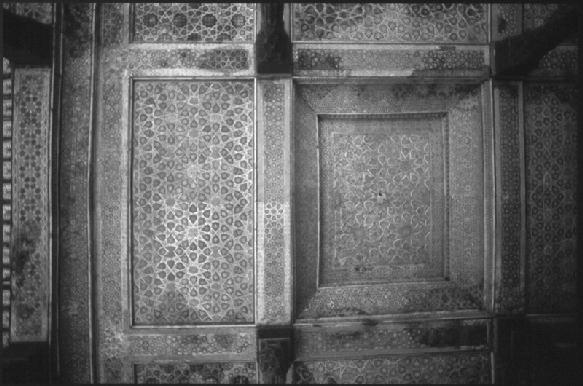
These woodworking techniques were very popular in the Safavid period, and many fine examples survive in Safavid buildings at Isfahan, especially the Hašt Behešt and Čehel Sotūn palaces (qq.v.). For windows, the lattices were usually filled with clear or colored glass and served simultaneously as barrier and connector between interior and exterior. Rectangular grilles were surmounted by a pointed arch, and large grilles were made up of three or more moveable panels. Over time the mesh was closed up, the pieces became thinner, and denser and more complex compositions with stars and polygons were created (illustrations in Orazi). Ceilings had elaborate mosaic compositions of stars and polygons, often highlighted with paint and gilding (see, for example, the ceiling over the porch in the Čehel Sotūn; Survey of Persia Art VIII, pls. 473-74; (PLATE I). During the Qajar period, curvilinear and floral patterns became popular, and mirrored glass was added to heighthen the decorative effect.
Bibliography
E. Diez, “Miḥrāb,” in EI1 III, pp. 485-90.
J. Golmohammadi, “Minbar 2,” in EI2 VII, pp. 76-79.
M.-Ṭ. Moṣṭafawī, Eqlīm-e Pārs, Tehran, 1343 Š./1964.
R. Orazi, Wooden Gratings in Safavid Architecture, Rome, 1976.
M. B. Smith, “The Wood Minbar in the Masdjid-i Djāmiʿ, Nāʾīn,” Ars Islamica 5, 1938, pp. 21-35.
H. Wulff, The Traditional Crafts of Persia, Cambridge, Mass., 1966, pp. 87, 98.