



FARANGI-SĀZI, a term (lit. making in an Occidental manner) referring to the style of a distinct group of Persian paintings from the second half of the 17th century. This new variant first appeared under the reign of Shah ʿAbbās II (q.v.; r. 1642-66) but was established under Shah Solaymān (1666-94).
Farangi-sāzi paintings adopt a wide array of subject matter, ranging from traditional Iranian scenes, including portraits of kings and nobles, to European portraits, landscapes, biblical, and mythological scenes. The art does not fully adhere to either the pictorial conventions of European art or the prototypes of traditional Persian painting. The use of perspective, light effects, and a variety of subject matter render these paintings clearly distinguishable from Herat, Tabriz, or Isfahan styles of painting.
Etymology. Literally, a farangi-sāzi (an object) is the work realized by a farangi-sāz (craftsman). Farangisāz is a compound term made of the adjective farangi and sāz, the present stem of the verb sāḵtan (to make, to construct). Farang in Persian and afranj in Arabic, are derived from “Frank,” a term generally applied to Occidentals in the Middle Ages. At the time, the geographical delimitation of Farang was almost the same as present-day Europe and, historically, refers to Christian countries.
In the same context, farangi-sāz refers to the craftsman working in the European style as well as the artifacts created using a European technique (Dehḵodā, X, p. 15087). The artifact need not necessarily be a painting. Indeed, during the Qajar and Pahlavi periods, farangi-sāzi also referred to the manufacture of wooden furniture with non-traditional motifs and designs and using types of wood not previously used by Iranian craftsmen (Anvari, VI, p. 5327).
The term farangi-sāzi does not occur in any Safavid source, with the notable exception of the signature (raqam) of Jāni Farangisāz found on some of the paintings in the Kaempfer Album, collected by Engelbert Kaempfer (q.v.), the German physician and traveler, around 1684-85 (Plate I). However, the most reputable works by Jāni Farangisāz are rarely referred to under this rubric. As a matter of fact, the paintings commonly associated with farangi-sāzi style are signed mainly by ʿAliqoli Jebādār (q.v.; alternatively Jabbadār or Jobbadār), Moḥammad Zamān, Moḥammad Solṭāni, Moḥammad-ʿAli, and Ḥāji Moḥammad. The technical and thematic differences between their works and those of Jani Farangisāz are considerable.
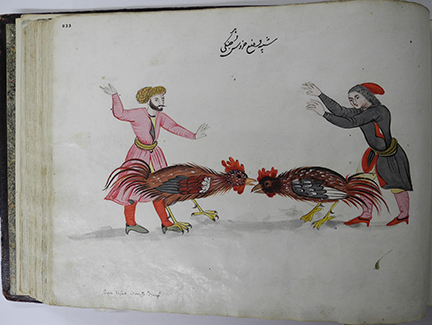
PLATE I. Album leaf from Album of Persian Costumes and Animals with Some Drawings by Kaempfer, Jāni, 1086/1684-85, British Museum, 1974,0617,0.1.33. © The Trustees of the British Museum, licensed under CC BY-NC-SA 4.0.
We have no written evidence dating back to the late 17th century testifying to these paintings being referred to as farangi-sāzi. It is indeed probable that this title was used for the first time in the first half of the 20th century by the Iranian scholar Yaḥyā Ḏokāʾ to describe Moḥammad Zamān’s artwork (Ḏokāʾ, p. 1008).
Art history studies often refer to farangi-sāzi style works as “Westernized,” “Europeanized,” “Perso-European,” or “Europeanizing” style. However, while the farangi-sāzi paintings certainly depart from some pictorial tenets of traditional Persian art, they are not a “Westernized” version of Persian painting (Habibi, 2018a, p. 36).
The European artistic influence is most striking in paintings with Occidental subject matter, such as mythology, biblical scenes, or European figures. However, upon closer examination, these European models are not copied but depicted in an aesthetically Persian ambience, limited to representations of certain exotic traits of a strange and alien world. The artists do not manifest a deep knowledge of this unknown world, nor do they represent the “other” in all its complexities (Habibi, 2018a, p. 153). These paintings are often limited to a representation of an occidental exoticism in which men and women wear seductive outfits and headdresses entirely alien to Persian styles and costumes, where landscapes, houses, animals, food, and drink are totally novel and distinct from the Iranian environment. These paintings provide a window into the Persian’s perception of the West in the second half of the 17th century (Habibi, 2018a, p. 42; Matthee, 1998a, pp. 231-32).
Characteristics. Farangi-sāzi paintings reflect a syncretistic style of painting that blends Safavid artistic traditions with European iconographic adaptations and pictorial techniques. The most important adopted techniques are watercolor and stippling in particular.
The art associated with the farangi-sāzi style is often based on large paintings with little calligraphy. Repetitive formulaic annotations do indicate the date and name of the artists, and sometimes the honorific title of patrons. These clues suggest that the paintings were mainly made for, or under, the patronage of a member of the royal court, household, or the ruler himself (Habibi, 2021, 429-37).
Men and women in the farangi-sāzi paintings are portrayed in elaborate settings, richly dressed and coiffed, either sitting or standing in various poses. Body proportions, hands, and facial components do not follow traditional prototypes. There are less repetitive and stylized common typologies, especially in ʿAliqoli Jebādār’s artworks.
One of the most striking novelties of the farangi-sāzi paintings is the presence of women represented as European. Probably derived from French engravings such as the “Four Seasons” or “Five Senses,” long tunics with short capes, gloves, and hats are the most characteristic European outfits seen in these paintings. As proposed by Sussan Babaie (2009, p. 110), the importance of these images is that they “evoke some shared social memory regarding ways of being European.” There are at least three categories of zan‑e farangi or European women in farangi-sāzi paintings: biblical saints, bathers, and individuals with farangi fashion and European outfits (Habibi, 2018b, pp. 225-26). These splendid depictions of European women are more elaborate and accomplished than those feminine portrayals appearing on the murals of Čehel Sotun or ʿĀli Qāpu palaces (qq.v.) in Isfahan. The women in farangi-sāzi paintings provide an idealized image of European women ranging from Venus to the queens and ladies of 17th-century Europe (Habibi, 2018a, p. 10; Plate II).
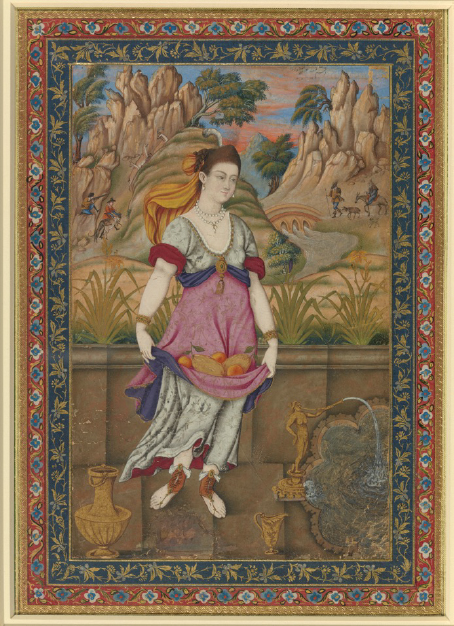
PLATE II. “A Woman by the Fountain,” ʿAliqoli Jebādār, undated. © Arthur M. Sackler Gallery, Smithsonian Institution, Washington, D.C.: The Art and History Collection, LTS1995.2.118.
The backgrounds of these paintings are mostly vast open panoramas, with mountains or forests disappearing into the distance under a pale blue sky with a mise-en-scène of birds and, occasionally, clouds. The landscapes gains unprecedented magnitude. They not only feature European scenery such as churches and bridges, they also represent some Safavid gardens with balconies, as we see in “Bahrām Gōr with the Indian Princess” (Plate III) or “Shah Solaymān and his Courtiers” (Plate IV).
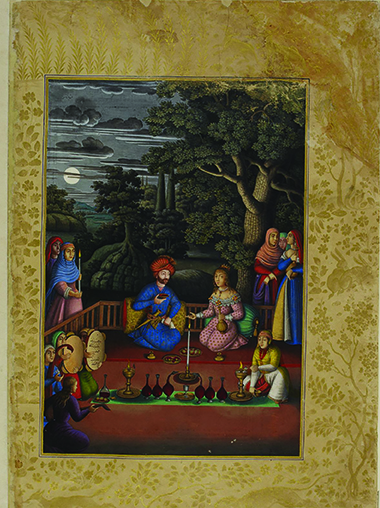
PLATE III. “Bahrām Gōr with the Indian Princess,” Moḥammad Zamān, 1086/1675-76. © British Library Board, Or. 2265, fol. 221v.
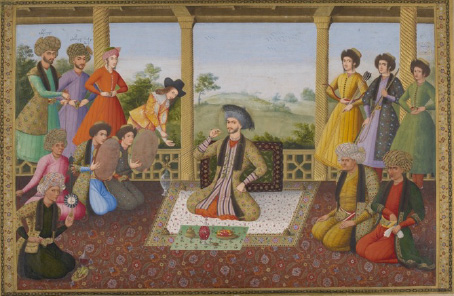
PLATE IV. “Shah Solaymān with his Courtiers,” ʿAliqoli Jebādār ḡolām-zāda qadim, ca. 1666-68. MS Institute of Oriental Manuscripts, St. Petersburg, Album E-14, fol. 98r. © Russian Academy of Sciences, the Institute of Oriental Manuscripts, St. Petersburg.
The perspective and the chiaroscuro employed in these paintings do not resemble the conventions found in European art. The background elements often provide the depth to the painting, rather than respecting a more academic geometrical perspective. The figurative objects (e.g., people, trees, mountains, and birds) gradually disappear in the distance with fading color. These paintings generally do not have a clear source of light, with some rare exceptions such as the “Bahrām Gōr with the Indian Princess.” In most paintings, the composition is not homogenously exposed, with each and every detail enjoying its own light and shadows.
Artists. The 17th-century farangi-sāzi style artists are few in number, with ʿAliqoli Jebādār and Moḥammad Zamān as forerunners, closely followed by Ḥāji Moḥammad-Ebrāhim, Moḥammad-ʿAli son of Moḥammad Zamān, and Moḥammad Solṭāni. The latter, probably a contemporary of Shah Solṭān Ḥosayn (r. 1694-1722), signed two pages of the great moraqqaʿ of St. Petersburg (Album E-14, fols.42 and 43; Akimushkin, p. 64).
Among these artists, Moḥammad Zamān is the most famous, and several studies were devoted to him in the early 20th century. He was considered for several years to be Moḥammad Paolo Zamān, the translator of Čin-nāma, a book by Matteo Ricci, the famous Italian Jesuit. The first essay on Moḥammad Zamān (the artist) dates back to 1912, where Fredrik Robert Martin relied in particular on the notes added to the Storia do Mogor, the travelogue of Niccolao Manucci (Martin, 1912, 124). This latter had indeed met a certain Moḥammad Paolo Zamān, who took refuge in the Mughal court of Aurangzeb (1658-1707) after being converted to Christianity during his stay in Italy. A note by William Irvine, the translator of Manucci, suggests that this Moḥammad Paolo Zamān may be indeed the same who signed a painting in Shah Ṭahmāsp’s Ḵ amsa (Storia de Mogor, 14, note 10). From that moment on and till 1979, when Anatoly Ivanov gave a new insight to the artist’s life and career, both Zamāns were considered as one and the pioneer of farangi-sāzi style based on Italian imagery (for a complete list of the studies on the artist, see Landau, 2007, pp. 60-75). ʿAliqoli Jebādār seems, however, a more appropriate artist for an in-depth analysis of farangi-sāzi paintings. Active between 1649-50 and 1673-74, the artist commenced producing paintings long before the reign of Shah Solaymān and was most likely active prior to Moḥammad Zamān. Unlike the latter, ʿAliqoli Jebādār did not produce any paintings directly relating to literary texts. Nevertheless, he was responsible for producing a considerable number of royal scenes, with portraits of kings and their male entourage, portraits of Iranians or Europeans, scenes with European women (zan-e farangi), and, finally, paintings in accordance with the aesthetics of various Mughal Indian courts (Habibi, 2018a, pp. 70-150). All of these subjects are undeniably the main topics and principal themes of farangi-sāzi paintings.
There are at least five different signatures associated with the name of ʿAliqoli Jebādār, though not all of these may be from the artist’s hand. Indeed, some signatures are in the same handwriting while others are notably different (Plate V). Titles relating to services to the king and the royal court are added to the name of the artist in certain signatures, especially those in which the spelling and calligraphy are similar. Moreover, titles such as ḡolām
zāda-ye qadim (son of a former servant: double sense: qadim in the more general sense of having been a devoted household slave for a longtime: more like “your old and faithful slave”) and jebādār, an official of the armory, indicate in all likelihood the place and importance of the artist at the Safavid court (Habibi, 2016, pp. 154-55).
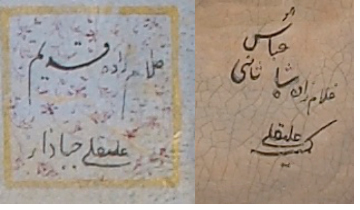
PLATE V. Two raqam/signatures of ʿAliqoli Jebādār, from Habibi, 2018a, p. 174.
ʿAliqoli Jebādār produced very fine compositions, not slavishly copied from the Occidental or Indian models, but inspired by a blend of Iranian and imported aesthetics. He created singular works that ultimately do not belong to either world, but reflect the artist’s personal universe (Langer, pp. 218-28; Habibi, 2018a, p.17). ʿAliqoli Jebādār’s style was not continued after his death, although some of his paintings were reproduced by Moḥammad-Bāqer, an artist active under Nāder Shah (r. 1736-47) in the first half of the 18th century.
Moḥammad Zamān, active between 1671 and 1700, was best known for his paintings illustrating the great manuscripts of earlier eras, such as Shah Ṭahmāsp’s
Ḵ
amsa or Shah ʿAbbās I’s Šāh-nāma. Similarly to Jebādār, he also created some paintings with European subject matter (Ivanov, 1996, pp. 33-38; Landau, 2007, pp. 139-68; Plate VI). Moḥammad Zamān influenced or trained some of his contemporary artists such as Moḥammad-ʿAli or Ḥāji Moḥammad-Ebrāhim in what Chahryar Adle called “Moḥammad’s School” (Adle, pp. 60-67).
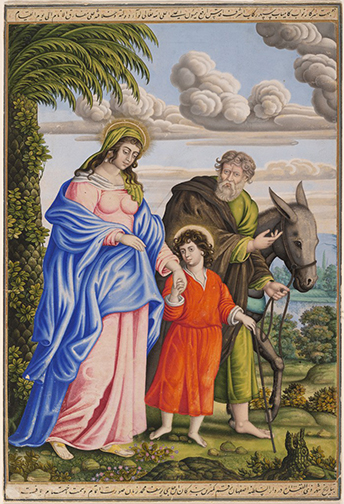
PLATE VI. “The Return from the Flight into Egypt,” Moḥammad Zamān, 1689. Harvard Art Museums/Arthur M. Sackler Museum, Gift of John Goelet, 1966.6 (https://harvardartmuseums.org/collections/object/216250). © President and Fellows of Harvard College.
The bibliography of Ḥāji Moḥammad-Ebrāhim is not as well documented as that of his brother Moḥammad Zamān. We know of one lacquered painting by the artist on a qalamdān (pen box) signed and dated 1681-82. The inscription on the qalamdān reveals that the full name of the painter is Moḥammad-Ebrāhim and his nesba is Qomi. The signature also confirms the name of his father as Ḥāji Yusof and attests that the painter was working in Isfahan in the service of Shah Solaymān. The artist’s lifespan is hard to determine; however, Adle (p. 42) proposes some 70 years between 1650 and 1718-20.
Moḥammad-ʿAli, son of Moḥammad Zamān, continued the artistic tradition of his father, without adding new features or developing it, except for his more extensive use of chiaroscuro. His most famous work is known as “The Distribution of Nowruz Presents by Shah Solṭān Ḥosayn,” dated 1720-21 (Plate VII).
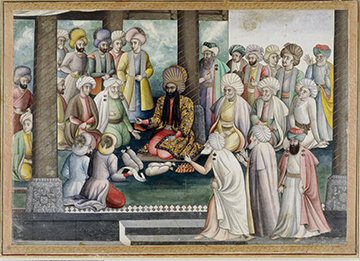
PLATE VII. “Distribution of Nowruz Gifts by Shah Solṭān-Ḥosayn,” Moḥammad ʿAli, 1720-21. © The Trustees of the British Museum, licensed under CC BY-NC-SA 4.0.
“Farangi-sāzi” in modern studies. Over the last century, the study of the farangi-sāzi style can be divided into three distinct phases. In the first phase, few were enthusiastic about the different Persian artistic styles that emerged after the reign of Shah ʿAbbās I (1588-1629). Those who did refer to it considered farangi-sāzi paintings as the tail end of the original and prestigious history of Persian art. For example, David Talbot Rice indicated that “a definite decline set in so far as painting was concerned, and though much quite attractive work was produced for another century or so, the majesty and glory of Persian painting was at an end” (Rice, pp. 248-51). John Carswell also mentioned that “various attempts to introduce Western art into Islamic art, such as the use of perspective or chiaroscuro, led to dismal failure.” He advanced the idea that 17th-century Persian painting was a good example of the corruption of oriental taste faced with Western influence (Carswell, II, p. 277).
These ideas gradually gave way to new observations and analysis of the paintings, which drew upon European art, notably Italian paintings, as the new source of inspiration for Persian painting. This was especially suggested, as mentioned above, in relation to the paintings by Moḥammad Zamān.
The “influence” of Italian art was repeatedly considered as the origin of farangi-sāzi paintings until two separate studies expanded the field of research in 1979. By redefining the career of Moḥammad Zamān, Anatoly Ivanov noted the Dutch origin of some works by the artist (Ivanov, 1979, pp. 65-70). At the same time, on the basis of surviving records from the Dutch East India Company (VOC), and referring to earlier studies in Dutch, Willem Floor (pp. 145-63) confirmed the presence of Dutch artists in Safavid Iran. These new elements shed a new light on Persian art history and more particularly on the analysis of farangi-sāzi paintings. Several studies reviewed the paintings’ characteristics by considering the European (this time Flemish) engravings used as models and the ways in which Persian painting came into contact with European art.
This marked the second period of studies on farangi-sāzi paintings. The majority of scholars focused on the increased political, commercial, and religious interactions between Europe and Persia. They considered the dissemination of European imagery in Isfahan to be the genesis of the farangi-sāzi styled paintings (Sims; Canby, 1996). Some scholars argued that Armenian merchants of New Jolfā in Isfahan may have imported European imagery into Persia (Sims; Adle; Canby, 1993, 1999a, 1999b; Babaie, 1994, 2013; Landau, 2007, 2011, 2014). The presence of Dutch artists in Safavid Isfahan was also considered to be a vector of technical and conceptual transmission (Diba and Ekhtiar; Landau 2014). Moreover, due to similarities with Indian art, it has also been suggested that farangi-sāzimasters were trained in Kashmir (Schmitz; Grube, p. 530).
The most recent literature, appearing since the turn of the millennium, represents the third phase in farangi-sāzi studies. These studies offer a new interpretation and a fresh reading of the paintings, pointing to the antecedents of Western-influenced art in Persia during the Mongol period (Necipoğlu). They mostly agree that it was during the reign of Shah ʿAbbās II that political and cultural exchanges between Persia and Europe were most visibly felt in the field of manuscript illustrations and single-sheet paintings. They also argue that the perception of depth and space is probably the first breakthrough of the European influence on Persian painting (Porter).
Further, by extending the comparative studies of farangi-sāzi paintings and their European models, scholars have invoked the existence of more subtle reasons for the creation of these paintings. In light of the political and social context of Safavid Persia in the second half of the 17th century, they argue that contemporaneous farangi-sāzi painting can no longer be seen as the continuation or artistic outcome of the first half of the century. A new visual language was developed following interest by local patrons in the West and occidental productions during the second half of the 17th century. This led to a greater emphasis on patrons and highlighted the artistic and historical value of the farangi-sāzi paintings.
Amy Landau thus emphasizes the role played by the Armenian community, especially the rich merchants of New Jolfā, who were partly westernized as a result of their interaction with Europe and Europeans (Landau, 2007, pp. 199-218; idem, 2014, pp. 76-77). Negar Habibi, on the other hand, points to local commissions spearheaded by the royal court and discusses the interest and taste of royal patrons for Persian adaptations of European imagery, introducing a personal interpretation of society and their place within it (Habibi, 2018a, p. 149). The reign of Shah Solaymān witnessed a rivalry between the chancery (the equivalent of the high administration) and the royal household (the entourage of the shah, headed by his mother and senior eunuchs). This led to a struggle between a public, official, and visible power and a private and unofficial authority (Matthee, 2012, pp. 55-57). This duality could be observed in two major groups of subject matter in the farangi-sāzi paintings. The first group consists of portraits of the nobles and courtiers demonstrating their royal functions. The second group includes paintings commissioned, according to their annotations, for the royal treasury, whose chiefs were all eunuchs in the reign of Solaymān. Interestingly the paintings with female and European subject matter belong to this second group (Habibi, 2021, pp. 437-438).
The farangi-sāzi paintings may have been produced for the Safavid courtiers and nobles, who often occupied royal functions for several generations, or in the case of the eunuchs and women, those who had the most significant positions in Shah Solaymān’s court, household, and diplomatic corps. The same people are also known to have commissioned architectural structures such as bridges, caravanserais, madrasas, etc. (Habibi, 2018a, p.156).
Ultimately, the discreet use of a European technique, a mere presence of chiaroscuro or perspective, would not be conclusive evidence to deem a painting farangi-sāzi. The Occidentalist character of some late 17th-century Persian paintings is borne out by the presence of European cultural elements, not in an exhaustive or scientific way, but rather in order to capture some evocative traits and fantasies. These provide the genesis of an exotic visual world. The late 17th-century paintings, especially those of ʿAliqoli Jebādār and Moḥammad Zamān, are certainly derived from this perception of the “Other” —the foreign and exotic 17th-century farangi— prevailing in the period between the reigns of Shah ʿAbbās II (r. 1642-66) and Shah Solṭān Ḥosayn (r. 1694-1727), which subsequently disappeared.
Bibliography
ʿAbd-al-ʿAli Adib Borumand, “Moʿarrefi yek nosḵa-ye moṣawwar-e tāriḵ-e Jahāngošāy-e nāderi,” Honar va mardom no. 188, 1978, pp. 40-45.
Chahryar Adle, Ecriture de l’union, reflets du temps des troubles : Oeuvres picturales (1083-1124/1673-1712) de Hāji Mohammad, Paris, 1980.
Yaʿqub Āžand, Maktab-e naqqāši-e Eṣfahān, Tehran, 2006.
Idem, Moḥammad Zamān va šiva-ye farangi-sāzi, Tehran, 2010.
Oleg F. Akimushkin, Il Murakka’ di San Pietoburgo: Album di Miniature Indiane et Persiane del XVI-XVIII Secolo, Milan, 1994.
Hasan Anvari, Farhang-e soḵan, 8 vols, Tehran, 1381/2002.
Sussan Babaie, “Shah ʿAbbās II, the Conquest of Qandahar, the Chihil Sutun, and Its Wall Paintings,” Muqarnas, 1994, pp. 124-42.
Idem, “Visual Vestiges of Travel: Persian Windows on European Weaknesses,” Journal of Early Modern History 13, 2009, pp. 105-36.
Idem, “Frontiers of Visual Taboo: Painted Indecencies in Isfahan,” in Francesca Leoni and Mika Natif, eds., Eros and Sexuality in Islamic Art, Dorchester, 2013, pp. 131-56.
Sheila R. Canby, Persian Painting, London, 1993.
Idem, “Farangi Sāz: The Impact of Europe on Safavid Painting,” in Silk and Stone: The Art of Asia, the Third Hali Annual, London, 1996, pp. 46-59.
Idem, Princes, Poets and Paladins: Islamic and Indian Paintings from the Collection of Prince and Princess Sadruddin Aga Khan, London, 1998, tr. Claude Ritchard, as Princes, Poètes et Paladins: Miniatures islamiques et indiennes de la collection du Prince et de la Princesse Sadruddin Aga Khan, Geneva, 1999a.
Idem, The Golden Age of Persian Art, 1501-1722, London, 1999b.
John Carswell, “Eastern and Western Influence on Art of the Seventeenth-Century in Iran,” in M. Y. Kiani and A. Tajvidi, eds., Vth International Congress of Iranian Art and Archaeology, 2 vols., Tehran, 1972, II, pp. 277-82.
Layla S. Diba and Maryam Ekhtiar, eds., Royal Persian Painting: The Qajar Epoch 1785-1925, New York, 1999.
ʿAli-Akbar Dehḵodā, Loḡat-nāma, 37 vols., Tehran, 1325-57/1956-78.
Yaḥyā Ḏokāʾ, “Moḥammad Zamān: awwalin naqqāš-e irāni ke ba Oroupā raft,” Soḵan 12, 1341/1962, pp. 1007-16.
Willem Floor, “Dutch Painters in Iran During the First Half of the 17th Century,” Persica 8, 1979, pp. 145-63.
Ernst J. Grube, “Wall Paintings in the Seventeenth Century Monuments of Isfahan,” Iranian Studies 7, 1974, pp. 511-42.
Negar Habibi, “Le Farangi sāzi et les peintures de ʿAli Qoli Jebādār: Un syncrétisme artistique sous Shāh Soleymān (1666-1694),” Ph.D. diss., Aix-Marseille University, 2014.
Idem, “Un peintre sāheb mansab? Une reconsidération de la carrière de ʿAli Qoli Jebādār,” Iran 54, 2016, pp. 143–58.
Idem, ʿAli Qoli Jebādār et l’occidentalisme safavide: Une étude sur les peintures dites farangi sazi, leurs milieux et commanditaires sous Shah Soleimān (1666-94), Leiden, 2018a.
Idem, “Zan-i farangi, a Symbol of Occident: The European Women in farangi sāzi Paintings (1666-1694),” in Margaux Whiskin and David Bagot, eds., Iran and the West: Cultural Perceptions from the Sasanian Empire to the Islamic Republic, London and New York, 2018b, pp. 225-40.
Idem, “The Making of New Art: From the Khazana to its Audience at the Court of Shah Soleyman,” in Charles Melville, ed., Safavid Persia in the Age of Empires, London, 2021, pp. 423-42.
A. A. Ivanov, “The Life of Muhammad Zaman: A Reconsideration,” Iran 17, 1979, pp. 65-70.
Idem, “Persian Miniatures,” in Oleg F. Akimushkin, The Saint Petersburg Muraqqa: Album of Indian and Persian Miniatures of the 16.-18. Centuries and Specimens of Persian Calligraphy of Imad Al-Hasani, Milan, 1996, pp. 33-38.
Amy S. Landau, “Farangi sāzi at Isfahan: The Court Painter Muhammad Zamān, the Armenians of New Julfa and Shāh Suleymān (1666-1694),” Ph.D. diss., Oxford University, 2007.
Idem, “From Poet to Painter: Allegory and Metaphor in a Seventeenth-Century Persian Painting by Muhammad Zamān, Master of Farangī-Sāzī,” Muqarnas 28, 2011, pp. 101-13.
Idem, “Reconfiguring the Northern European Print to Depict Sacred History at the Persian Court,” in Thomas Da Costa Kaufmann and Michael North, eds., Mediating Netherlandish Art and Material Culture in Asia, Amsterdam, 2014, pp. 65-82.
Axel Langer, “European Influences on Seventeenth-Century Persian Painting: Of Handsome Europeans, Naked Ladies, and Parisian Timepieces”, in idem, ed., The Fascination of Persia: The Persian-European Dialogue in Seventeenth-Century Art and Contemporary Art of Tehran, Zurich, 2013, pp. 170-237.
Niccolao Mannucci, Storia do Mogor or Mogul India, 1653-1708, trad., William Irvine, 2 Vols., London, 1906.
Fredrik Robert Martin, The Miniature Painting and Painters of Persia, India and Turkey, from the 8th to the 18th Centuries, 2 vols., London, 1912.
Rudi Matthee, “Between Aloofness and Fascination: Safavid Views of the West,” Iranian Studies 31, 1998, pp. 219-46.
Idem, “The Safavid, Afshar, and Zand Periods,” Iranian Studies 31, 1998b, pp. 483-93.
Idem, “From the Battlefield to the Harem: Did Women’s Seclusion Increase from Early to Late Safavid Times?” in Colin P. Mitchell, ed., New Perspectives on Safavid Iran: Empire and Society, London, 2011, pp. 97-121.
Idem, Persia in Crisis: Safavid Decline and the Fall of Isfahan, London, 2012.
Gülru Necipoğlu, “Persianate Images Between Europe and China: The ‘Frankish Manner’ in the Diez and Topkapı Albums, c. 1350-1450,” in Julia Gonnella, Friederike Weis and Christoph Rauch, eds., The Diez Albums: Contexts and Contents, Leiden and Boston, 2017, pp. 531-91.
Ruyin Pākbāz, Dā ʾerat -al-maʿāref-e honar, Tehran, 1385/2007.
Y. Porter, “La diffusion des gravures et de l’imagerie européenne dans l’Iran safavide du 17e siècle,” unpublished article presented at the “Colloque d’Art et civilisations judaïque, chrétienne et islamique,” Geneva, 12-13 February 2000 (see Habibi, 2014, Appendix 2).
Matteo Ricci, Čin-nāma, tr. Moḥammad Zamān, ed. Lu Jin, Tehran, 2008.
David T. Rice, Islamic Art, London, 1979.
Barbara Schmitz, “Indian Influence on Persian Painting,” Elr. XIII, 2008, pp. 76-81.
E. G. Sims, “Five Seventeenth Century Oil Paintings,” Persian and Mughal Art, London, 1976, pp. 221-48.
Anthony Welch, Artists for the Shah: Late Sixteenth-Century Painting at the Imperial Court of Iran, New Haven and London, 1976.