



ZARRINKUB, ʿABD-AL-ḤOSAYN (b. Borujerd, 19 March 1923; d. Tehran, 15 September 1999; Figure 1), prolific Iranian scholar, literary critic, literary historian, essayist, and translator.
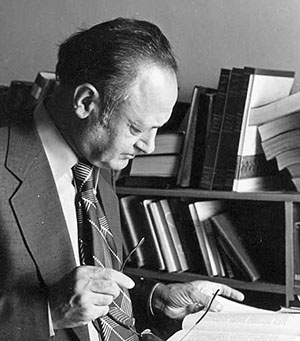
Zarrinkub was born in Borujerd (q.v.), in Lorestān province in western Iran. His father ʿAbd-al-Karim Zarrinkub originally followed in his uncle Ḥāji Moḥammad Ḥasan’s footsteps and worked as a goldsmith (zargar), but because he considered the work “frowned upon” (makruh: see ḤALĀL O ḤARĀM) on religious grounds took up horticulture (b āḡ bā ni) and farming. Despite this change of occupation, he continued to be known in Borujerd as “goldsmith,” so he decided to change the family name to zarrinkub (“golden-beater”; Afšāri). A devout man, steeped in Shiʿite theology and religious history, ʿAbd-al-Karim hosted preachers, scholars of religion, and reciters of Shiʿite elegiac literature (raw ż a-ḵ v ā ni, see TAʿZIA) from many parts of Iran (Zarrinkub, 1999b).
The young Zarrinkub studied the standard curriculum at the time up to the fifth year of high school in Borujerd. This included introductory lessons in French, in which – along with English – he became quite familiar on his own. At the urging of his father, he took up religious studies (ṭalabagi) at the Baḥr-al-ʿOlum seminary (known as Madrasa-ye Nurbaḵaš) and pursued Arabic literature with Shaikh ʿAli Javāheri (1904-95; Afšāri). With the closure of the school in 1940, he moved to Tehran to complete high school at Dabirestān-e Marvi. While in Tehran, he also studied dialectical theology (ʿelm-e kal ā m) and philosophy at two seminaries (Madrasa-ye Ḵān Marvi and Madrasa-ye Moḥammadiya Bāzār). One of his teachers was ʿAllāma Abu’l-Ḥasan Šaʿrāni (1903-73). Šaʿrāni, who taught at the Dabirestān-e Marvi and later joined the Faculty of Letters and Humanities (Dāneškada-ye adabiyāt wa ʿolum-e esāni) at the University of Tehran (see FACULTIES OF THE UNIVERSITY OF TEHRAN iv), may have shown the young Zarrinkub how an encyclopedic thirst for knowledge could be quenched by an understanding of foreign languages.
Zarrinkub scored highest on the nationwide college entrance examination for two faculties at the University of Tehran, Islamic Studies (Dāneškada-ye maʿqul o manqul, later Elāhiyāt, “Theology”) and Letters and Humanities. Although until that time much of his formal schooling had been devoted to a clerical career, he chose the latter faculty for his undergraduate studies. His choice may have been guided by extracurricular reading.
Before entering university, Zarrinkub had become familiar with the writing of the British philosopher, Herbert Spencer (1820-1903) and had read James Frazer’s (1854-1941) The Golden Bough (Afšāri). Through Spencer, whom Zarrinkub describes as “thoroughly engrossed in the sciences” (Zarrinkub, 1975, II, p. 751), he was exposed to the application of Darwinism and the theory of thermodynamics to the study of society; and, with Frazer’s book, he encountered the most influential 20th century work on religious belief from a comparative point of view.
In 1941, having finished the last year of high school in Tehran, Zarrinkub returned to Borujerd and taught Persian literature, history, geography, and foreign languages at high schools in that city and in Ḵorramābād, capital of Lorestān province. Zarrinkub’s teaching did not seem to interfere with his study of literature. The fruit of what must have been an intense period of reading and research was his first published book Falsafa-ye š eʿ r yā tā riḵ-e taṭawwor-e š eʿ r va šāʿeri (The philosophy of poetry or the history of the development of poetry and being a poet; 1944). In his Naqd-e adabi (Literary criticism), a comprehensive survey of literature and literary criticism based on original source materials in Arabic, Persian, Turkish, and several European languages, Zarrinkub (1975, II, p. 754) notes that Falsafa-ye šeʿr was written when Darwin and Spencer influenced his thinking about the genesis of literary expression. Parviz Khanlari (q.v.), at the time a newly appointed assistant professor of literature at the University of Tehran and editor of the literary journal Soḵan reviewed Zarrinkub’s book. Khanlari noted the inventive ways an unknown in the field of literary criticism (a prospective undergraduate, no less) used sources in Western languages to discuss Persian poetry, but he criticized him for presenting the results of his study without notes and references (p. 629). Khanlari was to prove one of Zarrinkub’s staunchest advocates in the world of letters. He also introduced his young protégé to the eminent novelist, essayist, and scholar Ṣādeq Hedāyat (q.v.; Rastegār Fasā’i, pp. 64-65).
In 1945, Zarrinkub enrolled in the Faculty of Letters and Humanities and graduated three years later. During that time, he also taught in high schools in Tehran and started reading through the holdings of the capital’s research libraries. Zarrinkub was admitted to the doctoral program at the University of Tehran in 1949. According to Iraj Afšār (1999, p. 11), Zarrinkub had little use for his classes, preferring instead to engage literature in more meaningful and skillful ways than his professors. While an undergraduate and during his graduate studies (1948-1955), he was the editor of the weekly Mehreg ān, the organ of graduates of the Teacher Training College (see JĀMEʿA-YE LISĀNSIAHĀ-YE DĀNEŠ-SARĀ-E ʿĀLI), founded by Moḥammad Deraḵšeš in 1948. The initial parts of Zarrinkub’s first book, Do qarn sokut (Two centuries of silence; 1951), a book on Iranian cultural and literary life after the Arab invasion of Iran which achieved remarkable success, and he considered it his favorite work (Āyati, p. 46), were serialized as marginalia to the main articles in Mehreg ān.
Zarrinkub was also active as a translator during this period. Fan-e šeʿr, his translation of Aristotles’ Peri poietik ē s (“Poetics”), appeared in 1958. The following year he translated two books by Verdun-Léon Saulnier (1917-1980), La littérature française du moyen âge: des origins à 1500 and La littérature française de la renaissance, later combined into a single Persian volume called Adabiy āt-e farānsa dar qorun-e wosṭā va ronessāns (French literature in the Middle Ages and the Renaissance). Seven years after completing his undergraduate studies, Zarrinkub finished his Ph.D. dissertation, a general study of literary criticism (1952).
Zarrinkub began teaching at the Faculty of Islamic Studies, which, given his interests, was not the right place for him. Fortunately, he became acquainted with the liberal statesman, Sayyed Ḥasan Taqizadeh (q.v.), who arranged Zarrinkub’s access to the Majles Library (The Parliamentary Library of Iran). An eight-year post-graduate “fellowship” ensued, during which Zarrinkub read through library’s holdings on history and literature in Middle Eastern and European languages (Afšār, 1999, p. 12). Armed with a working knowledge of English, French, and German, Zarrinkub digested many articles in, and sources of, the first and second editions of the Encyclopaedia of Islam (q.v.). Having made the most of his independent study fellowship, Zarrinkub developed an expertise in a variety of subjects pertaining to Iran. In the 1960s and 1970s, in addition to his academic and scholarly activities, he edited and wrote for Dāyerat al-maʿāref-e fārsi (q.v.), the first truly modern Persian language encyclopedia, which was partly based on the Columbia Viking Desk Encyclopedia. The introduction to the first volume of D āyerat al-maʿāref-e fārsi (pp. 51-53), which came out in 1966 under the general editorship of Gholam-Hosayn Mosaheb (q.v.), quotes Zarrinkub’s assessment of primary sources for Iranian history in the post-Islamic period. The extent of Zarrinkub’s learning is reflected in his original contributions to D āyerat al-maʿāref-e fārsi, which, because they dealt with Iranian studies, were beyond the scope of the English version. Other products of Zarrinkub’s erudition are articles and book reviews published in periodicals of the time. Some of these were compiled in Yāddāšt-hā va andiša-hā (Notes and thoughts; 1972). The book’s preface contains an annotated bibliography of 160 books, articles, and translations Zarrinkub published before 1972. Nah šarqi, nah ḡarbi – ensāni (Neither eastern, nor western – human; 1974) is another major compilation, the title of which refers to the obsessive concern among some intellectuals about what the West thinks of Iran.
At the end of the 1960s, Zarrinkub’s dim view of what happened in Iran after the Muslim conquest, which was first aired in Do qarn sokut, changed. The title reflects his understanding that the coming of the Arabs and Islam to Iran initiated a period of dormancy, during which almost all traces of Iran’s literary heritage were overwritten or erased, Arabic became the language of government while Persian went mute, and Zoroastrianism gave way to Islam. The publication of Kār-nāma-ye Eslām (The Record of Islam; 1975) marked an abrupt departure from his low opinion of the Arab invaders, their language, and the change of religion. As Siāvaš Šohāni (p. 177) points out, Kār-nāma-ye Eslām contradicts every assertion Zarrinkub made about Arabs and Islam in Do qarn sokut. Arabs were no longer uncivilized desert-dwellers dependent on Iran for their material needs, and Arabic was no longer “drier and more sterile than the scorching desert sands” (Zarrinkub, 1957, p.110). Instead of ill-treating the conquered peoples, in Kār-nāma-ye Eslām Arabs showed “compassion and tolerance” (tas āmoḥ). Islam was no longer a religion spread by the sword and the lash, but a world faith that transcended tribal, ethnic, and national allegiances. The way Zarrinkub spoke about the Qurʾan also changed markedly; at one point in Do qarn sokut (Zarrinkub, 1957, pp. 114-15), he had written, “Convinced their scripture was the only true guide for humanity, the Arabs used it to justify burning all books they found in the libraries of Iran.” The Qurʾan in Kār-nāma-ye Eslām was full of esoteric import clear to all able to get beyond the literal meaning of the text.
Zarrinkub’s changing view of the Qurʾan was evident before 1975 in biographies he wrote about two major Iranian figures: one of the greatest Persian poets, Hafez (q.v.), and the theologian, jurist, and mystic Abu Ḥāmed Moḥammad Ḡazāli (q.v.). In his study of Hafez, Zarrinkub (1970, pp. 31-32) writes that had the poet been an ordinary student of the Qurʾan, he would have spent his professional life as a reciter or copyist of scripture. Hafez’s restless genius, however, prevented his search for wisdom from ending at the text; meditation (tadabbor) on the Qurʾan opened the young man up to flashes of insights from the heart (ešrāqāt-e qalbi), what Zarrinkub (1970, p. 32) describes as super-sensory glimpses of the hidden world (donyā-ye ḡayb). In Farār az madrasa (Escape from the madrasa; 1974a), pondering of the deeper meaning of the Qurʾan causes Ḡazāli’s to abandon the comfort and prestige of a professorship and to venture into the unreason of mysticism. The esoteric meaning of the Qurʾan affected the master theologian-jurist the way it did Hafez; it taught him not to rely solely on pure reason to obtain certainty, but to discover it in flashes of insight fueled by the heart. According to Zarrinkub (1974a, p. 158), Ḡazāli’s “hunger for investigation lasted until the end of his life,” which is an apt epitaph for the author himself.
Unlike Ḡazāli, Zarrinkub stayed in academia and, despite failing health, continued to mentor students and edit and contribute to many scholarly publications. His works remained so popular after the 1979 Islamic Revolution that publishers avidly welcomed new writing or repackaged previous collections of his essays. Towards the end of his life, ʿElmi publishers brought out a flurry of Zarrinkub’s oeuvre: compilations of articles, commentaries on comparative and narrative literature, biographies of major figures in poetry, philosophy and theology, and, in 1999, Serr-e ney (The secret of the reed), a two-volume critical and comparative analysis of Jalāl-al-Din Rumi’s (q.v.) Maṯnawi.
The popularity of Zarrinkub’s writing did not exempt it from government meddling. In 1999, censors refused to allow the republication of Do qarn sokut unless it contained a foreword excerpted from Ayatollah Morteżā Moṭahhari’s (1919-1979) Ḵadamāt-e motaqābel-e Irān va eslām (Mutual services between Iran and Islam; 1970, pp. 583-90), which is harshly critical of intellectuals who longed for a return to a pre-Islamic past.
Zarrinkub’s much-publicized change of attitude toward the coming of Islam to Iran did not shield him from attack. In the summer of 1996, the controversial television program Hoviyat (Identity) identified Zarrinkub as one influential figure in a long line of Iranian “pseudo-intellectuals” (šebh-e rowšanfekrān) who mounted a “cultural assault” (šabiḵun-e farhangi) on Islam (“Zarrinkub, Saʿid Emāmi, va Hoviyat”). The aspersions continued after Zarrinkub died; in an interview, Šahriār Zaršenās linked him with a Masonic (see FREEMASONRY) conspiracy to portray “tolerance” (tas āmoḥ) as an ancient value, basic to Iranian identity. Without naming it, Zaršenās relies on Zarrinkub’s essay “Čeguna mitavān irāni bud? Čeguna mitavān irāni nabud” (How can one be Iranian? How can one not be Iranian?; Zarrinkub, 1974b, pp. 40-47), which praises Iranians for, among many things, not drowning the world in blood or setting fire to it in the name of religion or liberty; for not, having been conquered, massacring their enemies or taking them prisoner; for not setting up inquisition tribunals like the ones in medieval Europe; for not staging gory spectacles with infuriated bulls as means of public amusement; and for not inventing hellish torments for their opponents. In Zaršenās’s view, the crypto-Freemason Zarrinkub undermined Islam by portraying it as superstition, thereby depriving Iranians of their identity and making them susceptible to neocolonialism. Contrary to the author’s claim of being “moderate” (mo ʿtadel) and “balanced” (motaʿ ādel), Zaršenās says scrutiny of Zarrinkub’s books and SAVAK (Sāzmān-e Eṭṭelāʿāt wa Amniyat-e Kešvar, “National intelligence and security organization”) documents reveal him to be a masonic secularizer. This view stems partly from a nativism that suspects Iranian intellectuals influenced by or educated in the West of being witting or unwitting agents of first world imperialism. Opinion on Zarrinkub’s intellectual legacy has not been completely damning. In an article published online (2004), the historian-cleric ʿAli Abu’l-Ḥasani, known as “Monḏer” (1955-2012), lists Zarrinkub among the Pahlavi-era scholars enlisted in the effort “to attack Islam and sanctify ancient Iran” (ḥamla be-esl ām va taqdis-e Irān-e bāstān). The goal of this was to legitimize the monarchy while weakening the power of the clergy. Unlike others, however, Abu’l-Ḥasani praises Zarrinkub for seeing the error of his early writing. He recognizes two stages in Zarrinkub’s rehabilitation: the courageous (dalir āna) admission he made in the introduction to the second edition of Do qarn sokut and the more important step of writing the estimable (ger ā n-sang) book Kār-nāma-ye eslām.
Zarrinkub was familiar with modern historiographical trends and the works of European scholars of Iran, and showed considerable inventiveness in the use of sources, but as Fakhreddin Azimi points out (p. 419), did not always observe his own injunction regarding the necessity of a steadily critical assessment of them. His prose style was also sometimes clearly influenced, in an oddly mimetic manner, by the source he used. This idiosyncrasy is particularly evident in one of his later and more distinctly historical works, the ambitiously titled Tāriḵ-e mardom-e Irān (The history of the Iranian people; 1985).
A profoundly modest man, Zarrinkub eschewed titles and honors amassed over a remarkably long scholarly life. In addition to his academic positions, he was chief editor of several important periodicals including the influential literary and book review journal, R ā hnamā -ye ketā b (1963-64). Many of his articles and books are considered the last word on aspects of Persian literary history, comparative literature, Iranian music and folklore, and Sufism.
Zarrinkub’s life partner was Qamar Āriān (1922-2012), a noted scholar in her own right. They first met at the University of Tehran while both were students and married in 1953. They had no children and bequeathed their works and personal library to the Markaz-e Dāyerat al-maʿāref-e bozorg-e eslāmi (Center for the Great Islamic Encyclopedia).
Bibliography
Major works:
For a complete bibliography of Zarrinkub’s works, see ʿEnāyat-Allāh Majidi, “Ketābšenāsi-ye ketāb-hā va maqālāt-e doctor ʿAbd-al-Ḥosayn Zarrinkub,” in Yādgār-nāma-ye ostād ʿAbd-al-Ḥosayn Zarrinkub , ed. ʿAli Dehbāši, Tehran, 1997, pp. 24-52.
Falsafa-ye šeʿr yā tāriḵ-e taṭavvor-e šeʿr va šāʿeri, Borujerd, 1945.
Fan-e šeʿr, Tehran, 1948.
Adabiyāt-e farānsa dar qorun-e wosṭā, Tehran, 1949.
Adabiyāt-e farānsa dar dawra-ye ronessāns, Tehran, 1949.
Do qarn sokut: sargozašt-e ḥawādeṯ va awżāʿ-ye tāriḵi-e Irān dar do qarn-e awwal-e eslām, Tehran, 1951; rev. ed. 1957; tr. by Paul Sprachman as Two Centuries of Silence: An Account of Events and Conditions in Iran During the First Two Hundred Years of Islam, from the Arab Invasion to the Rise of the Tahirid Dynasty, Costa Mesa, Calif., 2017.
Šeʿr-e bi doruḡ, šeʿr-e bi neqāb: baḥṯ dar fonun-e šāʿeri, sabk va naqd-e šeʿr-e fārsi bā molāḥeẓāt-e taṭbiqi va enteqādi rājeʿ be šeʿr-e qadim va šeʿr-e emruz, Tehran, 1967.
Kār-nāma-ye eslām, Tehran, 1969.
Az kuča-ye rendān: dar bāra-ye zendagi va andiša-ye Ḥāfeẓ, Tehran, 1970.
Yāddāšt-hā va andiša-hā, az maqālāt, naqd-hā va ešārāt: nevešta-hā-ye ʿAbd-al-Ḥosayn Zarrinkub, ed. ʿEnāyat-Allāh Majidi, Tehran, 1972.
Farār az madrasa: dar bāra-ye zendagi va andiša-ye Abu Ḥāmed Ḡazāli, Tehran, 1974a.
Nah šarqi, nah ḡarbi – ensāni: majmuʿa maqālāt, taḥqiqāt, naqd-hā va namāyešvāra-hā, Tehran, 1974b.
“Čeguna mitavān irāni bud? Čeguna mitavān irāni nabud,” Kāveh 58, 1975, pp. 4-8.
Naqd-e adabi: josteju dar oṣul va raveš-hā va mabāḥeṯ-e naqqādi bā barrasi dar tāriḵ-e naqd va naqqādān, 2 vols., Tehran, 1975.
Adabiyāt-e farānsa dar qorun-e wosṭā va ronessāns, Tehran, 1978.
Tāriḵ-e mardom-e Irān, 2 vols., Tehran, 1985 and 1989.
Baḥr dar kuza, Tehran, 1987.
Dar qalamrow-e vojdān, Tehran, 1990.
Naqš bar āb, Tehran, 1991.
Pella pella tā molāqāt-e ḵodā, Tehran, 1991; tr. by Majdoddin Keyvani as Step by Step up to Union with God, New York, NY, 2009.
Serr-e ney: naqd va šarḥ-e taḥlili va taṭbiqi-e maṯnawi, 2 vols., Tehran, 1999a.
“Zarrinkub be qalam-e Zarrinkub,” Ketāb-e māh: adabiyāt va falsafa 23-24, 1999b.
Daftar-e ayyām, Tehran, 2010.
Other works cited.
Iraj Afšār, “ʿAbd al-Ḥosayn Zarrinkub,” Nāma-ye Farhangestān 4/2, 1999, pp. 7-20.
Idem, “Sābeqa-ye dusti bā Zarrinkub,” Bo ḵārā 15/91, 2013, pp. 244-66.
Mehrān Afšāri, “Zarrinkub,” Dāneš-nāma-ye jahān-e Eslām 21, Tehran, 2016.
Fakhreddin Azimi, “Historiography in the Pahlavi Era,” in Charles Melville, ed. Persian Historiography: A History of Persian Literature, HPL 10, London and New York, 2012, pp. 367-435.
ʿAṭā Āyati, “Do didār va goftogu bā doctor Zarrinkub dar Paris,” Boḵārā 2/7, 1999, pp. 40-50.
Dāyerat al-maʿāref-e fārsi, ed. Ḡolām-Ḥosayn Moṣāḥeb, vol. I, Tehran, 1966.
ʿAli Abu’l-Ḥasani (Monḏer), “Zamāna va kār-nāma-ye Ebrāhim Pur Dāvud,” Jamjam Online 23/25, 27 Ābān 1373 Š./18 November 1994, https://jamejamonline.ir/fa/news/52212/%D8%B2%D9%85%D8%A7%D9%86%D9%87-%D9%88-%DA%A9%D8%A7%D8%B1%D9%86%D8%A7%D9%85%D9%87-%D8%A7%D8%A8%D8%B1%D8%A7%D9%87%DB%8C%D9%85-%D9%BE%D9%88%D8%B1%D8%AF%D8%A7%D9%88%D9%88%D8%AF (accessed 31 August 2021).
Parviz Khanlari, “Falsafa-ye šeʿr yā tāriḵ-e taḥawwol-e šeʿr va šāʿeri dar Iran,” Soḵan 2/8, 1945, pp. 628-31 (book review).
Morteżā Moṭahhari, Ḵadamāt-e motaqābel-e Irān va Eslām, Tehran, 1970.
Manṣur Rastegār Fasā’i, Aḥwāl va āṯār-e doktor Parviz Nātel Ḵānlari, Tehran, 2000.
Verdun-Léon Saulnier, La littérature française du moyen âge: des origins à 1500, Paris, 1948.
Idem, La littérature française de la Renaissance (1500-1610 ), Paris, 1942.
Siāvaš Šohāni, “Do taʾwil as yak tamaddon, bāzḵāni-ye do aṯar-e ʿAbd-al-Ḥosayn Zarrikub: Do qarn sokut va Kār-nāma-ye Eslām,” Tāriḵ va tamaddon-e eslāmi 5/10, 2009, pp. 157-200.
“Zarrinkub, Saʿid Emāmi, va Hoviyat,” Eṭṭel āʿāt, no. 27100, 16 September 2018.
Šahriār Zaršenās, “Tāriḵ-negāri-e māsuni va nāsiyonālism-e bāstān-gerā: Goftegu bā ostād Šahriār Zaršenās,” Andiškada-ye moṭāleʿāt-e yahud website, http://jscenter.ir/slave-jews/cyrus/3857/%d8%aa%d8%a7%d8%b1%db%8c%d8%ae%e2%80%8c%d9%86%da%af%d8%a7%d8%b1%db%8c-%d9%85%d8%a7%d8%b3%d9%88%d9%86%db%8c-%d9%86%d8%a7%d8%b3%db%8c%d9%88%d9%86%d8%a7%d9%84%db%8c%d8%b3%d9%85/ (accessed 31 August 2021).