



MOḤAMMAD KHAN KERMĀNI, ḤĀJJ (b. Kerman, 1262/1846; d. Langar, 1324/1906; Figure 1), a master of the Kermani Shaikhis and author of important Shaikhi religious literature (see also SHAIKHISM).

Ḥājj Moḥammad Khan Kermāni succeeded his father Ḥājj Moḥammad-Karim Khan Kermāni (q.v.; d. 1288/1871) as head of the Kermani branch of Shaikhism (Hermann, 2017). Moḥammad Khan was a member of the Qajar royal family, the grandson of Moḥammad-Ebrāhim Khan Ẓahir-al-Dawla (q.v.; d. 1240/1824), a nephew of the ruler Fatḥ-ʿAli Shah (q.v.; r. 1797-1834), and a disciple of Sayyed Kāẓem Rašti (q.v.; Moḥammad-Karim Khan, Taḏkerat al-awliāʾ, pp. 55-58). Ẓahir-al-Dawla was governor of Kerman Province and Baluchistan for twenty-two years (1218-40/1803-24; Bāmdād, I, 21).
Moḥammad Khan was born in Kerman in 1846 and died in 1906 in Langar, a rural area near Kerman. He studied with his father, Moḥammad-Karim Khan, and collaborated with him on several books. He also received an ejāza (q.v.) from him. Unlike the first three masters of the Shaikhi school, he did not live in the ʿatabāt (q.v.). He studied and taught in Kerman at the Ebrāhimiya School with his brothers Moḥammad-Qāsem Khan and Raḥim Khan. This school (madrasa), which was devoted to the study of Shaikhism, was part of a large multifunctional complex known as the Majmuʿa-ye Ebrāhim Khan or Ẓahiriya built by his grandfather in the center of the Kerman bazaar (Hermann, 2017, pp. 127-29, 132; Hermann and Rezai, p. 94). His father Moḥammad-Karim Khan made this place the center of the Kermāni Shaikhi community in Iran thanks to a significant endowment deed (waqf), and he established a very rich library there (Hermann, 2017, pp. 62, 137).
It may thus be supposed that Moḥammad Khan initiated many inhabitants of Kerman into Shaikhism. For this reason, Abu’l-Qāsem Khan Ebrāhimi (d. 1389/1969), his nephew and master of the order between 1942 and 1969 and the author of the first history of Shaikhism composed by a teacher of the school, insisted on the very good reputation he enjoyed among the people of the city (Ebrāhimi, p. 57). Notably, Moḥammad Khan trained Sayyed Ḥosayn b. Sayyed Jaʿfar Yazdi (d. ca. 1917) and Mirzā Maḥmud Ḵafri (d. after 1885), who played an important role in the expansion of Shaikhism in their respective regions of origin. Sayyed Ḥosayn Yazdi was the author of some fifty books, most of which concerned the Hadith, and the most famous among them is Ebdaʿ al-moqātel. Mohammad Khan also took under his wing his younger brother Zayn-al-ʿĀbedin Khan Kermāni (d. 1360/1942), who succeeded him after his death as the head of the Kermāni Shaikhi school, and to whom he issued an ejāza.
It seems that the violence against Kerman’s Shaikhis was more common when Moḥammad Khan was directing the Shaikhi school than it had been in previous decades. This was particularly the case in 1295/1878 (Najmi, I, p. 472). In 1905, Moḥammad Khan was forced to flee to Langar, where his father had regularly isolated himself in order to meditate, pray, and write. Several religious leaders hostile to Shaikhis and determined to eradicate their presence from Kerman launched a violent campaign. Those clerics were called bālāsari (q.v.), a term originally used to distinguish ordinary Shiʿites from the members of the Shaikhi school and that became used mostly to refer in particular to Shiʿites hostile to the Shaikhis. It originally referred to those who, in Imam Ḥosayn’s mausoleum at Karbala (q.v), “advanced to a position above the head of the Imam in order to pray” (MacEoin, p. 583; Rafati, p. 48). heir activities were directed by a Turkmen cleric from Khorasan, called Šamširi, who surrounded himself with armed henchmen (Scarcia, pp. 225-26). Mirzā Moḥammad-Reżā, the grandson of a city cleric who challenged the right of Moḥammad-Karim Khan and the Shaikhis to use the Ebrāhimiya School, joined the fight against them. He called for jehād against the Shaikhis and against the city government, which was accused of heresy because of the protection it offered to the Shaikhis (Hermann, 2017, pp. 195-99). The violence reached its peak in Jomādā I 1323/July 1905 (Scarcia, p. 228) and Moḥammad Khan was even assaulted on 4 Ramażān 1323/2 November 1905 in Kerman before returning to Langar (Nāẓem-al-Eslām, p. 341).
Works. Moḥammad Khan’s works are relatively unknown to researchers. Naturally, more attention has been paid to the doctrinal statements of the co-founders of the order, Shaikh Aḥmad Aḥsāʾi (q.v.; d. 1241/1826) and Sayyed Kāẓem Rašti (q.v.; d. 1259/1843). Moḥammad Khan is the author of an impressive corpus of about 180 volumes divided into several categories (Ebrāhimi, pp. 578-670). He focused in particular on further clarifying the status of the nāṭeq-e wāḥed (the unique speaker), the highest authority of the occult hierarchy of the companions of the Imam of Time. The knowledge of this hierarchy was introduced by Moḥammad-Karim Khan as the fourth pillar (rokn-e rābeʿ; see Moḥammad-Karim Khan, Eršād al-ʿawāmm IV, pp. 427-508; idem, Rokn-e rābeʿ; Amir-Moezzi, 2001; Hermann, 2007b; idem, 2017, pp. 82-95; idem, “Moḥammad-Bāqer Hamadāni”). It is precisely the question of nāṭeq-e wāḥed that crystallized certain tensions within the Shaikhi school, resulting in a new branch founded by Moḥammad-Bāqer Hamadāni (q.v.) and known as jandaqi, eṣfahāni, mirzā bāqeriya, or hamadāni (Hermann, 2007b; idem Moḥammad-Bāqer Hamadāni). Moḥammad Khan and Moḥammad-Bāqer composed a work on the nāṭeq-e wāḥed in answer to the questions of a certain Shaikhi disciple, Mirzā Esḥāq Khan, in which the main points of contention are explained (Moḥammad-Bāqer Hamadāni, Esḥāqiya …; Moḥammad Khan, Esḥāqiya).
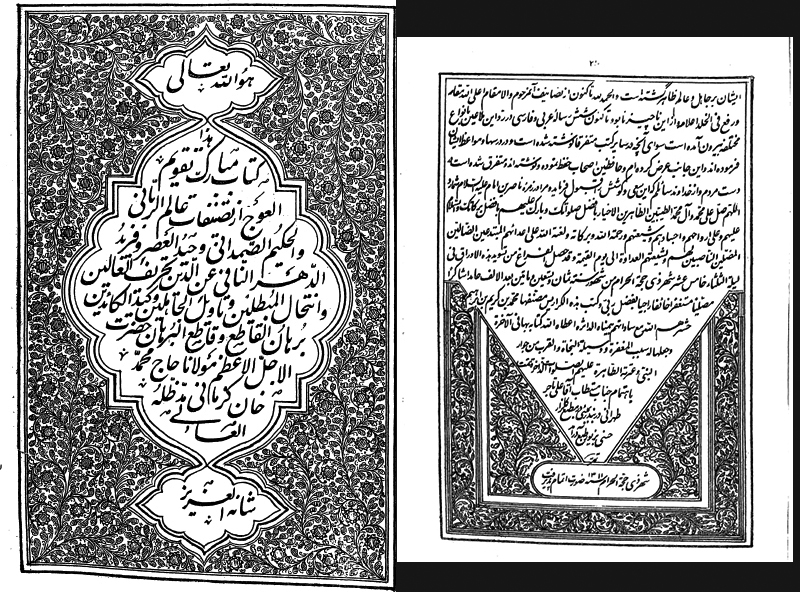
Moḥammad Khan was also the author of a monumental compilation of Hadith entitled Ketāb al-mobin. The structure of the work itself reveals the centrality of the doctrine of rokn-e rābeʿ in Shaikhism. Moḥammad Khan also composed four refutations of Babism (Resāla dar radd-e tāʾwilāt-e bābiya; Resāla dar jawāb-e baʿż-e eḵwān-e Širāz; al-Šams al-maużeʿa; and Taqwim al-ʿewaj; Figure 2). Noteworthy also is his Ḥosām-al-din dar eṯbāt-e taḥrif …, a work in response to the activity of Christian missionaries in Iran during the Qajar period, which is particularly interesting regarding the concept of taḥrif al-Qorʾān (falsification of the Qurʾan) in Shiʿism. He also wrote a few Qurʾanic commentaries.
Bibliography
Works (a selection).
Esḥāqiya, Kerman, 1378/1958-59.
Ḥosām-al-Din dar eṯbāt-e taḥrif-e Tawrāt wa Enjil, Kerman, 1974.
Ketāb-e mobārak-e meṣbāḥ al-sālekin, Kerman, n.d.
Ketāb al-mobin, n.p., n.d.
Resāla-ye Behbahāniya, Kerman, 1972.
“Resāla dar jawāb-e ʿAbd-al-ʿAli Ḵān Adib-al-Molk,” in idem, Majmaʿ al-rasāʾel III, Kerman, 1388/1968, pp. 66-107.
“Resāla dar jawāb-e baʿż-e eḵwān-e Širāz,” in idem, Majmaʿ al-rasāʾel VI, Kerman, 1973.
“Resāla dar jawāb-e soʾālāt-e baʿżi az moʿārafat-e šaḵṣ-e kāmel,” in idem, Majmaʿ al-rasā’el III, Kerman, 1388/1968, pp. 332-52.
Resāla dar radd-e taʾwilāt-e bābia, Kerman, 1398/1978.
al-Šams al-maużeʿa, litho. ed., Tabriz, 1322/1904.
Taqwim al-ʿewaj, litho. ed., Bombay, 1311/1893-94.
Studies.
Mohammad Ali Amir-Moezzi, “Une absence remplie de presences: Herméneutiques de l’occultation chez les Shaykhiyya (Aspects de l’imamologie duodécimaine VII),” BS(O)AS 64/1, 2001, pp. 1-18; Eng. version, as “An Absence filled with Presences: Shaykhiyya Hermeneutics of the Occultation (Aspects of Twelver Imamology VII),” in Rainer Brunner and Werner Ende, eds., The Twelver Shia in Modern Times: Religious Culture and Political History, Leiden, 2001, pp. 36-57.
Idem, “Shi‘ite Doctrine,” Encyclopaedia Iranica Online, http://dx.doi.org/10.1163/2330-4804_EIRO_COM_1365.
Mehdi Bāmdād, Šarḥ-e hāl-e rejāl-e Irān dar qorun-e 12, 13, 14 hejri I, Tehran, 1968.
Mangol Bayat, Mysticism and Dissent: Socio-Religious Thought in Qajar Iran, Syracuse, N.Y., 1982.
Henry Corbin, Terre céleste et corps de résurrection de l’Iran mazdéen à l’Iran shî’ite, Paris, 1960.
Idem, “L´Ecole shaykhie en théologie Shiite,” in Annuaire de l´Ecole Pratique des Hautes Etudes: Section des Sciences Religieuses 1960-61, Paris, 1961, pp. 3-59.
Idem, En islam iranien: Aspects spirituels et philosophiques IV, Paris, 1972.
Abu’l-Qāsem Khan Ebrāhimi, Fehrest-e kotob-e mašāyeḵ-e ʿeẓām, 3rd. ed., Kerman, n. d.
Moḥammad-Bāqer Hamadāni, Esḥāqiya dar jawāb-e soʾālāt-e Mirzā Esḥāq Ḵān, Mashhad, 1977.
Denis Hermann, “Shaykhism,” Encyclopaedia Iranica Online, forthcoming.
Idem, “Moḥammad-Bāqer Hamadāni,” Encyclopaedia Iranica Online, forthcoming.
Idem, “Ḥājj Moḥammad-Karim Khan Kermāni,” Encyclopaedia Iranica Online, forthcoming.
Idem, Le shaykhisme à la période qajare: Histoire sociale et doctrinale d’une école chiite, Turnhout, 2017.
Idem, “Quelques remarques à propos de l’interprétation du sens du rokn-e rābeʿ chez Moḥammad Bāqer Hamadānī, le fondateur de l’école Šayḵī hamadānī,” Journal Asiatique 295/2, 2007b, pp. 461-91.
Denis Hermann and Omid Rezai, “Le rôle du vaqf dans la formation de la communauté shaykhī kermānī à l’époque qājār (1259-1324/1843-1906),” Studia Iranica 36/1, 2007, pp. 87-131.
Denis M. MacEoin, “Bālāsarī,” in Encyclopaedia Iranica III, pp. 583-85 (available at http://dx.doi.org/10.1163/2330-4804_EIRO_COM_6500).
Moḥammad-Karim Khan Kermāni, Rokn-e rābeʿ, Kerman, 1368/1948-49.
Idem, Taḏkerat al-awliāʾ, Kerman, 1387/1967.
Idem, Eršād al-ʿawāmm, 4 vols., Kerman, 1975-76.
Šams-al-Din Najmi, Gāhšomār-e tāriḵ-e Kermān, Kerman, 2002.
Nāẓem-al-Eslām Kermāni, Tāriḵ-e bidāri-e Irāniān, Tehran, 1953 Vahid Rafati, “The Development of Shaykhī Thought in Shīʿī Islam,” Ph.D. diss., University of California at Los Angeles, 1979.
Gianroberto Scarcia, “Kerman 1905: La ‘Guerra’ tra Seiḫī e Bālāsarī Annali del Instituto Orientale Universitario di Napoli 13, 1963, pp. 195-238.