



KORSI, an Arabic loanword in Persian, originally borrowed from Aramaic (Syriac form kurseyāʾ, connected with Akkadian kussū and Sumerian guza; Jefferey, p. 249), meaning (i) a throne, chair, seat, stool, bench (of a judge) (Bodrogligeti, pp. 45, 158) of scholars (ahl-e korsi), pulpit, firmament or sphere of heavenly bodies, and (ii) a wooden frame (Dehḵodā).
The term korsi seems not have been used in Persian prior to the Arab-Muslim conquest, although Achaemenid (q.v.) and Parthian (see ARSACIDS) royalty and satraps made use of high-backed chairs that looked like a throne (see GĀH i. PLACE); dignitaries and women used a low-backed chair (Briant, pp. 97, 253, 345, 347; Curtis and Simpson, pp. 143, 150, 156, 158; Pynt and Higgs, p. 88; Rich, p. 20). The Sasanians (q.v.) used a bench-like throne (Harper and Meyers, pp. 102-4, 108, 122). However, these chair-thrones were not called korsi.
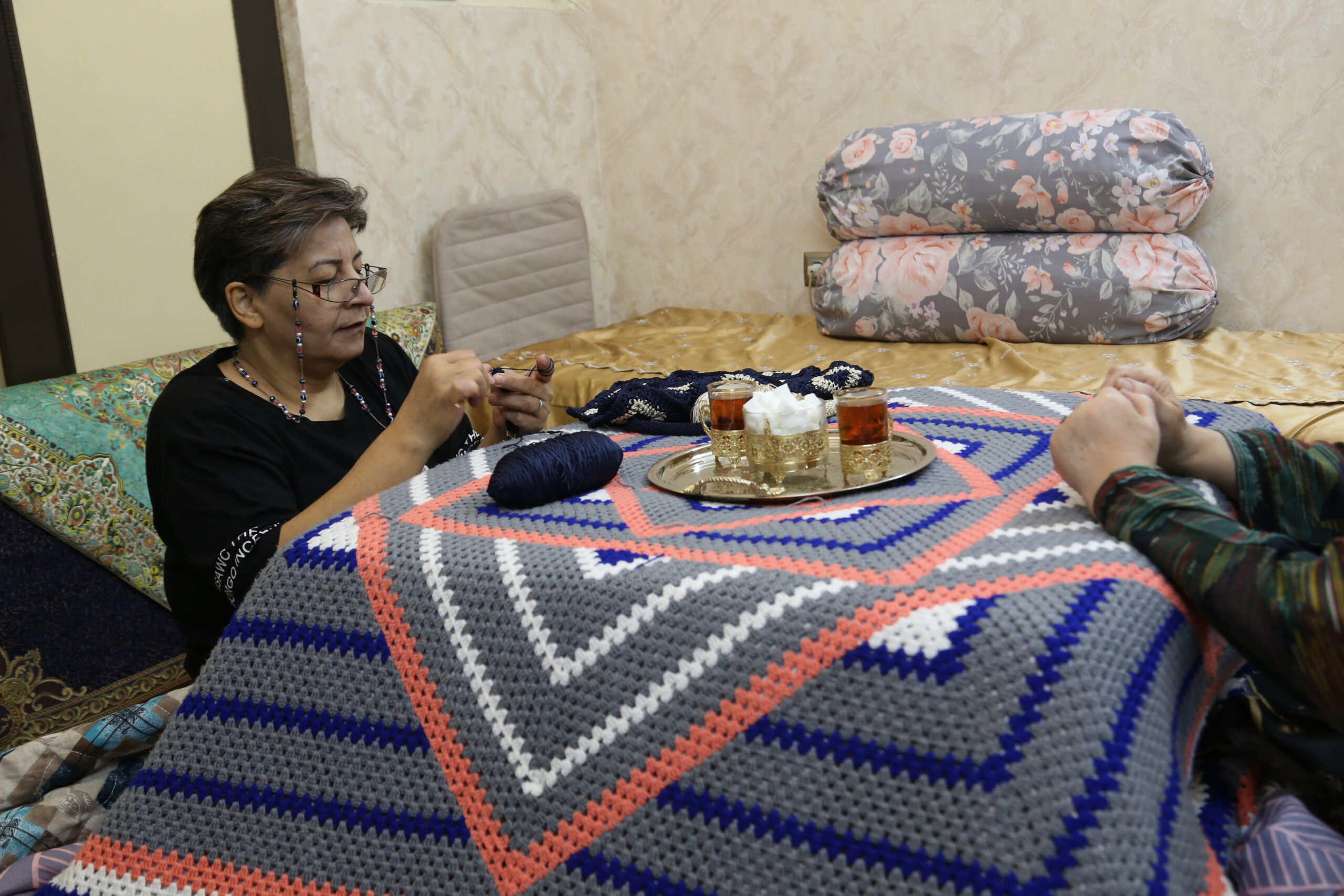
Figure 1. Image of a modern-day korsi.
The word korsi occurs in the Qurʾan (2:255 and 38:34), in the meaning of “throne,” on which God is metaphorically seated and king Solomon’s throne, respectively. Because of the anthropomorphic implications, Islamic scholars debated the meaning of the “throne of God” (Wensinck, pp. 67, 90, 93, 115, 148). To this Throne Verse and the word korsi in abjad (q.v.) numerology, magical powers were ascribed (Donaldson, pp. 111-12, 137-38, 175, 207; for India, see Shurreef, pp. 344, 383). In 687, an extremist Shiʿite group venerated an empty holy chair (“the throne of ʿAli”) which rite likely has its origin in Manichaeism (q.v.; Wellhausen, p. 85; Glassé p. 289; for possible Buddhist links, see Curtis and Simpson, p. 158).
Allegedly, the prophet towards the end of his life began to use a chair with two steps as a minbar. The Omayyads used chair-like thrones, while the ʿAbbasids (q.v.) used the Sasanian bench-like throne without a back, which was copied by succeeding dynasties. The fixed seat served to distinguish the ruler from his subjects. They also used chairs, while folding chairs were used, usually for members of the secretarial class serving the ruler (Bloom and Blair, vol. 1, pp. 83, 472; Turner, p. 200; Daniel and Mahdi, p. 80; A Guide…, pp. 7, 13, 16). Chairs were hardly used in Iran until the 20th century and then mostly for visiting Europeans (Peterson).
Until the mid-19th century, according to English-Persian dictionaries, the main word for “chair” in Persian was korsi, even as late at 1878 (Gladwin; Clarke; Johnson; Richardson and Wilkins; Sen; Tucker). However, by 1880, ṣandali and korsi were mentioned as synonyms (Palmer; Wollaston). This replacement of korsi by ṣandali was a gradual process. In 1866, the term ṣandali was still unknown in Kermanshah (Wills, p. 123). A review of Arthur Wollaston’s 1882 dictionary states that, “kursi is Indo-Persian, while sandali meaning chair is Persian” (p. 601). This is odd, because ṣandali usually denoted a “small stool to place sandals or boots on” (Dehḵodā), while in Mughal India it meant “a footstool” on which the vizier sat next to the ruler’s throne (ʿAllāmi, tr., I, [çandali], pp. ix, 306-7). This juxtaposition of throne and footstool is also found between taḵt and korsi and pišgāh and korsi in medieval times (Huart and Sadan, p. 509; Ebn al-Balḵi, p. 97; Dehḵodā), hence the synonym zirgāh, a chair, a seat.
II. Korsi further denotes a rectangular wooden frame with legs (pāya) mainly used for the traditional heating system. Its first mention in Persian and in European languages is around 1630 (Dehḵodā; Olearius, p. 554) although archeological data suggest that it may already have existed during the Sasanian period (Potts et al., p. 359). It was called ṣandali in Afghanistan and Baluchistan (Gray, pp. 252-53, 258, 490; Michaud, p. 249; Baloch, p. 331; Masson, vol. 2, pp. 272-73). The korsi is an open-sided wooden frame of varying dimensions (45 cm and even 1 m high and it measured from 0.19 square m to 0.60 square m). This frame was placed in the middle of the main room in the house over a fixed or portable brazier (q.v.; Pers. manqal), often merely a simple flat copper chafing dish, or, over a round fire hole (tandur, tanur, or čāla) usually small, although a rather large hole (60 cm deep and 60 cm in diameter) is also mentioned (in summer it was planked over). Depending on the wealth of the family and geographical area the fuel used was charcoal, charcoal dust and firewood, but mostly dung (q.v.) cakes. In this hole, which was clayed all around, or brazier there was a basin of ashes in which a fire was kept smoldering. A very small quantity of charcoal would last all day and during winter the korsi was in continuous operation. If necessary, the top of the korsi was removed and bread or food was baked in this tandur; the dough was flattened on top of the korsi. Over this frame a thickly-wadded quilt (leḥāf) or any cover was spread, which extended some 1.5 meters beyond the wooden frame. Wealthy people had a special cover (ru-korsi) made to protect the quilt from being soiled (for a picture of a ru-korsi, see Hali, p. 126; Tanavoli, p. 17). Around the korsi, mattresses or cushions were spread out on which the family sat or laid with their feet through the open sides towards the heat source. The family, only relatives and very close friends (if male, usually only those who were maḥram, although Col. Sheil was invited), was dressed in warm clothes to keep the rest of the body (arms, shoulders) warm. The quilt was tucked up to the waist or neck. The hands were kept free, because family members gossiped, smoked, played cards and games on the top of the korsi, on which also tea and meals were served.
During the long winter nights people told stories and poetry was read out aloud (Šahri, vol. 4, pp. 466-73; Melikian-Chirvani; Sheil, p. 100; Floyer, pp. 398-99, 401, 421; Wills, pp. 137-38, 143; Eastwick vol. 2, p. 72; Rice, pp. 37, 172; Sykes, vol. 2, p. 391; Hume-Griffith, p. 52; Dwight, pp. 104-5, 154, 266-67, 274-75, 278-79; Malcolm, p. 23; Wood, p. 39; Alberts, vol. 1, pp. 165-66; Christensen pp. 105, 114; Moin, p. 17; Yāraḥmadi, p. 234. For an illustration, see Durand, p. 246; Hume-Griffith, p. 55; Christensen fig. 6c; Panāhi Semnāni, p. 56; Yāraḥmadi, p. 235). Therefore, “a korsi is commonly referred to as a tambal-ḵāna, or lazy-house” (Rice, p. 172). When people went to sleep they, fully clothed, simply turned around. A visitor might then only see a circle of black hats sticking out from under the korsi. Because people seldom washed themselves, the korsi was a breeding place for vermin with which they were infested. Often accidents happened; people, especially small children might burn themselves or be overcome by carbon monoxide fumes (Sheil, p. 101; Dwight, p. 154; Adams, vol. 1, p. 166; Rice, pp. 173, 259). Therefore, people were advised not to sleep with their heads under the korsi and to ensure that the coals in the brazier were red hot before placing it under the cover (Dānešvar, p. 60).
Although most houses had a korsi (Dwight, p. 278), many poor households could not afford the cost of fuel. Therefore, frostbite was not uncommon among the poorest classes (Arnold, p. 276). In some cities, such as in Yazd, the korsi was less common (Malcolm, pp. 22, 30). Nomads seem not have used it (e.g., among the Baḵtiāris [q.v.], only sedentarized tribal members used the korsi for 2-3 months in the yeylāq, Digard, p. 178). The korsi was also used as a bed. In Naḵjavān (q.v.), William Ouseley (1767-1842) saw women reclining on “cursis or wooden frames covered with carpets, or felt nemmeds on the flat roof” (Ouseley, III, p. 346). Now, the korsi is a thing of the past. Change began in the 1930s, when a large room, or an office, or a hall with a public gathering needed to be heated, “stoves that usually burn coal or simple devices that burn oil were used” (Koelz, p. 161).
III. Other meanings are derived from the “support” connotation of korsi. They include a falcons nest; a triangular mallet; an arrow head support; a bezel; the teeth of the mill wheel; perfectly shaped and spaced letters (in calligraphy) or pearls in a necklace; and in orthography, the panj korsi, the supporting characters placed under certain letters (Dehḵodā).
Bibliography
A Guide to the Exhibition of the Abbasid Palace, Baghdad, 1935.
Robert C. Alberts, “Social Structure and Culture Change in an Iranian Village,” 2 vols., Ph.D. diss., University of Wisconsin, Madison, 1963.
Abu’l-Fażl b. Mobarak ʿAllāmi, Āʾin-e akbari, tr. H. Blochmann, as The Ain I Akbari by Abul Fazl ’Allami, vol. I, Calcutta, 1873; vols. II-III, tr. H. S. Jarrett, Calcutta, 1891-94; repr. Delhi, 1989; Piscataway, N. J., 2010.
Ḥasan Anwari, ed., Farhang-e bozorg-e soḵan, Tehran, 8 vols., 2002.
Reza and Josephine Arasteh, Man and Society in Iran, Leiden, 1964; repr. 1970.
Arthur Arnold, Through Persia by Caravan, London, 1877.
Hameed Baloch, The Balochistan Chronicles: The Archives of the Times, London and the New York Times on Balochistan, from 1842-2007, Karachi, 2008.
András J. E. Bodrogligeti, The Persian Vocabulary of the Codex Cumanicus, Budapest, 1971.
Jonathan Bloom and Sheila S. Blair, eds., The Grove Encyclopedia of Islamic Art and Architecture, 3 vols., Oxford, 2009.
Pierre Briant, From Cyrus to Alexander: A History of the Persian Empire, tr. Peter T. Daniels, Winona Lake, Ind., 2002.
Nerthus Christensen, “Haustypen und Gehöftbildung in Westpersien,” Anthropos 62/1-2, 1967, pp. 89-138.
John Curtis and St John Simpson, The World of Achaemenid Persia: History, Art and Society in Iran and the Near East, London, 2010.
Aḥmad Dānešvar, “Behdāšt-e ʿomumi,” Aḵgar 19, 1947, pp. 59-62.
Elton L. Daniel and Ali Akbar Mahdi, Culture and Customs of Iran, Westport, Conn., 2006.
ʿAli Akbar Dehḵhodā, Loḡat-nāma, Tehran, 1946-75, s.v. “Korsi,” “Ṣandali.”
Jean-Pierre Digard, Techniques des nomades Baxtiyari d’Iran, Paris, 1981.
Bess Allen Donaldson, The Wild Rue: A Study of Muhammadan Magic and Folklore in Iran, London, 1938.
Ella R. Durand, An Autumn Tour in Western Persia, Westminster, 1902; repr. New York, 1904.
Harrison G. Dwight, Persian Miniatures, Garden City, NY, 1917.
Edward B. Eastwick, Journal of a Diplomate’s Three Years’ Residence in Persia, 2 vols., London, 1864; repr., Tehran, 1976.
Ebn al-Balḵi, The Fársnáma, eds., Guy Le Strange and Reynold A. Nicholson, Cambridge, 1921.
Ernest A. Floyer, Unexplored Baluchistan: A Survey, with Observations Astronomical, Geographical, Botanical, etc.,London, 1882; repr., Quetta, 1977.
Francis Gladwin, A Dictionary, Persian, Hindoostanee and English; Including Synonyma, 2 vols., Calcutta, 1809.
Cyril Glassé, The New Encyclopedia of Islam, Walnut Creek, Calif., 2001, p. 289.
John Alfred Gray, At the Court of the Amīr, London, 1895.
Hali: The International Magazine of Fine Carpets, Textiles and Islamic Art 5, 1982.
Prudence O. Harper and Pieter Meyers, Silver Vessels of the Sasanian Period I: Royal Imagery, New York, 1981.
Cl. Huart and J. Sadan, “Kursī,” EI2, V, p. 509.
M. E. Hume-Griffith, Behind the Veil in Persia and Turkish Arabia: An Account of an Englishwoman’s Eight Years’ Residence Among the Women of the East, Philadelphia, 1909.
Arthur Jefferey, The Foreign Vocabulary of the Qur’an, Baroda, 1938; repr. Leiden, 2006.
Francis Johnson, A Dictionary, Persian, Arabic, and English, London, 1852.
Walter N. Koelz, Persian Diary, 1939-1941, Ann Arbor, 1983.
Napier Malcolm, Five Years in a Persian Town, London, 1905.
Charles Masson, Narrative of Various Journeys in Balochistan, Afghanistan and the Panjab, Including A Residence in Those Countries from 1826-1838, 3 vols., London, 1842.
Asadullah Souren Melikian-Chirvani and Jaʿfar Šahri, “Brazier,” Encyclopaedia Iranica IV, New York and London, 1990, pp. 443-44.
Roland Michaud and Sabrina Michaud, Afghanistan: The Land that Was, New York, 2002.
Baqer Moin, Khomeini: The Life of the Ayatollah, London, 1999.
Adam Olearius, Vermehrte newe Beschreibung der muscowitischen und persischen Reyse, Schleswig, 1656; repr., Tübingen, 1971.
William Ouseley, Travels in Various Countries of the East; More Particularly Persia, 3 vols., London, 1819-23.
Edward Henry Palmer, A Concise Dictionary: English-Persian, ed. Guy Le Strange, London, 1883.
Moḥammad Aḥmad Panāhi Semnāni, “Piša-hā va fanāvarihā-ye sonnati: tanurbandān dar Semnān, sāz va kār-e poḵt-e sonnati-ye nān dar Semnān,” Farhang-e Mardom 1, 2002, pp. 46-60.
Samuel R. Peterson, “Chairs and Change in Qajar Iran,” in Michael E. Bonine and Nikki R. Keddie, eds., Modern Iran: The Dialectics of Continuity and Change, New York, 1981, pp. 383-90.
Timothy Potts, Michael Roaf, and Diana L. Stein, eds., Culture Through Objects: Ancient Near Eastern Studies in Honour of P.R.S. Moorey, Oxford, 2003.
Jenny Pynt and Joy Higgs, A History of Seating, 3000 BC to 2000 AD: Function Versus Aesthetics, Amherst, NY, 2010.
Clara Colliver Rice, Persian Women and Their Ways, London, 1923.
Anthony Rich, The Legend of St. Peter’s Chair, London, 1851.
John Richardson and Charles Wilkins, A Dictionary, English, Persian and Arabic, 2 vols., London, 1806-10.
Ramdhun Sen, Dictionary, in English and Persian, Calcutta, 1833.
Jaʿfar Šahri, Ṭehrān-e qadim, 5 vols., Tehran, 1992.
Jaffur Shurreef, Qanoon-e Islam, or the Customs of the Moosulmans of India, tr. G.A. Herklots, London, 1832.
Mary L. Woulfe Sheil, Glimpses of Life and Manners in Persia, London, 1856.
Sir Percy Sykes, The History of Persia: From the Most Early Period to the Present Time, 2 vols., London, 1815; repr. 1969.
Parviz Tanavoli, Rustic and Tribal Weaves from Varamin, Tehran, 2001.
William Thornhill Tucker, A Pocket Dictionary of English and Persian, London, 1850.
John Persons Turner, “Inquisition and the Definition of Identity in Early Abbasid History,” Ph.D. diss., University of Michigan, Ann Arbor, 2001.
Julius Wellhausen, Die religiös-politischen oppositionsparteien im alten Islam, Berlin, 1901.
Arent Jan Wensinck, The Muslim Creed: Its Genesis and Historical Development, Cambridge, 1932.
Henry Wilberforce Clarke, The Persian Manual: A Pocket Companion, London, 1878.
Charles J. Wills, In the Land of the Lion and Sun, or, Modern Persia being Experiences of Life in Persia from 1866-1881, London, 1891.
Arthur N. Wollaston, An English-Persian Dictionary, London, 1882; reviewed in The Saturday Review of Politics, Literature, Science and Art 53, 13 May 1882, pp. 600-602.
M. M. Wood, Glimpses of Persia, London, 1922.
Ḡolāmhossayn Karzbar Yāraḥmadi, “Korsi-ye garm va zamestān-e sard dar Lorestān,” Farhang-e Mardom-e Iran 10, 2007, pp. 229-40.