



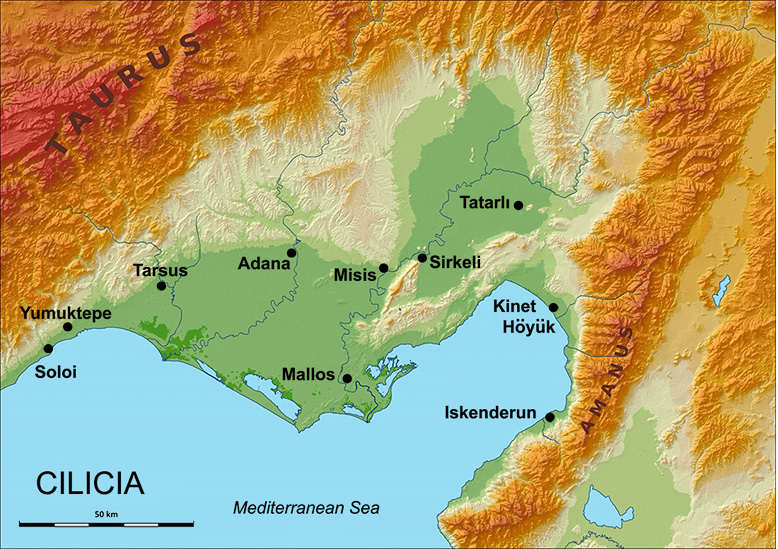
KINET HÖYÜK, an archaeological site on the Mediterranean coast near Dörtyol, Hatay province, Turkey. The excavations conducted from 1992 to 2012 at Kinet Höyük by a team from Bilkent University under the direction of Marie-Henriette Gates revealed important remains of the Persian and Hellenistic periods (the final reports are in preparation). Although this ancient seaport has been identified as Hittite Izziya and Classical Issos, near where Alexander the Great and Darius III (qq.v.) fought in 333 BCE, its current name is modern and of uncertain derivation (Gates, 2015, p. 83; Figure 1).
Excavations revealed a long history of occupation. Random finds of Ḥalaf ceramics indicate habitation in the Late Neolithic period (6th millennium BCE). Excavated architectural levels and stratigraphic documentation begin with the Early Bronze Age II (early 3rd millennium BCE); settlement continued almost without interruption through the Bronze and Iron Ages (qq.v.) to the Late Hellenistic period (early 1st century BCE). Following a lengthy abandonment, during the later Middle Ages (mid-12th to mid-14th centuries CE), the central part of the site, by this time a high hill with a dominant view of the coastal plain, was rebuilt as a fort (Redford et al.). After the third and final phase of this fortress was sacked, the site was permanently abandoned (PLATE I).

A key interest of the site is its lengthy excavated occupational sequence, matched in Cilicia (q.v.) and the transmontane Amuq plain only by Gözlü Kule (Tarsus) and Yumuktepe (Mersin). This allows insights on social and economic changes throughout its long history. In addition, as a rare excavated example of a Cilician harbor town, Kinet Höyük illustrates how seaports functioned and thrived over time. Its location off the main body of the Mediterranean offered advantages for ancient seafarers: deep water (the result of geological formations in this area where faults intersect) and protection from strong Mediterranean winds. Traders could benefit from the proximity of access to Cilicia and upper Mesopotamia as well as Cyprus (qq.v.) and the Levant. The Amanus Mountains (Nur Mountains), close by, were exploited for timber and metals.
Today the coastline is straight; the mound lies 500 m inland. This modern topography, the result of silting of the coastal plain by erosion from the Amanus Mountains, hides the ancient appearance. Geomorphological research and soundings in fields to the mound’s north and west have revealed the many changes in the rivers that flowed alongside the town, the configuration of the harbors, and the coastline (Gates, 2015, p. 82).
Two centuries of Achaemenid (q.v.) Persian control are documented. The beginning of Persian rule is obscure, as indeed throughout the region. Early architectural remains include sunken wall foundations filled with gravel, a practice unknown in the region but attested at Susa (q.v.) in the 4th century BCE—an indication of imperial impact. Rooms dating from the 5th century BCE (Kinet Period 4) yielded amphora fragments indicating trade activity with the Aegean and the southern Levant (Gates, 2015, p. 87). In the early 4th century BCE (Period 3B), a circuit wall was built to enclose the top of the mound. This fortification reflects the military importance of this seaport during a time of unrest in the eastern Mediterranean, when the Persians used Cilicia as a mustering ground for their armed forces and navy.
The city survived without break into the Hellenistic period, its walls and buildings of Period 3B continuing in use. Sometime in the mid-2nd century BCE, the town was re-founded with a new plan on a different orientation (see Novák et al., p.180). Despite a smaller scale, its material culture nonetheless demonstrates the continued intensity of commercial contacts.
Ancient settlement at Kinet Höyük came to an end circa 80 BCE, according to ceramic evidence. The reasons for the abandonment are unknown; silting of the harbors and malaria may have contributed.
Bibliography
Charles Gates, “The Place of the Achaemenid Persian Period in Archaeological Research in Cilicia and Hatay (Turkey),” in Pierre Briant and Rémy Boucharlat, eds., L’archéologie de l’empire achéménide: Nouvelles recherches, Persika 6, Paris, 2005, pp. 49-69.
Idem, “Kinet Höyük (Classical Issos): A Harbor Town in Southeast Cilicia during the Persian and Hellenistic Periods,” Journal of Eastern Mediterranean Archaeology and Heritage Studies 3/2, 2015, pp. 81-104.
Idem, “Cilicia, 550-330 BC: Persians and Locals,” in Ashk P. Dahlén, ed., Achaemenid Anatolia: Persian Presence and Impact in the Western Satrapies 546-330 BC. Proceedings of an International Symposium at the Swedish Research Institute in Istanbul, 7-8 September 2017, Uppsale, 2020, pp. 127-41.
Marie-Henriette Gates, “The Hittite Seaport Izziya at Late Bronze Age Kinet Höyük (Cilicia), Near Eastern Archaeology 76, 2013, pp. 223-34.
Marie-Henriette Gates, Charles Gates, Scott Redford, and Asa A. Eger, “Excavations at Kinet Höyük and Hisn al-Tinat,” in Aynur Özfırat and Çilem Uygun, eds., Hatay Arkeolojik Kazı ve Araştırmaları (Hatay archaeological excavations and surveys), Antakya, 2014, pp. 157-71.
Hansgerd Hellenkemper, “Das wiedergefundene Issos,” in Jakob Ozols and Volker Thewalt, eds., Aus dem Osten des Alexanderreiches: Völker und Kulturen zwischen Orient und Okzident; Iran, Afghanistan, Pakistan, Indien. Festschrift für 65. Geburtstag von Klaus Fischer, Cologne, 1984, pp. 43-50.
Gunnar Lehmann, “The Archaeology of the Assyrian Period in Cilicia in the Light of the Kinet Höyük Excavations,” in John MacGinnis, Dirk Wicke, and Tina Greenfield, eds., The Provincial Archaeology of the Assyrian Empire, Cambridge, 2016, pp. 321-33.
Mirko Novák and the Cilician Chronology Group, “A Comparative Stratigraphy of Cilicia: Results of the First Three Cilician Chronology Workshops,” Altorientalische Forschungen 44/2, 2017, pp. 150-86.
Scott Redford, Salima Ikram, Elizabeth M. Parr, and Timothy Beach, “Excavations at Medieval Kinet, Turkey: A Preliminary Report,” Ancient Near Eastern Studies 38, 2001, pp. 58-138.