



GIVALEVICH, ANDRE (b. Salmās district 1908 or 1911; d. Tehran, 1985; Figure 1), Assyrian painter and athlete. The Givalevich family originated from the village of Gotranis (Barwar district in Ottoman Turkey, now in Iraq) but had come to Iran due to the insecurity caused by Kurdish attacks on Ottoman Assyrians. In 1914-15, his extended paternal family (the Maravgul) fled to Tsarist Russia, first to Baku. then, in 1916, they settled in Rostov-on-Don (southern Russia).
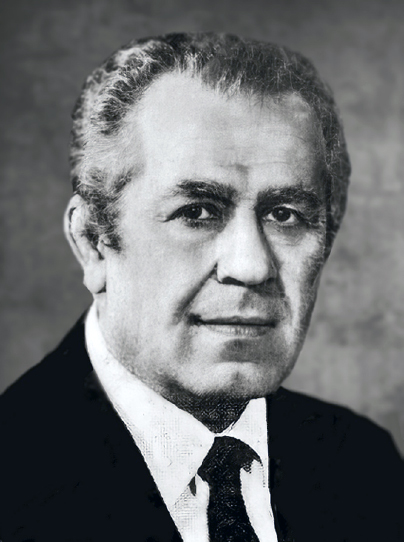
Andre’s father, Mikhael Nazarovich (Maravgul) ran a store and a teashop between 1916 and 1917 in Rostov. During 1918-19, he served as corporal in the White Army of General Ivan Denikin (1872-1947) during the Russian Civil War. He was killed after the retreat from Moscow, in the Crimea. Andre Givalevich’s uncle, Boris (Barcham) Yulev, born in 1884, then moved the entire family to Petrograd (St. Petersburg) in 1920. They lived there until he was arrested on 3 February 1938 during the Stalinist purges that swept up many Assyrians. He died a few months later due to harsh conditions.
Givalevich began his schooling in 1918 in Rostov and completed his studies in Leningrad/Petrograd. As a child, he had displayed artistic talent and so enrolled in the Leningrad Academy of Arts (1929-32) but maintained a passion for wrestling. He became a member of the wrestling team “Dynamo” and went on to become a wrestling champion of the Soviet Union. From 1932 to 1938 he worked as set designer at Leninfilm and then at Sovietskaya Byelorus. He was responsible for set design in such films as Pyotr pervyy I (Peter the First) (1937) and Groza (The Tempest), both milestones in Soviet cinematography.
In 1938, Givalevich was arrested by the NKVD, the Soviet internal secret service, as had been his uncle. He was allowed to leave the USSR on the promise that he would spy for the Soviet government. However, like other returning Assyrians who had fled Iran and who were suspect in the Pahlavi monarchy, he had to settle in Hamadan, away from Urmia. He was able to move to Tehran only in 1940. There, he made his living as a wrestling coach, a painter, and a photographer. His paintings won him first place at several international festivals. Likewise, the athletes he trained won honors, though he himself was not recognized except through the annual Andre (Givalevich) Cup matches. He died in Tehran on 12 June 1985.
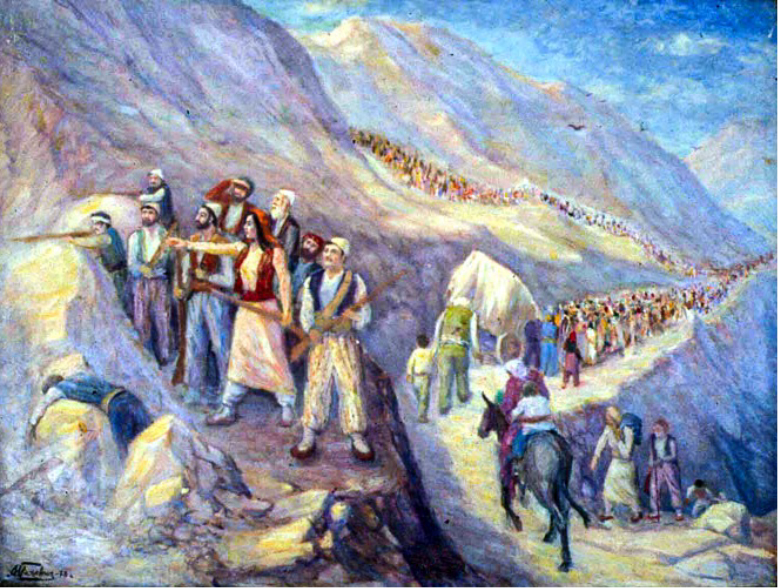
Givalevich’s large canvas “Raqa d-Aturaye” (Flight of the Assyrians) is his best-known painting (Figure 2). Featured in a lead article of the first Assyrian bilingual periodical, Datid bahrana to appear in Iran, it was transported to the United States by his daughter but has not been exhibited. Givalevch has been praised widely by Iranian art critics as a master of the Iranian landscape.
Bibliography
Arianne Ishaya, “Andre Givalevich: Portrait of an Artist and Athlete,” Assyrian Star, 54/2. Summer 2002, p. 19.
Stefan Sado, Materialy k biograficheskomu slovariu assiriĭtsev v Rossii: XIX-seredina XX veka (Materials for a biographical dictionary of Assyrians in Russia: mid-19th to mid-20th century) St. Petersburg, 2006, pp. 56-57.