



KIᾹNURI, NUR-AL-DIN (b. Tehran 20 October 1915; d. Tehran 5 November 1999; Figure 1), architect, political figure, and leader of the Tudeh (Tuda) party of Iran, 1979-83 (see COMMUNISM ii and iii).
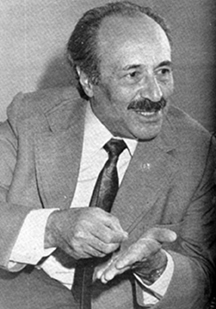
Early years (1915-41). Born in Tehran in 1915 (Kiānuri, 1942, p. 52; Ḥezb-e Tuda-ye Irān dar Ālmān-e Šarqi, p. 382), Nur-al-Din Kiānuri was the grandson of Shaikh Fażl-Allāh Nuri (q.v.), the prominent anti-constitutional cleric during the Iranian Constitutional Revolution (q.v.; Enqelāb-e mašruṭa) and son of Zahrā Solṭāni Nuri and Shaikh Mehdi Nuri, a judge residing in Tehran who had supported the revolution. Shaikh Mehdi was assassinated six months before Kiānuri’s birth, allegedly because of a speech he had given in opposition to the Russian occupation of northern Iran during World War I. Kiānuri’s childhood was spent in poverty (Kiānuri, 1992, pp. 33-36). Aḵtar‘s participation in the women’s organization of the Communist Party of Iran (Ferqa-ye komonīst-e Īrān, founded in 1920) and her marriage in 1925 to the prominent communist and Soviet protégé ʿAbd-al-Ṣamad Kāmbaḵš had a lasting effect on Kiānūri’s political orientation. His much older sister Aḵtar, too, later became a prominent member of the Tudeh party (Kiānuri, 1992, pp. 38-39). His family connection with Kāmbaḵš later also facilitated Kiānūri’s close ties with Soviet officials.
After completing his high school education at Dār al-Fonun (q.v.), Kiānuri entered the Engineering Faculty of the newly-founded University of Tehran (see FACULTIES OF THE UNIVERSITY OF TEHRAN) in September 1934 (Kiānuri, 1942, p. 52). At the university, he became acquainted with leftist students and briefly participated in a Marxist reading circle, but he was not affiliated with the “Group of Fifty-Three” (Goruh-e panjāh o se nafar), a circle of leftist intellectuals led by Taqi Arāni (q.v.) that gained much publicity after its members were detained by the authorities in 1937 (Kiānuri, 1992, pp. 55-56). In 1935, Kiānuri left Iran for Germany to commence his undergraduate studies in architecture at the Technische Hochschule Aachen (Technical University of Aachen). He initially received financial support from his brother and from a cousin residing in Aachen. After two years of study, he was able to secure a scholarship from the Iranian Ministry of Roads (Kiānuri, 1992, pp. 58-59). In November 1938, he received his diploma (HArch, 1368a). Shortly thereafter, he was employed by the Philipp Holzmann Company, a German firm commissioned to build a new hospital for the University of Tehran (Kiānuri, 1992, p. 59). At the same time, he began working on his civil engineering doctoral thesis “Krankenhausbau für Iran” (The Construction of Hospitals for Iran), which focused on the medical infrastructure in Iran. He successfully defended his thesis at the Technische Hochschule Aachen in September 1939 (Kiānuri, 1942, p. 52; HArch, 1368b).
Kiānuri returned to Tehran in late 1939. He was conscripted during the brief and ineffective military campaign against the Allied invasion of Iran in September 1941 but managed to evade combat duty. Following the completion of his national service, Kiānuri worked in the estates office of the Ministry of Finance and taught at the University of Tehran’s Faculty of Architecture, where some of the next generation of prominent architects trained under him, including Hušang Seyḥun (Kiānuri, 1992, p. 205).
Political activities in Iran (1942-56). Kiānuri joined the pro-Soviet communist Tudeh party in April 1942, with the party having been formed the previous year (Amirḵosravi and Āḏarnur, II, p. 32). In later years, other party figures such as Reżā Rustā would claim that Kiānuri’s delay in joining the party was due to his erstwhile Nazi sympathies (Eskandari, 1985, pp. 30-32; BArch, DY 30/3636, fol. 15). Kiānuri rapidly rose in the party ranks, serving in both the party’s provincial committee for Tehran and its disciplinary committee, while holding classes on Marxism for other party members at the residence of ʿAbd-al-Ṣamad Kāmbaḵš (Torbati Sanjābi, p. 75). In 1943, he married Maryam Firuz (q.v.; d. 2008), a scion of the Farmānfarmā family (see FARMĀNFARMĀ, ʿABD-AL-ḤOSAYN MIRZĀ) and a party member. The couple formed a strong and lasting bond. At the first national congress of the Tudeh in 1944, Kiānuri was elected to the second most powerful inner-party committee as a member of the Inspection Committee. He also worked in the party’s press branch as the license holder of the periodical Bašar barā-ye dānešjuyān (Eskandari, 1946).
Kiānuri’s stance on the Soviet-backed autonomous movements in Iran’s Kurdish- and Azeri-dominated provinces following the end of World War II and the Azarbaijan Crisis of 1946 (see Azarbaijan v. HISTORY FROM 1941 TO 1947)—when Moscow refused to withdraw its military forces from Iranian Azarbaijan in violation of the terms of the Tripartite Treaty of 1942 between the Soviet Union, Britain, and Iran—remain unclear, due to the lack of contemporary sources. It is unlikely that, as a member of the Tudeh party’s Inspection Committee, he was directly involved in formulating the party’s immediate reaction to the creation of the Soviet-backed Democratic Party of Azarbaijan (see FERQA-YE DEMOKRĀT-E ĀḎARBĀYJĀN) in September 1945. Yet, more than three decades later, after he had become first secretary of the Tudeh, he explicitly defended both autonomous provincial movements as anti-imperialist overtures. He claimed the autonomous movements were committed to equal treatment of all ethnic groups in Iran, democracy, and Iran’s territorial sovereignty (Kiānuri, 1980, pp. 13-17).
At the second congress of the party in 1948, Kiānuri was elected to the newly-created executive committee (Zabih, p. 145). He was among the senior Tudeh leaders arrested following the 4 February 1949 abortive attempt on the life of Moḥammad-Reżā Shah at the University of Tehran. Kiānuri’s prior knowledge of the intended objective of the assailant, Nāṣer Faḵr Ārāʾi, remains mired in controversy. According to Fereydun Kešāvarz, a senior party leader who fled the country following the assassination attempt, Kiānuri had established contact with Faḵr Ārāʾi in previous months. This assertion has been refuted by Kiānuri’s deputy at the time, ʿAbd-Allāh Aragāni, who was in contact with Faḵr Ārāʾi (Torbati Sanjābi, pp. 85-86). The event led to the prohibition of the Tudeh party. Kiānuri was arrested along with nine other prominent party members, among them Aḥmad Qāsemi, Morteżā Yazdi, and Ḥosayn Jowdat (Abrahamian, 1982, p. 318). Kiānuri was sentenced to ten years in prison. He was initially incarcerated at Yazd prison, where he translated and expanded his doctoral thesis, which was subsequently published by his brother (Kiānuri, 1992, pp.191-193). He was later transferred to Qaṣr prison in Tehran, from which he escaped on 15 December 1950, together with several other party leaders, and began six years of clandestine life (Kiānuri, 1992, p. 194).
In the coming years, Kiānuri was in charge of the party’s organizational affairs within the executive committee of the outlawed Tudeh party, now reduced to only five members. He also belonged to the “radical” inner-party faction, which was reluctant to support the oil nationalization movement led by premier Moḥammad Moṣaddeq and his National Front coalition, on grounds of the coalition’s allegedly bourgeois character (Behrooz, pp. 112-15). However, Kiānuri adopted a less intransigent stance toward Moṣaddeq following the 28 February 1953 anti-Moṣaddeq royalist mob disturbances in the capital and endorsed the prime minister in his confrontation with the royal court (Rowšan, 1959, p. 20). He was among the Tudeh leaders who expressed support for Moṣaddeq during the tense days of 16-19 August 1953, when the successful joint US and British orchestrated pro-shah coup that toppled Moṣaddeq’s government was unfolding (see COUP D’ETAT OF 1332 Š./1953). According to a Tudeh party witness, Kiānuri held two phone conversations with Moṣaddeq on the fateful day of the coup, but failed to reach an agreement with the prime minister on a joint strategy for countering the royalist camp (Anṣāri, pp. 233-35).
Kiānuri clandestinely remained in Iran following the coup and became a leading organizer of the Tudeh underground. He also took part in tense internal debates in the party over the party’s accountability in the collapse of Moṣaddeq’s government. Kiānuri left Iran in early 1956. Throughout the 1950s, Kiānuri grew increasingly critical of the party and its doctrinaire attitude toward the “national bourgeoisie,” which he blamed for the party’s passivity and irresolute support for Moṣaddeq during the oil nationalization crisis, on grounds of the latter’s insufficient commitment to social, agrarian, and other reforms (Rowšan, 1959).
Kiānuri in East Germany, re-election to the Tudeh executive committee, and supervision of the party’s international relations (1957-62). After a period of residence in Moscow, Kiānuri arrived in the German Democratic Republic (GDR) on 10 December 1957 (BArch, MfS, AIM 11177/81, fol. 42), eventually settling in Leipzig (Kiānuri, 1992, p. 377). At the fourth party plenum in Moscow in the summer of 1957, he had been re-elected to the executive committee At the next party plenum, held in Sofia in early 1958, he was also appointed to oversee the party’s international relations (BArch, DY 30/97100, fol. 92) and, additionally, became part of a three-member group led by first secretary Reżā Rādmaneš that was assigned to oversee the activities of the party in Iran and Western Europe (BArch, MfS, AIM 14683/84, fol. 42). In this capacity, he was involved in liaising with party members active in transnational organizations such as the International Union of Students (1946) or the Confederation of Iranian Students (1960) (see CONFEDERATION OF IRANIAN STUDENTS, NATIONAL UNION; Shokat, 1989, p. 377).
Kiānuri wrote several articles for the party’s internal publication Masāʾel-e Ḥezbi, under the penname “Rowšan.” One of these articles provided a brief guide for party work among university students, in which he argued for a clear distinction between political and organizing activities of Tudeh members on university campuses, both inside and outside Iran (Rowšan, 1960). He also discussed current relations between Tudeh and the Second National Front, following the formation of the latter in 1960, and reflected on the framework for cooperation between local Tudeh cells in Iran and their National Front counterparts, despite the lack of formal alliance between the two groups (Rowšan, 1961).
Kiānuri’s public career as an architectural theorist (1962-72). The tenth plenum of the Tudeh party in Moscow in the spring of 1962 constituted a turning point in Kiānuri’s political career in exile. The party’s central committee was in complete disarray, following internal disputes after the revelation that two members of the party, Ḥosayn and Fereydun Yazdi, were informants of the Iranian secret service, the National Intelligence and Security Organization (Sāzmān-e eṭṭelāʿāt wa amnīyat-e kešvar) (see CENTRAL INTELLIGENCE AGENCY). Unable to reach a consensus, the plenum decided to suspend the executive committee and replace it with a provisional bureau consisting of Reżā Rādmaneš, Iraj Eskandari (q.v.), and ʿAbd-al-Ṣamad Kāmbaḵš (BArch, NY 4182/1292, fol. 21). Kiānuri shortly withdrew from active participation in party affairs after an unsuccessful attempt to maintain his leverage in the party by organizing party branches in Western Europe along with his brother-in-law Kāmbaḵš. For the next seven years, he refrained from attending party meetings (BArch, MfS, HA II Nr. 28758, fol. 9; Amirḵosravi, 2020, pp. 293, 309, 313). His activities in connection with the party were effectively confined to minor undertakings, such as forging passports for cross-border operations as well as rare contributions to Donyā (q.v.), the political-theoretical journal of the party.
After the suspension of the executive committee in 1962, Kiānuri moved to East Berlin, where he had obtained a position at the German Building Academy (Deutsche Bauakademie). While less involved in the practical aspects of building planning, as a high-ranking member of the Academy’s division on “Urban Development–Prognosis” he contributed to theoretical works on the planning of future model socialist cities in East Germany (Flierl, p. 178). His scholarly work, which he always presented under the pseudonym Silvio Macetti at lectures, academic publications, or articles written for the general public in major newspapers such as the Berliner Zeitung, inspired many architects who played a key role in planning the built environment of East Germany (Zervosen, pp. 258-60; “Über das größte Hemmnis”; “BZ-Forum”; BArch, DH 2/21675; Macetti). Bruno Flierl, an influential architect both in the GDR and in post-unification Germany, has called Kiānuri his “most important guide” in architectural theory (Flierl, p. 180).
It was only in the context of the “Maoist split” of 1963-64 that Kianuri resumed active involvement in party matters. He continually engaged in direct discussions with leading dissidents in the ranks of Tudeh student organizations in Western Europe, who were lambasting the Tudeh leadership for the party’s inertia and its absolute obedience to the Soviet Union. During such meetings in East Berlin and Leipzig, Kianuri relied on his reputation among the younger party base as a “revolutionary” (Shokat, 1989, p. 119) in attempting to persuade the dissidents and others of Tudeh’s continued revolutionary platform and its political significance. While accepting some of the criticisms, Kianuri steadfastly, but unsuccessfully, tried to assuage the dissenting students, who eventually formed the nucleus of the breakaway and pro-China Revolutionary Organization of the Tudeh Party of Iran (1964) (Shokat, 1989, pp. 121-22; idem, 2005, pp. 43-46; idem, 2003, pp. 28, 34). At the eleventh Tudeh plenum, held in Moscow in January 1965, the central committee members Qāsemi and Ḡolām-Ḥosayn Forutan, along with a central committee candidate ʿAbbās Saḡāʾi, dissented from the party’s position over Soviet hostility toward China and the earlier Albanian-Soviet split (1961). Kianuri, initially opposing the expulsion of these individuals from the central committee on grounds of their sympathetic stance toward the communist parties of China and Albania, reversed his position and withdrew his vote after learning the Communist party of the Soviet Union would not countenance such a move, and that Tudeh’s own stability and security could be imperilled (Amirḵosravī and Āḏarnur, III, p. 100; Kiānuri, 1992, pp. 430-31).
Following Iraj Eskandari’s unseating of Reżā Rādmaneš as the party’s first secretary in November 1969, during the thirteenth plenum of the central committee, Kiānuri resumed his party activities in earnest. At the fourteenth plenum in January 1971, he became a member of the reinstated executive committee.
Second secretary of the Tudeh party (1972-79). After the death of his brother-in-law and second secretary of the party, ʿAbd-al-Ṣamad Kāmbaḵš, in November 1971, Kiānuri quit his career as an architect and succeeded Kāmbaḵš as second secretary. He was now again in charge of supervising party branches across Western Europe as well as those clandestinely active inside Iran (Kiānuri, 1992, p. 473; Flierl, p. 179). Under his auspices, the party experienced significant changes. From late 1971 onwards, the Tudeh intensified its transnational activities and managed to attract new followers after it had remained largely inactive for almost a decade (BayHStA). Within less than a decade, East Berlin became the hub of Tudeh activities, serving as party headquarters for overseeing its operations and with at least three safe houses for party activists (BArch, MfS, HA II Nr. 28831, fol. 2). At the same time, Kianuri increasingly strengthened his position in the party’s leading ranks. Old party cadres were replaced by his trusted comrades (BArch, MfS, HA II Nr. 27894, fol. 128). Ostensibly for security reasons, he withheld crucial information about party operations from other members in the executive committee and managed to monopolize the organization of Tudeh activities in both Europe and Iran. Thus, he increasingly marginalized other members of the executive committee, first and foremost the first secretary Eskandari (Kiānuri, 1992, p. 371; MfS, AIM 6552/80 II/1, 1974, fol. 108; ibid., 1976, fol. 155; ibid., 1978, fol. 159).
The Iranian Revolution of 1978-79 generated intense disagreements among the party’s leadership. While Eskandari was reluctant to support members of the clergy, Kiānuri endorsed the Islamist movement led by Ayatollah Ruhollah Khomeini (q.v.), praising the latter’s efforts to overthrow the shah’s regime and calling Khomeini “the leader of the political and religious opposition” (“Tudeh Party leader interviewed by Hungarian paper”). Kiānuri succeeded in convincing Soviet officials that Khomeini was an anti-imperialist and anti-American revolutionary leader. With Soviet backing, he traveled to Baku in early January 1979 to enlist the support of the Democratic Party of Azarbaijan, due to the latter organization‘s close ties to influential members of Azeri and Soviet Communist Parties, such as Heydar Aliev. On 13 January 1979, at a meeting of the executive committee of the Tudeh in Leipzig, Ḡolām-Yaḥyā Dānešyān, the chairman of the Democratic Party of Azarbaijan, successfully proposed Kiānuri as Tudeh’s new first secretary. Roughly one month later, Kiānuri’s election as party leader was confirmed during the sixteenth plenum of the central committee (Hasanli, pp. 391-92). Kiānuri returned to Iran in April 1979, and by May the Tudeh party had fully relocated its headquarters to Tehran. By then, the shah’s regime had been overthrown on 11 February, following Ayatollah Khomeini’s return to Iran from exile earlier in the month. Kiānuri‘s return to Iran and leadership of the Tudeh party (1979-83). After his return to Iran in mid-April 1979, Kiānuri rapidly consolidated his control over the fledgling Tudeh party then operating inside the country. He now dominated the party apparatus and soon created a disciplined and tightly controlled party organization by skillfully bringing together the two main branches of the party. These consisted of, on the one hand, party members returning from exile, including prominent members such as Kiānuri, and, on the other hand, those still committed members who had remained in Iran between the August 1953 coup and the 1978-79 Revolution, many having served prison sentences. Among party members returning from exile who actively assisted Kiānuri in reorganizing the party, swiftly expanding its support base, and overseeing its operations were his wife Maryam Firuz, Faraj-Allāh Mizāni, Kiumarṯ Zaršenās, Malaka Moḥammadi, Moḥammad Purhormozān, and Manučehr Behzādi. They were joined by the veteran Tudeh military officers Moḥammad-ʿAli ʿAmuyi, Reżā Šaltuki, Taqi Kaymāneš, Abutorāb Bāqerzāda, as well as the prominent intellectual Maḥmud Eʿtemādzāda (Beh-Āḏin; see BEHAZIN), all of whom had remained in Iran after the coup of 1953. Kiānuri engaged in a systematic public relations campaign by frequently speaking at rallies, holding numerous question and answer sessions with party members that were both tape-recorded and printed as leaflets and distributed widely, as well giving regular interviews to foreign journalists, particularly those with left-wing sympathies. The party also resorted to selective, and at times distorted, renditions of its past activities, particularly in regard to the Moṣaddeq era, the party’s fourth plenum (during which lower-ranking party cadres severely criticized the leadership for its conduct during the Moṣaddeq era and in the immediate aftermath of the 1953 coup), and the June 1963 uprising fomented by Ayatollah Khomeini’s supporters, which the party had originally ascribed to reactionary elements within Iranian society.
Kiānuri’s leadership style made him the “powerful commander” of the party (Figure 2), in contrast to the limited authority exercised by former first secretaries (Amirḵosravi, 2020, p. 445). This mode of leadership circumscribed internal debates over the party’s expressed allegiance to Ayatollah Khomeini. The revamped organ of the central committee, Nāma-ye mardom, and other party publications enthusiastically portrayed the party as a tenacious supporter of Khomeini, with resolute allegiance to the “Line of the Imam”(ḵaṭṭ-e emām) and a long track record of steadfast opposition to American imperialism. Opposition to American imperialism became Kiānuri’s main method of reaching out to pro-Khomeini factions. Kiānuri’s irascible style of leadership, including his use of emotive language and belittling of other senior cadres (Farahmand-Rād, pp. 16-17), increasingly alienated his predecessors Reżā Rādmaneš and Iraj Eskandari. In contrast to Eskandari, Kiānuri opposed any collaboration with other secular forces and engaged in an active campaign from Spring 1979 onwards to depict the first prime minister of the Islamic Republic, Mehdi Bazargan (Bāzargān), and other members of his cabinet as American stooges or as not firmly committed to anti-imperialist aspirations of the revolution. Kiānuri also routinely derided other groups on the Left, whom he variously branded as “gauchists” or “adventurers,” while on several occasions ideologically aligning the Tudeh with the Mojāhedin-e Ḵalq Organization and other pro-Khomeini factions as the genuinely anti-imperialist camp, including in an interview with an Italian communist newspaper (“Intervista al segretario del Pc iraniano”). With some overlapping members in the Kurdistan Democratic Party [of Iran], the Tudeh broke ranks with this affiliate organization following the Kurdish uprising of August 1979, and also accused the Maoist-leaning Komela party (see COMMUNISM iii. IN PERSIA AFTER 1953) of being an American creation. Despite expending considerable energy on revitalizing the party, resuming its activities across the country, and rebuilding ties with the surviving support base, and recruiting new members, Kiānuri’s efforts did not result in electoral success. Notwithstanding extensive propaganda initiatives, the entire central committee as candidates for Tehran constituencies could only muster 100,000 votes in the August 1979 elections for the constituent assembly, with Kiānuri receiving approximately 32,300 votes (“Natāyej-e qaṭʿi-e enteḵābāt-e Tehran eʿlām šod”).
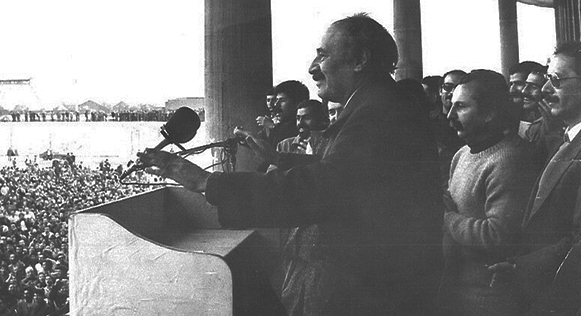
Figure 2. Nur-al-Din Kiānuri addressing a Tudeh rally (date unknown).
Kiānuri’s relations with the Soviet Union was one of unwavering compliance with Moscow’s decisions, even in situations when Moscow’s views contrasted with those of Khomeini. During a meeting with the Italian Communist Party’s (PCI) main representative to the Middle East four days after the Soviet invasion of Afghanistan in December 1979, Kiānuri steadfastly defended the Soviet invasion and condemned PCI’s opposition to the invasion (APCI). He had previously rebuked Western European communist parties for their rapprochement with Maoist China and for failing to comprehend the nature of the Iranian Revolution in their refusal to endorse the Tudeh’s labelling of the US embassy hostages (see HOSTAGE CRISIS) as “spies” (“Perché i comunisti iraniani sostengono la lotta di Khomeini”). After the outbreak of the Iran-Iraq War on 22 September 1980 (see IRAQ vii. IRAN-IRAQ WAR), Kiānuri met with influential Iranian officials, notably the speaker of the Majles (national assembly) Hāšemi Rafsanjāni, to whom he passed on secret military information gathered by officers belonging to the party as well as information regarding the activities of leftist organizations opposed to the Islamic Republic, while complaining of increasing limitations placed on Tudeh activities by the state (Hāšemi Rafsanjāni, pp. 108, 228). These postures resulted in a few concessions from the ruling establishment, the most significant of which was his inclusion in the widely-viewed televised debates on contemporary politics aired on state-controlled television and radio in the spring of 1981 (Figure 3). Kiānuri appeared alongside Mehdi Fatāpur, a leader of the majority faction of the leftist Organization of Iranian People’s Fadāʾi ān (see FADĀʾIĀN-E ḴALQ), which was aligned with the Tudeh in supporting the Islamic Republic. They faced Ayatollah Moḥammad Behešti, the head of the judiciary, and Ḥabib-Allāh Peymān, an Islamist activist. Kiānuri’s strategy of subservience to the Islamic regime continued following the banning of the Tudeh mouthpiece Nāma-ye mardom in June 1981 and the heightened state suppression of left-wing and other political groups deemed undesirable by the state. By the summer of 1982, the Tudeh party’s overt activities were encountering greater restrictions. Kiānuri unsuccessfully proposed the scaling down of the Iran-Iraq conflict, following the recapture by Iran of the city of Khorramshahr on 24 May 1982 and of other territories occupied by the Iraqi army since the start of the war. In the winter of 1983, he maintained the continuation of the war only benefited “world imperialism” and “Israeli Zionism.” He nevertheless continued to support the Islamic Republic as an authentic bulwark of anti-imperialism even in his last press interview shortly prior to his arrest in February 1983 (“L’Iran Quatre Ans Apres”).
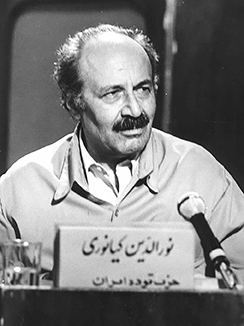
Figure 3. Nur-al-Din Kiānuri in the 1981 televised debate with Ayatollah Moḥammad Behešti, Mehdi Fatāpur, and Ḥabib-Allāh Peymān. Photograph in the public domain.
Kiānuri’s arrest and incarceration (1983-91). Nur-al-Din Kiānuri was among the first wave of Tudeh leaders to be arrested by the security forces of the Islamic Republic on 6 February 1983. On the same day, the party was declared illegal and disbanded. Between May and October of that year, Kiānuri appeared in staged televised programs during which detained Tudeh leaders confessed to alleged spying activities on behalf of the Soviet Union (Abrahamian, 1999, pp. 177-99). His wife Maryam Firuz was arrested together with him but did not appear in the televised forced confessions. Kiānuri admitted to charges that the Tudeh party was a Soviet instrument and had all along engaged in treason against the Iranian nation. His broadcast remarks caused dismay among the party cadres and leaders who were regrouping in exile, resulting in his replacement as first secretary by ʿAli Ḵāvari, with the latter’s leadership formally approved during the eighteenth party plenum, once again held in exile, in December 1983 in Prague, Czechoslovakia (personal recollection of three participants at the plenum communicated to the authors).
Kiānuri was among the few high-ranking members of the Tudeh, along with Moḥammad-Mehdi Partovi, Malaka Moḥammadi, and Moḥammad-ʿAli ʿAmuyi, who were spared execution during the 1988 extra-judicial mass killing of political prisoners by the Islamic Republic. He and other surviving Tudeh and opposition detainees were paraded on the stage at the Vaḥdat [concert] Hall in Tehran on 23 February 1989, where in a televised program he again recanted and claimed the party had sought to infiltrate state institutions with the objective of drawing the Islamic Republic into the orbit of Soviet influence, and that Tudeh had received financial assistance from the Soviet Union in exchange (“Soḵanān-e sarān-e barjasta”). However, during a meeting in 1990 with the UN Special Envoy on Human Rights in Iran, Reynaldo Galindo Pohl, Kiānuri denied all espionage charges and showed Pohl his broken arms and fingers as evidence of torture (“Report on the Human Rights Situation,” p. 32). Reportedly, in a letter addressed to Ayatollah Ali Khamenei (ʿAli Ḵāmenaʾi), who succeeded Khomeini as the supreme leader of the Islamic Republic, Kiānuri provided a detailed account of tortured and executed Tudeh members arrested in 1983, including his personal experience of torture (“Matn-e nāma-ye efšāgarāna-ye ‘Kiānuri’”).
Kiānuri was eventually released from prison in 1991 and placed under house arrest together with his wife Maryam Firuz. They were later allowed limited freedom of movement, including occasional contact with some former party members. In 1992 and 1997 respectively, Ḵāṭerāt-e Nur-al-Din Kiānuri (The Memoirs of Nur-al-Din Kiānuri) and Goftogu bā tāriḵ (Dialogue with history) were published in Tehran by the state-controlled Didgāh Institute (Moʾassesa-ye taḥqiqāti va entešārāti-e Didgāh), billed as an international relations research think tank. It is said Kiānuri repeatedly turned down requests to autograph copies of either book, stating “these memoirs are not mine” (authors’ personal correspondence with former party members), indicating the institute had calculatedly distorted and fabricated many aspects of his life.
Kiānuri left a divided legacy. Nāma-ye mardom, the Berlin-based organ of the remnants of the party in exile after 1983 led by ʿAlī Ḵāvari, only published a brief perfunctory obituary a few days after Kiānuri’s death on 5 November 1999. This obituary hardly reflected on Kiānuri’s party career (“Eʿlāmiya-ye komita-ye markazi”), while the publication of a rival organization of Tudeh members and sympathizers in exile, named Rāh-e Tuda (the Tudeh path), based in Frankfurt and led by the former member of the central committee ʿAli Ḵodāi, extensively commemorated Kiānuri (Rāh-e Tuda). Following the Iranian revolution, Kiānuri was widely criticised and despised by many Iranians belonging to other leftist organizations that opposed the Islamic Republic, on account of the Tudeh party’s vehement denunciation of those other organizations and profuse legitimization of the violent state crackdown on them. Kiānuri continues to provoke heated debates in the Iranian press and in Iranian intellectual circles inside and outside the country. Regardless, it is undeniable that he was a pivotal figure in the evolution of one of the most significant political parties of 20th-century Iran.
Bibliography
Ervand Abrahamian, Iran Between Two Revolutions, Princeton, 1982.
Idem, Tortured Confessions and Public Recantations in Modern Iran, Berkeley, 1999.
Bābak Amirḵosravi, Zendegi-nāma-ye siāsi, Spangå, Sweden, 2020. Bābak Amirḵosravi and Fereydun Āḏarnur eds., Ḵāṭerāt-e siāsi-e Iraj Eskandari, 4 vols, n.p., 1987.
Ṣādeq Anṣāri, Az zendegi-e man pā ba pā-ye ḥezb-e Tuda, Los Angeles, 1996.
[APCI] Archivio del partito comunista italiano, Roma, “Appunto sugli Incontri con Kianuri e Ghassemlu,” N. 0439 2800, 1980.
[BArch] Bundesarchiv, DH 2/21675, “Die komplexe Ökonomie der baulich-räumlichen Umwelt im Rahmen der Gesamtökonomie der Stadt. Ausarbeitung von Dr. Ing. Silvio Macetti,” 14 January 1971.
Idem , DY 30/97100, “Zentralkomitee der Tudeh-Partei des Iran an das Zentralkomitee der Sozialistischen Einheitspartei Deutschlands: Bericht zum 5. Plenum des Zentralkomitees der Tudeh-Partei,” 21 May 1958, fols. 91-92.
Idem, DY 30/3636, “Reza Rusta an den Sekretär des ZK der KpdSU Genossen B. N. Ponomarjow,” 8 February 1962, fols. 11-18.
Idem, MfS (Ministerium für Staatssicherheit), AIM 11177/81, “Beobachtungsbericht,” 7 January 1970, fols. 42-43.
Idem, MfS, AIM 6552/80 II/1, “Treffbericht,” 12 July 1974, fols. 105-108. Idem, MfS, AIM 6552/80 II/1, “Treffbericht,” 23 November 1976, fols. 154-58.
Idem, MfS, AIM 6552/80 II/1, “Treffbericht,” 24 July 1978, fols. 159-61. Idem, MfS, AIM 14683/84 Bd. 2, “Treffbericht,” 8 November 1964, fol. 42.
Idem, MfS, HA II Nr. 27894, “Treffbericht,” 30 July 1971, fols. 127-30.
Idem, MfS, HA II Nr. 28758, “Einige aktuelle Probleme der persischen Emigration in der DDR,” 3 February 1966, fols. 6-9.
Idem, MfS, HA II Nr. 28831, “Übersicht über die in der DDR wohnhaften iranischen Politemigranten,” 2 March 1978, fols. 1-3.
Idem, NY 4182/1292, “Information über die Arbeit des 10/3/ Plenums des ZK der Volkspartei des Iran (Tudeh),” 17 May 1962, fols. 15-21.
[BayHStA] Bayerisches Hauptstaatsarchiv, Ministerium des Innern (MInn) 97538, “Bayerisches Landesamt für Verfassungsschutz an das Bayerische Staatsministerium des Innern, betr.: Iranische Studenten; hier: Aktivität von Funktionären der Tudeh-Partei,” 9 November 1971.
Maziar Behrooz, “The 1953 Coup in Iran and the Legacy of the Tudeh,” in Mark J. Gasiorowski and Malcolm Byrne, eds., Mohammad Mossadeq and the 1953 Coup in Iran, Syracuse, 2004, pp. 102-25.
“BZ-Forum: Zeit für die Frau: Kein Frauenthema,” Berliner Zeitung, 27 February 1970, p. 7.
“Eʿlāmiya-ye komita-ye markazi-e ḥezb-e Tuda-ye Irān: rafiq Nur-al-Din Kiānuri dargoḏašt,” Nāma-ye mardom, 18 Ābān 1378 Š./9 November 1999, p. 3.
Iraj Eskandari, “Dāru-ye ʿeterāf,” Faṣl-i dar gol-e sorḵ (Saarbrücken) 1, 1985, pp. 30-44.
Idem, “Maṭbuʿāt-e ḥezbi-e mā,” Rahbar, 2 October 1946, p. 10.
Šivā Farahmand-Rād, Bā gāmhā-ye fājeʿa: dar ravand-e sarkub-e ḥezb-e Tuda-ye Iran, 2nd ed., Stockholm, 2017.
Bruno Flierl, Selbstbehauptung: Leben in drei Gesellschaften, Berlin, 2015.
Jamil Hasanli, At the Dawn of the Cold War: The Soviet-American Crisis over Iranian Azarbaijan, 1941-1946, Lanham, Md., 2006.
ʿAli-Akbar Hāšemi Rafsanjāni, ʿObur az boḥrān, Tehran, 1999.
[HArch] Hochschularchiv RWTH Aachen, Sig. 1368a, “Diplomhauptprüfungszeugnis Noureddin Kia-Nouri,” 22 November 1938.
Idem, Sig. 1368b, “Promotionszeugnis Noureddin Kia-Nouri,” 2 February 1942.
[Markaz-e barresi-ye asnād-e tāriḵi], Ḥezb-e Tuda-ye Irān dar Ālmān-e Šarqi beh revāyat-e asnād-e Sāvāk, Tehran, 2013. “Intervista al segretario del Pc iraniano,” Il Manifesto, 13 December 1979, p. 2.
“L’Iran quatre ans après,” Révolution (Paris), no. 156, 25 February-3 March 1983, pp. 24-26.
Nur-al-Din Kiānuri, Ḵāṭerāt-e Nur-al-Din Kiānuri, Tehran, 1992.
Idem [Noureddin Kia-Nouri], “Krankenhausbau für Iran,” Ph.D. diss., Technische Hochschule Aachen, 1942.
Idem, Nokāti az tāriḵ-e ḥezb-e Tuda-ye Irān: goft o šonudi ba rafiq Nur-al-Din Kiānuri, 2nd ed., Tehran, 1980.
Silvio Macetti [=Nur-al-Din Kiānuri], Großwohneinheiten, Berlin, 1968.
“Matn-e nāma-ye efšāgarāna-ye ‘Kiānuri’ az zendān-e Evin,” Rāh-e Tuda, Āḏar 1387 Š./November-December 1999, pp.19-24.
“Natāyej-e qaṭʿi-e enteḵābāt-e Tehran eʿlām šod,” Kayhān, 20 Mordād 1358 Š./11 August 1979, p. 3.
“Perché i comunisti iraniani sostengono la lotta di Khomeini,” L
’Unità (Rome), 26 November 1979, p. 5.
Rāh-e Tuda, Viža-nāma ba monāsebat-e dargoḏašt-e Nur-al-Din Kiānuri, Birresborn, 1999. [United Nations Economic and Social Council]
“Report on the Human Rights Situation in the Islamic Republic of Iran by the Special Representative of the Commission on Human Rights,” E/CN.4/1990/24, 12 February 1990 (https://digitallibrary.un.org/record/85464).
Rowšan [=Nur-al-Din Kiānuri], “Čand nokta darbāra-ye eškāl-e hamkāri-ye ḥezb-e Tuda-ye Irān va sāzmānhā-ye jebha-ye melli,”Masāʾel-e ḥezbi 15, 1961, pp. 2-7.
Idem, “Lozum va ahammiyat-e kār dar miān-e dānešjuyān,” Masāʾel-e ḥezbi 13, 1960, pp. 5-10.
Idem, “Monāsebat-e ḥezb-e Tuda-ye Irān va jebha-ye melli dar sālhā-ye 1328-1332,” Masāʾel-e ḥezbi 7, 1959, pp. 14-21.
Hamid Shokat, ed., Negāhi az darūn ba jonbeš-e čap-e Irān: goftogu bā Kuroš Lašāʾi, Tehran, 2002.
Idem, ed., Negāhi az darūn ba jonbeš-e čap-e Irān: goftogu bā Mehdi Ḵānbābā-Tehrāni, Saarbrücken, 1989.
Idem, ed., Negāhi az darūn ba jonbeš-e čap-e Irān: goftogu bā Moḥsen Reżvāni, n.p., 2005.
“Soḵanān-e sarān-e barjasta-ye goruhakhā dar gerdehamāi-e yek ruza-ye bayʿat ba Emām,” Kayhān, 4 Esfand 1367 Š./23 February 1989, p. 18.
Maḥmud Torbati Sanjābi, Panj golula barā-ye šāh, Tehran, 2002.
“Tudeh Party Leader Interviewed by Hungarian Paper,” BBC Summary of World Broadcasts, Part 4. The Middle East and Africa: A. the Middle East, ME/6038/A/9, 9 February 1979.
“Über das größte Hemmnis,” Berliner Zeitung, 12 October 1969, p. 11.
Sepehr Zabih, The Communist Movement in Iran, Berkeley, 1966.
Tobias Zervosen, Architekten in der DDR: Realität und Selbstverständnis einer Profession. Bielefeld, 2016.