



KUCHA, an oasis in the northern Tarim Basin in the Xinjiang Uighur Autonomous Region of China, historically an important kingdom in the trade network between ancient China, Farḡāna (q.v.), India, and the west of the Pamirs. The oasis and its surrounding areas are known for numerous pre-Islamic sites of Buddhist monasteries such as the Kizil and Kumtura Grottoes along the Muzart Darya (Muzat River), as well as the twin-monastery ruins at Subashi along the Kucha Darya.
The name. In Chinese annals, the name of the historical kingdom is given invariably as “龜茲”, Kucha from the Han (206 BCE – 220 CE) to the Song Dynasty (960-1127 CE). It is initially attested in the Hanshu (“Book of Han,” i.e., Ch’ien Han Shu [q.v.]) on the Han occupation of Dayuan (i.e. “Ta-Yüan,” quite possibly Farḡāna) in 104-101 BCE. According to the earliest commentaries (ca. the late 2nd century CE) on the Hanshu, the two characters are to be pronounced specifically the same as 丘慈 (Pinyin: Qiuci; Old Chinese *kʽǐwə-dzǐə following Guo) rather than the ordinary one (Pinyin: Guizi; Old Chinese *kǐwə-tsǐə) when the kingdom is designated. A late 4th-century transcription, 屈茨 Quci (EMC *khut-dzi following Pulleyblank), collected by Li Daoyuan (d. 527 CE) is close to the specific pronunciation. The forms attested in other pre-Islamic languages include Niya-Gāndhārī kuciya (adj.); Sanskrit kuci- (n.); Kuchean kuśiññe (adj.); Sogdian ’kwc’ (n., only one single attestation, see Sundermann, p. 735), ’kwc’n’y, kwc’ny, ’kwcyk (adj.); Old Turkic küsän. Among them, the Kuchean language—more widely called “Tocharian B” among linguists (see TOCHARIAN LANGUAGE)—was proved by Sylvain Lévi (1863-1935) to be the native and official language of the kingdom around the 7th century. The name underlying the adjective kuśiññe ‘Kuchean’ may be *Kuśi or *Kuśi ‘Kucha’ (Pinault, 1989, pp. 20-21; 2002b). This form, being similar to the name of Kuśinagara, the place where the historical Śākyamuni Buddha passed away, might have provided the locals with room for imagination when they constructed their history in an Indianized way by some sort of “géographie fantaisiste” (Pelliot, 1923, p. 130). Nevertheless, no native historiographical text is known to scholars among the finds in situ, even though it is widely accepted that the Kuchean language had been already written down before the 5th century (Peyrot, pp. 205-6; Sander, p. 135 Tab. 1). In the 11th-century Turkish lexicon of Maḥmud Kāšḡari, the oasis is called alternatively Küsän and Kuča, being “a frontier of Uighur” (tr. Dankoff and Kelly, I, pp. 339, 404). The Mandarin form 庫車 Kuche was established in 1758 (Mod. Uighur kučār).
Geography and historical environment. Today, the capital town of Kuche county (lat. 41° 43ʹ N., long. 82° 58ʹ E.) is situated at the historical center along the Kucha Darya. But before the Tang Conquest by January 649, the kingdom controlled a vast territory along the Kucha Darya, the Muzart Darya, and the section of the Tarim River to their south. In other words, its realm stretched from today’s Luntai (Mod. Uighur, bügür) county to the eastern periphery of Aksu (q.v.), spreading over Kuche, Xinhe (Mod. Uighur, toqsu), Shaya (Mod. Uighur, šāyār/shayar), and Baicheng (Mod. Uighur, bai). Historically this vast territory is usually to be treated as a whole (hereafter “the region”), but it is noteworthy that in the Chinese annals, several oases to its west from Aksu to east of Kashgar (q.v.) were usually described as petty kingdoms unified within it.
The region is along the southern periphery of the Tien Shan Mountains, so that many areas are generally sunny (i.e., south-facing) and relatively rich in water sources and therefore suitable for human habitation. In the Hanshu, the kingdom is far more populated than any other around the Tarim basin (number of residents/good soldiers: 81,317/21,076, cf. the data of Khotan [19,300/2,400], Yarkand [16,373/3,049], Kashgar [18,647/2,000] and Shanshan/Loulan [14,100/2,912] in the same book). The range of the Chöl-Tagh between the Tien Shan and Tarim basin was a good barrier to the nomads in the north, and the mountainous buffer zone between the Chöl-Tagh and the Tien Shan has deposits of resources such as copper, manganese, coal, and gypsum. The zone had been inhabited since the Bronze Age (q.v.), and then the extraction of the minerals made Kucha one of the main trade centers on the Silk Road. It is stated in the Suishu (Book of Sui, for the Sui Dynasty [581-618 CE]) that the kingdom produces “copper/bronze, iron, lead, deerskin, wool carpets, sal ammoniac, ‘salty green’ (copper chloride and/or more foreign pigments, e.g., malachite), orpiment, the hu powder (very likely white lead), benzoin, fine horses, and humped cattle.” While some items such as benzoin might be commodities on its market rather than local specialities, and the iron might be extracted more remotely from the Tien Shan by mountain peoples including some ancestral tribes of the Turks, the passage in the Suishu roughly corresponds with a passage about Kucha collected by Li Daoyuan (d. 527 CE): “There is a mountain at the distance of 200 li (ca. 90-100 km) north to [the capital of] Kucha, where flames shine at night and smoke hovers over during the day. People take the charcoal (or coal) [produced] in this mountain and smelt the iron [extracted] from the very mountain. Their products regularly supply all the states in the Western Regions (lit. ‘the thirty-six states’).” When the Chinese monk Xuanzang (602-64) arrived there in 629, he described its local products as “gold, silver, copper/bronze, lead, and tin.” The rich copper deposits further made the region become an important mintage center in Chinese Turkestan (q.v.).
Agriculture. Irrigation was developed locally before Islamization, although its scale is unknown before the colonization of the Han troops near Kucha around 68 BCE. As one can observe from a Kuchean wooden tablet, TC-495-1 kept in Tokyo, first deciphered by Georges-Jean Pinault in 1996, the Kuchean words ārte ‘river branch (?)’ and newiya ‘canal (?)’ seem to be Iranian loanwords (cf. Bactrian αρλ
ο ‘side, bank (of a ditch)’, νωιο ‘channel’), so the hydraulic engineering of the Iranian world presumably spread to pre-Tang Kucha, too. However, further research is required to establish precisely when these words were adopted and from which specific Iranian language. At any rate, Xuanzang observed local production of wine grape and pomegranate, in addition to planting of pear, apple, peach, and apricot trees as well as cultivation of foxtail millet, wheat/barley, and rice. It seems that after the Tang Dynasty established the Anxi protectorate in Kucha in 658 (restored in 692 after brutal attacks launched by the Western Turks and the Tibetans), cultivation of naked barley became important due to the demands of military and postal horses in addition to four staple crops (wheat, common barley, foxtail millet, and proso millet [Panicum miliaceum]), whereas cotton was planted in farming fields of local Buddhist monasteries (Ching, 2016). After the construction of modern reservoirs and water power plants, the landscape has largely been changed, but the region is still famous for delicious apricots, quinces, and apples.
Early history. According to the Hanshu, around 101 BCE, the king of Kucha received hostages, such as the crown prince of Wumi (today’s Dandān Öilïq [q.v.], cf. Nagasawa) called Laidan, who was then captured by Li Guangli on his way back to Chang’an via Kucha after his attack on Dayuan. Laidan, after being sent back to the Tarim basin in order to found a Han colony to the east of Kucha, was murdered by the latter’s king, whose name was not recorded. The king sent a diplomatic document expressing his apology to the Wu emperor of Han, but in the eyes of Chinese officers, Kucha did not pay the price for this misbehavior for more than thirty years until the reign of Jiangbin, the successor of the above mentioned anonymous king. Having been forced to execute the responsible counselor, Jiangbin coercively married the eldest daughter of the princess Jieyou (a niece of the Wu Emperor) and the Wusun Yabgu Wengguimi by retaining her when she was passing through Kucha after a visit to Chang’an (on Yabgu, see JABḠUYA). In this way, Jiangbin made the Xuan Emperor recognize him as a brother(-in-law) around 65 BCE and thus became the representative of the Han in the whole Tarim basin. Afterwards, the royal house supported the Han Protectorate (settled on the kingdom’s eastern frontier) until the fall of the Western Han and the rise of Yarkand (q.v.) in the early 1st century CE.
In the Western Han period, Kucha was an international society, where four translators-in-chief (yizhang譯長) were part of the local government. Afterwards, it is described in the Houhanshu (Book of the Later Han) that in the winter of 46 CE, Kucha was destroyed by Xian, who assumed the throne of Yarkand in 33 CE. The Xiongnu (q.v.) helped the locals to chase the governors from Yarkand and elect a noble of Kucha called 身毒 Shendu, hence Kucha allied with the Xiongnu against the Eastern Han. Since Shendu is a typical Chinese transcription for “Hindu/Sindhu” (Lévi, p. 377), the new king may have cultural or kinship ties with the Indo-Kushans. In 73 CE, Ban Chao reached Shanshan in order to restore the Han supremacy in the Tarim basin, and his biography in the Houhanshu shows that Kucha had a central position among the Xiongnu, the Han, and the Kushans. In 84-86 CE, the king of Kucha, Youliduo, established the alliance of his realm (including three petty states to the west of Kucha), Yarkand and Kashgar, with exception of a few fortifications near Kashgar occupied by Ban. The alliance was supported by Sogdiana (q.v.; 康居Kangju) and presumably also the Xiongnu, while Ban directed Shanshan and Khotan (q.v.). In 90 CE, the Kushan (q.v.) troops broke the standoff. Forecasting their strategy of buying provisions in Kucha, Ban defeated the Kushans; then, Youliduo surrendered to Ban promptly in the next year. From these detailed episodes in the history of Kucha in written sources, one may contemplate close commercial and diplomatic ties between Kucha and the Kushan Empire.
By substituting the rule of Youliduo with a pro-Han aristocrat, Bai Ba, Ban Chao settled the headquarters of the Protectorate in the region of Kucha. But Bai Ba’s rule was only stable in 91-106 CE. After the dismissal of Ban Chao’s son in 127, there was almost no news about the oasis until the fall of the Eastern Han in 220 CE. In other words, it is difficult to reconstruct the history of Kucha when both of its most powerful neighbors, namely the Han and the Kushans, were confronted with troubles. Consequently, it is far from safe to tell whether the Kuchean language (or its preceding phase) had become the most popularly spoken one in the local society by then.
Early Medieval history. Except for some tribute payments to Chinese courts and an attack by a ruler of Liangzhou (Gansu, China), Kucha virtually disappeared in the written histories until the 4th century. A conflict in the late 3rd century between the royal houses of Karashahr (Yanqi) and Kucha is found in the Jinshu (Book of Jin, for the Jin Dynasty [265-420 CE]). A Chinese preface to a Buddhist translation written in 379 (Lévi, pp. 338-39) depicts the flourishing Buddhism in the region; then, in 381 or 382, the rulers of Turfan and Shanshan invited Fu Jian (r. 357-85, a newly rising ruler in northern China) to conquer the region. The fall of Kucha caused the capture of Kumārajīva, who translated numerous Buddhists texts into Chinese for the rest of his life. It is remarkable that the Jinshu describes the men and women in Kucha as all clipping their hair at the nape. Such a hairstyle has usually been taken as a trait of Iranian culture (Harada, pp. 62-65).
When Fu’s troops entered Kucha in 384, they found huge grape wine cellars in some citizens’ residences. Perhaps some were owned by merchants, and a fondness for wine may have taken root there in an earlier period. Nevertheless, given that the meaning of Sogdian mwδy (AL4.R5, see ANCIENT LETTERS) has been corrected from “wine” to “price” as an Indian loanword (Skt. mūlya-, Gāndhārī [q.v.] muli, see Sims-Williams, 2017, p. 174), a prevailing opinion (Schwartz, p. 407; Tremblay, p. 438) to take the Kuchean word mot ‘alcoholic beverage’ as a Sogdian loanword needs to be re-examined. For the time being, it is hard to tell whether Bactrian μολο (< *madu-), Sogdian mδw /maδu/, or yet another Iranian language should be taken as its source language (Sims-Williams, personal communication, 21 March 2018).
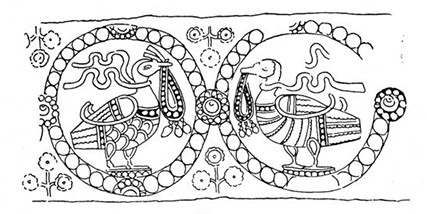
Figure 1. An Iranian motif found inside today’s Cave No. 60 of the Kizil Grottoes, traced and published by A. Grünwedel in 1912.
The splendor of the Buddhist sites reveals the prosperity of Kucha in the 5th-6th centuries. Written texts provide no details on the progress of expansion by newly rising nomads into this region, including the Rouran, the Gaoju, and the Hephthalites (q.v.), while the Sanskrit manuscripts found at Kizil only named four pre-7th-century Kuchean rulers, as deciphered by Heinrich Lüders (1869-1943) in 1922-30. The Kuchean and Sanskrit graffiti now surviving in situ provide two names in addition, but the corpus is far from sufficient to reconstruct a satisfactory chronology before 600 (Ching, 2017). A dramatic event is the rise of the Yueban in the early 5th century just to the north of Kucha. According to the Beishi (History of the Northern Dynasties), the Yueban was a nomadic group who imitated the (Iranian) hu peoples in clipping their hair and shaping their eyebrows; this nomadic group invited the Northern Wei to cooperate in attacking the Rouran in 448. As a result, the Northern Wei invaded Karashahr and Kucha in 448-49 and obtained immense amount of treasure from both oasis states. In the early 6th century, Kucha sent envoys to the Liang court in southern China. The one that arrived in 521 is called Kang Shiyiqiubona 康石憶丘波郍, presumably a person with genealogical or social ties with people in Samarqand. Pre-Tang images of Sogdian merchants (q.v.) are further found at the Kizil Grottoes (Rong; Kageyama). Interesting features are stated in the Suishu that the king of Kucha “ties his forehead with a colored ribbon and lets it hang down on his back” and “sits on a golden lion bench.” Obviously his attire and throne are not very Chinese and are thus to be compared with Iranian and Central Asian ones, not to mention the eye-catching “Indo-Iranian styles” defined by Albert Grünwedel (q.v.) in the local Buddhist Art (Figure 1). Moreover, the local taxation system described in the Zhoushu (Book of Zhou, for the Northern Zhou Dynasty [557-81 CE]) consisted of the tax on the land properties and the collection of silver coins from the non-farmers. The coins possibly mean Sasanian ones or their imitations, since a coin in the style of the time of Ḵosrow II (q.v.; 590-628) was unearthed at Subashi (Huang, p. 110), while the drachma (see DIRHAM) as unit of weight is attested in Kuchean texts (see TOCHARIAN LANGUAGE). The usage of the drachma as currency is found in Kha 5, a wooden Kucha-Kharoshti contract kept in Berlin (Ching, 2014).
In China, Kucha was famous for beautiful music from the 6th century onwards. After the rise of the Western Turks around the Tien Shan just to the northeast of Kucha, the royal house gradually became subordinated to them. A part of Kuchean aristocracy in the early 7th century was pro-Turkish, and the kings in this period were conferred with the Turkish title of Iltäbär. Under Tang rule, Kucha was still a major intersection on the Silk Road where Sogdian merchants operated (Arakawa; see also Sims-Williams and Bi; SOGDIAN TRADE).
According to Etsuko Kageyama, a few ossuaries (see ASTŌDĀN) excavated near the modern town of Kuche imply the existence of a Sogdian Zoroastrian community in the 7th-8th centuries. On the other hand, Kuchean and Chinese documents written locally around the 8th century mentioned a dozen inhabitants whose names contain obvious Sogdian elements. Some of them joined in the operational activities of local Buddhist monasteries, and some of them even undertook taxation affairs. Very probably, they played a key role in maintaining the Tang administration in the region (Ching, 2013a; 2018).
Tang rule continued until, in the 790s, the Anxi Protectorate was lost due to the conflicts with the Old Uighurs, the Old Tibetans, and the Qarluqs. Based on Yutaka Yoshida’s analysis of the Karabalgasun Inscription (q.v.), the Old Uighurs probably once defeated their enemies in Kucha (Sogd. k(ws’)n, cf. Yoshida, 2009, p. 350 n. 5) in 798. Afterwards, the region seems to have fallen into turmoil again, and scholars do not know much about its later history until 1758. The Middle Persian Manichean text Mahrnāmag found in Turfan (M1) mentioned Manicheans (q.v.) around Kucha by the early 9th century, where many believers’ names seem to be Turco-Sogdian ones, but the local ruler still bears a Chinese title ’kwcyk syrṭwšyy (< Chin. jiedushi節度使 ‘military governor’, see Sims-Williams and Durkin-Meisterernst, 2012, pp. 180-81). However, the existence of a Manichaean community in pre-Tang Kucha is far from evident from the archaeological sources, and the relevant historical issues demand future researches.
Kucha in the second millennium. Some mural paintings at the Kumtura Grottoes and other sites that can be compared with the ones in Turfan made in the 10th and 11th centuries imply a revival of Buddhist Art in Kucha before Islamization. If we adopt the view of Liangtao Wei that the “Uighur” in Maḥmud al-Kāšḡari’s Compendium, as opposed to the Qara-Khanids (see ILAK-KHANIDS), generally designates the West Uighur Kingdom (840-1209) founded in Turfan for most of its attestations, then the center of Kucha was still in the non-Islamic world in the 11th century. The last tribute paid from Kucha to the Chinese court before the rise of Genghis Khan (ČENGĪZ KHAN; r. 1206-27) was a “Buddha [statuette] made of jade” in 1096 (Lévi, p. 374), but Chinese officials failed to describe clearly the relation between the “Qiuci-Uighurs” (Qiuci huihu) and the West Uighur Kingdom. According to a wooden Chinese epigraph hung on a Muslim shrine tomb of the style of the Mazar near the town of Kuche, compiled in 1883, Islam was introduced there during the reign of the Li Emperor of Song (r. 1224-64) (Huang, p. 31), that is to say between the ones of Genghis Khan and Qubilai Khan (r. 1260-94). Since 1758, the local population has been mostly a Uighur one, with minorities of Mongolian, Manchurian, Chinese Han, and other groups. In 1890, the discovery of a 5th-century medical manuscript, the “Bower Manuscript,” in Kucha stimulated several archaeological expeditions to Chinese Turkestan.
Texts found in the region of Kucha. The “Bower manuscript,” written on birch bark and being the first Brāhmī (q.v.) manuscript known to the West, was deciphered by A.F.R. Hoernle (q.v.; 1841-1918) as a collection of Sanskrit texts. Nevertheless, the oldest text discovered in situ is a Chinese epigraph inscribed at the foot of the Tien Shan in 158 CE, probably resulting from a fortification project of Kucha against the nomads to its north. Thousands of Sanskrit and Kuchean fragments written in Brāhmī were collected in the region by foreign expeditions. Their genres are mostly Buddhist, generally in accord with Xuanzang’s observation that the Hīnayāna (i.e., the “Small Vehicle”) Buddhism represented by the (Mūla)-Sarvāstivādin School was popular there. Among the Kuchean fragments, most secular documents were made around the 8th century, except for the wooden laissez-passers (Pinault, 1987) and some other tablets that are to be dated before 649 CE. As to the Buddhist literature, parallelism between a few Kuchean and Tumshuqese texts have been detected (cf. Schmidt, 1988; Maue, 2007; 2015; Ogihara, 2013), and the Kuchean version of the Vessantara Jātaka seems to be closer to the Sogdian version than other known ones (Ogihara, 2018, pp. 10-22). It is noteworthy that, while most of the Sogdian Buddhist texts found at Dunhuang (q.v.) and in the Turfan region are translated from Chinese, at least one fragment, i.e., So 10100i (= Nr. 464 in Reck, 2016), was very likely translated from Kuchean by a Sogdian Buddhist living in Kucha (Henning, pp. 59-62); see also Yoshida’s reflections on several Sogdian fragments from Turfan and their possible prototypes: Among them, the “Miracle sūtra” (Prātihārya-sūtra) fragments may be compared with some mural paintings at the Kizil grottoes (Yoshida, 2019). On the other hand, before the ancestor of the Kuchean speakers sedentarized in Kucha, some Iranian words had been borrowed into their language (Pinault, 2002a, p. 245; TOCHARIAN LANGUAGE). The productive diminutive suffix –śke in Kuchean (cf. Bactr. –(η)ϸκο, Khot. –śka/–śkā) seems to be a good example of their long-term interactions with Iranian peoples: These forms may be traced back to an otherwise unattested Old Iranian language (Sims-Williams, 2002, pp. 236-40), and probably Khotanese (q.v.) borrowed the Kuchean suffix and not the other way around (Pinault, 2015, p. 176). Recently, the discovery of some Bactrian words in Early Medieval Bactrian documents such as the adjective σπαχνιιο ‘subject to service’ (cf. Kuchean/Agnean, spaktāṃ ‘service’) generally confirmed the postulation of scholars that the Kushan civilization once penetrated into the oasis, and cultural influence from Tokharistan was sustained even in the post-Kushan period.
Over thirty wooden fragments found around Kucha are written in a local variant of Kharoshti, which is defined by Klaus T. Schmidt (2001) as “Kučā-Kharoṣṭhī.” These pieces, written in a local variant of Prakrit, are generally official and civil documents, where a newly deciphered Iranian loanword divi ‘± document’ (cf. Bactr. λιβο ‘document, copy, text’ < *dipi-, OPers. dipi/ī- ‘writing, inscription’, see Sims-Williams, 2002, p. 227) is commonly attested (Ching, 2014). The development of Kucha-Kharoshti is under analysis, but its function as an official script in Kucha probably continued to the 6th century (Ching, 2013b). A slightly different type found on several paper fragments, i.e., “Kučā-Kharoṣṭhī Typ A” so classified by Schmidt, is not fully deciphered yet.
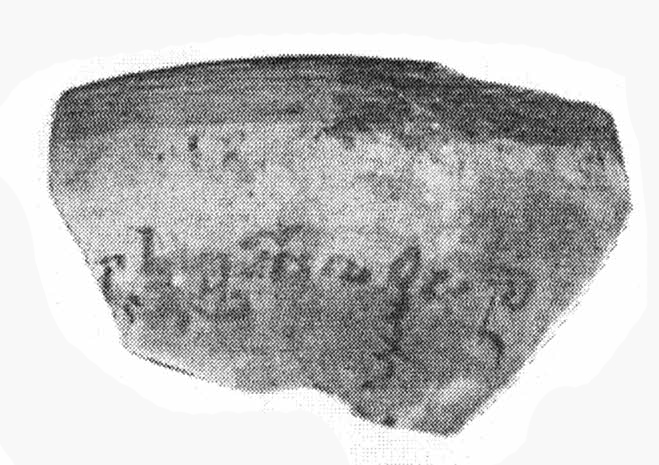
Figure 2. The potsherd with Sogdian and Kuchean ink inscriptions unearthed by W. Huang in 1958.
A small amount of pre-Islamic Iranian texts from the region are known, including: (1) Several Sogdian fragments in the series of “Pelliot sogdien” and “Pelliot chinois”; most of them are tentatively dated to the 8th century by Yutaka Yoshida (apud Kageyama, p. 363, n.4). A fragmentary Buddhist text (Nr. 801 in Reck, 2016) is kept in Berlin. In addition, a potsherd with a Kuchean inscription (Figure 2) about a donation was excavated by W. Huang, on which a word written in the Sogdian script is read by Yoshida as wxš(.)[], perhaps a donor’s name beginning with wxš ‘the Oxus’ (apud Ogihara, 2014, p. 274). (2) A few Tumshuqese pieces (cf. Maue, 2009; Ogihara, 2015). (3) Residue of heavily damaged Bactrian texts, including “Pelliot bactrien 1” (cf. Pinault, 2007, p. 188) and a photographic negative kept by the Musée Guimet. The writing in the negative is reversed and therefore must be transferred onto a wall or floor surface from a manuscript. It is similar to some reversed Brāhmī texts that were described as “décalques” (i.e., like usage of a decal) in Paul Pelliot’s (q.v.; 1878-1945) diary on 14 June 1907 at Subashi (Sims-Williams, personal communication 26 June and 3 July 2018). (4) Khotanese fragments P. 1068 (Bailey, p. 315) and Or. 12637/51, and perhaps also Or. 12637/41. For the latter two, see Skjærvø, p. 136 and p. 139, respectively. As to the graffiti surviving in situ, there are at least a Tumshuqese one at Subashi (= G-Su 41 in Pinault, 1987) initially identified by Maue (2009) and a few Sogdian others at Kizil and Kumtura read by Yoshida (1991). The language of a group of paper fragments written in the Sogdian script recently edited by Reck (2017), i.e. Cat. Nr. A1113-1120, is so far unidentifiable. They may have been found at either the Tuyoq Grottoes near Turfan or the Kizil Grottoes near Kucha.
Bibliography
Sources.
Harold W. Bailey, Khotanese Texts V, Cambridge, U.K., 1963.
Xiliang Guo, Hanzi guyin shouce (Handbook of ancient pronunciation of Chinese characters), Beijing, 2010.
Wenbi Huang, Talimu pendi kaoguji (Archaeological reports on the Tarim basin), Beijing, 1958.
Maḥmud Kāšḡari, Diw ān loḡat al-Tork, ed. and tr. Robert Dankoff and J. Kelly as Compendium of the Turkic Dialects (Dīwān Luγāt al-Turk), 3 vols., Duxbury, Mass., 1982-85.
Melanie Malzahn, ed., Instrumenta Tocharica, Heidelberg, 2007.
Dieter Maue, “Tumshuqese Manuscripts. A Provisional Handlist,” http://titus.fkidg1.uni-frankfurt.de/texte/iranica/tumshuq/handlist.pdf (last updated 2009).
Georges-Jean Pinault, “Épigraphie koutchéenne, I. Laissez-passer de caravanes, II. Graffites et inscriptions,” in Huashan Chao, Simone Gaulier, Monique Maillard and G.-J. Pinault, eds., Mission Paul Pelliot—Documents archéologiques VIII: Sites divers de la région de Koutcha, Paris, 1987, pp. 59-196, plates 40-96.
Idem, “Concordance des manuscrits tokhariens du fonds Pelliot,” in M. Malzahn, ed., Instrumenta Tocharica, Heidelberg, 2007, pp. 163-219.
Edwin G. Pulleyblank, Lexicon of Reconstructed Pronunciation in Early Middle Chinese, Late Middle Chinese and Early Mandarin, Vancouver, B.C., 1991.
Christiane Reck, Mitteliranische Handschriften Teil 2: Berliner Turfanfragmente buddhistischen Inhalts in soghdischer Schrift, Stuttgart, 2016.
Idem, Mitteliranische Handschriften Teil 3: Berliner Turfanfragmente christlichen Inhalts und Varia in soghdischer Schrift, Stuttgart, 2017.
Nicholas Sims-Williams and Desmond Durkin-Meisterernst, eds., Dictionary of Manichaean Sogdian and Bactrian, Turnhout, 2012.
Prods Oktor Skjærvø, Khotanese Manuscripts from Chinese Turkestan in the British Library: A Complete Catalogue with Texts and Translations, London, 2002, repr. 2003.
Éric Trombert, Les manuscrits chinois de Koutcha: Fonds Pelliot de la Bibliothèque nationale de France, Paris, 2000.
Studies.
Masaharu Arakawa, “Sogdian Merchants and Chinese Han Merchants during the Tang Dynasty,” in Étienne de la Vaissière and Éric Trombert, eds., Les sogdiens en Chine, Paris, 2005, pp. 231-42.
Huaiyu Chen and Xinjiang Rong, eds., Great Journeys across the Pamir Mountains: A Festschrift in Honor of Zhang Guangda on His Eighty-fifth Birthday, Leiden, 2018.
Chao-jung Ching, “The Activities of Sogdian Buddhists in Kucha as Observed in the Tocharian B Secular Documents,” in Matteo De Chiara et al., eds., Buddhism Among the Iranian Peoples of Central Asia, Vienna, 2013a, pp. 333-83.
Idem, “Reanalyzing the Kuchean-Prākrit Tablets THT4059, THT4062 and SI P/141,” Tocharian and Indo-European Studies 14, 2013b, pp. 55-94.
Idem, “Kezi’er chutu decang quluwen Qiuciwang zhaoyu yu qiyue wenshu yanjiu (On the decree of Kuchean King and two pieces of contracts written in Kharoṣṭhī among the findings from the Kizil Grottoes and kept in Berlin),” Xiyu Wenshi (Literature and history of the western regions) 9, 2014, pp. 51-73.
Idem, “On the Names of Cereals in Tocharian B,” Tocharian and Indo-European Studies 17, 2016, pp. 29-64.
Idem, Tuhuoluoyu shisu wenxian yu gudai Qiuci lishi (Tocharian secular texts and history of ancient Kucha), Beijing, 2017.
Idem, “On the Word ṣau Found in the Kuchean Secular documents,” in Huaiyu Chen and Xinjiang Rong, eds., Great Journeys across the Pamir Mountains: A Festschrift in Honor of Zhang Guangda on His Eighty-fifth Birthday, Leiden, 2018, pp. 1-19.
Matteo De Chiara, Mauro Maggi, and Giuliana Martini, eds., Buddhism Among the Iranian Peoples of Central Asia, Vienna, 2013.
Desmond Durkin-Meisterernst, “Manichaeism and Tocharian,” in Malzahn et al., eds., Tocharian T exts in C ontext: International C onference on Tocharian M anuscripts and Silk Road C ulture , June 25-29th, 2013, Bremen, 2015, pp. 57-71.
Yoshito Harada, “Saiiki hakken no kaiga ni mietaru fukushoku no kenkyū” (Research on the dresses and ornaments seen in the paintings from the western regions), Tōyō Bunko ronsō, Series A, Monograph No. 4., Tokyo, 1925.
Walter B. Henning, Sogdica, London, 1940.
Etsuko Kageyama, “Sogdians in Kucha: A Study from Archaeological and Iconographical Material,” in Étienne de la Vaissière and Éric Trombert, eds., Les Sogdiens en Chine, Paris, 2005, pp. 363-75.
Étienne de la Vaissière, “Note sur la chronologie de voyage de Xuanzang,” JA 298/1, 2010, pp. 157-68.
Étienne de la Vaissière and Éric Trombert, eds., Les Sogdiens en Chine, Paris, 2005.
Sylvain Lévi, “Le «Tokharien B», langue de Koutcha,” JA, 11e série, 2, 1913, pp. 311-80.
Melanie Malzahn, Michaël Peyrot, Hannes Fellner, and Theresa-Susanna Illés, eds., Tocharian T exts in C ontext: International C onference on Tocharian M anuscripts and Silk Road C ulture , June 25-29th, 2013, Bremen, 2015.
Dieter Maue, “Tumschukische Miszellen I: Beobachtungen zur Metrik,” in Maria Macuch, Mauro Maggi, and Werner Sundermann, eds., Iranian Languages and Texts from Iran and Turan: Ronald E. Emmerick Memorial Volume, Wiesbaden, 2007, pp. 225-38.
Idem, “Tumschukische Miszellen III,” in M. Malzahn et al., eds., Tocharian T exts in C ontext…, Bremen 2015, pp. 117-26.
Kazutoshi Nagasawa, “Kodai Saiiki nandō kō” (On the ancient southern route in Hsiyu), in Masao Mori, ed., Nairiku Ajia Nishi Ajia no shakai to bunka (Society and culture of Inner Asia and the Muslim world), Tokyo, 1983, pp. 57-77.
Hirotoshi Ogihara, “On the Karmavācanā in Tocharian,” in M. de Chiara et al., eds., Buddhism Among the Iranian Peoples of Central Asia, Vienna, 2013, pp. 311-31.
Idem, “Talimu pendi kaoguji Xinjiang kaogu fajue baogao suokan Tuhuoluoyu ziliao” (Tocharian materials published in Talimu Pendi Kaoguji and Xinjiang Kaogu Fajue Baogao),” in Xinjiang Rong and Yuqi Zhu, eds., Xiyu kaogu shidi yuyan yanjiu xin shiye (New perspectives on archaeology, history, geography and language of the western regions), Beijing, 2014, pp. 267-75.
Idem, “Kuchean Secular Documents in the Pelliot Koutchéen Nouvelle Série,” Tocharian and Indo-European Studies 16, 2015, pp. 81-105.
Idem, “Roshiya shōzō Tokaragō bunken ni kansuru oboegaki” (Remarks on the Tocharian manuscript remains housed in the Russian collection), Tokyo University Linguistic Papers (e-Journal format) 40, 2018, pp. e1-e41., available at https://repository.dl.itc.u-tokyo.ac.jp/?action=pages_view_main&active_action=repository_view_main_item_detail&item_id=51194&item_no=1&page_id=28&block_id=31
Paul Pelliot, “Notes sur les anciens noms de Kučā, d’Aqsu et d’Uč-Turfan,” T’oung Pao 22/2, 1923, pp. 126-32.
Idem, “Notes sur Kumārajīva,” in Antonino Forte and Federico Masini, eds., A Life Journey to the East: Sinological Studies in Memory of Giuliano Bertuccioli (1923-2001), Kyoto, 2002, pp.1-19 (review article by Paul Pelliot published posthumously).
Michaël Peyrot, Variation and Change in Tocharian B, Amsterdam, 2008.
Georges-Jean Pinault, “Introduction au tokharien,” Lalies 7, 1989, pp. 3-224.
Idem, “Tocharian and Indo-Iranian: Relations between Two Linguistic Areas,” in Nicholas Sims-Williams, ed., Indo-Iranian Languages and Peoples, Oxford, 2002a, pp. 243-84.
Idem, “Toch. B kucaññe, A kuciṃ et skr. tokharica,” IIJ 45, 2002, pp. 310-45. (= Pinault 2002b)
Idem, “The Formation of Buddhist Languages, as Exemplified by the Tocharian Evidence,” in M. Malzahn et al., eds., Tocharian Texts in Context…, Bremen 2015, pp. 159-85.
Xinjiang Rong, “Sabao or Sabo: Sogdian Caravan Leaders in the Wall-painting in Buddhist Caves,” in Étienne de la Vaissière and Éric Trombert, eds., Les Sogdiens en Chine, Paris, 2005, pp. 207-30.
Lore Sander, “Remarks on the Formal Brāhmī Script from the Southern Silk Route,” Bulletin of the Asia Institute 19, 2005[2009], pp. 133-44.
Klaus T. Schmidt, “Ein Beitrag des Tocharischen zur Entzifferung des Tumšuqsakischen,” AoF 15, 1988, pp. 306-14.
Idem, “Entzifferung verschollener Schriften und Sprachen dargestellt am Beispiel der Kučā-Kharoṣṭhī Typ B und des Kučā-Prākrits,” Göttinger Beiträge zur Asienforschung 1, 2001, pp. 7-27.
Martin Schwartz, “Irano-Tocharica,” in Philippe Gignoux and Ahmad Taffazzoli, eds., Mémorial Jean de Menasce, Louvain, 1974, pp. 399-411.
Nicholas Sims-Williams, ed., Indo-Iranian Languages and Peoples, Oxford, 2002.
Idem, “Ancient Afghanistan and Its Invaders: Linguistic Evidence from the Bactrian Documents and Inscriptions,” in Nicholas Sims-Williams, ed., Indo-Iranian Languages and Peoples, Oxford, 2002, pp. 225-42.
Idem, “The Sogdian Ancient Letter No. 4 and the Personal Name Manavaghichk,” in Alberto Cantera and Juanjo Ferrer-Lossila, eds., Estudios Iranios y Turanios: Homenaje a Helmut Humbach en su 95º aniversario, Girona, 2017, pp. 171-79.
N. Sims-Williams and Bo Bi, “A Sogdian Fragment from Niya,” in Huaiyu Chen and Xinjiang Rong, eds., Great Journeys across the Pamir Mountains…, Leiden, 2018, pp. 83-104.
Werner Sundermann, “Three Fragments of Sogdian Letters and Documents,” in idem, Manichaica Iranica: ausgewählte Schriften, Rome, 2001, pp. 725-38.
Xavier Tremblay, “Irano-Tocharica et Tocharo-Iranica,” BSOAS 68, 2005, pp. 421-49.
Liangtao Wei, Kalahan wangchao shi gao (A draft of the history of the Qara-Khanid dynasty), Urumchi, 1986.
Yutaka Yoshida, “Shinkyō Uiguru Jichiku shinshutsu Sogudogo shiryō 1990 nen chōsa ryokō hōkoku (Reports on the Sogdian texts newly discovered in Xinjiang),” Studies on the Inner Asian Languages 6, 1991, pp. 57-83.
Idem, “The Karabalgasun Inscription and the Khotanese Documents,” in Desmond Durkin-Meisterernst, Christiane Reck and Dieter Weber, eds., Literarische Stoffe und ihre Gestaltung in mitteliranischer Zeit: Kolloquium anlässlich des 70. Geburtstages von Werner Sundermann, Wiesbaden, 2009, pp. 349-62.
Idem, “On the Sogdian Prātihārya-sūtra and the Related Problems — One Aspect of the Buddhist Sogdian Texts from Turfan,” AOASH 72/2, 2019, pp. 141-63.
P. Zhang, Qiuci wenming – Qiuci shidi kaogu yanjiu (Kucha civilization: Archaeological studies on the history and geography of Kucha), Beijing, 2010.