
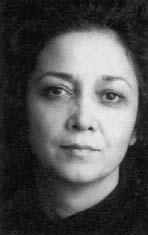



ṬUBĀ VA MAʿNĀ-YE ŠAB (1987, tr. Kamran Talattof and Havva Houshmand as Touba and the Meaning of Night, New York), a highly acclaimed novel by Shahrnush Parsipur (Šahrnuš Pārsipur, b. Tehran, 28 Bahman 1324 Š./17 February 1946), fiction writer and essayist (COMMUNISM i, ii), and the unfortunate courses that their lives take, all correspond to the different phases of the period’s turbulent history.
In less than a decade after the COUP D’ETAT OF 1332 Š./1953, the country’s seemingly modern and stable outlook is shattered by the waves of the religiously charged social unrests that culminate with the Islamic Revolution. Shattered too are the walls of Touba’s house with the arrival of another family, which, like the period of history it represents, is more absorbed by a politically charged religion than imported Marxist ideologies.
The novel has also been regarded as “a rebellion against the literary norms of pre-revolutionary socialist realism” (Talattof, 1997, p. 545) and as one the first instances of magical realism in Iran. The genre not “as much a poetics as a state of affairs in some parts of the world, where the seemingly fantastic is in fact a plausible representation of the daily events” (Moretti, p. 235), appeared as the most fitting literary genre to express the incredible political ‘realities’ that could have otherwise evaded expression within any satisfactory realm of rationality (Talattof, 2000, p. 156; Mirʿābedini, vol. II, p. 1118; Golširi, 1, p. 493). Parsipur’s skillful employment of the genre allows her not only to shuttle back and forth between the real and the magical, between the past and present, but also to juxtapose different socio-political discourses. By refusing to give either the magical or the real the upper hand, her technique questions and subverts traditional oppositions and hierarchies and challenges to dissolve them (Yavari, 2006, pp. 349-50). By treating the narrative time simultaneously as linear and circular, Parsipur highlights the archetypal essence of such characters, as Prince Gil and his wife, Laylā, who represents his unconscious female self, and sheds light on the dark landscape of the feminine sphere of Persian culture, offering new venues for political and cultural liberation (Talattof, 1997, p. 545).
The novel’s creative use of magical realism is colored by a distinctly mystical tone and has borrowed much of its flavor from the parables of Šahāb-al-Din Yaḥyā Sohrevardi, the 12th-century reviver of the theosophy of ancient Persia in Islamic Iran and the founder of Illuminationist Philosophy (see also Corbin), whose legacy as a visionary executed by an oppressive establishment struck a particularly sympathetic chord with the intellectuals of the period (Yavari, 1989, pp. 130-41; Milani, pp. 143-45).
Parsipur’s portrayal of Touba as a modern mystic traveler fills the story with visionary moments that appear as a recurrent motif in the last pages of the narrative and the final stages of Touba’s journey through darkness. Touba is left alone with a pomegranate tree in a once densely populated house. Beneath the tree she has buried two corpses, the slain body of a young girl, Setāreh, raped by a soldier and murdered by her uncle; and the bullet-stricken body of Maryam, a political activist during the 1979 revolution. Filled with magically guarded secrets, the house resembles a graveyard, an image not far removed from the cruel realities of killing and moral amnesia that have swept Iran in recent decades. Pacing back and forth inside the house and thinking, Touba is suddenly taken aback by the smiling mouths of numerous cracked pomegranates, sparkling in the sunshine. Recognizing that the tree, a graphic symbol mirroring the various stages of her spiritual quest, has borne the fruit of truth (Daryābandari, p. 27), Touba goes to the street and shares her pomegranates with people.
The novel was praised as a literary landmark (Daryābandari, p. 26) and enjoyed several reprints at the first year of its publication. Many critics commented on the novel’s setting, language, and narratological techniques (Mirʿābedini, II, pp. 1118-26), many more praised its protagonist, Touba, as a woman who is deeply rooted in tradition, immersed in mysticism, absorbed by Eastern philosophy (ʿAlāʾi, pp. 63-70; Abu’l-Hamd, pp. 26-28),and yet is fascinated by modern Western ideas and trends; a woman who journeys in search of the meaning of night in both internal and external directions (Šāyegān, p. 221), whose cohabitation is achieved through the narrative thread of “the search for self” (Khorrami, p. 43). The leitmotif of Parsipur’s fiction “is the battle of self-assertive and free souls, usually women, against the conformist ethos of their time” (Milani, p. 141).
The English translation of the novel also drew critical acclaim, following its release in the United States and the United Kingdom (
Bibliography
ʿAbd-al-Ḥamid Abu’l-Ḥamd, “Zan, sonnat, siāsat,” Ādina, 37, Ordibehešt 1367 Š./May 1998, pp. 26-28.
Mašiyat ʿAlāʾi, “Osṭura-ye zan: taḥlil-e falsafi-e Ṭubā va maʿnā-ye šab,” Kelk 1/1, Farvardin 1369 Š./April 1990, pp. 64-71.
Henry Corbin, “ʿAql-e Sorḵ,” in Encyclopaedia Iranica II, 1987, pp. 198-90.
Najaf Daryābandari, “Jā-ye šegefti dārad na tardid,” Ādina, no. 36, Farvardin 1367 Š./April 1968, pp. 26-29.
Hušang Golširi, “Dāstān-nevisi”, Bāḡ dar bāḡ, vol. I, Tehran, 1999, pp. 491-500.
Mohammad Mehdi Khorrami, “In Harmony With God, At Peace With Satan: A Reading of Tuba va Ma’na-ye Shab,” in idem, Modern Reflections of Classical Traditions in Persian Fiction, New York, 2003, pp. 39-60.
Abbas Milani, “Modernity and Blue Logos,” in idem, Lost Wisdom: Rethinking Modernity in Iran, Washington, D.C., 2004, pp. 139-54.
Ḥasan Mirʿābedini, Ṣad sāl dāstān nevisi dar Irān, 3 vols., Tehran, 1366-77 Š./1987-98.
Franco Moretti, Modern Epic: the World System from Goethe to García Marquez, New York, 1995.
Azar Nafisi, “Touba and the Meaning of Night,” at http://voices.cla.umn.edu/artistpages/parsipurShahrnush.php), accessed 12/02/2010.
Shahrnush Parsipur, Ṭubā va maʿnā-ye šab,Tehran, 1987.
Dāriuš Šāyegān, Afsun-zadegi-e jadid, Tehran, 2001.
Kamran Talattof, The Politics of Writing in Iran: A History of Modern Persian Literature, New York, 2000.
Idem, “Iranian Women’s Literature: From Pre-Revolutionary Social Discourse to Post-Revolutionary Feminism,” IJMES 29/4, November 1997, pp. 532-58.
Mohammad al-Urdun, “Iran’s Literary Giantess is Defiant in Exile….But Missing Home,” Camden New Journal, Middle East Eye, at http://www.thecnj.com/review/062107/middleeast072106_02.html, accessed 02 December 2010.
Houra Yavari, “Touba: A Woman for All Seasons,” afterword in Touba and the Meaning of Night, tr. Kamran Talattof and Havva Houshmand, New York, 2006, pp. 339-60.
Idem, “Taʾammol-i dar Ṭūbā va maʿnā-ye šab,” Irān-nāma 7/1, l989, pp. 130-41.